INTRODUCTION
Most research on racial and ethnic differences in cognition has focused on level of functioning. These studies are difficult to interpret, however, because race and ethnicity are associated with a range of cognition-related factors. These potentially biasing influences are likely to be relatively stable over time, particularly in old age, suggesting that rate of change in cognition function over time is substantially less biased. In the past decade, several longitudinal studies have compared rates of cognitive decline in older Latino and non-Latino persons (Alley, Suthers, & Crimmins, Reference Alley, Suthers and Crimmins2007; Early et al., Reference Early, Widaman, Harvey, Beckett, Park, Farias and Mungas2013; Hildreth, Grigsby, Bryant, Wolfe, & Baxter, Reference Hildreth, Grigsby, Bryant, Wolfe and Baxter2014; Karlamangla et al., Reference Karlamangla, Miller-Martinez, Aneshensel, Seeman, Wight and Chodosh2009; Masel & Peek, Reference Masel and Peek2009). Two studies found no ethnic group differences in rates of cognitive decline (Early et al., Reference Early, Widaman, Harvey, Beckett, Park, Farias and Mungas2013; Karlamangla et al., Reference Karlamangla, Miller-Martinez, Aneshensel, Seeman, Wight and Chodosh2009). The other studies found no difference on some measures and more rapid decline in the Latino subgroup on other measures (Alley et al., Reference Alley, Suthers and Crimmins2007; Hildreth et al., Reference Hildreth, Grigsby, Bryant, Wolfe and Baxter2014; Masel & Peek, Reference Masel and Peek2009). The factors contributing to these mixed results are uncertain. Because with few exceptions (Early et al., Reference Early, Widaman, Harvey, Beckett, Park, Farias and Mungas2013) previous studies have relied on brief of tests of global cognition, it may be that Latino ethnicity is related to decline in some cognitive functions but not others. It is also possible that ethnic differences in retest learning (Early et al., Reference Early, Widaman, Harvey, Beckett, Park, Farias and Mungas2013), socioeconomic status (Zeki Al Hazzouri, Haan, Kalbfleisch, et al., Reference Zeki Al Hazzouri, Haan, Kalbfleisch, Galea, Lisabeth and Aiello2011; Zeki Al Hazzouri, Haan, Osypuk, et al., Reference Zeki Al Hazzouri, Haan, Osypuk, Abdou, Hinton and Aiello2011), or health (Collins, Sachs-Ericsson, Preacher, Sheffield, & Markides, Reference Collins, Sachs-Ericsson, Preacher, Sheffield and Markides2009; Zeki Al Hazzouri et al., Reference Zeki Al Hazzouri, Haan, Neuhaus, Pletcher, Peralta, Lopez and Stable2013) are confounding comparisons between ethnic groups.
The aim of the present analyses was to compare trajectories of change in cognitive abilities in older Latino and non-Latino individuals. Persons from three longitudinal cohort studies were eligible if they did not have dementia at enrollment. We used propensity matching to identify subgroups of Latino and non-Latinos balanced in age at baseline, education, race, and number of completed cognitive evaluations. A battery of 17 cognitive tests was administered annually for a mean of nearly 6 years and previously established composite measures of specific cognitive functions were derived. In a series of mixed-effects models, we tested for ethnic group differences in cognitive trajectories and assessed whether retest effects or selected covariates influenced ethnic group comparisons.
METHOD
Participants
Analyses are based on older individuals from three ongoing longitudinal cohort studies that each include annual administration of a battery of 18 cognitive performance tests. The Religious Orders Study began in 1994 (Bennett, Schneider, Arvanitakis, & Wilson, Reference Bennett, Schneider, Arvanitakis and Wilson2012; Wilson, Bienias, Evans, & Bennett, Reference Wilson, Bienias, Evans and Bennett2004). Its participants are Catholic priests, monks, and nuns from across the United States. Approximately 5% are Latino. The Rush Memory and Aging Project began in 1997 (Bennett, Schneider, Buchman, Mendes de Leon, & Wilson, Reference Bennett, Schneider, Buchman, Mendes de Leon and Wilson2005; Bennett, Schneider, Buchman, Barnes, et al., Reference Bennett, Schneider, Buchman, Barnes, Boyle and Wilson2012). Its participants are lay persons residing in the Chicago metropolitan area and approximately 4% are Latino. The Minority Aging Research Study began in 2004. Its participants are Black persons from the Chicago metropolitan area (Arvanitakis, Bennett, Wilson, & Barnes, Reference Arvanitakis, Bennett, Wilson and Barnes2010; Barnes, Shah, Aggarwal, Bennett, & Schneider, Reference Barnes, Shah, Aggarwal, Bennett and Schneider2012). Approximately 2% are Latino. Persons in each study provided written informed consent following a detailed discussion about the project. The institutional review board of Rush University Medical Center approved each study.
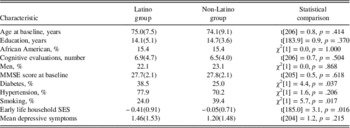
At the time of these analyses, 3336 persons without dementia at baseline had completed at least one annual follow-up assessment: 129 were Latinos and 3207 were non-Latinos. We formed groups of Latinos (n=104) and non-Latinos (n=104), balanced in age at baseline, education, race, and number of cognitive evaluations, using a greedy 5-to-1 digit algorithm in SAS for propensity score matching and subgroup identification (Rassen et al., Reference Rassen, Shelat, Myers, Glynn, Rothman and Schneeweiss2012). Table 1 shows that this approach yielded groups similar in age, education, race, and number of annual cognitive assessments. The groups also had similar distributions of gender and baseline Mini-Mental Sate Examination scores. The 25 Latino participants for whom a match could not be found compared to the 104 matched Latino participants were younger at baseline (67.7 vs. 75.0; t[127]=5.6; p<.001), less educated (6.8 vs. 14.1, t[127]=6.7; p<.001), less likely to be African American (0.0% vs. 15.4%; χ2 [1]=4.4; p=.036), but they had a similar percent of women (72.0 vs. 77.9; χ2 [1]=0.4; p=.532) and baseline score on the Mini-Mental State Examination (27.0 vs. 27.7; t[126]=0.9; p=.385).
Descriptive data on Latino and non-Latino groups

Note. Data are presented as mean (standard deviation) unless otherwise indicated.
MMSE=Mini-Mental State Examination; SES=socioeconomic status.
Clinical Evaluation
At each annual visit, there was a structured medical history, neurologic examination, and cognitive function testing. Following the evaluation, a clinician diagnosed dementia based on a history of cognitive decline and impairment in two or more domains of cognition following the guidelines of the joint working group of the National Institute of Neurological and Communicative Disorders and Stroke and the Alzheimer’s Disease and Related Disorders Association (McKhann et al., Reference McKhann, Drachman, Folstein, Katzman, Price and Stadlan1984). Persons were excluded from analyses if they met these criteria at baseline.
Cognitive Function Assessment
A battery of 18 cognitive tests was administered each year in an approximately 1-hr session. One test, the Mini-Mental State Examination, is a brief measure of global cognition. Based in part on previous factor analyses in Latino (Krueger, Wilson, Bennett, & Aggarwal, Reference Krueger, Wilson, Bennett and Aggarwal2009) and predominantly non-Latino (Wilson et al., Reference Wilson, Beckett, Barnes, Schneider, Bach, Evans and Bennett2002, Reference Wilson, Barnes, Krueger, Hoganson, Bienias and Bennett2005, Reference Wilson, Aggarwal, Barnes, Bienias, Mendes de Leon and Evans2009; Wilson, Barnes, & Bennett, Reference Wilson, Barnes and Bennett2003) groups, we placed the remaining 17 individual tests into one of five cognitive domains, and we formed composite measures of each domain for use in longitudinal analyses to minimize floor and ceiling artifacts. Episodic memory was based on 7 tests: immediate and delayed recall of Logical Memory Story A (Wechsler, Reference Wechsler1987) and the East Boston Story (Albert et al., Reference Albert, Smith, Scherr, Taylor, Evans and Funkenstein1991; Wilson et al., Reference Wilson, Beckett, Barnes, Schneider, Bach, Evans and Bennett2002) and Word List Memory, Word List Recall, and Word List Recognition (Welsh et al., Reference Welsh, Butters, Mohs, Beekly, Edland, Fillenbaum and Heyman1994; Wilson et al., Reference Wilson, Beckett, Barnes, Schneider, Bach, Evans and Bennett2002). Semantic memory was based on a 15-item version (Welsh et al., Reference Welsh, Butters, Mohs, Beekly, Edland, Fillenbaum and Heyman1994) of the Boston Naming Test (Kaplan, Goodglass, & Weintraub, Reference Kaplan, Goodglass and Weintraub1983), a 15-item word reading test (Wilson et al., Reference Wilson, Beckett, Barnes, Schneider, Bach, Evans and Bennett2002), and a verbal fluency test involving naming animals and vegetables in 1-min trials (Welsh et al., Reference Welsh, Butters, Mohs, Beekly, Edland, Fillenbaum and Heyman1994; Wilson et al., Reference Wilson, Beckett, Barnes, Schneider, Bach, Evans and Bennett2002). Working memory was based on Digit Span Forward, Digit Span Backward, and Digit Ordering (Wechsler, Reference Wechsler1987; Wilson et al., 2002). Perceptual speed was assessed with modified versions (Wilson, 2002) of the Symbol Digit Modalities Test (Smith, Reference Smith1982) and Number Comparison (Ekstrom, French, Harman, & Kermen, Reference Ekstrom, French, Harman and Kermen1976). Visuospatial ability was based on a 9-item form (Wilson et al., 2002) of Standard Progressive Matrices (Raven, Court, & Raven, Reference Raven, Court and Raven1992) and a 15-item form of Judgment of Line Orientation (Benton, Sivan, Hamsher, Varney, & Spreen, Reference Benton, Sivan, Hamsher, Varney and Spreen1994). We also formed a measure of global cognition based on all 17 tests. Each composite cognitive score was constructed by converting the raw scores of component tests to z scores, using the baseline mean and standard deviation of all individuals in the parent studies, and then computing the mean of the Z scores of the component tests. Additional information on the individual tests and composite measures is published elsewhere (Wilson et al., Reference Wilson, Beckett, Barnes, Schneider, Bach, Evans and Bennett2002; Wilson, Barnes, et al., Reference Wilson, Barnes and Bennett2003; Wilson et al., Reference Wilson, Barnes, Krueger, Hoganson, Bienias and Bennett2005).
Statistical Analyses
To assess change in cognitive function over time and to test for ethnic differences in annual rate of change, we used linear mixed-effects models (Laird & Ware, Reference Laird and Ware1982) with time treated as years since the baseline evaluation. Each model included terms for baseline age, sex, education, Latino ethnicity, and their interactions with time. Random effects for the intercept and slope were included to account for variability in initial level of cognition and rate of cognitive change. Subsequent analyses included terms for the interaction of Latino group × age and Latino group × age × time; excluded the only four Latino participants consistently tested in Spanish; used the Mini-Mental State Examination as the outcome; and added terms for selected covariates and their interactions with time. Model fit was assessed with pseudo-R-squared (Singer & Willett, Reference Singer and Willett2003).
Retest learning was assessed using two modeling approaches (Wilson, Capuano, Sytsma, Bennett, & Barnes, Reference Wilson, Capuano, Sytsma, Bennett and Barnes2015). First, to determine the existence and duration (in years) of the retest effect, we constructed a mixed-effects change point model that permitted the cognitive slope to shift. This model was fit with OpenBugs software (Lunn, Spiegelhatter, Thomas, & Best, Reference Lunn, Spiegelhalther, Thomas and Best2009) using a Bayesian Monte Carlo Markov Chain approach (Gelman, Carli, Stern, & Rubin, Reference Gellman, Carli, Stern and Rubin2004). The analytic model included parameters for the intercept at baseline, initial slope, change point, and slope after change point. We required the shift to take place during the first 6 years of observation to avoid capturing the terminal increase in cognitive decline often observed in the last years of life (Sliwinski et al., Reference Sliwinski, Stawski, Hall, Katz, Verghese and Lipton2006; Wilson, Beckett, Bienias, Evans, & Bennett, Reference Wilson, Beckett, Bienias, Evans and Bennett2003; Wilson, Segawa, Hizel, Boyle, & Bennett, Reference Wilson, Segawa, Hizel, Boyle and Bennett2012). The outcome for this change point model was a composite measure of global cognition. To assess retest learning in specific domains of cognition, we repeated the original linear mixed-effects models, first eliminating baseline data and then again eliminating data from baseline and the first follow-up because the change point analysis suggested that much of retest learning occurred in these initial visits.
RESULTS
Annual Rate of Cognitive Decline
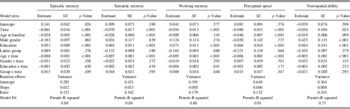
The primary analytic aim was to characterize rate of change in cognitive function and test whether ethnic group membership was associated with initial level of function or annual rate of cognitive decline (Table 2). To accomplish this aim, we used linear mixed-effects models adjusted for age at baseline, sex, and education. There was decline in each cognitive domain during the observation period, as indicated by the terms for time in Table 2. The groups did not differ in baseline level of cognitive function though there were nearly significant differences favoring the non-Latino group in working memory and perceptual speed. The ethnic groups did not differ in rate of decline in any domain, as indicated by the terms for group × time in Table 2.
Association of demographic variables with level of and change in different cognitive domains
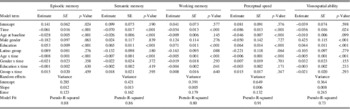
Note. From five separate mixed-effects models.
Table 2 also shows that there was an age × time interaction in each domain, indicating that rate of cognitive decline was more rapid in older participants compared to younger participants. To determine whether ethnicity was associated with this age related increase in cognitive decline, we repeated the initial models with terms added for the two-way interaction of Latino group × age and the three-way interaction of Latino group × age × time. None of these interactions was significant.
Most Latino participants opted for the English version of the cognitive tests on all (n=96) or some (n=4) occasions. Results were not substantially changed when the four individuals consistently tested in Spanish were eliminated.
Because previous research has mainly been based on the Mini-Mental State Examination (Hildreth et al., Reference Hildreth, Grigsby, Bryant, Wolfe and Baxter2014) or the Telephone Inventory of Cognitive Status (Alley et al., Reference Alley, Suthers and Crimmins2007; Karlamangla et al., Reference Karlamangla, Miller-Martinez, Aneshensel, Seeman, Wight and Chodosh2009; Masel & Peek, Reference Masel and Peek2009), a modification of the Mini-Mental State Examination adapted for administration by telephone, we conducted an analysis of the Mini-Mental State Examination for comparison purposes. In this analysis, the Mini-Mental State Examination score declined a mean of 0.606-point per year (SE=0.111; p<.001). The ethnic groups did not differ in baseline score level (estimate for Latino group=0.045; SE=0.263; p=.865) or in annual rate of change (estimate for Latino group × time=0.221; SE=0.139; p=.113).
Retest Learning
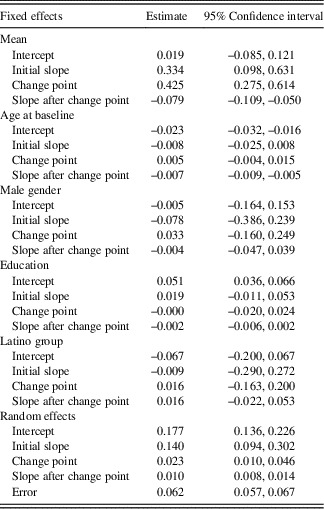
Repeated administration of cognitive tests results in improved performance (Wilson, Li, Bienias, & Bennnett, Reference Wilson, Li, Bienias and Bennett2006; Yang, Reed, & Kuan, Reference Yang, Reed and Kuan2012). Therefore, ethnic differences in retest learning, which have been reported in some prior research (Early et al., Reference Early, Widaman, Harvey, Beckett, Park, Farias and Mungas2013; Schleicher, Van Iddekinge, Morgeson, & Campion, Reference Schleicher, Van Iddekinge, Morgeson and Campion2010; Van Iddekinge, Morgeson, Schleicher, & Campion, Reference Van Iddekinge, Morgeson, Schleicher and Campion2011), could confound between group comparisons of cognitive aging. We investigated this possibility using two additional modeling approaches. First, because retest learning is maximal during initial exposures to the test (Bartels, Wegrzyn, Wiedl, Ackermann, & Ehrenreich, Reference Bartels, Wegrzyn, Wiedl, Ackermann and Ehrenreich2010), suggesting that linear models may not be optimal, we constructed a mixed-effects change point model that allowed cognitive functioning to improve for a variable time period before subsequently declining. To minimize error, this analysis was based on a measure of global cognition derived from all 17 cognitive tests. In all 208 participants at baseline, it had an approximately normal distribution (mean=0.012; SD=0.569; skewness=−0.2). As shown in Table 3, the global cognitive score improved at a mean rate of 0.334-unit per year for a mean of 0.425-year after which it declined at a mean rate of 0.079-unit per year. Latino ethnicity was not related to the duration or degree of retest learning, and there was no ethnic difference in cognitive decline subsequent to the inflection point.
Association of demographic variables with nonlinear change in global cognition

Note. From a mixed-effects change point model.
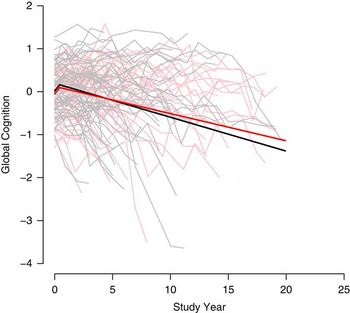
Plots of the crude paths of change in global cognition in all Latino (pink lines) and non-Latino (gray lines) participants suggest that change is not entirely linear (Figure 1). The mean paths predicted by the change point model for the Latino (red line) and non-Latino (black line) groups suggest similar patterns of retest learning.
Crude paths of global cognitive change in all older Latino (pink lines) and non-Latino (gray lines) participants and the paths predicted for a typical Latino (red line) and non-Latino (black line) from a mixed-effects change point model adjusted for age at baseline, sex, and education.

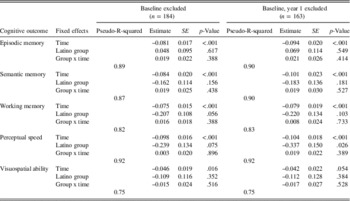
Second, to assess retest effects within cognitive domains, we repeated the initial linear mixed-effects models first excluding data from the baseline evaluation and then excluding data from the first two evaluations because the change point analysis suggested that most of the retest learning occurred during these evaluations. As shown in Table 4, the annual rate of cognitive decline estimated from these analyses, as indicated by the terms for time, was more rapid than the estimates from the initial models, and the fit of these linear models, as indicated by the estimates of pseudo-R squared in Table 4, was slightly improved compared to the initial models (Table 2). With this evidence that retest learning was reduced, there continued to be no evidence of ethnic group differences in level of function or rate of decline in any cognitive domain.
Effect of excluding initial evaluations on ethnic differences in cognitive trajectories

Note. From 10 separate mixed-effects models adjusted for age at baseline, sex, and education.
Potential Confounders
We considered the possibility that other factors associated with late-life cognitive function might affect the ethnic group comparisons. Because diabetes, smoking, and early household socioeconomic status have been related to cognitive health in previous research (Collins et al., Reference Collins, Sachs-Ericsson, Preacher, Sheffield and Markides2009; Zeki Al Hazzouri, Haan, Kalbfleisch, et al., Reference Zeki Al Hazzouri, Haan, Kalbfleisch, Galea, Lisabeth and Aiello2011; Zeki Al Hazzouri et al., Reference Zeki Al Hazzouri, Haan, Neuhaus, Pletcher, Peralta, Lopez and Stable2013) and were related to ethnic group membership in this study (Table 1), we repeated the initial analyses with terms for each covariate and its interaction with time. In separate sets of analyses for diabetes, smoking, and early life household socioeconomic status, there continued to be no ethnic group differences in level of function or rate of decline in any cognitive domain.
DISCUSSION
We assessed different cognitive abilities at annual intervals for an average of almost 6 years in older Latino and non-Latino individuals. Latino ethnicity was not related to initial level of function or rate of decline in any cognitive domain suggesting that cognitive aging is similar in Latinos and non-Latinos.
Several previous studies have reported more rapid cognitive decline in older Latino individuals compared to non-Latino individuals (Alley et al., Reference Alley, Suthers and Crimmins2007; Hildreth et al., Reference Hildreth, Grigsby, Bryant, Wolfe and Baxter2014; Masel & Peek, Reference Masel and Peek2009). However, these findings were based on brief mental status tests [i.e., Telephone Interview for Cognitive Status (Alley et al., Reference Alley, Suthers and Crimmins2007; Karlamangla et al., Reference Karlamangla, Miller-Martinez, Aneshensel, Seeman, Wight and Chodosh2009; Masel & Peek, Reference Masel and Peek2009), Mini-Mental State Examination (Hildreth el al., Reference Hildreth, Grigsby, Bryant, Wolfe and Baxter2014)] that are subject to floor and ceiling artifacts when used longitudinally and each study found no ethnic differences on other cognitive tests. In addition, one study had less than two years of follow-up (Hildreth et al., Reference Hildreth, Grigsby, Bryant, Wolfe and Baxter2014) and the findings of Alley et al. (Reference Alley, Suthers and Crimmins2007) were contradicted by subsequent analyses of the same cohort with more follow-up (Karlamangla et al., Reference Karlamangla, Miller-Martinez, Aneshensel, Seeman, Wight and Chodosh2009). The lack of an association between Latino ethnicity and cognitive decline in the present analyses is consistent with Karlamangla et al. (Reference Karlamangla, Miller-Martinez, Aneshensel, Seeman, Wight and Chodosh2009) and in conjunction with Early et al. (Reference Early, Widaman, Harvey, Beckett, Park, Farias and Mungas2013) adds to current knowledge by showing that aging profiles of Latinos and non-Latinos appear to be similar across diverse domains of cognitive functioning.
A challenge in longitudinal research on cognition is that test performance improves with repeated administration of the test and this retest learning effect is difficult to disentangle from actual change in underlying cognitive abilities, especially when follow-up intervals are uniform (Hoffman, Hofer, & Sliwinski, Reference Hoffman, Hofer and Silwinski2011) as in the present study. Ethnic group differences in retest learning could, therefore, confound comparisons of cognitive aging between ethnic groups. However, in the present analyses, Latino ethnicity was not related to the magnitude or duration of the retest effect and excluding data from evaluations most subject to retest learning did not substantially affect ethnic group comparisons. This is consistent with Karlamangla et al. (Reference Karlamangla, Miller-Martinez, Aneshensel, Seeman, Wight and Chodosh2009). One previous study found more retest learning in Latinos compared to non-Latinos (Early et al., Reference Early, Widaman, Harvey, Beckett, Park, Farias and Mungas2013), but this was only true for one of three outcomes. Therefore, the weight of the current evidence is that Latino ethnicity is probably not strongly associated with retest learning.
We considered the possibility that results might be affected by ethnic differences in cognition related aspects of health and well-being, particularly vascular risk factors (Collins et al., Reference Collins, Sachs-Ericsson, Preacher, Sheffield and Markides2009; Zeki Al Hazzouri et al., Reference Zeki Al Hazzouri, Haan, Neuhaus, Pletcher, Peralta, Lopez and Stable2013) and indicators of socioeconomic status (Zeki Al Hazzouri, Hann, Kalbfleisch, et al., 2011; Zeki Al Hazzouri, Hann, Osypuk, et al., Reference Zeki Al Hazzouri, Haan, Osypuk, Abdou, Hinton and Aiello2011) that have previously been associated with cognition in older Latino individuals. Compared to the non-Latino group, the Latino group in these analyses had lower household socioeconomic status in childhood and was less likely to have smoked and more likely to currently have diabetes. However, controlling for these factors did not substantially affect between ethnic group comparisons.
Strengths and limitations of these data should be noted. The propensity matching enhanced the comparability of the groups on factors other than ethnicity. There was a mean of nearly 6 years of annual cognitive testing with psychometrically sound cognitive outcomes, allowing us to characterize person-specific paths of linear and nonlinear cognitive decline. Participation in follow-up was high; minimizing the likelihood that selective attrition substantially affected results. Participants were selected and so the generalizability of the findings will need to be established in future research. There were fewer Latino participants in this study than most previous studies. The resulting relative lack of statistical power probably contributed to the absence of a Latino disadvantage in level of performance on some cognitive measures. We probably also lacked the power to detect a small ethnic group difference in rate of cognitive decline, but the observed differences generally favored the Latino subgroup, making it unlikely that we failed to detect a Latino deficit. The Latino participants in these analyses are well educated compared to older Latinos living in the United States and so the findings may not generalize to less educated Latinos. Finally, we treated ethnicity as a unitary construct, but our participants come or have ancestry from numerous countries throughout the Caribbean as well as Central and South America. This regional diversity, undoubtedly accompanied by cultural diversity, underscores the importance of understanding within ethnic group variability in late-life cognitive health in addition to between ethnic group differences.
In summary, these results suggest that trajectories of cognitive aging in Latinos and non-Latinos are broadly comparable. However, there was wide variability within the Latino group and the factors contributing to this variability have not been extensively investigated. Specifically, there have been few studies of potentially modifiable lifestyle and personality risk factors identified in groups of mostly non-Latino older persons. In addition, there have been few studies of biomarkers in Latinos and virtually no postmortem studies. The long-term goal of the present program of research is to recruit and enroll older Latinos who agree to detailed annual clinical evaluations, collection of antemortem biologic specimens, and brain autopsy and neuropathologic examination at death to determine the pathologic and non-pathologic factors underlying cognitive aging in Latinos and thereby inform strategies to preserve and enhance late-life cognitive health in Latinos.
ACKNOWLEDGMENTS
The authors have no conflicts of interest to disclose. This research was supported by NIH grants (D.A.B.: R01AG17917, P30AG10161), (L.L.B.: R01AG022018) and the Illinois Department of Public Health. The funding organizations had no role in the design or conduct of the study; collection, management, analysis, or interpretation of the data; or preparation, review, or approval of the manuscript. The authors thank the participants of the Minority Aging Research Study, Rush Memory and Aging Project, and Religious Orders Study for their invaluable contributions; Charlene Gamboa, MPH, Tracy Colvin, MPH, Tracey Nowakowski, Barbara Eubler, and Karen Lowe Graham, MS, for study recruitment and coordination; John Gibbons, MS, and Greg Klein, MS, for data management; Alysha Kett, MS, for statistical programming; and the staff of the Rush Alzheimer’s Disease Center.