CHD is one of the most common structural abnormalities in live births.Reference Abid, Elloumi and Abid1 The overall prevalence of CHD was 8.98 per 1000 live births in China.Reference Zhao, Liu, Wu, Ma, Niu and Huang2 Parents are the primary individuals who provide home care for infant patients with CHD. They are required to spend much time, energy, and financial resources in this process. In addition, these processes may make them feel stressed and anxious, adversely affecting their quality of life.Reference Woolf-King, Anger, Arnold, Weiss and Teitel3,Reference Silva, Moraes, Konstantyner and Leite4 Caregivers may use religion as a source of hope, comfort, motivation, or emotional support, as a means to actively face difficulties. In the face of stress, religious beliefs can improve people’s mental health. Research on caregivers of patients with some diseases found that organised religious participation was related to alleviating anxiety disorders.Reference Chong, Chong, Tang, Ramoo, Chui and Hmwe5 In recent years, more and more studies have emphasised the importance of religion to reduce the care burden. Reference Asadi, Fereidooni-Moghadam, Dashtbozorgi and Masoudi6,Reference Hatefi, Vaisi-Raygani, Borji and Tarjoman7 There is evidence that the religious beliefs of caregivers can help reduce the impact of stress on them and enhance their happiness. Reference Thombre, Sherman and Simonton8 Similarly, a higher level of religious participation is also related to an improvement in the quality of life of caregivers.Reference Nagpal, Heid, Zarit and Whitlatch9 However, so far, few studies have shown the effects of religion on the parents of infant patients with CHD. In addition, there is no relevant research on whether the different religious beliefs effect the mental health of parents of infant patients with CHD. Therefore, this study aims to examine the influence of religious beliefs on anxiety/depression, care burden, and quality of life in parents of infant patients with CHD. Another purpose of this study is to explore whether the different religious beliefs of these parents have different effects on these relationships.
Methods
This study was a cross-sectional study conducted in a teaching hospital in Fujian Province, China. The ethics committee of our hospital approved the study protocol, and informed consent was obtained for all parents who participated in the study. We used GPower 3.1.9.2 to calculate the sample capacity. According to previous survey results, a medium effect size and an alpha value of 0.05, the statistic was 0.9. The statistical results showed that at least 109 parents should be included in this study. We considered a loss to follow-up rate of 10% and then decided to recruit 120 parents of patients diagnosed with simple CHD. They all spent much time caring for their infants. Parents were interviewed by well-trained staff and completed a self-report questionnaire in the outpatient facility or on the WeChat platform. Interviewers were given specific guidance on their roles and attitudes, how to conduct interviews, and other factors. The final sample size consisted of 114 parents of patients with simple CHD who successfully completed the questionnaire between March 2020 and March 2021. The inclusion criteria were as follows: parents of an infant patient with simple CHD; parents were the primary caregivers; elective surgery was planned for the patients; and the parent who acted as primary caregiver. The exclusion criteria were as follows to caregivers were not the parents; patients had severe heart disease and required emergency surgery; patients with genetic syndrome; CHD was combined with serious other system diseases; and the family members of the patient refused to participate in this study.
Data collection
This study used two recruitment methods: outpatient recruitment and online recruitment. The researchers recruited parents whose children had follow-up physical examinations in the outpatient clinic within 1–3 months after birth. Participants filled out questionnaires onsite. Parents were also recruited through the WeChat platform and followed procedures similar to those for the onsite investigations. Research data were collected by research assistants, who explained to participants the nature, purpose, voluntary principles of participation, and the confidentiality of information. All parents who agreed to participate in this study signed informed consent forms and selected self-filled or substitute-filled questionnaires based on their situations. The parents filled out the Chinese version of the social demographic form, the Duke University Religion Index, the Hospital Anxiety and Depression Scale, the Zarit Caregiver Burden Interview, and the 36-Item Short-Form Health Survey. In addition, we collected demographic information, including the patient’s age, sex, weight, type of CHD, and other general clinical data.
Evaluation tool
Duke University Religion Index: The Duke University Religion Index is a short, comprehensive, and easy-to-use religious activity questionnaire designed for large-scale epidemiological studies and has been widely used. This tool has been evaluated in terms of reliability and effectiveness in China.Reference Wang, Rong and Koenig10 It consists of five items that evaluate the three dimensions of religion: organised religious activity (maximum score = 5); non-organised religious activity (maximum score = 5); and intrinsic religious beliefs (maximum score = 15). In the original version of the Duke University Religion Index, lower scores indicate firmer religious beliefs. However, in our research, to facilitate the explanation, the items were scored in reverse. Therefore, a higher score indicated a higher level of religious belief.
Hospital Anxiety and Depression Scale: The Hospital Anxiety and Depression Scale has been evaluated for reliability and effectiveness in China.Reference Yang, Ding, Hu, Zhang and Sheng11 The Hospital Anxiety and Depression Scale contains 14 questions. Specifically, seven of the questions (2, 4, 6, 8, 10, 12, and 14) are used to evaluate the degree of depression, and the remaining questions (1, 3, 5, 7, 9, 11, and 13) are used to evaluate the degree of anxiety. A Likert scale from 0 to 3 is used to answer each question. Thus, the entire scoring range is 0–21. In addition, the literature also shows the following scores: 0–7 indicates lack of anxiety or depression, 8–10 indicates average levels of anxiety or depression, and a score more than 11 shows increased levels of anxiety or depression.
The Zarit Caregiver Burden Interview is used to assess caregivers’ burden via 22 items. The tool has been evaluated in terms of reliability and effectiveness in China.Reference Ko, Yip, Liu and Huang12 In addition, the existence of two dimensions has been observed through confirmatory factor analysis: personal contingency dimensions, such as personal care stress, which is composed of 12 items, and the role response dimension, including social role restrictions due to nursing, which is composed of 6 items. The tool has a total score between 0 and 88 points, with a higher score indicating a “heavier” burden.
The 36-Item Short-Form Health Survey: This tool has also been evaluated regarding reliability and effectiveness in China.Reference Zhang, Qu, Lun, Guo and Liu13 There are 36 items on the 36-Item Short-Form Health Survey scale. Item 2 is a self-reported health change and is not included in the scoring. The remaining 35 items constitute eight dimensions: physical functioning, role-physical, bodily pain, general health, vitality, social functioning, role-emotional, and mental health. We encoded each dimension, summarised the scores, and converted the total to a score from 0 (the worst QoL) to 100 (the best QoL). Although there is no consensus on the best cut-off point to use, a review of the accuracy of a single 36-Item Short-Form Health Survey total score found that using 50 as a cut-off point can strike the best balance between sensitivity and specificity. Therefore, a total score of 36-Item Short-Form Health Survey ≤ 50 indicates that QoL is impaired.
Statistical analysis
Quantitative variables are expressed as the mean and standard deviation , and univariate analysis was used to describe the frequency and percentage of categorical variables. The study used a continuous variable correlation analysis method to determine the association between each dimension of participants’ religious beliefs and their mental state, care burden, and quality of life. In this study, the Pearson correlation coefficient was used to measure the correlation between quantitative variables. The data were analysed using SPSS version 25.0 (IBM, Armonk, NY, USA). A p-value < 0.05 was defined as statistically significant.
Results
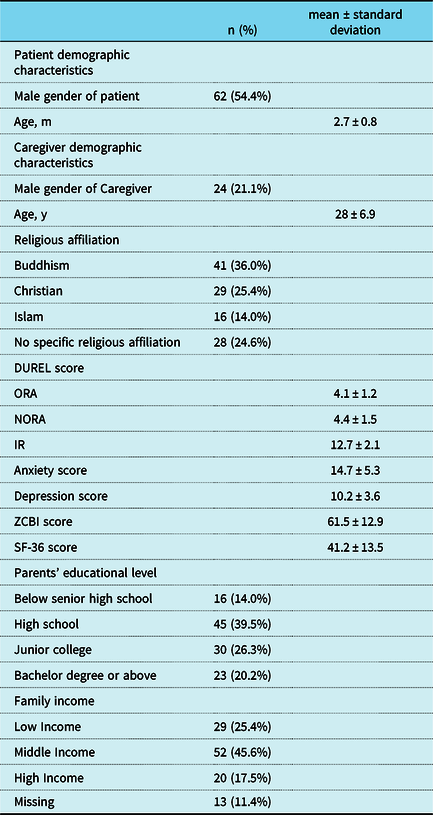
Table 1 described the sample characteristics of this study. A total of 114 parents were included in this study. The diagnostic components of the patients were ventricular septal defect (n = 60), patent ductus arteriosus (n = 26), atrial septal defect (n = 17), and pulmonary artery stenosis (n = 11). The average age of parents was 28 years old (standard deciation = 6.9), and the main caregiver for most of these patients was the mother (78.9%). Most of the parents recruited in this study had clear religious beliefs: 36.0% were Buddhist, 25.4% were Christian, 14.0% were Muslim, and 24.6% did not have clear religious beliefs. Among participants with clear religious beliefs, the average scores of the three dimensions were as follows: organisational religious activity: 4.1 (standard deviation = 1.2), non-organisational religious activity: 4.4 (SD = 1.5), and intrinsic religiosity: 12.7 (standard deviation = 2.1). The anxiety score of the parents was 14.7 (standard deviation = 5.3), the depression score was 10.2 (standard deviation = 3.6), the Zarit Caregiver Burden Interview score was 61.5 (standard deviation = 12.9), and the 36-Item Short-Form Health Survey score was 41.2 (standard deviation = 13.5).
Comparison of demographic characteristics of children and their parents between the two groups

Low income (<$50,00); Middle income ($50,00−$49,999); High income (>$50,000); Missing (did not disclose income).
ORA=organisational religious activity; NORA=non-organisational religious activity; IR=intrinsic religiosity; ZCBI score=Zarit care burden interview score; SF-36 score=The Short-Form Health Survey-36 score.
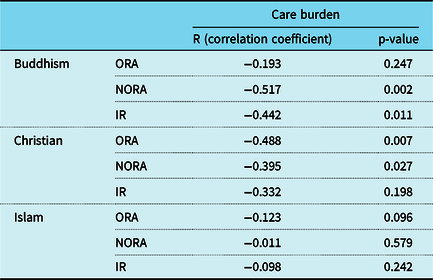
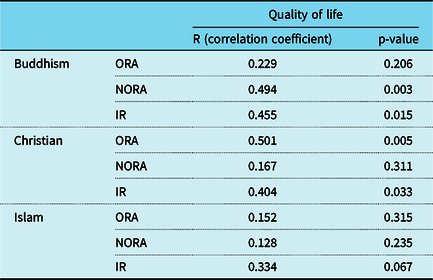
Table 2 showed that organisational religious activity, non-organisational religious activity, and intrinsic religiosity had a significant relationship with care burden and quality of life. Among these, non-organisational religious activity and intrinsic religiosity had a significant relationship with their anxiety symptoms. The results of the study did not find a correlation between parent’s religious beliefs and their depressive symptoms. Tables 3 and 4 showed that for Buddhist parents, non-organisational religious activity and intrinsic religiosity reduced their care burden and improved their quality of life. Among Christian parents, organisational religious activity and non-organisational religious activity were found to reduce the care burden, and organisational religious activity and intrinsic religiosity were found to improve quality of life. There was no correlation between the dimensions of religious belief and a negative impact on the care process in Muslim parents.
The correlation between each sub-dimension of DUREL and care burden, anxiety, depression, quality of life

Correlation of the moderating effect of the relationship between the sub-dimensions of different religious beliefs and the care burden

The relevance of the moderating effect of the relationship between the sub-dimensions of different religious beliefs and quality of life

Discussion
This study evaluated the correlation between the religious beliefs of 114 parents of patients with CHD and their anxiety/depression, care burden, and quality of life. It was the first study focused on the religious beliefs of the parents of infant patients with CHD. In this research, we found that the three dimensions of religious beliefs were all related to a reduction in the negative impact of caring for infant patients with CHD in parent caregivers. This result meant that parents with higher organisational religious activity, non-organisational religious activity, or intrinsic religiosity scores experienced a lower care burden and a higher quality of life. In addition, organisational religious activity and non-organisational religious activity also reduced the anxiety symptoms of the parent. This result meant that for the parents of infant patients with CHD with higher organisational religious activity or non-organisational religious activity, anxiety symptoms were less burdensome than for those with lower organisational religious activity or non-organisational religious activity. Our research results also showed that every religion − Buddhism, Christianity, and Muslim −had a positive impact on caregivers’ mental health. This result meant that religious beliefs might be a universal protective factor for these parents.
In addition, according to the different religious beliefs of caregivers, we investigated which kinds of religious beliefs could help alleviate the negative impact on caregivers. Interestingly, our research showed that the dimensions of religion that might help reduce the negative impact on these parents varied depending on the parents’ religious beliefs. For Buddhist parents, non-organisational religious activity and intrinsic religiosity reduced the care burden and improved quality of life. There was no correlation between the sub-dimensions of religious belief and a negative impact on the care process in Muslim parents, which might be caused by the small number of Muslim parents in the sample. Previous studies on the Christian culture mainly reported that organisational religious activity and intrinsic religiosity might be beneficial to the mental health of caregivers of patients with dementia, while the results were different from those of this study.Reference Yoon, Moon and Lee14 However, we found that no specific religious dimension improved depression symptoms more among the different religious beliefs. Our results also reflected different religious traditions/cultures characterised by different religions. For example, unlike Buddhists, Christians, and Muslims participate in organised and formal religious activities more frequently, and the forms of activities were more diverse. Their religious cultures also encouraged participation in religious meetings and private ceremonies.Reference Todd, Blevins and Yi15,Reference Saleem, Saleem, Mushtaq and Gul16 As mentioned above, these findings could be explained according to the different practices of each religion. The difference between other religions and Buddhism was that professional church pastors presided over formal religious activities more frequently, while some Buddhist monks usually did not interact directly with non-believers, and they organised fewer religious activities. In addition, Buddhists tended to practice religious beliefs in their lives instead of attending formal religious gatherings.Reference Meng, Xu and Shi17 Therefore, in our research, only non-organisational religious activity and intrinsic religiosity had a significant moderating effect on Buddhists.
Differences in the doctrines and religious practices of different religions might account for our results. On the one hand, different religions might have different doctrines, leading to different ways of thinking about things. On the other hand, differences in the religious practices of different religions might also lead to differences in how the religions influence their followers. In this study, the different religious groups could provide information about religion-related factors to reduce caregivers’ mental troubles. These results might help formulate specific religious interventions for the mental health and quality of life of the parents of patients with CHD. When adopting religious methods, it has been recommended appropriate religious intervention methods be selected according to the type of religious beliefs of the caregiver. For Christian and Islam caregivers, participating in organised religious activities might provide social support. Reference Heo and Koeske18 For Buddhists, strengthening their inner religious beliefs might be helpful. Reference Wiist, Sullivan, St George and Wayment19
Limitations
There were some shortcomings in this study. This study was a descriptive cross-sectional study with a small sample size and poor cross-sectional properties. We only focused on the three main religions in our area. Therefore, atheism and potentially mixed religions were not included in our study. We did not investigate the relationship between education level and religious beliefs which might have a certain impact on the results. Most of the evaluation indicators in this study were subjective evaluation indicators, which biased the results. Previous studies have shown that the Duke University Religion Index was suitable for assessing different religions, but the Duke University Religion Index was originally designed for mainstream Western religions (such as Christianity, Judaism, and Islam). Reference Lace and Handal20 Therefore, it might not be accurate in the evaluation of religious beliefs of Eastern religion (such as Buddhism) practitioners. In future research, it will be necessary to develop an evaluation tool more suitable for different religions to conduct more accurate research on the influence of religions. The burden of caregivers might be affected by other factors, such as the severity of the disease, the support of medical institutions, burnout syndrome, the number of children in a family, and lack of social participation, among which the severity of the disease might be the main factor increasing the burden of caregivers. These aspects need to be further studied to evaluate the influence of religious beliefs on the parents of infant patients with CHD more objectively.
Conclusion
Religious beliefs have a protective effect on the parents of infant patients with CHD. They help parents relieve anxiety about providing in-home care, reduce their care burden, and improve their quality of life. In addition, different religious beliefs have different influences on caregivers.
Acknowledgements
We appreciated all doctors and nurses in our centre for fruitful advice and discussions. We hope humans eventually defeat COVID-19.
Financial support
This study was supported by the National Key Research and Development Program of China (grant no. 2016YFC1301900).
Conflict of interest
All authors declared that they had no competing interests.