The process and the methods through which parties select their political staff are seen as crucial aspects of modern party democracies and of the concept of representation (Hazan and Rahat Reference Hazan and Rahat2010; Pitkin Reference Pitkin1967). Furthermore, the ways in which political parties select candidates for party tickets and how they build capacities for party tickets are essential to understanding why and how female representation is still a misrepresentation. Over the past few years, work published on intraparty factors and party strategies to promote female representation has indicated that the representation of female candidates is determined by more than just the number or strength of left-wing and right-wing parties (Bjarnegård and Zetterberg Reference Bjarnegård and Zetterberg2017; Kittilson Reference Kittilson2006; Pemstein, Meserve, and Bernhard Reference Pemstein, Meserve and Bernhard2015; Verge Reference Verge2010). All authors have confirmed that studying the gendered effects of intraparty mechanisms on women's representation is a worthwhile approach.
Especially when it comes to explaining variation across parties within one political system, intraparty mechanisms, such as the inclusiveness of the selectorate, can provide an additional analytic dimension. Apart from implementing formal rules such as party quotas or formal and informal selection criteria and their positive or negative effects on female representation (Bjarnegård and Zetterberg Reference Bjarnegård and Zetterberg2017; Dahlerup and Freidenvall Reference Dahlerup and Freidenvall2005; Fortin-Rittberger and Rittberger Reference Fortin-Rittberger and Rittberger2015; Hughes Reference Hughes2011; Pemstein, Meserve, and Bernhard Reference Pemstein, Meserve and Bernhard2015; Verge and de la Fuente Reference Verge and de la Fuente2014), parties have the ability to choose and empower female candidates in a number of ways. Such empowerment, in the form of non-quota strategies, can take place at different stages of the recruitment process by means of formal and informal rules, such as establishing women's sections, creating mentoring programs for women, ensuring gender-balanced sequences of speeches at party conventions, or just appealing to the gender awareness within the party organization (Childs and Kittilson Reference Childs and Kittilson2016; Krook and Norris Reference Krook and Norris2014). In most parties, male-dominated networks recruit eligible candidates who are at least skeptical regarding the empowerment of women, whereas hesitant women are less frequently recruited (Butler and Preece Reference Butler and Preece2016; Lawless and Fox Reference Lawless and Fox2005; Pruysers and Blais Reference Pruysers and Blais2019).
In this article, I combine approaches on candidate selection and strategies to promote gender equality to explain women's representation on local party tickets, measured as the total share of women on a ticket. The analysis tests not only institutional, socioeconomic, and cultural factors that explain variation between the local contexts, but also features that are specific to parties or individual local lists of a party. Therefore, the focus in this analysis is on non-quota strategies and party gatekeepers, while the impact of a party's gender quota rule is only used as a controlling factor. The variable non-quota strategies has not been examined in previous research in a large-scale comparative analysis with 1,475 cases, and thus it is of main interest. In the analysis, I construct a novel index that represents all formal and informal measures that a party has implemented to empower female party members, other than gender quotas.
The empirical analysis employs ordinary least squares (OLS) regression models and fixed-effects regression models based on a newly compiled data set consisting of 1,475 electoral lists for the 2014 local elections in the German federal state of Baden-Wuerttemberg.Footnote 1 Studying intraparty factors in this smaller (local) setting, where most of the contextual factors, such as the inclusiveness of the selectorate (Fortin-Rittberger and Rittberger Reference Fortin-Rittberger and Rittberger2015) or the electoral system, are held constant, promises to provide additional insights about the most decentralized level in party organizations (Kenny and Verge Reference Kenny and Verge2016; King, Keohane, and Verba Reference King, Keohane and Verba1994; Snyder Reference Snyder2001). Also, the local level is a stepping stone for political careers, and thus it is an important stage for the empowerment of women (Heinelt et al. Reference Heinelt, Magnier, Cabria and Reynaert2018; Ohmura et al. Reference Ohmura, Bailer, Meiβner and Selb2018).
POLITICAL PARTIES AND CANDIDATE SELECTION
Published theoretical and empirical work about parties’ candidate selection mechanisms and their strategies to achieve equal gender representation indicates a key leverage of the parties and central gatekeepers in promoting greater female representation (Bjarnegård and Zetterberg Reference Bjarnegård and Zetterberg2017; Crowder-Meyer Reference Crowder-Meyer2013; Fortin-Rittberger and Rittberger Reference Fortin-Rittberger and Rittberger2015; Hazan and Rahat Reference Hazan and Rahat2010; Hinojosa Reference Hinojosa2012; Kenny and Verge Reference Kenny and Verge2016; Kittilson Reference Kittilson2006; Krook and Norris Reference Krook and Norris2014; Lühiste Reference Lühiste2015; Meserve, Pemstein, and Bernhard Reference Meserve, Pemstein and Bernhard2018; Norris Reference Norris1997; Pemstein, Meserve, and Bernhard Reference Pemstein, Meserve and Bernhard2015; Pruysers and Blais Reference Pruysers and Blais2019; Verge Reference Verge2010; Verge and Claveria Reference Verge and Claveria2018). Recently, there has been some striking work concentrating on the intraparty perspective of candidate selection and women's representation combining party research and gender studies. Most of this work is inspired by Hazan and Rahat's (Reference Hazan and Rahat2010) theoretical framework, which sees candidate selection as a matter of power distributed at certain hierarchical levels within the party organization. While deepening the intraparty perspective of Hazan and Rahat (Reference Hazan and Rahat2010) on gendered effects, some researchers conclude that the inclusiveness of the selectorate affects the descriptive representation of women on party lists (see, e.g., Fortin-Rittberger and Rittberger Reference Fortin-Rittberger and Rittberger2015), while others formulate some justified doubts regarding the impact of the inclusiveness and decentralization of the selectorate, claiming that they cannot find any evidence on differences between and within different party families (Lühiste Reference Lühiste2015; Pruysers et al. Reference Pruysers, Cross, Gauja, Rahat, Scarrow, Webb and Poguntke2017). Furthermore, Pruysers et al. emphasize party ideology and “the ethos of a party [as] an essential component to understand why some parties nominate more women than others, even within the same country” (Reference Pruysers, Cross, Gauja, Rahat, Scarrow, Webb and Poguntke2017, 227). Also based on Hazan and Rahat's (Reference Hazan and Rahat2010) work, Bjarnegård and Zetterberg (Reference Bjarnegård and Zetterberg2017) adopt another perspective on parties’ selection criteria by emphasizing the negative effects of the formal requirements candidates have to fulfill, such as an ethnic or geographic background or intraparty experience.
Besides these intraparty perspectives on gender and candidate selection, the literature focuses on the adoption and the positive effects of voluntary party quotas on female representation (Bjarnegård and Zetterberg Reference Bjarnegård and Zetterberg2016; Caul Reference Caul2001; Childs and Kittilson Reference Childs and Kittilson2016; Kittilson Reference Kittilson2006; Krook Reference Krook2009; Verge Reference Verge2010; Verge and de la Fuente Reference Verge and de la Fuente2014; Verge and Espírito-Santo Reference Verge and Espírito-Santo2016). They all agree that party quotas are the most powerful mechanism for achieving gender equality on party lists. There is also some work concentrating on the informal aspects of party gatekeepers and their gender-biased candidate selection. While Tremblay and Pelletier (Reference Tremblay and Pelletier2001) find no gendered effects in candidate selection between male and female gatekeepers at the federal level in Canada, Verge (Reference Verge2010) notes an effect at the local level in Spain, and Krook (Reference Krook2010, 159) also sees gender-biased candidate selection originating from gatekeepers.
Others raise questions about the actors involved and their ambitions on running for office. Pruysers and Blais (Reference Pruysers and Blais2019) conclude that women recruited by male party recruiters are less likely to show interest in running for office. Their findings are based on the simple assumption of a gender gap in the political ambitions of potential candidates, as others have shown before (Lawless and Fox Reference Lawless and Fox2005, Reference Lawless and Fox2010; Pruysers and Blais Reference Pruysers and Blais2017). Therefore, women have to be motivated, and even then, their ambition to run for office is less developed. So even if parties ask potential female candidates, they are not able to close the gender gap in political ambition because women respond positively less frequently. Therefore, what is needed is more than a female recruiter or an appeal to the ambition of potential or eligible candidates. Still, all of the authors mentioned agree on the importance and influence of different candidate selection mechanisms and candidate quotas on the descriptive representation of women. Furthermore, they emphasize that parties can shape their candidate selection methods, but they conclude that male dominance in candidacy and candidate selection is the norm (Verge and Claveria Reference Verge and Claveria2018, 536).
This article concentrates on parties’ internal strategies to promote gender equality, mainly from a supply-side perspective (so-called non-quota strategies, referring to all party methods of improving the representation of women besides gender quotas). I want to examine whether a party's non-quota strategy has a positive impact of encouraging women to be nominated on electoral lists, even if potential female candidates are less ambitious than their male counterparts. For parties, such a non-quota strategy presents a creative solution for achieving gender equality by providing female party members with skills, networks, and resources and increasing the awareness of gender equality within the party organization (Krook and Norris Reference Krook and Norris2014). Even though these internal strategies are part of the parties’ statutes, in most cases, non-quota strategies influence the process of candidate selection and the parties’ recruitment processes indirectly rather than directly (in contrast to party quotas). Regarding the described aspects of candidate selection, this special part of intraparty politics has not received great attention yet, and the proposed impact on candidate selection as a holistic framework is still a theoretical one. Research on this important aspect of parties’ promotion strategies for women could therefore complement the growing literature on intraparty factors, parties’ candidate selection, and gender studies. I will outline these intraparty factors with examples from the study in Baden-Wuerttemberg in the next section.
NON-QUOTA STRATEGIES AS INTRAPARTY MEASUREMENTS TO PROMOTE GENDER EQUALITY
Derived from Norris and Lovenduski (Reference Norris and Lovenduski1995), it is especially the model's second stage (from aspirant to candidate) at which parties can intervene with strategies to promote female candidates (Krook and Norris, Reference Krook and Norris2014, 6). Non-quota strategies are thus all formal internal party measurements other than gender quotas that empower women to step forward. This includes all measures implemented as soft targets in a party's statute or daily routine, all internal party platforms exclusively for women, all internal party resources in regard to financing the purpose of empowering women, and all recruitment initiatives, campaigns, or mentoring programs or programs to build up the capacities necessary to run for office only provided for women. All these measures together reflect a party's internal strategy to empower women and provide them with tools and networks to compensate for the gender gap on representation within parties. The strategies can take place at different stages of the parties’ recruitment process, and their aim is to encourage women to take part in the daily party routine. Therefore, a party's non-quota strategy does not have to be coherent and holistic, but it could be. Parties react to new issues and relevant groups and make offers to integrate them (Kittilson Reference Kittilson2006, 32).
Krook and Norris (Reference Krook and Norris2014) offer a theoretical framework categorizing non-quota strategies in political parties by identifying five fields in which strategies can be developed and applied: women's sections, soft targets, recruitment initiatives, capacity building, and campaign funding. In each field, the strategies aim to raise gender equality within the party and empower women to run for office. Furthermore, each field contains different strategies that parties can formally apply and from which female party members can benefit, if the strategies change the male-dominated ordinary party routine. The following paragraphs outline these fields theoretically and with examples from the study of the German federal region of Baden-Württemberg.Footnote 2
Why should we consider that these strategies work on the actors involved in the process of recruitment and candidate selection, and who are these actors? On the one hand, party recruitment plays an important role in the placement of electoral party lists. We have possible recruiters at the local level recruiting eligible candidates and aspirants for electoral lists. On the other hand, from an office-seeking perspective, male party members and party elites have no interest in giving up potential resources resulting from mandates and offices. These groups of actors could limit the effects of non-quota strategies by resisting, actively or passively, the correct implementation of non-quota strategies (Krook Reference Krook2016; Verge Reference Verge2018). This is sure a point at the local level, where it is almost impossible for the regional party organization to monitor the correct implementation of non-quota strategies and gender quotas or recommendations in every local party branch. This could also explain why different parties have developed non-quota strategies to a varying extent, and it could explain a variance from an intraparty perspective. Therefore, from a demand-side perspective, local party recruiters play an important role in causing the gender gap. They recruit eligible candidates to run for office, but they recruit women less so than men as they prefer candidates similar to themselves and like to recruit people from their male-dominated networks (Crowder-Meyer Reference Crowder-Meyer2013; Lawless and Fox 2010; Pruysers and Blais Reference Pruysers and Blais2019). Here, non-quota strategies should provide a gender-sensible culture within party organizations by changing the male-dominated ordinary party routine to a gender-balanced or at least gender-neutral party routine and by establishing gender-balanced networks and networks exclusively for women. Yet these measures become highly relevant when establishing an intraparty culture by addressing the problems of female party members’ candidates and eligible candidates. In addition, they shed light on gender equality (Lovenduski Reference Lovenduski2005, 92). Furthermore, in contexts in which party quotas are not the rules in form (or the rules in form but not the rules in use), non-quota strategies are the only measures that party members and party officials may be willing to apply (Krook and Norris Reference Krook and Norris2014). Nevertheless, their implementation could be in some cases a latent sign of opposition.
On the other side of the recruitment and candidate selection process, we have the possible candidates for the electoral party lists. Studies show that the political ambitions of men and women differ significantly (Butler and Preece Reference Butler and Preece2016; Carroll and Sanbonmatsu Reference Carroll and Sanbonmatsu2013; Lawless and Fox Reference Lawless and Fox2005, Reference Lawless and Fox2010; Pruysers and Blais Reference Pruysers and Blais2017, Reference Pruysers and Blais2019). From a supply-side perspective, all these measures should provide women with skills and encourage them to run for a party office or elected office. In fact, non-quota strategies should encourage eligible women and female aspirants to run for office or consider political careers. In contrast to men, women are not self-starters, they are hesitant when being recruited, and, eventually, they are less likely to run for office. So what is needed are measures to raise the political ambition of women and female party members. Non-quota strategies can empower female party members and aspirants for electoral lists by providing them with skills, networks, and the prospect of support during their candidacy.
Ultimately, on the one hand, women find themselves in a situation in which male-dominated party networks recruit eligible candidates and these recruiters are at least skeptical regarding the empowerment of women. On the other hand, women themselves are hesitant in their self-awareness and regarding their own political ambitions (Butler and Preece Reference Butler and Preece2016; Lawless and Fox Reference Lawless and Fox2005; Pruysers and Blais Reference Pruysers and Blais2019). In this unfavorable situation, the empowerment of women in the form of non-quota strategies could be seen as a key to closing the gender gap in female representation on electoral lists.
Women's Sections
Women's sections represent a classic organizational platform for women inside parties. Such organizations allow women to present themselves as a group by organizing themselves, formulating policy preferences, and providing other female party members with skills and female networks (Celis et al. Reference Celis, Childs, Kantola and Krook2014; Krook and Norris Reference Krook and Norris2014, 10). They are an important tool for the inclusion of women in party politics. Kittilson (Reference Kittilson2011), for example, notices a positive effect of women's organizations on the policy preferences of parties, claiming a higher substantive representation of women. Pruysers et al. (Reference Pruysers, Cross, Gauja, Rahat, Scarrow, Webb and Poguntke2017, 224) do not find any evidence for the positive effect of women's sections and the representation of women on party tickets. Findings on this question are ambiguous at best. Childs and Kittilson (Reference Childs and Kittilson2016) analyze women's organizations on three dimensions in terms of their institutionalization (officially constituted, resourced, autonomous, status, marginalized-integrated continuum), power (policy development–policy veto continuum, descriptive representation guarantee), and accountability (to whom: the party leadership, women elected representatives, women party members, women voters) (Childs and Kittilson Reference Childs and Kittilson2016, 606).Footnote 3 Parties are gendered institutions with gendered processes and structures. Starting from an institutionalized party subgroup such as a women's organization, members can formulate gendered demands on the party's ability to recruit and select eligible female candidates. Even more, they have the ability to intervene ex ante and ex post in the recruitment process and in the process of candidate selection by formally demanding a greater share for their own.
In Baden-Wuerttemberg, the Green Party has one of the longest traditions of pursuing gender equality through women's sections, even at the local level. In terms of institutionalization, its women's section is officially constituted within the party's statute and has its own annual budget granted by the party. Furthermore, it can use party-owned infrastructure for meetings, publications, and public relations. Yet the organization does not possess any permanent infrastructure in the form of offices or employees. It does nevertheless have power in terms of agenda setting at party conventions and in party manifestos, as it can act as an independent group at conventions. Furthermore, it possesses the formal right to issue statements on the party's policies and politics—for example, whenever the party is planning to change its statute. The Green Party's women's section is elected by and accountable only to female party members, and its status is equal to other intraparty groups. Given these rules in form, the women's section of the Green Party in Baden-Wuerttemberg is a strong, institutionalized group and only accountable to female party members, yet it is financially dependent on the goodwill of the regional party leaders.
Soft Targets
Parties also formulate intraparty targets and recommendations (together: soft targets) to draw attention to and accomplish gender equality. Recommendations such as selecting a certain number of female candidates are seen as a cheap alternative to formal party quotas without their high political costs (Krook Reference Krook2009). Furthermore, adopting an equality rhetoric in speeches and party manifestos (Lovenduski Reference Lovenduski2005), formulating gender equality as a target in statutes or policy papers (gender-balanced speeches on party conventions or in meetings; gender-balanced leadership of the parties committees, women-friendly timetables) (Krook and Norris Reference Krook and Norris2014, 11), and evaluating the current or future status of gender equality (in reports or committees) can be seen as soft targets, encouraging women to step forward. In particular, they set a gendered light on problems, for example, in the recruitment process. According to Childs and Kittilson (Reference Childs and Kittilson2016), the level of regulation or the degree of institutionalization is important. While there is some doubt about the effects of soft targets on descriptive representation, these measures can at least help to achieve greater visibility of women within the party (Lawless and Fox Reference Lawless and Fox2005; Lovenduski Reference Lovenduski2005, 92) and have the potential to affect women's nominations directly (Krook and Norris Reference Krook and Norris2014, 11). Again, soft targets address the recruiters, on the one side, as well as the recruited or eligible candidates, on the other side.
In recent years, the regional branch of the center-right Christian Democratic Union (CDU) in Baden-Wuerttemberg has addressed gender equality in its party organization. Within its program “Women in Focus,” the CDU established a recommendation according to which the shares of women in local party committees should correspond to the relative share of local female party members. Furthermore, when selecting candidates for elected offices or party committees, the CDU's statute emphasizes the importance of a gender-balanced electoral list (although no formal party quota exists). Pushing forward the Women in Focus program, other soft target strategies, such as gender-balanced speeches at party conventions and in committees or a special women's charter in the party's statute, have not been established yet. In a nutshell, the CDU is only at the beginning of establishing soft targets to encourage women to step forward. And the fact that only soft targets have been implemented could also be seen as latent opposition to the empowerment of women.
Recruitment Initiatives and Capacity Building
Another strategy parties can develop are recruitment initiatives and programs to build up capacities to directly empower women to stand as candidates and raise the ambitions of women, as well as encouraging and sensitizing party recruiters to the gendered effects within the recruitment process (Krook and Norris Reference Krook and Norris2014, 11; Lovenduski Reference Lovenduski2005). Even if party quotas are applied, there has to be a pool of female aspirants to meet the party quota's goal and the formal selection criteria. Therefore, recruitment initiatives that target only women have the aim of increasing the potential pool of eligible women as aspirants for political offices. As Krook and Norris note, recruitment initiatives, such as directly contacting potential female candidates, are not an exclusive task of women's sections; initiatives from local party leaders are also possible (Krook and Norris Reference Krook and Norris2014, 11). In addition, mentoring programs for female party members and training for female candidates are considered to be strategies that almost every party applies (Childs Reference Childs2010; Lovenduski Reference Lovenduski2005). In mentoring programs, women can establish female networks and rely on the knowledge and political experience of their (mostly female) mentors. Such programs signal to potential candidates the support of a mentor. In trainings, women learn skills and tools used in politics and within the parties that are necessary for a successful candidacy. They get motivated, train in public speaking, and learn other useful communication skills (Krook and Norris Reference Krook and Norris2014, 11). Here, the continuity and frequency of the programs is relevant. All these measurements focus on aspirants and should raise the political ambition of women.
In Baden-Wuerttemberg, it is especially the Green Party that offers the largest range of recruitment initiatives and trainings for female party members and candidates. Furthermore, it provides an annual mentoring and trainee program for female party members. In the case of recruitment initiatives, the regional party encourages its local leaders to select more female candidates, and the party's women's section plays a crucial role in addressing and encouraging women to run for office.
Campaign Funding
A special tool for encouraging women from a resource-oriented perspective is financial support for women willing to run for a position. As Krook and Norris (Reference Krook and Norris2014, 2) note, women lack access to financial networks, and they have expenses (such as child care) that most of the men do not have. Furthermore, some scholars assume it may help overcome the negative perception of women in politics (e.g., Krook and Norris Reference Krook and Norris2014, 12). But as Kayuni and Muriaas (Reference Kayuni and Muriaas2014) demonstrate for elections in Malawi, it does not necessarily have to be that way. Therefore, establishing internal financial funds in parties or subsidies can help compensate for resource-based inequalities (especially in developing countries), but for helping overcome the negative perceptions of women in politics, the findings are inconsistent. In Germany, campaign funding for women is completely unknown to parties. There is some structural support for women regarding free child care at party conventions and party meetings, which is, for example, offered by the Green Party. But these offers can hardly be categorized as a financial subsidy and by no means as campaign funding.
On the demand side, the different non-quota strategies are aimed at conditioning party officials and recruiters to promote female party members, eligible candidates, and candidates. On the supply side, they are aimed at raising the political ambitions of women and female party members and providing them with their own networks and resources. They all matter in themselves, but the different non-quota strategies are connected with each other, too. This is the case with women's organizations. They start recruitment initiatives and provide their members with free speech training. Furthermore, from a supply-side perspective, a female aspirant possibly participates in different strategies. Maybe she is a member of the party's women's organization, but she also takes part in a mentoring program provided by her local party organization. On a structural level, she may have been profiting from some of the party's soft targets before. We cannot say what raised her political ambition and made her run in the first place. But we can say that female party members, eligible candidates, and candidates somehow benefit from non-quota strategies.
THEORETICAL EXPECTATIONS REGARDING NON-QUOTA STRATEGIES AND PARTY GATEKEEPERS
There are various fields that non-quota strategies, as described earlier, may cover, and each specific measure might contribute to the representation of women on local electoral lists. While there are no established criteria for judging which non-quota strategies can be expected to have a stronger impact than others, one can presume that greater use of non-quota strategies will generally increase women's chances of being placed on party tickets within the candidate selection for local councils by establishing and making use of different resources and networks necessary for getting selected (Krook and Norris Reference Krook and Norris2014). Furthermore, non-quota strategies facilitate the internal daily party routine by providing skills, networks, and capacities for women. This leads to the following hypothesis:
H 1:
Non-quota strategies increase the chances for women to be nominated on party tickets.
While non-quota strategies should increase the chances of women being nominated, male-dominated networks and male recruiters still have their place in party organizations, especially at the local level. Their possible fear of losing resources when women enter the political arena is one reason for their opposition, but they are still highly relevant as gatekeepers within the recruitment process. The aspect of typical gatekeepers in the local process of candidate selection concentrates more on the informal mechanisms of intraparty effects. Besides legal regulations, it is extralegal and informal rules that come into effect. Drawing on work by Norris and Lovenduski (Reference Norris and Lovenduski1995), Niven (Reference Niven1998) Lawless and Fox (Reference Lawless and Fox2005), Krook (Reference Krook2010), Crowder-Meyer (Reference Crowder-Meyer2013), Verge (Reference Verge2010), and Lühiste (Reference Lühiste2015), I assume that typical gatekeepers such as top candidates (who normally become party whips after the election) play a crucial role in the recruitment process.
The mechanisms leading to lower representation of women and other minorities are manifold but well known: within the process of candidate selection, stereotypical selection criteria come into effect that give men a disproportionate advantage. Seen as causal for this mechanism is the reproduction of classic stereotypical attributions that are often assumed to be required to fulfill a candidacy (e.g., Pruysers and Blais Reference Pruysers and Blais2017). From the recruiter's point of view, a man might fulfill the requirements significantly better than a woman (e.g., Norris and Lovenduski Reference Norris and Lovenduski1995, 14). Niven (Reference Niven1998) notes that male party leaders prefer skills and characteristics that are traditionally associated with men. On the other hand, as Tremblay and Pelletier (Reference Tremblay and Pelletier2001) cannot find any evidence that female party presidents in subnational Canada assess candidates by male traits, women seemingly do not withdraw from these stereotypical selection mechanisms. As a result, men are structurally favored by men and women. Another explanation for the exclusion of women by male gatekeepers is the so-called old boy's network. While a man's informal network is dominated by men and a women's network is dominated by women, these networks provide their members with necessary resources for their political work and career progress (Butler and Preece Reference Butler and Preece2016; Verge Reference Verge2010, 178). As Verge (Reference Verge2010) shows for parties in subnational Spain, women are more likely to recruit women than men. Based on these considerations, I test the following expectation:
H2:
Party tickets with a female gatekeeper have a higher share of female candidates.
DATA AND CASE DESCRIPTION
Overall, the data set includes 1,475 election lists from 402 communities (average: 3.7 election lists per community).Footnote 4 Every election list is represented by one party or independent voting association and has a certain share of female candidates on it (the dependent variable). Therefore, the electoral lists are nested within local parties, and the local parties are nested within regional parties (if there is a regional party branch). At the local level in Germany, traditional parties such as the CDU or the Green Party compete with parties and voting associations that do not emerge at the federal level but are very common at the local level (so-called independent or free voting associations), especially in the region of Baden-Wuerttemberg. In smaller communities, two or three election lists compete, while in bigger communities, up to 12 election lists compete. The electoral lists for the local elections are open, can be registered by political parties or free voting associations (independent candidates), and are nominated by the local members. Such electoral lists are the basic prerequisite for local council elections in the proportional election system of Baden-Wuerttemberg. In smaller communities, the local council has a minimum of eight seats. In bigger cities, the council has up to 60 seats. Usually, the parties nominate as many candidates for their organization as the local council has seats.
The results of the last elections in 2014 reflect the power structure in the local party system: the independent voter associations gained with 31.4% more than the biggest party from the national level, the Christian Democratic Party, with 28.3%. The Social Democratic Party (SPD) received 17.7%, and the Greens got 11.5%. All other parties gained less than 5%. The German local level is often described as a consensual political system. Especially in Baden-Wuerttemberg, the polarization of the party system is very low, and most of the time council members from different groups and parties work together independent from their parties’ ideology. But with an increase of the population in a community, the party system gets more and more polarized and fragmented, but still at a low level.
The German region of Baden-Wuerttemberg reflects a broad range of interesting characteristics for local-level studies in Germany and Europe: it consists of a high number of small and large communities, which are to a certain extent typical regarding the number of residents, while at the same time including a combination of parties from the national level (CDU, SPD, Die Linke, Free Democratic Party, Greens), as well as typical parties and free voting associations at the local level in Germany.
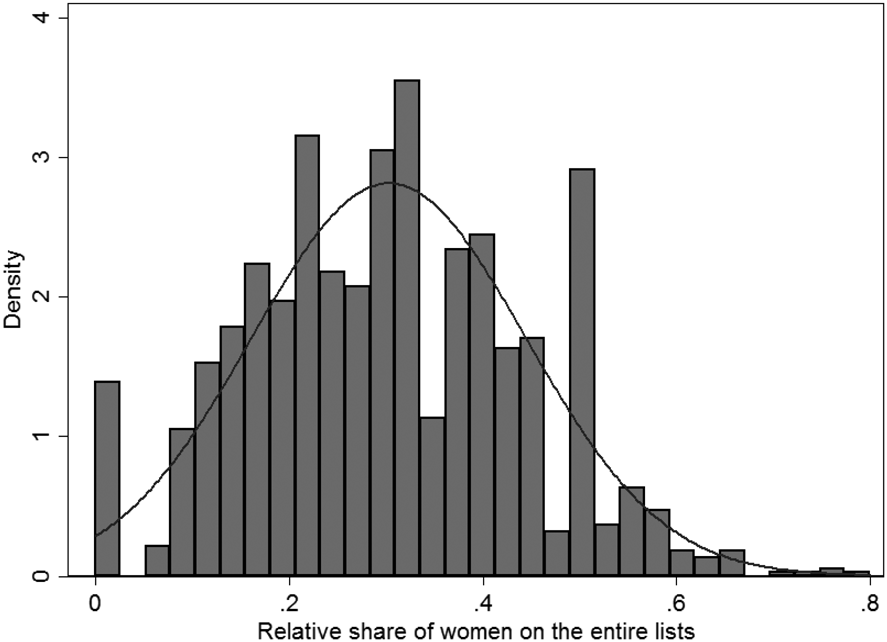
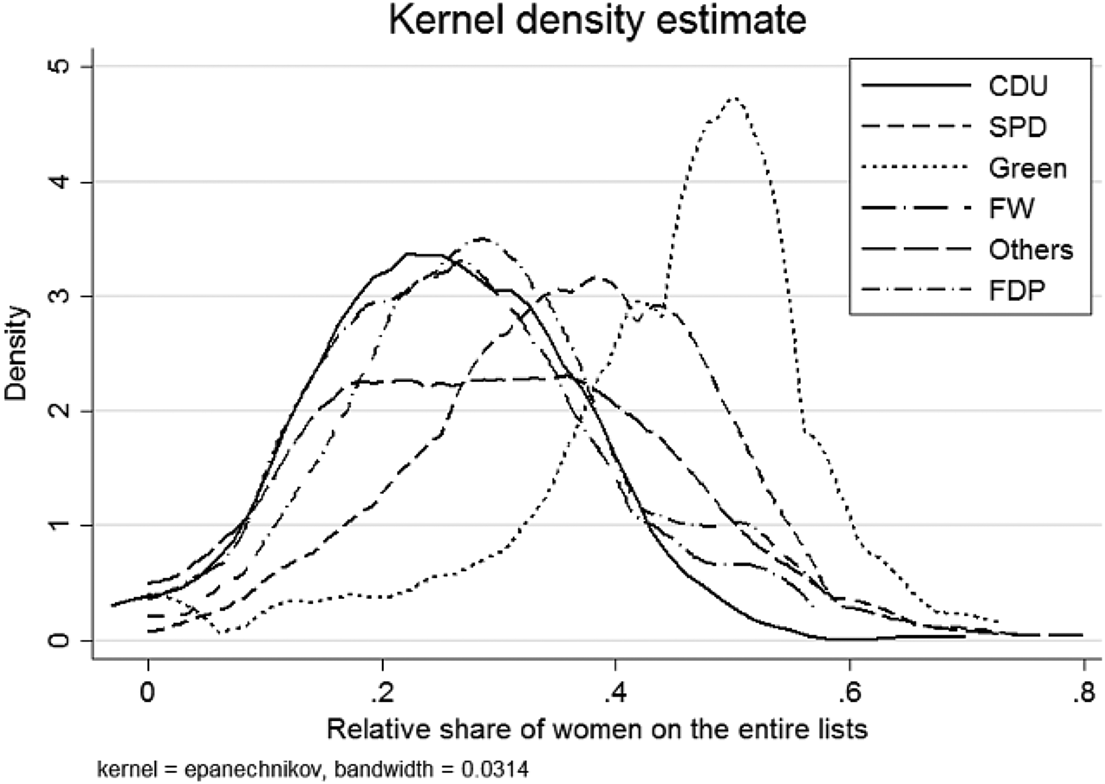
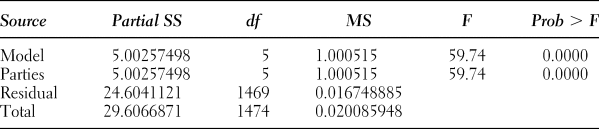
Figure 1 shows the dependent variable, the total share of women on party tickets for the local elections in 2014. The data are normally distributed even though there is a right-skewed distribution and a few remarkable peaks. The first peak includes all lists with no female candidates. The second remarkable peak includes all party tickets with a 50/50 proportional filling. The average share of women on all of the lists in the data set is 30.27%, which is 0.23% lower than the official number of women on party tickets in Baden-Wuerttemberg. The data set consists of 36.6% of all local communities in the German state of Baden-Wuerttemberg and is thus an original and newly compiled data set never used before. Figure 2 shows the dependent variable for each of the parties at the local level in Baden-Wuerttemberg. The analysis of variance for the parties indicates a significant difference in the share of women on party tickets for the local elections between and within the parties.Footnote 5
Party tickets and their average share of female candidates on the entire list. Source: Based on author's calculations.

Kernel density estimate for the share of female candidates on the entire list after party.Source: Based on author's calculations.

METHOD
To analyze the effect of non-quota strategies on the share of women on party tickets, I concentrate on electoral lists prepared before elections rather than elected candidates in order to exclude the effect of elections. This special focus makes it possible to concentrate on party-specific variance and keeps the number of possible disruptive factors to a minimum. The analysis captures the non-quota strategies and the gender quota rules of all parties in Baden-Wuerttemberg at the regional level and the gender of the party's local gatekeepers as the main independent variables. Moreover, I include further institutional, socioeconomic, and cultural variables in the analyses, all located at the local level. These are the degree of party competition, the population size, left-party strength, the share of Catholic population, the share of married people, the share of women with an academic degree, the place-child ratio for child care, the employment rate of women, and the wealth as gross domestic product per capita. In general, there is broad agreement in the literature on how cultural, institutional, and socioeconomic variables affect women's representation at different levels of the political system.
Contributions concentrating on the national or supranational level and making comparisons between nation-states underestimate the variance of the dependent variable, the total share of women on local electoral lists, between parties within a country or region (Caul Reference Caul1999, 80; Kenny and Verge Reference Kenny and Verge2016). Such an approach leads scholars to focus on institutional, socioeconomic, and cultural variables with high variance between nation-states. Even though the variance of such independent variables decreases tremendously by focusing on one country or region, the variance of the dependent variable still remains high (King, Keohane, and Verba Reference King, Keohane and Verba1994; Pruysers et al. Reference Pruysers, Cross, Gauja, Rahat, Scarrow, Webb and Poguntke2017, 208–9; Snyder Reference Snyder2001).Footnote 6 In this case, local-level factors may explain this variance. For instance, the inclusiveness of the selectorate has been proven to be highly relevant when it comes to the representativeness of women on party tickets (Fortin-Rittberger and Rittberger Reference Fortin-Rittberger and Rittberger2015; Rahat and Hazan Reference Rahat and Hazan2001). Yet Pruysers et al. (Reference Pruysers, Cross, Gauja, Rahat, Scarrow, Webb and Poguntke2017) do find some contrary evidence suggesting the degree of centralization and the inclusiveness of the selectorate do not affect women's representation on party tickets to the theorized extent.
Focusing on local council elections has the upshot that most institutional factors, such as the inclusiveness of the selectorate or the electoral system, show no variance at the local level since the electoral code for the local level requires a certain procedure and all parties and free voting associations have to elect their party tickets at local general party meetings. This setting thus makes the study suitable for analyzing interparty and intraparty variance while other possibly relevant variables are held constant. Thus, an analysis of the local level does not capture different mechanisms of the non-quota strategies and therefore only implies a shift in the level that I focus on. Therefore, a shift to the local level has many advantages the research design and no advantages or a shift in measures in relation to the parties’ non-quota strategies.
The observations in the analyzed data set are local party lists. Based on the theoretical assumptions, systematic local and regional differences can account for a portion of the variance in the share of women on these local electoral lists. The remaining variables either vary between parties (non-quota strategies, party quotas), or between parties and municipalities (e.g., the gatekeeper variable), or between the local levels (left-party strength, party competition, population, Catholic, partnership, education, child care, employment, prosperity). However, the local party lists can be regarded as lists of party branches that are nested within the larger party organizations at the regional level. Hence, pooling the data without taking into account this potentially relevant grouping into parties may lead to confounded effect estimates of those variables that concern the local level.
Two kinds of regression models are thus employed to fit the data. First, a pooled OLS regression using all variables has been performed.Footnote 7 This way, variables that vary over both parties and municipalities as well as variables that capture only local-level variation enter the model. Here, the main focus of this approach is on explaining the party-specific variation by non-quota strategies and gender quotas.
Second, a regression using fixed effects for the parties has been performed. Comparing the pooled OLS with this fixed-effects model allows for determining whether the former model does well in explaining interparty differences, or whether there remains considerable unexplained variance between parties so that the coefficients of variables explaining local-level variance might be confounded. The fixed-effects regression allows for controlling for variables that are impossible to measure or for which inclusion might cause misleading results (Allison Reference Allison2009). On the one hand, this serves to handle the identification problem, making sure that the local-level coefficients are estimated properly through neutralizing party differences. On the other hand, using party fixed effects means that party-specific variables (non-quota strategies and gender quotas) have to be left out of the analysis as the entire variation between parties is accounted for.
Another regression model is employed with communities as fixed effects. This model captures only variables that vary between parties using geographic units as fixed effects. Therefore, variables that differ between both parties and municipalities (e.g., the gatekeeper variable) or between the local levels have to be left out as the entire variation between the geographic units is accounted for in this model. With 402 communities and 1,475 cases in total, the average sample size within a fixed-effects group is 3.67, quite small for a within-group estimator. This model can be seen as a test of the party-specific variables for non-quota strategies and party quotas, and the results need to be treated with caution.
MEASURING NON-QUOTA STRATEGY, PARTY GATEKEEPERS, AND GENDER QUOTAS
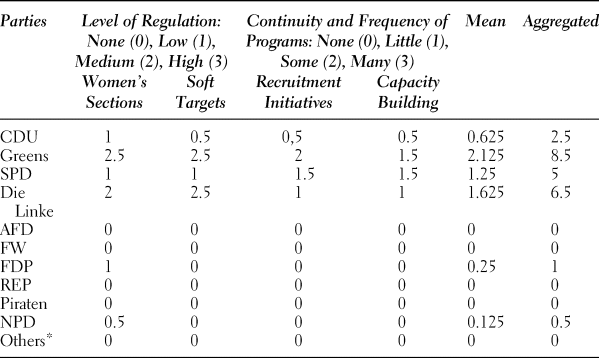
For analytic use and to operationalize the independent variable for hypothesis 1 (non-quota strategy), I operationalize the theoretical model on non-quota strategies using a scoring system that includes the level of regulation (with regard to women's sections and soft targets) and the frequency and continuity of certain intraparty programs (regarding recruitment initiatives and capacity building). Because the instrument of campaign funding provided only for women does not exist in Germany, this measure is not included in the index. The classification presented in Table 1 is based on party statutes and official information on party strategies for the regional party associations in the years 2014, 2015, and 2016.
Classification of non-quota strategies to promote female candidates

Source: Author's calculation. Classification scheme derived from Krook and Norris (Reference Krook and Norris2014).
* Others include all free voting associations at the local level without a supraregional structure.
There are very strong correlations between the different aspects of the non-quota strategies.Footnote 8 However, it seems pretty clear that intraparty strategies for promoting female candidates have different effects on the share of selected female candidates (Hinojosa Reference Hinojosa2009). Further, I assume that the individual strategies are equal in their effects but differ on the level of regulation and the continuity and frequency of the programs. But it appears to be evident that women in parties benefit from the broad range of non-quota strategies as a holistic approach. In the end, it is hard to say which element empowered a female candidate to run for office. Was it the gender-balanced sequence of speeches on the party platforms that empowered her to run? Or was she taking part in the regional party's mentoring program and someone else encouraged her afterward to run for office? Or was it a combination of both? Starting from this point, different weighting of the measures seems to be arbitrary. Therefore, I average the five fields for every party. Within these fields, the level of regulation and the continuity and frequency of the programs determine the party's value between 0 and 3. It seems obvious that only parties with formal structures above the local level can attain points in this classification system. Besides the Free Voters (FW), there are no other local voter associations at the local level with supraregional structures. Therefore, all other voting associations get 0 points.
This work concentrates on top candidates (the future party whips) identified as the person in the first place on the party's election list.Footnote 9 For most of the parties and free voting associations at the local level, these people are the only identifiable gatekeepers, and they have an outstanding position in recruiting new people for their election list. Furthermore, candidates on the election lists are, especially in smaller communities, the only active party members and the main recruiters of new candidates. The only purpose of many independent election lists and free voting associations at the local level is to nominate an election list for the local council elections. Here, the standard approach to identifying party gatekeepers through the party leaders does not work because there are only election lists and no party structure.
The local level in Baden-Wuerttemberg (and the German local level in general) is characterized by small communities in which the adoption of party quotas seems unlikely. Nevertheless, I include a quota dummy at the party level for parties with a self-imposed quota rule for selecting women on party tickets because the quota rule is part of the parties’ official policy and is applied at least on some party tickets. I do recognize the effect of party quotas, even though it is unclear why some local party branches adopt it and some do not. On party lists with a share of 50% of women, the party quota seems to works well, but in general, the compliance of party quotas is an exception rather than a norm. To most of the parties at the local level, a party quota from the regional or federal level seems to be more of a recommendation. Therefore, including more than a quota dummy could mislead the analysis since the quota rule seems to be interpreted as a recommendation reminding the local party branch to select female candidates in an appropriate way, while the prescribed number of women probably just serves as a point of reference.
THE REPRESENTATION OF WOMEN ON LOCAL PARTY TICKETS
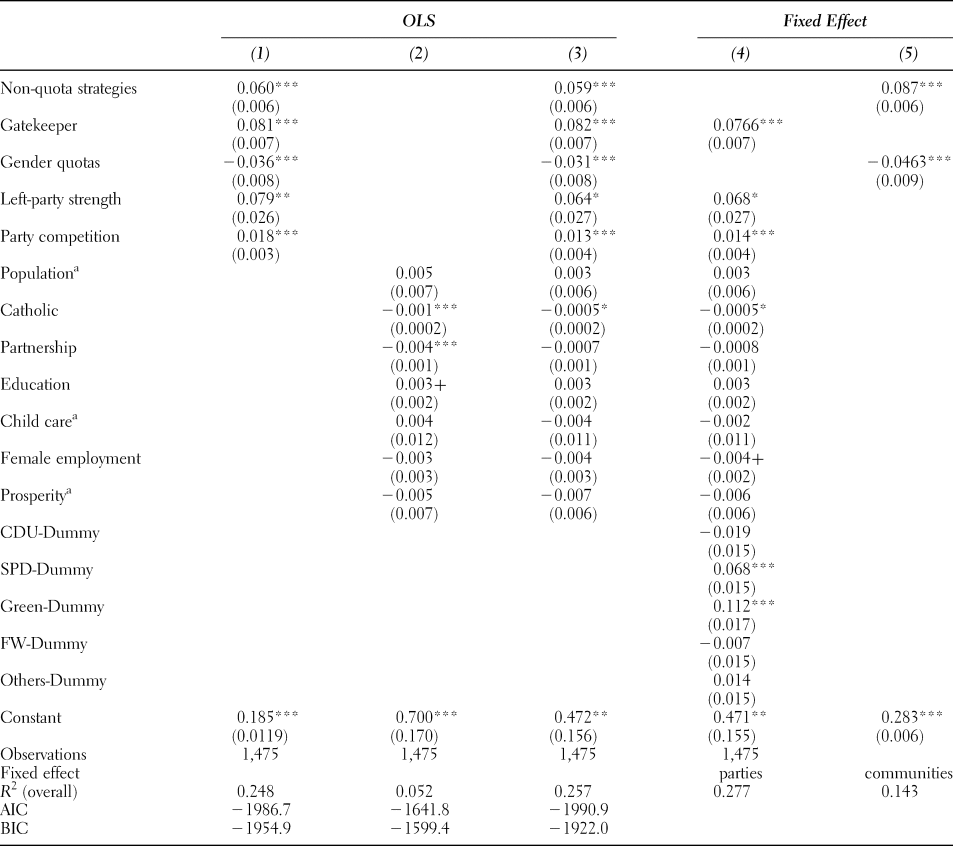
The results from the regression analyses are presented in Table 2. Models 1–3 sequentially add different blocks of determinants, starting with party- and party-list-specific variables and then adding variables that capture the conditions of the local context.
Regression models

Figure based on own calculations. Standard errors in parentheses.
+ p < .1; * p < .05; ** p < .01; *** p < .001.
Dependent variable: The share of women on the election list (percent). Fixed effects: Six regional party labels. Reference category for party dummies: FDP.
a. The variables population, prosperity, and child care are scaled to present a lower number of significant digits: population = population/100,000; prosperity = prosperity/10,000; child care = child care/10.
ANOVA for parties and their share of women on local electoral lists

Note: Figure based on author's calculations with Stata 13.
Looking at the coefficients for the determinants that are party or individual party-list features, the evidence strongly supports the notion that non-quota strategies and gatekeepers matter for the representation of women on local party lists. These determinants show clear positive effects even when adding all control variables. A difference in the index on a party's non-quota strategy from 1 to 2 results in an increase of women of about 6 percentage points. Furthermore, the models confirm the positive impact of female gatekeepers on the representation of women on local electoral lists. If the gatekeeper is a women, the share of women on the electoral list increases by 8%. Therefore, H 1 and H 2 are very much supported by the results presented in Table 2. In addition, if we take a look at the standardized beta coefficients, we can compare the strength of the effect of each individual independent variable on the dependent variable. The beta coefficient for non-quota strategies is the highest (0.2962), followed by female gatekeepers (0.2669). In this model, the impact of non-quota strategies is in line with the theorized assumption. Clearly, measures to empower women within parties have the ability to increase the share of women on the local electoral lists, and this by far has the strongest effect in comparison with all other independent variables.
Strikingly, the coefficient for party quotas is in line with the discussed problem about the impact of a party's gender quota recommendation from the regional level on the local level. It seems that—at least for the examined German case—if regional parties recommend recruiting a certain amount of women for local electoral lists, the local party branches fail to fulfill their own recommendations, which could be seen as a sign of local resistance toward gender quotas and nonexistent control mechanisms when applying or not applying gender quotas or the simple effect of not having a legal electoral gender quota for electoral lists or an insufficient pool of female candidates. In comparison, and by looking at the beta coefficients, the effect of a party's gender quota is less influential compared with the main independent variable (non-quota strategies) and the other significant independent variables. Model 5 emphasizes the findings for the effect of non-quota strategies and party quotas, as all variables that differ between both parties and municipalities or the local levels have to be left out because the entire variation between the geographic units is accounted for in this model. The effect of the two variables confirms the positive impact of non-quota strategies and the negative impact of a regional parties gender quota on the representation of women on local electoral lists.
While the strongest comparable effect (based on beta coefficients) derives from non-quota strategies directly followed from local female gatekeepers, other independent variables at the local level explain also a considerable share of the dependent variable but to a lesser extent. These are variables describing the local party system: the degree of party competition in the local council (beta coefficient: 0.1131) and the overall left-party strength (beta coefficient: 0.752) in the council. Higher party competition at the local level increases the share of female candidates on electoral lists. More competition between parties seems to stimulate the representation of women. Also, the strength of left parties in a municipality has a positive impact on the share of women on the parties’ electoral lists. In municipalities with a higher share of left parties, the share of women on the electoral lists increases, too. But the variables designed to capture variance between municipalities altogether show little explanatory power and controlling factors, such as the share of Catholic population in a municipality, showing only a weak negative impact on the share of women on the electoral list: if the share of the Catholic population decreases by 1%, the share of women on the electoral lists increases by 0.05%. In comparison with other independent variables, the standardized beta coefficient for Catholic is low at –0.0665.
In Model 2, socioeconomic and cultural municipality factors are included. Only in this model, the independent variables partnership and education have an impact on the total share of women. If the share of married women in a municipality (partnership) increases from 60% to 60.1%, the dependent variable decreases by 0.4%. In fact, there is a significant but not influential effect that also vanishes when including party system and party-specific variables. The same findings apply to the share of women in insurable employment in a municipality (female employment). The impact is too low to have a practical effect on the dependent variable, and the effect vanishes when including other variables. Other variables show no notable effects.
Taking into account socioeconomic and cultural variables at the local level explains only a small amount of the dependent variable's variance (model 2: 5.2%). This effect was expected as the analysis makes use of the homogenous conditions provided in such a local-level study. However, a technical reason for the low explanatory power of the local context variables could be that there is an identification problem. If the dependent variable varies between parties, the variance between municipalities for each party (i.e., the local party lists of the individual parties) would be on different levels. Pooling the data would then confound any effects of variables for explaining local-level variance.
Yet it does seem that the coefficients for the local-level variables are estimated properly. The coefficients in Model 4 are almost identical to those in the pooled OLS regression (Model 3). Moreover, the overall explained variance of 0.277 in the fixed-effects model is only slightly higher than the 0.257 in the pooled OLS. This is strongly reassuring that the pooled OLS is an adequate choice for modeling the data. We can also conclude, as the comparison of the R 2 values from the models presented in Table 2 also shows, that the variables included in Model 3 vary over both municipalities and parties (gatekeepers, party competition and left-party strength) and those that differ between parties (non-quota strategies, gender quotas) explain by far the largest portion of among all included determinants. This is also emphasized by the beta coefficients.
CONCLUSION
This analysis contributes to the topic of intraparty factors that influence women's representation on party tickets. Within a newly collected data set of 1,475 party lists, I show that non-quota strategies and the gender of party gatekeepers are central explanatory factors for the selection of female candidates, at least at the local level in the German federal region of Baden-Wuerttemberg. Who runs on the party tickets seems to be, in this study, a question of the intraparty dynamics caused by different mechanisms of female promotion strategies and gender-biased candidate selection at the local level combined with interparty effects of local party competition and, to a lesser extent, by overall left-party strength and a low share of Catholic population in the municipalities. What does this mean regarding the representation of women in the future? As Crowder-Meyer notes (Reference Crowder-Meyer2013, 409), it is eminent that the recruiters’ networks on the local party level is changing from male-dominated to more gender-balanced networks. Or to say it in the language of this work: more local female gatekeepers are necessary. Thus, even though the operationalization of gatekeepers is an unusual one, this work confirms the findings on female gatekeepers by Verge (Reference Verge2010). This work provides an additional insight: it is not only the gender of central gatekeepers that decides who is placed on party tickets, but it is also the parties’ ability to promote women in different ways and their contributions to a more encouraging environment for women in parties (Krook and Norris Reference Krook and Norris2014; Verge Reference Verge2018).
Under the impression of the robust effects of the non-quota strategies and the gatekeeper variable in this work, other usually important explaining factors such as the share of left parties (e.g., Sundström and Stockemer Reference Sundström and Stockemer2015, 266), party quotas, and socioeconomic resources (e.g., Smith, Reingold, and Owens Reference Smith, Reingold and Owens2012, 322; Pruysers et al. Reference Pruysers, Cross, Gauja, Rahat, Scarrow, Webb and Poguntke2017; Tripp and Kang Reference Tripp and Kang2008) or cultural variables (e.g., Inglehart and Norris Reference Inglehart and Norris2003) do not provide a broad explanation for the representation of women at the local level. Even though the homogenous institutional, socioeconomic, and cultural conditions of a local-level study are responsible for that, future studies should pay more attention to party-specific variance. In fact, this work contributes to the findings and assumptions on candidate selection made by Hazan and Rahat (Reference Hazan and Rahat2010), the conceptualization of non-quota strategies by Krook and Norris (Reference Krook and Norris2014), and the requirements for analyzing women's representation established by Kenny and Verge (Reference Kenny and Verge2016). As Pruysers et al. (Reference Pruysers, Cross, Gauja, Rahat, Scarrow, Webb and Poguntke2017, 210) notice, parties are gatekeepers, but it is the intraparty perspective that is breaking down the gatekeeping function of parties: even within the same party, it is relevant if a women or a man is performing as a gatekeeper in the selection process. And between the parties, it is the parties’ ability to promote women with non-quota strategies rather the parties’ ideological label or, in this case, a party's gender quota recommendation from the federal level.
The results of this work are related to the variance on women's representation between parties within the German regional state of Baden-Wuerttemberg and have to be considered carefully when it comes to the effects of intraparty factors and women's representation on cross-national comparisons, as the institutional, socioeconomic, and cultural variance is much higher. But the special focus in this work and the almost consistent conditions that the subnational level provides show that the parties’ capacities (or lack thereof) for gendered recruitment is one major explaining factor and should be tested at least in cross-national comparisons.
For future work, we should keep in mind that the differences between the proportional shares of women are caused by parties. We have to dig deeper and analyze the internal structure of parties and the mechanisms central gatekeepers apply when it comes to candidate selection. Future work should also concentrate on the effects single aspects of non-quota strategies have on the women participating.