The percentage of seats held by women is increasing in many legislatures, and it is becoming more common for women to hold leadership posts. Are these changes affecting the gendered nature of legislatures as institutions? We explore participation in standing committees in a legislature with near numeric equality of women and men to learn whether near numerical equality in the chamber overall translates into equal participation in committees whose sex ratios vary quite a lot. These are important questions because much research has shown that power relations are gendered, with the result that women are less likely than men to speak in groups, so we need a better understanding of the circumstances under which women become empowered.
We use participation records of men and women in standing committees in the Costa Rican Legislative Assembly to shed light on how institutions operate as the numbers of men and women become more balanced in a chamber. Standing committees are well suited to this research because in Costa Rica's Assembly, much of the real work occurs in committees acting as gatekeepers (modifying or killing bills). Standing committees typically operate outside of the media spotlight. As small groups (nine people) whose members interact repeatedly, they can facilitate constructive work rather than partisan drama. Such an atmosphere, in which committee members can become accustomed to working together and there may be less incentive to engage in party competition, would be expected to appeal to women's preferences to avoid conflict and to give priority to connecting with others and working together (see Karpowitz and Mendelberg Reference Karpowitz and Mendelberg2014, 65–68 for a review of related literature). Because standing committees have different policy jurisdictions and different gender ratios, studying men's and women's participation in different committees allows us to explore whether participation varies across stereotypically feminine or masculine policy domains and how stereotypically masculine policy domains can have aspects of “feminine” policy interest.
Kanter's (Reference Kanter1977) research about how gender dynamics change with the sex ratio of the group leads us to expect that women will be more likely to participate as committee membership becomes more gender balanced. A larger percentage of women, however, may become a threat and produce backlash from men (Bratton Reference Bratton2005; Kanthak and Krause Reference Kanthak and Krause2010. Kathlene Reference Kathlene1994). Karpowitz and Mendelberg (Reference Karpowitz and Mendelberg2014), studying the United States using primarily experimental methods, show that participation by even small numbers of women is facilitated by a unanimity decision rule, but when there are many women in a group, a majority rule is beneficial to their participation. Costa Rica's standing committees operate with majority rules, so this project offers an opportunity to examine the generalizability of their findings to a real-world setting of repeated interactions for group members in a different cultural context.
We explore how gender dynamics and individual-level attributes affect men's and women's participation in committee sessions. We use a multilevel modeling strategy to model the variation among committee sessions (e.g., sex ratios, sex of the leader, topic of discussion) while also controlling for individual-level attributes that do not vary across sessions (e.g., personality, partisanship). This strategy essentially captures deviations in an individual's behavior that are caused by various conditions while accounting for the fact that multiple observations of an individual are not independent. As an example, consider hypothetical Legislator Salazar. During committee session 1, there is a balanced sex ratio and the committee is discussing a bill that interests Salazar, and she participates a lot during this session. During session 2, the committee is discussing the same bill, but many women are absent, so the gender balance is skewed toward men, and she participates less. In session 3, the sex ratio is again skewed, but the committee is discussing a bill that Salazar's party opposes, and she participates a lot. The multilevel modeling approach groups all of these observations together (rather than treating them as independent) to estimate the effect of these conditions on Salazar's behavior. In sessions 1 and 2, the sex ratio appears to be affecting Salazar's behavior, but in session 3, partisanship appears to be playing a greater role.
Overall, our data indicate that women legislators participate at equal rates or more than men in day-to-day committee sessions. However, the results of our multilevel models suggest that women legislators participate even more when the sex ratio of the committee is not skewed toward men (i.e., at least 40% women). If the committee discusses a “women's issue” bill, this also seems to affect women's participation, although not in the expected direction. In addition, having a woman committee leader or having previous political experience does not seem to improve women's participation. The empirical results also indicate that men's participation is affected little by the institutional factors that significantly determine women's participation. These results indicate that although women's participation in committees does not lag behind their male counterparts, sex ratios on the committee, the topic of discussion, and committee leader sex are relevant factors for women's participation.
WOMEN'S PARTICIPATION IN LEGISLATURES
Findings have been mixed about whether getting women into the legislature is enough to enable women to participate in policy making. Some studies find that women participate less than men in plenary sessions or committee hearings (Diamond Reference Diamond1977; Henderson Reference Henderson2005; Kathlene Reference Kathlene1994; Miguel Reference Miguel, Franceschet, Krook and Piscopo2012; Taylor-Robinson and Ross Reference Taylor-Robinson and Ross2011; Thomas Reference Thomas1994), but others find that women are active participants (Broughton and Palmieri Reference Broughton and Palmieri1999; Murray Reference Murray2010b; Pearson and Dancey Reference Pearson and Dancey2011). Other work shows that participation varies with the subject matter under discussion, with women more active than men when the debate concerns a “women's issue” (Bicquelet, Weale, and Bara Reference Bicquelet, Albert and Bara2012; Bird Reference Bird2005; Catalano Reference Catalano2009; Chaney Reference Chaney2006; Childs and Withey Reference Childs and Withey2004; Pearson and Dancey Reference Pearson and Dancey2012; Piscopo Reference Piscopo2011; Swers Reference Swers2001, Reference Swers, Escobar-Lemmon and Taylor-Robinson2014; Taylor-Robinson and Heath Reference Taylor-Robinson and Heath2003). Hawkesworth (Reference Hawkesworth2003, 535) found that in the U.S. Congress, when African American women want to get their legislation passed, they will let the (typically white male) committee leader take credit for the bill because credit is less important than getting the bill passed. Other studies of the United States have found that women are more effective legislators than men (Volden, Wiseman, and Wittmer Reference Volden, Wiseman and Wittmer2013). The literature points to the quantity of women, type of issue, institutional procedures, or a combination thereof affecting women's participation.
Legislatures can be gendered institutions (Acker Reference Acker1992; Catalano Reference Catalano2009: 46; Duerst-Lahti Reference Duerst-Lahti, Thomas and Wilcox2005; Kenney Reference Kenney1996; Mackey Reference Mackey, Krook and Mackey2011). Policy-making norms and procedures, the zero-sum conflictual atmosphere of policy debates, and continued importance of “good old boys” networks that exclude women prompt scholars to describe legislatures as “inherently gendered” (Reingold Reference Reingold, Wolbrecht, Beckwith and Baldez2008, 132; see also Beckwith Reference Beckwith2005; Mackey Reference Mackey, Krook and Mackey2011). Indicators include overrepresentation of women in committees with traditionally feminine policy domains, which are also often committees lacking in prestige, and underrepresentation of women in the most powerful committees (Aparicio and Langston Reference Aparicio and Langston2009; Baekgaard and Kjaer Reference Baekgaard and Kjaer2012; Frisch and Kelly Reference Frisch and Kelly2003; Heath, Schwindt-Bayer, and Taylor-Robinson Reference Heath, Schwindt-Bayer and Taylor-Robinson2005; Miguel Reference Miguel, Franceschet, Krook and Piscopo2012; Murray Reference Murray2010a; Towns Reference Towns2003; Zetterberg Reference Zetterberg2008).Footnote 1 We explore whether there is evidence that legislative committees, like many legislatures, operate like gendered institutions by studying participation in three standing committees. Specifically, we explore whether increases in the ratio of women to men in a committee, having a woman committee president, and leveling the playing field with regard to seniority are associated with equal participation by women and men in standing committees (see Cammisa and Reingold Reference Cammisa and Reingold2004).
HYPOTHESES ABOUT PARTICIPATION IN LEGISLATIVE COMMITTEES
Many bills die in committee, and markup in committee can change bill content, so it is important for the representation of diverse perspectives on policy for women to be equal participants inside committees. We use three of Hall's (Reference Hall1996) measures of committee participation in the U.S. Congress as the basis for how we study participation in Costa Rica: participation in bill debates, motions to amend bills, and motions to bring in outside speakers on bills. All three forms of participation matter in Costa Rican committees, as Saint-Germain and Morgan (Reference Saint-Germain and Morgan1991) illustrated in their study of the slow process that ultimately led to the adoption of a much-modified form of a law of gender equality in Costa Rica (see also Taylor-Robinson and Ross Reference Taylor-Robinson and Ross2011 for statistical analysis of committee work).
Committee members air opinions about parts of bills, often giving their party's perspective or explaining why a bill is important for their province. Which groups and government actors are invited to give testimony about the bill influences the decision of the committee. Committees can assign bills to a subcommittee, and the subcommittee's report may be adopted as a substitute for the original bill. All these tactics were utilized in the Social Issues Committee for the women's equality bill. Saint-Germain and Morgan (Reference Saint-Germain and Morgan1991) noted how the opposition of the committee's male president endangered the bill, but then a new committee composition, including a woman committee president, the following year helped get the bill passed, albeit with watered-down text. These three types of participation are also interesting for studying gender and political participation because women are often found to be more reluctant than men about public speaking (see Karpowitz and Mendelberg Reference Karpowitz and Mendelberg2014, 58; Latu et al. Reference Latu, Mast, Lammers and Bombari2013). Participation in committee hearings requires public speaking, but the other measures allow a deputy to propose a motion in writing before the committee meets.
The proposition underpinning this research is that, in a situation of (near) institutional equality, women will be as active in all types of committee participation as their male colleagues because they will have the capacity to participate. Institutional equality can occur in the chamber overall, within a specific standing committee, or both. We theorize that there are multiple components to institutional equality for women: having equal seniority as men, an increasing percentage of women, and women holding leadership positions. Institutional equality may also be affected by whether women are appointed to committees in which they can use their work and educational backgrounds and whether women with prior political experience are equally likely to participate in committees as men with similar experience. Costa Rica offers an interesting opportunity to explore the role deputy background plays in committee participation because the norm is to assign deputies to committees that make use of their background and expertise, and deputies can switch their committee assignment by making an arrangement with another deputy from their party (Article 70), which is not uncommon at the beginning of each new year.Footnote 2
In most legislatures, men typically have more seniority because most women are newcomers, unless term limits or a reelection ban makes many or all legislators newcomers (Schwindt-Bayer Reference Schwindt-Bayer2005). Immediate reelection is prohibited in Costa Rica, so both men and women lack seniority, leveling the playing field in the Assembly (see Carey Reference Carey1996; Taylor Reference Taylor1992). In the 2010–14, term only 7 of the 57 members of the legislature had previously been a deputy, 4 of whom are part of our dataset (one woman, three men).
Kanter's typology of sex ratios in organizations leads us to expect more participation by women as the sex ratio becomes “tilted” (65/35) instead of “skewed” (85/15)—Hypothesis 1 (see also Beckwith Reference Beckwith2007; Karpowitz and Mendelberg Reference Karpowitz and Mendelberg2014, 51–52). Chamber and committee leaders may be advantaged in debates because of their agenda-setting powers and their ability to determine who gets to speak. Lack of women in leadership posts has been argued to be one reason why women participate less than men (Hawkesworth Reference Hawkesworth2003; Reingold Reference Reingold, Wolbrecht, Beckwith and Baldez2008). Women leaders may encourage greater participation by other women, as they have been found to be more inclusive in the way they run meetings (Kathlene Reference Kathlene1994; Rosenthal Reference Rosenthal1997, Reference Rosenthal, Thomas and Wilcox2005). We expect women will participate more when there are women in leadership positions—Hypothesis 2.
However, men may react negatively to a woman committee leader and participate more as a form of backlash (Mansbridge and Shames Reference Mansbridge and Shames2008). As explained by Karpowitz and Mendelberg, “gender role theory provides an overarching framework for understanding why women and men walk into formal discussion with different proclivities to engage in what society views as a core masculine behavior: to exercise authority” (Reference Karpowitz and Mendelberg2014, 52; see Chapter 3 for a useful literature review; see also Wood and Karten Reference Wood and Karten1986). A major purpose of this research is to explore whether this expectation about gender roles holds in a country, and a legislature, where there has been near numerical equality of women for several terms.
Women are more likely than men to initiate bills on women's issues (this has been found in Costa Rica; see Escobar-Lemmon, Schwindt-Bayer, and Taylor-Robinson Reference Escobar-Lemmon, Schwindt-Bayer, Taylor-Robinson, Escobar-Lemmon and Taylor-Robinson2014), so we expect that women will participate more when a women's issue bill is the topic of discussion—Hypothesis 3. Footnote 3 This expectation is reinforced by experimental findings in social psychology showing that “direct information about competence has a greater impact on expectations and behavior than inferences about competence based on diffuse status characteristics” and, in addition, when gender was not associated with a task “men displayed greater verbal power-related behavior than did women” (Dovidio et al. Reference Dovidio, Brown, Heltman, Ellyson and Keating1988, 581, 583).
EMPIRICAL CONTEXT: THREE STANDING COMMITTEES IN THE COSTA RICAN ASSEMBLY
We conduct multilevel analyses of sessions of three standing committees: Agriculture and Natural Resources, Economics, and Social Issues. The other three standing committees are Budget, Judicial Issues, and Government and Administration; the last two are viewed as the least important.Footnote 4 Committee assignments (and selection of the Chamber Directorate) are made yearly, and many deputies change committees. The Assembly president makes committee assignments based on proposals by party faction leaders (Arias Ramírez Reference Arias Ramírez2008) and proportional representation of parties. Committees have 9 members (11 on the Budget Committee), and deputies are assigned to one standing committee a year. Committees elect a president and secretary. Women served as presidents of three of the six standing committees during each of the years we study (2010–13).Footnote 5
The Social Issues Committee, historically and in our dataset, has the most women members (range: 67% to 78%) and elected a woman president in all three years of our study. The Economics Committee, a power committee in the Assembly, historically and in our dataset, has a majority male membership (range: 22% to 33% women), although it elected a woman president in the second year of the 2010–14 term. Agriculture and Natural Resources, also a majority male committee (range: 22% to 44% women), elected a woman president in the first and third years of our dataset. The percentage of women on the three committees that we do not study is as follows: Judicial Issues ranges from 11% to 22%, Government and Administration ranges from 22% to 44%, and the Budget Committee ranges from 45% to 67%; and each of these committees elected a woman president in one year. During the years we study, no woman was elected president of the Assembly, but women held other posts in the Chamber Directorate, ranging from 33% to 50% of Directorate members.
The Social Issues Committee covers what is considered to be a feminine policy domain: labor, social security, health, social protection, and education (Article 66, Reglamento de la Asamblea Legislativa, Acuerdo Legislativa 399, November 29, 1961, modified February 27, 2012). Economics has a masculine domain: economics, commerce, industry, the common market, and integration (Article 66). The Agriculture Committee would generally be viewed as masculine (agriculture, ranching, energy, natural resources, and related materials [Article 66]), but a more nuanced conceptualization of “feminine policy domain” and of the topics that fit under the heading “women's issues” makes the committee more difficult to categorize. As we discuss later, the idea of familismo suggests that some of the topics in the jurisdiction of the Agriculture Committee can be considered women's issues.
Representation of women in Costa Rica's government has increased dramatically. In 2010, Laura Chinchilla of the National Liberation Party became the first woman president.Footnote 6 In the 2010–14 Assembly, 22 of 57 deputies were women (39%). That was the third election since implementation of a 40% gender quota in 2002, so politicians and parties have had time to adjust to the influx of women into politics (see Beckwith Reference Beckwith2007, 39 for discussion of the potential importance of “newness”).Footnote 7 The caucus of the three largest parties was made up of more than 40% women, two smaller parties elected less than 40% women, and three parties with one seat each elected men.
Costa Rica's Supreme Court and the Elections Tribunal have for many years adopted a perspective that equality of results, not just of opportunities, is required for the country to achieve its ideals of democracy (see Piscopo Reference Piscopo2015). Judicial decisions endorsing affirmative action with the goal of equal results began after the debates about the Law of Gender Equality in the late 1980s, with bill opponents often arguing that the constitution already guaranteed equality of men and women and that affirmative action was prejudicial and unconstitutional. Subsequent experiences with adopting and reforming gender quota laws make Costa Rica's Assembly an interesting case to explore whether increasing numbers of women on standing committees are associated with equality in participation, which should be a component of equality of results. Finally, the Assembly acts as a genuine check on the president (Carey Reference Carey, Mainwaring and Soberg Shugart1997; Gutierrez Saxe and Straface Reference Gutiérrez Saxe and Straface2008), so women are not obtaining a large number of seats in a powerless institution.
DATA AND VARIABLE OPERATIONALIZATION
Our data come from committee hearings from May 2010 to December 2012. Although our dataset does not cover the entire four-year term, it provides ample variance in committee- and deputy-level characteristics. A deputy operates in a potentially different context each time a committee meets as the agenda changes, the sex ratio varies, and the sex of the committee leader changes if the president is not in attendance and an ad hoc president fills in. Institutional equality at the level of the chamber is a constant for our study, but the extent of equality within a committee varies across committees and also within each committee over time. Our dataset includes 37 deputies (of the 57 Assembly members) and 558 committee session meetings.
Our main explanatory variables are sex of the deputy (coded 1 for women), sex of the committee president for a session (coded 1 for woman), sex ratio of the committee session, and the topic of discussion. We explored different ways to operationalize sex ratio and concluded that the heart of Kanter's (Reference Kanter1977) concept of a “skewed” versus “tilted” gender ratio and its impact on behavior was a tipping point. An increase in the percentage of women, but still a very small percentage, would not be expected to change behavior; likewise for an increase from a large to an even larger percentage. Therefore, we consider the sex ratio “tilted” if women make up 40% or more of members in attendance (coded 1).Footnote 8
We also expect that women will speak more about a women's issue. Defining “women's issues” is the subject of debate (see Escobar-Lemmon and Taylor-Robinson Reference Escobar-Lemmon and Taylor-Robinson2014; Schwindt-Bayer and Taylor-Robinson Reference Schwindt-Bayer and Taylor-Robinson2011). Following Schwindt-Bayer (Reference Schwindt-Bayer2010) and Escobar-Lemmon, Schwindt-Bayer, and Taylor-Robinson (Reference Escobar-Lemmon, Schwindt-Bayer, Taylor-Robinson, Escobar-Lemmon and Taylor-Robinson2014), we define women's interests as women's equality bills, children/family bills, and bills to aid the poor, many of whom are women and their families. In addition, based on the concept of familismo, we include some agriculture bills as part of this children/family coding. Familismo can be defined as “family loyalties and trust as a pattern of family life and as a way to uphold valuable and cultural traditions” (Penchaszadeh Reference Penchaszadeh2001, 194; see also Sabogal et al. Reference Sabogal, Marín, Otero-Sabogal, Marín and Perez-Stable1987; Steidel and Contreras Reference Steidel and Contreras2003). The concept applies well in rural agriculture systems (e.g., an entire family working to harvest crops rather than only the males of the family). Familismo occurs when the agriculture sector is dependent on family labor. Family becomes the underlying influence in becoming part of the agriculture system, in which women play a vital role (Deere Reference Deere1978, Reference Deere1982; Deere and León de Leal Reference Deere, León de Leal, Carmen Deere and León de Leal1987; León de Leal Reference León de Leal, Deere and León de Leal1987).
Women in Latin America can be influenced by familismo in various manners. For example, women who experience domestic abuse must decide whether to preserve their duty to their family or maintain obligations to themselves (Eldeson, Hokoda, and Ramos-Lira Reference Edelson, Hokoda and Ramos-Lira2007, 8). Health risks (domestic abuse, exposure to pesticides) are aggravated by familismo because these issues are meant to be kept within the family rather than seeking outside help (Galanti Reference Galanti2003). In a culture of familismo, women on the Agriculture Committee are not only representing the agricultural workforce but also rural women's interests and family interests. Familismo draws links between family and agricultural policy, with specific emphasis on family welfare, inheritance rights, and health, extending women's issues to include fiscal and health care discussions in the agricultural sector, a policy area typically considered a masculine domain.
We expect other factors to increase participation by both men and women.Footnote 9 Legislators may be more likely to participate if they have prior experience in government (see Kerevel and Atkeson Reference Kerevel and Atkeson2013 on Mexico) or experience related to the policy purview of their committee. Because the literature has found that women are less likely to propose themselves as candidates unless they are extremely well qualified (see Lawless and Fox Reference Lawless and Fox2005), we also explore whether political experience is more important for women's committee participation than for men's. Political experience is coded 1 if a deputy has prior experience in the Assembly, cantonal government, or cabinet.Footnote 10 Related occupation is coded 1 if a deputy has education or work experience germane to the committee's policy jurisdiction (e.g., a career in banking for the Economics Committee, a teacher or doctor appointed to the Social Issues Committee, an agricultural producer on the Agriculture Committee). Committee experience is a count of the number of years that a deputy has served on the committee (range = 1–4).Footnote 11
In addition, we control for whether the deputy was first on his or her party's list (coded 1) to proxy standing within the party. Committee president is coded 1 for sessions in which the deputy served as the president or president ad hoc. Governing party is coded 1 for deputies from President Chinchilla's party, the National Liberation Party. Author of bill is coded 1 if the deputy is an author of the bill in discussion. Bill directed at province is coded 1 if the bill under discussion mentions the deputy's province. Amount of speech is the total lines of speech made by a deputy during a committee hearing (range = 0–807). Dummy variables for the Social Issues and Economics committees control for variables related to the committees' policy domains (Agriculture is the reference category).
ANALYSIS AND RESULTS
We have three dependent variables: (1) participation in debates, measured by tallying each deputy's lines of speech during a committee session;Footnote 12 (2) a dichotomous variable coded 1 if the deputy proposed one or more motions to amend the bill in discussion during the committee session (including motions to substitute the subcommittee report for the original bill); and (3) a dichotomous variable coded 1 if the deputy proposed one or more motions for consultation with a group or organization on a bill in discussion.
We use multilevel models with random intercepts. The level 1 unit of analysis is the deputy—committee session. The level 2 unit is the deputy. This approach allows the level 1 intercepts to vary across level 2 units, explicitly modeling the hierarchical structure of our data. It would be inappropriate to treat each observation of the deputy's behavior as unique because behavior is conditioned on unmeasured variables relevant to that deputy (e.g., personality). An approach that ignored the multilevel structure of our data (e.g., clustering standard errors, fixed effects) could lead to imprecise estimates of standard errors, causing an increase in Type I errors—that is, variables appear to have a significant effect when they do not (Steenbergen and Jones Reference Steenbergen and Jones2002). This strategy allows us to analyze how a deputy's participation in committee X on day Y changes under various conditions (level 1 unit of analysis), while controlling for unmeasured variables related to the deputy (level 2) that may be driving participation.
Participation in Committee Debates
For our first analysis, we use a multilevel negative binomial regression model because the dependent variable is a count of lines of speech made by a deputy during a committee session, based on session minutes posted on the Assembly's web page (http://www.asamblea.go.cr).Footnote 13 Because our theory suggests that committee-level institutional factors affect men and women differently, we include interaction terms for the deputy's sex with (1) the sex of committee president, (2) gender composition of the committee session, (3) whether the bill in discussion is a woman's issue, and (4) whether the deputy has previous political experience.
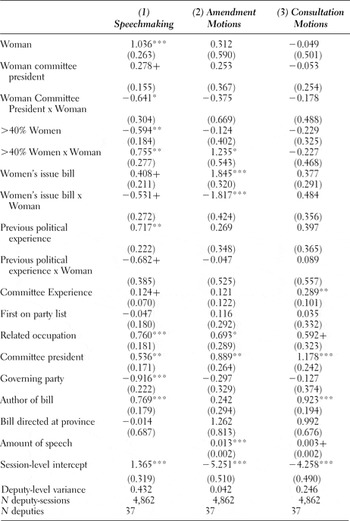
Column 1 in Table 1 presents the results for speechmaking. Results suggest that women speak less when a woman is president of the committee and men speak more, contradicting our hypothesis that women participate more in committees when a woman holds the leadership role. Women deputies may feel that their interests are represented by the woman committee president, so they are less motivated to speak, or women committee leaders may be strategic about when they encourage participation (see Funk Reference Funk2015). The finding that men speak more when a woman is committee leader might be an indication of backlash on behalf of men. Testing these interpretations, however, would require interviews with committee members about topics such as how deputies strategize outside of committee meetings and what motivates deputies to take part in committee hearings. Results also suggest that women speak more (and men less) when women compose at least 40% of the members present, which supports our hypothesis that women speak more when there are more women present.
Participation in committee sessions (results from hierarchical linear models)

Notes: Fixed effects for committees (Social Issues and Economics) included but not reported. Standard errors in parentheses. Model 1 is a hierarchical negative binomial regression. Models 2 and 3 are hierarchical logistic regressions.
+p < .10; *p < .05; **p < .01; ***p < .001.
Women do not participate more in debates when the bill under discussion is a “women's issue” bill, although men do. Further examination reveals that men speak most on women's issues bills coded in this category based on familismo. This suggests that men may also be interested in “women's issues” if the concept is broadly defined. However, we are cautious about drawing strong conclusions because of the small number of women's issue bills in our data: 5 in Agriculture, 3 in Economics, and 41 in Social Issues. It is, however, consistent with Schwindt-Bayer's (Reference Schwindt-Bayer2010, 76–80) finding from her survey of Costa Rican deputies in the 1998–2002 term that women, like men, prioritize a wide array of issues, although women place greater priority than men on women's equality issues. Previous political experience does not increase speech by women, but it does increase speech by men. Deputies with previous experience on the committee or a related occupation, along with the committee president and authors of the bill in discussion, are also found to speak more during committee meetings, while deputies from the governing party speak less.
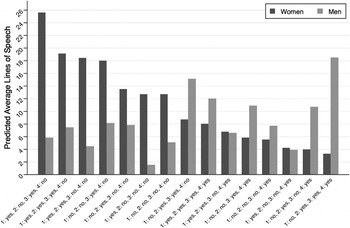
Figure 1 presents the average predicted amounts of speech for men and women across various institutional situations. On average, women speak most when there are at least 40% women in attendance, a male committee president, a women's issue bill is being discussed, and the deputy has no previous political experience. Predicted speech for a woman in this scenario is about 26 lines. Compared with about 3 lines under the worst scenario for women (less than 40% women, woman committee president, women's issue bill in discussion, previous political experience), the difference is 23 lines—which is notable considering that the mean amount of speech for women is 16 lines. There is a smaller range in the predicted amount of speech for men (a difference of about 17 lines between the worst and best scenarios), suggesting that institutional factors may have a greater impact on the speech behavior of women than men.
Average predicted amount of speech for men and women. Note: 1 = at least 40% women? 2 = woman committee president? 3 = women's issue bill discussed? 4 = previous political experience? Predicted values are not presented for one scenario (1: yes, 2: no, 3: yes, 4: yes) because no observations in the dataset meet these criteria.

Motions to Amend a Bill
Motions to amend bills are fairly rare, so our dependent variable equals 1 if the deputy initiated one or more amendment motions during the committee session (else 0).Footnote 14 In addition to the variables used earlier, we control for the deputy's amount of speech during each session (previous dependent variable) as a proxy for a deputy's propensity to participate. Results in Column 2 of Table 1 suggest that the sex of the committee president does not have a statistically significant impact on the likelihood of proposing an amendment motion. However, women are more likely to propose an amendment motion when the committee session is composed of more than 40% women. The predicted probability of proposing an amendment motion increases from .016 to.048 for women when there are more than 40% women in attendance. This finding is consistent with our finding in regard to the speechmaking behavior of women.
We also find that women are less likely, and men are more likely, to propose an amendment motion when the bill in discussion is a women's issue bill. This finding might indicate that as the percentage of women increases at the chamber level, women are not “sidelined” to working only on women's issues (in contrast to the findings of Heath, Schwindt-Bayer, and Taylor-Robinson Reference Heath, Schwindt-Bayer and Taylor-Robinson2005). A more cynical interpretation is that men are attempting to block, modify, or water down women's issues legislation by offering more amendment motions. However, these explanations are speculative, and this finding should be investigated further in future research.
Deputies are also more likely to propose an amendment motion if they are the committee president, have a related occupation, and speak more. This underscores the importance of women holding leadership positions in order to have the capacity to engage in substantive representation of women and other groups, which was also illustrated in Saint-Germain and Morgan's (Reference Saint-Germain and Morgan1991) study of the slow route to passage of the Women's Equality Law.
Motions for Consultation
Consultation motions typically request to bring in an expert to speak at a committee hearing (e.g., the Ministry of Health or education interest groups for the Social Issues committee; the Ministry of Foreign Trade or banking groups for the Economics committee; the Ministry of Natural Resources or producer groups for the Agriculture committee). The opportunity to give a group the ability to articulate its position on a bill is important for determining which groups get their views heard in the policy-making process (Holli Reference Holli2012; Saint-Germain and Morgan Reference Saint-Germain and Morgan1991; Taylor-Robinson and Ross Reference Taylor-Robinson and Ross2011). Thus, it is potentially important for the representation of diverse interests that women make use of their capability to provide groups with this opportunity.
Consultation motions are fairly rare events, so our dependent variable equals 1 if the deputy initiated one or more motions for consultation during the committee session. Results in Column 3 of Table 1 suggest that none of the factors that we hypothesized would influence women's participation within committees (sex of the leader, percentage women, topic of discussion) are statistically significant. We take this finding as an indication that institutional equality in the overall chamber creates a setting that is conducive to participation by women, and institutional equality within the committee is not required for women to be equal participants in terms of proposing motions for consultations. Committee experience, a related occupation, being the committee president, authoring a bill, and speaking during debate increase a deputy's likelihood of proposing a motion for consultation.
CONCLUSIONS
In the 2010 term of Costa Rica's Legislative Assembly, we find that even when women are a minority on a committee, or a man chairs the committee, women take part in committee proceedings as much as men.Footnote 15 Our findings suggest that when numerical, leadership, and seniority measures indicate (near) gender equality at the level of the chamber, women are able to be full and equal participants in diverse legislative committees. This indicates that the way legislatures treat women members can change, and because women have been elected to the Costa Rican Assembly in much greater numbers, these women have become willing and able to talk in front of a male audience. This finding comports with Schwindt-Bayer's (Reference Schwindt-Bayer2010, 99) analysis of deputy responses in the 1998–2002 term to a survey question about how often they participate in committee debates. In their self-assessment of how often they speak in committees, women indicated that they speak more than men. The finding here is notably more encouraging than what was observed in a similar empirical analysis that counted lines of speech and used similar covariates for deputies on the same committees in the 1990–94 and 1994–98 terms—before implementation of the gender quota law—which revealed that women spoke significantly less in committee debates than did their male colleagues (Taylor-Robinson and Ross Reference Taylor-Robinson and Ross2011, 486).
Because women are often still underrepresented on some committees, it is important that women be able and willing to participate in these settings—even when numerical gender equality is not present. It is also important in light of findings from interviews with female deputies in earlier Costa Rican Assemblies, when many fewer women were elected. Rose Marie Karpinsky (1986–90) explained that “I had to wage a very big political battle” to be elected president of the Finance Committee. “But I waged that battle, a little for women in general, because I wanted to set an example of what women can do” (quoted in Saint-Germain and Metoyer Reference Saint-Germain and Chavez Metoyer2008, 155–56). Gladys Rojas, a female deputy in the 1990–94 term, explained that “women must develop their pride and self-esteem along with a thick skin. They must not let men frighten them out of the political arena” (quoted in Saint-Germain and Metoyer Reference Saint-Germain and Chavez Metoyer2008, 175–76). Norma Jimenez (1986–90 term) explained that men want to keep women on the margins, but “then it is up to us women to have the guts to say, ‘No, sir, I'm just as much a deputy as you are’” (Saint-Germain and Metoyer Reference Saint-Germain and Chavez Metoyer2008, 176).
Research indicates that women elected officials have diverse policy interests. One of the arguments for why it is important for women to be represented in legislatures is to expand the scope of deliberation, and that will only be achieved if women are not only seen (i.e., elected) but also heard—able to speak in committee debates, modify bills, and determine which groups will be consulted by committees. This research indicates that women are now participating as much as the men in all these ways. We also find that women speak more in bill debates and are more likely to propose a motion to amend a bill when at least 40% of members present at a committee session are women. We also observe that the committee president is more likely to participate in all three ways examined here, which indicates that women need to have equal access to leadership posts to be frequent contributors to the policy-making process.
Given findings in the literature that women are more likely to participate in debates of women's issue bills, it is noteworthy that we do not find that women participate more when a women's issue bill is under discussion. We find that women are less likely to propose amendments when a women's issue bill is the subject of debate, while men are more likely to propose amendments and also to speak about bills that concern familismo issues. This merits more detailed study of the content and success rate of amendments proposed by men, as these bills may be viewed both as “women's issues” and as “men's issues” bills. Future research should also explore how different types of previous experience in politics influence participation because we find that previous political experience increases men's, but not women's, speechmaking. Overall, it appears that men's participation is not as mutable as women's and is less affected by the institutional factors that significantly determine the extent to which women participate in legislative committees.
Our findings are encouraging regarding women's participation: when women are present in large numbers in the chamber, hold leadership posts, and are equal to men in seniority, women and men are equally active participants in committees. On at least one dimension in which legislatures are often shown to operate as gendered institutions—access to participation in debates—Costa Rica's Assembly appears to operate as a more gender-equal institution. Formal rules of Costa Rica's Assembly give all deputies equal opportunity to participate, but in the past, when the number of women was quite small, interviews with women indicated that the men worked to keep women out of power and out of the spotlight, and empirical analysis suggested that women were either reluctant to participate or were not recognized to speak in committees. Such barriers appear to have come down and women are now equal participants in Costa Rican standing committees, though numbers still appear to be important as women are more active speechmakers and more likely to offer amendments to bills when women compose at least 40% of members present at a committee session.