Introduction
Tephritid fruit flies are a major threat to the horticulture industry in Africa owing to economic losses from their extensive damage to major fruit and vegetable crops (White and Elson-Harris, Reference White and Elson-Harris1992), and their quarantine status (Ishida et al., Reference Ishida, Nakahara, Minoura and Dohino2005). Economically important fruit fly pests in sub-Saharan Africa belong to the genera Bactrocera, Ceratitis, Dacus and Trirhithrum (De Meyer et al., Reference De Meyer, Mohamed and White2014). In Ghana, the flies observed earlier to be of major concern were Ceratitis capitata (Wiedemann), which attacked citrus (Afreh-Nuamah, Reference Afreh-Nuamah1999), and Ceratitis cosyra (Walker), which attacked mango (Lux et al., Reference Lux, Ekesi, Dimbi, Mohamed, Billah, Neuenschwander, Borgemeister and Langewald2003b ). However, the arrival of the African invader fly Bactrocera invadens (Drew, Tsuruta and White) (Billah et al., Reference Billah, Wilson, Cobblah, Lux and Tumfo2006) has worsened the situation in the fruit and vegetable production sector (GPPRSD, 2010). Fruit fly pests are known to spread through the movement of infested commodities due to the weakness of phytosanitary surveillance and control systems for the export of fruit and vegetable crops among member countries (Mwatawala et al., Reference Mwatawala, White, Maerere, Senkondo and De Meyer2004). In particular, B. invadens was first detected in Kenya, eastern Africa, in 2003 (Lux et al., Reference Lux, Copeland, White, Manrakhan and Billah2003a ; Drew et al., Reference Drew, Tsuruta and White2005), and in Ghana in 2005 (Billah et al., Reference Billah, Wilson, Cobblah, Lux and Tumfo2006), where it is currently the most devastating quarantine tephritid pest posing a serious threat to fruit and vegetable production (GPPRSD, 2010).
Sustainable management of fruit-infesting flies in any geographical region requires accurate knowledge of the species range and their host spectrum (Aluja, Reference Aluja, McPheron and Steck1996) to understand their biology, ecology and behaviour. This information would be helpful in the exploration of natural enemies in biological control efforts, by determining the type of lure to be used in trapping programmes (Lux et al., Reference Lux, Ekesi, Dimbi, Mohamed, Billah, Neuenschwander, Borgemeister and Langewald2003b ; IAEA, 2003) and in selecting the type of crop to be cultivated in a given agro-ecosystem (Vayssières et al., Reference Vayssières, Sanogo and Noussourou2007; Mwatawala et al., Reference Mwatawala, De Meyer, Makundi and Maerere2009). Moreover, importing countries generally require information on the tephritid species present in a particular host fruit to identify which species are pests, describe the host they attack, and prescribe recommended post-harvest treatment procedures prior to export (Ishida et al., Reference Ishida, Nakahara, Minoura and Dohino2005; STDF, 2009). Hence, accurate and reliable determination of the status of a particular plant species as a host of a given fruit fly species has become critical in this era of intensive international trade and the expansion of fruit-growing regions in sub-Saharan Africa.
Unfortunately, the literature on fruit fly species and their host plants is marred by methodological flaws and inaccuracies to the extent that these have even generated longstanding commercial disputes between trading partners (Aluja, Reference Aluja, McPheron and Steck1996; STDF, 2009). According to Norrbom and Kim (Reference Norrbom and Kim1988), a host record should be validated only if the infestation occurred under natural field conditions. Ovruski et al. (Reference Ovruski, Aluja, Sivinski and Wharton2000) noted that host records should also be accompanied by information on the species infested, levels of infestation, fruiting phenology and ecological distribution of the host species. According to Cowley et al. (Reference Cowley, Baker and Harte1992), the fact has to be considered that host status can change over time and is influenced by environmental conditions such as drought and the concomitant effect on the availability of primary and secondary hosts. Considering the latter, Cowley et al. (Reference Cowley, Baker and Harte1992) proposed a strict experimental procedure to ascertain unequivocally the host status of fruit flies through field collection and incubation of fruits.
The species diversity and host associations of fruit fly pests have been investigated in several African countries. For instance, De Meyer et al. (Reference De Meyer, Copeland, Lux, Mansell, Quilici, Wharton, White and Zenz2002) provided an annotated checklist of host plants for the Afrotropical regions. However, their report is specific only to Ceratitis species and does not provide information on the interaction and host-resource partitioning in particular areas. In addition, an inventory of tephritid pests infesting various fruit and vegetable crops has been documented for Kenya (Copeland et al., Reference Copeland, Wharton, Luke and De Meyer2002, Reference Copeland, White, Okumu, Machera and Wharton2004, Reference Copeland, Luke and Wharton2009; Rwomushana et al., Reference Rwomushana, Ekesi, Gordon and Ogol2008), Guinea (Vayssières and Kalabane, 2000), Bénin (Vayssières et al., Reference Vayssières, Goergen, Lokossou, Dossa and Akponon2005), Tanzania (Mwatawala et al., Reference Mwatawala, De Meyer, Makundi and Maerere2006, Reference Mwatawala, De Meyer, Makundi and Maerere2009), Mali (Vayssières et al., Reference Vayssières, Sanogo and Noussourou2007), Cameroon (Abanda et al., Reference Abanda, Quilici, Vayssieres, Kouodiekong and Woin2008), Nigeria (Umeh et al., Reference Umeh, Garcia and De Meyer2008), Côte d'Ivoire (N'Dépo et al., Reference N'Dépo, Hala, Allou, Aboua, Kouassi, Vayssières and De Meyer2009), Senegal (Vayssières et al., Reference Vayssières, Vannière, Gueye, Barry, Hanne, Korie, Niassy, Ndiaye and Delhove2011) and Burkina Faso (Ouedraogo et al., Reference Ouedraogo, Vayssières, Dabire and Rouland-Lefevre2011). For Ghana, however, there is inadequate research information on the species and host diversity of tephritid pests. Afreh-Nuamah (Reference Afreh-Nuamah1999) reported C. capitata as a major pest of citrus and C. cosyra of mango in Ghana. Billah et al. (Reference Billah, Wilson, Cobblah, Lux and Tumfo2006) reported the first detection of the African invader fly, B. invadens. Nboyine et al. (Reference Nboyine, Billah and Afreh-Nuamah2012), Billah (Reference Billah2012) and Wih and Billah (Reference Wih and Billah2012) reported a range of fly species infesting mango in the country. However, these studies provided no information on the associations of fruit flies with other host plants. Moreover, as in many of the other studies cited earlier, these reports are based on trapping surveys or are mainly targeted at fly species associated with one or a few commercial crops such as mango and citrus. There has been no comprehensive study to catalogue the species spectrum of fruit flies and their associations with wild and cultivated plants in Ghana, especially in the northern sector of the country where fruit and vegetable production is gaining commercial advantage.
Mwatawala et al. (Reference Mwatawala, De Meyer, Makundi and Maerere2009) noted that a clear understanding of the use of the different potential hosts available in a given area and the host partitioning among the different competitive fruit fly pests is necessary in developing a sustainable integrated pest management (IPM) programme. There is, thus, the need to document baseline information useful for planning an integrated control programme to help reduce the damage caused by pestiferous fruit flies in Ghana. Copeland et al. (Reference Copeland, White, Okumu, Machera and Wharton2004, Reference Copeland, Luke and Wharton2009) indicated that collection and incubation have been the most reliable means of obtaining a wider range and higher diversity of tephritid species and their host associations in a given ecology. This study, involving a 2-year collection and incubation of both wild and cultivated fruits, sought to document baseline information on tephritid diversity and their host flora in the northern savannah ecology of Ghana.
Materials and methods
Field sites
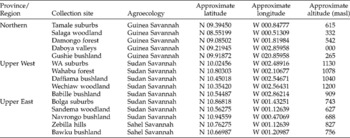
Collection sites were chosen to maximize the diversity of fruit-bearing plants in the area and the survey involved extensive sampling from farmlands, backyard gardens, roadsides, woodlands and forest habitats in selected sites within the Northern, Upper West and Upper East regions of the country. A total of 15 collection sites (five from each region) were selected for the study. Table 1 presents the major areas surveyed and their approximate geo-referenced positions. To facilitate free and easy access to the collection localities, official permission was sought from the District Directors of Agriculture using an introductory letter from the National Fruit Fly Management Committee of Ghana. In some situations, verbal permission was requested before sampling on private property. Such permission also helped to eliminate suspicion about the purpose of the work and facilitated the assistance of the local youth who would help in the location, searching for, collecting and carrying samples.
Fruit collection sites with their approximate latitudes, longitudes and altitudes

Fruit collection
The method of fruit collection in the field generally followed the procedure of Copeland et al., (Reference Copeland, Wharton, Luke and De Meyer2002, Reference Copeland, White, Okumu, Machera and Wharton2004, Reference Copeland, Luke and Wharton2009) and Mwatawala et al. (Reference Mwatawala, De Meyer, Makundi and Maerere2009). From October 2011 to September 2013, trips were made to each selected site at seasons/times when host fruits were available for sampling. The general rule was to maximize their quantity and diversity to help increase the probability of finding rare fly species. At each site, available fruits (wild and cultivated) were collected from the ground (as ‘windfalls’) or from the plants. Whenever possible, mature, ripe and/or falling fruits were selected, as these were generally more likely to be infested. Attempts were made to sample a large quantity of fruits although this depended on type, availability or accessibility. Sometimes, species not encountered at the sampling sites were purchased from roadside markets, and, wherever possible, attempts were made to establish the place of origin. Records of collections were kept by indicating the date, site, geographical positioning system (GPS) coordinates and plant species for each sample.
Samples were placed in plastic bags with the appropriate labels; each bag was put inside a piece of synthetic mesh and placed in a plastic container. The ends of the synthetic mesh were pulled tight over the rim of the container elevating the contents above the bottom of the container so as to avoid physical damage to samples on the rough local roads. To ensure adequate ventilation, the middle portion of the container lid was cut out and replaced by a 10 × 15 cm piece of tightly woven synthetic mesh capable of retaining any emerged insects. During transportation from field to laboratory, the containers were covered with moistened cotton fabric to avoid excessive heating.
Fruit incubation
Fruit samples were transported for incubation to a rearing unit established at the Biology Laboratory, Faculty of Agriculture, University for Development Studies (UDS), Nyankpala, Ghana. In the laboratory, fruits in each sample were counted and weighed before being placed in incubation units that each consisted of a 1.5-litre rectangular plastic container with 0.5 cm ellipsoid holes cut into the bottom. An ellipsoid but not a circular hole prevented fruits from clogging the holes during incubation while at the same time allowing mature larvae to fall through after they had exited the host. The lid of the container was cut open at 1.0 × 0.5 cm in the middle and covered with synthetic mesh for ventilation. The container with holes was nested in a second container (without holes at the bottom) and covered with the lid. A layer of sterilized sand at the bottom of the second container served as a pupation medium for the exiting larvae.
The incubators were arranged on metal shelves with legs in water-filled containers to supplement humidity while acting as effective barriers to predatory insects. Each fruit sample was maintained for a minimum of 4 weeks at 25 ± 3 °C and 60 ± 10% relative humidity (RH). Larger moist fruits were held for one additional week. Most of the fruits were shrunken and dry by the end of the holding period that encompassed the period of larval pupation. During the holding period, samples were kept moist by being sprayed with a fine mist of water as required, except those prone to mouldiness. After the incubation period, fruits in each sample were cut open and examined for any trapped/hidden larvae or puparia before being discarded.
Insect monitoring
Each incubation unit was checked daily for the presence of puparia, which were picked up using soft forceps or by gentle sifting and counted before being placed in Petri dishes with moistened filter paper. These were placed in small, ventilated, transparent, rectangular Plexiglas (Perspex) boxes used as rearing cages. The rearing room was maintained at 26–28 °C and 60–70% RH, a condition adequate for preventing pupal water loss while minimizing the development of mould. The puparia were held in the cages for 5–7 days for the emergence of adult flies. Emerging tephritids were provided with an artificial diet of three parts of sugar and one part of brewer's yeast. Droplets of pure honey were also spotted into the underside of the roof of the cage, and cotton wool soaked with distilled water was placed in a small container on the cage floor to sustain the flies. Flies were allowed to feed for 3 days until full adult development and body coloration were attained. They were killed (by freezing) and the number recorded in a data sheet; representative samples were preserved in vials containing 80% ethanol.
Plant and fly identification
At the time of each collection, photographic vouchers of plants and their fruits were taken for identification using the botanical keys developed by Akoègninou et al. (Reference Akoègninou, van der Burg and van der Maesen2006) and photographic illustrations provided by Arbonnier (Reference Arbonnier2004) for confirmation of identity. All botanical names and authors followed the nomenclature and classification of the International Plant Names Index database. The photographic vouchers of plants and fruits were deposited at the UDS Horticulture Herbarium. Specimens of emerged fruit flies were examined using a Motic SMZ-143 digital stereo microscope (Brunel, UK) in a dark room. Taxonomic identification was performed using the keys developed by White and Elson-Harris (Reference White and Elson-Harris1992) and Billah and Mansell (Reference Billah, Mansell, Ekesi and Billah2006). Dr Maxwell K. Billah, Department of Animal Biology and Conservation Sciences, University of Ghana, Legon, further confirmed the identity of some species. Voucher specimens of fruit flies were deposited at the Entomology Laboratory of UDS.
Data analysis
The incidence and infestation indices were determined for each fruit species. Incidence was defined as the number of infested/positive samples in comparison with the total number of samples per fruit species. The infestation level (expressed as infestation index) was calculated as the number of adult flies per 100 fruits, and per unit weight (1 kg) of fruit. The two parameters made it possible to compare infestation rates in different fruit species, despite the differences in numbers and weights of samples. The infestation levels of species (source of variation) at collection sites (replicates) were compared by one-way AVOVA using GenStat (VSN International Ltd, UK), and pairwise comparison of means was performed using the least significant difference (LSD) test. Uniformity in infestation by the most abundant fly species in the most attacked fruit species was determined using the χ2 test.
Results
Host plants and fruit fly species
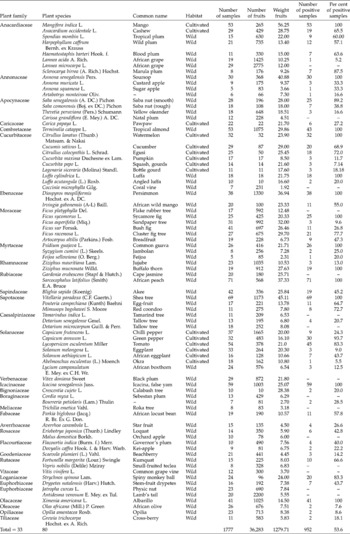
During the study period, 1777 samples of 36,283 fruits, totalling about 1279.71 kg, were collected from 80 species (including 14 cultivated species) belonging to 33 different families. Out of these, 65 (81.5%) of the species, representing 952 (53.6%) samples, were found to be positive to tephritid fruit flies; 12 species proved 100% positive (with flies emerging from all incubated samples) (Table 2). The results also indicated that 15 species were negative to the fruit flies (with no incubated sample producing flies). In comparison with known records in Africa, 12 plant species were identified as new hosts to B. invadens (Table 3).
Fruit species collected in northern Ghana with their sample details and host status to tephritid pests

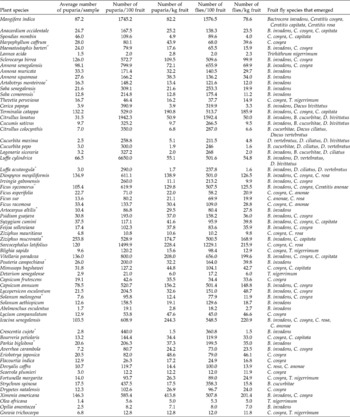
Host plants of tephritid pests in northern Ghana and their infestation indices

+ New hosts to B. invadens (some samples were infested by more than one fruit fly species, hence the sum of the individual positive samples can be higher than the total of positive samples in general). Records of new hosts were based on comparison with records from Ekesi and Billah (Reference Ekesi and Billah2006); Vayssières et al., (2009), Mwatawala et al., (Reference Mwatawala, De Meyer, Makundi and Maerere2009) and Goergen et al., Reference Goergen, Vayssières, Gnanvossou and Tindo2011. D. ciliatus and T. nigerrimum were identified as new records in the study ecology.
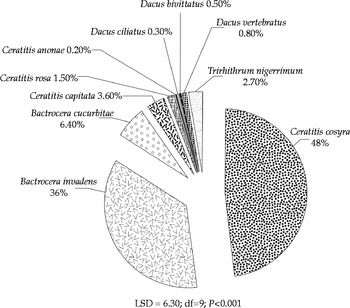
Ten different fruit fly species from four genera were reared from the incubated fruits: four from Ceratitis (C. cosyra, C. capitata, C. rosa and C. anonae), two from Bactrocera (B. invadens and B. cucurbitae), three from Dacus (D. vertebratus, D. bivittatus and D. ciliatus) and one from Trirhithrum (T. nigerrimum). Of these, D. ciliatus and T. nigerrimum were identified as first records in northern Ghana. In terms of relative abundance, 48.0% of the flies were C. cosyra and 36.0% were B. invadens. The other fly species were relatively low in occurrence with each occupying less than 6.5% of the total tephritids reared in the fruit samples (Fig. 1). Significant differences in abundance were observed among C. cosyra, B. invadens and B. cucurbitae (P< 0.001), but comparison among the minor fly species did not show any significant difference.
Tephritid species and their incidence in host fruits in northern Ghana

Incidence and infestation indices
Among the tephritid-positive fruit species, 36.9 puparia/sample were recovered on average. Host species that recorded maximum numbers of puparia (above 50 puparia/sample) included mango, marula plum, soursop, tropical almond, luffa, persimmon, sycamore fig, jujube, African peach, shea tree, green pepper, icacina and albarillo. Among these, jujube, shea tree, persimmon, tropical almond and African peach proved to be the most heavily infested. Moreover, seven plant species were found to be poor hosts to the fruit flies with each recording fewer than three puparia/sample (Table 3). Meanwhile, the total number of puparia/100 fruits was highest in luffa, followed by mango and African peach. In addition, the total number of puparia/kg fruit ranged from 413.8 in albarillo to 1.5 in calabash tree. Other host species recording maximum puparia on a fruit weight basis (>50 puparia/kg) were icacina, African peach, shea tree, tropical almond, jujube, green pepper, persimmon, sycamore fig, marula plum and mango.
Adult fly emergence followed a trend similar to that of puparia recovered even though some levels of pupal mortality could be observed. In the area, C. cosyra and B. invadens were the most polyphagous fly species emerging from fruits of most plant families and species. Generally, B. invadens was dominant in the cultivated fruits and C. cosyra in the wild fruits. A total of 19 plant species acted as hosts to both species; 11 were hosts only to B. invadens and 7 only to C. cosyra. All species of Dacus and B. cucurbitae were reared from the cucurbits. Moreover, C. capitata emerged mainly from mango, cashew, tropical almond, jambolan, jujube and shea tree. Ceratitis rosa also emerged from mango, as well as persimmon, cluster fig, buffalo thorn, African peach, icacina and wild apricot; C. anonae emerged from sycamore fig, sand paper tree, cluster fig, icacina and wild apricot. Trirhithrum nigerrimum was reared from African grape, yellow oleander, ackee apple, tallow, kumquat, opilia and cross-berry. Two or more fly species were found to co-emerge from the same sample. In effect, the co-existence of Ceratitis and Bactrocera spp. was most commonly observable among samples from Annonaceae, Apocynaceae, Ebenaceae, Myrtaceae and Solanaceae.
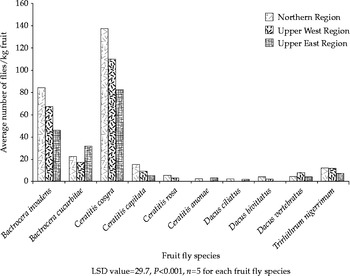
The average infestation levels of the 10 fruit fly species in relation to the study regions are shown in Fig. 2. The results indicated significant variations in infestation levels (LSD = 29.7; df = 9; P< 0.001). In all the regions, the highest level of infestation was recorded for C. cosyra and B. invadens, with significant differences between them. Infestation levels were not significantly different among the minor fruit fly species (P< 0.10) although B. cucurbitae dominated the group. Some species of Ceratitis and Dacus were not recorded in samples from the Upper West and Upper East regions. In general, samples from the Northern region recorded the highest levels of infestation for most fly species except B. cucurbitae whose infestation level was highest in the Upper East region as recorded mainly in samples of Cucurbitaceae.
Infestation indices (number of flies/kg fruit) of each of the fruit fly species recorded in the host plant species (pooled data) in relation to the study regions

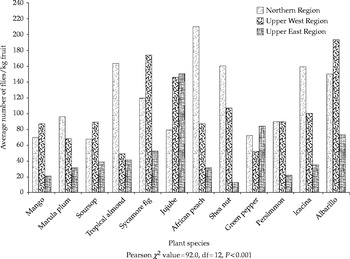
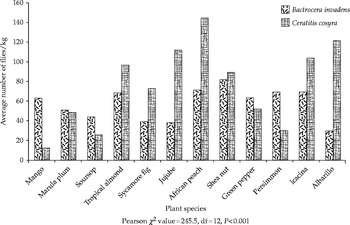
As shown (Fig. 3), the 12 most highly infested plant species were analysed separately for their levels of infestation by the fly species. These differed significantly among the various host plants in all study regions (χ2= 92, P< 0.001). In the Northern region, host plants such as marula plum, tropical almond, African peach, shea tree and icacina recorded the heaviest tephritid infestation. In the Upper West region, infestation was highest in mango, soursop, sycamore fig and albarillo; in the Upper East region, the highest infestation was recorded in jujube and green pepper. Results from the infestation levels of the 12 plant species most attacked by the two major species of fruit fly indicated that B. invadens was the main species infesting mango, marula plum, soursop, green pepper and persimmon; C. cosyra dominated the other less highly infested host plant species (Fig. 4). The infestation levels of each species were not uniform across host plants, i.e. the host type influenced the infestation level. All potential hosts did not appear to be equally vulnerable to B. invadens, although it was polyphagous and showed high rates of infestation for some crops. In general, however, cultivated host species such as mango and green pepper recorded higher infestation levels for this pest than for C. cosyra, and the reverse was observed among most of the wild reservoir hosts (Fig. 4).
Infestation indices (number of flies/kg fruit) of the 12 plant species most attacked by the fruit fly species (pooled data) in relation to the study regions

Average infestation index of the 12 most attacked plant species by the two major fruit fly species (Bactrocera invadens and Ceratitis cosyra)

Discussion
The results of this study have demonstrated a widespread availability of host plants in the savannah ecology of Ghana, which provides suitable reservoirs for diverse tephritid species resulting in their significant impact on fruit crop production. A total of 11 wild fruit species were reported as new hosts to B. invadens in Africa. In addition, two fly species, D. ciliatus and T. nigerrimum, were identified for the first time in northern Ghana. In terms of positive hosts, abundance and infestation levels, the polyphagous C. cosyra and B. invadens were the dominant fly species in the study area. This had earlier been reported in a trapping experiment on mango by Billah (Reference Billah2012) and Nboyine et al. (Reference Nboyine, Billah and Afreh-Nuamah2012). According to Mwatawala et al. (Reference Mwatawala, De Meyer, Makundi and Maerere2009), C. cosyra is a widespread polyphagous species found throughout the African continent attacking over 30 different fruit species. Before 2006, it was considered the main fruit fly found in mango, accounting for major losses in production (De Meyer et al., Reference De Meyer, Copeland, Lux, Mansell, Quilici, Wharton, White and Zenz2002; Mwatawala et al., Reference Mwatawala, De Meyer, Makundi and Maerere2006).
Wild fruit species, such as African peach, albarillo, icacina, shea tree, jujube and tropical almond, generally harboured higher tephritid populations than cultivated fruits, such as cashew, pawpaw, guava, watermelon, tomato and eggplant. This could be due to the inherent characteristics of these cultivated fruits as poor hosts for fruit flies and/or to the effect of human interventions (cultural practices, insecticide application) with a negative impact on tephritid populations in crop farms. Hernández-Ortiz et al. (Reference Hernández-Ortiz, Delfin-Gonzalez, Escalante-Tio and Manrique-Saide2006) made similar observations on parasitoids of Anastrepha fruit flies reared from different host fruits in Yucatan, Mexico; they attributed the low fly population to orchard management practices in which periodic pesticide use could have a negative impact on tephritid populations. This indicates the existence of a preference of the dominant fly species for the wild fruit habitat reported here. Higher infestation levels in wild fruits can serve as sources of infestations in cultivated fruits and as potential reservoirs for the development of fruit flies throughout the year. The results further indicated that the wild fruit species were more infested by C. cosyra than by B. invadens, whereas cultivated fruit species showed higher incidence for B. invadens than for C. cosyra. This could be due to the competitive displacement of C. cosyra by B. invadens. Studies have demonstrated that the invasive Bactrocera species are highly competitive and capable of displacing indigenous Ceratitis species in cultivated fruits. Exploitative competition through larval scrambling for resources and interference competition through the aggressive behaviours of the invader are important mechanisms contributing to the displacement of C. cosyra by B. invadens in fruit agro-ecosystems (Ekesi et al., Reference Ekesi, Billah, Nderitu, Lux and Rwomushana2009).
Based on the results on infestation of cucurbit fruits by B. invadens, it could be observed that the fly occasionally utilizes the plants with a relatively lower infestation rate. Mwatawala et al. (Reference Mwatawala, De Meyer, Makundi and Maerere2009) observed that the number of plants positive to B. invadens was relatively lower among cucurbit fruits. Goergen et al. (Reference Goergen, Vayssières, Gnanvossou and Tindo2011), however, recorded B. invadens in eight different cucurbit species in West and Central Africa. In this study, which covered a wider spectrum of potential host fruits, several other plant families (including representatives of Anacardiaceae, Annonaceae, Apocynaceae, Rhamnaceae, Bignoniaceae, Mimosoideae, Moraceae, Sapotaceae, Solanaceae and Opiliaceae) were identified as new hosts for B. invadens compared with existing records in Africa (Ekesi and Billah, Reference Ekesi and Billah2006; Mwatawala et al., Reference Mwatawala, De Meyer, Makundi and Maerere2009; Goergen et al., Reference Goergen, Vayssières, Gnanvossou and Tindo2011) (Table 3). Although we cannot convincingly claim that these host species are unique to northern Ghana, it is noteworthy that the host species were not included in samples of the previous surveys, probably due to their unavailability or limited survey coverage in time and space.
Moreover, the ability of B. invadens to co-exist with highly aggressive invasive species such as B. cucurbitae (Goergen et al., Reference Goergen, Vayssières, Gnanvossou and Tindo2011) as well as major indigenous pests (such as C. cosyra, C. capitata and Dacus spp.) could be of ecological interest. Studies have demonstrated that B. invadens possesses some characteristics and some traits of both k-strategy (i.e. aggression, adaptation to new environments, strong competition) (Rwomushana et al., Reference Rwomushana, Ekesi, Gordon and Ogol2008) and r-strategy by being highly fecund (Ekesi et al., Reference Ekesi, Nderitu and Rwomushana2006). These traits contribute to the polyphagous nature of the pest. Apparently, this polyphagous and versatile behaviour may account for its ability to become established in niches less utilized by other frugivorous tephritids, and, therefore, facilitate its spread and exacerbate the damage and losses in cultivated fruits in the region.
In Kenya, Rwomushana et al. (Reference Rwomushana, Ekesi, Gordon and Ogol2008) reported 14 cultivated and wild fruit species as hosts of B. invadens. Among those heavily infested were mango (Anacardiaceae), banana (Musaceae) and orange (Rutaceae). Marula and tropical almond (Combretaceae) were the most preferred among the wild host plants. In Tanzania, Geurts et al. (Reference Geurts, Mwatawala and De Meyer2012) in a study along altitudinal gradients added several host plant species to the list, most important of which is avocado Persea americana (Lauraceae). Other plants infested with B. invadens in Tanzania belong to families Cucurbitaceae, Rutaceae, Rosaceae, Rubiaceae and Flacourtiaceae (Geurts et al., Reference Geurts, Mwatawala and De Meyer2012). In the present study, a total of 12 plant species from nine different families were recorded as potentially new hosts for B. invadens. The study also established that sweet pepper and tomato, in addition to mango, were the most preferred among the commercial hosts. In Bénin B. invadens has also been reared from citrus, cashew, papaya, guava and several wild host plants (Goergen et al., Reference Goergen, Vayssières, Gnanvossou and Tindo2011).
In terms of the diversity, relative abundance and infestation levels of tephritid species, the Northern region generally proved to be the most favourable reservoir compared with the Upper West and Upper East regions. According to Piedra-Rodriguez and Zuñiga-Anell (Reference Piedra-Rodriguez and Zuñiga-Anell1993), the degree of species dominance is influenced by ecological background (i.e. the richness and diversity of host plant species) and by altitudinal gradients. The Northern region is predominantly Guinea savannah, whereas the Upper West region is predominantly Sudan savannah and the Upper East region is both Sudan savannah and partly Sahel savannah. These Upper regions of the country are at relatively higher altitudes (Table 1) and thus may not constitute such favourable ecological niches for the major host and fruit fly species as the Northern region. Geurts et al. (Reference Geurts, Mwatawala and De Meyer2012) observed a spatial increase in diversity and population density of tephritid species along lower elevations (below 581 masl) in the Morogoro mountains of Tanzania and concluded that host availability and climatic differences were the determining factors for explaining variations in their occurrence and abundance in time and space.
Even though C. capitata showed limited host range in our records, it has recently been reported from a wide variety (55 species) of indigenous host plants in Kenya (Copeland et al., Reference Copeland, Wharton, Luke and De Meyer2002) where it showed a larger host spectrum than other fruit fly pests, including C. cosyra and C. rosa (Copeland 2006). However, the host range of C. rosa in this study was more diverse than that of C. capitata as it has been reared from approximately 100 hosts, belonging to 30 plant families (De Meyer et al., Reference De Meyer, Copeland, Lux, Mansell, Quilici, Wharton, White and Zenz2002; Geurts et al., Reference Geurts, Mwatawala and De Meyer2012). Although C. capitata is often considered the most harmful fruit fly with an African origin (De Meyer et al., Reference De Meyer, Copeland, Lux, Mansell, Quilici, Wharton, White and Zenz2002), its presence in the savannah ecology of Ghana seems to be limited, based on the incubation results. The question of whether this is due to environmental factors unfavourable to the establishment of this species or a recent phenomenon due to displacement by other polyphagous species needs to be elucidated. Comparing the impact and host range thus far, it appeared that the widespread native pests, such as the medfly, now seem to be restricted to a more limited commercial host range in areas where they co-occur with B. invadens. In conclusion, the widespread availability of host plants and the incidence of diverse fruit fly species call for particular attention to their impact on commercial fruits and the development of sustainable management strategies against these economically important pests in the region.
Acknowledgements
The authors are grateful to the Research Technicians at the University for Development Studies (UDS) who assisted in the field and laboratory work. The Ghana National Fruit Fly Management Committee provided logistical support while the Wienco Chairholder of the UDS provided financial assistance to the research.