Telemedicine, providing health care over a distance by means of telecommunication technologies (7), has been around for a little more than a half century, yet is sometimes still considered to be a new idea or solution to many in the healthcare field. However, with a growing aging population, increasing costs of medical care, and a shortage of healthcare providers, telemedicine is poised to become a standard in health delivery. Much of the telemedicine research in the past has focused on health outcomes (Reference Bensink, Hailey and Wootton1;Reference Hailey, Ohinmaa and Roine4;Reference Hersh, Hickam and Severance6), satisfaction (Reference Gustke, Balch, West and Rogers3;Reference Mair and Whitten10;Reference Weatherburn, Dowie, Hema and Young14;Reference Whitten, Doolittle and Mackert16), and cost-effectiveness (Reference Jennett, Affleck Hall and Hailey8;Reference Shore, Brooks, Savin, Manson and Libby12;Reference Whitten and Holtz17;Reference Whitten, Mair and Haycox18) of individual telemedicine applications, thus far, there has been little research on how best to structure a telemedicine program within an organization. Therefore, this research sought to understand how to maximize telemedicine programs by investigating programs nationwide and examining their organizational adoption, influence, and structure. In an effort to better appreciate and inform healthcare organizations on developing or restructuring a telemedicine program, the following research questions were proposed: RQ1: What is the most effective organizational design of a telemedicine program to provide the most benefit? RQ2: What are the organizations' overall attitudes and perceptions of telemedicine? RQ3: How are the operations of the telemedicine program structured? RQ4: How are the finances of a telemedicine program operated?
METHODS
Participants
This study used an online survey application to research organizational characteristics and perceptions of managers or supervisors of established telemedicine programs and departments. Participants were selected through a professional telemedicine association (American Telemedicine Association [ATA]) membership list of known telemedicine/telemedicine programs and departments and organizations that are represented through an Office for the Advancement of Telehealth resource center. From the ATA membership list, those programs that no longer existed, had invalid contact information, were vendors, or did not directly operate a telemedicine program were excluded, leaving a total of 303 active programs. All of those programs received an invitation to participant in this research. Participants were from the United States, either a manager or supervisor of the program, and over 18 years old.
Data Collection
To inform the participants of the coming request to participate in the research study, a letter was sent to each program. This letter provided them information regarding the study, contact information, and a URL (uniform resource locator [Internet address]) to the survey. A week later, emails were sent to request the programs to take the survey, again providing the URL to the survey. A month later, researchers begin to call those programs that had not responded to the survey, asking them to take the survey.
A survey was developed for this research order to access the organizational characteristics of telemedicine departments and programs. Most of the items were based on instruments that have been used to examine general organizational characteristics, namely the Unified Theory of Acceptance and Use of Technology (UTAUT) (Reference Ventatesh, Morris, Davis and Davis13) and the Organizational Readiness for Change (ORC) assessment (Reference Lehman, Greener and Simpson9). The UTAUT's four core determinants of intention and usage are performance expectancy, effort expectancy, social influence, and facilitating conditions. Performance expectancy is briefly defined as how well the specific technologic application helps an individual do their job. Effort expectancy is a construct used to determine an individual's perception of a technology's ease of use. Social influence is defined as how an individual perceives important others to view them if they use (or do not use) the technology. Lastly, facilitating conditions refers to the resources the organization makes available to help with the implementation of the technology. When the measure was first constructed, 48 separate validity tests were run to determine convergent and divergent validity. Loading patterns were acceptable, with a majority at .70 or higher. The UTAUT was also empirically validated among four businesses in various industries (the health sector was a notable exception), and cross-validated using data from two other businesses. UTAUT was able to explain 70 percent of technology acceptance behavior, a considerable improvement on previous models, which routinely explain at most 40 percent of acceptance (Reference Ventatesh, Morris, Davis and Davis13).
The main objective of the ORC is to determine which characteristics of an organization may prevent or encourage adoption of new processes. The ORC details four main constructs, including motivation, resources, employee characteristics, and organizational climate. Motivation is defined as an organization's perceived need for improvement, training needs of staff, and the amount of pressure to change. Resources measures an individual's perceived adequateness of their office, staff, training, equipment, and computer resources. The third construct is employee characteristics, which measures the staff members’ perceived opportunities for professional development, confidence in their skills, individual influence of staff members, and their ability to enact change. Finally, organizational climate is an individual's understanding of the organization's mission and goals, staff cohesion, staff autonomy, communication style, stress, and attitude toward innovativeness. This assessment examines the community attitudes and values, leadership commitment, and the formality of the processes and procedures. Lehman et al. (Reference Lehman, Greener and Simpson9) conducted a reliability and validity study using a national sample of over 500 staff members from more than 100 programs. Coefficient alphas for the majority of the constructs were .70 or higher. A diverse group of programs was used to test this instrument for validity and reliability.
Other items that were developed by researchers to address many of the structural features, cost issues, leadership, and formality of the procedures were based off of the UTAUT and ORC. Demographic information was also collected. The complete survey was pretested with affiliates of the Midwest Alliance for Telemedicine and Technology Resource Center (MATTeR) for face validity. All questions were answered based on a five-point Likert-type scale, where 1 indicated strong disagreement and 5 indicated strong agreement
Analysis
Analyses included all surveys completed between February 2008 and September 2008. Descriptive statistics were used to summarize the data. Correlations were also used to further demonstrate relationships and answer the research questions.
RESULTS
This study had ninety-two responses for a 30 percent response rate. To present the results in a coherent manner the results are presented by research question.
Effective Organizational Design
Research question 1 examined the organizational structure and design of telemedicine programs and how they are situated within an existing organization. Several themes regarding the overall characteristics of the programs and organizations emerged.
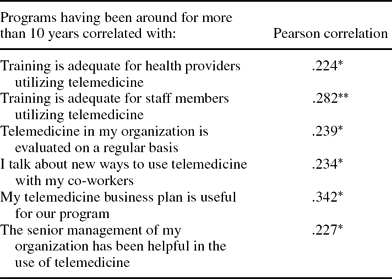
The programs surveyed were distributed by how long they had existed: 23.1 percent have been in operation for 1 to 5 years, 43.6 percent have been in operation for 6 to 10 years, and 33.3 percent have been in operation for over 10 years. The length of time a program has been in existence was related to some of the variables, including how participants explained the role of senior management in their healthcare organization. There was a positive correlation between senior management helpfulness and programs that had been in place for 10 years or longer, r(91) = .23; p < .05; whereas, programs that have only been operating for 1 to 5 years reported a negative correlation between senior management helpfulness and length of program operation, r(91) = −.28; p < .01, a one-way analysis of variance (ANOVA) concludes that these are statistically significant differences, F(2,84) = 4.14; p = .019. Another difference that emerged when examining length of time of a program related to managers reporting having discussions with their coworkers about new ways to use telemedicine. Programs with a shorter history had a significant negative correlation, r(91) = −.22; p < .05, while those programs that have been around for 10 or more years had a positive significant correlation, r(91) = .23; p < .05. These differences are statistically significant when performing a one-way ANOVA, F(2,85) = 3.17; p = .047. Table 1 highlights other significant correlations with programs that have been operating for 10 or more years.
Length of program

* = Correlation is significant at the .05 level (two-tailed)
** = Correlation is significant at the .01 level (two-tailed)
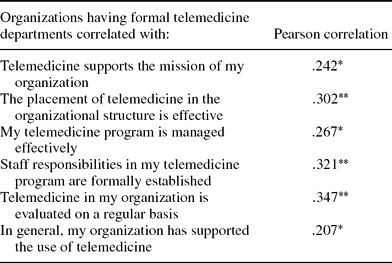
A series of clear program characteristic emerged regardless of the duration of program, for example, 72.3 percent stated that within their organization, the telemedicine program was formally defined as a distinct entity, and 34 percent of the programs reported they are part of another existing department. Characteristics that were significantly correlated to having a formal telemedicine program are provided in Table 2. In terms of the structure of the larger organization, 68.5 percent described their organization as being either very or somewhat hierarchical. This description mirrors the agreement of the participants to the statement, “people at the top have more power than those lower in the organization” (mean [M] = 3.98, standard deviation [SD] = 0.94). As for the services these programs provide, almost half (49.2 percent) of the programs cite clinical applications are at least half of the what they provide, 25.6 percent of the programs say administrative applications are used the most, and administrative purposes trails at 5.4 percent.
Formal telemedicine department

* = Correlation is significant at the .05 level (two-tailed)
** = Correlation is significant at the .01 level (two-tailed)
Rigor or accountability also emerged as a characteristic that many of these programs exhibited. Here, rigor is defined as how accountable people are in the performance of their program. The respondents stated that people in the program are held accountable for producing quality work (M = 4.18; SD = 0.84). A majority of the programs believed the most important organizational goals for telemedicine were access to care (63.8 percent), quality of care (44.7 percent), and information transfer (7.4 percent) ranked last.
Feedback was an important program characteristic. Clinician feedback was demonstrated to be key, and respondents reported clinicians as being active in evaluating the program (M = 3.81; SD = 1.08) and have an easy way to communicate about telemedicine issues (M = 3.94; SD = 0.95). Evaluation of the program was also established as being important (M = 3.70; SD = 0.91) and those results are shared with staff members (M = 3.77; SD = 0.88).
These programs also described themselves as being able to adapt to change and change focus easily. They stated their organization encourages collaboration across programs (M = 4.19; SD = 0.77). They also described themselves as continually adapting to change (M = 4.01; SD = 0.81) and being flexible (M = 3.81; SD = 0.93).
Attitudes and Perceptions of Telemedicine
The second research question sought to understand the overall attitudes and perceptions of innovation within the organization. These concepts are important to explaining how telemedicine is viewed, supported, and its role in providing quality patient care. One of the prevailing themes that emerged was a sense of being avant garde, or forward thinking, by managers as well as the organization as a whole. These are the organizations that are innovative and pushing past the “norm” in health care. They are looking for new and daring ways to offer fresh ways of providing patient care. Some examples of this attitude include statements such as, “I receive praise for developing new ways to use telemedicine in my organization” (M = 4.24; SD = 0.74). The managers also stated that they received respect for coming up with new ideas and ways to operate the program (M = 4.14; SD = 0.70). There was also a sense of communication about new ways to use telemedicine among colleagues (M = 4.65; SD = 0.50) and superiors (M = 4.65; SD = 0.50) in the organization.
Support from the organization in having and running a telemedicine program was also seen as being an important component of program success (M = 4.11; SD = 0.58). Respondents stated their ability to function creatively as a program is supported and respected by the organization (M = 4.04; SD = 0.80). The senior management of the organization was also perceived as being key in the buy-in, by lending support and assistance to the program (M = 4.01; SD = 1.0). However, it was also indicated that a strong desire for the program to succeed is necessary, either through an individual or group champion (M = 4.53; SD = 0.583).
Awareness of the telemedicine program was also indicated as being important. Respondents indicated all of the leaders within the organization (M = 4.16; SD = 0.91) and the local government to some extent (M = 3.38; SD = 1.11) were aware of happenings of the telemedicine program.
Another key feature among the perceptions and attitudes regarding the telemedicine program was the sense of the quality of care that it provided to patients. Respondents stated that telemedicine provides for the continuity of care (M = 4.49; SD = 0.80) and improved patient care (M = 4.73; SD = 0.59). They also indicated the organization provides better service due to the telemedicine program (M = 4.27; SD = 0.69) and, by doing so, supports the mission of the organization (M = 4.65; SD = 0.65).
Structure of the Operations
Research question 3 attempts to address how operations of the telemedicine programs are structured. This includes the programs’ operational issues and challenges. Utilization of a business plan was a theme that arises from this research question. Overall, most of the respondents who responded that they have a business plan stated that their telemedicine program follows their business plan (M = 4.07; SD = 0.65) that is updated regularly (M = 3.76; SD = 0.99).
Program logistics covers a variety of concepts such as communications, referrals, organizational values, and technology. For example, respondents agreed that telemedicine aids communication between personnel (M = 4.08; SD = 0.77). They also stated that telemedicine facilitates referrals between healthcare facilities (M = 3.49; SD = 1.17). It was also noted that the staff responsibilities of the telemedicine program workers are formally established (M = 4.01; SD = 0.72).
Financial Characteristics
Research question 4 addresses the financial characteristics of a successful telemedicine program. Sustainability and cost of telemedicine programs are major issues in research and in organizational planning. This research question asked participants to describe current sources of funding and where they anticipate their funding will come from in the next 5 years. They were asked to provide what percentage of their budget came from the following sources: internal (departmental) sources, the organization, state, grants, and service/contracts/revenue.
• Current Funding (percentage of programs totals more than 100 percent as they could select more than one source of funding):
(i) 64 percent of telemedicine programs receive 50 percent or more of their funds from their organization.
(ii) 40 percent of telemedicine programs receive 50 percent or more of their funds from their own department.
(iii) 28.6 percent of telemedicine programs receive 50 percent or more of their funds through grants.
(iv) 23 percent of telemedicine programs receive 50 percent or more of their funds from state sources.
(v) 22.3 percent of telemedicine programs received 50 percent or more of their funds from service, revue and contracts.
Looking ahead a decade, the noticeable differences come from grant funding, which decreases by more than half (18.5 percent to 9 percent), and service, which increases by 20 percent.
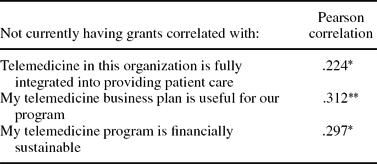
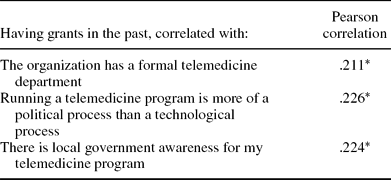
Seventy-three percent of all programs stated that they have had grants in the past to help fund the telemedicine program. However, only 45.7 percent of them reported that they currently have grants funding their programs. Table 3 highlights some characteristics that emerged that are correlated to not having current grants, and Table 4 illustrates some aspects that significantly correlated with having grants in the past.
Current grants

* = Correlation is significant at the .05 level (two-tailed)
** = Correlation is significant at the A6.01 level (two-tailed)
Past grants

* = Correlation is significant at the .05 level (two-tailed)
** = Correlation is significant at the .01 level (two-tailed)
In summary, the research suggests that to have a sustainable telemedicine program, it is important to define the program or department as a separate entity. This distinction can allow for adequate training, evaluation processes, development and maintenance of a business plan, as well as serious and pragmatic discussion of innovation. Programs that valued accountability, encouraged and used feedback as well as the ability to easily adopt to change were all demonstrated to be successful within their organization. Another prevailing theme of successful telemedicine programs in organizations was that of having a forward thinking, or avant garde, outlook. It was suggested that, if telemedicine was presented as a way to improve the quality of care for patients, this might facilitate awareness and eventually buy-in from the senior management. Most of the programs reported they started their programs through grant funding. Programs that were sustainable, outside of grant money, were also better integrated in providing patient care and reduced their need for soft-money.
DISCUSSION
This study is useful as it gives a current description of actual telemedicine programs, and how they operate within the larger organization. There were several findings that we expected such as most healthcare facilities tend to be fairly hierarchical where people at the top tend to have more authority (Reference Rizzo, House and Lirtzman11). The respondents also believed the employees in the organization were accountable for their work in supporting the mission of the organization, which was focused on providing accessible, quality health care. This is partly done through the provision of providing telemedicine services, and is measured through continuous evaluation and feedback with the staff and the healthcare providers.
Through the found results a definition of successful has been teased out. This definition includes programs that have a high level of creativity, organizational support, having and following a business plan, developing a formally defined program and understanding how financial support effects the program. Through these attributes, several recommendations can be made to those wishing to develop a program or seeking to restructure their current program.
Creativity
While the hierarchical structure of healthcare organizations may seem to promote a static environment, this research indicated that organizations with telemedicine programs tended to be those that allowed and supported employees to be more imaginative and creative in their work. These organizations also tended to create awareness in the community and the government regarding their telemedicine programs and highlight their innovativeness. The ability to implement novel solutions in patient care was also seen to be important in supporting the mission of the organization. This also effectively echoes recent research that demonstrated healthcare organizations that proactively implement information communication technologies (ICT) in the facilities improve patient satisfaction (Reference Whitten, Mylod, Gavran and Sypher19). That research found that quality of care, patient satisfaction, and financial outcomes are all interrelated and improved through being “wired” (Reference Whitten, Mylod, Gavran and Sypher19). The current research could suggest that an organization that encourages such avant garde thinking could enhance its role in the community through providing telemedicine services.
Organizational Support
Organizations agreed that organizational support is necessary for telemedicine projects to succeed functionally and creatively. The length of time the telemedicine program has been established also seemed to indicate that some features promote long term sustainability, including senior management being helpful and effective strategies to communicate with coworkers on new ways to use telemedicine. An argument could be made that programs that have been around for over 10 years have enjoyed a certain amount of success and, therefore, have garnered positive attention from senior management. In addition, the programs that have been established for a decade may also be in the position to explore new ways to use telemedicine and will engage in these conversations. However, it could also indicate the programs that have had a long history have enjoyed support from senior management and have always been looking for new uses for telemedicine.
Business Plans and Formally Defined Programs
Operational aspects are important in developing and sustaining any successful program and initiative. Those surveyed have developed a business plan, and of those, many of the programs moderately agreed that they updated it on a regular basis. A business plan also demonstrates a clear goal and supports the mission of the organization. The development of a business plan should generally include formal definitions of the program and job role descriptions, which this research would suggest to be key in a success telemedicine program. Successful telemedicine programs were associated with possessing formal work roles and duties, indicating these job duties should not be ad hoc. The formality of having roles and responsibilities defined was established as being key in the achievement of having a long-standing program. In general, a formally defined job description lends to an individual's feeling of job stability and reduces many work related uncertainties (Reference Hardy5). This can allow an individual to become a champion of the program and develop and promote its long-term success.
Financial Support
Probably the biggest concern of any organization thinking about creating a telemedicine program is the economic piece. It is no surprise many of the programs have had funding through grant mechanisms in the past; however, it was interesting to discover that the programs believe their funding will shift to inside revenue generated funds. Many of the programs believed that their funding was going to shift from outside sources, such as grants, to become more internally based, for example by means of fees for service. This research suggests that grants are necessary to help establish a program, but once established, the program can remain stable without this type of support. Reasons for this financial paradigm shift could be the changes in reimbursement currently occurring across the United States. A handful of studies have demonstrated that about half of all telemedicine programs receive reimbursement from private insurers and that this number continues to climb (Reference Brown2;Reference Whitten and Buis15). Public payers are another important consideration, specifically Medicaid. It has varying coverage, services, and payment policies throughout the states, and it does reimburse for telemedicine services in most (Reference Brown2).
CONCLUSION
This research has illustrated key features in having or developing a successful telemedicine program within a healthcare organization. Altogether, this study highlights key structured pieces necessary to have a successful telemedicine program. It also demonstrated that there are several organizational characteristics that should be goals for those interested in starting a telemedicine program. It also highlighted and further demonstrated what other studies have found, such as having a focus on patient demands of accessible and quality care, which can be achieved through telemedicine. This attention to the needs of patients can enhance their satisfaction, which can lead to positive financial outcomes. This research provides a data-driven understanding on how telemedicine can be maximized to help achieve the overall goals of an organization. Telemedicine has the ability to transform the healthcare organization into a more economical and comprehensive method of provisioning care.
CONTACT INFORMATION
Pamela Whitten, PhD (pwhitten@msu.edu), Dean, College of Communication Arts & Sciences, Bree Holtz, MSc (bholtz@msu.edu), Doctoral Candidate, 408 Communications Arts & Sciences, Telecommunications, Information Studies & Media, Lianh Nguyen (nguye167@msu.edu), Department of Clinical Laboratory Science, Michigan State University, East Lansing, Michigan 48824-1818