Introduction
Water hyacinth (Pontederia ( = Eichhornia) crassipes Mart. (Pontederiaceae), Pellegrini et al., (Reference Pellegrini, Horn and Almeida2018)) is a free-floating perennial aquatic weed that has become invasive in many waterways in the tropical, subtropical and some temperate regions of the world, including South Africa. Water hyacinth is considered the most damaging aquatic weed and is included among the world's 100 worst invasive species (Lowe et al., Reference Lowe, Browne, Boudjelas and De Poorter2000). The plants grow vegetatively to form dense mats, which lead to reduced aquatic biodiversity due to shading and subsequent lowered dissolved oxygen concentrations in the water column (Midgley et al., Reference Midgley, Hill and Villet2006; Coetzee et al., Reference Coetzee, Jones and Hill2014). Water hyacinth reduces water quality through the build-up of sulphur dioxide beneath the mats, and quantity through evapotranspiration, putting great stress on water resources, particularly in water-scarce countries such as South Africa (Fraser et al., Reference Fraser, Hill and Martin2016; Arp et al., Reference Arp, Fraser and Hill2017).
Attempts to combat the spread of water hyacinth have led to the implementation of biological control programmes in many countries around the world, including Papua New Guinea, the USA, China and South Africa (Cofrancesco et al., Reference Cofrancesco, Stewart and Sanders1985; Cilliers, Reference Cilliers1991; Julien and Orapa, Reference Julien, Orapa and Spencer1999; Jianqing et al., Reference Jianqing, Ren, Weidong and Guoliang2001) where the most commonly released biological control agents are the two congeneric weevils, Neochetina eichhorniae Warner and N. bruchi Hustache (Coleoptera: Erirhinidae). While the weevils are effective in tropical regions of the world (Julien and Orapa, Reference Julien, Orapa and Spencer1999; Cock et al., Reference Cock, Day, Herren, Hill, Julien, Neuenschwander and Ogwang2000), successful control is limited in cooler, more temperate areas where water hyacinth has invaded, prompting importation and release of additional agents in these regions. In South Africa, a further seven biological control agent species (including several arthropods and a pathogen) have been released (Cilliers, Reference Cilliers1991; Hill and Coetzee, Reference Hill and Coetzee2017), but despite this high number, success has been limited compared to other countries. The high nutrient status of the rivers and dams in South Africa, which are among the most eutrophic in the world, significantly enhance the rate of water hyacinth growth, thus reducing the impact of the current suite of biological control agents (Coetzee and Hill, Reference Coetzee and Hill2012). Reductions in the populations of established biological control agents also occur in response to the improper, or overuse of non-specific chemical herbicides, as well as from stochastic events such as flooding. In these situations, plants with agents are removed, but infestations regenerate from seeds in the absence of biological control agents (Hill and Olckers, Reference Hill and Olckers2001; Coetzee et al., Reference Coetzee, Hill, Byrne and Bownes2011).
In addition, Hill and Olckers (Reference Hill and Olckers2001) identified cold winters as having a significant negative impact on the successful biological control of water hyacinth. Cold weather offers a significant metabolic challenge to insects and decreases in temperature can lead to reduced survival, fecundity and feeding frequency (Kingsolver, Reference Kingsolver1989). Certain parts of the USA, such as California, Louisiana and Texas have documented that cold winters are deleterious to control efforts (Grodowitz et al., Reference Grodowitz, Stewart and Cofrancesco1991; Moran et al., Reference Moran, Pitcairn and Villegas2016). Further, Coetzee et al. (Reference Coetzee, Byrne, Hill and Center2009) concluded that the mirid, Eccritotarsus catarinensis (Carvalho) (Hemiptera: Miridae) would not be suitable for release in parts of the USA above 35°N latitude, as the severe winter temperatures would significantly limit the survival of the insects. Biological control agents of water hyacinth introduced from the tropical areas of South America experience a climatic mismatch in some regions of their introduced range, and this is expected to have a negative effect on their establishment and population growth during the winter in temperate regions (Byrne et al., Reference Byrne, Hill, Robertson, King, Jadhav, Katembo, Wilson, Brudvig and Fisher2010). Furthermore, as the growing season ends, the nutritional quality of the host-plants declines, and in areas prone to frost, water hyacinth leaves turn brown and die. This winter dieback leaves only the crown of the plant and its submerged roots intact, removing a significant proportion of the available food supply and habitat for the host-specific herbivores (Madsen et al., Reference Madsen, Luu and Getsinger1993). The combined effect of low temperatures and poor food quality leads to high levels of mortality among biological control agents, causing seasonal population bottlenecks. As a result, few to no progeny are produced over winter and, hence, agent populations in frost-affected areas typically only reach damaging levels near the end of the growing season (Hill and Cilliers, Reference Hill and Cilliers1999). This lag-period means that water hyacinth can regrow rapidly during spring and summer with limited impact from biological control (Hill and Cilliers, Reference Hill and Cilliers1999).
To account for stochastic changes and seasonal variation, new agents which have shorter generation times to build-up populations rapidly post-winter have been targetted. Megamelus scutellaris Berg. (Hemiptera: Delphacidae), a host-specific natural enemy of water hyacinth collected from Argentina, was found to be most likely to fulfil the required niche and was tested for host-specificity and cleared for release in the USA in 2010 (Tipping et al., Reference Tipping, Center, Sosa and Dray2011; Reference Tipping, Sosa, Pokorny, Foley, Schmitz, Lane, Rodgers, McCloud, Livingston-Way, Cole and Nichols2014), and in South Africa in 2013 (Coetzee, Reference Coetzee2013). Megamelus scutellaris is a multivoltine phloem-feeding insect with a short generation time and overlapping generations (Sosa et al., Reference Sosa, Marino De Remes Lenicov, Mariani and Cordo2005; Reference Sosa, Cordo and Sacco2007). Studies have shown that M. scutellaris is highly effective as a biological control agent in both greenhouse experiments and field settings (Coetzee, Reference Coetzee2013; Moran et al., Reference Moran, Pitcairn and Villegas2016; Miller et al., Reference Miller, Coetzee and Hill2019). However, research on the thermal tolerance of this species conducted by May and Coetzee (Reference May and Coetzee2013) concluded that M. scutellaris was climatically incompatible with certain high altitude sites around South Africa, which experienced cold winters with frosting events. On the other hand, Tipping et al. (Reference Tipping, Sosa, Pokorny, Foley, Schmitz, Lane, Rodgers, McCloud, Livingston-Way, Cole and Nichols2014) noted that, while M. scutellaris performed poorly in areas in the USA with very hot summers, the agent has overwintered for at least 3 consecutive years in Gainesville, Florida (29°22′51.9″N 82°13′20.6″W) despite multiple days of below-freezing winter temperatures.
This study aimed to monitor M. scutellaris population dynamics in a cold temperate region of South Africa to determine its response to cold winters and the subsequent recovery in the following spring and summer. The Kubusi River in the Eastern Cape Province (South Africa) was selected because it is the water hyacinth biological control site in the country that experiences the coldest winters (Byrne et al., Reference Byrne, Hill, Robertson, King, Jadhav, Katembo, Wilson, Brudvig and Fisher2010), and it was the first field site where M. scutellaris was released in South Africa and has persisted since that time (pers. obs.). Based on the results, improved management strategies that counter the effects of cold temperatures on water hyacinth biological control in cooler regions of the world can be developed.
Materials & methods
Study site
The Kubusi River, near Stutterheim in the Eastern Cape of South Africa, (32°33′54.0″S 27°29′21.1″E; 774 m AMSL) is heavily infested with water hyacinth, often experiencing 100% cover in the summer. Since the late 1990s, release efforts at the Kubusi River facilitated the establishment of permanent, self-perpetuating populations of the biological control agents E. catarinensis and both water hyacinth weevil species, N. eichhorniae and N. bruchi. This is the coldest site where biological control agents have established on water hyacinth in South Africa making this site thermally important (Byrne et al., Reference Byrne, Hill, Robertson, King, Jadhav, Katembo, Wilson, Brudvig and Fisher2010). The climate of the area is characterized as temperate (minimum mean temperature = 5.09°C; maximum mean temperature = 27.22°C), with year-round rainfall and cold winters which can experience up to 56 days of frost each year (Byrne et al., Reference Byrne, Hill, Robertson, King, Jadhav, Katembo, Wilson, Brudvig and Fisher2010).
Data collection
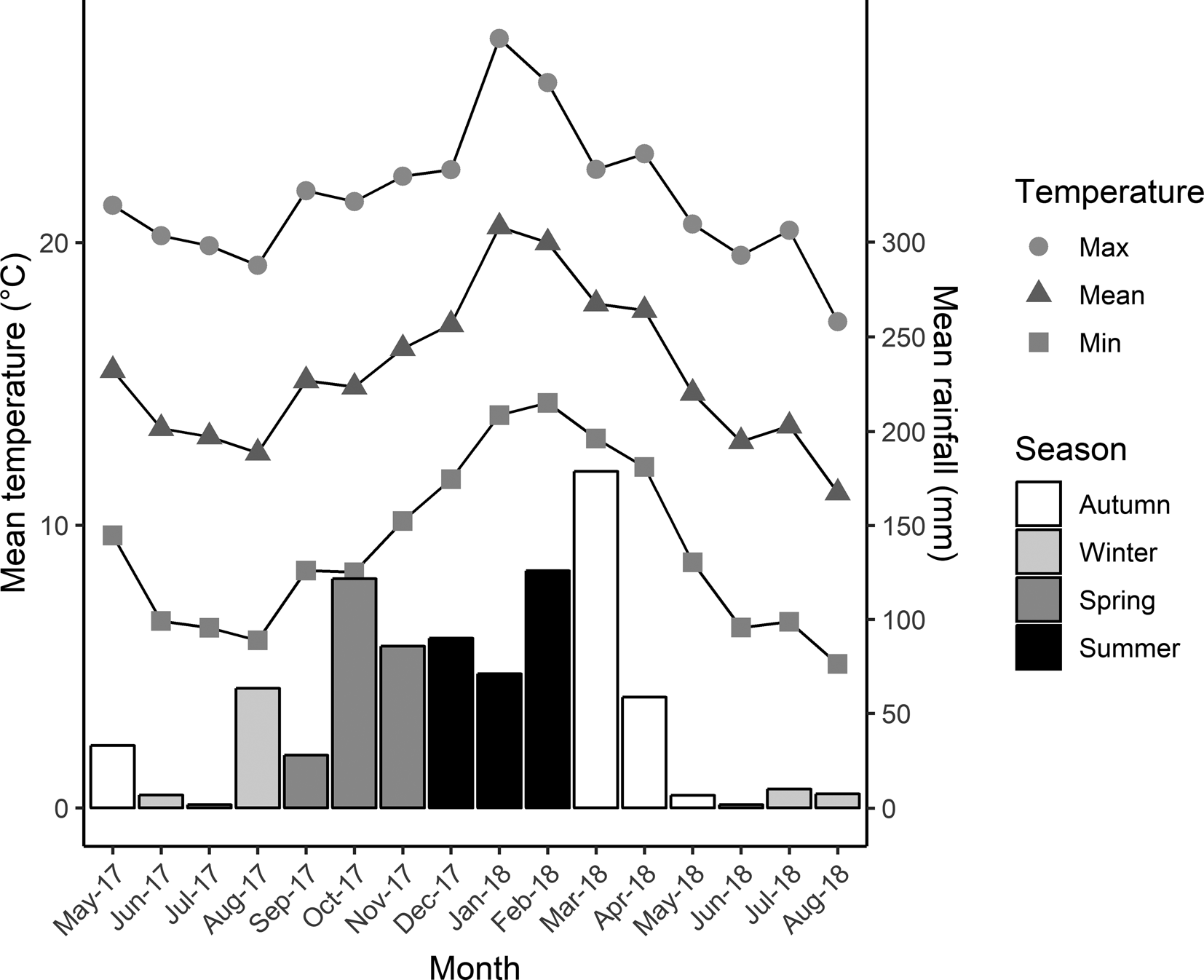
The site was sampled monthly for 15 months from May 2017 until August 2018. Plant and insect data were collected from the same site on the system each month and the data were compared with temperature and rainfall data received from the nearby Dohne Weather Station approximately 3 km away from the study site (fig. 1) (S 32°32′02.4″ E 27°28′01.2″, 901 m AMSL) (www.weathersa.co.za). A study by Coetzee (Reference Coetzee2012) concluded that the microclimate at the Kubusi River and the Dohne Weather Station climate were not significantly different and, therefore, these data could be used as a proxy for the climate at the study site.
Monthly minimum, maximum and mean temperature (lines) and total monthly rainfall (bars) by season from the Dohne Weather Station near the Kubusi River throughout the study.

Plant health and fecundity measurements
The population structure and establishment potential of a biocontrol agent are determined, in part, by the quality and quantity of its host plant. Therefore, plant parameters were measured monthly from ten randomly selected water hyacinth plants from within the site. The measured plant parameters were adapted from Coetzee and Hill (Reference Coetzee and Hill2012) and included: (1) the length of the longest live petiole, which is a measure of plant height, (2) total root length which is an indication of nutrient status and intra-species competition, (3) the number of ramets (daughter plants) which determine the extent of clonal reproduction, and (4) the number of photosynthetically active leaves on each plant, which is a measurement of host-plant quality and as a determinant of possible feeding sites for M. scutellaris. Feeding damage is difficult to detect at the plant level at agent densities recorded over the study period, particularly in high nutrient water (Miller et al., Reference Miller, Coetzee and Hill2019), therefore damage was not measured in this study as the focus of the study was the population dynamics of the insect, in particular after winter. A thorough post-release evaluation is currently being conducted on this agent in South Africa, and this study forms part of the larger study.
Each month, three randomly selected 0.25 m2 quadrats of biomass were also removed from within the water hyacinth mat (see online supplementary material fig. 1), and the contents of each quadrat were separated into above water biomass (green leaves and petioles), below water biomass (roots) and dead biomass and these were weighed to determine the wet weight per unit area. The number of individual plants per quadrat was also recorded.
Megamelus scutellaris population measurements
The density of M. scutellaris present at the site on the Kubusi River was determined using a purpose-built sampler (see online supplementary material fig. 2), which was adapted from the ‘Minteer Method’ (C. Minteer, unpublished) which has been used to measure aquatic insect numbers on floating aquatic macrophytes in the USA. The sampler used here was devised from a 70 L black plastic bin from which the bottom was removed and into which a thin metal wire cross-wise frame was built. The sampler was placed over water hyacinth plants in the water and pushed down, submerging the plants. The wires kept the plants underwater, allowing M. scutellaris nymphs and adults present on the water hyacinth to float up onto the water's surface and the side of the bucket where they could be counted. No differentiation was made between the nymphs or adults in the analysis. This was repeated 10 times in different parts of the site at wading depth at intervals of approximately between 5 and 10 m. The sample size was considered representative of the population as water hyacinth is a uniform clonal species. Standard errors of the mean plant growth parameters were within 5% of each other confirming that measuring ten plants were representative of the population. Data on other biological control agents present on the water hyacinth were recorded, but these data form part of a long-term study which was not the focus of this study. Research has shown that there are no negative interactions between M. scutellaris and the different species of biological control agents on water hyacinth (Petela, Reference Petela2018).
Statistical analyses
All statistical analyses were completed using RStudio v 3.4.3 (R Core Team, 2017). To find a comparative method of measuring the insect density, the data were transformed from a measure of insects per sample to insects m−2 by equating the circular area of the base of the sampler to a square metre, yielding a conversion factor of
 $$\displaystyle{{{\bar{{\rm X}}}_{{\rm insect\;}\;{\rm number}\;{\rm per}\;{\rm sample}}} \over { 0 .093}}{\rm} = {\rm insects}{\rm .\;}{\rm m}^{ \hbox{-} 2}$$
According to the Shapiro–Wilks test for normality, the data were not normally distributed, so non-linear statistics apply. The data were analyzed using a negative binomial generalized mixed-effects model (GLMM) (Bolker et al., Reference Bolker, Brooks, Clark, Geange, Poulsen, Stevens and White2009) to determine how climate and the availability of food (number of leaves) impacted the density of M. scutellaris. Month was specified as a random effect as the data were collected from the same site over many months. The fixed effects included the minimum temperature, season and the number of leaves on each plant. The most supported model was selected using a stepwise backward selection process and AICc scores (Burnham &Anderson, Reference Burnham and Anderson2002) and models were considered if they were within 7 AICc points of this model (ΔAICc = 0). In addition, for every extra parameter added to the model (K), 2 AICc points were added to account for potential overfitting of the model. Model diagnostics checks performed in the ‘DHARMa’ package in R (Hartig, 2020), indicated that the model specification was appropriate. The log-likelihood values were also used to determine the maximum likelihood of the model.
Results
Plant population dynamics
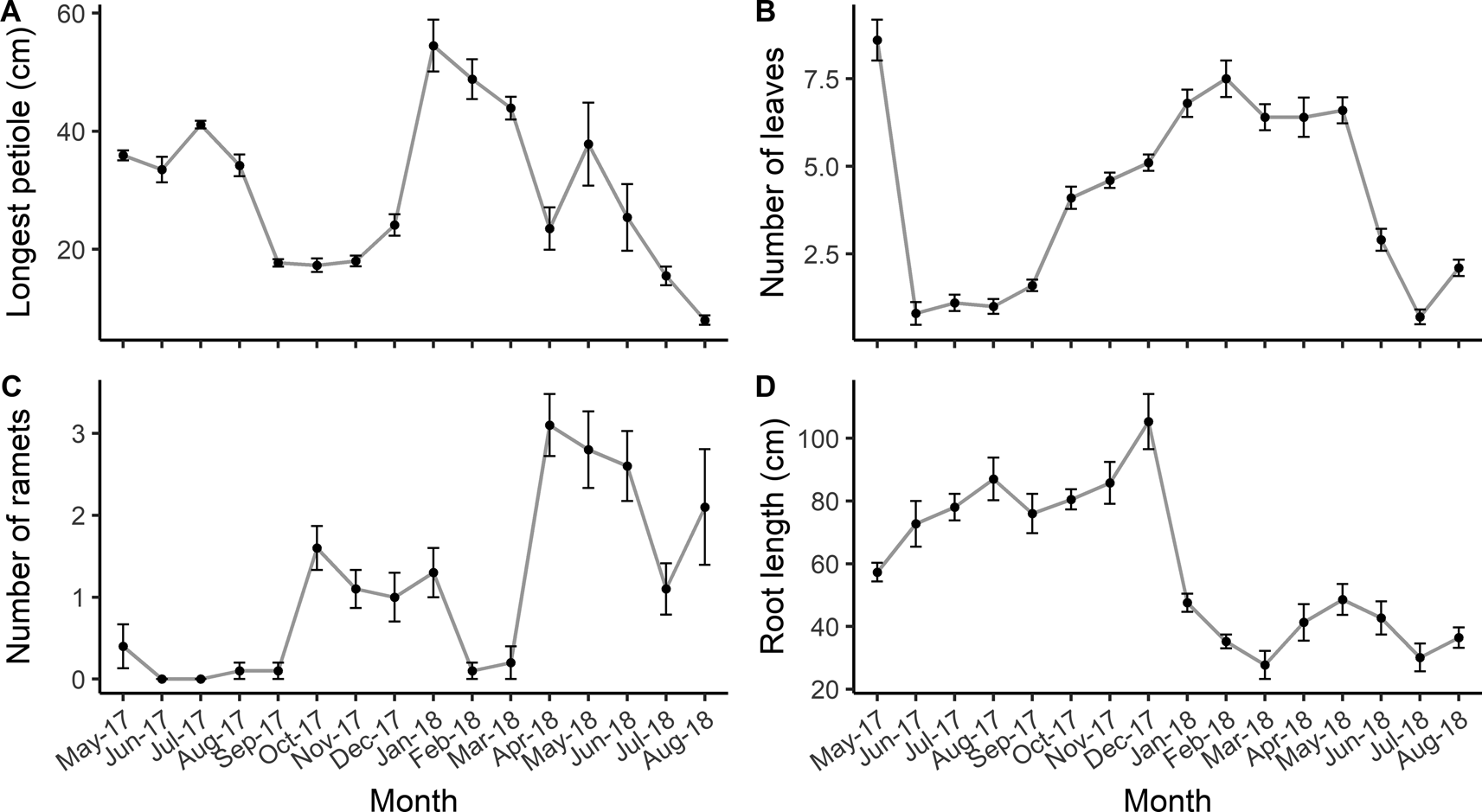
Over the 15-month sampling period, the length of the longest petiole fluctuated greatly depending on the season. On average, the plants were tallest during mid-summer, January 2018 (54.48 ± 4.38 cm) and shortest during late winter, August 2018 (8.00 ± 0.80 cm) (fig. 2a). The mean number of leaves per plant was greatest in May 2017, with a mean of 8.6 ± 0.58 leaves per plant. However, in both years, leaf number decreased rapidly after May as a result of frosts in June, reducing the number of viable leaves in the canopy to the annual minimum of 0.8 ± 0.33 leaves per plant. The annual minimum in 2018 occurred a month later than in 2017, with 0.7 ± 0.21 leaves per plant in July 2018 (fig. 2b).
Mean (a) length of the longest petiole (cm), (b) number of leaves per plant, (c) number of ramets per plant and (d) root length of water hyacinth plants in the Kubusi River between May 2017 and August 2018. Error bars = ± S.E.

The ramet production was reduced to almost zero over the winter of 2017, with only a few plants bearing any daughter plants. However, the number of ramets produced over the winter of 2018 was much higher, with a mid-winter mean of 2.8 ± 0.47 and 2.6 ± 0.43 ramets for May and June 2018 respectively, whereas only 0.4 ± 0.27 were recorded during May 2017, and none in June 2017 (fig. 2c). The highest number of ramets were recorded in April 2018, with a mean of 3.1 ± 0.38 ramets per plant. Root length varied over time and between seasons. The longest roots were recorded in December 2018, during mid-summer (105.28 ± 8.78 cm), while the shortest roots occurred in late summer, March 2018, at 27.7 ± 4.48 cm (fig. 2d).
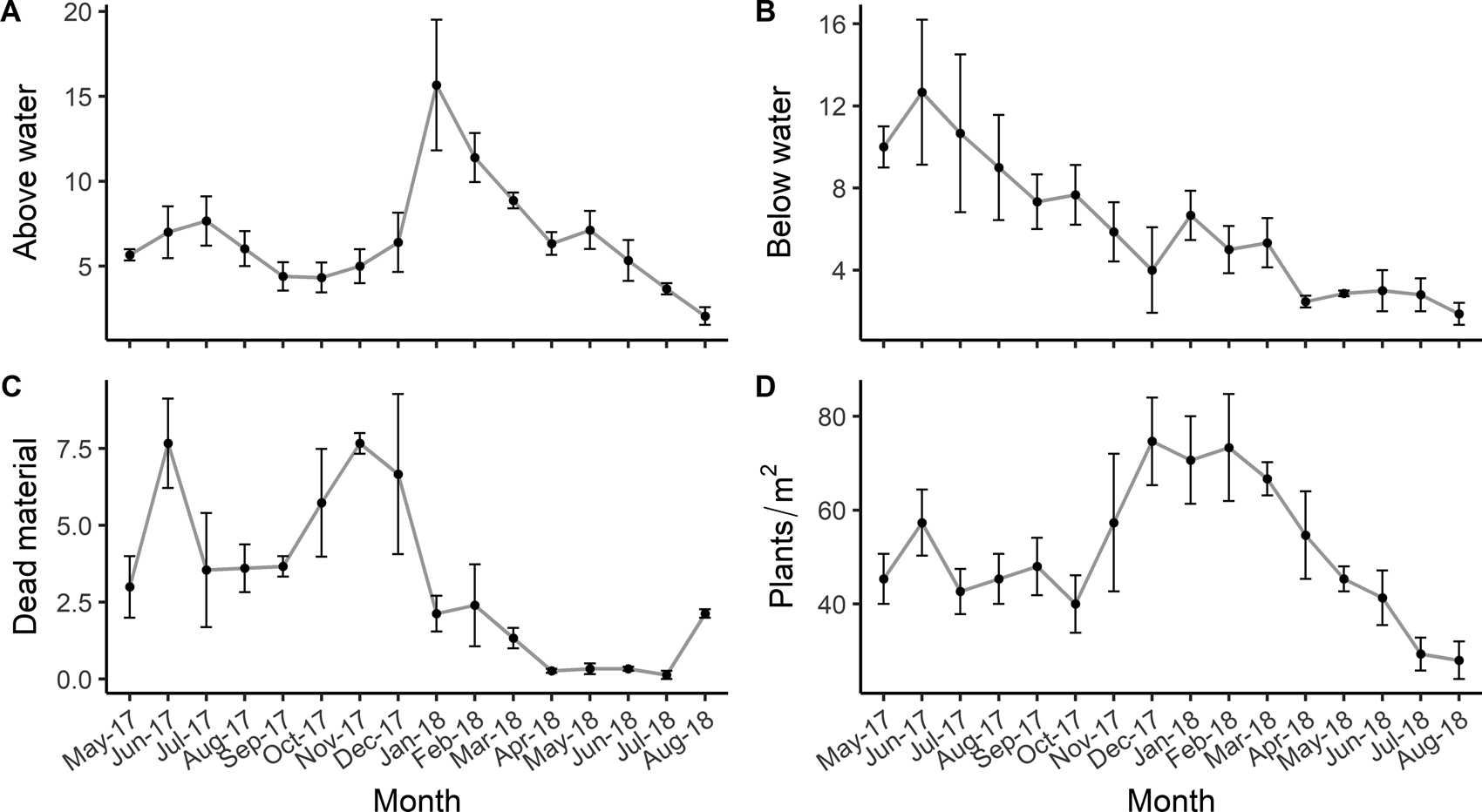
The above water biomass peaked in January 2018. At the highest point, the above water biomass was 15.67 ± 3.84 kg m−2 (fig. 3a). There was a marked decrease in the above water biomass as winter set in, leading to annual minima of 4.33 ± 0.88 kg m−2 in October 2017 and 2.07 ± 0.52 kg m−2 in August 2018. However, the below water biomass, which is an indicator of nutrients and intraspecific competition, was variable between months, but there was a generally decreasing trend in the root biomass throughout the study. The maximum root biomass of 12.67 ± 3.53 kg m−2 was measured in June 2017, decreasing steadily to a mean minimum in August 2018 of 1.87 ± 0.92 kg m−2 (fig. 3b). The lowest root biomass also coincided with the lowest above water biomass in August 2018.
Mean (a) above water biomass (kg m−2) (b) below water biomass (kg m−2), (c) dead biomass (kg m−2) and (d) number of plants m−2 of water hyacinth plants in the Kubusi River between May 2017 and August 2018. Error bars = ± S.E.

Old leaves and petioles that had senesced or been damaged by winter frosts formed the dead biomass. The amount of dead biomass present at each sampling interval was variable and did not follow a seasonal trend. The mass of dead material did, however, decrease sharply in January 2018 to 2.13 ± 0.58 kg m−2, which coincided with a marked increase in live biomass (fig. 3c). The least dead biomass was recorded in July 2018 (0.13 ± 0.13 kg m−2), and the greatest mass of dead material was recorded equally in June and November 2017, both measuring 7.67 kg m−2 (±1.45 and ± 0.33 respectively) (fig. 3d).
The highest density of plants was recorded during December 2017, with 74.67 ± 9.33 plants m−2, while the lowest plant density occurred at the end of winter in August 2018, with only 28.00 ± 4.00 plants m−2. Both the number of leaves per plant (y = 0.72x−2.5, F1,14 = 25.85; P < 0.001; R2 = 0.62) and the above water biomass (y = 0.76x−0.3; F1,14 = 14.16; P = 0.002; R2 = 0.47) were significantly correlated with the minimum recorded temperature (see online supplementary material fig. 3). In this instance, we used the minimum temperature as it is a limiting factor to the growth of both M. scutellaris and water hyacinth.
Seasonal interactions between insect and plant populations
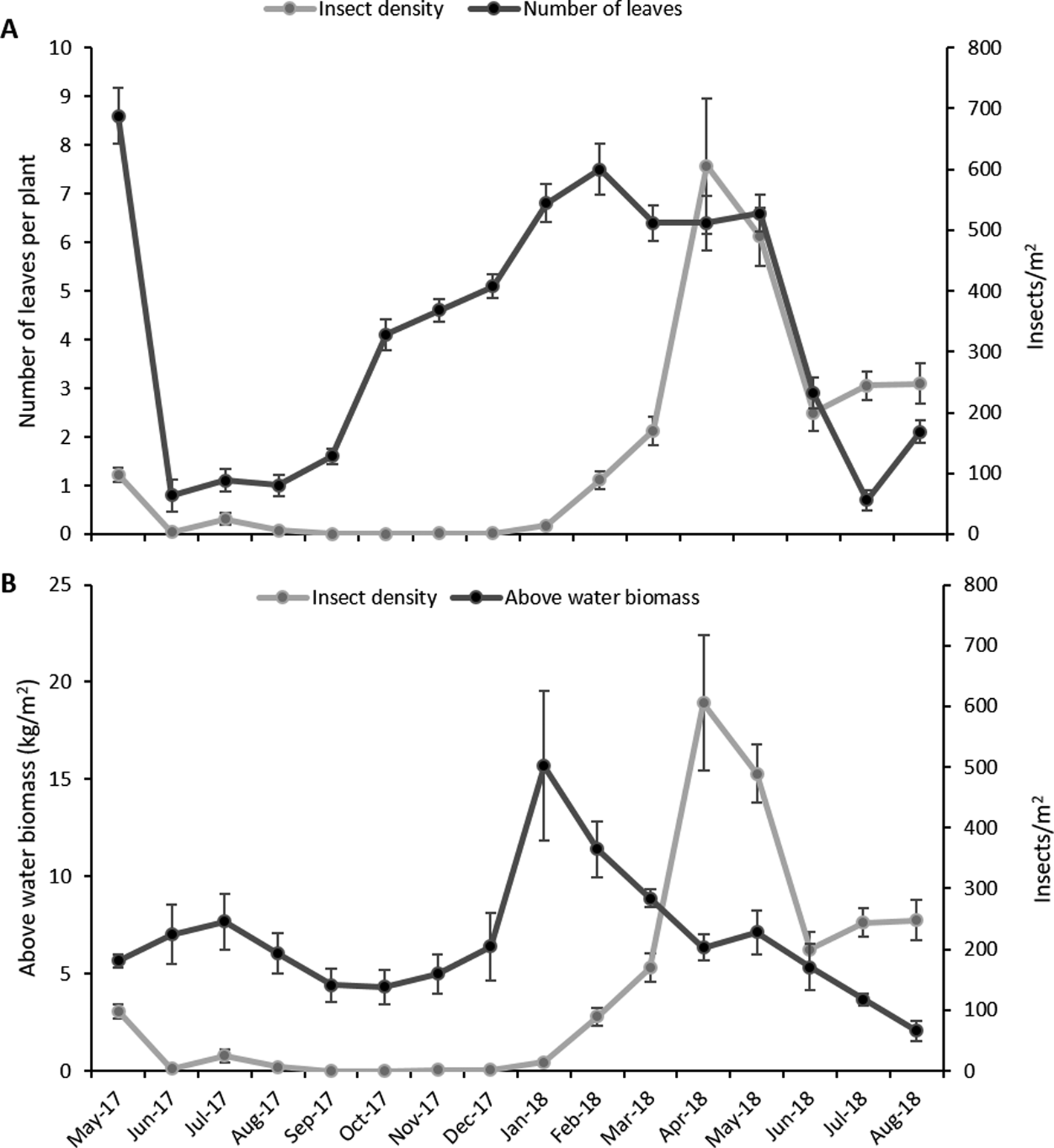
The number of insects per square metre followed seasonal and climatic trends. During the spring of 2017, the insect density was low (mean numbers of insectsm−2 ranging between 0 and 1.08 insects between September and December 2017) (fig. 4). By April 2018, late summer/early autumn, the insect numbers had increased to their maximum recorded density of 605.34 ± 111.91 insects m−2. The insect numbers were also higher in the winter months of 2018 than they were in the winter of 2017, with a mean of 11.47 ± 3.92 insects m−2 in 2017 compared to 230.45 ± 16.57 insects m−2 in 2018.
The relationship between Megamelus scutellaris density, (a) leaf number and (b) above water biomass on Kubusi River between May 2017 and August 2018. Error bars indicate S.E.

The change in the density of M. scutellaris was associated with both the number of leaves per water hyacinth plant and the above water biomass (fig. 4a). The number of leaves increased rapidly post-winter, showing signs of recovery between September and October 2017, while the M. scutellaris population recovery lagged until it reached a maximum population density in April 2018 (fig. 4a). Biomass decreased initially in early summer as the new plants began to grow, but, by the late summer, the biomass rapidly increased (fig. 4b). Importantly, the maximum density of M. scutellaris lagged until after the biomass and the number of leaves had reached their maxima. Both the insect density and the number of leaves declined sharply at the start of winter in June of 2017 and 2018. Biomass began to decline in autumn, prior to the first frosts.
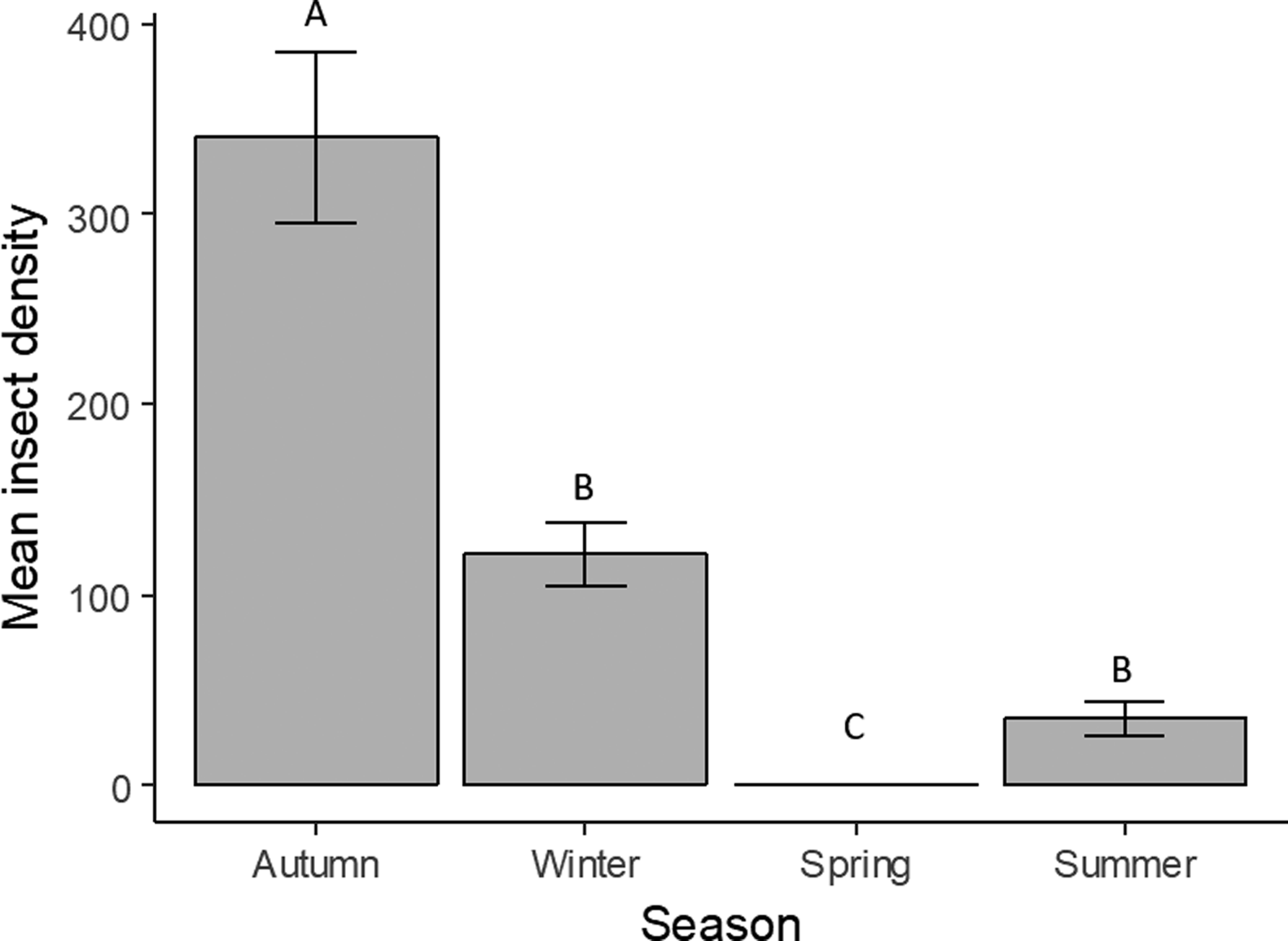
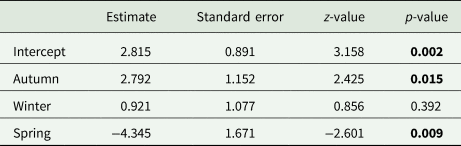
The best-supported model determined that season was the most influential variable affecting the density of M. scutellaris at the Kubusi River (Table 1) (see online supplementary material Table 1 for AIC table). Between seasons, the density of M. scutellaris was 876% higher in autumn than in summer (z = 2.425, P = 0.015) (fig. 5), while winter densities were 248% higher than summer (z = 0.856, P = 0.392), but this was not a significant difference according to the model. Density decreased significantly between summer and spring, reducing insect populations by 99% (z = −2.601, P = 0.009).
Seasonal mean insect density m−2 at the Kubusi River between May 2017 and August 2018. Error bars indicate S.E. Significant differences are indicated by a different letter (P < 0.05).

Fixed effect variables in the best supported negative binomial generalized mixed-effects model for Megamelus scutellaris density. Values in bold are significant (P < 0.05).

Month was specified as a random effect to account for non-independence between monthly surveys.
Discussion
Understanding how biotic and abiotic factors influence the population dynamics of a biological control agent is key to the success of invasive plant management programmes. The results of this study indicate that the population of M. scutellaris varies over time and between seasons. Even though the season was the most influential factor affecting the population density of the insect at the Kubusi River, changing seasons also have a direct impact on the growth and quality of the host plant, both of which directly affect the post-winter recovery of host-specific insect herbivores. Host plant quality was considerably reduced in the winter, particularly with the onset of frost, which had deleterious effects on plant vigour and leaf quality. Grodowitz et al. (Reference Grodowitz, Stewart and Cofrancesco1991) found the same trend with the onset of winter in Texas, which lead to a dramatic decrease in the population of the weevil N. eichhorniae from a maximum population density of 55 weevils m−2 to a minimum of 8 weevils m−2 for 5 months, however, N. eichhorniae were found to overwinter as larvae, and larval populations increased over winter.
Although low winter temperatures negatively affect both water hyacinth and M. scutellaris, the water hyacinth plants were able to recover more rapidly at the Kubusi River. However, the population of M. scutellaris, which was significantly reduced each winter by a severe winter bottleneck, was unable to mirror the rapid population growth rate of its host plant until later in the growing season, by which time the plants were able to recover with only a negligible impact from biological control. The mirid E. catarinensis and both water hyacinth weevil species, N. eichhorniae and N. bruchi, also only re-emerged after an extended post-winter lag-period, with adult mirids and weevils only modelled to emerge by late October (Byrne et al., Reference Byrne, Hill, Robertson, King, Jadhav, Katembo, Wilson, Brudvig and Fisher2010). This is a 2-month lag between the onset of spring and the recovery of the natural enemy populations (Byrne et al., Reference Byrne, Hill, Robertson, King, Jadhav, Katembo, Wilson, Brudvig and Fisher2010). Elsewhere, it has been found that M. scutellaris was able to overwinter successfully through multiple winters at cooler sites in California in the western USA, as well as in Florida, despite several nights where temperatures were below freezing (Tipping et al., Reference Tipping, Sosa, Pokorny, Foley, Schmitz, Lane, Rodgers, McCloud, Livingston-Way, Cole and Nichols2014; Moran et al., Reference Moran, Pitcairn and Villegas2016). Successful establishment was more likely if there was riparian vegetation offering shaded areas to the insects to buffer the effects of rapid diel temperature fluctuations (Tipping et al., Reference Tipping, Sosa, Pokorny, Foley, Schmitz, Lane, Rodgers, McCloud, Livingston-Way, Cole and Nichols2014).
The lag-period in post-winter recolonization by biological control agents was initially proposed by Hill and Olckers (Reference Hill and Olckers2001) to be a hindrance to all of the water hyacinth natural enemies released in South Africa, as well as being one of the reasons that complete control of water hyacinth has not yet been achieved through biological control. These results document this relationship for the first time in the field and are an indicator of the accuracy of the predictions which suggested that biological control agent populations that are reduced by cold winters will only recover completely nearer the end of the growing season. The lower developmental threshold (t 0) reported by May and Coetzee (Reference May and Coetzee2013) for M. scutellaris is 11.458 °C, below which development ceases. However, the minimum temperature did not exceed t 0 between May 2017 and December 2018, and only between January and April 2018 was the mean temperature high enough to facilitate the development of M. scutellaris. This short period of development time also coincides with, and may explain, the greatest increases in the populations of the insects at the Kubusi River. The results of a similar study which monitored the seasonal population density of both Neochetina species on the Kubusi River closely reflected those presented here, where the adult weevil density remained at or near zero over winter and peaked during late summer and early autumn, only to collapse again with the first frosts (Byrne et al., Reference Byrne, Hill, Robertson, King, Jadhav, Katembo, Wilson, Brudvig and Fisher2010). The same trend was reported by both Moran et al. (Reference Moran, Pitcairn and Villegas2016) and Hopper et al. (Reference Hopper, Pratt, McCue, Pitcairn, Moran and Madsen2017) who found M. scutellaris population densities to be temperature-dependent in California, peaking between October and November. The peak in density coincided with late summer/early autumn in the northern hemisphere, and the population declined again over winter when temperatures were close to the reported t 0. Hopper et al. (Reference Hopper, Pratt, McCue, Pitcairn, Moran and Madsen2017) also determined that, among other water hyacinth biological control agents, the presence of a climatic mismatch as well as the lag phase in post-winter agent recovery are major factors responsible for biological control efforts on water hyacinth not being as successful in the USA as in other parts of the world.
However, one of the major benefits of using M. scutellaris as a natural enemy of water hyacinth in South Africa is that it is multivoltine with a fast generation time (Sosa et al., Reference Sosa, Marino De Remes Lenicov, Mariani and Cordo2005; Reference Sosa, Cordo and Sacco2007). Yet, the low temperatures experienced by these insects in the field still has the effect of prolonging their developmental time to as much as 65.6 days (at 19°C) from egg to adult, where, under ideal conditions, M. scutellaris can complete its development in 39.42 days at 27°C (May and Coetzee, Reference May and Coetzee2013). Furthermore, from observations in the field, M. scutellaris was often the first biological control agent to appear post-winter, and in the greatest numbers – particularly after major environmental disturbances, such as drought. Megamelus scutellaris is able to co-exist with other biological control agents, and can even increase the damage caused by other agents (Petela, Reference Petela2018). Therefore, competition is unlikely to be the reason that M. scutellaris was able to recolonize faster than the other water hyacinth biological control agents at the site. Furthermore, evidence from sites in California suggests that the presence of M. scutellaris contributed to a 27% reduction in overall leaf number on water hyacinth at a temperate site in Folsom, California, USA (Moran et al., Reference Moran, Pitcairn and Villegas2016). Additionally, M. scutellaris has been shown to vector phytopathogenic fungi which contribute to reduced plant biomass and daughter plant production (Sutton et al., Reference Sutton, Compton and Coetzee2016).
This study has determined that M. scutellaris can overwinter successfully in the coldest water hyacinth biological control site in South Africa and that our results are consistent with those recorded in temperate sites in the northern hemisphere. Furthermore, overwintering populations faced a significant lag-period before their densities built up to a sufficient size in the late summer, as a result of temperatures below the developmental threshold of the insect, as well as due to the reduction of above-water plant biomass and leaf tissue as a food source over winter. Certain factors, such as fewer frost days, can lead to small populations of M. scutellaris remaining throughout the winter (pers. obs), thus reducing the bottleneck effect and allowing faster post-winter population increases. However, emphasis needs to be placed on understanding the anthropogenic drivers of water hyacinth invasions, such as eutrophication and excessive herbicide application (Coetzee & Hill, Reference Coetzee and Hill2012; Hill et al., Reference Hill, Coetzee and Ueckermann2012).
We recommend that, where water hyacinth is present in temperate regions of the world, augmentative releases of biological control agents should be made in early spring as soon as the plants show signs of recovery (September–October) to reinforce existing overwintering populations and reduce the effect of the lag-periods between the onset of the plant growing season and the increase in the biological control agent populations. Long-term post-release evaluations, in turn, are required at these sites to monitor population numbers so that successes can be recorded and biological control agent populations can be monitored and manipulated if needed.
Supplementary material
The supplementary material for this article can be found at http://doi.org/10.1017/S0007485320000516
Acknowledgements
This work was funded by the National Research Foundation SARCHi and the South African Working for Water (WfW) Programme of the Department of Environmental Affairs: National Resource Management; Department of Environmental Affairs. Any opinion, finding, conclusion or recommendation expressed in this material is that of the authors and the NRF does not accept any liability in this regard. The authors also acknowledge gratefully the assistance of Mr Z Maseko for his assistance in the field, and Dr G Sutton for his valuable advice and assistance with the statistical analyses.