… saepe quod in foro probavit judex, in museo condemnat litteratus.Footnote 1
And often, what the judge approved in court, the scholar condemns in his study.
Quoniam tota vis Archivi, ac ejusdem Scripturae dependet ab authoritate ejus, in cujus postestate Archivum est.Footnote 2
Consequently, the entire force of an archive, and of its records, depends on the authority of him in whose power the archives are.
I
In the second edition of his Handbuch der Urkundenlehre – a high-water mark for the discipline of diplomatics published in 1912 – Harry Bresslau reviewed the standard narrative of the discipline's founding. Central to his account was Dom Jean Mabillon, the late seventeenth-century Benedictine monk whose De re diplomatica libri VI of 1681 refuted the ‘hypercritical’ assertions – insightful in method, but untempered by Mabillon's prudence, according to Bresslau – that the Jesuit Daniel Papebroche had published in 1675.Footnote 3 Mabillon proposed a general method for assessing the authenticity of ancient charters and provided a treasury of exemplary specimens in the De re diplomatica's pages, an accomplishment, in Bresslau's estimation, that ‘assures Mabillon for all time one of the most distinguished places of honour in the history of the sciences’.Footnote 4 Despite critical attacks by George Hickes and Barthélémy Germon in the early eighteenth century, Mabillon's insights and thoroughness, ‘which the work of the coming generations standing on his shoulders has only insignificantly expanded’, became the cornerstone for the insightful diplomatic assessment of documents, modern as well as medieval.
This foundational narrative of how diplomatics emerged as a discipline is often recapitulated within the field, while the connections among legal thinking, antiquarianism, and historiography in the early modern period have been the focus of superb studies by authors ranging from Arnaldo Momigliano to Donald Kelley.Footnote 5 This article will review the origins of diplomatics from a somewhat different perspective, not in order to debunk the classical story, but rather to address its significance to a related field, namely the history of archives. A reading of Papebroche, Mabillon, and Germon in juxtaposition with a contemporary but little-known group of German tracts expounding a novel theory of a ius archivi, I argue, helps illuminate not only the peculiar disciplinary divisions between historiography and diplomatics that emerged in the eighteenth century, but also why historians in general, and early modern European historians in particular, have addressed so little attention to archives – which are, after all, where they pursue much of their own research.
As Francis X. Blouin and William G. Rosenberg observe in their recent study, ‘the scholar's encounter with the archives – so fundamental to historical understanding – has rarely been examined in any informed way’.Footnote 6 Equally, the history of archives – how they were formed, how contemporaries understood their collections, and how they were used for purposes other than scholarship – has long remained a sparsely populated field. Even as historians refined their turn to original documents in the nineteenth century with ever more powerful techniques for interpreting the documents and texts they encountered in archives, they paid only cursory attention to archives as historical phenomena. This set of circumstances emerged after, and in part because of the way that diplomatics was defined in the debates around 1700. The separation of historical from juridical truth suggested in this article's opening epigram from Alexander Wilthemius captures one turning point in how historians understood evidence. In particular, privileging the document and identifying it with the Renaissance idea of the source, as Mabillon's diplomatics did, helped erase the archive (particularly in its medieval and early modern sense as a juridical treasury) as an object of historical analysis and critique. At the same time, the identification of archival authenticity with state sovereignty by the ius archivi theorists – exemplified in the second epigram above – foreshadowed the modern heterogeneous archive as a site of valid information for states' political and juridical contestations. The triumph of provenance as the organizing principle for the custodial archive that prevailed in the late nineteenth and twentieth centuries, moreover, effectively institutionalized the ius archivi in the form of archival authority.Footnote 7 Recent technological transformations in archivistics and changing understandings of history – notably post-colonial and feminist approaches critiquing the formation of archives that silenced their subjects – have undermined the circumstances governing this long lacuna on the history of archives.Footnote 8 In the last few years, new studies have begun to emerge that employ historical methods resting on sources and archives, but simultaneously challenge archival evidence by turning these critical methods on archives themselves.Footnote 9
The article will begin with a brief review of early modern developments in how records in general, and particularly instrumenta (formal legal documents), could serve as evidence. The law of proof in effect in much of Europe increasingly incorporated Roman practices as they were re-imagined in the twelfth and thirteenth centuries by the Glossators and canonists, and continued to evolve throughout the early modern period. In parallel, late medieval and Renaissance thinkers developed new models for deploying documents as sources (fontes) in historical arguments, a process greatly accelerated during the debates triggered by the Protestant Reformation. Both legal and historical thinking took distinctive forms in the different national traditions, moreover, producing a tapestry of positions about the reliability of documentary evidence in various contexts.Footnote 10 In the seventeenth century, a series of erudite bella diplomatica broke out over ecclesiastical and political history across Europe, provoking a great deal of original thinking. Contemporary intellectuals rehearsed their interpretive differences in heated debates over authority and scepticism, debates that found their high point in Pyrrhonist attacks on the possibility of any secure historical knowledge.Footnote 11
The second section of the article will turn to a new legal category that emerged around 1600 in the Holy Roman Empire, the ius archivi. First developed in the context of practice before the imperial courts, the ius archivi explained to litigants, commissioners, and judges how to decide which documents deserved credence when sovereignty and privileges were at stake. The authors involved, including Rutger Ruland, Nicolaus Mylerus, and most notably Ahasver Fritsch, who published his Tractatus de iure archivi et cancellarie Footnote 12 in 1664, drew on the neo-Roman legal category of publica fides (public faith) to authorize the archival holdings of the petty principalities that many of them served. Not the examination of documents by scholars, they claimed, but rather the proper categorization of the archives where documents were located should be the key determinant of documents' legal authenticity.
The third section of the article will turn to the better-known dispute over the authenticity of documents in France and the Franco-imperial borderlands that began with Daniel Papebroche's dismissal of some allegedly Merovingian charters in Trier, but took on enormous importance for subsequent developments through the publication of Mabillon's De re diplomatica in 1681. Mabillon offered an explicitly antiquarian and scholarly method for determining how authentic documents from the past could be distinguished from the many false ones, and provided extensive specimens of hands, seals, signatures, and textual features that served, in effect, as a portable archive of authenticity. The science of diplomatics that grew out of Mabillon's work and culminated in Bresslau's Handbuch made the individual charter or diploma the object of meticulous, deeply informed analysis of every aspect of its material and textual form by scholars who judged whether it was authentic, a forgery, or contained a combination of genuine and spurious elements.
Mabillon's work generated a range of critical responses, most importantly the French Jesuit Germon's sceptical De veteribus regum francorum diplomatibus of 1703.Footnote 13 Mabillon responded to his critics with a Supplementum to his magnum opus in 1704, which was followed in 1708 by an anonymous French-language dialogue, the Histoire des contestations sur la diplomatique, that laid out the various participants' positions.Footnote 14 The course of these debates is well known to specialists, who have addressed them in terms of their implications for diplomatics and the philosophy of history.Footnote 15 When viewed together, however, both the obscure ius archivi and Mabillon's much better-known diplomatics also illuminate the diverse ways thinkers at the turn of the eighteenth century understood evidence from archives.
II
The use of documents to provide proof of specific and legally binding acts, especially on the part of rulers and magistrates granting privileges to others, was a constant and a constantly evolving feature of European law and politics from late antiquity.Footnote 16 Roman precedents continued to shape such practices long after formal Roman authority collapsed, especially after the Western recovery of Roman law codes in the high middle ages. Equally influential in practice was the Roman enshrinement of the tabellio, the forerunner of the notary, as a potent guarantor of evidentiary authenticity. The late Roman tabellio was a government official who received, authenticated, and kept records in a public archive, the tabularium.Footnote 17 Records produced from the tabularium during litigation enjoyed special authority as evidence, which later came to be known as publica fides.Footnote 18 Such documents, known as instrumenta authentica or instrumenta publica, were still open to challenge in court, but the party challenging them bore the burden of proving that they were flawed.Footnote 19
The collapse of Roman administration undermined the operation of this system of public authentication, but left behind vocabulary and concepts that never vanished entirely from legal practice. Particularly in Italy, the civil notarial tradition survived, revived in the eleventh century by urban authorities interested in ensuring that contracts could be enforced and property defended.Footnote 20 Elsewhere in Europe, however, it was the recipients of documents (who were not generally public authorities in the Roman sense) who became the primary preservers of legal proofs in their own archival treasuries, a practice that emerged as early as the sixth century among monasteries founded by the barbarian kings or seeking their protection. Foundations such as St Denis near Paris thus possessed original instrumenta from the Merovingian and Carolingian dynasties, which they preserved long after these kings' own archives – if they had any – were lost.
In the later middle ages, the chancelleries and archives of monarchies, churches, and communes across Europe appropriated the public faith possessed by the tabellio's records kept in a public archive, though incompletely. A complex science of proofs emerged, documented by the sixteenth century in extensive compendia such as Giuseppe Mascardi's Conclusiones probationum omnium and Giacomo Menochio's De praesumptionibus, coniecturis, signis & indiciis, which provided detailed guides to how courts should approach witness testimony, documents, and various other sources of evidence in deciding what had been proved by the parties.Footnote 21 Such compendia gave many examples, but provided few general principles for establishing (or rejecting) any particular document's veracity. In practice, simply coming from a public archive conveyed authority upon many documents. As Denis Godefroy, an important late sixteenth-century French commentator on Justinian put it summarily, ‘Documents produced out of public archives provide public testimony.’Footnote 22 Even though the nature of archives had changed fundamentally since antiquity, such commentaries show that the vocabulary of public faith in public instruments remained potent throughout the early modern period. The reality for public law contestation as well as for the antiquarian bella diplomatica of the seventeenth century, however, was that many old documents – particularly the oldest and potentially most significant ones – could not provide the kind of provenance that would have justified giving them a priori public faith.
Both Justinian's code and early modern jurist's handbooks also recognized that false instrumenta were possible. Indeed, the corrupt notary willing to falsify the record for passion or pay was a stock figure of abuse, and the same commentaries that defined public and private instruments also provided sensible rules to prevent forged records from gaining unauthorized force.Footnote 23 These rules' focus was particularistic, and left most decisions about which documents to admit to judges' discretion.Footnote 24 Signs found within actual documents, such as witness signatures, seals, and the proper textual forms took on growing importance in the commentaries, since most documents lacked the guarantees of the tabellio and tabularium.Footnote 25 In effect, early modern civil and canon lawyers possessed a good practical sense but little theory about how to distinguish genuine instruments from spurious ones.
III
The political contexts in which old charters were deployed had important consequences for discussions of proof as they intensified in the seventeenth century, nowhere more than in the German lands. Germany's division into a fragmented, often inconsistent tapestry of semi-sovereign political entities meant that interactions with the monarchy – the Holy Roman Emperors – took place largely in the Empire's various courts. All German polities that enjoyed imperial liberty (Reichsfreiheit) owed it to their fiercely guarded privileges from former lords or past emperors. Roman law principles gained some traction in the German lands in the fifteenth century, but the complexity of the jurisdictional fabric as well as suspicions that the Roman law was excessively friendly to the Habsburg rulers calling themselves Roman emperors slowed and complicated its application. By the end of the sixteenth century, Roman law was acknowledged as the ius commune, the common law, but applied only when territorial statute or specific privileges did not supersede it. Roman law principles penetrated into civil and public law largely owing to the custom of referring difficult cases to university law faculties for consultation. Since these faculties were hotbeds of Roman law jurisprudence, neo-Roman procedure became more familiar through such consultations, a process that accelerated in the seventeenth century when university-trained chancellors and judges became the norm even in the Empire's smaller territories.Footnote 26
A particularity of the German context was that jurists played a leading intellectual role not only in the evolution of law, but also in debates over historical knowledge. The structure and complexity of the political terrain gave jurists strong incentives to use historical evidence in their debates over the emerging Romano-German public law (ius publicum Romano-Germanicum), which regulated relations among the emperors and the imperial estates in the seventeenth century. Key figures included Christian Thomasius, Samuel Pufendorff, and especially Hermann Conring, whose voluminous publications not only ‘reduced the right of the Roman emperor to rule the world to a historical absurdity’ but also developed innovative approaches to assessing the authenticity of documents.Footnote 27 Meanwhile, university-educated administrators in the provinces sought to fit Germany's complex legal realities into the Roman law categories they had been taught. Drawing on the advice found in widely circulated handbooks such as Veit Seckendorff's Teutscher Fürsten-Staat, they understood their obligations to include careful management of instruments and other written documents:
it follows from [chancellors'] service that in matters of governance they should diligently read, weigh the information and writings or instruments that lie in the princely archives and repositories or which arrive daily in the chancellery and are gathered there, and then faithfully report on or produce from them what they contain, and what pertains to the issue at hand.Footnote 28
The petty to medium-sized states these men served wrangled constantly over their borders, privileges, and control of trade and populations in regional and imperial courts. As Michael Stolleis notes, this group of functionaries also provided the authors for a flood of practically oriented publications on the Empire's law.Footnote 29
Among these publications were a number of tracts outlining a ius archivi, which defined ‘proof by archive’ (probatio per archivum) as a method equivalent to the more traditional Roman law proofs by witness testimony, instruments, and so forth.Footnote 30 A first coherent treatment of the issue appeared in a chapter of Rutger Ruland's 1604 handbook, Tractatus de commissariis, on the practice of legal delegation.Footnote 31 In 1658, Nicolaus Mylerus included the ius archivi among the regalian rights enjoyed by German imperial territories in his De principibus & statibus imperii Rom. Germ … succincta delineatio.Footnote 32 Mylerus defined the ius archivi as a set of procedural rights, resting on sovereignty, that guaranteed the legal validity of the instruments found in princely and urban archives. A few years later, Ahasver Fritsch's more ambitious Tractatus de iure archivi et cancellariae reached similar conclusions, but reframed them in a way that further elevated the importance of a document's provenance over most of its physical or textual characteristics.Footnote 33 Fritsch drew directly on neo-Roman law in attributing to the archive of a tabellio – a term that he and the other ius archivi thinkers unhesitatingly extended to secretarial officials like themselves – a critical role in establishing whether a document was an instrumentum that should rightly enjoy public faith. The principles behind the ius archivi were thus uncontroversial: what is revealing, rather, is how the authors stretched Roman principles to adapt them to the circumstances of smaller German states.
The ius archivi refined and extended the definitions of certain key terms, beginning with the word archive itself, so as to enhance the authority of the princes its authors served. The first step was to specify what a real archive was, and, most importantly, who was authorized to maintain such an institution. From Ruland on, these authors traced the etymology of the word archive, and noted that in Roman law, ‘an archive, popularly called a public depository, is where public instruments are deposited and guarded’.Footnote 34 The emphasis on public deposition led to a more consequential point: not all collections of documents were archives, regardless of whether the individual documents found in them were authentic. As Fritsch's contemporary Nicholas Christoph Lyncker put it, ‘private cabinets (privata scrinia) do not merit the name archive, since they lack public faith’.Footnote 35 Only a magistrate with sovereign authority, they argued, could provide the public faith that transformed mere collections into archives. Fritch and his colleagues thus assimilated modern rulers' archives to the tabularium of Roman law by deploying the new and potent concept of sovereignty, which promised those rulers possessing it a wide-ranging authority over all legal matters.Footnote 36
The importance of granting many German chancelleries and their repositories the status of public archives is emphasized by the amount of detail that Ruland and his successors put into specifying which magistrates possessed the ius archivi. This was a complex question in Germany, where political authority had leaked from the emperors to many lesser political units co-existing under the empire's umbrella. The second-longest chapter of Fritsch's Tractatus dedicated six pages explaining ‘To whom the ius archivi applies’.Footnote 37 Counts in the Empire and imperial cities enjoyed the right, he argued, even if they did not call their chief administrators chancellors; so did the Hanseatic as well as imperial towns. In contrast, any city whose laws required approval by a prince was excluded, as were colleges, universities, and – controversially, if not surprisingly for a Protestant – the church.Footnote 38 Imperial knights enjoyed the ius archivi for their associations, but individual knights lacked it. These fine distinctions closely echoed the institutional structure of the Empire as a whole.
The next step, complementary to the first, was to expand the range of public instruments that true archives could deliver to the courts. Fritsch made sweeping claims for what should be included in an archive:
What has been discussed so far, and experience itself make it clear that the necessity and utility of archives is great in any polity. Many have an interest, truly, that the archive be correctly established. For this it is required, among other things, that it be perfect, that is, that in it every type of document and written monument is placed, the memory of which might have any public or private utility.Footnote 39
The longest chapter of Fritsch's Tractatus followed up on these broad claims under the heading ‘Concerning faith in archival proofs’ (‘De archivali probationis fide’).Footnote 40
A major distinction that Fritsch dismissed, surprisingly, was the one between instruments that were public or private. Echoing a claim already found in Godefroy and Mascardi,Footnote 41 Fritsch asserted:
we conclude … that the instruments brought by the parties that are found in a public archive and are authentic – even if they are in themselves private – are said to take on a public character … Thus the primary conclusion: documents (scripturae) produced from a public archive, even if they might not be public themselves, routinely generate complete confidence, and prove fully.Footnote 42
As Ernst Pitz has observed, this move responded to a major gap in the legitimation of the German states, namely that their privileges and authority rested largely on medieval sealed charters, which according to neo-Roman law belonged among private, not public documents.Footnote 43 The wholesale upgrading of private charters deposited in sovereign archives that Ruland, Fritsch, and their successors attempted therefore represented an important step in re-establishing in Roman law terms the legitimacy of the German princely states that these authors served.
Once the question of private versus public status had been resolved for the contents of sovereigns' archives, other limitations on the authority of documents could also be overcome. Archival authority applied, the ius archivi theorists argued, even when documents were missing their seals, existed as copies, or were fragmentary. Fritsch listed authorities who affirmed the question ‘whether copies found in a public archive, by the power of the archive possess the same faith as authentic instruments', though he hesitated to allow archival provenance to substitute for all other requirements for authenticity.Footnote 44 His contemporary Johannes Schilter's brief ‘Probatio per Archivum’ was bolder: ‘the power of proof also extends to transcripts or copies, even if the original no longer exists, as long as its antiquity is agreed on’.Footnote 45 Fritsch and Schilter concurred, in any event, that ‘documents produced from an archive require no other extrinsic proof, nor recognition of the seals’.Footnote 46 Even official documents in private possession still deserved greater faith than other private documents.Footnote 47 Only documents seized by force should have no effect if used as testimony against their rightful possessors, according to these thinkers – a provision equally useful against external rivals and rebellious subjects.
The ius archivi thinkers also recognized several external conditions, drawn primarily from the law of notaries, that an archive had to fulfil if documents produced from it were to enjoy publica fides.Footnote 48 Mylerus, for example, required that ‘an official should preside over the archive’, that instruments had to be ‘stored among other authentic documents’, and that the officials in charge should validate the documents' authenticity with their signatures.Footnote 49 Fritsch investigated such conditions systematically in the Tractatus, but in the end dismissed them:
It seems to us, in conclusion, that the previously listed requirements are not all precisely necessary for public faith in an archive … Normally, just one of these requirements seems sufficient by itself, that an archive is well maintained in a public place without suspicion by someone who enjoys the ius archivi. Footnote 50
Sovereignty's umbrella thus transformed a wide variety of documents in archives into legally untouchable public testimony. In effect, the ius archivi replaced the papyrus or parchment objects at the centre of medieval legal and early modern antiquarian attention with institutionalized records authorized, partly or completely, by the sovereign power of their possessor.
It is only fair to note that the ius archivi drew little attention at the time, and has since enjoyed scarcely any analysis. Ruland and Mylerus were prolific producers of practical works without being juristic luminaries, while Fritsch is known primarily for his spiritual poetry, not for his ideas about archives. Still, these thinkers' efforts to establish that archival documents' authority depended not on their material features but rather on their institutional context reveals an important approach to assessing documents that flourished during the seventeenth century.
IV
Debates over historical method after the Reformation and during the bella diplomatica of the seventeenth century also put old documents into question in various ways, including their utility as historical evidence and the forensic authenticity so important to the ius archivi theorists. More and more charters circulated in published form, both as polemical dossiers issued during the hot controversies of the Thirty Years War and in expansive and equally polemical histories of kingdoms, domains, and cities, thus creating new incentives on all sides to impugn spurious records. Antiquarians, meanwhile, busily collected and published diverse historical material relevant to the assessment of documents, including coins, inscriptions, and chronicles. Erudite scholars like Joseph Scaliger proved in their treatises that critical analysis resting on close observation could decipher complex issues of chronology and events in the past, while also revealing the spuriousness of texts such as the works of Dionysius the pseudo-Areopagite or the Etruscan forgeries of Annius of Viterbo. In the field of history, philosophical investigations offered diverse approaches to determining the truth, while others produced comprehensive studies on topics of broad interest.Footnote 51
The Jesuits in Douai and later Antwerp who decided to produce a systematic history of the Catholic saints provide an ambitious example of such erudition. In the course of their Acta sanctorum project, the Bollandists scoured the libraries and archives of Europe for evidence of the saints' holy lives and deaths. The Bollandists had every reason to care about the authenticity of the records they collected – even when their care annoyed various orders whose saints turned out to be less than convincingly documented – so that their Acta could stand fast against the heretics.Footnote 52 During a debate over the authenticity of a Trier charter attributed to the Merovingian king Dagobert, the Bollandist Daniel Papebroche published in 1675 his ‘Propylaeum antiquarium’, an ‘antiquarian introduction concerning the distinction of the true from the false among old parchments’. In addition to scrutinizing specific Merovingian documents, this treatise offered general principles for how to distinguish authentic charters from spurious ones. Papebroche's method involved the systematic comparison of a charter under review with other specimens whose authenticity was secure (although, as it turns out, his own primary specimen in this case was itself a fabrication),Footnote 53 while setting a very demanding standard for authenticity. A genuine charter, he argued, would correspond in all significant ways, both material and textual, with valid specimens. Any deviation – say, a date expressed in an anachronistic form, use of inappropriate writing materials, or language not corresponding to the period – sufficed to demonstrate that a charter was spurious. Papebroche consequently concluded in the Propylaeum that a high proportion of the oldest surviving documents in northern Europe, especially the Merovingian ones, were in fact not genuine.Footnote 54
Papebroche recognized that his claims would be controversial, and took several precautions to defend his enterprise, such as mentioning the encouragement that Pope Alexander VII had expressed for the Bollandists' critical approach, and noting that Caesare Baronio had rejected the Donation of Constantine without threatening the church's authority.Footnote 55 He also quoted a letter from his colleague Alexander Wilthemius, cited above, on the legal validity of spurious charters. Given this context, Papebroche's repetition of Wilthemius's claim that ‘what the judge approved in court, the scholar may condemn in his study’, can be read in two ways. On one hand, Wilthemius's view supported Papebroche's claim that he did not seek to undermine authentic legal privileges. By offering an approach that treated some historically spurious charters as conveying legally authentic contents, Papebroche sought to forestall critics who believed his method represented a threat. On the other hand, the effect of this distinction was to drive an epistemological wedge between the work of jurists and historians. Claiming that a document condemned by the historian might still function as proof in a court implied that different standards of truth applied to different disciplines. In 1675, this distinction may have seemed a useful precaution to Papebroche, something that could free historians to follow their sources without threatening the established order. From the other end of modernity, however, its consequences require more careful reflection.
The most significant response to Papebroche's essay appeared in Mabillon's De re diplomatica, published six years later in 1681.Footnote 56 This folio volume, divided into six books, is dedicated to Jean-Baptiste Colbert, Louis XIV's chief secretary and a man fascinated by written information. Mabillon's dedication addressed the danger that Papebroche's essay represented:
From this a huge confusion has been born: almost entirely false judgements about true instruments, among inane conjectures about false ones; scarcely any reverence of, nor hardly any authority for quite holy documents, unless perhaps on the part of the more impartial and most erudite, who have purged their spirits of the prejudices of the hypercritical.Footnote 57
The De re diplomatica countered such alleged errors in several ways. The first was to reject the rigorous stance taken by Papebroche, which had led him to dismiss almost all charters from the Merovingian and Carolingian periods as spurious. However, Mabillon also sought to avoid the position that only the authority of the church could establish authenticity for questionable documents. Rather, Mabillon's second goal was to refine the essentially philological method suggested by Papebroche so that it could produce more measured distinctions among true and false documents, distinctions that took full account of historical, chronological, numismatic, and material evidence as well as the formal features of the documents. The great bulk of the De re diplomatica was dedicated to this enterprise.Footnote 58
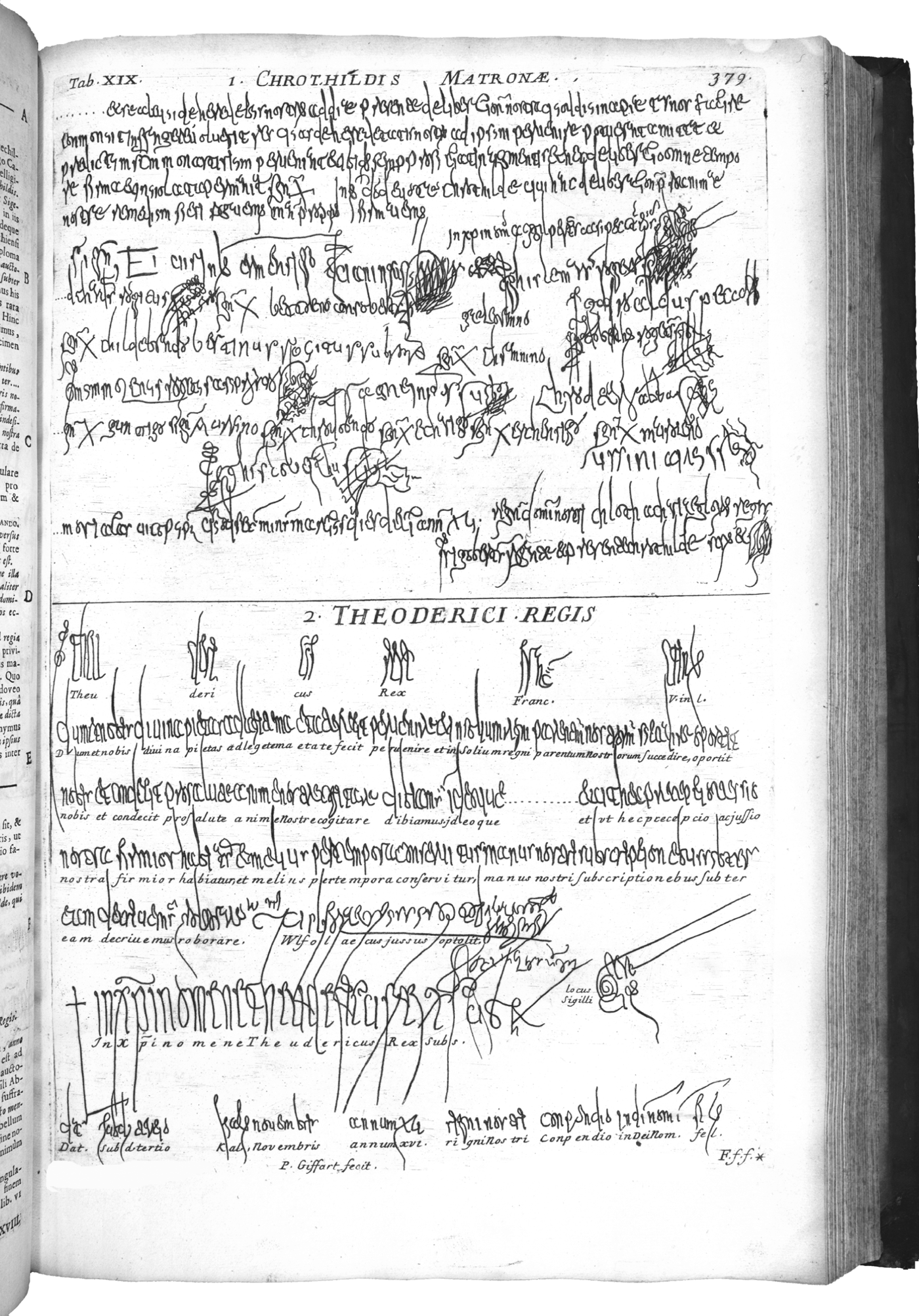
Significantly, Mabillon also invoked the juristic concept of public faith when possible.Footnote 59 He argued explicitly that the papal and episcopal archives were indeed public in the legal sense, even for the earliest periods, and that cartularies and polyptychs from them, like original charters from public archives, therefore provided authentic testimony. He also proposed that although monastic archives could not themselves be called public, they might still contain documents carrying public faith as well.Footnote 60 Provenance from a public archive thus remained one criterion in his assessment of documents, though it lacked the categorical quality that it possessed both in the juristic commentaries and for the ius archivi. The essence of Mabillon's ultimately philological method lay in the comparison of documents in all of their characteristics, rather than searching for a single feature that could disqualify them (as Papebroche did), or for a single source of authentication that could guarantee them (as the ius archivi did). To enable this method, the De re diplomatica contained an archive of specimens labelled as indubitably authentic on the basis of Mabillon's decades of study and his order's unparalleled holdings of very early charters. Seals, signatures, subscriptions, verbal formulae, materials, inks, and hands all received detailed treatment. Mabillon thus provided readers with abundant evidence about what authentic Merovingian and Carolingian documents should look like. His approach found immediate resonance among scholars, who have continued to develop the comparative method through the discipline of diplomatics ever since (Fig. 1).Footnote 61
Two Merovingian charters as reproduced in De re diplomatica. Mabillon provided specimens for comparison that he described as indubitable, thus offering key tools for assessing the authenticity of further documents according to his method (Paris, 1681), p. 379. Photo Courtesy of the Newberry Library.

Mabillon took a moderate position among his peers in two respects. In assessing actual charters, he adopted neither the hypercritical position of the sceptics nor the a priori acceptance of documents by authority that traditionalists demanded. His moderation on this point has been widely recognized.Footnote 62 He also took a moderate position on the more abstract question of the authority of rulers and the utility of their archives. Here, he rejected the sharp separation between legal and historical authenticity that Wilthemius had proposed, which effectively freed the state to set its own standards of proof in disregard of historical evidence. But he did not assume a complete unity of legal and historical truth, either, calling instead for a prudent assessment of documents that took into account both historical circumstances, such as long possession, as well as material features, even if imperfect. Rather than treating the absence of a signature or survival only in a cartulary as grounds to negate the legal validity of titles, Mabillon saw flawed documents as contributing to the legitimacy of possession even when their authenticity was dubious. It was this position that led the English scholar George Hickes to describe the De re diplomatica as ‘nothing less than a manual for the defence, rather than the prosecution, of forgeries’.Footnote 63
Mabillon's magnum opus drew criticism as well as praise immediately after its publication, but a more energetic debate emerged around 1700, most notably with the publication of Barthélémy Germon's De veteribus regum Francorum diplomatibus in 1703.Footnote 64 Germon's lively tract criticizing Mabillon drew considerable attention, judging by its multiple editions and by a popular French-language discussion of the issues, the Histoire des contestations sur la diplomatique published in 1708. Germon laid out seven points on which he found the De re diplomatica unpersuasive, but all of them revolved around one issue: Mabillon could not prove that his specimen charters, the heart of his comparative method, were themselves authentic. Without indubitable specimens, however, it was entirely possible that forgeries were validating further forgeries.Footnote 65 For Germon, the lack of repositories characterized by public faith from the earliest periods represented a critical problem that Mabillon's method could not overcome. ‘Bring me charters from public tabularia, or at least from those that have been constantly protected from the perfidy of forgers’, Germon demanded.Footnote 66 His point was not that all Merovingian charters were falsae, but rather that since none of them were indubitable, no subset of them (including Mabillon's) could serve as paradigms for validating further documents.Footnote 67
Germon's first points questioned the surviving hoards of early charters. He observed that papyrus – the material substrate of many Merovingian charters – was unlikely to survive for nearly a thousand years, as Mabillon maintained, since even stone buildings from that period were long gone. The autograph specimens crucial for Mabillon's method had existed only in one exemplar, or at most two, and the ravages of time and the disinterest of monastic archivists had surely destroyed nearly all. Moreover, that same disinterest had allowed forgers many opportunities to introduce spurious charters in place of authentic ones, as all experts, including Mabillon, admitted.
In his following four objections, Germon insisted that no secondary signs, such as hands, seals, paper, and so forth, could overcome the doubts engendered by the promiscuous intermingling of genuine and spurious charters in monastic archives, which lacked the public faith that could provide certainty. Any quality that Mabillon could identify, forgers could also have identified and made use of themselves: ‘Therefore neither the use of bark or Egyptian papyrus, nor the multiple names of subscribing witnesses, nor the royal seals placed on the earliest charters are sure signs of truth, since, indeed, all of these are shared equally between false and true diplomas.’Footnote 68 Germon here identified a real problem in the detection of forgeries, as later studies have shown. More surprising, though, was his turn back to public faith as the only reliable guarantor of authenticity.
Germon was careful to explain how sacred and profane books might have survived this difficult period, since failing to do so would have put both scripture and the patristic corpus in doubt. ‘The fortune of books and of instruments must have been greatly different. For what pertains to books, they could not all perish at one time since many copies of them are held.’Footnote 69 In the French rendition of the debate, the Histoire des contestations, Germon's defender, the Conseiller, expanded on this point by claiming a novel kind of public faith for old books:
But a book, being written for the public (pour le public), is multiplied as much as possible. Instead of one, or maybe two copies of a charter that one retains, there are hundreds and hundreds of copies of a book that one seeks to scatter … It is necessary, he said, to compare manuscripts not with the charters buried in the archives of monasteries and confided to the care of a single person (un particulier), but with those instruments preserved under public faith (foi publique).Footnote 70
This passage, along with Germon's assertion that publica fides was the only sufficient guarantee for specimen documents, demonstrates the on-going vitality of the concept even as understandings of the public changed.Footnote 71
Archives – divided into the authenticating public and the dubious private – thus played a critical part in Germon's attack on Mabillon's method. This became visible in his seventh and final point of critique. Here, Germon maintained that ‘the repositories (scrinia) from which [Mabillon's specimens] are plucked increase and confirm our suspicions’.Footnote 72 The archive of St Denis was his target, here, since Mabillon cited more ancient charters from it alone than from all other monasteries together.Footnote 73 Germon pointed out that the lists of Merovingian charters produced by different scholars working at St Denis differed, and that Mabillon presented more such charters than were found either in a 1625 catalogue by Jacques Doublet or in an anonymous medieval cartulary originally from the ninth century.Footnote 74 Germon's insinuation was that Mabillon had either forged additional exemplars, or at least failed to recognize some very recent forgeries interpolated since 1625 – an implication that infuriated Mabillon.Footnote 75
In 1708, Mabillon issued a Supplementum to the De re diplomatica that defended his method against Germon's attack by addressing two themes: trust in expertise, and trust in archives. Mabillon began his defence by reiterating the damage that an excessively critical approach could do: ‘Those who seek to lessen the faith and authority of old diplomas and instruments, it seems to me, just as they introduce a great bane into letters, so they violate and pervert both public and private law.’Footnote 76 Mabillon insisted that such evils could be avoided by calling on experienced experts like himself:
Not simply guided by my own cleverness and judgement, nor by the occasional inspection of a few documents, nor by rashly prescriptive examination, nor by the reading of a few days did I begin this work: rather, I entered on my studies and this work by long practice and daily experience over the course of some twenty years, while reviewing and scrutinizing ancient books and archives, and reading collected editions of old instruments.Footnote 77
His critics claimed that no argument could indubitably distinguish true from false charters, but Mabillon maintained that he could, ‘just as an experienced goldsmith can often tell true from false gold simply by touch, the painter an original painting from a copy, or a connoisseur of numismatics the genuine from the spurious on a single glance’.Footnote 78 Rather than the black-and-white world of the jurist, Mabillon here appealed to the judgements of experience as warrant to authenticate his essential specimens.
The second guarantee of authenticity that Mabillon's Supplementum invoked was the continuity of archives. Germon and the other critics sharply distinguished genuine archives from the mere chests held by private actors, but Mabillon demurred. ‘First, I deny that false or interpolated instruments are so common in monasteries or churches, as my opponents accuse.’ Indeed, he noted, ‘our ancestors’ care for archives was great, since the entire fortune of families was contained in them’, and maintained in consequence that certain monasteries had indeed provided consistent and lasting care for the documents still found in their archives.Footnote 79 Among these, none had done a better job than St Denis, which held precious Merovingian royal instruments whose sheer reality – ‘the fact stands firm’Footnote 80 – Germon could not deny.
Mabillon also sought to show that Germon's book hid a more acid scepticism than was immediately visible by turning against him his assertion that only public archives could provide authentic specimens. As Mabillon pointed out, the public archives Germon alluded to actually suffered from the same defect as other monasteries' archives: ‘But I fear that no one can identify any public archive in which certain false or interpolated diplomas are not mixed among the genuine.’Footnote 81 Questioning one paradigmatic specimen could only lead to demands for another specimen, on and on: ‘The same problem would apply to the third, the fourth, and for more: thus, the matter would stretch out into infinity.’Footnote 82 The seeming modesty of Germon's claims, according to Mabillon, thus concealed unbridled Pyrrhonism: ‘Indeed, if we should accept the logic of such arguments, it's all over with the authority of any kind of diploma or instrument, whether having to do with far away ancient times, or with later and more recent affairs.’Footnote 83 Still, Germon had identified an irrefutable weakness in Mabillon's method, and Mabillon in the end had to concede that his method could provide only moral, rather than metaphysical certainty.Footnote 84
V
Two possible responses thus emerged during the debates over documentary authority in the late seventeenth century: a turn to authenticating documents primarily through their institutional status, as proposed in the ius archivi, and a turn to philological examination of individual documents, as proposed by the founders of modern diplomatics. These corresponded, to a certain extent, to disciplinary approaches from law and from historiography. The theory of proof by archive proposed by Ahasver Fritsch and his colleagues gave not the document but the repository and its institutional position a decisive role in the law of proof. Whereas the diplomatists eagerly catalogued seals, subscriptions, and hands, the ius archivi actively denied that such material details necessarily mattered for the authority of a document from a sovereign archive. What Wilthemius had proposed defensively – that a document might retain legal force even if its form or content had been proved false historically – was stood on its head by Mylerus, Fritsch, and Schilter: for them, historical detail could not detract from the institutional and legal authority that sovereignty provided. The discipline of diplomatics emerging in the Low Countries and France, in contrast, concentrated the full power of its erudition on individual documents, relegating archival provenance to secondary status.
Each possibility had significant implications, both for how the consolidating states of eighteenth-century Europe approached the mountains of documents they possessed, and also for further evolution in the forms and in the use of the medieval archivum and its modern successor, the heterogeneous state archive. The assumptions made explicit in the ius archivi treatises correspond to practices of governance through information that characterized most European states in the eighteenth century and beyond. Diplomatics' concentration on documents, not archives, meanwhile, and the resulting division of labour between historiography and diplomatics, made it easier for historians to imagine that the records they drew on provided authentic, though incomplete, conduits to past truth rather than representing the products of mutable historical processes that had taken place in chancelleries and archives.