By most accounts it was not broken, so why did it need fixing? The old China trade, the ‘Canton trade’, was efficient and predictable in its charges and procedures, and it was well regulated. It serviced what was for the British an increasingly important exchange, which produced revenues from monopoly opium sales for British India, and tea duties for the British exchequer, delivered silver for the East India Company at Canton and shipped tea to British drinkers. We have recently been learning a good deal more about this trade and its global position, and getting away from Anglophone perspectives which have dominated accounts to date. Ranged across the Pearl River delta, the trade was headquartered at the Portuguese colony of Macao, active in the foreign ‘factories’ at Canton; ships (and men) were serviced at Whampoa, and opium hulks were moored at Lintin. It was a polyglot, cosmopolitan and profitable arrangement. It served the Qing court, to which was funnelled directly revenue from the Canton customs; it was profitable for the East India Company which shipped out tea, and for the private or country traders, Parsees, Scots, English and the Americans, who shipped in opium; and it was lucrative too for the ‘cohong’ (gonghang), the Chinese official merchant monopoly at Canton, and for the Chinese traders all down the illicit supply line which funnelled deep into China the fast-rising dark-star of the wider Canton trade: opium.Footnote 1
Until the late 1830s, there was a tiny little foreign colony on the riverbank on the south-west side of the great walled city of Canton. Although only formally allowed to lodge there during the trading season, the few-score foreigners were able to do their business, and use this window on China to great effect: as well as commodities – principally tea and silk – information about the empire of the Great Qing dynasty poured out, and not just information gleaned from Chinese books and the court's official news record, but botanical and geological specimens, wildlife and material objects. It was a pretty cosy life, its cellars well stocked, servants attentive and luxury cheap. Members of the Cohong entertained the foreigners well, banqueting them in style, showing them the city's great gardens, serving their varied needs. The foreigners were largely left to regulate themselves, for this was efficient, and was in the general pattern of Qing administrative practice. We have some fine memoirs of this period. American William Hunter's is the most well known. The ‘Fan Kwae’ [‘Foreign Devils’] at Canton before treaty days is an affectionate portrait of his years working there for Russell & Co., and in later years, Hunter can be spotted regaling youthful companions on P&O steamers all the way to China with tales of his twenty years in the east, his ‘manner too of imparting information is so very pleasing & his views of everything display so much good sense that you never tire of listening to him’.Footnote 2 Hunter had everything he needed, and he left China in 1842 with a $200,000 fortune: not bad for eighteen years work, worth a tyro listening to.
This Canton compromise was a peculiar arrangement, but it worked, and it certainly worked for William Hunter. But then along came the Scots, Hugh Hamilton Lindsay and his cohort, and they wrecked it, smashing it beyond repair, and they led Britain to take its ‘place’ in Asia, an ordained place in their eyes, not one subservient to the Qing, or dependent on Portuguese whims. Their impatience brought twenty years of disorder and conflict to south and east China, rebellion as well as war, and brittle stand-offs that passed for peace.Footnote 3 This paper explores the world of this man, Hugh Hamilton Lindsay, the world he helped fashion and the tools with which he helped make change happen. He was an East India Company official, a pamphleteer, trader and MP; he was an innovator, and a risk taker who challenged the status quo. The nephew of the sixth earl of Balcarres, his father, Hugh Lindsay, was eighth son of the fifth earl – which was not exactly an auspicious start in life. But Hugh Lindsay senior was an East India Company mariner, who joined its court of directors in 1814, and was sometime chairman of the company. He would have retired financially comfortable from the maritime service. This elder Lindsay is remembered, if at all, for so strongly opposing the introduction of steamships to the maritime service that the first steamer built in India, in 1829, for running experimentally on the Suez–Bombay run, was mockingly named after him.Footnote 4
The son proved less conservative and as radical in fact as that steamer. Hugh Hamilton Lindsay arrived in Canton in late 1821 as a writer with the East India Company's select committee there. He left the company in 1833, later setting up a business in Canton. With the expansion of the British presence across south and east China after the First Opium War, Lindsay & Co. became one of the most prominent of British firms, riding high and aristocratic, living extravagantly, investing in new markets, pushing hard at the apparent limits to British enterprise in China and later in Japan. Lindsay also directed attention at the developing British presence in Southeast Asia, particularly Borneo. That was to prove a disaster for Lindsay, but a telling one. And his eponymous firm, Lindsay & Co., went bankrupt, spectacularly, in 1865, the highest-profile early victim of the bursting of the great Shanghai bubble as a result of the disastrous outbreaks of peace in both the United States and in China, with the ending of their respective civil wars.Footnote 5 Jardine, Matheson & Co.'s continuing contemporary success and inescapable historical notoriety has obscured the tale of the failures, Dent & Co., and Lindsay's, who formed with the ‘Princely Hong’ the key British commercial triumvirate in early treaty port China.
Lindsay served the East India Company in Canton in the last decade of its formal China trade monopoly, which ended at the close of 1833, so by necessity he had to look to, and shape his own future.Footnote 6 He is routinely noted amongst the advance guard of belligerent British lobbyists clamouring for war with China, and for breaking down the closed door of the Qing. First, in 1832, he led a clandestine East India Company reconnaissance of the southern and eastern ports of China, most famously landing at Shanghai and harassing officials there.Footnote 7 He lectured them on the actual meaning of a term they used when dealing with him, which he insisted on interpreting as ‘barbarian’, when they assured him it simply meant ‘foreigner’. They were being disingenuous: foreigners were barbarians, they were outside the pale of civilisation. This debate about the meaning of ‘yi’ – ‘barbarian’ or ‘foreigner’ – rumbles on yet, but the British later fixed their interpretation in treaty, forbidding its use by Qing officials.Footnote 8 Lindsay also distributed wherever and whenever he could a pamphlet, in bad Chinese (‘pidgin Chinese’ concluded one reader), containing an ‘Account of the English character’.Footnote 9 Sometimes officials forbade people to accept it, but generally those who came to look at or meet the Britons eagerly took copies away. Secondly, Lindsay published in 1840 in London a starkly titled pamphlet: Is the War with China a Just One? It hardly needs adding that his answer was ‘yes’, and in this way Hugh Hamilton Lindsay gifted himself to historians and commentators looking for evidence of British warmongering at the onset of Commissioner Lin's opium imbroglio at Canton. And on the basis of his account of the 1832 voyage he already had form: he was a warmonger's warmonger, the foremost of the ‘war hawks’.Footnote 10 Lindsay even has a walk-on role in Amitav Ghosh's 2011 novel, River of Smoke, as the ‘rubicund’, ‘genial’, president of the British chamber of commerce at Canton. So he is a fixture of the Canton coast in the run up to confrontation and war, in histories of it and in fictions.
This paper first explores the life and character of this ‘courtly’, violent man. It then outlines his activities and assesses his significance in three up-to-now separate spheres in which he or his firm have been discussed: in pre-Opium War Canton, in treaty port China after 1842 and in the ‘Eastern Archipelago’, and more precisely Labuan, on the island of Borneo. Significantly, his operations in the latter two spheres were directed from London, for Lindsay was to retire from Asia in 1839 when he left Canton to lobby for war, although he did not retire from the Asian fray. This is a story of the man on the spot, and what he can do to further imperial expansion, but it also reinforces the point that London remained a key spot, for the men in the East, and a site of British China. And Lindsay never actually saw in person the China opened to wider foreign residence that he had lobbied so long and forcefully for.
Canton and the coast
The Lindsay family – there are scores of them, with a fairly narrow repertoire of Christian names – is hardly obscure, and like Emma Rothschild's Johnstons, it was tightly woven into the fabric of Britain's global empire. Lindsay's aunt, as Lady Anne Barnard, has outshone her husband, mere colonial secretary at the new Cape Colony, with her now well-mined letters and journal, and through acting as hostess for the governor, Lord Macartney. Volume III of the 1849 Lives of the Lindsays contains her memoir alongside accounts of his great-grandfather, fourth earl, governor of Jamaica; the 1780 battle of Conjeveeram (two Lindsays amongst those captured by Tipu Sultan); and the defence of St Lucia against the French in 1779 (uncle Colin), and an escapade of his own father at Canton. Lindsays saw the Cape, India, the Caribbean and China.Footnote 11 And the family was embedded in domestic public life: there were prominent cousins, at various removes, but actively intertwined in his business and private life: Coutts Lindsay, founder of the Grosvenor Gallery; Alexander Lindsay, bibliophile and art historian. When Lindsay & Co. defaulted in 1865, Lindsay turned to the wider family for private support to attempt to prevent official bankruptcy and family embarrassment.Footnote 12 The company itself was then led by his nephew, Robert Crawford Antrobus. So family and business are intertwined: no surprise there. Lindsay as we shall see lived in two overlapping worlds of business, that of familial relations, credit and trust, and that of the still-evolving world of the joint stock company, and a business world in which expectations were changing.
Lindsay's early years are obscure but it seems that he did not graduate from any of the Scottish universities, and possibly studied at Vienna. He certainly knew the university, and spoke German.Footnote 13 His appointment was approved by the East India Company directors in late March 1821, upon the nomination of his father (at the cost of all other patronage rights for the season), and a month later he was on the company ship Windsor heading out east. He arrived in China in September 1821, his first job ‘to assist generally in the office, and weigh and receive teas’. Lindsay served initially as a salaried writer, and from 1829 as a Supercargo earning commission, earning an additional allowance as a student of Chinese.Footnote 14 He seems to have been attentive to this, fancying himself a Sinologist, and speculating about making a future name for himself in ‘Chinese affairs and politics’.Footnote 15 At this point, very few Britons knew any Chinese, or thought of learning it. Lindsay went home on leave in 1825, returning in 1827, and in 1829 he made a visit to Java, which ‘much inchanted’ him, with two Company colleagues.Footnote 16 He left the Company in 1833, part-travelling back on that steamship named for his father, and returned to Canton in 1836 to trade on his own account, as Lindsay & Co.Footnote 17 There he became chairman of a new chamber of commerce (it was his ‘child’ one correspondent noted), and in May 1839 he was one of those who hurried back to Britain to lobby the government to take action against China when Commissioner Lin launched his campaign to stamp out the opium trade.Footnote 18
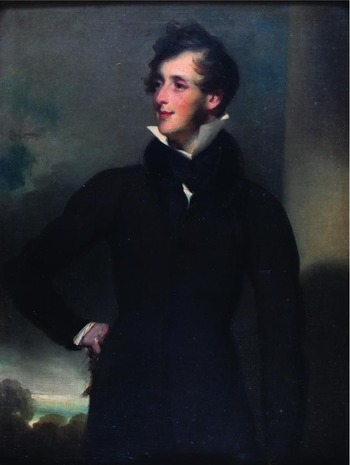
Personally he seems to have been as genial as Ghosh's fictional recreation, described as ‘droll’, and a ‘pleasant person of courtly and polished manners’. He was tall, and handsome in his youth, before China, sickness and perhaps youthful ‘dissipation’ took their toll. (The suspicion is that of an ambivalent admirer's in 1833.) Courtly polish notwithstanding, Lindsay's key contributions are violent, disruptive and challenging. But then he was also seen as ‘always ready, for adventures of any kind’; he ‘has the spirit of adventure most fully developed’.Footnote 19 The artist George Chinnery communicated some of that spirit in his portrait, which seems to date to c. 1827–33 (Figure 1). Lindsay enters history actively in 1832 when together with Karl Gützlaff, a Lutheran missionary from Pomerania, and with the connivance of the outgoing select committee president, Charles Marjoribanks, he ventured east and then north along the Chinese coast in a chartered ship, the Lord Amherst. They stopped at Xiamen (Amoy), Fuzhou and Ningbo, before reaching Shanghai, where they stayed some weeks. Then they sailed north touching the Shandong coast, before sailing across to Korea, and back south via the Ryukyus to Canton. They were away for six months, and the British at Canton were able to chart their progress, for the efficient administrative reporting system of the Qing was frantic with information and reports about the mysterious appearance at the various ports of a British ship, name unknown, those in charge of which included ‘Hu Xiami’ (Lindsay), and Jia Li (Gützlaff) – who spoke good Chinese (and was often thought to be Chinese) – claiming to have come from Bengal and been blown off course.Footnote 20
Portrait of the Hon. Hugh Hamilton Lindsay, by George Chinnery, c. 1827–33, reproduced by kind permission of Sir William Young.

At each port, Lindsay parlayed in Chinese, seeking permission to trade (they carried a large stock of sample products), and all the while distributing their little pamphlet on the British. Local officials tried to blockade them from entering ports, ordered them to leave and generally sent along to Peking somewhat hazy reports about their success in getting the foreigners to go. The ship undertook an ‘experiment’ (Lindsay's term) in violence, in order to get its way at one or two points when war junks were being used to block them. At Shanghai, they lingered longest, and argued most hotly about language and status. Qing officials laughed when Lindsay said or wrote that they came from ‘Great’ Britain – ‘Da Yingguo’ – for the Qing was referred to as the Great Qing (Da Qing), but the Scotsman would object and harangue his generally unfailingly polite hosts with his notions of his own and Britain's status.Footnote 21
Lindsay refused to stand such slights, literally in fact: he refused to stand in the presence of Qing officials if they – conforming with their own notions of their status – sat and did not allow him to do so as well. There was much storming out of meeting rooms, and palaver over physical dispositions in encounters over tea and snacks. The ostensible reason for the voyage, in Lindsay's formal instructions, was ‘to ascertain how far the northern posts of this empire may gradually be opened to British commerce’.Footnote 22 In fact, there were other aims. Lindsay and his supporters were trying to outflank the authorities at Canton, by getting their views about what they saw as British difficulties at that port transmitted to Peking by other officials. Secondly, and related to this, he was disseminating positive information about the British, in Chinese, wherever he could. A copy of the pamphlet did in fact make its way to Peking – but hardly had the desired effect for the emperor found it quite unintelligible. But Lindsay was also attempting to outflank his more conservative elders in the Company, by taking the initiative and heading out of confined Canton along the coast. This was also the twilight of the Company's monopoly operation in China, so Lindsay and his ‘country trade’ supporters were clearly also scouting out opportunities that might be opened in the new era to come. This mystery ship was treated with somewhat surprising restraint, and in the records of the voyage compiled by Lindsay and by Gützlaff it is clear that what violence there was, in words, and in actions, came from the British side.
Those records took the form of Lindsay's official report for the Canton select committee, which was printed too as a parliamentary paper, and then as a book. Gützlaff provided a supplementary account, which he also republished in a later volume containing three such memoirs of voyaging along the closed Chinese coast.Footnote 23 The voyage made Lindsay's name, for it was the subject of much debate in the periodical press, and very strongly informed British and other discussions in the 1830s of the potential of the China market, especially in the north at Shanghai.Footnote 24 It had its critics, who thought Lindsay bombastic, if not at times ridiculous as he sat on his dignity in meetings with officials. They deprecated the episodes of violence, and argued that forcing China further open would be counter-productive. And the whole episode was deceitful and contrary to the laws of the Qing, and led by a man whose argument was that the Chinese were deceitful and ignored the laws of the Qing. For some critics, the hypocrisy was self-evident, and disabling. But Lindsay launched some of the longest-running of British beliefs about what to do in China: that a little bit of violence could go a long way to unpick problems (a navy frigate, or a few Indiamen would do), and that the British needed to assert their dignity and standing to the haughty and arrogant Chinese. And he also reported privately that he could have sold any amount of opium if he had had it to trade.
Lindsay's report and other work, and his private correspondence, was suffused with anger. But why so angry, if the Canton trade could, objectively, work well and smoothly as most observers thought it did? The British, at least a vocal core of them, were angry at being confined to and in Canton, in a tiny trading colony where a man could easily count the width in steps of the only ground allowed for exercise (except a few times a month, when they were permitted to use a garden along the river). They were angry at other personal restrictions, which were intermittently applied with vigour, and they were angry at the seeming obtuseness of their erstwhile hosts, who would not officially recognise them, and would not allow them to communicate directly and formally with officials. Aside from bluster, the only ‘weapon’ the British had was to suspend trade, obviously a double-edged sword. In one dispute in 1829, the committee had moved its ships to Kowloon, opposite the island of Hong Kong. (Lindsay was with them, and concluded that ‘a more advantageous spot for a settlement could not easily be found’.)Footnote 25 In 1831, during another stoppage, Lindsay was ordered back to Canton from Macao to hand over symbolically to the Chinese authorities the keys to the Company's quarters: in a humiliating public spectacle, these were refused.Footnote 26 The committee capitulated as it had in 1829. This was not how Britons expected to be treated, and increasingly for Lindsay and others, asserting British status meant being prepared to do so by force.
Back in England from 1833, Lindsay followed up his Lord Amherst book with a published Letter to . . . Viscount Palmerston on British Relations with China in March 1836. This was part of a concerted broadside of pamphlets fired by the British China traders aching for action, and sparked by the ‘Napier affair’.Footnote 27 The first post-Company British superintendant of trade in China, the bumptious Lord Napier, had tried on his own initiative (though his orders were contradictory and ambiguous) to assert his office and status in Canton, and to secure recognition from the Qing officials. He was stonewalled, pilloried in proclamations pasted on Canton walls, placed under house-arrest and so retreated, ignominiously, his health broken in addition, to Macao, where he promptly died. Lindsay and other belligerents penned angry denunciations of the Chinese, and urged action on the British government. He argued for ‘direct armed interference to demand redress for past injuries and security for the future’, and continued to be precise about the limited means that need be committed: a battleship, two large frigates, six corvettes, three or four armed steamers and 600 men would do. And a ‘lithographic press’: they would blockade, and they would publish explanations of their actions to secure the support of the ordinary Chinese populace.Footnote 28 At the very least, the British should terminate what official presence they had in China, it was expensive to maintain, and insultingly ignored.
As we know, after 1839 the Canton British got their war; the warships (and the printing press) sailed. Lindsay had arrived in China just as the balance of trade was about to tip in favour of the foreign traders. Silver flowed out of the Qing, first slowly, then at rapidly greater and greater volumes, to widespread and destabilising effect. The combined effects of silver outflow and drug smuggling forced the Qing to take action, and that action led to war.Footnote 29 Lindsay churned out pamphlets once he got to London which lobbied for conflict and supported it once launched. All delivered his trenchant view of the violent path to putting relations on an equitable footing, and lobbying hard for compensation for the confiscation of British opium surrendered by Napier's successor to the Qing authorities.Footnote 30 The Canton British got that compensation, and they got out of their tiny reservation on the Pearl River. The road to China itself had already been opened: the Anglo-Dutch Treaty of London in 1824 had secured the status of Singapore, and passage through the straits.Footnote 31 But now, the British acquired bridgeheads within the realm of the Qing. Under the 1842 Treaty of Nanjing, the British acquired Hong Kong island and the Kowloon peninsula in perpetuity, as well as the right to reside and trade in five ports: Canton, Amoy, Fuzhou, Ningbo and Shanghai. Lindsay had seen all of these for himself back in 1832. And there was no Company now. China opened, however narrowly, to all Britons on an equal footing: those already prepared to jump in best placed to seize the opportunity. Lindsay & Co. was ready. The firm now leapt into opened China, acquiring plots in Hong Kong and Shanghai. They constructed what are thought to be the first buildings in the new colony, the Albany Godowns, and secured a good large plot in Shanghai, not on what became the bund, but at the heart of the new settlement nonetheless. In 1845, Lindsay & Co. – its Chinese name given in English as ‘Quong Loong’ (Guanglong) – had three partners, and six foreign staff. In 1859, in Hong Kong alone it had two partners, and nine foreign staff, an office at Fuzhou and a partner and five foreign staff at Shanghai.Footnote 32
Lindsay & Co
Lindsay & Co. took off in the newly opened treaty ports and the colony at Hong Kong. This was a classic merchant house of this era. It dealt in everything: opium, cotton piece goods, tea and held a share of an insurance company. A look at the company's activities through reports in the Shanghai press for a single year, 1852, when the firm was riding high, provides details of its global connections and its concerns. Quang Loong's opium hulk at Shanghai, the Swallow, was moored with the others outside the harbour limits, flying its blue, white and blue house flag. Lindsay had commissioned a London shipbuilder, Richard Green, to build him an American-style clipper, the magnificent 700-ton, 174-foot long Challenger, which arrived on its maiden voyage in June, 108 days out from London, loaded with cottons. On 27 July, it sailed for home, with 625,000 pounds of tea and a thousand bales of silk.Footnote 33 This turned into one of the first of the famous clipper races, as the American Challenge and Lindsay's Challenger raced each other back from Anjer point. With Captain James Killick at the helm, Lindsay's vessel won by two days (under Killick's command, it was regularly two weeks swifter than under his successors).Footnote 34 Challenger was never the fastest of the clippers, but its innovative design set the pace, prefiguring the great ships to come: Thermopylae, Sir Launcelot, Ariel, great names from the triumphant age of sail. The Suez Canal opened in 1869, and until then, and for years afterwards, although the steamers steadily improved, sail carried this intensifying global trade.Footnote 35
Such exchanges continued for Lindsay & Co. throughout 1852 at Shanghai: cotton goods from London; nearly two million pounds of tea to Liverpool, London and Sydney (via Manila); 3,000 bales of silk to London; cottons and opium from India. This was the licit trade, opium apart, which though illicit (hence the hulk moored outside the harbour limits) was effectively tolerated. But even with the licit trade, Lindsays and their staff, like all the British China companies smuggled and bribed their way through Chinese regulations, as the first inspector general of the foreign-staffed Chinese maritime customs outlined in a report in 1862: sixty hogsheads of coal shipped by Lindsays turned out to contain specie, whose export was forbidden, and the coal hid more treasure boxes: all were confiscated.Footnote 36 They and others denied the charges, and blamed individual wrong-doers, perhaps with good cause. But the culture of British and other foreign business in China was not amenable to Chinese restriction, and it was a commercially brave firm that played strictly by the rules.Footnote 37
This was the China trade at Shanghai. But what did Lindsay himself do with his new-found freedom of movement in China? He stayed in Britain: Lindsay had entered parliament for the Tories in May 1841, although he did not do much there: twelve contributions to ten debates over the next two years, and half of those about compensation for opium seized, or justifying that trade. He spoke for the borough of Sandwich, but, as he later put it, entered the House ‘to advocate and support the interests of my brother merchants in China’, and from 1843 until he stood down in 1847, he was silent.Footnote 38 Newspapers provide some glimpses of his life in Britain, public committee activity, presentation at court, hunting gossip, an estate near Chichester, taking a lease on a grouse moor: the life of a man who has repatriated his China trade profits and assumed a place in British public life. But China still needed lobbying for at the centre and a China house needed a British base. China remained distant, and exotic, and British China was too distant from power, and too much in the shadow of British India and its Southeast Asian satellites. Commercial considerations aside, British China needed a China lobby, or, as lobby is perhaps yet too concrete a description here, it needed settled visibility in London if it was to retain effective channels to power, and the ability to support ‘brother merchants in China’. And there in the heart of the empire Lindsay also advertised himself as agent for vessels heading east: shippers to Batavia, Bombay, Hong Kong, Calcutta, Amoy and Shanghai were enjoined to contact his office in East India Chambers on Leadenhall Street. While he had long left John Company, he kept close to its central city location.Footnote 39 At Shanghai and in London, the personal stature of the partners, and their connections into the city, into Indian and into other markets were crucial to the high regard in which they were held.
By 1865, the firm had diversified further, and extended its geographical reach. Lindsay ostensibly withdrew in December 1856, as his private debts by then ‘prejudiced the credit, and interests’ of the firm, although he retained significant capital in the company, and owned its Shanghai property, and was soon in fact back in an influential position within it.Footnote 40 By 1865, Lindsay & Co. had steamers serving the new Yangzi trade, the thousand-ton Fire Cracker and the equally huge paddle-steamer Fire Queen, both built for the company in New York to take advantage of the newly opened river.Footnote 41 The senior partner was their registered owner. There was an office at Niuzhuang, new-opened in the north, property at Hakodate in Japan, a hulk at Hankou, interest in a cargo boat company at Shanghai and more. They shipped sugar, coal, rice, pepper and peas in the coastal and river trade.Footnote 42 Much of this was trade within China, the coastal trade into which such firms inserted themselves, or it was a Southeast Asian country trade, where again the British were well-equipped interlopers. It was not all trade with China. However much the Chinese lapped up foreign manfactures – they loved revolvers and eyeglasses for example – markets for foreign goods remained difficult to access directly. Foreign trading interests diversified their operations, interpolating themselves structurally into existing markets by using their technological and treaty positions (their steamers and privileged tax status) to secure advantages in carrying trades.
The China trade required constant reinvention. Those who failed to change, to leap into newly opened ports or who failed to experiment with different business, soon suffered and fell. With the opening of the Yangzi to foreign navigation, new opportunities were also thrown open, and foreign enterprises leapt in. The early 1860s were gold-rush years. The Second Opium War of 1856–60 threw open new ports. The Times talked up Shanghai as ‘the new El Dorado of commercial men’; clerks in London were impatient to get out there believing on appointment that their fortunes were made – if they lived out their terms in the East.Footnote 43 Lindsay and his firm proved steady and dramatic innovators. The ‘enterprising spirit’ of the man who pushed to get the Lord Amherst up the coast in 1832, led the firm first in to Hong Kong, to invest in the Challenger – the first of the great British clippers – to have it tugged straight to Hankou (Hankow) in 1863 to sail direct from there with the new season's tea crop – at significantly higher freight rates – and to commission the Fire Cracker.Footnote 44 Lindsays were not always first, of course, and they had strong competition, but they were prominent.
Reinvention and innovation were also needed because for all their new advantages – notably extraterritoriality, and the treaty-set low tariff – the foreign firms constantly found themselves outflanked by Chinese merchants who had more capital, knew their markets, knew good technology when they saw it (they loved the steamers too) and constantly edged the foreigner out of his new markets. Jardines, for example, steadily diversified. By 1872, they had largely left the opium trade and the cotton business, moving instead firmly into shipping and insurance and banking (the firm later made private loans to the imperial household). Tea exports would also eventually face debilitating competition from Indian teas, and Jardines switched to providing services for other exporters of tea, as well as silk, as the markets changed.Footnote 45 Change was not forced on the ‘Princely Hong’ by business failure as it was on smaller China fry, such as Little Brothers (who moved out of commerce and into treaty port utilities, and local journalism), or Dow & Co., but the continuing difficulties of competing against Chinese merchants dictated shifting to operations in which the British might have structural or other advantages. New treaty ports were quickly ‘lost’ to Chinese trade dominance. So the British and other foreign traders were always looking for new advantage. Where once they had railed against Chinese and East India Company restriction, now they lobbied hard for protection of their treaty ‘rights’, and for the advantages that this new form of shelter provided them.
So Lindsay & Co. were a key player in British-opened China. And they had flair: the Lord Amherst's reconnaissance set an example that was still pursued three decades on in 1859, when the company's Shanghai partner Alexander Michie took a ship to explore new ports designated for opening in the north, Niuzhuang and Yantai, before the 1858 Tianjin Treaty had been ratified, and before, it turned out to his alarm, the war had actually concluded. Michie had to hop back to safety pretty swiftly. In 1861, he led a Shanghai chamber of commerce foray along the Yangzi.Footnote 46 The shifting topography of China opened to foreign trade demanded this readiness to jump ahead, scout out the land, make new contacts, bag a lot from the consul in the still just-marked-out new British concession, pitch for a wharf site and set to work.
The firm also had style and status. The stately Challenger itself epitomised that for Michie, on his maiden voyage east to join the firm in 1854 as his mail steamer spoke to the clipper in the Straits of Malacca, its ‘shapely back hull and white sails reflecting the morning sun’.Footnote 47 Michie joined a firm in the thick of foreign public life in Shanghai: the chamber of commerce, council, all the public committees, the race club. Lindsay's nephew Antrobus was commander of the Shanghai volunteer corps, and in 1864–5 council chairman. Lindsays also lived well in China: Antrobus had his beagle pack at Shanghai, and made sure he secured a cricket ground (he was no mean bowler). Quaker landowner Thomas Hanbury was shocked at the extravagance of their living at Shanghai: a reputed, and staggering, £16,000 annual housekeeping budget in 1865. Ernest Bowra sailed east in 1863 with Antrobus, ‘the great China merchant’, a gentleman ‘in birth and by position’.Footnote 48 Such panache and gentlemanliness was also good credit-worthiness, and for getting company bills accepted. The property at Shanghai was ‘a magnificent house. All the furniture &tc sent out from England.’ There was no roughing it for Lindsays with their pillared drawing room, which could comfortably host a dance for sixty in 1851.Footnote 49 Everybody was extravagant before the great bust of 1865, though Lindsays seemed to have stood out even from that competitive pack right up until the crash.
The Eastern Archipelago Company
But as Shanghai's small elite community danced in his drawing room, Hugh Hamilton Lindsay in London was battling in court, pamphlet and press to save other investments, and later his own reputation. The focus now needs to turn to Borneo, away from the luxury of Shanghai, to the contrasting difficulties of a start-up mining operation on the island of Labuan. The British enterprise in China was coalescing into a firmer network of port cities. An offshoot of Indian resource, power and trade, it was secured by the Nanjing Treaty and by the Southeast Asian gains of Singapore and Penang, and the London Treaty. It was an increasingly sophisticated operation on the ground. It was headquartered at Hong Kong until the 1860s, after which the commercial centre of balance shifted to Shanghai; indeed, Lindsays relocated their headquarters there in 1861, while the diplomatic focus switched to now-open Peking and the new British Legation.Footnote 50 In 1860/1 the British China presence rapidly expanded into north China and along the Yangzi. After 1859, Japan had been an off-shoot; little copy-cat British concessions had been established there and staffed from China.Footnote 51 Holding all of this together were the treaties, the ‘vigilance’ of British officials and military power, and those ships. And although this was the heyday of sail, it was also clear that steam would be king. P&O secured its mail contracts, and chuffed reliably to Hong Kong and on to Shanghai.Footnote 52 And steam needed coal.
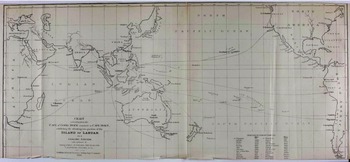
By March 1848, Hugh Hamilton Lindsay was a director, and by the summer chairman, of the Eastern Archipelago Company (EAC), granted a Royal Charter in July 1847 for twenty-one years to develop the resources of the new British colony at Labuan in Borneo.Footnote 53 In March 1848, the company advertised a share issue. Their key interest was that necessity coal: coal for the royal navy, coal for the P&O (whose directors publicly supported the new company), coal for Singapore, coal for Hong Kong, coal for the ocean highway to Australia. Coal, in fact, for the world: in a telling map published in one of its later annual reports showing the ‘advantageous position’ of Labuan as a coaling station, the island was pictured at the centre of a global network of steamship routes (Figure 2), and such maps mesmerise.Footnote 54 That slow old bucket the Hugh Lindsay (which could carry coal for five days’ travel) was now an antique, and though its successors ate their coal more efficiently, there were many more of them, moving more regularly and swiftly. The company had secured the charter, although its founder Henry Wise – former East Indiaman and London agent and publicist of Sir James Brooke, the ‘White Rajah’ – had secured the Labuan coal concession in his own name. Wise, who is widely credited with having made Brooke's reputation in Britain through his publicity efforts and lobbying, assembled a board of prominent directors, including Lindsay. The two men had known each other for some thirty years. Wise was placed within the new company as managing director (on a fine salary) and was largest shareholder, but now there developed a very tricky situation. Not only did matters proceed very slowly on the ground, for the company was undercapitalised and did not provide sufficient resource to its agents who confronted steep logistical and environmental challenges in Labuan, but a spiralling and multifaceted dispute between Wise and Brooke proved crippling. Brooke had first arrived in Borneo in 1839, and by 1842 had secured the governorship of the territory of Sarawak from the sultan of Brunei in return for his armed intervention to suppress rebellion. The Briton had parlayed promises of position into a perpetual personal grant of territory, and then used it to lever official British support for his gains. While Brooke, as even one of his friends admitted, had ‘as much idea of business as a cow has of a clean shirt’, he knew a potential threat to his new-consolidated position in Borneo when he saw one: a chartered company that he did not control.Footnote 55
Labuan at the centre of the steamship world. Source: frontispiece to Sixth Annual Report (Year Ending 30th June 1854) of the Directors of the Eastern Archipelago Company (1855).

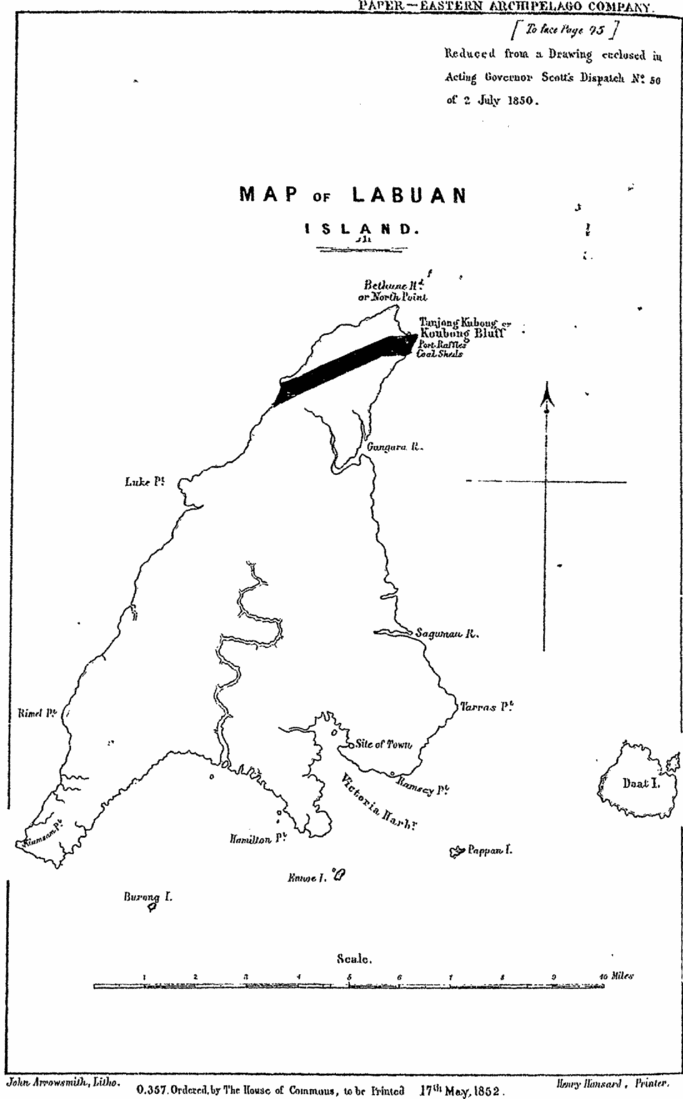
In the aftermath of the railway crash, and other joint stock company scandals, and the 1847 financial crisis, 1848 was a very bad year for a new company to try and raise funds.Footnote 56 Its charter had already provoked opposition from two chambers of commerce which opposed this seeming new grant of colonial monopoly, an East India Company in the making. Only a chartered company could manage this major task of colonial development, countered the Board of Trade.Footnote 57 But by November 1851, the EAC had shipped out barely 8,000 tons of coal, half to Singapore, a little to Hong Kong, the rest to navy ships at Labuan, and these had mostly to load it on their ships’ boats from the beach and scull it out and haul it aboard.Footnote 58 One of their managers at Labuan, James Motley, rather more involved himself in the island's natural history than its coal, to notable scientific effect it might be said; the other (his brother) paid the staff with cloth, to his alleged private profit. Labuan's potential remained hypnotic; the island ‘appears one immense coal field’, reported one of the company's agents from the island. The seam the EAC had begun mining was pictured ranging across the entire northern peninsula of the colony (Figure 3). But excavating this black gold was proving a ‘beastly’ process.Footnote 59
Labuan, island of coal. Source: ‘Map of Labuan island’, copy of sketch enclosed in despatch from the officer administering the government of Labuan to Earl Grey, 2 July 1850, in Eastern Archipelago Company. Copies or Extracts of All Correspondence . . ., Parliamentary Papers, 1852 (357), facing 95.

James Brooke proved Lindsay's undoing. Having tried and failed at the China trade himself, Brooke had made his name and way in Borneo, and was ‘rajah’ of Sarawak. He had also now secured British recognition, rode high in public esteem and was governor of Labuan from 1847, and Borneo consul general. He and Wise comprehensively fell out by the middle of 1848, and Brooke attacked Wise through the EAC, which, besides being a vehicle which clearly enriched Wise before a single piece of coal had been lifted, also presented that clear political challenge to Brooke's authority. The company's slow progress in Labuan proved bad enough, for Brooke as governor moved to get it stripped of its charter on those grounds in various official dispatches starting in January 1850, though the Colonial Office saw no need and rebuffed him in January 1852.Footnote 60 But Brooke had an ace up his sleeve, and he then played it, for he knew that the directors had taken a risky short-cut in July 1848 by certifying to the Board of Trade that the Company had capital of £51,000 paid up as required under the terms of its charter. It had not: the money market in early 1848 had not delivered. Lindsay later commented on ‘the utter horror and suspicion with which the public look at all joint-stock companies since the great railway crash; hence the utter impossibility of getting the public generally to take shares and advance money’. So, they ‘purchased’ Wise's existing plant at Labuan, against his future salary, royalties and shares, and presented that debt to Wise, for it was nothing but that, as capital. This was not desperately unusual for its time, but such creative accounting proved the charter's undoing.Footnote 61
Lindsay was the public butt of the scorn that came to be directed at this certificate, news of which sparked a prominent debate highlighting anxieties about the morality of joint stock enterprises which were already under intense scrutiny as a result of the railway crash.Footnote 62 Despite consistently asserting that they had Board of Trade approval for this measure (which its legal assistant, later chancellor of the exchequer, Sir Stafford Northcote, did to an extent attest to), Lindsay and his colleagues were widely criticised in parliament, initially at Brooke's instigation through MP Henry Drummond, and the press.Footnote 63 Two withering commentaries in The Times in the summer of 1852 inflicted grievous wounds. Lindsay appealed to its editor, ‘as one gentleman to another’, to read the voluminous documentation justifying their action that the Company published, and to undo these ‘unjust attacks upon private character’, but to little avail.Footnote 64 In return, Wise and others attacked Brooke, and he and his supporters attacked them and their staff in Borneo. Lindsay had tried to get personality out of the dispute in meetings and in correspondence with Brooke. ‘Well, you advise arbitration’, Brooke wrote to him, as he did, but there was nothing to arbitrate: ‘Mr Wise has behaved ill and [for] that he will pay the penalty.’Footnote 65 Lindsay delivered the last of his pamphlets, assailing Brooke for abuse of his government office in attacking the company.Footnote 66 But Lindsay's reputation was hammered, and, equally to the point, so was his pocket, to the tune of at least £12,000 by the summer of 1851, and probably a great deal more by 1854.Footnote 67 It all came out, and as news of their sleight of registration hand was made public in 1851–2, the court cases began: a shareholder demanded his money back (he failed); the crown moved to annul the charter. Brooke appeared as a witness. The legal struggle lasted two years, reputations were technically restored, but the removal of the charter was confirmed in 1854.Footnote 68
Brooke nonetheless proved a vulnerable opponent, for the allegations launched against him in this struggle led to his dismissal as governor of Labuan in 1852 and surrender of his other official appointments, which he had clearly abused, and more seriously to an 1854 commission of enquiry in Singapore, at which Wise provided damaging testimony, returning the earlier favour in London.Footnote 69 Brooke survived this, but not without humiliation and lingering questions about his actions and character. He was attacked as a tyrant, who had executed indigenes without due process, and who had with royal navy support massacred ‘pirates’ at the 1849 ‘Battle’ of Batang Marau, when the royal naval steamer Nemesis (which had made its devasting debut during the Opium War in the waters around Canton) confronted and destroyed a large fleet of Dyak ‘pirate’ canoes.Footnote 70 He slapped back that his accusers were exploiting labour, were simply incompetent and had lied to secure confirmation of their charter. This personal quarrel between Wise and Brooke became a public dispute about slavery, freedom and tyranny. British empire in Asia had opened up routes for free and unfree migration: Chinese poured out of the empire of the Qing in the hungry 1840s to what they called ‘Old Gold Mountain’ (San Francisco) and ‘New Gold Mountain’ (Australia/Melbourne). British ‘Coolie traders’ – often conveniently badged as Spanish, and so at a technical remove from the reach of British officials – turned a blind eye to the press-ganging of men by their contractors into the ‘Barracoons’ at Xiamen, to be shipped off to Peru, Chile or Cuba. The new British infrastructure – laws, colonies and concessions, steamer routes – facilitated this fast-developing movement of people. The EAC recruited labourers from Bombay and Malaya; and we can always easily get a thousand Chinese, reported Lindsay to one Company meeting.Footnote 71 Officials moved to contain and regulate the trade as new press networks disseminated accounts of abuses and alleged abuses. But such anxieties and scandals of empire provided a further layer to the EAC dispute.
Brooke won the initial battle, comprehensively. The charter was removed, and without it the Company could not long survive. And Welsh coal proved cheaper at Hong Kong than Labuan's. In early 1857, it went into voluntary liquidation. Lindsay had thrown in good money after bad and lost out.Footnote 72 Wise did alright. In the midst of the crisis Lindsay surrendered his China partnership, temporarily it turned out, leaving a substantial amount of capital in the firm but clearly separating Lindsay & Co. liabilities from his own.Footnote 73 However, as noted, he seems swiftly to have regained an influential role within it. This Labuan episode was a disaster, but Lindsay had actually made the right call. His vision of British Asia was joined up: Labuan, Singapore, Hong Kong, Shanghai, hubs and out-stations of an integrated system. Lindsay & Co. acted as agents for the EAC in China, his nephew Antrobus attesting in 1855 to the strong demand from steamers at Hong Kong that the company could profitably meet.Footnote 74 But the EAC showed that while a entrepreneur like Henry Wise might work a joint stock company to his own signal advantage, it also proved that the Lindsay style, the old China coast style, of impulsive adventuring, would no longer suffice. It could not adequately serve the furnaces of the P&O and royal navy steamers: that needed smart, careful and efficient management, and technical expertise on the ground that did not overly dally with ‘shells insects and birds’ as Motley had; it needed resource. It certainly needed inspiration and imagination, but that was not enough. We start to move into the era of British consolidation in Asia, although China remains a shifting imperial frontier for a decade yet, and Lindsay himself does not fare so well.
Conclusion
The 1850s proved up and down years for Lindsay & Co., but in 1865 like many others, they were caught as the Shanghai bubble popped. It should have been too big to fall, or at least too grand: ‘When houses like Lindsays’ fail & Dents’ retrench, . . . nobody can consider himself safe’, wrote one smaller player on the China scene as the firm crashed.Footnote 75 Lindsay sold his horses, fired his servants and tried to salvage what he could. Coutts Lindsay and Lord Lindsay declined to throw him a family lifeline, and the bankruptcy was a public affair. There was a lingering taint of impropriety in the last days of the company – ‘accusations of fraud and dishonesty’; bill transactions which were ‘the common talk of the city’ – which caused family rupture as Lindsay distanced himself from Antrobus, who had the ‘entire management of the firm’ in his hands. Thereafter, Lindsay's was a quieter life. He is listed as a registered broker in London in 1866, and remarked on as such in 1873, operating at Lloyds, but I find little else before his largely unremarked death in 1881: unremarked in China; unremarked in Britain except in The Times as the former member for Sandwich. There was nothing there on China, or on Labuan.Footnote 76 Lindsay slid out of the China trade world that he had so contributed to shaping. His last public China contributions that can be documented were in February 1860, and in 1863. Just elected a fellow of the Royal Geographical Society, on the nomination of John Crawfurd who had in fact long before mocked his Lord Amherst report, Lindsay delivered a paper sent by Alexander Michie about the abortive foray to the Gulf of Bohai in 1859, and the attention of the meeting was drawn to Lindsay's own long-ago foray into China incognita, but there was really little he could usefully now add to any discussion.Footnote 77 And in 1863, he proposed a motion calling for cuts in tea duties at a public meeting in London, but otherwise there seems to have been silence.Footnote 78
Silence seems strange after his decades of shouting. The British struggle in China was partly a war of words, fought on the walls of Chinese cities, in pamphlets handed out from the ‘Lord Amherst’, or from naval boats, and fought across the globalising world of the Anglophone public. The installation of the Canton select committee's new Chinese-language printing press at Canton, it was remarked in 1831, ‘may be regarded as forming a new era in our connections with China’. ‘We have the means if we have the inclination’, they claimed, ‘to throw off in a few hours, any number of copies of any document in the Chinese language.’Footnote 79 So they did: the British threw off broadsides from their armed steamers, and then rowed to shore and handed out leaflets explaining why. Their pamphlets, handbills and posters were aimed to bypass local officials, notably at Canton, in order to reach ordinary city people and merchants, as well as higher officials. They tried to create a public debate, by breaking the Qing monopoly on information about the British. Lindsay was a self-conscious actor in this struggle, and knew the importance of words. He pamphleted in London, broadsiding the peacemongers, old John Company, the Chinese and later Sir James Brooke. He knew this was a struggle about representation, in the field, and at the centre, and he played his role. Words also followed deeds: reports, letters, delivery of the intelligence that he had garnered in the form and with the conclusions he wanted, of course. Lindsay worked to make China visible in texts and to sketch out his vision of a better and more secure British position in China, and he also contributed to the representation of China with exhibits at the Great Exhibition and then the Crystal Palace at Sydenham.Footnote 80 Words marked deeds too. He renamed parts of the landscape: Gützlaff Island, Marjoribanks Bay were inscribed on the charts the Lord Amherst brought back from the coast. And there is also a spotted kingfisher named for him, a memorial of his 1829 trip to Java.
Lindsay also stands out for the force of his anger, and for the argument that the British problem with and in China lay not simply in Qing ‘obduracy’, but in the fact (as he saw it) of British ‘degradation’. National honour, he argued, was demeaned by British acceptance of Chinese restriction. Lindsay and his allies sought to make the Chinese understand who they were dealing with, who the British actually were: and when words alone failed, those should be joined with violence. For only then, it seemed, would the pacific character of the British – who had ‘no thirst for conquest’ as Marjoribanks's pamphlet put it – be understood.Footnote 81 ‘Our object in China is commercial intercourse, not territorial aggrandizement’, Lindsay reiterated in 1840. He is not the last of the angry men in the history of Sino-British relations, nor was he the most damaging; that was probably the villain of the Arrow War, Harry Parkes, but he remains a prominent and noisy voice all the same. Lindsay's vision of a British China was one in which there was armed security for ‘free and liberal’ commercial intercourse. An ‘insular possession’ – an island seized from the Chinese – might be necessary, if the Chinese would stand it, another Gibraltar might be developed, although he argued that if the British ‘planted our flag’, then ‘our career of British India would be repeated in China’. Perhaps there was glory to be had there, perhaps if ‘light shines upon them from abroad’ then
how bright a page would such a consummation emblazon for us in the history of nations! To see so many millions of our fellow-creatures, now wrapt in darkness, pursuing the onward march of improvement in morality, science, and arts, but, beyond all, adopting the pure tenets of Christianity, would be a triumph indeed.Footnote 82
Others toyed with this view. And there was a moment in the early mid-1860s when it seemed as if the flag would be decisively planted, and some talk of how much better a British China would be than a British India, but the moment passed, and the Qing state re-strengthened itself. The bloody horrors of the Anglo-French occupation of Canton in 1858–61 proved for some, such as H. N. Lay's successor Robert Hart, that ‘cooperation’ was the only course.Footnote 83 But what Lindsay mostly and steadily aimed at was not possession but security, a commerce placed on an ‘equitable footing’ in which the British ‘dictate the terms’, and always he lobbied for the prohibition of those opprobrious and insulting epithets that he discoursed about repeatedly.
Lindsay operated at the cusp of wide-ranging structural changes: change in the China trade, change in Sino-foreign relations, technological change, the spatial reorganisation of British power in East and Southeast Asia, changes in the organisation of capital and of legal frameworks. The British dictated most of the terms of that change. He was operating in advance of change too, and at least in times in advance of societal consensus on the propriety of innovative new structures and practices, and as entrepreneurs like him seized opportunity and courted controversy as law and governance struggled to keep up with the consequences of the new order in Asia. Controversy could not but follow. Lindsay had entered the fray through the old world patronage system of the declining East India Company, but he proved to be a modern. For Lindsay, unlike William Hunter, there was no good life at Canton. The trade was not efficient and predictable, but even if it was, his understanding of the British character, and his performance of it, meant that he could not tolerate the restrictions placed on the foreigner at Canton, accepted by his superiors, and on Britons generally though subservience to the old company monopoly. He attacked India House as he attacked the viceroy's Yamen at Canton. For Lindsay, this was the ‘period of our degradation’: opportunity motivated him, but anger and pride shaped his actions, infused his language and stoked his anger.Footnote 84 Lindsay saw Asia, saw it whole, and interconnected, and saw a new place in it for Britain, and through war and commerce set out to make it a British Asia. He fought both Qing and East India Company monopolies, substituting in their place a free-trade enterprise that smashed laws and customs. He is in some ways a gift for fictions.
It is worth comparing Brooke and Lindsay briefly. Both were sons of the Company. Brooke, the younger by a year, was born in it, and served it in India. Raised in England from the age of twelve, he entered the Company military in 1919, two years before Lindsay sailed east. Lindsay was better born, and certainly better educated. Both made their way in Asia as the East India Company declined, and both went forward beyond the accepted frontiers of empire, scouting out the territory beyond. They were young men in a hurry at the close of monopoly and the opening of a region that could be Britain's, with flag or traders planted, and that they intended to stake their own claims within. Brooke sailed in his armed schooner Royalist, Lindsay on the Lord Amherst. Both were also self-publicists, publishing manifestoes and apologias, sketching out grand visions of how Asia could and ought to be changed by Britain. Obviously, there was a world of difference between Shanghai in 1832 and the Borneo James Brooke first saw in 1839, but both men sought post-Company roles in the new spheres in Asia that British power was opening up, and lobbied for that deployment of British power, arguing in words and showing in deeds what might be done, and in both cases they were happy with necessary murder, with the use of the Nemesis and its like, whether against Dyak ‘pirates’ or the recalcitrant Qing.
Brooke's sultanate and interventions in Borneo proved an easy target for political radicals, and his is the more flamboyant contribution to British imperial history. But Lindsay was arguably a more important figure: the 1832 foray put north China on the British map – literally, for their surveys of harbours and estuaries provided pioneering charts, used by the British war fleet in 1840–2. And he then put deeds to words. There were other lobbyists and warmongers, and other firms leapt in, and lasted. But with Hugh Hamilton Lindsay, we have the angry vision of an Asia that needs transformation, and a voice demanding change and detailing how to effect it; a voice challenging Chinese law and British weakness, challenging the Chinese language, even, a voice for violence. He was a man out for his fortune, and on the make, but a man powerfully driven by notions of what it was to be a Briton when faced with Asia, and how Asia was to be reshaped on ‘British terms’, and British assumptions and practices reshaped too, and driven to deliver a true account of the British character. That specific vision of the British character, angry, violent, visionary even, might then stand as his legacy, given its impact overall on the history of British relations with China.