Introduction
The aim of this study was to explore aspects contributing to experiences of safety in everyday life among a sample of older adults who have received home modification services.
To feel safe in everyday life is of great importance for older adults' wellbeing (Dahlin-Ivanoff et al. Reference Dahlin-Ivanoff, Haak, Fänge and Iwarsson2007) and for enabling independent living in their own homes in the community (Cheek, Ballantyne and Roder-Allen Reference Cheek, Ballantyne and Roder-Allen2005; Fonad et al. Reference Fonad, Robin Wahlin, Heikkilä and Emami2006; Socialdepartementet 2008). In Sweden (Socialstyrelsen 2008), Europe (Kinsella and Velkoff Reference Kinsella and Velkoff2001), North America and most parts of the Western world (Gitlin Reference Gitlin2003; Kinsella and Velkoff Reference Kinsella and Velkoff2001), the political strategies during the past decades have been targeted at enabling older adults to age in their own homes, i.e. ageing in place. Research has shown that the home is regarded as a central, meaningful and important place for older adults (Cutchin Reference Cutchin2003; Dahlin-Ivanoff et al. Reference Dahlin-Ivanoff, Haak, Fänge and Iwarsson2007; Rowles Reference Rowles2000; Rubenstein Reference Rubenstein1989). However, as people age the ability to perform everyday life activities decreases (Femia, Zarit and Johansson Reference Femia, Zarit and Johansson2001; Jagger et al. Reference Jagger, Arthur, Spiers and Clarke2001) and the possibility to live in a private home could be threatened (Fonad et al. Reference Fonad, Robin Wahlin, Heikkilä and Emami2006). Feeling unsafe in the home and in the performance of everyday life activities has been identified as a large threat to ageing in place and also as a reason for moving to sheltered housing (Cheek, Ballantyne and Roder-Allen Reference Cheek, Ballantyne and Roder-Allen2005; Fonad et al. Reference Fonad, Robin Wahlin, Heikkilä and Emami2006; Socialdepartementet 2008). Despite the importance of safety for enabling ageing in place for older adults there is, however, a great lack of scientifically based knowledge of how challenges to safety at home can be understood and how safety can be facilitated.
Society offers a broad variety of interventions to enable older adults to age in place safely. Home modifications are interventions with the purpose of facilitating a more independent performance of everyday life activities (Svensk Författningssamling 1992). The intervention includes adaptations to the physical home and immediate outdoor environment (Boverket 2005). Research has shown that various technologies such as home modifications and assistive devices can help to increase safety in everyday life. In an earlier study by Petersson et al. (Reference Petersson, Lilja, Hammel and Kottorp2008), it was found that people ageing with disabilities perceived their everyday lives as safer after receiving home modifications, especially in activities related to transfers and personal hygiene. In addition, studies on assistive devices have identified a positive impact of technology on facilitating a safer and more secure occupational performance (Gitlin, Swenson Miller and Boyce Reference Gitlin, Swenson Miller and Boyce1999; Häggblom-Kronlöf and Sonn Reference Häggblom-Kronlöf and Sonn1999). These studies indicate that technology has an impact on safety in everyday life. Thus the studies do not provide an understanding of how older adults, from their own perspective, experience safety in everyday life and how challenges to safety are experienced.
This present study was included in a larger research programme studying impacts of home modification services for older adults during 2002–08 in Sweden. The research programme had a quasi-experimental design and included a total of 114 older adults, divided into one experimental group receiving home modification and a second comparison group not receiving the intervention. The participants were followed longitudinally, and both quantitative and qualitative data of the participants' everyday lives were collected in three sessions before home modification installation as well as after the installation. Main outcomes from the intervention study showed that older adults receiving home modification rated their everyday lives as less difficult and safer, although how safety was perceived and experienced after home modification remains to be investigated (Petersson et al. Reference Petersson, Lilja, Hammel and Kottorp2008). In the research project as well as in this present study the concept of safety is viewed as the individuals' own self-perceived experiences of safety in everyday life. The experiences of safety are therefore discussed in relation to how they perceived their safety in different everyday life activities such as transferring outside the home or showering, and aspects contributing to their experiences of safety in these situations.
Methods
Design
This study was conducted by applying an explorative qualitative design influenced by grounded theory (Glaser and Strauss Reference Glaser and Strauss1967) and a hermeneutic interpretative approach as described by Ödman (Reference Ödman2007). The study was approved by an Ethical Committee.
Participants
The participants in this study were recruited from a previously presented research programme studying impacts of home modification services for older adults. The recruitment process for the project has been described in more detail elsewhere (Petersson et al. Reference Petersson, Lilja, Hammel and Kottorp2008). Inclusion criteria for this specific study were that the participants had to: (a) have ended their participation in the longitudinal research project, (b) have received their applied home modification, (c) be over the age of 65, and (d) have reported lack of safety in any of the 18 activities in the Client-Clinician Assessment Protocol (C-CAP) Part I instrument (Lilja Reference Lilja2002; Petersson et al. Reference Petersson, Fisher, Hemmingsson and Lilja2007), in at least one out of the three data collections in the longitudinal research project. The C-CAP is an instrument that assesses a client's ability to perform everyday life tasks in the home environment. The instrument consists of four parts that are administered separately. In C-CAP Part I, which has been used in this study, the clients rate their safety, difficulty, and independence in the performance of 18 activities (personal and instrumental activities, mobility and leisure). C-CAP Parts II–IV consist of a professional observation of activity performance and environmental aspects (Lilja Reference Lilja2002).
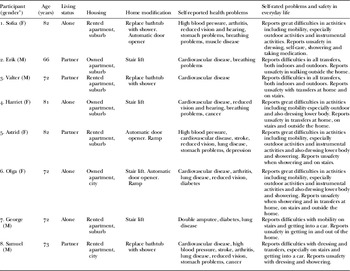
In order to provide variations in the participants' demographics, differences were sought in age, gender, housing and social situation, urban and rural areas, as well as in home modifications received. The potential participants were selected from the longitudinal research programme on the basis of the inclusion criteria and the demographic characteristics requested for this qualitative study. The first author contacted potential participants with an information letter. The letter was followed by a telephone contact obtaining verbal consent for participation and booking the interview. The participants were included in the study one at a time in order to enrich and fill gaps in the data and emerging categories until saturation was reached (Glaser and Strauss Reference Glaser and Strauss1967). Point of saturation was met when no new experiences of safety emerged in the data, resulting in a final sample of eight people. The participant characteristics are presented in Table 1.
Characteristics of the participants

Note:
1. M: male; F: female.
Data collection and analysis
Data were collected through interviews in the participants' homes in two sessions by the first author. The interview was conducted after the participants had ended their involvement in the longitudinal research project. The participants had received their home modification on average 12 months before the first interview. An interview guide including open-ended questions directed at experiences in everyday life (Kvale Reference Kvale1996) was used in the first interview with all participants. The guide included questions related to everyday life such as: ‘Can you tell me about an event or task where you felt safe?’, ‘Why did you choose this situation?’, ‘Could you describe something that makes you feel safe?’ Probe questions were used in combination with the open-ended narrative questions in order for the participant to describe the activities or situations in more detail, for instance ‘Can you tell me more?’ After the first interview the data were read and discussed by the authors. This discussion indicated further directions by: (a) providing a foundation for the follow-up interview and (b) guiding the inclusion of additional participants in order to enrich the data. The guiding principle was to search for as many differences in characteristics as possible (Glaser and Strauss Reference Glaser and Strauss1967).
In the second interview, conducted about two weeks after the first interview, an individual interview guide based on the first data collection was applied. In this interview the researcher invited the participant to further develop and describe aspects that emanated from the first data collection or to reflect on new aspects related to safety (Glaser and Strauss Reference Glaser and Strauss1967). The interviews lasted between 25 and 65 minutes. The 16 interviews were tape-recoded and transcribed verbatim immediately after completion.
The data were analysed using a comparative approach (Glaser and Strauss Reference Glaser and Strauss1967). A comparative approach is characterised by making comparisons at each level of the analytic work. The purpose of going back and forth in the data is to find similarities and differences in the data. In the first phase, all interviews were read very closely until the authors felt they had a good grasp of the data and were oriented in it. In the second phase each participant's data were coded. This analysis started with a line-by-line coding (Strauss and Corbin Reference Strauss and Corbin1998) of sequences that were of interest for this study. The aim of the study guided the coding process. Data that were not included in this analysis were related to other topics such as data on family members' interests. During the line-by-line coding the data were labelled with active codes close to the participant's own wording, i.e. an attempt was made to describe what was going on and what this meant for the participant from an inside perspective. After coding all participants' data, the codes and contents were compared and similar codes were brought together. In the third phase of coding the most significant codes from all participants were identified through a constant comparison of the initial codes and the data. Codes were compared on the basis of similarity and were explored and developed into categories. Each category represented a set of codes with a related context. This step included moving back and forth, constantly comparing and re-examining data within and across categories. This verification was done to make sure that the results remained close to the participants' experiences and to make sure that there were no data overlaps. In the next phase each category was carefully examined and sub-categories identified.
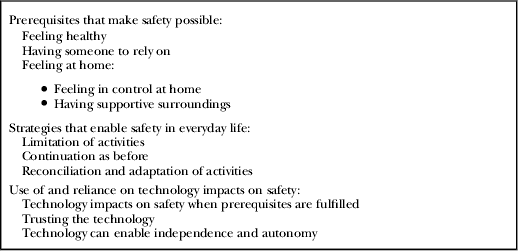
Three categories and sub-categories contributing to experiences of safety in everyday life were identified. Finally, as a last step in the analysis the categories were interpreted by applying an approach from the hermeneutic tradition (Gustavsson Reference Gustavsson1996). The hermeneutic approach was applied to learn about possible interpretations related to the structure and relationship of the categories and their impact on safety in everyday life for older adults.
During the data collection and analysis process, as described above, the three authors held continuous discussions related to the quality of the data and different coding and interpretation possibilities. By continuously moving back and forth between the data and the emerging categories and interpretations the authors made sure that the findings were grounded in the data (Kvale Reference Kvale1996).
In order to investigate the validity of the interpretations of the structure and relationship of aspects influencing safety, a criterion by Gustavsson (Reference Gustavsson1996) was used. In analysing the data, several possible interpretations were formulated and applied as possible explanations related to the findings. The criteria stated that the interpretation of the structure and the relationship between the aspects influencing safety which was finally chosen had to provide the most fruitful explanation (Gustavsson Reference Gustavsson1996). This meant that the interpretations were continuously checked and revised according to the search for the most gainful explanation.
Findings
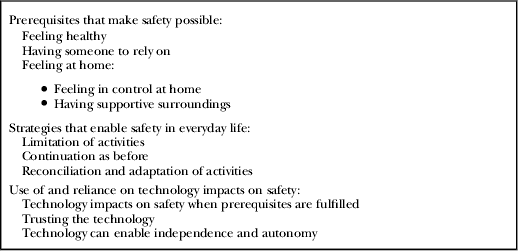
The findings in this study describe aspects contributing to experiences of safety in everyday life for older adults receiving home modification services. The analysis identified three categories with sub-categories, all related to each other and all impacting on safety. Table 2 shows a summary of the findings.
Summary of categories and sub-categories contributing to experiences of safety in older adults' everyday lives after home modification
Prerequisites that make safety possible
The participants' experiences of what contributed to safety in their everyday lives were shown to be founded on, and supported by, what can be described as some prerequisites. These prerequisites should in this study be seen as fundamental for the participants' experience of safety. The prerequisites had three characteristics – feeling healthy, having someone to rely on, and feeling at home. The present status of these three prerequisites was found to be more or less developed and supportive for the participants, and their status profoundly affected the experience of safety. The three prerequisites were also found to impact on and serve as a foundation for the participants' strategies in handling problems in everyday life and their abilities to use and benefit from technology. These findings will be further described.
Feeling healthy
All of the participants had some form of functional limitation or illness, but despite this most of the participants regarded themselves as healthy. Feeling healthy was related to their ability to handle everyday life activities as they wished – not necessarily independently, but with a feeling of satisfaction. Reliance on their ability to handle everyday life activities were established when experience showed them that they could in fact carry out the activities they wished to perform. This reliance on one's ability facilitated a feeling of safety in everyday life. A person who showed this line of reasoning was George. George was a double amputee and had several illnesses, among them diabetes and lung disease, but nonetheless he regarded himself as healthy because he could handle activities, and that made him feel safe. George expressed it like this:
My safety lies in my being as healthy as I am. So I can take care of myself properly … It's jolly good to be able to prepare my food and not need to have someone from the home help services come over with packaged meals. Now I can cook exactly what I want, and eat when I want to, and I think that's fine.
Most of the participants felt like George. However, some differences were also found. Contrary to the other participants, Harriet felt that she could not rely on her ability to handle everyday life activities. She had heart problems which reduced her endurance and she did not rely on her body to be strong enough to perform certain activities such as climbing stairs and getting about outside the home. This lack of trust in her own health and in her ability to perform everyday life activities created a sense of feeling unsafe.
Having someone to rely on
Another prerequisite for experiencing safety in everyday life was to have someone to rely on. This someone was often a family member like a spouse or child, but it could also include other people who were close to the participants, such as friends or even neighbours or professionals working at the health-care centre. In the participants' descriptions it was revealed that it was not the people per se who made them feel safe, but rather the notion that people would support them if a need arose – that they could rely on someone to help when necessary. To live with a partner provided a feeling of safety. The trust in the partner was often based on a long-term relationship and experience of exchanging help and support from the partner. The participants who lived alone and therefore could not place their trust in a partner had instead established other social safety nets. These were well developed, and answered the needs for trust that the participants had. To have a close relationship with neighbours was emphasised by several of the participants. George lived alone but had good contact with his neighbours. He trusted that they would notice if something had happened to him, and elaborated on this as follows:
I know that they'd wonder where I am, where I've gotten to. That's what Pia [a neighbour] said, I met her last Monday morning when she was on her way to work. I was sitting on the balcony. Where've you been? she asked, I haven't seen you all week, she said. Right away, you know, they ask. How I'm feeling ‘n’ that. So everyone would wonder where I'd gotten to.
Knowing that someone would help if it became necessary was one of the most important prerequisites for feeling safe in everyday life. Thus it was not sufficient to have access to just any person; it had to be someone that one trusted and could rely upon.
Feeling at home
As was the case with feeling confident about their health and about people around them, the places where the participants lived were also of great importance to them. Feeling at home both in the dwelling as well as in the surroundings was considered important in order to feel safe and secure in everyday life.
Feeling in control at home
Feeling at home was related to issues of being in control. The home was regarded as a place where the participants felt that they had control. The term ‘control’ here means that they knew what would happen during the day, and also that they could affect what was about to happen. This feeling was also related to experiencing autonomy. The participants felt they were safe in their homes as they could to a great extent determine what would happen during the day and how their activities would be performed. They had established regular habits that they valued, as that helped to prevent the occurrence of unexpected events that would threaten their control and make them feel unsafe. The control was also apparent in the arrangement of the home. This was shown primarily through two aspects – knowledge of placement of belongings as well as a conscious placement of belongings. For example, Valter described that he felt safe in his home because he was familiar with the placement of his belongings. This also facilitated a feeling of independence as he was able to fetch whatever he needed at the moment. He stated:
There's safety in having everything right around you. I know just where everything is. I don't need to shout out that I would like something, please bring me this or that … instead I can just go there and get whatever it is that I want.
Familiarity with the home was fostered by having lived there for several years as well as by the possibility to decide how to arrange the home in order to attain autonomy.
Having supportive surroundings
Feeling safe in everyday life activities was not just related to feeling at home inside the dwelling but also to feeling at home in the surroundings. Supportive surroundings enabled the participants to perform everyday life activities both inside and outside the home with a feeling of safety. A supportive environment was characterised by familiarity, by being in an environment that was free from stress and violence and had access to the outdoors. To be acquainted with people in the surroundings was described as important. This meant being close to service providers like shops and post office, but also being acquainted with people in these enterprises. The fact that these people were aware of their situations and needs was regarded by the participants as providing safety. Olga says:
I've lived here since 1989, and of course I know all the shopkeepers. As soon as I look into the florist's shop she comes out and says hello, what can I help you with today? That makes me feel safe in the neighbourhood around here. It's very lovely. But it's also nice just to know people and be able to nod and say hello and exchange a few words, that's fun … Naturally I feel more secure. You do that when you know people.
In contrast to most of the other participants, Sofia felt that she lived in a disorderly area. She was often disturbed by noises, fights and loud music from the neighbours. Due to this she felt unsafe and had problems with concentrating and performing everyday life activities. She felt that she did not have any control over her everyday life and her autonomy was therefore decreased. Sofia expressed her situation like this:
This has been a problem for several years. And then I feel so stressed that I just don't know what to do. When I'm sitting there quietly, you know, I must be able to concentrate on what I'm doing and then comes THAT [referring to the neighbour's music] … I go out, I just can't stay home then.
In summary, the three prerequisites presented above – feeling healthy, having someone to rely on and feeling at home – all served as conditions for being able to feel safe in everyday life. Prerequisites that were not fulfilled were found to decrease the person's ability to perform everyday life activities and to feel safe. The status of the prerequisites was also found to impact on the participants' strategies to handle problems in everyday life and also on their ability to use and benefit from technology. These impacts will be further developed in the following categories.
Strategies that enable safety in everyday life
The participants expressed that their ability to perform everyday life activities had changed and become more difficult as well as more unsafe, often as the result of ageing and health problems. To feel safe in everyday life activities was regarded as important in order to perform everyday life activities and to be able to live at home. The participants used different strategies to ensure safety in everyday life. These were limitation of activities, continuation as before, and reconciliation and adaptation of activities. In the analysis it was revealed that the participants' prerequisites, i.e. feeling healthy, having someone to rely on and feeling at home, impact on their choice of strategy. Persons whose prerequisites were fulfilled chose to a greater extent to reconcile themselves with their new situations, and adapt themselves and the activities in order to be able to remain active in a satisfactory way. In contrast, participants with unfulfilled prerequisites chose to limit their everyday life activities to a greater extent and to avoid activities in which they felt unsafe, and which were not considered necessary.
Limitation of activities
One strategy used by the participants to handle problems in everyday life was to avoid performing tasks. Limitation of activities meant that the person only performed the most necessary ones, for instance they would do their shopping but not visit a friend. The participants who applied this strategy had unfulfilled prerequisites with no one to rely on, a negative view of their health and lived in disorderly areas. Harriet was one user of this strategy, and she describes her views like this:
I avoid things that are not necessary, things that I might have done otherwise. For example, I would have liked to go and pick lilies of the valley – I did that last year, but this year I didn't dare. I knew I might not have been able to do it. There's quite a lot that I avoid doing. Things that I just have to do without, but they meant a lot to me.
By avoiding activities that involved a great deal of difficulty, Harriet could continue to live her life without problems and unsafety. The consequences were, however, that she did not engage in activities that were linked to her interests, such as picking flowers.
Continuation as before
The participants who applied this strategy chose to perform everyday life activities as before, despite decreased abilities. These individuals did not wish to accept or reconcile themselves to the difficulties in performing everyday life activities. They performed activities with, from an observer's point of view, a great risk for injury. As the participants wanted everything to continue as before, they also found it hard to use and benefit from different services such as assistive devices. Erik is an example; he had several heart attacks, resulting in severely diminished stamina. After this he found it difficult to accept his new situation and did not allow himself to be sick. He received a stair lift as a home modification but he did not use it because he did not see the need. He continued to use the stairs as he had always done and described it like this:
I can absolutely not accept that I am so sick. I can manage a carrier bag in my right hand, and then I pull myself up with the other hand. That works. I can manage.
Erik felt that he was safe if he could carry out his everyday life activities as he did earlier, even though from an observer's point of view it appears to be a performance that was linked with great unsafety and risk of injury.
Reconciliation and adaptation of activities
Some of the participants applied a strategy that included reconciliation and adaptation of activities in order to feel safe in everyday life. These individuals had fulfilled prerequisites and had a positive attitude towards their health, many people to rely on, and a supportive home and surrounding environment. The participants who used this strategy valued continuing with everyday activities of interest but chose not to continue as before. They chose rather to adapt and find new solutions, including reconciliation and adaptation. The participants experienced a successive deterioration and found that the result of their performance was not safe or satisfactory to them. Reconciliation to the new situation was hard for the participants and took a long time but was necessary in order to begin to adapt both the activities and their habits and routines. Many of the participants stressed the importance of listening to one's body and being a step ahead. To take regular rests and not expose oneself to stress were some examples of ways of adapting to the new situation in order to perform everyday life activities with a feeling of safety. Samuel gave various descriptions of how he adapted himself to the new situation in order to perform activities and to feel safe. He regards himself as a ‘chess player’, always planning his next move and being one step ahead. He expresses it like this:
I always think like a chess player, I think one step further ahead all the time so I know what I'm doing. Every time I rise I have to stand there for a moment before I get my balance. I can never just stand up and walk, that doesn't work. But I must stand still for a little while until I feel that I can move, and then I do that. So I can never be in a hurry.
Habits and routines reduced unexpected events happening and thereby helped the participants not only to perform everyday life activities but also to feel safe.
These findings described how the participants themselves choose to act and take a position, i.e. strategies on problematic situations in their everyday lives, in order to feel safe and secure. The choice of strategy was related to the status of the prerequisites, where participants with fulfilled prerequisites to a greater extent used a more adaptable and reconciling strategy toward handling everyday life.
Use of and reliance on technology impacts on safety
Feeling safe in everyday life was, as earlier described, related to the prerequisites as well as to participants' own strategies for handling problems. Moreover, participants also reported that technology could help to facilitate a feeling of safety. This will be discussed further in the following categories. All of the participants had experience of technology in some form as they had all received home modifications. Other technologies used were assistive devices (such as walkers) as well as everyday technology (such as mobile phones).
Technology impacts on safety when prerequisites are fulfilled
The participants' descriptions revealed that technology could not on its own facilitate safety in everyday life. Technology was considered more as a complement to the prerequisites. In order for technology to have impact it had to be supported by fulfilled prerequisites (i.e. feeling healthy, relying on someone and feeling at home). The prerequisites served as a foundation that affected how the participants could use and integrate the technology into their everyday lives. If unfulfilled, the technology was unlikely to have the possibility of improving experiences of safety. An example of this can be seen in participant Sofia. Sofia received both an automatic door opener and a walker. The technology reduced the difficulty she had when getting in and out of her building but it did not made her go out more often and it did not improve her safety. Sofia's prerequisites were unfulfilled and this hindered her ability to engage in everyday life activities despite the use of technology. First, Sofia viewed her health as bad and was afraid of falling when walking outside. As a result of her fear of falling she used a strategy of avoiding activities that were not absolutely necessary. Second, she did not have anyone to rely on whom she felt would have helped her, for example if she fell outside. And third, she regarded her home environment as a disorderly area and was afraid of being victimised while out walking.
Trusting the technology
For the participants, technology was regarded as a supporting factor that together with the presence of prerequisites impacted on experiences of safety in everyday life. Trusting that the technology would support the performance of an activity was both a basic condition for using it, as well as for it to impact on safety in everyday life. Samuel described how the reliance on his walker has enabled him to take walks and to feel safe:
The safety that I have is really when I walk with my walker. I simply cannot be without it when I go out walking. Because I'm not at all sure of myself; I have a bad sense of balance. It's a great help for that. Now I can walk down to the road there without any problems. … I can't do it without the walker, there's not a chance.
The participants did, however, also describe situations in which their lack of trust in technology decreased their safety in everyday life. One example of this was experiences with personal safety alarms. The participants' apprehensions were based on two factors – that they could not rely on getting a response if they used the alarm, and that they were unsure that they would be able to use the alarm when they needed it. Erik describes it like this:
If I were to fall, and was alone at home, I'd have to be able to push the alarm button. But before they get here, and at best they have a car or a bicycle or otherwise they have to walk, it doesn't really matter because by that time I'd already be dead. This safety alarm is completely unnecessary.
This example shows the importance of being able to rely on and trust the technology in order to influence experiences of safety in everyday life.
Technology can enable independence and autonomy
The participants also described that once safety in everyday life was established the technology also helped to improve independence and autonomy. By using and relying on technology their ability to perform activities without help or with reduced help from another person increased. Another aspect that was highlighted by the participants was the technology's impact on their possibilities to make their own decisions; it influenced their autonomy. To feel autonomous was of great value to participants. The possibility of deciding about their situations themselves and how their everyday life activities were to be performed was considered important and came as a result of feeling safe. Valter had problems with transfers outdoors. He was afraid of falling and felt very unsafe. He relied on his wife to help him when walking outside. Valter received an electric wheelchair to support his transfers. Valter describes his experiences like this:
I stayed indoors, I sat inside for almost a year before the electric wheelchair arrived. Since then I haven't needed to stay indoors at all. I was feeling very insecure, I felt like that all the time. Maybe it wasn't necessary, but it seemed to come automatically. You almost have to have been in that situation to understand it … and it wasn't at all nice. Now I just go and sit myself on the electric wheelchair and drive off. I can go wherever I want to. I can ride down to the lake and to the shop, I can plan it all just as I want. I don't need to have anyone help me anymore, that's the best part of it. I don't have to have someone look after me all the time, that was tiresome.
By using technology, Valter was granted a safe, independent and autonomous performance of his everyday life activities.
The fundamental role of prerequisites
An interpretation of the findings suggests that the prerequisites (i.e. feeling healthy, having someone to rely on and feeling at home) served as a foundation or a necessary prerequisite in order for the participants to experience safety. It is possible to argue that the prerequisites that were identified in the study also served as very important prerequisites for the individual benefiting from the technology and also effected participants' strategies for handling problems in everyday life One example of this is Valter. Valter had fulfilled prerequisites and benefited a lot from using his electric wheelchair. The electric wheelchair facilitated getting around safely outside but also allowed him to get around more independently and autonomously. Valter also made use of an active strategy towards problems in everyday life, including reconciliation and adaptation of everyday life. This indicates that individuals with unfulfilled prerequisites, characterised by those who did not feel healthy, who did not have anyone to rely on, and who did not feel at home in their dwelling and surrounding environment, also felt more unsafe. It was evident in the analysis how the lack of supportive prerequisites effected participant's choice of strategies, often leading to a limitation of activities, and also how the lack of prerequisites reduced the benefit from technology in order to feel safe in everyday life. This was demonstrated in the case of Sofia. Sofia was equipped with both a walker and an automatic door opener in order to facilitate getting in and out of her building. Despite this technology Sofia did not feel safe nor did she engage in activities outside the home as often as she wished due to unfulfilled prerequisites such as not feeling at home and not having anyone to rely on. In Sofia's case the technology was not enough to make a change in her life, as the prerequisites were not fulfilled. The interpreted findings have strong implications for clinical practice and especially for planning for interventions aimed at supporting older adults ageing in place.
Discussion
The focus in this study is on aspects contributing to safety in everyday life for older adults who have received home modifications. The participants shared the experience of having to face challenges in the physical environment. Safety in everyday life was characterised by different aspects related both to the person, such as strategies, and also to aspects outside the person, such as surroundings and technology. The aspects found to influence safety are not surprising. We know from previous research, for example, that technology (Gitlin, Swenson Miller and Boyce Reference Gitlin, Swenson Miller and Boyce1999; Häggblom-Kronlöf and Sonn Reference Häggblom-Kronlöf and Sonn1999; Petersson et al. Reference Petersson, Lilja, Hammel and Kottorp2008), social support (Young, Russell and Powers Reference Young, Russell and Powers2004) and the neighbourhood (Ziersch et al. Reference Ziersch, Baum, MacDougall and Putland2005) impact on older adults' perceptions of safety. However, this study increased the knowledge about how these aspects influence safety in everyday life and about how these aspects relate to each other.
These findings have shown that to feel safe in everyday life was founded on three aspects identified as prerequisites: feeling healthy, having someone to rely on and feeling at home. The last interpretative step of the study showed that it was possible to argue how the fulfilment of these prerequisites effected participants' strategies for handling problems in everyday life, and also on the ability to use and benefit from technology such as home modifications. The findings have important clinical implications for professionals working with older adults in the home environment, and highlight how the person's perceptions clearly contribute to their functioning in everyday life and use of technology such as a home modification. Wahl et al. (Reference Wahl, Fänge, Oswald, Gtilin and Iwarsson2009) also stress that intra-individual factors such as coping with home environment or attitudes towards the home modification contribute to the relationship between the home environment and function in everyday life. It is therefore of importance that future research on older adults functioning at home also considers the individuals' perceptions such as sense of autonomy, personal control or readiness to make changes.
To feel safe at home is of importance in order to facilitate ageing in place (Cheek, Ballantyne and Roder-Allen Reference Cheek, Ballantyne and Roder-Allen2005; Fonad et al. Reference Fonad, Robin Wahlin, Heikkilä and Emami2006; Socialdepartementet 2008). To facilitate safety should also be one of the aims of services such as rehabilitation, nursing, home help and technology provided to older adults who are ageing in place. This study did, however, identify that in order to facilitate a safe everyday life the person first needs to have certain prerequisites fulfilled. Therefore these prerequisites need to be given more attention in both assessment and services provided, as they can be seen as a condition for making use of other more traditional interventions such as assistive devices and home modifications. These findings need, however, to be further investigated by research.
One of the most important prerequisites stressed by the participants was relying on someone. The social environment has been found to have a large impact not only on older people's safety (Andersson-Svidén and Borell Reference Andersson-Svidén and Borell1998) but also on their participation (Vik, Lilja and Nygård Reference Vik, Lilja and Nygård2007), satisfaction (Johannesen, Petersen and Avlund Reference Johannesen, Petersen and Avlund2004) and health (Ziersch et al. Reference Ziersch, Baum, MacDougall and Putland2005). Vik, Lilja and Nygård (Reference Vik, Lilja and Nygård2007) identified that older people perceived their social environment as more supportive for participation than accessible physical environment. Similar results were found in this study, where reliance on the social environment was considered a prerequisite for feeling safe and for being able to use and benefit from technology. This is an interesting finding as most interventions, such as home modifications and assistive devices for older people, are targeted at the physical environment (Socialstyrelsen 2003). Hence more interventions from professionals should be aimed at increasing the person's reliance on people in the social environment, both family and friends, and also people in the local neighbourhood.
The participants' experiences of safety in everyday life included situations that were considered autonomous and without difficulties. The participants described that they felt safe since they could decide and have control over what was going to happen during the day and how the everyday life activities were performed, and this gave them a feeling of autonomy. It is very interesting to notice the distinction made by the participants, where receiving help in everyday life activities, i.e. being dependent, was not considered in this study to be a threat to safety. This was true as long as the help provided was based on their needs, values and wishes, i.e. when the need for autonomy was respected. Autonomy has been defined by Beauchamp and Childress (Reference Beauchamp and Childress2008) as the possibility to make choices on what to perform and how it should be performed. Independence has long been the goal of interventions such as home modifications (Stark Reference Stark, Letts, Rigby and Stewart2003; Svensk Författningssamling 1992) as well as in rehabilitation (Wade Reference Wade1992). However, for the older people in this study, it is instead autonomy that is significant. This finding is supported by other researchers (Haak et al. Reference Haak, Fänge, Iwarsson and Dahlin-Ivanoff2007; Jackson Reference Jackson, Zemke and Clarke1996) who also found that autonomy could be of greater importance for older people than performing everyday life activities independently.
Methodological considerations
This study has methodological considerations specifically related to the samples that need to be addressed. First, the participants in this study consisted of a limited sample of eight people receiving home modifications. Participants were recruited for this study one at a time until saturation was met. This means that the recruitment was ended when nothing new emerged in the participants' experiences of their safety, resulting in a final sample of eight persons. Second, the participants consisted of older people who had received home modifications, and the experience of technology could therefore have been central for the participants. Despite this, the participants gave rich descriptions including technology and other issues which facilitated and influenced safety in their everyday lives. It would therefore be interesting to investigate this further in a sample that has not received home modification services.
Third, this study sought a variation in the participants' demographic aspects of gender, housing, and type of home modification as these might have impacted on the participants' experiences of safety. In the analysis it was revealed that living arrangement and type of housing were related to the experience of safety as previously presented, although the findings were not found to be related to either gender or type of home modification.
Conclusion
The findings identified that contributions to older people’ safety in everyday life are related to at least three important aspects; prerequisites that make safety possible, strategies towards handling problems in everyday life and reliance on technology. The findings in this study have important implications for professionals working with older adults, not just in Sweden but in all cultures that emphasise ageing in place. The study showed that different services such as home help services, home modifications and assistive devices need to be related to the older adults' situations, strategies for handling problems, as well as the individuals' values and needs, since the services alone will not be able to facilitate experiencing a safe everyday life. Therefore to facilitate a safe everyday life for older adults more of the interventions' emphasis should focus on fulfilling the prerequisites, in order for other services such as care and technology to have any impact.