Central-line–associated bloodstream infections (CLABSIs) have long been among the most common forms of healthcare-associated infections (HAIs). They are associated with increased morbidity, mortality, length of stay (LOS), and healthcare costs.Reference Iordanou, Middleton, Papathanassoglou and Raftopoulos 1 – Reference Goudie, Dynan, Brady and Rettiganti 4 The estimated increased LOS for 10–19 days is US$32,000–$45,814 per CLABSI episode.Reference Kaye, Marchaim and Chen 3 – Reference Zimlichman, Henderson and Tamir 6 The development of CLABSIs is directly related to the use of central venous catheters (CVCs), and the CLABSI rate increases with the prolonged catheter dwell time.Reference Callister, Limchaiyawat, Eells and Miller 7 However, in recent studies, CVCs were frequently retained unnecessarily because of inappropriate placement, or they were not removed promptly.Reference Burdeu, Currey and Pilcher 8 , Reference Tejedor, Tong and Stein 9 Thus, interventions that reduce unnecessary CVC use may enhance the comfort and safety of patients.
Notable efforts have been devoted to reducing the national incidence of CLABSI, and recent data from Centers for Disease Control and Prevention (CDC) indicated a 50% decrease in the CLABSI rate occurred between 2008 and 2014 among national acute-care hospitals, 10 usually by implementing a bundle of measures. However, little attention has been given to strategies that reduce unnecessary CVC use, and no evidence-based articles have explored the effectiveness of these strategies. Thus, we performed a systematic review to identify, describe and evaluate interventions to reduce unnecessary CVCs use for preventing CLABSIs in adults.
Methods
This review was conducted following the Preferred Reporting Items for Systematic reviews and Meta-Analyses (PRISMA) statementReference Moher, Liberati, Tetzlaff and Altman 11 and the recommendations in the Cochrane Handbook for Systematic Reviews of Interventions version 5.1.0.Reference Higgins and Green 12 This review has been registered with PROSPERO (registration no. CRD42018086680).
Criteria for study selection
We considered experimental and observational studies with or without a control group that evaluated any intervention to reduce unnecessary CVC use. We defined CVC interventions as interventions aimed at improving appropriateness, awareness of device presence, or prompt removal of devices in adult patients (age ≥ 18 years). The primary outcomes were CVC use and CLABSI rate. Measurements of CVC use vary, including the percentage of patients with (unnecessary) CVCs before and after the intervention versus the total (or mean) number of days of CVC use before and after the intervention. CLABSI rates are mainly reported as the proportion of patients who developed CLABSIs or as CLABSI episodes per 1,000 CVC days before and after the intervention. The secondary outcomes of interest include compliance with the intervention, catheter-related noninfectious complications, hospital-related outcomes (LOS and mortality of patients), and cost.
Data sources and searches
Four electronic databases were searched from inception until August 28, 2018: PubMed, EMBASE, The Cochrane Central Register of Controlled Trials (CENTRAL), and the Cumulative Index to Nursing and Allied Health (CINAHL). We also scanned the reference lists of all included articles and relevant reviews identified through the search. We did not apply a language restriction. The search strategy included terms relating to or describing the population, intervention, and outcomes. Further details of the search strategies are available in the Supplementary Materials online.
Data extraction and analysis
Titles, abstracts, and full-text screening, as well as data extraction, were performed independently by the 2 review authors (Xiong, Chen). Any disagreement was settled by discussion. A standardized, pilot-tested form was utilized to extract data from the included studies for assessment of study quality and key characteristics of the identified studies. Extracted information included author, publication year, country, study design, characteristics of participants, follow time, details of the intervention, and information for assessment of the risk of bias. The methodological quality of the studies was evaluated using various methods depending on the study design.
The quality of randomized controlled trials (RCTs) was assessed using the Cochrane Review Manager (Revman) version 5.3 ‘Risk of bias’ table software.Reference Higgins and Green 12 The following 7 standard criteria were used to assess the methodological quality of RCTs: (1) sequence generation, (2) allocation concealment, (3) blinding of participants and researchers/healthcare providers, (4) blinding of outcome assessors, (5) methods of addressing incomplete outcome data, (6) selective reporting of outcomes, and (7) other possible sources of bias. For each quality criterion, we assessed and graded the study as low risk, high risk, or unclear risk according to recommendations for judging the risk of bias provided in chapter 8 of the Cochrane Handbook for Systematic Reviews of Interventions.Reference Higgins and Green 12
The quality of quasi-experimental studies (QESs) was assessed using the Joanna Briggs Institute (JBI) Critical Appraisal Checklist for Quasi-Experimental Studies (nonrandomized experimental studies).Reference Tufanaru, Munn, Aromataris, Campbell and Hopp 13 The checklist included 9 items: (1) clear cause and effect, (2) similar participants, (3) similar treatment, (4) whether there is a control group, (5) multiple measurements of the outcome both before and after the intervention, (6) complete follow-up, (7) outcomes measured in the same way, (8) outcomes measured in a reliable way, and (9) appropriate statistical analysis. Each criterion was graded as yes, no, unclear, or not applicable according to the explanation for the critical appraisal tool for QESs.Reference Tufanaru, Munn, Aromataris, Campbell and Hopp 13
The quality of observational studies was assessed using the Newcastle-Ottawa Scale (NOS),Reference Wells, Shea and O’Connell 14 which has been used by review groups at the Cochrane Collaboration to evaluate the quality of observational analytical studies. This 8-item tool uses a star system to assess methodological quality across 3 categories: the methods for selecting the study groups; their comparability at baseline; and the ascertainment of the outcome of interest. Scores range from 0 to 9 stars.
Data verification and analysis were conducted by one author (Xiong), and a descriptive analysis was performed.
Results
Search results
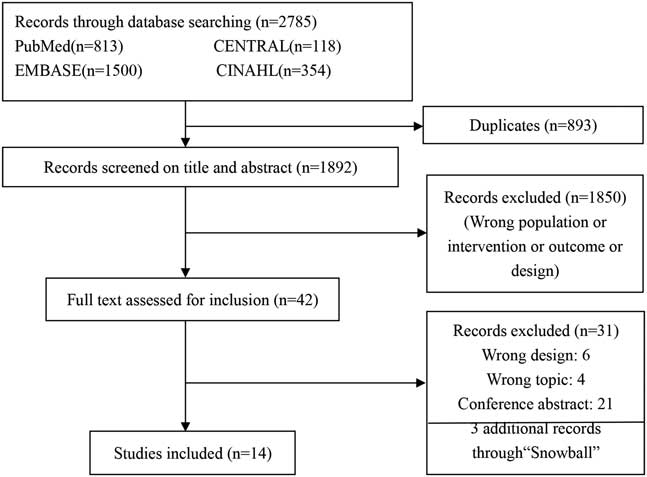
In total, 1,892 unique citations were retrieved through the literature search; of these, 14 studies were included in this review (Fig. 1). The study selection procedure is described below.
Flow chart of study selection procedure. Note. CENTRAL: The Cochrane Central Register of Controlled Trials; CINAHL: Cumulative Index to Nursing and Allied Health.

Characteristics of included studies
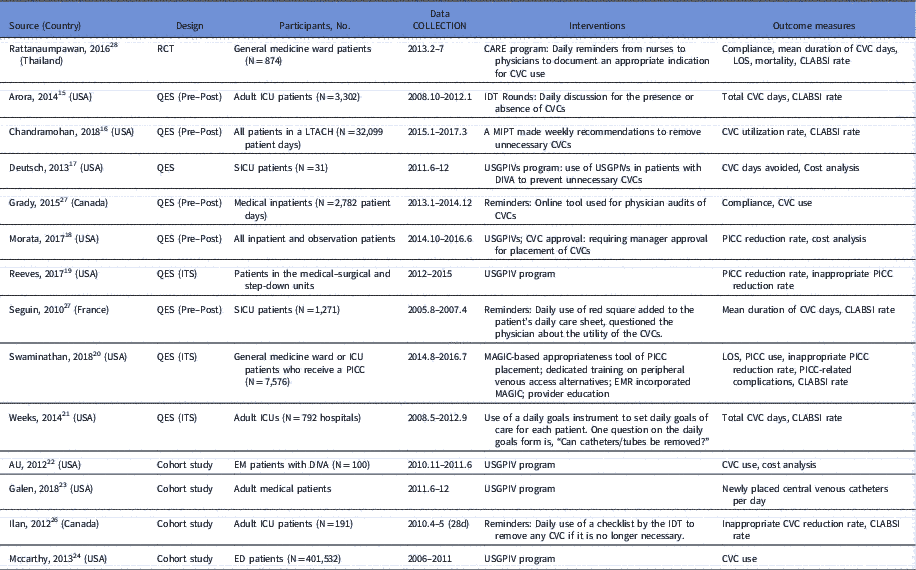
A comprehensive description of the studies is summarized in Table 1. The 14 included studies were published between 2010 and 2018 and were performed in the United States,Reference Arora, Patel, Engell and LaRosa 15 – Reference Mccarthy and Al 24 Canada,Reference Grady 25 , Reference Ilan, Doan, Cload, Squires and Day 26 France,Reference Seguin, Laviolle, Isslame, Coue and Malledant 27 and Thailand.Reference Rattanaumpawan, Teeratorn and Thamlikitkul 28 Of the eligible studies, 1 (7.1%) was a cluster RCT,Reference Rattanaumpawan, Teeratorn and Thamlikitkul 28 4 (28.6%) were cohort studies,Reference Au, Rotte, Grzybowski, Ku and Fields 22 – Reference Mccarthy and Al 24 , Reference Ilan, Doan, Cload, Squires and Day 26 and 9 (64.3%) were QESs, including 5 before-and-after QESs,Reference Arora, Patel, Engell and LaRosa 15 , Reference Chandramohan, Navalkele, Mushtaq, Krishna, Kacir and Chopra 16 , Reference Morata, Ogilvie, Yon and Johnson 18 , Reference Grady 25 , Reference Seguin, Laviolle, Isslame, Coue and Malledant 27 3 interrupted time-series studies,Reference Reeves, Altmiller and Morrison 19 – Reference Weeks, Hsu, Yang, Sawyer and Marsteller 21 and 1 pilot study.Reference Deutsch, Anantha Sathyanarayana, Singh and Nicastro 17 These studies were all conducted in adult departments; all patients were ≥18 years old. Only 2 studies included all inpatients and observation patients.Reference Chandramohan, Navalkele, Mushtaq, Krishna, Kacir and Chopra 16 , Reference Morata, Ogilvie, Yon and Johnson 18 Most studies included only a specific department: 5 studies implemented the intervention in the medical and/or surgical wards,Reference Reeves, Altmiller and Morrison 19 , Reference Swaminathan, Flanders and Rogers 20 , Reference Galen and Southern 23 , Reference Grady 25 , Reference Rattanaumpawan, Teeratorn and Thamlikitkul 28 2 studies were performed in the emergency departments,Reference Au, Rotte, Grzybowski, Ku and Fields 22 , Reference Mccarthy and Al 24 and 5 studies focused on patients in intensive care units only.Reference Arora, Patel, Engell and LaRosa 15 , Reference Deutsch, Anantha Sathyanarayana, Singh and Nicastro 17 , Reference Weeks, Hsu, Yang, Sawyer and Marsteller 21 , Reference Ilan, Doan, Cload, Squires and Day 26 , Reference Seguin, Laviolle, Isslame, Coue and Malledant 27
Characteristics of Included Studies

NOTE. RCT, randomized controlled trial; QES, quasi-experimental study; ITS, interrupted time series; ICU, intensive care units; LTACH, long-term acute-care hospital; SICU, surgical intensive care units; PICC, peripherally inserted central venous catheters; EM, emergency department; DIVA, difficult intravenous access; CVC, central venous catheter; CARE, the catheter reminder and evaluation; MIPT, multidisciplinary infection prevention team; IDT, interdisciplinary team; USGPIV, ultrasound-guided peripheral intravenous catheter; MAGIC: Michigan Appropriateness Guide for Intravenous Catheters; EMR, electronic medical record; LOS, length of stay; CLABSI, central-line–associated bloodstream infection.
Only 4 studies (28.6%) specified the type of CVC used.Reference Morata, Ogilvie, Yon and Johnson 18 – Reference Swaminathan, Flanders and Rogers 20 , Reference Grady 25 Morata,Reference Morata, Ogilvie, Yon and Johnson 18 Swaminathan,Reference Swaminathan, Flanders and Rogers 20 and ReevesReference Reeves, Altmiller and Morrison 19 included only peripherally inserted central venous catheters (PICCs). GradyReference Seguin, Laviolle, Isslame, Coue and Malledant 27 defined the CVCs as nontunneled; nondialysis catheters in jugular, subclavian, or femoral veins; or PICCs. Only 5 studies (35.7%) mentioned the definition of CLABSI,Reference Arora, Patel, Engell and LaRosa 15 , Reference Chandramohan, Navalkele, Mushtaq, Krishna, Kacir and Chopra 16 , Reference Swaminathan, Flanders and Rogers 20 , Reference Weeks, Hsu, Yang, Sawyer and Marsteller 21 , Reference Grady 25 and they all used the Centers for Disease Control and Prevention/National Healthcare Safety Network (CDC/NHSN) criteria.
The sample size of included studies varied. Most studies reported sample size in terms of number of patients, ranging from 31 to 401,532 patients.Reference Arora, Patel, Engell and LaRosa 15 , Reference Deutsch, Anantha Sathyanarayana, Singh and Nicastro 17 , Reference Swaminathan, Flanders and Rogers 20 , Reference Au, Rotte, Grzybowski, Ku and Fields 22 , Reference Mccarthy and Al 24 , Reference Ilan, Doan, Cload, Squires and Day 26 – Reference Rattanaumpawan, Teeratorn and Thamlikitkul 28 Other studies reported only the patient daysReference Chandramohan, Navalkele, Mushtaq, Krishna, Kacir and Chopra 16 , Reference Grady 25 or number of studied hospitals.Reference Weeks, Hsu, Yang, Sawyer and Marsteller 21 Another 3 studies did not specify the sample size.Reference Morata, Ogilvie, Yon and Johnson 18 , Reference Reeves, Altmiller and Morrison 19 , Reference Galen and Southern 23 The duration of data collection was variable from 1 month to 60 months, and some studies collected >1 set of preintervention or/and postintervention data. For our analysis, we used only the first preintervention and the final postintervention data.
Description of interventions
The types of interventions reported varied across studies. We classified all interventions into 2 categories. First, we considered interventions that sought to avoid unnecessary CVC placement (ie, patients without CVCs do not develop CLABSIs). Accordingly, 7 studies (50.0%) examined the effect of interventions to avoid unnecessary CVC placement. Among them, 1 study (7.1%) implemented institutional restrictions on CVCs, which used the Michigan Appropriateness Guide for Intravenous Catheters (MAGIC) to improve PICC use.Reference Swaminathan, Flanders and Rogers 20 Another 6 studies (42.9%) used ultrasound-guided peripheral intravenous catheters (USGPIVs) as an alternative to CVCs.Reference Deutsch, Anantha Sathyanarayana, Singh and Nicastro 17 – Reference Reeves, Altmiller and Morrison 19 , Reference Au, Rotte, Grzybowski, Ku and Fields 22 – Reference Mccarthy and Al 24 Especially for patients with difficult vascular access, USGPIVs may reduce the need for CVCs.
Second, we considered interventions to prompt the removal of unnecessary CVCs. Although guidelines strongly recommend prompt removal of CVCs, many CVCs are left in place when they are no longer needed. Chopra et alReference Chopra, Govindan and Kuhn 29 reported that 21.2% of clinicians were unaware of the presence of a CVC, and only a few hospitals had a written policy to evaluate CVC necessity or appropriateness.Reference Chopra, Kuhn, Ratz, Flanders and Krein 30 The most common strategy is to maintain physician or nurse awareness of the CVC’s existence, which occurs with reminder-system interventions. The remaining 7 studies (50.0%) all implemented reminder interventions.Reference Arora, Patel, Engell and LaRosa 15 , Reference Chandramohan, Navalkele, Mushtaq, Krishna, Kacir and Chopra 16 , Reference Weeks, Hsu, Yang, Sawyer and Marsteller 21 , Reference Grady 25 – Reference Rattanaumpawan, Teeratorn and Thamlikitkul 28 Reminder formats included verbal reminders, written or printed reminders, and online reminders.
Quality of included studies
The quality analysis of the included studies is presented in the Supplementary Materials online. The only RCT included had a medium risk of bias due to random sequence generation and blinding of outcome assessment, but it did not include allocation concealment or blinding of participants.Reference Rattanaumpawan, Teeratorn and Thamlikitkul 28 Among the 9 QESs, 8 reported clear cause and effect,Reference Arora, Patel, Engell and LaRosa 15 – Reference Deutsch, Anantha Sathyanarayana, Singh and Nicastro 17 , Reference Reeves, Altmiller and Morrison 19 – Reference Weeks, Hsu, Yang, Sawyer and Marsteller 21 , Reference Grady 25 , Reference Seguin, Laviolle, Isslame, Coue and Malledant 27 5 included similar participants in comparisons,Reference Arora, Patel, Engell and LaRosa 15 , Reference Deutsch, Anantha Sathyanarayana, Singh and Nicastro 17 , Reference Reeves, Altmiller and Morrison 19 – Reference Weeks, Hsu, Yang, Sawyer and Marsteller 21 and all 9 reported participants that received similar treatments. However, only 1 study had a control group,Reference Swaminathan, Flanders and Rogers 20 and 4 studies had multiple measurements of outcomes both before and after the intervention.Reference Morata, Ogilvie, Yon and Johnson 18 – Reference Weeks, Hsu, Yang, Sawyer and Marsteller 21 The remaining 4 cohort studies all reported a low risk of bias in the selection of participants, comparability of cohorts, and outcome measures.Reference Au, Rotte, Grzybowski, Ku and Fields 22 – Reference Mccarthy and Al 24 , Reference Ilan, Doan, Cload, Squires and Day 26 Overall, the quality of studies included was moderate to high.
Primary outcomes
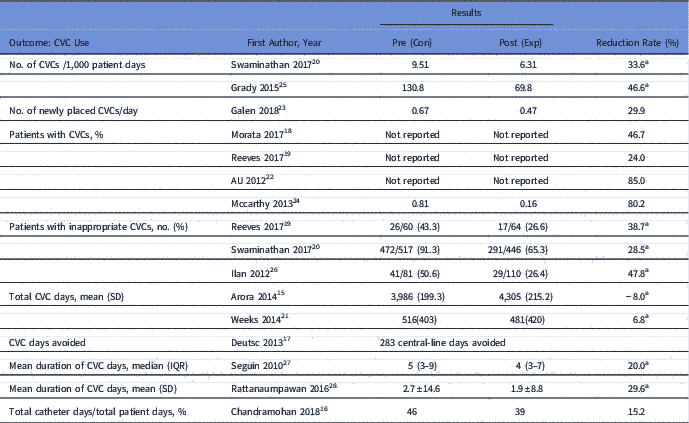
CVC use. All included studies reported the outcomes of CVC use despite diverse measurements and reporting methods (Table 2). Overall, 7 studies reported the number of CVCs used,Reference Morata, Ogilvie, Yon and Johnson 18 – Reference Swaminathan, Flanders and Rogers 20 , Reference Au, Rotte, Grzybowski, Ku and Fields 22 – Reference Grady 25 with different reporting methods. Moreover, 2 studies reported the number of CVCs used per 1,000 patient days. Compared with nonintervention groups, CVC use in the intervention groups significantly decreased by 46.6% and 33.6%, respectively (P<.01).Reference Swaminathan, Flanders and Rogers 20 , Reference Grady 25 Galen et alReference Galen and Southern 23 described the number of newly placed CVCs per day and found a 29.9% decrease, but the difference was not significant (P=.08). The other 4 studies simply reported the reduction in the rate of patients with CVCs, ranging from 24.0% to 85.0%.Reference Morata, Ogilvie, Yon and Johnson 18 , Reference Reeves, Altmiller and Morrison 19 , Reference Au, Rotte, Grzybowski, Ku and Fields 22 , Reference Mccarthy and Al 24
Details of Central Venous Catheter (CVC) Use Outcomes Reported in Studies

Note. CVC, central venous catheter; SD, standard deviation; IQR, interquartile range; Pre (Con), preintervention or control group; Post (Exp), postintervention or experimental group; Reduction rate, (pre–post)/pre×100%.
a P<.05, statistically significant.
The rate of inappropriate CVC placement was reported in 3 studies, including 2 QESsReference Reeves, Altmiller and Morrison 19 , Reference Swaminathan, Flanders and Rogers 20 and 1 cohort study,Reference Ilan, Doan, Cload, Squires and Day 26 but the definitions of inappropriate CVCs were quite different among the 3 studies. Reeves et alReference Reeves, Altmiller and Morrison 19 referred to PICCs inserted only because of an inability to obtain PIV access; Swaminathan et alReference Swaminathan, Flanders and Rogers 20 defined it in accordance with MAGIC; and Ilan et alReference Ilan, Doan, Cload, Squires and Day 26 referred to no apparent indication for CVC placement. In all 3 studies, however, a significant decrease in the percentage of patients with inappropriate CVCs after an intervention was reported (P<.05).
Moreover, 6 studies reported the CVC use in terms of CVC days,Reference Arora, Patel, Engell and LaRosa 15 – Reference Deutsch, Anantha Sathyanarayana, Singh and Nicastro 17 , Reference Weeks, Hsu, Yang, Sawyer and Marsteller 21 , Reference Ilan, Doan, Cload, Squires and Day 26 , Reference Seguin, Laviolle, Isslame, Coue and Malledant 27 and they all described a decrease of CVC days at the intervention site compared to the nonintervention site, except one. Aora et alReference Arora, Patel, Engell and LaRosa 15 found a statistically significant increase in the number of CVC days, which may have been related to more CVCs being captured through the implementation of a reminder intervention. Deutsch et alReference Deutsch, Anantha Sathyanarayana, Singh and Nicastro 17 reported a total of 283 central-line days avoided during the study period by using USGPIVs. Weeks et alReference Weeks, Hsu, Yang, Sawyer and Marsteller 21 showed significant decreases in total line days and 4% fewer central-line catheter days. The other 2 studies reported that a reminder intervention significantly reduced the mean duration of CVC days per patient (P<.01).Reference Seguin, Laviolle, Isslame, Coue and Malledant 27 , Reference Rattanaumpawan, Teeratorn and Thamlikitkul 28 Chandramohan et alReference Chandramohan, Navalkele, Mushtaq, Krishna, Kacir and Chopra 16 mentioned that the CVC utilization ratio, calculated by dividing the number of total catheter days by the number of patient days, nonsignificantly decreased from 46% to 39%.
CLABSI rate
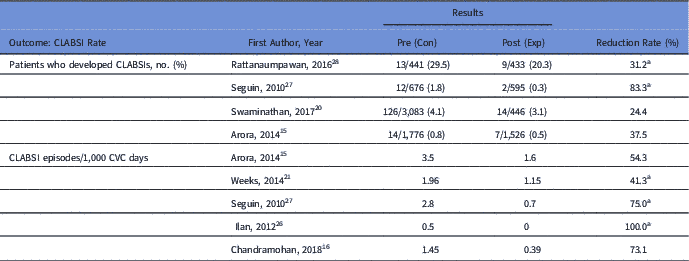
Overall, 7 studies reported the incidence of CLABSIs; they all described a trend toward a reduction in CLABSI ranging from 24.4% to 100.0% (Table 3). Another 4 studies reported the CLABSI rate as a percentage of patients who developed CLABSIs.Reference Arora, Patel, Engell and LaRosa 15 , Reference Swaminathan, Flanders and Rogers 20 , Reference Seguin, Laviolle, Isslame, Coue and Malledant 27 , Reference Rattanaumpawan, Teeratorn and Thamlikitkul 28 Only Rattanaumpawan et alReference Rattanaumpawan, Teeratorn and Thamlikitkul 28 and Seguin et alReference Seguin, Laviolle, Isslame, Coue and Malledant 27 found a statistically significant reduction (P<.05). Moreover, 5 studies reported CLABSI episodes per 1,000 CVC days,Reference Arora, Patel, Engell and LaRosa 15 , Reference Chandramohan, Navalkele, Mushtaq, Krishna, Kacir and Chopra 16 , Reference Weeks, Hsu, Yang, Sawyer and Marsteller 21 , Reference Ilan, Doan, Cload, Squires and Day 26 , Reference Seguin, Laviolle, Isslame, Coue and Malledant 27 the preferred reporting method requested by the CDC/NHSN, and 3 studies reached a statistically significant reduction in the CLABSI rate (P<.05).Reference Weeks, Hsu, Yang, Sawyer and Marsteller 21 , Reference Ilan, Doan, Cload, Squires and Day 26 , Reference Seguin, Laviolle, Isslame, Coue and Malledant 27
Details of Central-Line–Associated Bloodstream Infection (CLABSI) Rate Outcomes Reported in Studies

Note. CLABSIs, central-line–associated bloodstream infections; pre (Con), preintervention or control group; post (Exp), postintervention or experimental group; reduction rate=(pre–post)/pre×100%.
a P<.05, statistically significant.
Secondary outcomes
Only 2 studies mentioned compliance with the intervention. Rattanaumpawan et alReference Rattanaumpawan, Teeratorn and Thamlikitkul 28 reported that nurse compliance was 83%, whereas responsible physician compliance was only 74%. Grady et alReference Grady 25 reported an overall auditing adherence rate of 70%.
Only 1 study provided data on catheter-related noninfectious complications.Reference Swaminathan, Flanders and Rogers 20 They observed a significant decrease of 6.4% in the proportion of patients with catheter occlusion after intervention and no significant change in the proportion of patients with venous thrombus embolism.
The single cluster RCT reported hospital-related outcomes.Reference Rattanaumpawan, Teeratorn and Thamlikitkul 28 In this study, the reminder group had a significantly shorter LOS, but hospital mortality was comparable between the 2 groups.
Two studies analyzed the cost-effectiveness of implementing USGPIV to replace CVCs. Deutsch et alReference Deutsch, Anantha Sathyanarayana, Singh and Nicastro 17 reported an estimated cost savings of $13,614 were avoied during the study period. Morata et alReference Morata, Ogilvie, Yon and Johnson 18 observed a cost savings of ~$1,545,600.
Discussion
In this review, we identified a decrease in CVC use after interventions, despite nonuniform reporting methods. The reduction in CVC use varied from 6.8% to 85%. Such a wide range in the reduction rate is likely related to several factors: diverse study designs, different settings, variable analysis units, and differing definitions. Half of the included studies indicated that the CLABSI rate decreased by 24.4%–100.0% after the intervention. Also, CVCs were inserted in ~30% of hospitalized patients,Reference Climo, Diekema and Warren 31 and CVC use has inherent risks, most notably CLABSI. However, many CVCs are now inserted inappropriately or are not promptly removed, resulting in CVCs being unnecessarily retained in patients.Reference Becerra, Shirley and Safdar 32 Our literature review revealed that the prevalence of unnecessary CVC use ranges between 4.6% to 32.7%.Reference Trick, Vernon, Welbel, Wisniewski, Jernigan and Weinstein 33 , Reference Kara, Johnson, Murray, Dillon and Hui 34 Previous studies have described a strong link between unnecessary CVC use and adverse device-related local and systemic complications.Reference Becerra, Shirley and Safdar 32 These reports are consistent with our findings that interventions for the prevention of unnecessary CVC use are effective in decreasing CLABSIs.
Data regarding our secondary outcomes were limited. Only 2 studies reported compliance with interventions, and these rates varied from 70% to 84%, which were comparably high, based on previously reported rates of compliance to CLABSI bundles of 53.7%–80%.Reference Lee, Cho, Jeong, Kim, Han and Song 35 – Reference Osorio, Álvarez, Pacheco, Gómez and Lozano 38 Similarly, few studies have focused on noninfectious complications and hospital-related outcomes; more studies are needed to assess these outcomes. Regarding cost, 2 studies employing the USGPIVs program both reported a lower cost compared with CVC use: 2 other kinds of intervention (ie, restriction of CVCs insertion and reminders) are essentially simple and low-cost approaches.
In 2014, Meddings et alReference Meddings, Rogers, Krein, Fakih, Olmsted and Saint 39 published a narrative review to summarize interventions to reduce catheter-associated urinary tract infection (CAUTI) by reducing unnecessary urinary catheter use. Urinary catheter reminders and stop orders significantly reduced CAUTI rates in this study. To our knowledge, no evidence-based studies have assessed the efficacy of reducing CLABSI using interventions that avoid unnecessary CVC use. Our review provides the first evidence that interventions to reduce unnecessary CVC use are effective in preventing CLABSI in adults. Furthermore, these interventions appear to be convenient, low risk, low cost, effective, and sustainable.
Our study has several limitations. First and most importantly, the included studies varied significantly in methodology. The studies varied in terms of study design; details of the interventions; definitions of CLABSI, CVC, and unnecessary CVC; and outcome reporting methods. Because of the substantial methodological differences, we did not perform a meta-analysis of the results of the studies. Second, only 1 of the included studies was a cluster RCT; the remaining 13 studies were either QESs or cohort studies. Because RCTs are more methodologically rigorous than other study designs, factors inherent in the studies included may limit the generalizability of our review. Third, only 2 studies mentioned compliance with these interventions. Osorio et alReference Osorio, Álvarez, Pacheco, Gómez and Lozano 38 suggested that compliance with a CLABSI bundle was a protective factor against the development of CLABSI, so compliance may impact CLABSI rate. Fourth, we did not assess the efficacy of these interventions on noninfectious complications and health-related outcomes because the information provided was insufficient to do so. Finally, data on the insertion conditions of interventions implementing USGPIVs were insufficient. However, previous studies have demonstrated a significantly higher success rate, shorter time to successful cannulation, and fewer attempts for USGPIVs compared with the traditional method.Reference Liu, Alsaawi and Bjornsson 40
In summary, interventions to reduce unnecessary CVC use significantly decreases the rate of CLABSIs. Healthcare providers should strongly consider implementing interventions to avoid CVC use (eg, alternatives to CVCs or restriction of CVC insertion) and/or to ensure prompt removal of unnecessary CVCs (eg, reminders). More RCTs with uniform definitions and outcome measures regarding CVC use and CLABSI rates are needed to comprehensively assess the effectiveness and safety of these interventions.
Financial support
No financial support was provided relevant to this article.
Conflicts of interest
All authors report no conflicts of interest relevant to this article.
Supplementary material
To view supplementary material for this article, please visit https://doi.org/10.1017/ice.2018.250