Introduction: Pharyngeals in Iranian Languages
No known Iranian language, extinct or living, is known to have inherited the laryngeals that existed in proto-Indo-European.Footnote 1 The Persian lexicon, in addition to the native stock, is crammed with Arabic loanwords, but has assimilated alien sounds to the closest native phonemes; this includes the pharyngeal stop ʿ [ʕ] and fricative ḥ [ħ], which are realized as /ʾ/ [ʔ] and /h/ respectively.Footnote 2 Arabic loanwords in other Iranian languages normally carry the Persian form.
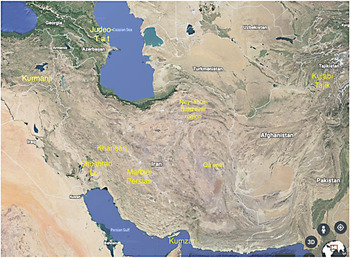
There are nevertheless Iranian languages, varieties of Persian included, that carry the pharyngeal consonants [ʕ] and [ħ], often as marginal phonemes, sometimes in free variation with glottal [ʔ] and [h], in Arabic loanwords as well as in some native words (see Figure 1). This phenomenon is apparently due to language contact with the speakers of Arabic.
Iranian languages with Pharyngeal consonants.
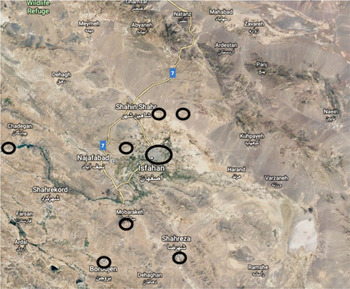
Source: The base map is from Google Earth.

The chronology can be different depending on the language. Among the Iranian languages currently in contact with Arabic, Kumzari, spoken in an entirely arabophone setting south of the Strait of Hormuz, has expectedly been open to Arabic influence in both phonology and morphosyntax. Likewise, the Lori variety of Šuštar’s possession of pharyngeals must be an outcome of centuries-old proximity to the Arabic-speaking tribes of Khuzestān. In Kurmanji Kurdish, another language in contact with Arabic, pharyngealization is a current and expanding process.Footnote 3
There are examples of historical linguistic contact as well. Pharyngeals are abundant in Judeo-Tat spoken in the eastern Caucasus in and around the city of Darband. Chronicles report that during the Islamic conquest some 24,000 Syrian troops were stationed in Darband, also known as Bāb al-Abwāb, to resist Khazar invasions, and that some of the soldiers settled down on a permanent basis in the area.Footnote 4 This documentation provides an exemplary case for language contact, in this case between Tat and Arabic. Nevertheless, we face a dilemma here: pharyngeals are not reported for the Tat dialects spoken in the Muslim villagesFootnote 5 in the same region. One possibility therefore is that while pharyngeals were lost in Muslim Tat their position in the phonology of Judeo-Tat was reinforced by its Hebrew and Aramaic vocabulary. Subsequently, one should not rule out the role that may have been played by Hebraisms in Judeo-Tat, nor overlook contact with North Caucasian languages, which also have pharyngeals.
Moving from the peripheral territories to the inner plateau, we encounter more examples of Iranian languages with pharyngeals. One is the Central-Plateau-type language spoken in Xwānsār to the northwest of Isfahan, where there may have been historical associations with Arab tribes.Footnote 6
In Khorasan, where massive Arab migrations are reported to have taken place in the early Islamic era and there exist to this date patches of arabophone communities,Footnote 7 we find some Persian varieties with pharyngeals in Qāʾenāt and in the Neyšābur-Sabzevār area. Arabic speakers can be found further east in Afghanistan and across the Oxus. Here, in southern Tajikistan, in the Tajik dialect of Kulāb, the pharyngeal stop and fricative occur in many loanwords from Arabic: ʿayb “flaw,” šiʿla “flame,” ḥozir “now,” soḥib “owner,” among others. The pharyngeals also occur, un-etymologically, in a few native words, e.g. ʿımed “hope,” ḥınar “art.”Footnote 8
Interestingly, the pharyngealized form for “horse” occurs far and wide in three corners of the Iranian linguistic domain. These are ʿasp in Kulabi and ʿasb in Šuštari,Footnote 9 Xwānsāri,Footnote 10 and Judeo-Tat.Footnote 11 (Cf. Kurmanji hasp, with an un-etymological initial /h/.) Considering that “horse” is among just a few pharyngealized native words in each of these languages, mere coincidence is improbable. The distribution suggests an early pharyngealized form. Could the word carry its original Proto-Indo-European laryngeal consonant (h₁éḱwos)? Not if we subscribe to the consensus that laryngeals had already ceased to exist in Old Iranian.Footnote 12
The Great Vowel Shift in Persian vs. Isfahani Persian Vowels
The vocalic inventory of Middle West Iranian, with Parthian and Middle Persian being the only attested varieties, is hypothesized to have had eight vowels and two diphthongs,Footnote 13 a system that persisted in early New Persian and to a large extent in Classical Persian of the tenth to fifteenth centuries.Footnote 14 The system eventually split up in the early modern period, likely during the fourteenth–seventeenth centuries, between the eastern and western varieties of Persian.Footnote 15 As this development is comparable to the Great Vowel Shift in English, roughly during a comparable time interval, the designation “Great Vowel Shift in Persian” sounds fit. The extent of the shift in western Persian, as exhibited in Table 1, was so that no vowel retained exactly its original form. The western Persian vowels shown in Table 1 are heard in the varieties of Persian spoken along the north–south axis of Tehran–Isfahan–Shiraz.Footnote 16

While Isfahani Persian has no pharyngeal consonant in its current form, there are phonological irregularities that do not tally with the common pattern of Persian vowels; this suggests that the vocalic system of Isfahani Persian should have been influenced by pharyngeals sometime in history. The irregularities are ‘coloration’ of vowels adjacent to original pharyngeals, in the following sequences:
(1) -ʿa, -ḥa > -a (otherwise, -e)
(2) ʿay, ḥay > ay (otherwise, ey)
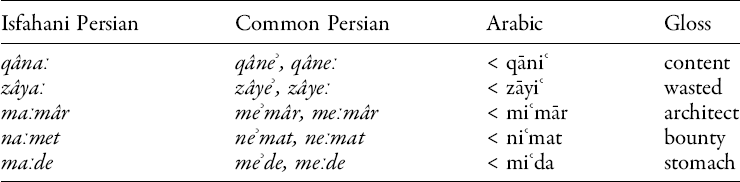
(3) syllable-final iʿ > aː (otherwise, e)
(4) other changes adjacent to pharyngeals
In the first two sequences the original pharyngeals prevent the historical vowel raising from /a/ to /e/. A parallel distribution may be sought in Kurmanji, in which most native words that are pharyngealized as a result of contact with Arabic have their pharyngeals directly adjacent to the vowel /a/, with a few adjacent to /ɪ/.Footnote 17
Feature 1: Word-final -e vs. -a
A large number of words in modern Persian end in -e. These words may diachronically be recognized as:
-e < Classical Persian -a < Mid. West Iranian -ag < Old Iranian -akaFootnote 18
-e < Classical Persian -a < Arabic feminine suffix -ahFootnote 19
none of the above, in če, ke, se, âre, bale, šanbe Footnote 20
Isfahani Persian follows all the above-mentioned rules regularly; the -e < -a can be exemplified in: pâye “foot,” sibe “covered passageway,” pile “cocoon,” katune “hen coop,” dâyze “maternal aunt,” buːne “pretext,” mive “fruit,” tâxče “niche,” zande “alive,” vâysâde (past participle) “standing,” qeyme “stew,” kaːbe “Kaaba,” Sekine (proper name).Footnote 21
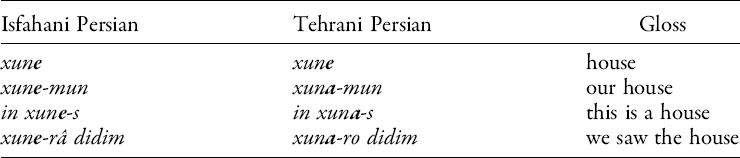
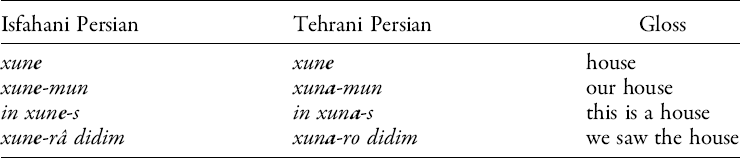
It is worth mentioning that the morphophonological rule in colloquial Persian of Tehran in which the final -e shifts to -a when taking a clitic or a suffix,Footnote 22 does not hold in Isfahani Persian. Examples for xâne “house” are shown in Table 2.
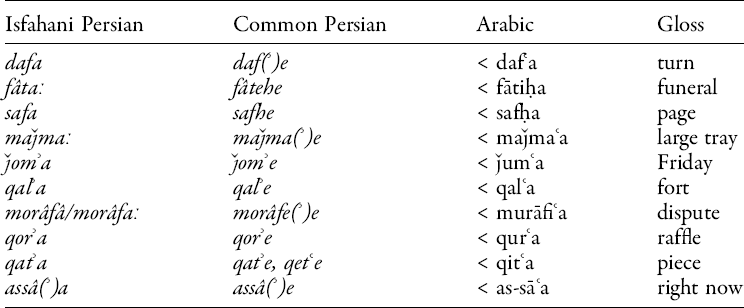
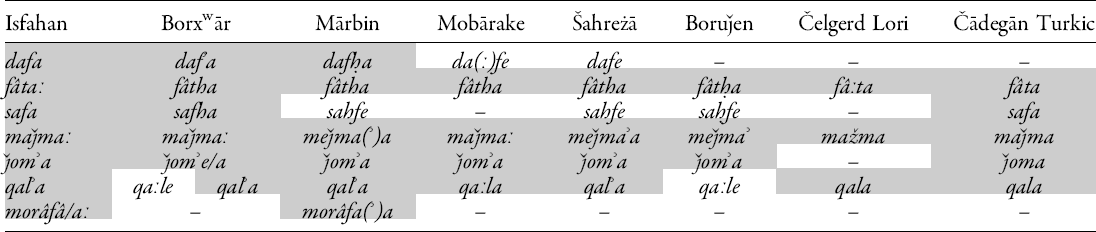
In Isfahani Persian, final -a survives in a finite set of Arabic loanwords,Footnote 23 as listed in Table 3. In these words, the original -a retains its quality when succeeding Arabic pharyngeal consonants, i.e. -ʿa and -ḥa > -a. This list is not necessarily exhaustive, but it must be nearly so. Having only ten words, the list might be far shorter than expected, given the preponderance of this Arabic word class in Persian.Footnote 24 However, a large majority of words with this phonological feature are too formal to have been embedded in colloquial Persian, Isfahani or other varieties. The words that do not show this development can be discerned as recent borrowings from formal, educated Persian into Isfahani, such as motʾe (otherwise siqe) “temporary marriage.”

Feature 2. The Diphthong ey vs. ay
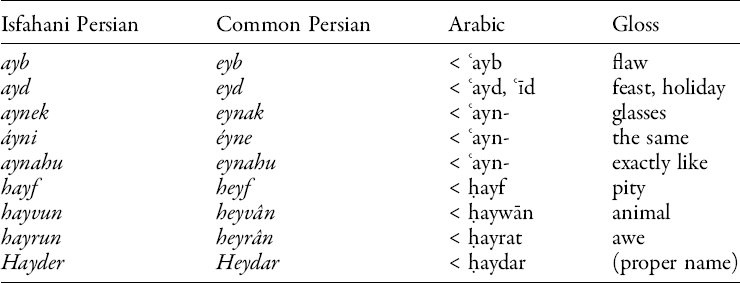
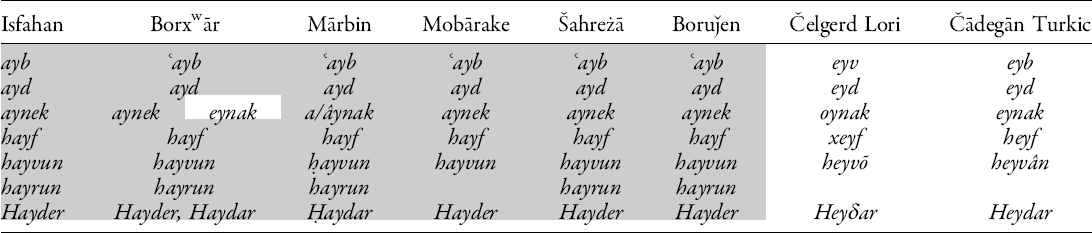
Classical Persian shared the diphthong /ay/ with Classical Arabic and therefore adopted it unchanged in its Arabic loanwords. Modern Persian shifted the diphthong to /ey/ as a consequence of the Great Vowel Shift (Table 1). Isfahani Persian has this diphthong in many words, native and Arabic alike: eyvun “porch,” ey-vây! (interjection), peydâ “apparent,” meydun “plaza,” key “when,” pey “basis; following,” tey “deal,” xeyr “goodness,” šeyx “sheikh,” qeyret “zeal,” reyhun “basil,” qeytun “braid.”Footnote 25 However, Isfahani Persian retains the diphthong /ay/ before Arabic pharyngeal consonants—hence ʿay and ḥay > ay. The list given in Table 4 makes no claim to completeness.

Feature 3. Syllable-final iʿ > aː
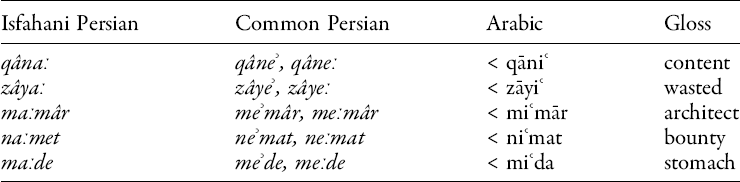
Classical Persian /i/ shifts to /e/ in modern Persian (Table 1). The variety of Persian spoken in Isfahan is no exception, as exemplified in del “heart,” kerm “worm,” meh “mist,” zeyvâr (< zih-vār) “cord,” mehmun “guest,” leh “squashed,” peder (< pidar) “father,” beyter “better” (< behtar), bedeykâr “debtor,” meyter (< mehtar, mihtar) “head groom.” However, in positions preceding the Arabic pharyngeal stop /i/ shifts to/a/Footnote 26 with a compensatory gemination due to the loss of the pharyngeal consonants.Footnote 27 The items carrying this sequence are listed in Table 5.
Other Features
Other vowel colorations associated with pharyngeals have limited outcomes:Footnote 28 cross-syllabic aʿ, aḥ > â in tââm (< taʿām) “food, salt,” mâhâl < maḥāl (lit. “places,” occurring in toponyms such as Čârmâhâl); ʿa- > â in âmu (< ʿamm) “uncle”; amâːret (otherwise ʿemārat in Persian) “building”; anun (< otherwise ʿenān in Persian) “bridle”; sâhab (cf. Tehrani Pers. sâhâb < ṣāḥib) “owner”; elil (< ʿalīl) “crippled”; Maːmed, Maham(m)ed (< Moḥammad).
Geographic Distribution of the Features
How far away from Isfahan do these phonological rules hold? To answer this question, I collected data from several localities around the city of Isfahan (Figure 2). These include the Median dialect of Xworzuq and the Persian variety of Ḥabibābād, both in the northern district of Borxwār, and the Persian varieties spoken in the district of Mārbin in the west of the city.Footnote 29 In the south, comparison was made with the Persian varieties of Mobārake and Šahreżā, which are historically and economically connected to Isfahan. From the neighboring Čahārmaḥāl o Baxtiāri province, data was collected from the Persian variety spoken in Boruǰen as well as the Lori-Baxtiāri variety of Čelgerd at the source of the Zāyandarud River. As a sample of Turkic, the variety spoken in Čādegān in the upper Zāyanderud basin is also included in Tables 6 and 7.
Data collected in Isfahan region.


Beyond these limits the comparison becomes largely irrelevant. Towards the south and west either Lori or varieties of Persian that are historically distinct or are fairly remote from Isfahan are spoken. In the north of the selected area, towards Kashan, the native language is no longer Persian but varieties of what is known as the Central Plateau language group are spoken in scattered pockets.Footnote 30 In these Median-type languages the final vowel derived from Middle West Iranian -ag is not consistent but varies in each dialect according to the grammatical gender of the word. Even in those dialects that have lost grammatical gender its relics remain, so that, in a synchronic perspective, words end in -a and in -e randomly; therefore, they do not lend themselves to this comparative study. Moreover, some dialects, Persian or Median, systematically show the ending vowel as -a, and are therefore not suitable to be included. Regarding the diphthong, many of the Median dialects inherit ay rather than shifting it to ey. The Great Vowel Shift of Persian shown in Table 1 has influenced Median only partially.Footnote 31
Tables 6 and 7 list the outcomes of Features 1 and 2 for seven localities, in addition to Isfahan itself. The blank cells of the tables represent the words that are not used in the vernacular or, when elicited, the reply was uncertain. For instance, most vocabularies lacked the word morâfeʾe “dispute” and some other words listed in Tables 3 and 4 that are exclusively urban. Elicitation of Feature 3 failed in most vernaculars as well.
As is evident from the tables, most of the vernaculars spoken in the Isfahan region demonstrate similar trends but none as completely as Isfahani Persian. The word-final -a succeeding pharyngeals remains in most of the elicited words, save for dafʿe “turn” and ṣafḥe “page,” which are likely to be more recent loanwords taken from standard Persian as propagated by means of radio and television. The outcome for Feature 2 shows a marked split among the vernaculars. Retention of the diphthong ay after pharyngeals is the case in all data except those from Lori of Čelgred and Turkic of Čādegān. This should come as no surprise since the latter settlements have a far lower degree of language contact with Isfahan than the other localities included in this study.
All in all, the areal distribution suggests that the focal point of these phonological features is the city of Isfahan itself and not the surrounding countryside, whose population has historically been less stable than the city itself.
Historical Context: Arabs and Arabic in Isfahan
The phonological features presented above imply language contact with Arabic at a given point in history. Let us accordingly examine the presence of the Arabs in Isfahan throughout history.
The Islamic conquest of the seventh–eighth centuries was followed by migration of Arab tribes into the Iranian Plateau. While the magnitude and distribution of the influx is largely unknown, it is evident from the sources that one of the largest Arab garrisons was stationed at Isfahan and that Isfahan had a significant share of the settlers.Footnote 32 The traveling geographer Yaʿqubi (d. 897) reports that in addition to the basic ʿAǰam (native) population there were Arab immigrants in Isfahan from Kufa and Basra who had retained their ethnic identity to various Arab tribes.Footnote 33 Abu Nuʿaym Isfahani (d. 1038) reports that Arabs migrated to Isfahan to teach the people about religious duties and the hadith.Footnote 34 In spite of these reports, there is little reason to believe that Arabic was widely spoken as the lingua franca in Isfahan, or that the Arab settlers resisted normal linguistic assimilation known in other immigrant communities worldwide beyond a couple of generations after immigration. Even if not a significant vernacular, Arabic gained the status of high language in Isfahan: while Persian was flourishing in the northeastern province of Khorasan, Arabic was the language of literature and learning in Isfahan under the Daylamites and later (tenth–twelfth centuries), when hundreds of local poets would entertain themselves and their patrons by emulating Arabic verse.Footnote 35 The significance of Arabic in Isfahan can be inferred from an account about Avicenna: when he came to settle in Isfahan, he soon realized that his knowledge of Arabic required much refinement, albeit he had already compiled his salient Cannon of Medicine in Arabic.Footnote 36 Despite this earlier milieu, by the thirteenth century Arabic had lost its leverage in Isfahan, giving way to Persian as the literary language that had already spread all over Persia.
There appears to be another “Arabic” influx in the late fourteenth century. In 1387, Tamerlane invaded Isfahan and ordered the massacre of the local population, a calamity that decimated the city’s population significantly.Footnote 37 By the end of the century, many rural and suburban landlords and notables, the Arab Banu ǰaʿfariya clan of Xuzān among them, moved en masse to a depopulated Isfahan and before long took over leading positions in the local bureaucracy under Tamerlane’s immediate successors. The Xuzānis were originally from Iraq and claimed descent from the Quraysh clan.Footnote 38
The Arab clans of ʿĀmeri and Šaybāni are found in pockets along a geographical band that begins in the Isfahan-Kashan region and circumvents the Central Desert clockwise on the map to reach Bir and in southern Khorasan. The remnants of these clans that are found in the districts of Ardestān and Naṭanz to the north of Isfahan are presently Persophonic but identify themselves as Arabs.Footnote 39 Even if the presence of the ʿĀmeris and Šaybānis is not known in the immediate environs of Isfahan, toponymic relics of probable Arab tribes survive in the rural district situated nearby in the northwest of Isfahan: Davāzdah-deh-e ʿArabestān, which borders on the Šeš-deh-e ʿArabestān in Xwānsār district, suggesting Arab settlements in an unknown time in history, albeit both districts are now Persophonic.Footnote 40
Isfahan was witness to another influx of Arabic-speaking immigrants during the seventeenth century, when the city became Persia’s capital under the Safavid Shah Abbas I. These were chiefly Shi’i jurists from ǰabal ʿĀmel in Lebanon. Among them was the renowned polymath Sheikh Bahāʾi, who migrated to Isfahan probably in his teen years and wrote dozens of works in both Arabic and Persian.Footnote 41 While the magnitude of immigration remains unknown, it is unlikely that it was sufficiently high to leave an impact on the common language of the city.
These historical reports notwithstanding, a recent DNA report reveals that the current population of Isfahan has no stronger association than other typical Iranian cities have with the haplogroups that dominate southern Iraq or the Arabian Peninsula.Footnote 42
Historical Context: The Jews of Isfahan
Another community that may have introduced pharyngeals in Isfahani Persian is Isfahan’s Jewry. The Jewish community of Isfahan is probably as old as the city itself. The small nucleus town that grew into the present city was originally called al-Yahūdiyya in Arabic and ǰuhūdistān in Persian, both meaning “Jewish place.”Footnote 43 Yahūdiyya roughly corresponds to contemporary ǰubāre,Footnote 44 an old, northern quarter of Isfahan that hosted the bulk of its Jewry before their recent emigration.Footnote 45
Isfahan’s Jewry preserved an Iranian vernacular called Judeo-Isfahani or Jidi. Jidi is a Median-type language and belongs to the Central Plateau language group spoken in central Iran between Isfahan and Kashan.Footnote 46 Historical evidence demonstrates that Isfahan itself was home to a population that once spoke Median,Footnote 47 but that the original vernacular survived only in conservative Jewish quarters and among Muslims in the countryside. Jidi is thus an older survival, while Persian has moved in more recently.Footnote 48
Jidi as well as some of the Median dialects spoken around Isfahan possess pharyngeal consonants, [ʿ] and [ḥ], even if at an allophonic level. This is indeed strong evidence in favor of the existence of pharyngeals in the otherwise extinct Median of Isfahan. However, we find marked differences between the current Median vernaculars spoken in and around Isfahan and Isfahani Persian:
(1) The accent is different: Jidi and other Median dialects lack the high pitch on unstressed syllables characteristic of Isfahani Persian.Footnote 49
(2) None of the Median dialects show the dentalization of affricates (tʃ> ts and dʒ > dz) idiosyncratic to Isfahani Persian in central Iran.
(3) Jidi interdentalizes sibilants s and z into θ and ð respectively.
(4) The ezafe connector is different, e.g. Isfahani Persian angur-i siâ vs. Jidi angir-e θiâ “black grapes.”
These remarkable differences render a direct correlation between Isfahani Persian and Jidi quite doubtful.
Concluding Remarks
The existence of pharyngeals in Iranian languages points to Arabic as the source language. As for Isfahan, there is sufficient evidence for linguistic contact with the Arab settlers and immigrants before they were absorbed by the native, Iranian-speaking population. Considering the presence of pharyngeal consonants in some of the Median rural dialects as well as in Judeo-Isfahani, it is very likely that the contact took place when the common vernacular of the city had not been shifted from Median to Persian, i.e. during the earlier centuries of Islam, when Arabic was dominant at the administrative level.
There are, however, problems of periodization. A case in point that suggests the persistence of pharyngeals into the late medieval period is Isfahani Persian aynek “eyeglasses,” corresponding to the standard Persian pronunciation eynak, consisting of Arabic ʿayn “eye” and the Persian suffix -ak. Spectacles are known since the fourteenth or fifteenth centuries in Persian miniature paintings, and an early citation of the word is found in the Persian verse of the seventeenth-century poet Ṣāʾeb, a resident of Isfahan who lived in India for a while. Another problematic item, ʿayd < ʿīd “festival,” raises the question whether the diphthongization of ī to ay predated the coloration of the initial vowel (Feature 2, above).
The history of language development in Isfahan becomes even more problematic if we include the most noticeable phonological feature of Isfahani Persian, that is, dentalization of affricates (tʃ, dʒ > ts, dz), as stated above: if inherited from the earlier Median vernacular, why is it neither a feature in the Median-speaking countryside nor among the Jewish residence who have preserved the old language of the city? It should now be clear that there is no all-inclusive answer to these questions given the current state of knowledge about Isfahan’s history. A period to look into is the first half of the sixteenth century, during which the population of the city grew tenfold to at least a half a million,Footnote 50 with an influx of linguistic communities from all over Persia and the rest of the world.


 ahān be-dast-e Aʿrāb,” 53.
 o vaqāyeʿ o ḥokkām o salāṭin-e Eṣfahān. 377–8, 387–8.