


Introduction
There is substantial evidence that body-related behaviours and their associated cognitions play a role in the maintenance of eating psychopathology, including body image concerns. Two such behaviours have been detailed and researched substantially in the existing literature – body checking and body avoidance (Fairburn, Cooper and Shafran, Reference Fairburn, Cooper and Shafran2003; Grilo et al., Reference Grilo, Reas, Brody, Burke-Martindale, Rothschild and Masheb2005; Reas, Grilo, Masheb and Wilson, Reference Durkin, Paxton and Wertheim2005; Reas, Whisenhunt, Netemeyer and Williamson, Reference Reas, Whisenhunt, Netemeyer and Williamson2002; Shafran, Fairburn, Robinson and Lask, Reference Shafran, Fairburn, Robinson and Lask2004). Checking involves the repeated checking of one's body, through weighing, using mirrors, or other idiosyncratic behaviours (e.g. measuring specific parts of one's body). Avoidance is the tendency to avoid exposure or sustained exposure to one's body (e.g. covering all mirrors in the home, bathing clothed). There is also some evidence regarding body comparison (Cahill and Mussap, Reference Cahill and Mussap2007). Comparison manifests as repeated examination of others’ bodies in order to reach a judgement about one's own appearance (e.g. comparing one's body or clothes size against those of others).
Each of these three body-related patterns of behaviour and cognition can be seen as a safety behaviour, which has both short- and long-term impact on body-related cognitions (Shafran, Lee, Payne and Fairburn, Reference Shafran, Lee, Payne and Fairburn2007) and on emotional states such as anxiety (Mountford, Haase and Waller, Reference Mountford, Haase and Waller2006) and shame (Andrews, Reference Andrews1997). Clinical observation indicates that such safety behaviours reduce the aversive emotional state in the short-term by providing some measure of reassurance (e.g. “I have not put on huge amounts of weight”; “I did not have to see how fat I am”; “At least there are other fat people in the world”), and this emotional reduction reinforces the behaviour. However, these behaviours result in more distress in the long-term (e.g. “If I don't check all the time, then my weight will shoot up”; “I cannot go out in case I see my reflection in a shop window”; “What if everyone is much thinner than I am when I go out tonight?”). Similar clinical observations have been made in body dysmorphic disorder (Grant and Phillips, Reference Grant and Phillips2005). Thus, an important element of cognitive behavioural therapy for the eating disorders is to address the way in which these behaviours maintain the eating- and body-related cognitions and behaviours. This can be done through the use of behavioural experiments and exposure-based methods (Waller, Cordery, et al., Reference Waller, Cordery, Corstorphine, Hinrichsen, Lawson, Mountford and Russell2007).
Clinical experience in the eating disorders suggests that there is a further body-related cognitive-behavioural pattern that merits attention in the maintenance of eating psychopathology, i.e. body display. This pattern involves the deliberate presentation of clear views of one's body (e.g. through choice of fitted clothes). While such behaviours may be relatively functional in some situations (e.g. on a date), clinical experience suggests that their cognitive underpinning is different in the eating disorders. For example, such behaviours may be driven by beliefs about gaining care if others see how ill one looks, or by relatively narcissistic beliefs about how one can give others a lesson in how to dress (Waller, Sines, Meyer, Foster and Skelton, Reference Waller, Sines, Meyer, Foster and Skelton2007). It can be hypothesized that body display is an additional safety behaviour, which maintains eating pathology in the same way as the other behaviours detailed above. For example, in the short term, the individual might gain support from others by dressing in a way that demonstrates dangerously low weight or scars from self-harm, or might seek respect for the ability to wear very “skinny” clothes. However, these behaviours can result in a longer-term enhancement of the individual's shame or anxiety (e.g. “Others will stop noticing me unless I have lost more weight or acquired new scars”; “I am panicking that my weight might go up and I will not look good any more, and no-one will see me then”), resulting in further development and maintenance of eating psychopathology.
To summarize, there is a relatively well-known role for some body-related behaviours and cognitions in the maintenance of eating and body image disturbance – particularly body checking and avoidance (Shafran et al., Reference Shafran, Lee, Payne and Fairburn2004). In contrast, less is known about the role of body comparison, and there is no evidence base regarding the role of body display. Nor is it known how much these four factors overlap, and whether or not they play independent roles in driving eating pathology. Therefore, this study examines the association of the four identified elements of body-related behaviours and cognitions (checking, avoidance, comparison, display) with eating pathology, including body concerns. It will be important to consider whether these associations simply reflect raised levels of anxiety or depression rather than being specific to eating concerns and behaviours. In keeping with the preliminary nature of this research, the study is carried out with a non-clinical group, to ensure that the associations are not masked by entrenched pathological eating patterns. It is hypothesized that the four behavioural patterns will be associated with eating- and body-related attitudes, eating behaviours and weight, but it is not possible to make specific predictions about which individual elements of body-related behaviours will be associated with specific elements of eating pathology, including body concerns.
Method
Participants
The participants were 162 women and 88 men, drawn from undergraduate, postgraduate and non-student populations. The women had a mean age of 24.0 years (SD = 7.86), a mean weight of 63.4kg (SD = 12.6), and a mean height of 1.68m (SD = 0.07). The men had a mean age of 25.5 years (SD = 7.55), a mean weight of 78.8kg (SD = 12.4), and a mean height of 1.80m (SD = 0.06). A further 26 individuals agreed to participate, but failed to complete the measures fully. None were excluded due to presence of psychiatric symptoms, to ensure that this non-clinical sample had a representative level of psychopathology for the general population.
Measures and procedure
The participants were approached via undergraduate classes or personal contacts. None received payment or course credits for participation. Each participant completed three self-report measures, assessing their anxiety and depression, their eating psychopathology, and their body-related behaviours and associated cognitions. They also gave self-reports of their height and weight, to yield their body mass index (BMI = weight[kg]/height[m]2). The mean BMI for the sample was 23.2 (SD = 4.20), which is in the normal range. A subset of 76 of the women also completed a measure of anxiety and depression, to determine whether the BRBS was influenced by mood.
Eating Disorder Examination – Questionnaire version (EDE-Q; Fairburn and Beglin, Reference Fairburn and Beglin1994). The EDE-Q is a 36-item self-report measure of eating psychopathology. It contains 22 items reflecting pathological eating attitudes, divided into four scales: weight concern, shape concern, eating concern and restraint. Higher scores on the EDE-Q indicate a greater level of eating pathology. The measure has been validated against the Eating Disorder Examination interview (Black and Wilson, Reference Black and Wilson1996; Fairburn and Beglin, Reference Fairburn and Beglin1994). The participants’ mean scores on the EDE-Q scales were as follows: Restraint, M = 1.40, SD = 1.40; Eating concerns, M = 0.94, SD = 0.95; Shape concerns, M = 1.84, SD = 1.40; Weight concerns, M = 1.52, SD = 1.36; Objective binges, M = 0.70 in 28 days, SD = 2.15; Subjective binges, M = 0.60 in 28 days (SD = 2.39); Vomiting, M = 0.13 in 28 days, SD = 0.89; Laxative use, M = 0.09 in 28 days, SD = 0.72; and Exercise to control weight, M = 3.12 in 28 days, SD = 5.81. These scores are in the normal range (Luce, Crowther and Pole, Reference Luce, Crowther and Pole2008; Mond, Hay, Rodgers, Owen and Beumont, Reference Mond, Hay, Rodgers, Owen and Beumont2004).
Body-Related Behaviours Scale (BRBS). This scale was developed for the current study. It consists of 38 items, which measure clinically relevant behaviours and the associated cognitions. The scale addresses: checking behaviours (10 items – e.g. “I check my size by measuring parts of my body with my fingers”; “Checking my body makes me feel calmer”); avoidant behaviours (10 items – e.g. “I do not use mirrors if I can avoid them”; “If I can avoid seeing my body, then I am less upset by my appearance”); comparison behaviours (8 items – e.g. “I judge my appearance in comparison with those people around me”; “If I see someone who looks slim, then I tend to see myself as fat”); and display behaviours (10 items – e.g. “I like others to be able to see my bones through my skin”; “If I could not show other people how my body looks, then they would not notice me”). The items are scored according to how accurate the statement is about the individual respondent (0 = not at all; 1 = occasionally; 2 = sometimes; 3 = often; 4 = all the time). Scales are scored as the mean of the relevant items (range 0–4). Each scale's internal consistency was determined (Cronbach's alpha).
Body Checking Questionnaire (BCQ; Reas et al., Reference Reas, Whisenhunt, Netemeyer and Williamson2002). The BCQ measures a range of body checking behaviours. It is a 23-item inventory with three subscales: Overall appearance, Specific body parts, and Idiosyncratic checking. Participants rate each item on a 5-point Likert scale (1 = never; 5 = very often). The BCQ has acceptable reliability and validity in eating-disordered and non-eating-disordered women (Reas et al., Reference Reas, Whisenhunt, Netemeyer and Williamson2002, Reference Reas, Grilo, Masheb and Wilson2005; Reas, White and Grilo, Reference Reas, White and Grilo2006).
Body Checking Cognitions Scale (BCCS; Mountford et al., Reference Mountford, Haase and Waller2006). The BCCS measures cognitions associated with body checking behaviours. It has 19 items, divided into four subscales: Objective verification; Reassurance; Safety beliefs; and Body control. Each item is rated on a 5-point Likert scale (1 = never; 5 = very often), where higher scores indicate a greater level of the cognitions. Good psychometric properties have been demonstrated in clinical and non-clinical women (Haase, Mountford and Waller, Reference Haase, Mountford and Waller2007; Mountford et al., Reference Mountford, Haase and Waller2006).
Hospital Anxiety and Depression Scale (HADS; Zigmond and Snaith, Reference Zigmond and Snaith1983). The HADS is a 14-item self-report measure of anxiety and depression, which has good psychometric properties among both clinical and non-clinical groups. This group's mean anxiety score was 7.70 (SD = 3.59), and their mean depression score was 3.09 (SD = 2.47).
Data analysis
The internal consistency of the BRBS scales was calculated using Cronbach's alpha for the group as a whole and for the males and females separately, removing any items that reduced the internal consistency of the scale substantially. The males’ and females’ BRBS scores were compared using MANOVA. The intercorrelations of the four BRBS scales were tested using Pearson's r correlations. In order to determine the validity of the BRBS, and their association with measures of body checking, anxiety and depression were tested using Pearson's r. The hypothesis (association of body-related behaviours and cognitions with eating pathology) was tested using simultaneous entry multiple regression analyses, with the BRBS scales as independent variables and eating pathology (BMI; individual EDE-Q scales and behaviours) as the dependent variables. All tests were two-tailed.
Results
Preliminary analyses
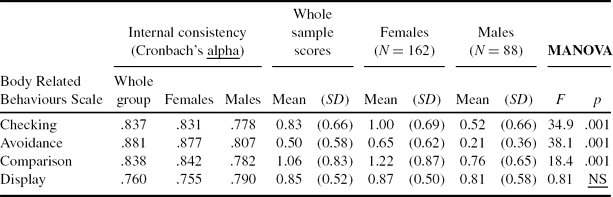
Table 1 shows the Cronbach's alpha of the BRBS scales. While each scale initially had an acceptable alpha level (> 0.70) for males, females and the group as a whole, the removal of three items with low corrected item-total correlations improved those alpha levels (items 1, 23 and 24 from the original scale). Therefore, the final version of the scales consisted of 9 items relating to body checking, 10 addressing body avoidance, 6 relating to body comparison, and 10 reflecting body display. The resulting Cronbach's alpha scores are given in Table 1, demonstrating that each scale reflects an internally consistent construct for males, females and the group as a whole. All BRBS scores used henceforth are derived from the resulting 35-item version of the scale.Footnote 1
Females’ and males’ mean levels of body-related behaviours and cognitions (Body Related Behaviours Scale). Internal consistency for the BRBS scales is shown using Cronbach's alpha

Table 1 also shows the participants’ scores on these “trimmed” versions of the BRBS scales. The females had significantly higher levels of each behavioural element apart from “display”, where they were equivalent to the males.
The BRBS scales showed varying levels of intercorrelation. The checking scale was positively associated with avoidance (r = .537, p < .001), comparison (r = .681, p < .001) and display (r < .308, p < .001). Comparison was positively associated with avoidance (r = .624, p < .001) and display (r = .174, p = .005). However, avoidance and display were not correlated (r = .009, p = .889). To summarize, the different body-related behaviours were not independent constructs, as might be expected given that the constructs measured by the BRBS reflect different components of the broader construct of body image.
Validity of the BRBS
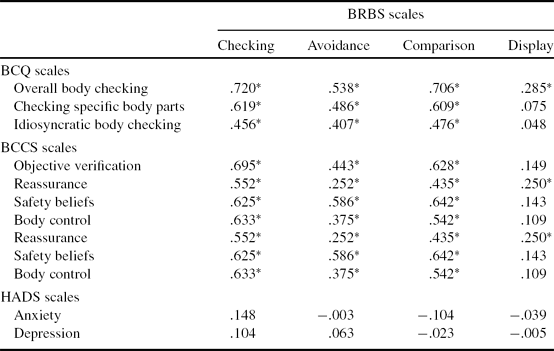
A key element in the validation of the BRBS is whether it is associated with other measures of body-related behaviours and cognitions. Although it was not possible to identify and use a full range of such measures within the scope of this study, measures of body checking behaviours (BCQ) and cognitions (BCCS) were used for this purpose. Table 2 shows the correlations between the BRBS scales and these two measures of body checking.
Bivariate associations (Pearson's r) of body-related behaviours (BRBS scales) with levels of anxiety and depression (HADS scales, and with measures of body checking (BCQ and BCCS scales)

* p < .001.
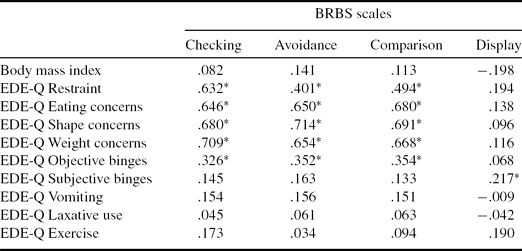
Variate associations (Pearson's r) of body-related behaviours (BRBS scales) with eating pathology (EDE-Q scales) and body mass index

* p < .001.
The correlations demonstrate that body checking as measured by the BCQ and BCCS were most strongly associated with BRBS body checking and body comparison, less strongly linked to BRBS body avoidance, and relatively unrelated to BRBS body display. This pattern of association reflects the strongest single association between BRBS scales (checking and comparison – see above), which is likely to be due to the pragmatic fact that comparison of one's own body with that of others depends on being aware of one's own body through checking it.
Association with depression and anxiety levels
An obvious concern is that any association between BRBS scores and eating disorder features might be explained by mood. Table 2 details bivariate correlations (Pearson's r) between the BRBS scales and the HADS scales. Body related behaviours were uncorrelated with depression or anxiety. Therefore, as this lack of correlation means that HADS scores could not explain any association between BRBS and EDE-Q scores, anxiety and depression were not considered as potential covariates in subsequent analyses.
Association of body-related behaviours and cognitions with eating and body image disturbance
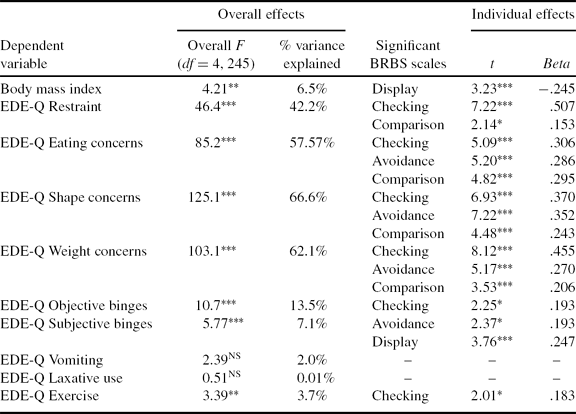
Table 4 shows the results of the multiple regression analyses, using the BRBS scales to explain the variance in BMI and EDE-Q scores. The table details the overall effect (F-value) and explained variance (adjusted R2 × 100). Where there was a significant overall effect, the individual scales that contributed significantly to the variance are given, along with their t- and Beta-values.
Association of body related behaviours (BRBS scales) with body mass index and eating attitudes and behaviours (EDE-Q scales), using multiple regression analyses

NS = non-significant; * p < .05; ** p < .01; *** p < .001.
Body-related behaviours and cognitions predicted large amounts of variance in EDE-Q attitudinal scales. Body checking was positively linked with all four EDE-Q scales, body comparison was related to eating, shape and weight concerns, and avoidance was associated with EDE-Q weight and shape concerns. Body display was not linked to any of these attitudinal scales. In terms of eating behaviours and weight, the amount of variance explained was smaller. None of the BRBS scales were associated with purging behaviours (vomiting and laxative abuse). Body checking was associated with greater levels of exercise to control weight and objective bingeing. However, body display was associated with greater levels of subjective bingeing (in combination with body avoidance) and with a lower body mass index.
Discussion
This study has examined the role of body-related behaviours and cognitions in the maintenance of eating psychopathology (including body image) among a non-clinical group of females and males. The findings confirm that there are independent effects of the two best known of the behaviours – body checking and avoidance (Shafran et al., Reference Shafran, Lee, Payne and Fairburn2004; Grilo et al., Reference Grilo, Reas, Brody, Burke-Martindale, Rothschild and Masheb2005) – with each contributing to levels of eating-disordered attitudes. The less well-researched behaviours and cognitions associated with body comparison also played a similar, independent role. None of those effects could be explained by general levels of anxiety or depression. Thus, it can be concluded that these three known patterns of safety behaviour are discrete factors in maintaining unhealthy eating attitudes and shape concerns in non-clinical women and men. This is despite the fact that some of the body-related behaviours are relatively closely associated, as might be expected (particularly the link between body checking and body comparison, where the latter requires the former).
More importantly, body display was associated with eating pathology in a way that differed from all the other body-related behaviours and cognitions. This safety behaviour was the principal body-related element that was associated with subjective binges and body mass index. The link with subjective binges indicates that there is an association with a sense of loss of control, but not with the overeating element itself (as opposed to body checking, which was associated with objective binges). Thus, both body display and avoidance are associated with the most pathological element of binge eating (sense of loss of control – Niego, Pratt and Agras, Reference Niego, Pratt and Agras1998). The negative association of body display and body mass index might be explained as being due to the individual feeling that their body is relatively attractive (because it is thinner), or it might reflect be the safety behaviour that was hypothesized above.
As anticipated, all four body-related behaviours and cognitions were associated with eating pathology in this non-clinical sample. They were all relevant, rather than there being key roles for one or two of the behaviours. The fact that the sample does not include a clinical group is a clear limitation of the study, which reduces the generalizability of the findings. This limitation needs to be addressed in future research to replicate and extend these findings with a clinical sample. It would also have been desirable for the sample that was used to establish the psychometric properties of the scale to have been distinct from the sample used to address the research question, and such differentiation would be valuable in future research. It will also be important to determine the association of such behaviours and cognitions with personality features, since there is evidence of a link between body checking and narcissism among clinical and non-clinical women (Waller, Sines, Meyer and Mountford, Reference Waller, Sines, Meyer and Mountford2008). However, the current findings suggest that formulating the eating disorders is likely to depend on understanding the role of such behaviours and cognitions, and that patients should be routinely asked about their use of such behaviours as part of their treatment. Where the behaviours are present, the underpinning cognitions should be investigated (e.g. Mountford et al., Reference Mountford, Haase and Waller2006). These behaviours and cognitions should be addressed using cognitive restructuring, exposure, surveys and behavioural experiments (Cooper, Whitehead and Boughton, Reference Cooper, Whitehead, Boughton, Bennett-Levy, Butler, Fennell, Hackmann, Mueller and Westbrook2004; Waller et al., Reference Waller, Sines, Meyer, Foster and Skelton2007). Since disturbed body image is a predictor of relapse post-treatment (Keel, Dorer, Franko, Jackson and Herzog, Reference Keel, Dorer, Franko, Jackson and Herzog2005), it can be hypothesized that cognitive-behavioural treatment is likely to be more effective if it addresses these elements. Given that these associations were found in a non-clinical group, it can also be hypothesized that primary prevention might be more beneficial if it explicitly addressed the negative impact of such body-related safety behaviours, rather than focusing only on more cognitive and emotional challenges (e.g. Durkin, Paxton and Wertheim, Reference Durkin, Paxton and Wertheim2005).



Comments
No Comments have been published for this article.