

1. Introduction
One major topic of research in extremal graph theory is to determine minimum degree conditions on a graph G which force it to contain copies of a spanning subgraph H. The primal example of such a theorem is Dirac’s theorem [Reference Dirac5], which states that if
 $\delta(G)\ge\tfrac12 v(G)$
then G is Hamiltonian. Optimal results of this type were established for a wide range of other spanning subgraphs H with bounded maximum degree such as powers of Hamilton cycles, trees, or F-factors for any fixed graph F (see e.g. [Reference Kühn and Osthus14] for a survey). In particular, we have the following two results.
Theorem 1 For each integer
 $k\ge3$
, if n is sufficiently large and G is an n-vertex graph with
 $\delta(G)\ge\tfrac{k-1}{k}n$
, then G contains a collection of
 $\big\lfloor\tfrac{n}{k}\big\rfloor$
vertex-disjoint copies of
 $K_{k}$
, and also the
 $(k-1)$
st distance power of a Hamilton cycle.
The first statement here is the Hajnal–Szemerédi Theorem [Reference Hajnal and Szemerédi8] (which actually holds for all n) and the second is the Pósa–Seymour conjecture, proved by Komlós et al. [Reference Komlós, Sárközy and Szemerédi13]; the kth power of a Hamilton cycle is the graph obtained from a Hamilton cycle by joining all pairs of vertices at distance k or less.
One characteristic all these graphs H have in common is that they have sublinear bandwidth. The bandwidth of a labelling of the vertex set of H by integers
 $1, \ldots, n$
is the minimum b such that
 $|i-j| \leq b$
for every edge ij of H. The bandwidth of H is the minimum bandwidth among all its labellings. The relevance of this parameter was highlighted in [Reference Böttcher, Schacht and Taraz4], where the following asymptotically optimal general result was proved.
Theorem 2 (Bandwidth Theorem [Reference Böttcher, Schacht and Taraz4]). For every
 $\unicode[Times]{x03B3} >0$
,
 $\Delta \geq 2$
, and
 $k\geq 1$
, there exist
 $\beta>0$
and
 $n_0 \geq 1$
such that for every
 $n\geq n_0$
the following holds. If G is a graph on n vertices with minimum degree
 $\delta(G)\geq \left(\frac{k-1}{k}+\unicode[Times]{x03B3}\right)n$
and if H is a k-colourable graph on n vertices with maximum degree
 $\Delta(H) \leq \Delta$
and bandwidth at most
 $\beta n$
, then G contains a copy of H.
More recently, the transference of extremal results from dense graphs to sparse graphs became a research focus. Again, a prime example, due to Lee and Sudakov [Reference Lee and Sudakov15], is that if
 $\Gamma=G(n,p)$
is a typical binomial random graph with
 $p\ge C\tfrac{\log n}{n}$
, for some large C, then any
 $G\underline{\subset}\Gamma$
with minimum degree
 $\big(\tfrac12+o(1)\big)pn$
is Hamiltonian. This is a transference of Dirac’s theorem to sparse random graphs. Further such results exist, all focused on finding small-bandwidth subgraphs (for a comprehensive list see, e.g., the recent survey [Reference Böttcher3]). One can also ask similar questions in other sparse graphs than random graphs—for example for sufficiently pseudorandom graphs—but we will not focus on this question here.
As for the classical extremal statements, it is desirable to have a result covering a very general class of spanning subgraphs. This is achieved in [Reference Allen, Böttcher, Ehrenmüller and Taraz1], where the following transference of the Bandwidth Theorem to sparse random graphs is proved.
Theorem 3 (Sparse Bandwidth Theorem [Reference Allen, Böttcher, Ehrenmüller and Taraz1, Theorem 6]). For each
 $\unicode[Times]{x03B3} >0$
,
 $\Delta \geq 2$
, and
 $k \geq 1$
, there exist constants
 $\beta^\ast >0$
and
 $C^{\ast} >0$
such that the following holds asymptotically almost surely for
 $\Gamma = G(n,p)$
if
 $p \geq C^{\ast}\big(\frac{\log n}{n}\big)^{1/\Delta}$
. Let G be a spanning subgraph of
 $\Gamma$
with
 $\delta(G) \geq\left(\frac{k-1}{k}+ \unicode[Times]{x03B3}\right)pn$
, and let H be a k-colourable graph on n vertices with
 $\Delta(H) \leq \Delta$
, bandwidth at most
 $\beta^\ast n$
, and with at least
 $C^{\ast} p^{-2}$
vertices which are not contained in any triangles of H. Then G contains a copy of H.
Note however that this result is not quite what one would expect as a transference of the Bandwidth Theorem. There is an additional restriction that some vertices of H may not be in triangles. This restriction is necessary, since in a sparse random graph an adversary who creates G from
 $\Gamma$
can typically remove only a tiny fraction of the edges at each vertex and still make the neighbourhoods of
 $\Omega(p^{-2})$
vertices into independent sets. This prompts the question how we should restrict the adversary so that any H with small maximum degree and sublinear bandwidth is contained in G? Our main result answers this question. As the statement is somewhat technical, let us first give the required condition for a transference of Theorem 1.
Theorem 4 For each
 $\unicode[Times]{x03B3} >0$
and
 $k,\Delta \geq 2$
, there exists a constant
 $C^{\ast} >0$
such that the following holds asymptotically almost surely for
 $\Gamma = G(n,p)$
if
 $p \geq C^{\ast}\big(\frac{\log n}{n}\big)^{1/\Delta}$
. Let G be a spanning subgraph of
 $\Gamma$
with
 $\delta(G) \geq\left(\frac{k-1}{k}+ \unicode[Times]{x03B3}\right)pn$
, such that for each
 $v\in V(G)$
there are at least
 $\unicode[Times]{x03B3} p^{\binom{k-1}{2}}(pn)^{k-1}$
copies of
 $K_{k-1}$
in
 $N_G(v)$
.
If
 $\Delta= k-1$
, then G contains
 $\big\lfloor\tfrac{n}{k}\big\rfloor$
vertex-disjoint copies of
 $K_k$
.
If
 $\Delta=2k-2$
, then G contains the
 $(k-1)$
st distance power of a Hamilton cycle.
Observe that the extra condition we put on G here is that each vertex neighbourhood contains a constant (but perhaps rather small) fraction of the copies of
 $K_{k-1}$
which it has in
 $\Gamma$
. Obviously, if there is a vertex of G which is not in any copy of
 $K_k$
, then that vertex cannot be in a
 $K_k$
-factor or in a
 $(k-1)$
st power of a Hamilton cycle, and as observed above, the minimum degree condition on G does not force all vertices to be contained in copies of
 $K_k$
, so this structural condition is necessary.
The parameter
 $\Delta$
here is simply the maximum degree of the subgraph of G we want to find, and it determines the probability p we can work with. We do not believe that our results are optimal in terms of the probability. It is well known that if
 $p\ll n^{2/(k+1)}$
then asymptotically almost surely each vertex of G(n,p) is contained in far fewer copies of
 $K_k$
than edges. If we choose a vertex set X of size
 $n/(2k)$
and delete all edges outside X which are contained in copies of
 $K_k$
, we obtain a subgraph G which satisfies the conditions of Theorem 4 (provided
 $\unicode[Times]{x03B3}$
is small) but in which at most
 $n/2$
vertices can be covered by disjoint copies of
 $K_k$
. It seems reasonable to believe that this construction in fact indicates the optimal probability for Theorem 4, though we cannot prove it.
So far, we have seen (Theorem 3) that if H is a bounded degree graph in which
 $\Omega(p^{-2})$
vertices are not in triangles, then the natural transference of the Bandwidth Theorem is true, and that to transfer Theorem 1, where we consider a graph H where all vertices are in copies of
 $K_k$
, then we need to insist that all vertices of G are in a reasonable number of copies of
 $K_k$
. The obvious generalisation is that if H is a graph where some
 $\Omega(p^{-2})$
vertices have s-colourable neighbourhoods (where we choose s minimal such that this is the case), then we need to insist that all vertices of G are in a reasonable number of copies of
 $K_{s+1}$
. This however turns out to be false: we will give in Section 6.2 an example of a graph H which satisfies this condition (for
 $s=2$
) but which need not be a subgraph of G satisfying the conditions of our Theorem 5. The correct condition is that some
 $\Omega(p^{-2})$
vertices have neighbourhoods which are coloured with s colours in a fixed k-colouring of H, and this is the content of our main theorem below.
Theorem 5 (Main result). For each
 $\unicode[Times]{x03B3} >0$
,
 $\Delta \geq 2$
,
 $k \geq 2$
and
 $1\le s\le k-1$
, there exist constants
 $\beta^\ast >0$
and
 $C^{\ast} >0$
such that the following holds asymptotically almost surely for
 $\Gamma = G(n,p)$
if
 $p \geq C^{\ast}\big(\frac{\log n}{n}\big)^{1/\Delta}$
. Let G be a spanning subgraph of
 $\Gamma$
with
 $\delta(G) \geq\left(\frac{k-1}{k}+ \unicode[Times]{x03B3}\right)pn$
, such that for each
 $v\in V(G)$
there are at least
 $\unicode[Times]{x03B3} p^{\binom{s}{2}}(pn)^s$
copies of
 $K_s$
in
 $N_G(v)$
. Let H be a graph on n vertices with
 $\Delta(H) \leq \Delta$
, bandwidth at most
 $\beta^\ast n$
and suppose that there is a proper k-colouring of V(H) and at least
 $C^{\ast} p^{-2}$
vertices in V(H) whose neighbourhood contains only s colours. Then G contains a copy of H.
The observant reader may note that Theorem 5 does not actually imply Theorem 4 if k does not divide n, since the
 $(k-1)$
st distance power of a Hamilton cycle is not k-colourable. Much as with the Bandwidth Theorem, this can be dealt with by allowing an extra colour ‘zero’ on a few carefully chosen vertices of H. Our main technical theorem, Theorem 22 in Section 3, makes this precise and does imply Theorem 4.
We should comment on the relation between this result and the recent work of Fischer, Škorić, Steger and Trujić [Reference Fischer, Škorić, Steger and Trujić6], who show ‘triangle-resilience’ for the square of a Hamilton cycle. Triangle-resilience is a stronger condition to impose on G than our Theorem 5 would require for proving the existence of the square of a Hamilton cycle, so in this sense our result is stronger. However, we can only work with
 $p\gg\big(\tfrac{\log n}{n}\big)^{1/4}$
, whereas in [Reference Fischer, Škorić, Steger and Trujić6] p may be as small as
 $Cn^{-1/2}\log^3n$
. This is rather close to the lower bound
 $p=n^{-1/2}$
at which point even a typical G(n,p) does not contain the square of a Hamilton cycle, so in this sense the result of [Reference Fischer, Škorić, Steger and Trujić6] is much stronger. It would be very interesting to improve the probability bounds in our result. But the method of [Reference Fischer, Škorić, Steger and Trujić6] uses the structure of the square of a Hamilton cycle in an essential way (in particular that it has constant bandwidth), and it is not clear how one might use their ideas in our more general situation.
1.1. Outline of the paper
We prove Theorem 5 by making use of the sparse regularity lemma of Kohayakawa and Rödl [Reference Kohayakawa10, Reference Kohayakawa and Rödl11], the sparse blow-up lemma of [Reference Allen, Böttcher, Hàn, Kohayakawa and Person2], and several lemmas from [Reference Allen, Böttcher, Ehrenmüller and Taraz1]. In Section 2 we give the definitions and results necessary to state and use the sparse regularity lemma and the sparse blow-up lemma, and also a few probabilistic lemmas. In Section 3, we give a somewhat more general statement (Theorem 22) than Theorem 5, which allows for graphs H which are not quite k-colourable, and outline briefly how to prove it using various lemmas.
The basic proof strategy, and most of the lemmas, are taken from [Reference Allen, Böttcher, Ehrenmüller and Taraz1]. The main exception is the pre-embedding lemma, Lemma 25, which replaces the ‘Common Neighbourhood Lemma’ of [Reference Allen, Böttcher, Ehrenmüller and Taraz1]. An outline of the idea, followed by the proof of this lemma, is provided in Section 4. This lemma requires new ideas and is the main work of this paper. The setup that this pre-embedding lemma creates also entails a number of modifications to the proof from [Reference Allen, Böttcher, Ehrenmüller and Taraz1], which need some work. The details are given in Section 5, where we give the proof of the main technical theorem, Theorem 22.
Finally, we finish with some concluding remarks in Section 6. In particular, while we prove that
 $\Theta(p^{-2})$
vertices of H need to have neighbourhoods containing s colours, we do not pin down the value of the multiplicative constant hidden by this notation. Our methods should allow for this more accurate result in some simple cases, and we comment on how there. We also discuss what one can say if
 $\Gamma$
is not truly random, but only satisfies some quasirandomness condition.
2. Preliminaries
Throughout the paper
 $\log$
denotes the natural logarithm. We assume that the order n of all graphs tends to infinity and therefore is sufficiently large whenever necessary. Our graph-theoretic notation is standard. In particular, given a graph G its vertex set is denoted by V(G) and its edge set by E(G). Let
 $A,B\subseteq V$
be disjoint vertex sets. We denote the number of edges between A and B by e(A,B). For a vertex
 $v \in V(G)$
we write
 $N_G(v)$
for the neighbourhood of v in G and
 $N_G(v,A)\;:\!=\; N_G(v) \cap A$
for the neighbourhood of v restricted to A. Finally, let
 $\deg_G(v) \;:\!=\; |N_G(v)|$
be the degree of v in G. For the sake of readability, we do not make any effort to optimise the constants in our theorems and proofs.
2.1. The sparse regularity method
Now we introduce some definitions and results of the regularity method as well as related tools that are essential in our proofs. In particular, we state a minimum degree version of the sparse regularity lemma (Lemma 9) and the sparse blow-up lemma (Lemma 13). Both lemmas use the concept of regular pairs. Let
 $G= (V,E)$
be a graph,
 $\varepsilon, d >0$
, and
 $p \in (0,1]$
. Moreover, let
 $X,Y \subseteq V$
be two disjoint nonempty sets. The p-density of the pair (X,Y) is defined as
 \begin{equation*}d_{G,p}(X,Y) \;:\!=\; \frac{e_G(X,Y)}{p|X||Y|}\,.\end{equation*}
We now define regular, and super-regular, pairs. Note that what we are calling ‘regulaR ′ is sometimes referred to as ‘lower-regulaR ′ by contrast with ‘fully-regulaR ′ (sometimes just called ‘regulaR ′) pairs in which an upper bound on p-densities is also imposed. It is immediate from the definition of the latter that a fully-regular pair is also lower-regular, with the same parameters; the converse is false.
Definition 6 (regular pairs, fully-regular pairs, super-regular pairs). The pair (X,Y) is called
 $(\varepsilon,d,p)_G$
-regular if for every
 $X'\subseteq X$
and
 $Y'\subseteq Y$
with
 $|X'|\geq \varepsilon|X|$
and
 $|Y'|\geq \varepsilon |Y|$
we have
 $d_{G,p}(X',Y') \geq d- \varepsilon$
. It is called
 $(\varepsilon,d,p)_G$
-regular if there is some
 $d'\ge d$
such that for every
 $X'\subseteq X$
and
 $Y'\subseteq Y$
with
 $|X'|\geq \varepsilon|X|$
and
 $|Y'|\geq \varepsilon |Y|$
we have
 $\big|d_{G,p}(X',Y')-d'\big| \le \varepsilon$
.
If (X,Y) is
 $(\varepsilon,d,p)_G$
-regular, and in addition we have
 \begin{align*} |N_G(x,Y)| &\geq (d-\varepsilon)\max\big(p|Y|,\deg_\Gamma(x,Y)/2\big)\quad\text{and}\\ |N_G(y,X)| &\geq (d-\varepsilon)\max\big(p|X|,\deg_\Gamma(y,X)/2\big)\end{align*}
for every
 $x \in X$
and
 $y \in Y$
, then the pair (X,Y) is called
 $(\varepsilon,d,p)_G$
-super-regular.
A direct consequence of the definition of
 $(\varepsilon,d,p)$
-regular pairs is the following proposition about the sizes of neighbourhoods in regular pairs.
Proposition 7 Let (X,Y) be
 $(\varepsilon, d,p)$
-regular. Then there are less than
 $\varepsilon |X|$
vertices
 $x\in X$
with
 $|N(x,Y)| < (d-\varepsilon)p|Y|$
.
The following proposition is another immediate consequence of Definition 6. It states that an
 $(\varepsilon,d,p)$
-regular pair is still regular if only a linear fraction of its vertices is removed.
Proposition 8 Let (X,Y) be
 $(\varepsilon, d,p)$
-regular and suppose
 $X'\subseteq X$
and
 $Y' \subseteq Y$
satisfy
 $|X'| \geq \mu |X|$
and
 $|Y'|\geq \nu |Y|$
with some
 $\mu, \nu >0$
. Then (X’,Y’) is
 $(\frac{\varepsilon}{\min\{\mu,\nu\}},d,p)$
-regular.
In order to state the sparse regularity lemma, we need some more definitions. A partition
 ${\mathcal V} = \{V_i\}_{i\in\{0,\ldots,r\}}$
of the vertex set of G is called an
 $(\varepsilon,p)_G$
-regular partition of V(G) if
 $|V_0|\leq \varepsilon |V(G)|$
and
 $(V_i,V_{i^{\prime}})$
forms an
 $(\varepsilon,0,p)_G$
-fully-regular pair for all but at most
 $\varepsilon\binom{r}{2}$
pairs
 $\{i,i^{\prime}\}\in \binom{[r]}{2}$
. It is called an equipartition if
 $|V_i| = |V_{i^{\prime}}|$
for every
 $i,i^{\prime}\in[r]$
. The partition
 ${\mathcal V}$
(or the pair
 $(G,{\mathcal V})$
) is called
 $(\varepsilon,d,p)_G$
-regular on a graph R with vertex set [r] if
 $(V_i, V_{i^{\prime}})$
is
 $(\varepsilon,d,p)_G$
-regular for every
 $\{i,i^{\prime}\}\in E(R)$
. The graph R is referred to as the
 $(\varepsilon,d,p)_G$
-reduced graph of
 ${\mathcal V}$
, the partition classes
 $V_i$
with
 $i \in [r]$
as clusters and
 $V_0$
as the exceptional set. We also say that
 ${\mathcal V}$
(or the pair
 $(G,{\mathcal V})$
) is
 $(\varepsilon,d,p)_G$
-super-regular on a graph R ′ with vertex set [r] if
 $(V_i, V_{i^{\prime}})$
is
 $(\varepsilon,d,p)_G$
-super-regular for every
 $\{i,i^{\prime}\}\in E(R')$
.
Analogously to Szemerédi’s regularity lemma for dense graphs, the sparse regularity lemma, proved by Kohayakawa [Reference Kohayakawa10], Kohayakawa and Rödl [Reference Kohayakawa and Rödl11] and Scott [Reference Scott16], asserts the existence of an
 $(\varepsilon,p)$
-regular partition of constant size of any sparse graph. We state a minimum degree version of this lemma, whose proof can be found in the appendix of [Reference Allen, Böttcher, Ehrenmüller and Taraz1].
Lemma 9 (Minimum degree version of the sparse regularity lemma). For each
 $\varepsilon >0$
, each
 $\alpha \in [0,1]$
, and
 $r_0\geq 1$
there exists
 $r_1\geq 1$
with the following property. For any
 $d\in[0,1]$
, any
 $p>0$
, and any n-vertex graph G with minimum degree
 $\alpha p n$
such that for any disjoint
 $X,Y\subset V(G)$
with
 $|X|,|Y|\ge\tfrac{\varepsilon n}{r_1}$
we have
 $e(X,Y)\le \big(1+\tfrac{1}{1000}\varepsilon^2\big)p|X||Y|$
, there is an
 $(\varepsilon,p)_G$
-regular equipartition of V(G) with
 $(\varepsilon,d,p)_G$
-reduced graph R satisfying
 $\delta(R) \geq (\alpha-d-\varepsilon)|V(R)|$
and
 $r_0 \leq|V(R)| \leq r_1$
.
We will need the following version of the sparse regularity lemma (see e.g. [Reference Allen, Böttcher, Ehrenmüller and Taraz1, Lemma 29] for a proof), allowing for a partition equitably refining an initial partition with parts of very different sizes. Given a partition
 $ V(G)=V_1\,{\cup\mkern-12.5mu\cdot\mkern5mu} \cdots {\cup\mkern-12.5mu\cdot\mkern5mu}\,V_s $
, we say a partition
 $\{V_{i,j}\}_{i\in[s],j\in[t]}$
is an equitable
 $(\varepsilon,p)$
-regular refinement of
 $\{V_i\}_{i\in[s]}$
if
 $|V_{i,j}|=|V_{i,j^{\prime}}|\pm 1$
for each
 $i\in[s]$
and
 $j,j^{\prime}\in[t]$
, and there are at most
 $\varepsilon s^2t^2$
pairs
 $(V_{i,j},V_{i^{\prime},\kern0.5pt j^{\prime}})$
which are not
 $(\varepsilon,0,p)$
-fully-regular.
Lemma 10 (Refining version of the sparse regularity lemma) For each
 $\varepsilon>0$
and
 $s\in\mathbb{N}$
there exists
 $t_1\geq 1$
such that the following holds. Given any graph G, suppose
 $V_1\,\cup\mkern-12.5mu\cdot\mkern5mu \cdots \cup\mkern-12.5mu\cdot\mkern5mu\,V_s$
is a partition of V(G). Suppose that
 $e(V_i)\le 3p|V_i|^2$
for each
 $i\in[s]$
, and
 $e(V_i,V_{i^{\prime}})\le 2p|V_i||V_{i^{\prime}}|$
for each
 $i\neq i^{\prime}\in[s]$
. Then there exist sets
 $V_{i,0}\subset V_i$
for each
 $i\in[s]$
with
 $|V_{i,0}|<\varepsilon|V_i|$
, and an equitable
 $(\varepsilon,p)$
-regular refinement
 $\{V_{i,j}\}_{i\in[s],j\in[t]}$
of
 $\{V_i\setminus V_{i,0}\}_{i\in[s]}$
for some
 $t\le t_1$
.
A key ingredient in the proof of our main theorem is the so-called sparse blow-up lemma established in [Reference Allen, Böttcher, Hàn, Kohayakawa and Person2]. Given a subgraph
 $G \subseteq \Gamma =G(n,p)$
with
 $p \gg (\log n/n)^{1/\Delta}$
and an n-vertex graph H with maximum degree at most
 $\Delta$
with vertex partitions
 ${\mathcal V}$
and
 ${\mathcal W}$
, respectively, the sparse blow-up lemma guarantees under certain conditions a spanning embedding of H in G which respects the given partitions. In order to state this lemma we need some definitions.
Let G and H be graphs on n vertices with partitions
 ${\mathcal V}=\{V_i\}_{i\in[r]}$
of V(G) and
 ${\mathcal W}=\{W_i\}_{i\in[r]}$
of V(H). We say that
 ${\mathcal V}$
and
 ${\mathcal W}$
are size-compatible if
 $|V_i|=|W_i|$
for all
 $i\in[r]$
. If there exists an integer
 $m \geq 1$
such that
 $m \leq|V_i| \leq \kappa m$
for every
 $i\in [r]$
, then we say that
 $(G,{\mathcal V})$
is
 $\kappa$
-balanced. Given a graph R on r vertices, we call
 $(H,{\mathcal W})$
an R-partition if for every edge
 $\{x,y\}\in E(H)$
with
 $x\in W_i$
and
 $y\in W_{i^{\prime}}$
we have
 $\{i,i^{\prime}\}\in E(R)$
. The following definition allows for image restrictions in the sparse blow-up lemma.
Definition 11 (Restriction pair). Let
 $\varepsilon,d>0$
,
 $p \in [0,1]$
, and let R be a graph on r vertices. Furthermore, let G be a (not necessarily spanning) subgraph of
 $\Gamma = G(n,p)$
and let H be a graph given with vertex partitions
 ${\mathcal V}= \{V_i\}_{i\in[r]}$
and
 ${\mathcal W} = \{W_i\}_{i\in[r]}$
, respectively, such that
 $(G,{\mathcal V})$
and
 $(H,{\mathcal W})$
are size-compatible R-partitions. Let
 ${\mathcal I}=\{I_x\}_{x\in V(H)}$
be a collection of subsets of V(G), called image restrictions, and
 ${\mathcal J}=\{J_x\}_{x\in V(H)}$
be a collection of subsets of
 $V(\Gamma)\setminus V(G)$
, called restricting vertices. For each
 $i\in [r]$
we define
 $R_i\subseteq W_i$
to be the set of all vertices
 $x \in W_i$
for which
 $I_x \neq V_i$
. We say that
 ${\mathcal I}$
and
 ${\mathcal J}$
are a
 $(\rho,\zeta,\Delta,\Delta_J)$
-restriction pair if the following properties hold for each
 $i\in[r]$
and
 $x\in W_i$
.
-
(RP1) We have
 $|R_i|\leq\rho|W_i|$
.
-
(RP2) If
$x\in R_i$
, then
$I_x\subseteq \bigcap_{u\in J_x} N_\Gamma(u, V_i)$
is of size at least
$\zeta(dp)^{|J_x|}|V_i|$
. -
(RP3) If
$x\in R_i$
, then
$|J_x|+\deg_H(x)\leq\Delta$
and if
$x\in W_i\setminus R_i$
, then
$J_x=\varnothing$
. -
(RP4) Each vertex in V(G) appears in at most
$\Delta_J$
of the sets of
${\mathcal J}$
. -
(RP5) We have
$\big|\bigcap_{u\in J_x} N_\Gamma(u, V_i)\big| = (p\pm\varepsilon p)^{|J_x|}|V_i|$
. -
(RP6) If
$x\in R_i$
, for each
$xy\in E(H)$
with
$y\in W_j$
,
\begin{equation*}\text{the pair }\quad\Big( V_i \cap \bigcap_{u\in J_x}N_\Gamma(u), V_j \cap \bigcap_{v\in J_y}N_\Gamma(v)\Big)\quad\text{ is $(\varepsilon,d,p)_G$-regular.}\end{equation*}


The sparse blow-up lemma needs not all pairs in the reduced graph R to be super-regular, but only those in a subgraph R ′ of R. This, however, is only possible if a good proportion of H is embedded to the pairs in R ′. The following definition of buffer-sets makes this requirement precise. Moreover, we need certain regularity inheritance properties for the pairs in R ′.
Definition 12 (
 $(\vartheta, R')$
-buffer, regularity inheritance) Let R and R ′ be graphs on vertex set [r] with
 $R'\subset R$
. Suppose that
 $(H,{\mathcal W})$
is an R-partition and that
 $(G,{\mathcal V})$
is a size-compatible
 $(\varepsilon,d,p)_G$
-regular partition with reduced graph R. We say that the family
 $\widetilde{\mathcal{W}}=\{\widetilde{W}_i\}_{i\in[r]}$
of subsets
 $\widetilde{W}_i\subseteq W_i$
is an
 $(\vartheta,R')$
-buffer for H if
-
i.
$|\widetilde{W}_i|\geq\vartheta |W_i|$
for all
$i\in[r]$
, and -
ii. for each
$i\in[r]$
and each
$x\in\widetilde{W}_i$
, the first and second neighbourhood of x go along R ′, i.e., for each
$\{x,y\},\{y,z\}\in E(H)$
with
$y\in W_j$
and
$z\in W_k$
we have
$\{i,j\}\in E(R')$
and
$\{j,k\}\in E(R')$
.


We say
 $(G,{\mathcal V})$
has one-sided inheritance on R ′ if for every
 $\{i,j\}, \{j,k\}\in E(R')$
and every
 $v\in V_i$
the pair
 $\big(N_\Gamma(v, V_j),V_k\big)$
is
 $(\varepsilon,d,p)_G$
-regular. We say
 $(G,{\mathcal V})$
has two-sided inheritance on R ′ for
 $\widetilde{\mathcal{W}}$
if for each
 $i,j,k \in V(R')$
such that there is a triangle
 $x_ix_jx_k$
in H with
 $x_i\in \widetilde{W}_i$
,
 $x_j\in W_j$
, and
 $x_k\in W_k$
the following holds. For every
 $v\in V_i$
the pair
 $\big(N_\Gamma(v, V_j),N_\Gamma(v, V_k)\big)$
is
 $(\varepsilon,d,p)_G$
-regular.
Now we can finally state the sparse blow-up lemma.
Lemma 13 (Sparse blow-up lemma [Reference Allen, Böttcher, Hàn, Kohayakawa and Person2, Lemma 1.21]). For each
 $\Delta$
,
 $\Delta_{R'}$
,
 $\Delta_J$
,
 $\vartheta,\zeta, d>0$
,
 $\kappa>1$
there exist
 $\varepsilon_{{BL}},\rho>0$
such that for all
 $r_1$
there is a
 $C_{BL}\;such\;that\;for\;p \geq C_{BL}(\log n/n)^{1/\Delta}$
the random graph
 $\Gamma=G_{n,p}$
asymptotically almost surely satisfies the following.
Let R be a graph on
 $r\le r_1$
vertices and let
 $R'\subseteq R$
be a spanning subgraph with
 $\Delta(R')\leq \Delta_{R'}$
. Let H and
 $G\subseteq \Gamma$
be graphs given with
 $\kappa$
-balanced, size-compatible vertex partitions
 ${\mathcal W}=\{W_i\}_{i\in[r]}$
and
 ${\mathcal V}=\{V_i\}_{i\in[r]}$
with parts of size at least
 $m\geq n/(\kappa r_1)$
. Let
 ${\mathcal I}=\{I_x\}_{x\in V(H)}$
be a family of image restrictions, and
 ${\mathcal J}=\{J_x\}_{x\in V(H)}$
be a family of restricting vertices. Suppose that
-
(BUL1)
$\Delta(H)\leq \Delta$
, for every edge
$\{x,y\}\in E(H)$
with
$x\in W_i$
and
$y\in W_j$
we have
$\{i,j\}\in E(R)$
and
$\widetilde{\mathcal{W}}=\{\widetilde{W}_i\}_{i\in[r]}$
is an
$(\vartheta,R')$
-buffer for H, -
(BUL2)
$(G,{\mathcal V})$
is
$(\varepsilon_{BL},d,p)_G$
-regular on R,
$(\varepsilon_{{BL}},d,p)_G$
-super-regular on R ′, has one-sided inheritance on R ′, and two-sided inheritance on R ′ for
$\widetilde{\mathcal{W}}$
, -
(BUL3)
${\mathcal I}$
and
${\mathcal J}$
form a
$(\rho,\zeta,\Delta,\Delta_J)$
-restriction pair.


Then there is an embedding
 $\phi\colon V(H)\to V(G)$
such that
 $\phi(x)\in I_x$
for each
 $x\in H$
.
Observe that in the blow-up lemma for dense graphs, proved by Komlós et al. [Reference Komlós, Sárközy and Szemerédi12], one does not need to explicitly ask for one- and two-sided inheritance properties since they are always fulfilled by dense regular partitions. This is, however, not true in general in the sparse setting. The following two lemmas will be very useful whenever we need to redistribute vertex partitions in order to achieve some regularity inheritance properties.
Lemma 14 (One-sided regularity inheritance [Reference Allen, Böttcher, Hàn, Kohayakawa and Person2]). For each
 $\varepsilon_{{OSRIL}}, {\alpha_{{OSRIL}}} >0$
there exist
 $\varepsilon_0 >0$
and
 $C >0$
such that for any
 $0 < \varepsilon < \varepsilon_0$
and
 $0 < p <1$
asymptotically almost surely
 $\Gamma=G(n,p)$
has the following property. For any disjoint sets X and Y in
 $V(\Gamma)$
with
 $|X|\geq C\max\big(p^{-2}, p^{-1} \log n\big)$
and
 $|Y|\geq C p^{-1} \log n$
, and any subgraph G of
 $\Gamma[X,Y]$
which is
 $(\varepsilon, {\alpha_{{OSRIL}}},p)_G$
-regular, there are at most
 $C p^{-1}\log (en/|X|)$
vertices
 $z \in V(\Gamma)$
such that
 $(X \cap N_{\Gamma}(z),Y)$
is not
 $ (\varepsilon_{{OSRIL}},\alpha_{{OSRIL}},p)_G $
-regular.
Lemma 15 (Two-sided regularity inheritance [Reference Allen, Böttcher, Hàn, Kohayakawa and Person2]). For each
 ${\varepsilon_{TSRIL}},{\alpha_{TSRIL}}>0$
there exist
 $\varepsilon_0>0$
and
 $C >0$
such that for any
 $0<\varepsilon<\varepsilon_0$
and
 $0<p<1$
, asymptotically almost surely
 $\Gamma=G_{n,p}$
has the following property. For any disjoint sets X and Y in
 $V(\Gamma)$
with
 $|X|,|Y|\ge C\max\{p^{-2},p^{-1}\log n\}$
, and any subgraph G of
 $\Gamma[X,Y]$
which is
 $(\varepsilon,{\alpha_{{TSRIL}}},p)_G$
-regular, there are at most
 $C\max\{p^{-2},p^{-1}\log (en/|X|)\}$
vertices
 $z \in V(\Gamma)$
such that
 $\big(X\cap N_\Gamma(z),Y\cap N_\Gamma(z)\big)$
is not
 $(\varepsilon_{{TSRIL}},{\alpha_{{TSRIL}}},p)_G$
-regular.
Finally, we need a statement about random subpairs of regular pairs (which is used to prove Lemma 15).
Corollary 16 ([7, Corollary 3.8]) For any d,
 $\beta$
,
 $\varepsilon'>0$
there exist
 $\varepsilon_0>0$
and C such that for any
 $0<\varepsilon<\varepsilon_0$
and
 $0<p<1$
, if (X,Y) is an
 $(\varepsilon,d,p)$
-regular pair in a graph G, then the number of pairs
 $X'\subseteq X$
and
 $Y'\subseteq Y$
with
 $|X'|=w_1\ge C/p$
and
 $|Y'|=w_2\ge C/p$
such that (X′,Y′) is an
 $(\varepsilon',d,p)$
-regular pair in G is at least
 $(1-\beta^{\min(w_1,w_2)})\binom{|X|}{w_1}\binom{|Y|}{w_2}$
.
2.2. Concentration inequalities
We close this section with two of Chernoff’s bounds for random variables that follow a binomial (Theorem 18) and a hypergeometric distribution (Theorem 19), respectively, and the following useful observation. Roughly speaking, it states that a.a.s. nearly all vertices in G(n,p) have approximately the expected number of neighbours within large enough subsets (for a proof see e.g. [Reference Allen, Böttcher, Ehrenmüller and Taraz1, Proposition 18]).
Proposition 17 For each
 $\varepsilon>0$
there exists a constant
 $C >0$
such that for every
 $0<p<1$
asymptotically almost surely
 $\Gamma=G(n,p)$
has the property that for any sets
 $X,Y\subset V(\Gamma)$
with
 $|X|\ge {Cp}^{-1}\log n$
and
 $|Y|\ge Cp^{-1}\log (en/|X|)$
the following holds.
-
a. If X and Y are disjoint, then
$e(X,Y)=(1\pm\varepsilon)p|X||Y|$
. -
b. We have
$e(X)\le 2p|X|^2$
. -
c. At most
$C p^{-1} \log (en/|X|)$
vertices
$v \in V(\Gamma)$
satisfy
$\big||N_{\Gamma}(v,X)| - p |X|\big| > \varepsilon p |X|$
.


We use the following version of Chernoff’s Inequalities (see e.g. [Reference Janson, Łuczak and Rucinski9, Chapter 2] for a proof).
Theorem 18 (Chernoff’s Inequality, [Reference Janson, Łuczak and Rucinski9]). Let X be a random variable which is the sum of independent Bernoulli random variables. Then we have for
 $\varepsilon\leq 3/2$
 \begin{equation*}\mathbb{P}\big[|X-\mathbb{E}[X]| > \varepsilon \mathbb{E}[X]\big] < 2e^{-\varepsilon^2\mathbb{E}[X]/3}\,.\end{equation*}
Furthermore, if
 $t\ge 6\mathbb{E}[X]$
then we have
 \begin{equation*}\mathbb{P}\big[X\ge\mathbb{E}[X]+t\big]\le e^{-t}\,.\end{equation*}
Finally, let N, m, and s be positive integers and let S and
 $S' \subseteq S$
be two sets with
 $|S| = N$
and
 $|S'| = m$
. The hypergeometric distribution is the distribution of the random variable X that is defined by drawing s elements of S without replacement and counting how many of them belong to S ′. It can be shown that Theorem 18 still holds in the case of hypergeometric distributions (see e.g. [Reference Janson, Łuczak and Rucinski9], Chapter 2 for a proof) with
 $\mathbb{E}[X]= ms/N$
.
Theorem 19 (Hypergeometric inequality, [Reference Janson, Łuczak and Rucinski9]). Let X be a random variable is hypergeometrically distributed with parameters N, m, and s. Then for any
 $\varepsilon>0$
and
 $t\ge\varepsilon ms/N$
we have
 \begin{equation*}\mathbb{P}\big[|X - ms/N| > t \big] < 2e^{-\varepsilon^2t/3}\,.\end{equation*}
We require the following technical lemma, which is a consequence of the hypergeometric inequality stated in Theorem 19.
Lemma 20 For each
 $\varepsilon^+_0,d^+>0$
there exists
 $\varepsilon^+>0$
, and for each
 $\varepsilon,d>0$
there exists
 $\varepsilon^->0,$
such that for each
 $\eta>0$
and
 $\Delta$
there exists C such that the following holds for each
 $p>0$
.
Let
 $W\subset [n]$
, let
 $t\le 100n^{\Delta+1}$
, and let
 $T_1,\ldots,T_t$
be subsets of W. Let G be a graph on W. For each
 $i\in[t]$
let
 $(X_i,Y_i)$
be a pair which is either
 $(\varepsilon^+,d^+,p)_G$
-regular, or
 $(\varepsilon^-,d,p)_G$
-regular (respectively), and which satisfies
 $m|X_i|/|W|,m|Y_i|/|W|\ge 2Cp^{-1}\log n$
.
For each
 $m\le |W|$
there is a set
 $S\subset W$
of size m such that for each
 $i\in[t]$
 \begin{equation*}|T_i\cap S|=\tfrac{m}{|W|}|T_i|\pm \big(\eta|T_i|+C\log n\big)\,,\end{equation*}
and the pair
 $\big(X_i\cap S,Y_i\cap S\big)$
is
 $\big(\varepsilon^+_0,d^+,p\big)$
-regular, or
 $(\varepsilon,d,p)$
-regular (respectively).
Proof. Given
 $\varepsilon^+_0,d^+$
, let
 $\varepsilon^+$
be returned by Corollary 16 for input
 $d^+$
,
 $\beta=\tfrac12$
and
 $\varepsilon^+_0$
. Given
 $\varepsilon,d$
, let
 $\varepsilon^-$
be returned by Corollary 16 for input d,
 $\beta=\tfrac12$
and
 $\varepsilon$
. Let
 $C\ge 30\eta^{-2}\Delta$
be large enough for these applications of Corollary 16.
Observe that for each i, the size of
 $T_i\cap S$
is hypergeometrically distributed. By Theorem 19, for each i we have
 \begin{equation*}\mathbb{P}\big[|T_i\cap S|\neq \tfrac{m}{|W|}|T_i|\pm \big(\eta|T_i|+C\log n\big)\big]<2e^{-\eta^2C\log n/3}<\frac{2}{n^{2+\Delta}}\,,\end{equation*}
so taking the union bound over all
 $i\in[t]$
we conclude that the probability of failure is at most
 $2t/n^{2+\Delta}\le 200/n\to 0$
as
 $n\to\infty$
, as desired.
To obtain the second property, observe that Theorem 19 also implies that we have
 $|X_i\cap S|,|Y_i\cap S|\ge Cp^{-1}\log n$
for each
 $i\in[t]$
with probability tending to one as
 $n\to\infty$
. Conditioning on the size of
 $|X_i\cap S|$
, the set
 $X_i\cap S$
is a uniformly distributed subset of
 $X_i$
of size
 $|X_i\cap S|$
, and the same applies to
 $Y_i\cap S$
. Now Corollary 16 says that, conditioning on
 $|X_i\cap S|,|Y_i\cap S|\ge Cp^{-1}\log n$
, the probability that
 $\big(X_i\cap S,Y_i\cap S\big)$
fails to have the desired regularity in G is at most
 $2^{-Cp^{-1}\log n}$
, and taking a union bound over the choices of i the result follows.
3. Main technical result and main lemmas
We deduce Theorem 5 from the following technical result (corresponding results also appear in the predecessor papers [Reference Allen, Böttcher, Ehrenmüller and Taraz1, Reference Böttcher, Schacht and Taraz4]). This result is more general in that it allows for an extra colour, zero, in the colouring of H, provided that this colour does not appear too often.
Definition 21 (Zero-free colouring). Let H be a
 $(k+1)$
-colourable graph on n vertices and let
 ${\mathcal L}$
be a labelling of its vertex set of bandwidth at most
 $\beta n$
. A proper
 $(k+1)$
- colouring
 $\sigma:V(H) \to \{0,\ldots,k\}$
of its vertex set is said to be
 $(z,\beta)$
-zero-free with respect to
 ${\mathcal L}$
if any z consecutive blocks contain at most one block with colour zero, where a block is defined as a set of the form
 $\{(t-1)4k\beta n +1, \ldots, t4k\beta n\}$
with
 $t \in [1/(4k\beta)]$
.
Theorem 22 (Main technical result). For each
 $\unicode[Times]{x03B3}>0$
,
 $\Delta \geq 2$
,
 $k\geq 2$
and
 $1\le s\le k-1$
, there exist constants
 $\beta >0$
,
 $z>0$
, and
 $C>0$
such that the following holds asymptotically almost surely for
 $\Gamma = G(n,p)$
if
 $p\geq C\big(\frac{\log n}{n}\big)^{1/\Delta}$
. Let G be a spanning subgraph of
 $\Gamma$
with
 $\delta(G) \geq\big(\frac{k-1}{k}+\unicode[Times]{x03B3}\big)pn$
such that for each
 $v\in V(G)$
there are at least
 $\unicode[Times]{x03B3} p^{\binom{s}{2}}(pn)^s$
copies of
 $K_s$
in
 $N_G(v)$
and let H be a graph on n vertices with
 $\Delta(H) \leq \Delta$
that has a labelling
 ${\mathcal L}$
of its vertex set of bandwidth at most
 $\beta n$
, a
 $(k+1)$
-colouring that is
 $(z,\beta)$
-zero-free with respect to
 ${\mathcal L}$
and where the first
 $\sqrt{\beta} n$
vertices in
 ${\mathcal L}$
are not given colour zero and the first
 $\beta n$
vertices in
 ${\mathcal L}$
include
 $Cp^{-2}$
vertices whose neighbourhood contains only s colours. Then G contains a copy of H.
The basic proof strategy for this theorem is analogous to the proof strategy for [Reference Allen, Böttcher, Ehrenmüller and Taraz1, Theorem 23]. Eventually, we will apply the sparse blow-up lemma, Lemma 13, to embed most of H into G, and we need to obtain the necessary conditions for this lemma. The difficulty is that, whatever regular partition of G we take, there may be some exceptional vertices which are ‘badly behaved’ with respect to this partition. Our first main lemma, the following Lemma for G, states that there is a partition with only few such vertices, which we collect in a set
 $V_0$
. These vertices will be dealt with in a pre-embedding stage before the application of the sparse blow-up lemma.
For the application of the sparse blow-up lemma the following two graphs
 $B^k_r$
and
 $K^k_r$
, which we shall find as subgraphs of the reduced graph of G, are essential. Let
 $r, k \geq 1$
and let
 $B^k_r$
be the backbone graph on kr vertices. That is, we have
 \begin{equation*}V(B^k_r) \;:\!=\; [r] \times [k]\end{equation*}
and for every
 $j \neq j^{\prime} \in [k]$
we have
 $\{(i,j),(i^{\prime},\kern0.5pt j^{\prime})\} \in E(B^k_r)$
if and only if
 $|i-i^{\prime}|\le1$
. Let
 $K^k_r \subseteq B^k_r$
be the spanning subgraph of
 $B^k_r$
that is the disjoint union of r complete graphs on k vertices given by the following components: the complete graph
 $K^k_r[\{(i,1),\ldots, (i,k)\}]$
is called the i-th component of
 $K^k_r$
for each
 $i\in [r]$
.
A vertex partition
 ${\mathcal V}' = \{V_{i,j}\}_{i\in[r],j\in[k]}$
is called k-equitable if
 $\big||V_{i,j}| -|V_{i,j^{\prime}}|\big|\leq 1$
for every
 $i\in [r]$
and
 $j,j^{\prime}\in[k]$
. Similarly, an integer partition
 $\{n_{i,j}\}_{i\in[r],j\in[k]}$
of n (meaning that
 $n_{i,j} \in \mathbb Z_{\geq 0}$
for every
 $i\in [r],j\in[k]$
and
 $\sum_{i\in[r]j\in[k]} n_{i,j} = n$
) is k-equitable if
 $|n_{i,j}-n_{i,j^{\prime}}| \leq 1$
for every
 $i\in[r]$
and
 $j,j^{\prime}\in[k]$
.
The Lemma for G then guarantees a k-equitable partition for G whose reduced graph
 $R^k_r$
contains a copy of the backbone graph
 $B^k_r$
, is super-regular on
 $K^k_r\subset B^k_r$
, and satisfies certain regularity inheritance properties.
Lemma 23 (Lemma for G, [Reference Allen, Böttcher, Ehrenmüller and Taraz1, Lemma 24]). For each
 $\unicode[Times]{x03B3} > 0$
and integers
 $k \geq 2$
and
 $r_0 \geq 1$
there exists
 $d > 0$
such that for every
 $\varepsilon \in \left(0, \frac{1}{2k}\right)$
there exist
 $r_1\geq 1$
and
 $C^{\ast}>0$
such that the following holds a.a.s. for
 $\Gamma = G(n,p)$
if
 $p \geq C^{\ast} \left(\log n/n\right)^{1/2}$
. Let
 $G=(V,E)$
be a spanning subgraph of
 $\Gamma$
with
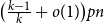
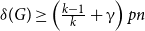 $\delta(G) \geq \left(\frac{k-1}{k} + \unicode[Times]{x03B3}\right)pn$
. Then there exists an integer r with
 $r_0\leq kr \leq r_1$
, a subset
 $V_0 \subseteq V$
with
 $|V_0| \leq C^{\ast} p^{-2}$
, a k-equitable vertex partition
 ${\mathcal V} = \{V_{i,j}\}_{i\in[r],j\in[k]}$
of
 $V(G)\setminus V_0$
, and a graph
 $R^k_r$
on the vertex set
 $[r] \times [k]$
with
 $K^k_r \subseteq B^k_r \subseteq R^k_r$
, with
 $\delta(R^k_r) \geq \left(\frac{k-1}{k} + \frac{\unicode[Times]{x03B3}}{2}\right)kr$
, and such that the following is true.
-
(G1)
$\frac{n}{4kr}\leq |V_{i,j}| \leq \frac{4n}{kr}$
for every
$i\in[r]$
and
$j\in[k]$
, -
(G2)
${\mathcal V}$
is
$(\varepsilon,d,p)_G$
-regular on
$R^k_r$
and
$(\varepsilon,d,p)_G$
-super-regular on
$K^k_r$
, -
(G3) both
$\big(N_{\Gamma}(v, V_{i,j}),V_{i^{\prime},\kern0.5pt j^{\prime}}\big)$
and
$\big(N_{\Gamma}(v', V_{i,j}),N_{\Gamma}(v, V_{i^{\prime},\kern0.5pt j^{\prime}})\big)$
are
$(\varepsilon,d,p)_G$
-regular pairs for every
$\{(i,j),(i^{\prime},\kern0.5pt j^{\prime})\} \in E(R^k_r)$
and
$v\in V\setminus V_0$
, -
(G4)
$|N_{\Gamma}(v,V_{i,j})| = (1 \pm \varepsilon)p|V_{i,j}|$
for every
$i \in [r]$
,
$j\in [k]$
and every
$v \in V \setminus V_0$
.


The next step is to find a partition of H which more or less matches that of G. This partition of H defines an assignment of the vertices of H to the clusters of G. In other words, we assign the vertices in V(H) indices (i,j) of the partition
 ${\mathcal V}$
, such that about
 $|V_{i,j}|$
vertices are assigned (i,j) and all edges of H are assigned to edges of
 $R^k_r$
. In fact, the lemma states further that most edges of H are assigned to edges of
 $K^k_r$
, and only those incident to vertices of a small set of special vertices X may be assigned to other edges of
 $R^k_r$
.
Lemma 24 (Lemma for H, [Reference Allen, Böttcher, Ehrenmüller and Taraz1, Lemma 25]). Given
 $D, k, r \geq 1$
and
 $\xi, \beta > 0 $
the following holds if
 $\xi \leq 1/(kr)$
and
 $\beta \leq 10^{-10}\xi^2/(D k^4r)$
. Let H be a D-degenerate graph on n vertices, let
 $\mathcal L$
be a labelling of its vertex set of bandwidth at most
 $\beta n$
and let
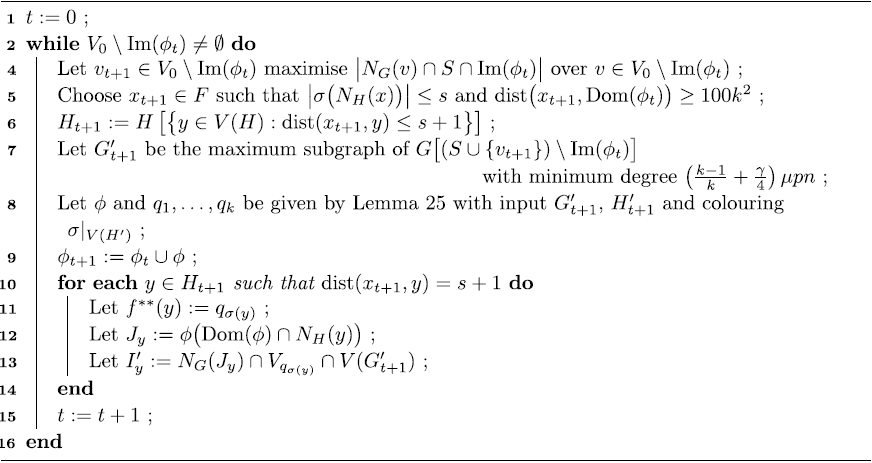
 $\sigma: V(H) \to \{0,\ldots k\}$
be a proper
 $(k+1)$
-colouring that is
 $(10/\xi, \beta)$
-zero-free with respect to
 $\mathcal L$
, where the colour zero does not appear in the first
 $\sqrt{\beta}n$
vertices of
 $\mathcal{L}$
. Furthermore, let
 $R^k_r$
be a graph on vertex set
 $[r] \times [k]$
with
 $K^k_r \subseteq B^k_r \subseteq R^k_r$
such that for every
 $i\in [r]$
there exists a vertex
 $z_i \in \big([r]\setminus\{i\}\big) \times [k]$
with
 $\big\{z_i, (i,j)\big\} \in E(R^k_r)$
for every
 $j\in [k]$
. Then, given a k-equitable integer partition
 $\{m_{i,j}\}_{i\in[r],j\in[k]}$
of n with
 $n/(10kr) \leq m_{i,j} \leq 10n/(kr)$
for every
 $i \in[r]$
and
 $j\in [k]$
, there exists a mapping
 $f \colon V(H) \to [r]\times[k]$
and a set of special vertices
 $X \subseteq V(H)$
such that we have for every
 $i\in [r]$
and
 $j\in[k]$
-
(H1)
$m_{i,j} - \xi n \leq |f^{-1}(i,j)| \leq m_{i,j} + \xi n$
, -
(H2)
$|X| \leq \xi n$
, -
(H3)
$\{f(x),f(y)\} \in E(R^k_r)$
for every
$\{x,y\} \in E(H)$
, -
(H4)
$y,z\in \cup_{j^{\prime}\in[k]}f^{-1}(i,j^{\prime})$
for every
$x\in f^{-1}(i,j)\setminus X$
and
$xy,yz\in E(H)$
, and -
(H5)
$f(x) = \big(1, \sigma(x)\big)$
for every x in the first
$\sqrt{\beta}n$
vertices of
$\mathcal{L}$
.





Our next lemma concerns the pre-embedding stage, in which we cover the vertices in
 $V_0\subset V(G)$
with vertices of H. For this purpose we use the vertices of H whose neighbourhood contains only s colours. Let x be one of these vertices, let H ′ be the subgraph of H induced on all vertices of distance at most
 $s+1$
from x (including x), and let T be the set of those vertices in H ′ of distance exactly
 $s+1$
from x. We cover a vertex v of
 $V_0$
by embedding x onto v, and we also embed all other vertices in the corresponding H ′ which are not in T. This creates image restrictions on the vertices of G to which we can embed the vertices in T. For the application of Lemma 13, we need that these image restrictions satisfy certain conditions, and that this pre-embedding preserves the super-regularity of the remaining partition of G. For achieving the latter, we take a random induced subgraph G ′ of G containing roughly
 $\mu n$
vertices, and perform the pre-embedding in G ′ only. In each cluster of G, the subgraph G ′ selects roughly a
 $\mu$
-fraction of the vertices, and the induced partitions on G ′ and on
 $G-V({G^{\,\prime}})$
are also super-regular. The next lemma states that we can also obtain suitable image restrictions for the vertices in T while performing the pre-embedding in G ′.
This lemma is a main difference to the proof in [Reference Allen, Böttcher, Ehrenmüller and Taraz1] and is the place where we need that the neighbourhood of every vertex in G has a certain density of
 $K_s$
’s. Another difference to our proof strategy that this lemma creates, is that it selects a clique
 $\{q_1,\ldots,q_k\}$
in R, which might not be one of the cliques of the chosen
 $K_r^k\subseteq R$
, and the vertices of T are assigned to the corresponding clusters in G (that is, the image restriction of
 $y\in T$
is a subset of the cluster
 $V_{q_j}$
to which it is assigned). This assignment may well differ from the assignment given by the Lemma for H, so in our proof of Theorem 22 we need to adapt to this difference by reassigning some more H-vertices.
Lemma 25 (Pre-embedding lemma). For
 $\Delta,k\ge 2$
,
 $2\le s\le k-1$
, and
 $\unicode[Times]{x03B3},d>0$
with
 $d \le \frac{\unicode[Times]{x03B3}}{32}$
there exists
 $\zeta>0$
such that for every
 $\varepsilon'>0$
there exists
 $\varepsilon_0>0$
such that for all
 $0 < \varepsilon < \varepsilon_0$
, all
 $\mu>0$
and
 $r\geq 10^5\unicode[Times]{x03B3}^{-1}$
, there exists a constant
 $C^\ast>0$
such that the random graph
 $\Gamma=G(n,p)$
a.a.s. has the following property if
 $p\ge C^\ast\big(\tfrac{\log n}{n}\big)^{1/\Delta}$
. Suppose we have the following setup.
-
(P1) H ′ is a graph with
$\Delta(H')\le\Delta$
, with a root vertex x, and no vertex at distance greater than
$s+1$
from x. -
(P2)
$\rho$
is a proper k-colouring of V(H ′) in which N(x) receives at most s colours, and T is the set of vertices in H ′ at distance exactly
$s+1$
from x. -
(P3) G is a spanning subgraph of
$\Gamma$
with
$\delta(G)\ge\big(\tfrac{k-1}{k}+{\unicode[Times]{x03B3}}\big)pn$
with an
$(\varepsilon,p)$
-regular partition
$ V(G)=V_0{V}_1\,\cup\mkern-12.5mu\cdot\mkern5mu{\cdots}\cup\mkern-12.5mu\cdot\mkern5mu\,V_r $
with
$(\varepsilon,d,p)$
-reduced graph R, and such that
$\frac{n}{4r} \le |V_i| \le \frac{4n}{r}$
for all
$i \in [r]$
. -
(P4)
${G^{\,\prime}}\subset G$
is a graph with
$|V({G^{\,\prime}})|=(1\pm\varepsilon)\mu n$
, with
$\delta({G^{\,\prime}})\ge\big(\tfrac{k-1}{k}+{\unicode[Times]{x03B3}}\big)p|V({G^{\,\prime}})|$
, and
$|N_{{G^{\,\prime}}}(W)| \le 2 \mu n p^{t}$
for any set
$W \subset V({G^{\,\prime}})$
of size
$t \le \Delta$
. Suppose further that
$\left|V_i\cap V({G^{\,\prime}})\right|=(1\pm\varepsilon)\mu|V_i|$
for each i, and that
$V_0\cap V({G^{\,\prime}}),\dots,V_r\cap V({G^{\,\prime}})$
is also an
$(\varepsilon,p)$
-regular partition of G ′ with
$(\varepsilon,d,p)$
-reduced graph R. -
(P5)
$v\in V({G^{\,\prime}})$
is a vertex such that there are at least
$\unicode[Times]{x03B3} p^{\binom{s+1}{2}}(\mu n)^s$
copies of
$K_s$
in
$N_{{G^{\,\prime}}}(v)$
.


Then there exist a partial embedding
 $\phi:V(H')\setminus T\to V({G^{\,\prime}})$
of H ′ into G ′ and a subset
 $\{q_1,\dots,q_k\}\subset [r]$
with the following properties. For each
 $u,u'\in T$
, each
 $j\in[k]$
, and for
 $\Pi(u)=\phi\big(N_{H'}(u)\cap {\mathrm{Dom}}(\phi)\big)$
, we have
-
(P1’)
$\phi(x)=v$
. -
(P2’)
$q_1,\dots,q_k$
forms a clique in R. -
(P3’)
$\big|N_\Gamma\big(\Pi(u)\big)\cap V_{q_{\rho(u)}}\big|=(1\pm\varepsilon')p^{|\Pi(u)|}|V_{q_{\rho(u)}}|$
. -
(P4’)
$\big|N_G\big(\Pi(u)\big)\cap V_{q_{\rho(u)}}\cap V({G^{\,\prime}})\big|\ge2\zeta p^{|\Pi(u)|}|V_{q_{\rho(u)}}\cap V({G^{\,\prime}})|$
. -
(P5’) If
$j\neq\rho(u)$
and
$|\Pi(u)|\le\Delta-1$
then the pair
$\big(N_\Gamma(\Pi(u),V_{q_{\rho(u)}}),V_{q_j}\big)$
is
$(\varepsilon',d,p)_G$
-regular. -
(P6’) If
$uu'\in H'$
then the pair
$\big(N_\Gamma(\Pi(u),V_{q_{\rho(u)}}),N_\Gamma(\Pi(u'),V_{q_{\rho(u')}})\big)$
is
$(\varepsilon',d,p)_G$
-regular.


After the pre-embedding stage, we want to apply the sparse blow-up lemma to embed the remainder of H. However, the sizes of the clusters
 $V_{i,j}$
from Lemma 23 do not quite match the sizes of the sets
 $X_{i,j}$
from Lemma 24. Also, Lemma 25 embeds some vertices, creating a little further imbalance, and we need to slightly alter the mapping f from Lemma 24 to accommodate these pre-embedded vertices. The next lemma allows us to change the sizes of the clusters
 $V_{i,j}$
slightly to match the partition of H, without destroying the properties of the partition of G and of the pre-embedded vertices we worked to achieve.
Lemma 26 (Balancing lemma, [Reference Allen, Böttcher, Ehrenmüller and Taraz1, Lemma 27]). For all integers
 $k\geq 1$
,
 $r_1, \Delta \geq 1$
, and reals
 $\unicode[Times]{x03B3}, d >0$
and
 $0 < \varepsilon < \min\{d,1/(2k)\}$
there exist
 $\xi >0$
and
 $C^{\ast} >0$
such that the following is true for every
 $p \geq C^{\ast} \left(\log n/n\right)^{1/2}$
and every
 $10\unicode[Times]{x03B3}^{-1}\le r \leq r_1$
provided that n is large enough. Let
 $\Gamma$
be a graph on vertex set [n] and let
 $G=(V,E)\subseteq \Gamma$
be a (not necessarily spanning) subgraph with vertex partition
 ${\mathcal V} = \{V_{i,j}\}_{i\in[r],j\in[k]}$
that satisfies
 $n/(8kr) \leq |V_{i,j}| \leq 4n/(kr)$
for each
 $i\in[r]$
,
 $j\in[k]$
. Let
 $\{n_{i,j}\}_{i \in [r], j\in [k]}$
be an integer partition of
 $\sum_{i\in[r],j\in[k]} |V_{i,j}|$
. Let
 $R^k_r$
be a graph on the vertex set
 $[r] \times [k]$
with minimum degree
 $\delta(R^k_r) \geq \big((k-1)/k+\unicode[Times]{x03B3}/2\big) kr$
such that
 $K^k_r \subseteq B^k_r \subseteq R^k_r$
. Suppose that the partition
 ${\mathcal V}$
satisfies the following properties for each
 $i\in[r]$
, each
 $j\neq j^{\prime}\in[k]$
, and each
 $v\in V$
. Suppose we have
-
(B1)
$n_{i,j} - \xi n \leq |V_{i,j}| \leq n_{i,j} + \xi n$
, -
(B2)
${\mathcal V}$
is
$\big(\tfrac{\varepsilon}{4},d,p\big)_G$
-regular on
$R^k_r$
and
$\big(\tfrac{\varepsilon}{4},d,p\big)_G$
-super-regular on
$K^k_r$
, -
(B3)
$\big(N_{\Gamma}(v, V_{i,j}),V_{i,j^{\prime}}\big)$
and
$\big(N_{\Gamma}(v, V_{i,j}),N_{\Gamma}(v, V_{i,j^{\prime}})\big)$
are
$\big(\tfrac{\varepsilon}{4},d,p\big)_G$
-regular, and -
(B4)
$|N_{\Gamma}(v,V_{i,j})| = \big(1 \pm \tfrac{\varepsilon}{4}\big)p|V_{i,j}|$
.


Then, there exists a partition
 $\mathcal{V'}=\{V'_{\!\!i,j}\}_{i\in[r],j\in[k]}$
of V such that for each
 $i\in[r]$
, each
 $j\neq j^{\prime}\in [k]$
, and each
 $v\in V$
we have
-
(B1’)
$|V'_{\!\!i,j}|=n_{i,j}$
, -
(B2’)
$|V_{i,j}\triangle V'_{\!\!i,j}|\le 10^{-10}\varepsilon^4k^{-2}r_1^{-2} n$
, -
(B3’)
$\mathcal{V'}$
is
$(\varepsilon,d,p)_G$
-regular on
$R^k_r$
and
$(\varepsilon,d,p)_G$
-super-regular on
$K^k_r$
, -
(B4’)
$\big(N_{\Gamma}(v,V'_{\!\!i,j}), V'_{\!\!i,j^{\prime}}\big)$
and
$\big(N_{\Gamma}(v,V'_{\!\!i,j}), N_\Gamma(v,V'_{\!\!i,j^{\prime}})\big)$
are
$(\varepsilon,d,p)_G$
-regular, and -
(B5’) for each
$1\le s\le\Delta$
and for each
$v_1,\ldots,v_s\in[n]$
\begin{equation*}\Big|\bigcap_{i\in[s]} N_\Gamma(v_1,V_{i,j})\triangle \bigcap_{i\in[s]} N_\Gamma(v_1,V'_{\!\!i,j})\Big|\le 10^{-10}\varepsilon^4k^{-2}r_1^{-2}\deg_\Gamma(v_1,\ldots,v_s)+C^{\ast}\log n\,.\end{equation*}


After applying Lemma 26 it remains only to check that the conditions of Lemma 13 are met to complete the embedding of H and thus the proof of Theorem 22.
4. Proof of the pre-embedding lemma
Before outlining how this proof works in general, let us briefly explain how it would work in a simple case. If all vertices of H ′ are adjacent to the root x (as would be the case, for example, if H is a
 $K_k$
-factor), then the set T is empty, and hence most of the properties we need are vacuously true. We just have to find an embedding of H ′ to G ′ extending
 $x\to v$
. We apply the Sparse Regularity Lemma to
 $N_{{G^{\,\prime}}}(v)$
, and (since there are many copies of
 $K_s$
in that neighbourhood) we are guaranteed to find s clusters
 $W'_{\!\!1},\dots,W'_{\!\!s}$
among which every pair is
 $(\nu_0,d',p)$
-regular. Here
 $\nu_0$
is a regularity parameter which is small compared to
 $1/v(H')$
but quite a lot larger than the
 $\varepsilon$
regularity we get from the Lemma for G; and d ′ is roughly d. We now use a standard sparse regularity vertex-by-vertex embedding method. That is, we begin by assigning to each vertex
 $y\in V(H')\setminus\{x\}$
a candidate set
 $W'_{\!\!\rho(y)}$
. By construction, all candidate sets are reasonably large, and if y and y ′ are adjacent in H ′ then their candidate sets form a
 $(\nu_0,d',p)$
-regular pair. This is the initial setup.
We now embed vertices one at a time: when we embed a vertex y, we insist on embedding it to its current candidate set, and we then update the candidate sets of its neighbours by intersecting them with
 $N_{G}(y)$
. We can do this in such a way that the two properties mentioned above are maintained, i.e. all candidate sets are reasonably large and adjacent vertices’ candidate sets form a regular pair (with a regularity parameter which is not necessarily as small as
 $\nu_0$
, but does not get too much larger). To show this is possible, we use the definition of a regular pair, plus the regularity inheritance Lemmas 14 and 15. The argument that we can do this—i.e. given a collection of reasonably large candidate sets with the above regularity properties, we can embed one more vertex to its candidate set and maintain that our remaining vertices have reasonably large candidate sets with the regularity properties—is given in Claim 2 below.
The difficulty comes when T is not empty. What we want to do is to obtain a similar initial setup: the neighbours of x in H ′ should be given candidate sets as before, while the vertices in T should be given candidate sets chosen from
 $\{V_{q_1},\dots,V_{q_k}\}$
, where
 $V_1,\dots,V_r$
is the ambient regular partition with reduced graph R supplied to the lemma, and
 $q_1,\dots,q_k$
form some clique in R. The remaining vertices should somehow be given candidate sets such that (as above) every vertex has a reasonably large candidate set, and adjacent vertices have candidate sets which form
 $(\nu_0,d',p)$
-regular pairs. If we can do this, then using the above mentioned Claim 2 repeatedly to embed
 $V(H')\setminus T$
will automatically give all the required properties for the vertices in T.
The reason why getting this initial setup is tricky is that the only way we can ensure that the Sparse Regularity Lemma gives us a regular partition consistent with the ambient partition is to apply the refining version, Lemma 10, with clusters of the ambient partition as the input. Ideally, we would simply input the ambient partition and
 $N_{{G^{\,\prime}}}(v)$
as the sets to refine. We would then get a fine partition with a corresponding fine
 $(\nu,d',p)$
-reduced graph. As above, we would be able to find
 $W'_{\!\!1},\dots,W'_{\!\!s}$
contained in
 $N_{{G^{\,\prime}}}(v)$
which form a clique in the fine reduced graph which are candidate sets for the neighbours of x. In addition, from the minimum degree condition it follows that any k vertices in the fine reduced graph have a common neighbour which is contained in some part of the ambient partition, and we can use this to greedily find candidate sets for the vertices of H ′ further from x until finally we can assign candidate sets for the vertices of T which are contained in the ambient partition.
This ideal strategy fails for the following reason. The fine partition will have too many parts: that is, a part of the fine partition contained in any
 $V_i$
will be a very tiny (much smaller than
 $\varepsilon$
) fraction of
 $V_i$
, and hence the candidate sets for vertices of T will not be sufficiently large for (
P4’). The reason that this occurs is that the number of parts into which we split
 $V_i$
depends on the number of parts of the input partition we give to Lemma 10, which in turn depends on
 $\varepsilon$
(and these dependencies are not in our favour).
What we therefore do is to fix a number
 $\ell$
of parts of the ambient partition, and a set L of
 $\ell$
parts, where
 $\ell$
is not too large (in particular it is tiny compared to
 $\varepsilon^{-1}$
) and we use Lemma 10 with input only the
 $V_i$
with
 $i\in L$
and
 $N_{{G^{\,\prime}}}(v)$
. This breaks the above undesired dependency in our constant choices. In order to make the argument go through, however, we need
 $\bigcup_{i\in L}V_i$
to ‘witness’ the minimum degree of G. It turns out that if
 $\ell$
is not too small, then choosing L uniformly at random works for this latter purpose. We justify this in Claim 1.
Proof of Lemma 25. First, we fix all constants that we need throughout the proof. Let
 $\Delta, k\geq 2$
and
 $\unicode[Times]{x03B3}, d>0$
be given. Recall
 $d\le\tfrac{\unicode[Times]{x03B3}}{32}$
by assumption of the lemma. Let
 $d' = \min(\tfrac12d, 10^{-5k}\unicode[Times]{x03B3})$
and choose
 $\xi= 10^{-6}2^{-k}\unicode[Times]{x03B3}$
and an integer
 \begin{equation*}\ell=\max\big(1000\xi^{-6}\log\xi^{-1},100\cdot 2^k\unicode[Times]{x03B3}^{-1}\big)\,.\end{equation*}
Let
 $\nu^{\ast}_{\Delta-1,\Delta-1}=\nu^{\ast}_{i,\Delta}=\nu^{\ast}_{\Delta,i}=\tfrac{1}{100\Delta}8^{-\Delta}d'^{\Delta}$
for
 $i \in [\Delta]$
. For each
 $(i,j) \in\{0, \dots, \Delta-1\}^2\setminus\{(\Delta-1,\Delta-1)\}$
in reverse lexicographic order, we choose
 $\nu^{\ast}_{i,j}\le\nu^{\ast}_{i+1,j},\nu^{\ast}_{i,j+1},\nu^{\ast}_{i+1,j+1}$
not larger than the
 $\varepsilon_0$
returned by Lemma 14 for both input
 $\nu^{\ast}_{i+1,j}$
and d ′, and for input
 $\nu^{\ast}_{i,j+1}$
and d ′, and not larger than the
 $\varepsilon_0$
returned by Lemma 15 for input
 $\nu^{\ast}_{i+1,j+1}$
and d ′. Choose
 $\nu_0=\min\big(\nu^{\ast}_{0,0},\tfrac{d'}{2},10^{-5}\unicode[Times]{x03B3}\big)$
. Now, Lemma 10 with input
 $\nu_0^2/(16\ell^2)$
and
 $2\ell$
returns
 $t_1$
.
Set
 $\zeta= \big(\tfrac{d'}{4}\big)^\Delta /4 t_1$
. Given
 $\varepsilon'$
, let
 $\varepsilon^{\ast\ast}_{\Delta} = \varepsilon'$
and for every
 $i \in (\Delta-1, \dots,1,0)$
, let
 $\varepsilon^{\ast\ast}_{i}\le\varepsilon^{\ast\ast}_{i+1}$
be returned by Lemma 14 with input
 $\varepsilon_{{OSRIL}}= \varepsilon^{\ast\ast}_{i+1}$
and
 $\alpha_{OSRIL} = d$
. Next, let
 $\varepsilon^{\ast}_{\Delta-1,\Delta-1}=\varepsilon'$
and
 $\varepsilon^{\ast}_{i,\Delta}=\varepsilon^{\ast}_{\Delta,i}=1$
for
 $i \in [\Delta]$
. For each
 $(i,j) \in\{0, \dots, \Delta-1\}^2\setminus\{(\Delta-1,\Delta-1)\}$
in reverse lexicographic order, we choose
 $\varepsilon^{\ast}_{i,j}\le\varepsilon^{\ast}_{i+1,j},\varepsilon^{\ast}_{i,j+1},\varepsilon^{\ast}_{i+1,j+1}$
not larger than the
 $\varepsilon_0$
returned by Lemma 14 for both input
 $\varepsilon^{\ast}_{i+1,j}$
and d, and for input
 $\varepsilon^{\ast}_{i,j+1}$
and d, and not larger than the
 $\varepsilon_0$
returned by Lemma 15 for input
 $\varepsilon^{\ast}_{i+1,j+1}$
and d.
We choose
 $\varepsilon_0 \leq \varepsilon^{\ast\ast}_0, \varepsilon^{\ast}_{0,0}, \frac{\nu_0}{2t_1}$
small enough such that
 $(1+\varepsilon_0)^{\Delta} \leq 1+\varepsilon'$
and
 $(1-\varepsilon_0)^{\Delta} \geq 1-\varepsilon'$
. Given
 $r\ge 10^5\unicode[Times]{x03B3}^{-1}$
,
 $\varepsilon$
with
 $0<\varepsilon\le\varepsilon_0$
, and
 $\mu > 0$
, let C be a large enough constant for all of the above calls to Lemmas 14 and 15, and for Proposition 17 with input
 $\varepsilon_0$
. Finally, we choose
 $C^{\ast}=10^{10\Delta}d'^{-\Delta}\ell t_1r\mu^{-1}$
.
Let
 $\Gamma = G(n,p)$
with
 $p \geq C^{\ast} {(\log n/n)}^{1/\Delta}$
. Then
 $\Gamma$
satisfies a.a.s. the properties stated in Lemma 14, Lemma 15, Proposition 17 and Lemma 10 with the parameters specified above. We assume from now on that
 $\Gamma$
satisfies these good events and has these properties. Let G ′,
 $v\in V({G^{\,\prime}})$
, G,
 $\{V_i\}_{i\in \{0, \ldots, r\}}$
, H ′,
 $x \in V(H')$
, the k-colouring
 $\rho$
of V(H ′), and the
 $(\varepsilon,d,p)$
-reduced graph R, be as in the statement of the lemma. Since
 $\varepsilon\le\varepsilon_0$
, R is also an
 $(\varepsilon_0,d,p)$
-reduced graph.
To be able to apply Lemma 10 we need to choose a suitable subset of the clusters
 $\{V_i\}_{i\in \{0, \ldots, r\}}$
of bounded size. As the clusters
 $\{V_i\}_{i\in \{0, \ldots, r\}}$
might be of different sizes and we will want to have a minimum degree condition on the reduced graph, we will consider a weighted version of this degree that takes the cluster sizes into account.
Claim 1. There exists
 $L \subset [r]$
of size
 $\ell$
such that
 $R^\ast\;:\!=\;R[L]$
satisfies the following weighted minimum degree condition, where
 $V^\ast = \bigcup_{i \in L} V_i$
.
 \begin{equation*} \forall i \in L: \sum_{j \in N_R(i) \cap L} \frac{|V_j|}{|V^\ast|} \ge \left(\frac{k-1}{k} + \frac{\unicode[Times]{x03B3}}{5}\right)\,. \end{equation*}
Additionally, we have that
 \begin{equation*} W\;:\!=\; \left\{ w \in N_{G^{\kern1pt\prime}}(v): |N_{G^{\,\prime}}(w) \cap V^\ast| \ge \left(\frac{k-1}{k} + \frac{\unicode[Times]{x03B3}}{5}\right)p|V^\ast \cap V({G^{\,\prime}})| \right\} \end{equation*}
has size at least
 $(1 - \xi) |N_{{G^{\,\prime}}}(v)|$
and there are at least
 $\frac12 \unicode[Times]{x03B3} p^{\binom{s+1}{2}}{(\mu n)}^s$
copies of
 $K_s$
in W.
Proof. We choose a subset
 $L \subset [r]$
of size
 $\ell$
uniformly at random. First, we will transfer the minimum degree of G to the reduced graph and show that with high probability the minimum degree is preserved on the chosen clusters. Recall that G satisfies a minimum degree of
 $\delta(G) \ge (\frac{k-1}{k} + \unicode[Times]{x03B3})pn$
and that the cluster sizes satisfy
 \begin{equation} \frac{4n}{r} \ge |V_i| \ge \frac{n}{4r} \ge Cp^{-1} \log n\,.\end{equation}
Without loss of generality, we may assume that no
 $V_i$
forms an irregular pair with more than
 $\sqrt{\varepsilon}$
of the clusters, otherwise, add it to
 $V_0$
, which over all clusters increases the size of
 $V_0$
by at most
 $4\sqrt{\varepsilon}n$
. Fix
 $i \in [r]$
. Proposition 17 applied to the edges between
 $V_i$
and
 $V_0$
implies that
 \begin{equation*} e(V_i, V_0) \le 2p (\varepsilon + 4\sqrt{\varepsilon})n |V_i| \quad \text{and} \quad e(V_i) \le 2p {|V_i|}^2 \le 2p \frac{16}{r}n |V_i|\,.\end{equation*}
Also, we can bound the number of edges from
 $V_i$
to other clusters that are in pairs which are not dense or
 $(\varepsilon,p)$
-regular by
 \begin{equation*} e\Big(V_i, \bigcup_{j \in R \setminus N_R(i)} V_j\Big) \le dpn |V_i| + 2p \cdot 4\sqrt{\varepsilon} n |V_i|\,.\end{equation*}
Putting the above together, we obtain that
 \begin{equation*} e\Big(V_i, \bigcup_{j \in N_R(i)} V_j\Big) \ge \left(\frac{k-1}{k} + \unicode[Times]{x03B3} - 2\varepsilon - 16\sqrt{\varepsilon} - d - \frac{32}{r}\right)pn |V_i|\,.\end{equation*}
As, again by Proposition 17, the number of edges between any
 $V_i$
and
 $V_j$
is at most
 $(1+\varepsilon_0)|V_i||V_j|$
, we get that
 \begin{equation*} \sum_{j \in N_R(i)} \frac{|V_j|r}{|V(G)|} \ge \left(\frac{k-1}{k} + \unicode[Times]{x03B3} - 2\varepsilon - 16\sqrt{\varepsilon} - d - \frac{32}{r}\right) {(1+\varepsilon_0)}^{-1} r \ge \left(\frac{k-1}{k} + \frac{\unicode[Times]{x03B3}}{2} \right) r\,.\end{equation*}
By the size conditions on the clusters, the relative sizes
 $w_j \;:\!=\; \frac{|V_j|r}{|V(G)|}$
take values in
 $(\frac 14,4)$
. We now consider
 \begin{equation*} w'_{\!\!j} = \xi \left\lfloor {w_j}/{\xi} \right\rfloor,\end{equation*}
the discretisation of
 $w_j$
into steps of size
 $\xi$
. Of these discretised weights, we will ignore those that occur fewer than
 $\xi^2 r$
times. We lose at most a factor of
 $4\xi$
due to the discretisation as all weights are at least
 $\frac 14$
. Also weights in
 $(\frac 14,4)$
occurring fewer than
 $\xi^2 r$
times contribute at most
 $16 \xi r$
to the sum, so we get the lower bound
 \begin{equation*} \sum_{j \in N_R(i)} w'_{\!\!j} \ge \left(1-4\xi\right) \left(\frac{k-1}{k} + \frac{\unicode[Times]{x03B3}}{2} \right) r - 16 \xi r \ge \left(\frac{k-1}{k} + \frac{\unicode[Times]{x03B3}}{3} \right) r\,.\end{equation*}
We can now apply the hypergeometric inequality (Theorem 19) to all possible rounded weight values separately. For any
 $j \in [r]$
the probability that j is in L is
 $\ell/r$
and so for a given density in
 $(\frac 14, 4)$
, which occurs, say,
 $\theta r$
times, the probability that this density is chosen fewer than
 $(1-\xi)\theta\ell$
times is at most
 $2e^{-\xi^2 \cdot \xi \theta \ell/3} \le 2e^{-\xi^5 \ell/3}$
. This implies by the union bound that with probability at most
 $4\xi^{-1} 2e^{-\xi^5 \ell/3}$
we do not have
 \begin{equation} \sum_{j \in N_R(i) \cap L} w_j \ge (1-\xi)\left(\frac{k-1}{k} + \frac{\unicode[Times]{x03B3}}{3} \right) \frac{\ell}{r} r \ge \left(\frac{k-1}{k} + \frac{\unicode[Times]{x03B3}}{4} \right) \ell\,.\end{equation}
So by the union bound the expected number of vertices in
 $R^\ast$
that do not satisfy (2) is at most
 $\ell 8 \xi^{-1} e^{-{\xi^5 \ell}/{3}}<1/10$
, where the inequality is by choice of
 $\ell$
. By Markov’s inequality, the probability that there is any such vertex in
 $R^\ast$
is thus at most
 $1/10$
. By the same discretisation of
 $w_j$
and application of the hypergeometric inequality to the discretised weights, we can also deduce that
 \begin{equation} |V^\ast| = \frac{|V(G)|}{r} \sum_{i \in L} w_i = (1 \pm 100\xi) \frac{\ell}{r} \sum_{i \in [r]} w_i = (1 \pm 100\xi) (1 \pm \varepsilon) \frac{\ell |V(G)|}{r}\end{equation}
with probability at least
 $9/10$
. Putting (2) and (3) together implies that with probability at least
 $8/10$
the first claimed statement holds.
For the claim, we also require that the minimum degree condition of the vertices in
 $N_{{G^{\,\prime}}}(v)$
carries over to the chosen clusters for most vertices. Fix w in
 $N_{{G^{\,\prime}}}$
. For
 $j \in [r]$
we consider the weighted p-density, which may take values in (0,5), defined by
 \begin{equation*} {d}_{w,j} = {d}_{G,p}(\{w\},V_j \cap V({G^{\,\prime}})) \frac{|V_j \cap V({G^{\,\prime}})|r}{|V({G^{\,\prime}})|}\,.\end{equation*}
Accounting for the exceptional set
 $V_0$
with Proposition 17, the minimum degree condition on G ′ of
 $(\frac{k-1}{k} + {\unicode[Times]{x03B3}})p|V({G^{\,\prime}})|$
implies that these weighted p-densities satisfy
 \begin{equation*} \sum_{j \in [r]} {d}_{w,j} \ge \left(\frac{k-1}{k} + {\unicode[Times]{x03B3}} - 2\varepsilon\right)r \ge \left(\frac{k-1}{k} + \frac{\unicode[Times]{x03B3}}{2}\right)r\,.\end{equation*}
Similarly to before, we consider
 ${d'}_{w,i} = \xi \lfloor {{d}_{w,i}}/{\xi} \rfloor$
, the discretisation of
 ${d}_{w,i}$
into steps of size
 $\xi$
. Of these discretised weighted densities, we ignore those that occur fewer than
 $\xi^2 r$
times and those that are smaller than
 $\sqrt{\xi}$
. The small densities contribute at most
 $\sqrt{\xi}r$
to the sum and we lose a factor of at most
 $\sqrt{\xi}$
due to the discretisation for larger values. Also weights in
 $(\sqrt{\xi},5)$
occurring fewer than
 $\xi^2 r$
times contribute at most
 $25\xi r$
to the sum, so we get the lower bound
 \begin{equation*} \sum_{i \in [r]} {d'}_{w,i} \ge (1 - \sqrt{\xi}) \left(\frac{k-1}{k} + \frac{\unicode[Times]{x03B3}}{2} - \sqrt{\xi} - 25 \xi\right)r \ge \left(\frac{k-1}{k} + \frac{\unicode[Times]{x03B3}}{3}\right)r\,.\end{equation*}
Applying the hypergeometric inequality to all density values separately as before, we get that for any
 $w \in N_{{G^{\,\prime}}}(v)$
with probability at most
 $5\xi^{-1} 2e^{-\xi^5 \ell/3} \ge \xi / 10$
we do not have
 \begin{equation} \sum_{i \in L} {d'}_{w,i} \ge \left( 1 - \xi\right) \left(\frac{k-1}{k} + \frac{\unicode[Times]{x03B3}}{3}\right) \frac{\ell}{r} r \ge \left(\frac{k-1}{k} + \frac{\unicode[Times]{x03B3}}{4}\right) \frac{\ell}{r} r\,.\end{equation}
So the expected number of vertices in
 $N_{{G^{\,\prime}}}(v)$
not satisfying (4) is at most
 $\xi |N_{{G^{\,\prime}}}(v)| / 10$
. By Markov’s inequality, with probability at least
 $9/10$
at most a fraction
 $\xi$
of vertices in
 $N_{{G^{\,\prime}}}(v)$
violate (4). And in particular all vertices satisfying (4) have at least
 \begin{equation*} (1 - 100\xi) (1 - \varepsilon) \left(\frac{k-1}{k} + \frac{\unicode[Times]{x03B3}}{4}\right) (1 - \varepsilon) \mu p|V^\ast| \ge \left(\frac{k-1}{k} + \frac{\unicode[Times]{x03B3}}{5}\right)p|V^\ast \cap V({G^{\,\prime}})|\end{equation*}
neighbours in
 $V^\ast \cap V({G^{\,\prime}})$
if (3) holds. So indeed with probability at least
 $7/10$
the first two claimed statements hold, so assume we chose L such that they do.
For the claim it only remains to show the lower bound on the number of cliques in W. It follows, by inductively building up cliques, from the assumption in the lemma that any
 $t \le \Delta$
vertices of G ′ have at most
 $2 p^t \mu n$
common neighbours in G ′, that v and each
 $w \in N_{{G^{\,\prime}}}(v)$
are contained in at most
 \begin{equation*} \prod_{t=2}^{s} 2 p^t \mu n = p^{\binom{s+1}{2}-1} {(2\mu n)}^{s-1}\end{equation*}
copies of
 $K_{s+1}$
. Since
 $|W|\ge (1-\xi)|N_{{G^{\,\prime}}}(v)|$
, the number of copies of
 $K_s$
which are in
 $N_{{G^{\,\prime}}}(v)$
but not W is at most
 $\xi|N_{{G^{\,\prime}}}(v)|\cdot p^{\binom{s+1}{2}-1}(2\mu n)^{s-1}$
. Since
 $|N_{{G^{\,\prime}}}(v)|\le 2\mu pn $
, and
 $N_{{G^{\,\prime}}}(v)$
contains at least
 $\unicode[Times]{x03B3} p^{\binom{s+1}{2}}(\mu n)^s$
copies of
 $K_s$
, there are at least
 \begin{equation*} \unicode[Times]{x03B3} p^{\binom{s+1}{2}}{(\mu n)}^s - \xi \cdot2\mu pn\cdot p^{\binom{s+1}{2}-1} {(2\mu n)}^{s-1} \ge \tfrac12 \unicode[Times]{x03B3} p^{\binom{s+1}{2}} {(\mu n)}^s\end{equation*}
copies of
 $K_s$
in W.
Let
 $\{W_i\}_{i \in [\ell]}$
be an arbitrary equipartition of W into
 $\ell$
parts (so that the fine partition we are about to obtain has enough parts in W). We apply Lemma 10 to G ′ with the
 $2\ell$
-part initial partition
 $\{ (V_i \cap V({G^{\,\prime}})) \setminus W \}_{i\in L} \cup \{W_i\}_{i \in [\ell]}$
and input parameter
 $\nu_0^2/(16\ell^2)$
. This returns a partition refining each of these sets into
 $1\le t\le t_1$
clusters
 $\{V_{i,j}\}_{i\in L,j\in[t]}\cup\{W_{i,j}\}_{i\in[\ell],j\in[t]}$
together with small exceptional sets
 $\{V_{i,0}:i\in L\}\cup\{ W_{i,0}: i\in[\ell]\}$
. From the definition of a regular refinement, there are at most
 $\tfrac{\nu_0^2}{16\ell^2}\cdot(2\ell t)^2$
irregular pairs in this partition, and in particular at most
 $\nu_0 t$
of the clusters form an irregular pair with more than
 $\nu_0 t$
of the clusters. Include the vertices of all those clusters in the exceptional sets, which now make up a fraction of at most
 $2 \nu_0$
of the vertices.
We now want to obtain s clusters
 $W'_{\!\!1},\dots,W'_{\!\!s}$
in
 ${\{W_{i,j}\}}_{i \in [\ell],j \in [t]}$
that are pairwise
 $(\nu_0, d', p)$
-regular. Assume for a contradiction that no such clusters exist. So each
 $K_k$
in W must either contain an edge meeting an exceptional set
 $W_{i,0}$
, one which does not lie in a
 $(\nu_0, d', p)$
-regular pair or one that is contained completely in some set
 $W_{i,j}$
for
 $i\in[\ell]$
and
 $j\in[t]$
. Note that we have for all
 $i \in [\ell]$
and
 $j \in [t]$
that
 \begin{equation*} |W_{i,j}| \ge \frac{1}{2 \ell t_1} |W| \ge \frac{\mu np}{4\ell t_1} \ge Cp^{-1} \log n\,.\end{equation*}
So we may apply Proposition 17 to bound the number of edges within and between clusters. Using the upper bound on common neighbourhoods in G ′ given in the lemma statement to bound the number of edges meeting the exceptional sets, we obtain that deleting at most
 \begin{equation*} 2 \nu_0 |W| 2p^2 \mu n + 2p(\nu_0 + d') {|W|}^2 + \ell 2p {(|W|/\ell)}^2 \le (8\nu_0 + 8\nu_0 + 8d' + {2}/{\ell}) p^3 \mu^2 n^2\end{equation*}
edges would remove all cliques from W. Again by the upper bound on common neighbourhoods in G ′ given in the lemma any of these edges is contained in at most
 \begin{equation*} \prod_{t=3}^{s} 2 p^t \mu n = p^{\binom{s+1}{2}-3} {(2\mu n)}^{s-2}\end{equation*}
copies of
 $K_{s+1}$
together with v. So there would be at most
 \begin{equation*} (16\nu_0 + 8d' + {2}/{\ell}) p^3 \mu^2 n^2 p^{\binom{s+1}{2}-3} {(2\mu n)}^{s-2} < \tfrac12 \unicode[Times]{x03B3} p^{\binom{s+1}{2}} {(\mu n)}^s\end{equation*}
copies of
 $K_s$
in W, a contradiction. It follows that there are some s clusters in W which are pairwise
 $(\nu_0,d',p)$
-regular. Let
 $W'_{\!\!1},\dots,W'_{\!\!s}$
in
 ${\{W_{i,j}\}}_{i \in [\ell],j \in [t]}$
be pairwise
 $(\nu_0, d', p)$
-regular.
Because the vertices of W each have at least
 $\big(\tfrac{k-1}{k}+\tfrac{\unicode[Times]{x03B3}}{5}\big)p|V^*\cap V({G^{\,\prime}})|$
G ′-neighbours in
 $V^*$
, the number of edges leaving each cluster
 $W'_{\!\!i}$
to
 $V^*$
is at least
 $|W'_{\!\!i}|\big(\tfrac{k-1}{k}+\tfrac{\unicode[Times]{x03B3}}{5}\big)p|V^*\cap V({G^{\,\prime}})|$
. By Proposition 17, and because at most
 $\nu_0t$
irregular pairs leave
 $W'_{\!\!i}$
, at most
 $(1+\varepsilon_0)p|W'_{\!\!i}|\nu_0|V^*\cap V({G^{\,\prime}})|$
of these edges lie in irregular pairs. By definition, at most
 $d'p|W'_{\!\!i}||V^*\cap V({G^{\,\prime}})|$
of these edges lie in pairs of relative density less than d ′. Thus the remaining edges lie in
 $(\nu_0,d',p)$
-regular pairs, and there are at least
 $|W'_{\!\!i}|\big(\tfrac{k-1}{k}+\tfrac{\unicode[Times]{x03B3}}{6}\big)p|V^*\cap V({G^{\,\prime}})|$
of these edges. Since the number of edges between
 $W'_{\!\!i}$
and any given
 $V_{i^{\prime},\kern0.5pt j^{\prime}}$
is at most
 $(1+\varepsilon_0)p|W'_{\!\!i}||V_{i^{\prime},\kern0.5pt j^{\prime}}|$
by Proposition 17, we obtain
 \begin{equation} \sum_{V_{i^{\prime},\kern0.5pt j^{\prime}}:\, (W'_{\!\!i}, V_{i^{\prime},\kern0.5pt j^{\prime}})\text{ is }(\nu_0, d', p)-\text{regular}} \frac{|V_{i^{\prime},\kern0.5pt j^{\prime}}|}{|V^\ast \cap V({G^{\,\prime}})|} \ge \left(\frac{k-1}{k} + \frac{\unicode[Times]{x03B3}}{8}\right)\,.\end{equation}
Now we can choose the clusters into which we will embed the vertices of H ′. We choose sequentially
 \begin{equation*} (q_{s+1},j_{s+1}),\dots,(q_{k+1},j_{k+1}) \in L \times [t]\end{equation*}
such that for each
 $1\le i\le s$
and each
 $s+1\le i^{\prime}\le k+1$
, the pair
 $\big(W'_{\!\!i},V_{q_{i^{\prime}},j_{i^{\prime}}}\cap V({G^{\,\prime}})\big)$
is
 $(\nu_0,d',p)$
-regular, and for each
 $s+1\le i^{\prime}<i^{\prime}\le k+1$
the pair
 $(q_{i}',q_{i^{\prime}})$
is an edge of
 $R^*$
. This is possible by (5) and Claim 1, which give a weighted minimum degree condition that implies that for any k clusters (in W or
 $V^*$
or a mixture) there is a cluster in
 $V^*$
which satisfies the given condition with respect to all k clusters.
We then choose pairs
 $(q_{s},j_{s}),\dots,(q_{1},j_{1})$
in that order sequentially such that for each
 $a \in \{s, \dots, 1\}$
the clusters
 \begin{equation*} W'_{\!\!1},\dots,W'_{\!\!a-1}, V_{q_{a},j_{a}},V_{q_{a+1},j_{a+1}},\dots,V_{q_{k+1},j_{k+1}}\end{equation*}
satisfy the same condition, i.e. for each
 $1\le i\le a$
and each
 $a+1\le i^{\prime}\le k+1$
, the pair
 $\big(W'_{\!\!i},V_{q_{i^{\prime}},j_{i^{\prime}}}\cap V({G^{\,\prime}})\big)$
is
 $(\nu_0,d',p)$
-regular, and for each
 $a+1\le i^{\prime}<i^{\prime}\le k+1$
the pair
 $(q_{i}',q_{i^{\prime}})$
is an edge of
 $R^*$
. Note that by choice of
 $\varepsilon_0$
, if
 $(q_{i^{\prime}},q_{i^{\prime}})$
is an edge of
 $R^*$
then the pair
 $\big(V_{q_{i^{\prime}},j_{i^{\prime}}}\cap V({G^{\,\prime}})\setminus W,V_{q_{i^{\prime}},j_{i^{\prime}}}\cap V({G^{\,\prime}})\setminus W\big)$
is
 $(\nu_0,d',p)$
-regular in G ′. For convenience, we let
 $V'_i\;:\!=\;V_{q_i,j_i}\cap V({G^{\,\prime}})\setminus W$
for each
 $1\le i\le k+1$
.
We will embed
 $H'-(\{x\}\cup T)$
into the chosen clusters, i.e.
 $W'_{\!\!1},\dots,W'_{\!\!s},V'_{\!\!1},\dots,V'_{\!\!k+1}$
, using the regularity embedding strategy mentioned above. We will need to embed some vertices of H ′ which are not neighbours of x into the sets
 $W'_{\!\!i}$
. For this to work, each such vertex u needs to have at most
 $\Delta-3$
neighbours which we embed before u, and the aim of the next arguments is to assign vertices of H ′ to clusters, and put an order on V(H ′), which ensures this.
Recall that
 $\rho$
is a proper k-colouring of H ′ which uses only s colours on N(x). Reordering the colours if necessary, let us assume
 $\rho$
uses only colours in [s] on N(x). We define a proper
 $(k+1)$
-vertex colouring
 $\rho':V(H') \to [k+1]$
inductively as follows. Initially, we set
 $\rho'(w)=\rho(w)$
for all w in H ′. Let
 \begin{equation*} U_{\rho^{\prime}} = \bigcup_{i=2}^{s} \left\{ w \in N^i(x): \rho'(w) \le s-i+1 \right\},\end{equation*}
where
 $N^i(x)$
refers to the vertices at distance i from x. If
 $U_{\rho^{\prime}}$
contains a vertex w with no neighbour in
 ${\rho'}^{-1}(i)$
for some
 $\rho'(w)+1\le i\le k+1$
, we set
 $\rho'(w)=i$
(if there are several such i, we choose one arbitrarily). We repeat this step until
 $U_{\rho^{\prime}}$
contains no such vertices. Since the colour of any given vertex only increases through this process, the recolouring procedure must terminate eventually. The resulting
 $\rho'$
has the following property: if u is any vertex with
 $d(x,u)\ge 2$
and
 $d(x,u)+\rho'(u)\le s+1$
, then u has a neighbour in each of the colour classes
 $\rho'(u)+1,\dots,k+1$
. In particular, since
 $\rho'(u)\le s-1$
(as otherwise
 $d(x,u)+\rho'(u)\le s+1$
is impossible), and since
 $s\le k-1$
by assumption of the lemma, u has a neighbour in each of the colour classes
 $k-1$
, k and
 $k+1$
. Observe that no vertex in these colour classes is in
 $U_{\rho^{\prime}}$
by definition.
Note that the colouring remains unchanged on N(x) and the vertices at distance
 $s+1$
from x. We define an order
 $<_{\rho^{\prime}}$
on
 $V(H')\setminus \{x\}$
by putting first all the vertices of
 $U_{\rho^{\prime}}$
in an arbitrary order, then the remaining vertices of
 $V(H')\setminus (T\cup\{x\})$
in an arbitrary order, and finally the vertices of T in an arbitrary order. With the colouring
 $\rho'$
defined as above, this gives us, for all u at distance at least two from x with
 $\rho'(u) + d(x,u) \le s+1$
:
 \begin{equation} |\text{pred}_{<_{\rho^{\prime}}}(u) \cap N(u)| = |\{u': u' <_{\rho^{\prime}} u, u' \in N(u)\}| \le \Delta - 3\,.\end{equation}
Now we can assign the vertices of H ′ to clusters. For
 $u \in V(H')$
, let
 \begin{equation*} V_u = V_{q_{\rho^{\prime}(u)}} \quad \text{and} \quad C_u = \begin{cases} W'_{\!\!\rho^{\prime}(u)} & \text{if } \rho'(u) + d(x,u) \le s+1 \\ V_{q_{\rho^{\prime}(u)},j_{\rho^{\prime}(u)}} & \text{otherwise}.\\ \end{cases}\end{equation*}
We now iteratively embed the vertices of H ′ in the order specified above respecting the assignments to clusters. The following claim, which we prove by induction on the number of embedded vertices, encapsulates the conditions we maintain through this embedding. Here, as in the statement of the lemma, we set
 $\Pi(u)=\phi\big(N_{H'}(u)\cap {\mathrm{Dom}}(\phi)\big)$
, and recall that T is the vertices in H ′ at distance exactly
 $s+1$
from v.
Claim 2. For each integer
 $0 \le z \le |V(H')\setminus T|-1$
there exists an embedding
 $\phi$
of the first z vertices of
 $H'\setminus (T\cup\{x\})$
(w.r.t. to the order
 $<_{\rho^{\prime}}$
) into G such that
-
(I1) for every
$u \in {\mathrm{Dom}}(\phi)$
we have
$\phi(u) \in C_{u}$
,


and for every
 $u,u' \in H'\setminus ({\mathrm{Dom}}(\phi)\cup\{x\})$
, where
 $u' \in N_{H'}(u)$
we have the following.
-
(I2)
$|N_G(\Pi(u),C_u)| \geq \left(\frac{d'}4\right)^{|\Pi(u)|} p^{|\Pi(u)|}|C_u|$
, -
(I3)
$|N_{\Gamma}(\Pi(u),C_u)| = {(1\pm\nu_0)}^{|\Pi(u)|}p^{|\Pi(u)|} |C_u|$
, -
(I4)
$\big(N_{\Gamma}(\Pi(u),C_u),N_{\Gamma}(\Pi(u'),C_{u'})\big)$
is
$(\nu^{\ast}_{|\Pi(u)|,|\Pi(u')|},d',p)_G$
-regular.


Also, if
 $d(x,u)+\rho'(u),d(x,u')+\rho'(u')> s+1$
we have
-
(L1) if
$|\Pi(u)|\le\Delta-1$
then
$\big(N_{\Gamma}(\Pi(u),V_u),V_{q_j}\big)$
is
$(\varepsilon^{\ast\ast}_{|\Pi(u)|}, d, p)_G$
-regular for each
$j\neq\rho'(u)$
, -
(L2)
$|N_{\Gamma}(\Pi(u),V_u)| = {(1\pm\varepsilon_0)}^{|\Pi(u)|}p^{|\Pi(u)|} |V_u|$
, -
(L3)
$\big(N_{\Gamma}(\Pi(u),V_u),N_{\Gamma}(\Pi(u'),V_{u'})\big)$
is
$(\varepsilon^{\ast}_{|\Pi(u)|,|\Pi(u')|},d,p)_G$
-regular.


Proof. We prove the claim inductively, starting with
 $z=0$
and
 $\phi$
the empty embedding. We first check that the claimed properties hold for this embedding. (
I1) is true vacuously. Since
 $\Pi(u)=\emptyset$
for each
 $u\in V(H')\setminus\{x\}$
, the various neighbourhoods in
 $C_u$
and
 $C'_{\!\!u}$
are equal to
 $C_u$
and
 $C_{u'}$
. So (
I2) and (
I3) hold trivially, and (
I4) holds by choice of the
 $W'_{\!\!i}$
and by choice of
 $\nu^{\ast}_{0,0}$
. Similarly, (
L1) and (
L3) hold because by choice of the
 $q_j$
the pair
 $(V_{q_j},V_{q_{j^{\prime}}})$
is
 $(\varepsilon,d',p)$
-regular for each
 $1\le j<j^{\prime}\le k+1$
, and (
L2) holds trivially.
We now have to show the induction step holds; suppose that for some
 $0\le z<|V(H')\setminus T|-1$
, the map
 $\phi$
is an embedding of the first z vertices of
 $H'-(T\cup \{x\})$
satisfying the conclusion of Claim 2. Let w be the
 $(z+1)$
st vertex of
 $H'-(T\cup\{x\})$
. We aim to show the existence of an embedding
 $\phi^{\prime}$
extending
 $\phi$
satisfying the conclusion of Claim 2 for
 $z+1$
.
To do this, it is enough to show that, for each statement among (
I2)–(
I4) and (
L1)–(
L3) separately, the number of vertices in
 $N_G\big(\Pi(w),C_w\big)$
which cause the given statement to fail is small compared to
 $\big|N_G\big(\Pi(w),C_w\big)\big|$
; then we choose a vertex y in that set (so guaranteeing (
I1)) which causes none of the statements to fail, and have the desired embedding
 $\phi\cup\{w\to y\}$
. We therefore record some lower bounds on
 $\big|N_G\big(\Pi(w),C_w\big)\big|$
.
Suppose
 $d(x,w)\ge2$
and
 $d(x,w)+\rho'(w)\le s+1$
, or if
 $d(x,w)=1$
and w has two neighbours in
 $H'-x$
which come after w in
 $<_{\rho^{\prime}}$
. In the first case, by (6), we have
 $|\Pi(w)|\le\Delta-3$
. In the second case, since w has three neighbours in H ′ which do not come before it in
 $<_{\rho^{\prime}}$
(as x is not in that order at all) we have
 $|\Pi(w)|\le\Delta-3$
. In either case, by (
I2), we get
 \begin{equation}\big|N_G\big(\Pi(w),C_w\big)\big|\ge\big(\tfrac{d'}{4}\big)^{\Delta-3}p^{\Delta-3}|C_w|\ge\big(\tfrac{d'}{4}\big)^{\Delta-3}p^{\Delta-2}\cdot\tfrac{\mu n}{4\ell t_1}\ge 100C\Delta^2p^{-2}\log n\,,\end{equation}
where the final inequality uses
 $p\ge C^*\big(\tfrac{\log n}{n}\big)^{1/\Delta}$
and the choice of
 $C^*$
. By a similar calculation, if either
 $d(x,w)=1$
and w has a neighbour coming after in in
 $<_{\rho^{\prime}}$
, or
 $d(x,w)+\rho'(w)>s+1$
and w has a neighbour coming after it in
 $<_{\rho^{\prime}}$
, we have
 \begin{equation}\big|N_G\big(\Pi(w),C_w\big)\big|\ge\big(\tfrac{d'}{4}\big)^{\Delta-1}p^{\Delta-1}\cdot\tfrac{\mu n}{4\ell t_1r}\ge 100C\Delta^2p^{-1}\log n\,.\end{equation}
Finally, if either
 $d(x,w)=1$
or
 $d(x,w)+\rho'(w)>s+1$
, we get
 \begin{equation}\big|N_G\big(\Pi(w),C_w\big)\big|\ge\big(\tfrac{d'}{4}\big)^{\Delta}p^{\Delta}\cdot\tfrac{\mu n}{4\ell t_1r}\ge 100C\Delta^2\log n\,.\end{equation}
We now estimate the fraction of
 $\big|N_G\big(\Pi(w),C_w\big)\big|$
which causes each of the desired statements to fail. The statement (
I2) can only fail for a neighbour u of w, and then only if we choose
 $y\in N_G\big(\Pi(w),C_w\big)$
which has too few neighbours in
 $N_G\big(\Pi(u),C_u\big)$
. But by (
I4) these two sets are on either side of a
 $\big(\nu^*_{|\Pi(w)|,|\Pi(u)|},d',p)_G$
-regular pair, and by (
I2) and (
I3) the latter covers more than a
 $\nu^*_{\Delta,\Delta}$
-fraction of
 $N_{\Gamma}\big(\Pi(u),C_u\big)$
. So by regularity, at most
 $\nu^*_{\Delta,\Delta}|N_{\Gamma}\big(\Pi(w),C_w\big)\big|$
vertices of
 $\big|N_G\big(\Pi(w),C_w\big)\big|$
can cause (
I2) to fail for u. Using (
I2) and (
I3), and summing over the at most
 $\Delta$
choices of u, we see that at most a
 $8^\Delta d'^{-\Delta}\Delta\nu^*_{\Delta,\Delta}$
-fraction of
 $\big|N_G\big(\Pi(w),C_w\big)\big|$
cause (
I2) to fail.
For (
I3), we note that embedding w can only cause this statement to fail if w has at least one neighbour in H ′ coming after it in
 $<_{\rho^{\prime}}$
, and in this case by (7) and (8), we have
 $\big|N_G\big(\Pi(w),C_w\big)\big|\ge 100C\Delta^2p^{-1}\log n$
. Now a vertex
 $y\in N_G\big(\Pi(w),C_w\big)$
can only cause (
I3) to fail if it has the wrong number of neighbours in
 $N_{\Gamma}\big(\Pi(u),C_u\big)$
for some neighbour u of w. Because the good event of Proposition 17 occurs, this happens for at most
 $Cp^{-1}\log n$
vertices, and summing over the at most
 $\Delta$
choices of u, we see that at most a
 $\tfrac{1}{100}$
-fraction of
 $\big|N_G\big(\Pi(w),C_w\big)\big|$
cause (
I3) to fail.
For (
I4), we need to be a bit more careful. To start with, if there are no neighbours of w coming after w in
 $<_{\rho^{\prime}}$
, then no matter how we embed w we cannot make (
I4) fail. Suppose first that there are neighbours of w coming after w in
 $<_{\rho^{\prime}}$
, but that no two such neighbours are adjacent. As above, by (7) and (8), we have
 $\big|N_G\big(\Pi(w),C_w\big)\big|\ge 100C\Delta^2p^{-1}\log n$
. By (
I4), a vertex
 $y\in N_G\big(\Pi(w),C_w\big)$
can only cause (
I4) to fail for a given u,u ′ if u is a neighbour of w and u ′ is not, and y is one of the at most
 $Cp^{-1}\log n$
vertices which fail to inherit regularity, as guaranteed by the good event of Lemma 14. Summing over the at most
 $\Delta^2$
choices of u,u ′, we see that in this case at most a
 $\tfrac{1}{100}$
-fraction of
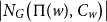 $\big|N_G\big(\Pi(w),C_w\big)\big|$
cause (
I4) to fail. The remaining case is that there are two adjacent neighbours of w coming after w in
 $<_{\rho^{\prime}}$
. In this case, we need the good events of Lemmas 14 and 15, and consequently for given u,u ′ up to
 $Cp^{-2}\log n$
vertices might fail to inherit regularity. But in this case by (7) we have
 $ \big|N_G\big(\Pi(w),C_w\big)\big|\ge 100C\Delta^2p^{-2}\log n$
, and again in this case at most a
 $\tfrac{1}{100}$
-fraction of
 $\big|N_G\big(\Pi(w),C_w\big)\big|$
cause (
I4) to fail.
The proofs that at most a
 $\tfrac{1}{100}$
-fraction of
 $\big|N_G\big(\Pi(w),C_w\big)\big|$
cause any one of (
L1)–(
L3) are essentially identical, and we omit the details.
Summing up, by choice of
 $\nu^*_{\Delta,\Delta}$
and since
 $|V(H')|\le\sum_{i=0}^{s+1}\Delta^i$
, we see that at least half of
 $\big|N_G\big(\Pi(w),C_w\big)\big|$
consists of vertices y such that
 $\phi\cup\{w\to y\}$
satisfies the conclusions of Claim 2 for
 $z+1$
, completing the induction step and hence the proof of the claim.
Now we can conclude the proof of Lemma 25. Given an embedding of
 $H'-(T\cup\{x\})$
satisfying the conclusions of Claim 2, we extend it to an embedding
 $\phi$
of
 $H'-T$
by setting
 $\phi(x) = v$
. This is a valid embedding since we embedded all neighbours of x to W, and we obtain (
P1’). Property (
P2’) holds by choice of the
 $q_1,\dots,q_{k}$
. For every vertex u in T we have that
 $C_u = V_{q_{\rho'(u)},j_{\rho'(u)}}$
and
 $|C_u| \ge |{V_{q_{\rho'(u)}}}\cap V({G^{\,\prime}})|/{2 t_1}$
. So by the choice of
 $\zeta$
, (
P4’) follows from (
I2). The choice of constants ensures that the remaining statements in the lemma are a direct consequence of (
L1)–(
L3).
5. Proof of the main technical result
The proof of Theorem 22 is broadly similar to the proof of [Reference Allen, Böttcher, Ehrenmüller and Taraz1, Theorem 23]. Again, basically the idea is that we apply the lemmas of Section 3 in order to first find a well-behaved partition of G and a corresponding partition of H. We then deal with the few badly behaved vertices of G by sequentially pre-embedding onto them some vertices of H whose neighbourhoods contain at most s colours. Lemma 25 deals with this pre-embedding, and sets up for the vertices which are not pre-embedded but which have pre-embedded neighbours restriction sets in the sense of Definition 11. We then adjust the partition of H to fit this pre-embedding, and balance the partition of G to match. Finally, we see that the conditions of Lemma 13 are met, and that lemma completes the desired embedding of H in G.
As in [Reference Allen, Böttcher, Ehrenmüller and Taraz1], there are two slightly subtle points. The first is that for
 $\Delta=2$
we can have
 $Cp^{-2}>pn$
, so that we should be worried that we come to some badly behaved vertex of G onto which we wish to pre-embed and discover that all its neighbours have already been used in pre-embedding. As in [Reference Allen, Böttcher, Ehrenmüller and Taraz1], this is easy to handle: at each step we choose the badly behaved vertex with most neighbours already embedded to. It is easy to check that this ordering avoids the above problem. The second, more serious, problem is that we need restriction sets fulfilling the conditions of Definition 11. Although Lemma 25 gives us pre-embeddings satisfying these conditions, we might destroy the conditions when we pre-embed later vertices. The condition we could destroy is simply that we need each restriction set to be reasonably large; the danger is that we pre-embed many vertices to some restriction set. The solution to this is (as in [Reference Allen, Böttcher, Ehrenmüller and Taraz1]) to select a set S, whose size is linear in n but small, using Lemma 20 to avoid large intersections with any possible restriction set. When we apply Lemma 25 to cover a badly-behaved vertex v, we will pre-embed to v and to some vertices chosen from S, and not to any other vertex. The badly behaved vertices are not (by construction) in any restriction set, while S has small intersection with all restriction sets, so that even removing all of S would not make the restriction sets too small.
The only point in the proof where we really need to do more than in [Reference Allen, Böttcher, Ehrenmüller and Taraz1] (apart from using Lemma 25 to pre-embed) is that we need to ensure the conditions of Lemma 25 are met. When we wish to cover a badly-behaved v, its neighbourhood within the set S must contain many copies of
 $K_s$
. Further, some vertices of S will have been used in earlier pre-embeddings, and we need to ensure that these used vertices do not hit too many of the copies of
 $K_s$
. For this, we apply the sparse regularity lemma, Lemma 10, to
 $G\big[N_G(v)\big]$
before choosing S. We will see that (since
 $N_G(v)$
contains many copies of
 $K_s$
) we find a set of s clusters in
 $N_G(v)$
such that all the pairs are relatively dense and regular. When we use Lemma 20 to choose S, we also insist that S contains a significant fraction of each of these clusters. The order in which we cover badly behaved vertices ensures that a (slightly smaller but still) significant fraction of each cluster is not used by the previous pre-embedding; and we find the desired many copies of
 $K_s$
in
 $N_G(v)\cap S$
as a result.
As a final observation, Lemma 25 ( P4’) gives us something which looks like an image restriction set suitable for Definition 11—but it is a subset of S. A careful reader will see from the constant choices below that it is therefore too small for Lemma 13. However, the fact that S is selected at random allows us to deduce the existence of a larger image restriction set which is suitable for Lemma 13.
Proof of Theorem 22. Given
 $\unicode[Times]{x03B3}>0$
, we set
 $d^+=2^{-s-5}\unicode[Times]{x03B3}$
and
 $\varepsilon^+_{s-2}=16^{-s}(d^+)^{2s}/s$
. For each
 $i=s-3,s-4,\ldots,0$
sequentially, let
 $0<\varepsilon^+_i\le \varepsilon^+_{i-1}$
be sufficiently small for Lemma 15 with input
 $d^+$
and
 $\varepsilon^+_{i+1}$
. Let
 $\varepsilon^+\le\varepsilon^+_0$
be small enough for an application of Lemma 20 with input
 $d^+$
and
 $\varepsilon^+_0$
. Let
 $t_1^+$
be returned by Lemma 10 for input
 $\varepsilon^+$
and
 $\lceil1/d^+\rceil$
, and let
 $\alpha^+=\tfrac14d^+/t_1^+$
. Let
 $\unicode[Times]{x03B3}^+=2^{-4s^2}(d^+)^{-2s^2}(t_1^+)^{-s}$
. Note we have
 $\unicode[Times]{x03B3}^+<\unicode[Times]{x03B3}$
.
We now choose
 $d \le \frac{\unicode[Times]{x03B3}^+}{32}$
not larger than the d given by Lemma 23 for input
 $\unicode[Times]{x03B3}$
, k and
 $r_0\;:\!=\;10^5\unicode[Times]{x03B3}^{-1}$
. We let
 $\alpha$
be the
 $\zeta$
returned by Lemma 25 for input
 $\Delta$
, k, s,
 $\unicode[Times]{x03B3}^+$
and d. We set
 $D=\Delta$
and let
 $\varepsilon_{BL}$
be returned by Lemma 13 for input
 $\Delta$
,
 $\Delta_{R'}=3k$
,
 $\Delta_J=\Delta$
,
 $\vartheta=\tfrac{1}{100D}$
,
 $\zeta=\tfrac{1}{4}\alpha$
, d and
 $\kappa=64$
. Next, putting
 $\varepsilon^{\ast}\;:\!=\;\tfrac18\varepsilon_{BL}$
into Lemma 25 (with earlier parameters as above) returns
 $\varepsilon_0>0$
. We set
 $\varepsilon=\min(\varepsilon_0,d,\varepsilon^*/4\Delta,1/100k)$
, and set
 $\varepsilon^-\le\varepsilon$
small enough for Lemma 20 with input as above and
 $d,\varepsilon$
. Now Lemma 23, for input
 $\varepsilon^-$
and earlier constants as above, returns
 $r_1$
. At last, Lemma 26, for input k,
 $r_1$
,
 $\Delta$
,
 $\unicode[Times]{x03B3}$
, d and
 $8\varepsilon$
, returns
 $\xi>0$
. Without loss of generality, we may assume
 $\xi<10(10kr_1)$
, and set
 $\beta=10^{-12}\xi^2/(\Delta k^4 r_1^2)$
. Let
 $\mu=\varepsilon^2/(100000kr_1)$
. Next, suppose
 $C^{\ast}$
is large enough for Lemma 25, and also to play the rôle of C in each of these other lemmas, and also for Proposition 17 with input
 $\varepsilon$
, for Lemma 15 with input
 $d^+$
and each of
 $\varepsilon^+_i$
for
 $i=1,\ldots,s-2$
, and for Lemma 20 with input
 $\varepsilon\mu^2$
,
 $\varepsilon$
,
 $\min(d,d^+)$
and
 $\Delta$
.
We set
 $C=10^{100}k^2 r_1^2 \varepsilon^{-2}\xi^{-1}\Delta^{1000k^3}\mu^{-\Delta}C^{\ast}$
and
 $z=10/\xi$
. Given
 $p\ge C\big(\tfrac{\log}{n}\big)$
, a.a.s.
 $\Gamma=G(n,p)$
satisfies the good events of each of the lemmas and propositions listed above with each of the specified inputs.
In addition, for each set W of at most
 $\Delta$
vertices of G(n,p), the size of the common neighbourhood
 $N_{G(n,p)}(W)$
is distributed as a binomial random variable with mean
 $p^{|W|}(n-|W|)$
. By Theorem 18, the probability that the outcome is
 $(1\pm\varepsilon)p^{|W|}n$
is at least
 $1-n^{-(\Delta+1)}$
for sufficiently large n. By the union bound, we conclude that a.a.s. G(n,p) satisfies
 \begin{equation} \text{for each $W\subset V\big(G(n,p)\big)$ with $|W|\le\Delta$ we have }\big|N_{G(n,p)}(W)\big|=(1\pm\varepsilon)p^{|W|}n\,.\end{equation}
Suppose that
 $\Gamma=G(n,p)$
satisfies these good events. Let G be a spanning subgraph of
 $\Gamma$
such that
 $\delta(G)\ge\big(\tfrac{k-1}{k}+\unicode[Times]{x03B3}\big)pn$
and such that for each
 $v\in V(G)$
the neighbourhood
 $N_G(v)$
contains at least
 $\delta p^{\binom{s}{2}}(pn)^s$
copies of
 $K_s$
. Let H be a graph on n vertices with
 $\Delta(H)\le\Delta$
. Let
 $\sigma$
be a proper colouring of V(H) using colours
 $\{0,\dots,k\}$
, and let
 ${\mathcal L}$
be a labelling of V(H) with bandwidth at most
 $\beta n$
with the following properties. The colouring
 $\sigma$
is
 $(z,\beta)$
-zero-free with respect to
 ${\mathcal L}$
, the first
 $\sqrt{\beta}n$
vertices of
 ${\mathcal L}$
do not use the colour zero, and the first
 $\beta n$
vertices of
 ${\mathcal L}$
contain
 $Cp^{-2}$
vertices whose neighbourhood contains only s colours.
We now claim that for each
 $v\in V(G)$
we can find s large subsets of
 $N_G(v)$
all pairs of which are dense and regular in G. This forms a ‘robust witness’ that each vertex neighbourhood in G contains many copies of
 $K_{s}$
.
Claim 3. For each
 $v\in V(G)$
, there exist sets
 $Q_{v,1},\dots,Q_{v,s}\subset N_G(v)$
each of size at least
 $\alpha^+pn$
such that for each
 $i<j$
the pair
 $(Q_{v,i},Q_{v,j})$
is
 $(\varepsilon^+,d^+,p)$
-regular in G.
Proof. We apply Lemma 10 with input
 $\varepsilon^+$
and
 $\lceil 1/d^+\rceil$
to
 $G\big[N_G(v)\big]$
, with an arbitrary equipartition into
 $\lceil 1/d^+\rceil$
sets as an initial partition. Note that the conditions of Lemma 10 are satisfied because the good event of Proposition 17 holds. We obtain an
 $(\varepsilon,p)$
-regular partition of
 $N_G(v)$
whose non-exceptional parts are of size between
 $\alpha^+pn$
and
 $8\alpha^+pn$
, by choice of
 $\alpha^+$
and since
 $\big|N_G(v)\big|>\tfrac12pn$
. If there exist s parts in this partition all pairs of which form
 $(\varepsilon^+,d^+,p)$
-regular pairs, then these parts form the desired
 $Q_{v,1},\cdots\!,Q_{v,s}$
. So we may assume for a contradiction that no such s parts exist. It follows that when we delete all edges within parts, meeting the exceptional sets, in irregular pairs, and in pairs of density less than
 $d^+p$
, we remove all copies of
 $K_s$
from
 $G\big[N_G(v)\big]$
.
The total number of such edges is, since the good event of Proposition 17 holds, at most
 \begin{align*} (d^+)^{-1}\cdot 8p^3n^2(d^+)^{2}+2p(2\varepsilon^+pn)(2pn)+4\varepsilon^+p^3n^2+4d^+p^3n^2&\le (12\varepsilon^++12d^+)p^3n^2\\ &\le 2^{-s}\unicode[Times]{x03B3} p^3n^2\,, \end{align*}
where the final inequality is by choice of
 $d^+$
and
 $\varepsilon^+$
. We now estimate simply how many copies of
 $K_{s+1}$
a given edge e, together with v, can make in
 $\Gamma$
. Since by (10) any
 $\ell$
-tuple of vertices of
 $\Gamma$
has at most
 $2p^\ell n$
common neighbours, the number of copies of
 $K_4$
containing e and v is at most
 $2p^3n$
, and inductively the number of copies of
 $K_{s+1}$
containing e and v is at most
 \begin{equation*}\prod_{\ell=3}^{s}2p^\ell n=2^{s-2}p^{\binom{s+1}{2}-3}n^{s-2}\,.\end{equation*}
Putting these estimates together we see that the total number of copies of
 $K_s$
in
 $G\big[N_G(v)\big]$
is at most
 $\tfrac12\unicode[Times]{x03B3} p^{\binom{s+1}{2}}n^{s}$
. This is the desired contradiction, completing the proof.
We apply Lemma 23 to G, with input
 $\unicode[Times]{x03B3}$
, k,
 $r_0$
and
 $\varepsilon^-$
, to obtain an integer r with
 $10\unicode[Times]{x03B3}^{-1}\le kr\le r_1$
, a set
 $V_0\subset V(G)$
with
 $|V_0|\le C^\ast p^{-2}$
, a k-equitable partition
 ${\mathcal V}=\big\{V_{i,j}\big\}_{i\in[r],j\in[k]}$
of
 $V(G)\setminus V_0$
, and a graph
 $R^k_r$
on
 $[r]\times[k]$
with minimum degree
 $\delta(R^k_r)\ge\big(\tfrac{k-1}{k}+\tfrac{\unicode[Times]{x03B3}}{2}\big)kr$
, such that
 $K^k_r\subset B^k_r\subset R^k_r$
and such that the following hold.
-
(G1a)
$\frac{n}{4kr}\leq |V_{i,j}| \leq \frac{4n}{kr}$
for every
$i\in[r]$
and
$j\in[k]$
, -
(G2a)
${\mathcal V}$
is
$(\varepsilon^-,d,p)_G$
-regular on
$R^k_r$
and
$(\varepsilon^-,d,p)_G$
-super-regular on
$K^k_r$
, -
(G3a) both
$\big(N_{\Gamma}(v, V_{i,j}),V_{i^{\prime},\kern0.5pt j^{\prime}}\big)$
and
$\big(N_{\Gamma}(v, V_{i,j}),N_{\Gamma}(v, V_{i^{\prime},\kern0.5pt j^{\prime}})\big)$
are
$(\varepsilon^-, d,p)_G$
-regular pairs for every
$\{(i,j),(i^{\prime},\kern0.5pt j^{\prime})\} \in E(R^k_r)$
and
$v\in V\setminus V_0$
, and -
(G4a)
$|N_{\Gamma}(v,V_{i,j})| = (1 \pm \varepsilon)p|V_{i,j}|$
for every
$i \in [r]$
,
$j\in [k]$
and every
$v \in V \setminus V_0$
.


Given
 $i\in[r]$
, because
 $\delta(R^k_r)>(k-1)r$
, there exists
 $v\in V(R^k_r)$
adjacent to each (i,j) with
 $j\in[k]$
. This, together with our assumptions on H, allow us to apply Lemma 24 to H, with input D, k, r,
 $\tfrac{1}{10}\xi$
and
 $\beta$
, and with
 $m_{i,j}\;:\!=\;|V_{i,j}|+\tfrac{1}{kr}|V_0|$
for each
 $i\in[r]$
and
 $j\in[k]$
, choosing the rounding such that the
 $m_{i,j}$
form a k-equitable integer partition of n. Since
 $\Delta(H)\le\Delta$
, in particular H is
 $\Delta$
-degenerate. Let
 $f\colon V(H) \to [r] \times [k]$
be the mapping returned by Lemma 24, let
 $W_{i,j} \;:\!=\; f^{-1}(i,j)$
, and let
 $X \subseteq V(H)$
be the set of special vertices returned by Lemma 24. For every
 $i\in [r]$
and
 $j\in [k]$
we have
-
(H1a)
$m_{i,j} - \tfrac{1}{10}\xi n \leq |W_{i,j}| \leq m_{i,j} + \tfrac{1}{10}\xi n$
, -
(H2a)
$|X| \leq \xi n$
, -
(H3a)
$\{f(x),f(y)\} \in E(R^k_r)$
for every
$\{x,y\} \in E(H)$
, -
(H4a)
$y,z\in \bigcup_{j^{\prime}\in[k]}f^{-1}(i,j^{\prime})$
for every
$x\in f^{-1}(i,j)\setminus X$
and
$xy,yz\in E(H)$
, and -
(H5a)
$f(x)=\big(1,\sigma(x)\big)$
for every x in the first
$\sqrt{\beta}n$
vertices of
$\mathcal{L}$
.


We let F be the first
 $\beta n$
vertices of
 $\mathcal{L}$
. By definition of
 $\mathcal{L}$
, in F there are at least
 $C p^{-2}$
vertices whose neighbourhood in H receives at most s colours from
 $\sigma$
.
Next, we apply Lemma 20, with input
 $\varepsilon\mu^2$
and
 $\Delta$
, to choose a set
 $S\subset V(G)$
of size
 $\mu n$
. We let the
 $T_i$
of Lemma 20 be all sets which are common neighbourhoods in
 $\Gamma$
of at most
 $\Delta$
vertices of
 $\Gamma$
, and all sets which are common neighbourhoods in G of at most
 $\Delta$
vertices of
 $\Gamma$
into any set of
 ${\mathcal V}$
, together with the sets
 $V_{i,j}$
for
 $i\in[r]$
and
 $j\in[k]$
, and the sets
 $Q_{v,i}$
for
 $v\in V(G)$
and
 $i\in[s]$
. We let the regular pairs
 $(X_i,Y_i)$
of Lemma 20 be the pairs
 $(Q_{v,i},Q_{v,j})$
for
 $1\le i<j\le s$
and
 $v\in V(G)$
, and all regular pairs
 $(V_{i,j},V_{i^{\prime},\kern0.5pt j^{\prime}})\in R^k_r$
.
The result of Lemma 20 is that for any
 $1\le\ell\le\Delta$
, any
 $V\in{\mathcal V}$
, and any vertices
 $u_1,\dots,u_\ell$
of V(G), we have
 \begin{equation} \begin{split} \Big|S\cap\bigcap_{1\le i\le\ell}N_\Gamma(u_i)\Big|&=(1\pm\varepsilon\mu)\mu\Big|\bigcap_{1\le i\le\ell}N_\Gamma(u_i)\Big|\pm \varepsilon\mu p^\ell n\,,\\ \Big|S\cap V\cap \bigcap_{1\le i\le\ell}N_G(u_i)\Big|&=(1\pm\varepsilon\mu)\mu\Big|V\cap\bigcap_{1\le i\le\ell}N_G(u_i)\Big|\pm \tfrac{\varepsilon\mu p^\ell n}{4kr}\,,\quad \text{and}\\ \big|S\cap V_{i,j}\big|&=(1\pm\tfrac12\varepsilon)\mu|V_{i,j}|\quad\text{for each $i\in[r]$ and $j\in[k]$\,,} \end{split}\end{equation}
where we use the fact
 $p\ge C\big(\tfrac{\log n}{n}\big)^{1/\Delta}$
and choice of C to deduce
 $C^{\ast}\log n<\tfrac{\varepsilon\mu p^\Delta n}{4kr}$
. Furthermore, for each
 $v\in V(G)$
and
 $1\le i<j\le s$
the pair
 $\big(Q_{v,i}\cap S,Q_{v,j}\cap S\big)$
is
 $\big(\varepsilon^{+}_0,d^+,p)$
-regular in G, and for each
 $(V_{i,j},V_{i^{\prime},\kern0.5pt j^{\prime}})\in R^k_r$
the pair
 $\big(V_{i,j}\cap U,V_{i^{\prime},\kern0.5pt j^{\prime}}\cap U\big)$
is
 $(\varepsilon,d,p)$
-regular in G.
Our next task is to create the pre-embedding that covers the vertices of
 $V_0$
. We use the following algorithm, starting with
 $\phi_0$
the empty partial embedding.
Pre-embedding

Suppose this algorithm does not fail, terminating with
 $t=t^*$
and with a final embedding
 $\phi\;:\!=\;\phi_{t^*}$
. Let
 $H'=H\setminus{\mathrm{Dom}}(\phi)$
. Then
 $\phi$
is an embedding of
 $H\big[V(H)\setminus V(H')\big]$
into V(G) which covers
 $V_0$
and is contained in
 $V_0\cup S$
. The algorithm in addition defines
 $f^{**}(y)\in R^k_r$
,
 $J_y\subset S$
and
 $I^{\prime}_{y}\subset S$
for each
 $y\in V(H')$
which has H-neighbours in
 ${\mathrm{Dom}}(\phi)$
. The meanings of these are as follows. When we apply the sparse blow-up lemma, we will embed y to the cluster
 $V_{f^{**}(y)}$
. We will need to image restrict y (as in Definition 11), and the image restricting vertices will be
 $J_y$
. The set
 $I^{\prime}_{y}$
will not be the image restriction we use, but we will deduce the existence of a suitable image restriction from
 $I^{\prime}_{y}$
. Before we explain this, we first claim that the algorithm does not fail, and the requirements of Lemma 25 are met at each iteration.
Proof. Observe that in total we embed at most
 $\Delta^{s+2}$
vertices in each iteration, and the number of iterations is at most
 $|V_0|\le C^{\ast} p^{-2}$
, so that the total number of vertices we embed is at most
 $C^{\ast}\Delta^{s+2}p^{-2}$
.
We begin by discussing the choice of
 $v_{t+1}$
. Suppose that at some time t we pick a vertex
 $v=v_{t+1}$
such that
 $\big|N_G(v)\cap S\cap{\mathrm{Im}}(\phi_t)\big|>\tfrac12\alpha^+\mu pn$
. For each
 $t-\tfrac14\Delta^{-s-2}\mu\alpha^+ pn\le t'<t$
, we have
 $\big|N_G(v)\cap S\cap{\mathrm{Im}}(\phi_{t'})\big|>\tfrac14\alpha^+\mu pn$
, yet at each of these times v is not picked, so that the vertex picked at each time t ′ has at least
 $\tfrac14\alpha^+\mu pn$
neighbours in
 ${\mathrm{Im}}(\phi_t)\cap S$
, and in particular in
 ${\mathrm{Im}}(\phi_t)$
, a set of size at most
 $C^{\ast}\Delta^{s+2}p^{-2}$
. Let Z be a superset of
 ${\mathrm{Im}}(\phi_t)$
of size at least
 $C^{\ast} p^{-1}\log n$
. Now the good event of Proposition 17 states that in
 $\Gamma$
at most
 $C^{\ast}p^{-1}\log n$
vertices of
 $\Gamma$
have more than
 $2p|Z|<\tfrac14\alpha^+\mu pn$
neighbours in Z. Since
 $\tfrac14\Delta^{-s-2}\mu\alpha^+ pn>C^{\ast} p^{-1}\log n$
by choice of p, this is a contradiction. We conclude that at each time t, the vertex
 $v_{t+1}$
picked at time t satisfies
 $\big|N_G(v)\cap S\cap{\mathrm{Im}}(\phi_t)\big|\le\tfrac12\alpha^+\mu pn$
.
From this point on we consider a fixed time t, and write v rather than
 $v_{t+1}$
, and
 $\phi$
for
 $\phi_t$
, and so on.
Since we cover at most
 $C^{\ast}\Delta^{s+2} p^{-2}$
vertices, so we have
 $|S\setminus{\mathrm{Im}}(\phi)|=(1\pm\tfrac12\varepsilon)\mu n$
. Now, to obtain the maximum subgraph of
 $G\big[(S\cup\{v\})\setminus{\mathrm{Im}}(\phi)\big]$
with minimum degree
 $\big(\tfrac{k-1}{k}+\tfrac{\unicode[Times]{x03B3}}{4}\big)\mu pn$
, we successively remove vertices whose degree is too small until no further remain. We claim that less than
 $\tfrac18\mu\alpha^+pn$
vertices are removed, and v is not one of the vertices removed. To see this, observe that every vertex has at least
 $\big(\tfrac{k-1}{k}+\tfrac{\unicode[Times]{x03B3}}{2}\big)\mu pn$
neighbours in S by (11). Suppose for a contradiction that there is a set Z of
 $\tfrac18\mu\alpha^+pn$
vertices which are the first removed from S in this process. Then each vertex of Z has at least
 $\tfrac14\unicode[Times]{x03B3}\mu p n$
neighbours in
 $Z\cup{\mathrm{Im}}(\phi)$
, which by choice of
 $\alpha^+$
is a contradiction to the good event of Proposition 17.
We conclude
 $\big|(S\cup\{v\})\setminus{\mathrm{Im}}(\phi)\big|=(1\pm\varepsilon)\mu n$
. Since v has at least
 $\big(\tfrac{k-1}{k}+\tfrac{\unicode[Times]{x03B3}}{2}\big)\mu pn$
neighbours in S, of which at most
 $\tfrac12\alpha^+\mu pn$
are in
 ${\mathrm{Im}}(\phi)$
and at most
 $|Z|$
are in Z, the vertex v is not removed. Furthermore, for each
 $i\in[s]$
we have
 $|Q_{v,i}\cap V({G^{\,\prime}})\big|\ge\tfrac12\big|Q_{v,i}\cap S\big|$
. We now use this to count copies of
 $K_s$
in
 $N_{{G^{\,\prime}}}(v)$
. We choose for
 $i=1,\ldots,s$
sequentially vertices in
 $Q_{v,i}\cap V({G^{\,\prime}})$
, at each step choosing a vertex
 $w_i$
which is adjacent to the previous vertices, and which is such that
 $w_1,\ldots,w_i$
have at least
 $(d^+-\varepsilon^+_{s-2})^ip^i|Q_{v,j}|$
common G-neighbours in each
 $Q_{v,j}$
for
 $j>i$
, and have
 $(1\pm\varepsilon)^ip^i|Q_{v,j}|$
common
 $\Gamma$
-neighbours in each
 $Q_{v,j}$
for
 $j>i$
, and the pair
 \begin{equation*}\Big(\bigcap_{\ell\in[i]} N_{\Gamma}(w_\ell,Q_{v,j}), \bigcap_{\ell\in[i]} N_{\Gamma}(w_\ell,Q_{v,j^{\prime}})\Big)\end{equation*}
is
 $(\varepsilon^+_i,d^+,p)$
-regular in G for each
 $i<j<j^{\prime}\le s$
. Note that all these properties hold when
 $i=0$
vertices have been chosen. Assuming these properties hold when we come to choose
 $w_i$
, there are at least
 $2^{1-i}(d^+)^{i-1}p^{i-1}|Q_{v,i}|$
vertices of
 $Q_{v,i}$
which are adjacent to all previously chosen vertices. If
 $i=s$
then all of these are valid choices. If
 $i<s$
, by Propositions 7 and 8, and because the good event of Proposition 17 holds, at most
 \begin{equation*} s\cdot 4^i(d^+)^{1-i}\varepsilon^+_{s-2}p^{i-1}|Q_{v,i}|+s\cdot C^{\ast} p^{-1}\log n\end{equation*}
vertices of
 $Q_{v,i}$
cause the numbers of G- or
 $\Gamma$
-common neighbours in some
 $Q_{v,j}$
for
 $j>i$
to go wrong. Finally, if
 $i=s-1$
then there is no choice of
 $i<j<j^{\prime}\le s$
and so no failure of regularity can occur, while if
 $i<s-1$
then by the good event of Lemma 15 the number of vertices which cause a failure of regularity is at most
 $s^2C^{\ast} p^{-2}\log n$
. By choice of
 $\varepsilon^+_{s-2}$
and p, in total at least
 $2^{-i}(d^+)^{i-1}p^{i-1}|Q_{v,i}|$
vertices of
 $Q_{v,i}$
are thus valid choices for
 $w_i$
. Finally, by choice of
 $\unicode[Times]{x03B3}^+$
the total number of copies of
 $K_s$
in
 $N_{{G^{\,\prime}}}(v)$
is at least
 $2\unicode[Times]{x03B3}^+ p^{\binom{s}{2}}\big(p|S|\big)^s \ge \unicode[Times]{x03B3}^+ p^{\binom{s+1}{2}}(\mu n)^s$
, as desired.
The remaining conditions of Lemma 25 are simpler to check. By (11) we have
 $\big|N_{{G^{\,\prime}}}(W)\big| \le \big|N_\Gamma(W)\cap S\big|\le 2\mu n p^{|W|}$
for any
 $W \subset V({G^{\,\prime}})$
of size at most
 $\Delta$
. The graph G with the regular partition
 $(V_{i,j})_{i\in[r],j\in[k]}$
, with reduced graph
 $R^k_r$
, has the required minimum degree. By (11) the intersection of the part
 $V_{i,j}$
with S has size
 $(1\pm\tfrac12 \varepsilon)\mu |V_{i,j}|$
, so that
 $|V_{i,j}\cap V({G^{\,\prime}})|=(1\pm\varepsilon)\mu|V_{i,j}|$
as required. Furthermore the regular pairs of R intersected with S are regular, and so by Proposition 8 the subpairs obtained by intersecting with V(G ′) (which is, except for v, contained in S; and v is in
 $V_0$
hence not in any of these pairs) are also sufficiently regular. Finally, the graph
 $H_{t+1}$
chosen at each time t satisfies the conditions of Lemma 25 by definition. Note that we can at each step choose
 $x_{t+1}$
and hence
 $H_{t+1}$
because there are at least
 ${Cp}^{-2}$
vertices of F whose neighbourhood is coloured with at most s colours; even after embedding all of
 $V_0$
, the domain of
 $\phi$
contains at most
 ${C}^{\ast}\Delta^{s+2}p^{-2}$
vertices, and hence at most
 $C^{\ast}\Delta^{s+100k^2+3}p^{-2}<Cp^{-2}$
vertices of H are too close to
 ${\mathrm{Dom}}(\phi)$
.
We next define image restricting vertex sets and create an updated homomorphism
 $f^{*}:V(H')\to [r]\times[k]$
. The former is easier. Let
 $X^{**}$
consist of the vertices of H ′ which have at least one H-neighbour in
 ${\mathrm{Dom}}(\phi)$
. The vertices of
 ${\mathrm{Dom}}(\phi)$
are partitioned according to the
 $x_t$
chosen at each time in Algorithm 1, and because these vertices are chosen far apart in H, any vertex y of
 $X^{**}$
is at distance
 $s+1$
from some
 $x_t$
. The neighbours in H ′ of y are either also at distance
 $s+1$
in H from
 $x_t$
and not adjacent to any vertices of
 ${\mathrm{Dom}}(\phi)$
corresponding to other
 $x_{t'}$
, or they are not adjacent to any vertex of
 ${\mathrm{Dom}}(\phi)$
at all. It follows that for each
 $y\in X^{**}$
the quantities
 $f^{**}(y)$
,
 $J_y$
and
 $I^{\prime}_{y}$
are set exactly once in the running of Algorithm 1. By Lemma 25 and (11), given
 $y\in X^{**}$
, we have
 $|I^{\prime}_{y}|\ge 2\alpha p^{|J_y|}|(1-\varepsilon)\mu|V_{f^{**}(y)}|$
. We claim this implies
 \begin{equation} \big|N_G(J_y)\cap V_{f^{**}(y)}\big|\ge\alpha p^{|J_y|}\big|V_{f^{**}(y)}\big|\,. \end{equation}
Indeed, suppose for a contradiction that (12) fails. Since
 $I^{\prime}_{y}$
is by construction contained in S, we have
 $|I^{\prime}_{y}|\le\big|N_G(J_y)\cap V_{f^{**}(y)}\cap S\big|$
. Using (11) to estimate the size of the latter set, we get
 \begin{equation*}|I^{\prime}_{y}|\le (1\pm\varepsilon\mu)\mu\cdot\alpha p^{|J_y|}\big|V_{f^{**}(y)}\big|+\tfrac{\varepsilon\mu p^{|J_y|}n}{4kr}<2\alpha p^{|J_y|}|(1-\varepsilon)\mu|V_{f^{**}(y)}|\,,\end{equation*}
where the final inequality is by choice of
 $\varepsilon$
and since
 $|V_{f^{**}(y)}|\ge\tfrac{n}{4kr}$
by (
G1a). This is in contradiction to the lower bound on
 $|I^{\prime}_{y}|$
from Lemma 25 stated above.
We construct the updated homomorphism as follows. We will have
 $f^*(y)=f(y)$
for all vertices which are not within distance
 $s+\binom{k+1}{2}$
of
 ${\mathrm{Dom}}(\phi)$
in H. Given a vertex x of H chosen at some time t in Algorithm 1, we set
 $f^*(y)$
for each y at distance between
 $s+1$
and
 $s+\binom{k+1}{2}$
from x in H as follows. We will generate a collection
 $Z_1,\ldots,Z_{\binom{k+1}{2}}$
of copies of
 $K_k$
in
 $R^k_r$
, each labelled with the integers
 $1,\ldots,k$
. For each
 $i=1,\ldots,\binom{k+1}{2}$
, if y is at distance
 $s+i$
from x in H, then we set
 $f^*(y)$
to be the label
 $\sigma(y)$
cluster of
 $Z_i$
. The properties of the sequence
 $Z_1,\ldots,Z_{\binom{k+1}{2}}$
we require are the following. First,
 $Z_1$
is the clique returned by the application of Lemma 25 at x with the labelling given by that lemma. Second,
 $Z_{\binom{k+1}{2}}$
is the clique
 $\big(V_{1,1},\dots,V_{1,k}\big)$
, labelled
 $1,\ldots,k$
in that order. Third, for each
 $i=2,\ldots,\binom{k+1}{2}$
, each cluster of
 $Z_i$
is adjacent in
 $R^k_r$
to each differently labelled cluster of
 $Z_{i-1}$
. Assuming such a sequence of cliques exists, the resulting
 $f^*$
has the properties that each vertex y of
 $X^{**}$
is assigned by
 $f^*$
to
 $f^{**}(y)$
, that each edge of H ′ is mapped by
 $f^*$
to an edge of
 $R^k_r$
, and that f and
 $f^*$
disagree on at most
 $C^{\ast} p^{-2}\Delta^{s+\binom{k+1}{2}+3}$
vertices of H ′, all in the first
 $\sqrt{\beta}n$
vertices of
 ${\mathcal L}$
. These will be the properties we need of
 $f^*$
. Note that this definition is consistent, in that it does not attempt to set
 $f^*(y)$
to two different clusters for any y, because the vertices chosen at each step of Algorithm 1 are at pairwise distance at least
 $100k^2$
. It remains only to show that the desired sequence of cliques always exists.
Claim 5. For any k-cliques
 $Z_1$
and
 $Z_{\binom{k+1}{2}}$
in
 $R^k_r$
a sequence
 $Z_1,\ldots,Z_{\binom{k+1}{2}}$
with the above properties exists.
Proof. By the minimum degree of
 $R^k_r$
, any k-set in
 $V(R^k_r)$
has at least one common neighbour. We will use this fact at each step in the following algorithm. Set
 $t=2$
. We loop through
 $j=1,\ldots,k-1$
sequentially. For each value of j we perform the following operation.
For each
 $i=j+1,\ldots,k$
sequentially, choose a cluster
 $w_{t}$
of
 $R^k_r$
which is adjacent to all the clusters of
 $Z_{t-1}$
except possibly that labelled i, and which is also adjacent to the cluster of
 $Z_{\binom{k+1}{2}}$
labelled j. We let
 $Z_{t}$
be the clique obtained from
 $Z_{t-1}$
by replacing the label i cluster with
 $w_t$
, which we label i; all other clusters keep their previous label. We increment t.
After performing the
 $i=k$
operation, we let
 $Z_{t}$
be obtained from
 $Z_{t-1}$
by replacing the label j cluster of
 $Z_{t-1}$
with the label j cluster of
 $Z_{\binom{k+1}{2}}$
, and increment t. We now proceed with the next round of the j-loop.
Observe that after the completion of each j-loop, the clusters of
 $Z_{t-1}$
labelled
 $1,\ldots,j$
are the same as those of
 $Z_{\binom{k+1}{2}}$
. In particular, the given
 $Z_{\binom{k+1}{2}}$
has the required adjacencies in
 $Z_{\binom{k+1}{2}-1}$
(the final clique constructed in the
 $j=k-1$
loop), while the remaining required adjacencies hold by construction.
At this point, we complete the proof almost exactly as in [Reference Allen, Böttcher, Ehrenmüller and Taraz1]. What follows is taken from there, with only trivial changes, for completeness’ sake.
For each
 $i\in[r]$
and
 $j\in[k]$
, let
 $W'_{\!\!i,j}$
be the set of vertices
 $w\in V(H')$
with
 $f^*(w)\in V_{i,j}$
, and let X ′ consist of X together with all vertices of H ′ at H-distance
 $100k^2$
or less from some
 $x_t$
with
 $t\in[t^*]$
. The total number of vertices
 $z\in V(H)$
at distance at most
 $100k^2$
from some
 $x_t$
is at most
 $2\Delta^{200k^2}|V_0|<\tfrac{1}{100}\xi n$
. Since
 $W_{i,j}\triangle W'_{\!\!i,j}$
contains only such vertices, we have
-
(H1b)
$m_{i,j}-\tfrac15\xi n\le |W'_{\!\!i,j}|\le m_{i,j}+\tfrac15\xi n$
, -
(H2b)
$|X'| \leq 2\xi n$
, -
(H3b)
$\{f^*(x),f^*(y)\} \in E(R^k_r)$
for every
$\{x,y\} \in E(H')$
, and -
(H4b)
$y,z\in \bigcup_{j^{\prime}\in[k]}W'_{\!\!i,j^{\prime}}$
for every
$x\in W'_{\!\!i,j}\setminus X'$
and
$xy,yz\in E(H')$
.


where (
H2b), (
H3b) and (
H4b) hold by (
H1a) and definition of X ′, by definition of
 $f^*$
, and by (
H4a) and choice of X ′, respectively.
Furthermore, we have
-
(G1a)
$\frac{n}{4kr}\leq |V_{i,j}| \leq \frac{4n}{kr}$
for every
$i\in[r]$
and
$j\in[k]$
, -
(G2a)
${\mathcal V}$
is
$(\varepsilon,d,p)_G$
-regular on
$R^k_r$
and
$(\varepsilon,d,p)_G$
-super-regular on
$K^k_r$
, -
(G3a) both
$\big(N_{\Gamma}(v, V_{i,j}),V_{i^{\prime},\kern0.5pt j^{\prime}}\big)$
and
$\big(N_{\Gamma}(v, V_{i,j}),N_{\Gamma}(v, V_{i^{\prime},\kern0.5pt j^{\prime}})\big)$
are
$(\varepsilon, d,p)_G$
-regular pairs for every
$\{(i,j),(i^{\prime},\kern0.5pt j^{\prime})\} \in E(R^k_r)$
and
$v\in V\setminus V_0$
, and -
(G4a)
$|N_{\Gamma}(v,V_{i,j})| = (1\pm \varepsilon)p|V_{i,j}|$
for every
$i \in [r]$
,
$j\in [k]$
and every
$v \in V \setminus V_0$
. -
(G5a)
$\big|V_{f^*(x)}\cap\bigcap_{u\in J_x}N_G(u)\big|\ge\alpha p^{|J_x|}|V_{f^*(x)}|$
for each
$x\in V(H')$
, -
(G6a)
$\big|V_{f^*(x)}\cap\bigcap_{u\in J_x}N_\Gamma(u)\big|=(1\pm\varepsilon^*)p^{|J_x|}|V_{f^*(x)}|$
for each
$x\in V(H')$
, and -
(G7a)
$\big(V_{f^*(x)}\cap\bigcap_{u\in J_x}N_\Gamma(u),V_{f^*(y)}\cap\bigcap_{v\in J_y}N_\Gamma(v)\big)$
is
$(\varepsilon^*,d,p)_G$
-regular for each
$xy\in E(H')$
. -
(G8a)
$\big|\bigcap_{u\in J_x}N_\Gamma(u)\big|\le(1+\varepsilon^{\ast}) p^{|J_x|}n$
for each
$x\in V(H')$
,


Properties (
G1a) to (
G4a) are repeated for convenience (replacing
 $\varepsilon^-$
with the larger
 $\varepsilon$
). Properties (
G5a), (
G6a) and (
G8a), are trivial when
 $J_x=\emptyset$
. Otherwise, (
G5a) is guaranteed by (12), and (
G6a) and (
G8a) are guaranteed by Lemma 25. Finally, (
G7a) follows from (
G2a) when
 $J_x,J_y=\emptyset$
, and otherwise is guaranteed by Lemma 25, as follows. If both
 $J_x$
and
 $J_y$
are non-empty, then (
P6’) states that the desired pair is
 $(\varepsilon^{\ast},d,p)_G$
-regular. If
 $J_x$
is empty and
 $J_y$
is not, then necessarily
 $|J_x|\le\Delta-1$
, and by (
P5’) the pair
 $\big(V_{f^*(x)}\cap\bigcap_{u\in J_x}N_\Gamma(u),V_{f^*(y)}\big)$
is
 $(\varepsilon^*,d,p)_G$
-regular.
For each
 $i\in[r]$
and
 $j\in[k]$
, let
 $V'_{\!\!i,j}=V_{i,j}\setminus{\mathrm{Im}}(\phi_{t^*})$
, and let
 ${\mathcal V}'=\{V'_{\!\!i,j}\}_{i\in[r],j\in[k]}$
. Because
 $V_{i,j}\setminus V'_{\!\!i,j}\subset S$
for each
 $i\in[r]$
and
 $j\in[k]$
, using (11) and Proposition 8, and our choice of
 $\mu$
, we obtain
-
(G1b)
$\frac{n}{6kr}\leq |V'_{\!\!i,j}| \leq \frac{6n}{kr}$
for every
$i\in[r]$
and
$j\in[k]$
, -
(G2b)
${\mathcal V}'$
is
$(2\varepsilon,d,p)_G$
-regular on
$R^k_r$
and
$(2\varepsilon,d,p)_G$
-super-regular on
$K^k_r$
, -
(G3b) both
$\big(N_{\Gamma}(v, V'_{\!\!i,j}),V'_{\!\!i^{\prime},\kern0.5pt j^{\prime}}\big)$
and
$\big(N_{\Gamma}(v, V'_{\!\!i,j}),N_{\Gamma}(v, V'_{\!\!i^{\prime},\kern0.5pt j^{\prime}})\big)$
are
$(2\varepsilon, d,p)_G$
-regular pairs for every
$\{(i,j),(i^{\prime},\kern0.5pt j^{\prime})\} \in E(R^k_r)$
and
$v\in V\setminus V_0$
, and -
(G4b)
$|N_{\Gamma}(v,V'_{\!\!i,j})| = (1 \pm 2\varepsilon)p|V_{i,j}|$
for every
$i \in [r]$
,
$j\in [k]$
and every
$v \in V \setminus V_0$
. -
(G5b)
$\big|V'_{\!\!f^*(x)}\cap\bigcap_{u\in J_x}N_G(u)\big|\ge\tfrac12\alpha p^{|J_x|}|V'_{\!\!f^*(x)}|$
, -
(G6b)
$\big|V'_{\!\!f^*(x)}\cap\bigcap_{u\in J_x}N_\Gamma(u)\big|=(1\pm2\varepsilon^*)p^{|J_x|}|V'_{\!\!f^*(x)}|$
, and -
(G7b)
$\big(V'_{\!\!f^*(x)}\cap\bigcap_{u\in J_x}N_\Gamma(u),V'_{\!\!f^*(y)}\cap\bigcap_{v\in J_y}N_\Gamma(v)\big)$
is
$(2\varepsilon^*,d,p)_G$
-regular. -
(G8b)
$\big|\bigcap_{u\in J_x}N_\Gamma(u)\big|\le(1+2\varepsilon^{\ast}) p^{|J_x|}n$
for each
$x\in V(H')$
,


We are now almost finished. The only remaining problem is that we do not necessarily have
 $|W'_{\!\!i,j}|=|V'_{\!\!i,j}|$
for each
 $i\in[r]$
and
 $j\in[k]$
. Since
 $|V'_{\!\!i,j}|=|V_{i,j}|\pm 2\Delta^{200k^2}|V_0|=m_{i,j}\pm 3\Delta^{200k^2}|V_0|$
, by (
H1b) we have
 $|V'_{\!\!i,j}|=|W'_{\!\!i,j}|\pm \xi n$
. We can thus apply Lemma 26, with input k,
 $r_1$
,
 $\Delta$
,
 $\unicode[Times]{x03B3}$
, d,
 $8\varepsilon$
, and r. This gives us sets
 $V''_{\!\!\!\!i,j}$
with
 $|V''_{\!\!\!\!i,j}|=|W'_{\!\!i,j}|$
for each
 $i\in[r]$
and
 $j\in[k]$
by (
B1’). Let
 ${\mathcal V}''=\{V''_{\!\!\!i,j}\}_{i\in[r],j\in[k]}$
. Lemma 26 guarantees us the following.
-
(G1c)
$\frac{n}{8kr}\leq |V''_{\!\!\!i,j}| \leq \frac{8n}{kr}$
for every
$i\in[r]$
and
$j\in[k]$
, -
(G2c)
${\mathcal V}''$
is
$(4\varepsilon^{\ast},d,p)_G$
-regular on
$R^k_r$
and
$(4\varepsilon^{\ast},d,p)_G$
-super-regular on
$K^k_r$
, -
(G3c) both
$\big(N_{\Gamma}(v, V''_{\!\!\!i,j}),V''_{\!\!\!i^{\prime},\kern0.5pt j^{\prime}}\big)$
and
$\big(N_{\Gamma}(v, V''_{\!\!\!i,j}),N_{\Gamma}(v, V''_{\!\!\!i^{\prime},\kern0.5pt j^{\prime}})\big)$
are
$(4\varepsilon^{\ast}, d,p)_G$
-regular pairs for every
$\{(i,j),(i^{\prime},\kern0.5pt j^{\prime})\} \in E(R^k_r)$
and
$v\in V\setminus V_0$
, and -
(G4c) we have
$(1-4\varepsilon)p|V''_{\!\!\!i,j}| \leq |N_{\Gamma}(v,V''_{\!\!\!i,j})| \leq (1 + 4\varepsilon)p|V''_{\!\!\!i,j}|$
for every
$i \in [r]$
,
$j\in [k]$
and every
$v \in V \setminus V_0$
. -
(G5c)
$\big|V''_{\!\!\!f^*(x)}\cap\bigcap_{u\in J_x}N_G(u)\big|\ge\tfrac14\alpha p^{|J_x|}|V''_{\!\!\!f^*(x)}|$
, -
(G6c)
$\big|V''_{\!\!\!f^*(x)}\cap\bigcap_{u\in J_x}N_\Gamma(u)\big|=(1\pm4\varepsilon^*)p^{|J_x|}|V'_{\!\!f^*(x)}|$
, and -
(G7c)
$\big(V''_{\!\!\!f^*(x)}\cap\bigcap_{u\in J_x}N_\Gamma(u),V''_{\!\!\!f^*(y)}\cap\bigcap_{v\in J_y}N_\Gamma(v)\big)$
is
$(4\varepsilon^*,d,p)_G$
-regular.


Here (
G1c) comes from (
G1b) and (
B2’), while (
G2c) comes from (
B3’) and choice of
 $\varepsilon$
. (
G3c) is guaranteed by (
B4’). Now, each of (
G4c), (
G5c) and (
G6c) comes from the corresponding (
G4b), (
G5b) and (
G6b) together with (
B5’). Finally, (
G7c) comes from (
G7b) and (
G8b) together with Proposition 8 and (
B5’).
For each
 $x\in V(H')$
with
 $J_x=\emptyset$
, let
 $I_x=V''_{\!\!\!f^*(x)}$
. For each
 $x\in V(H')$
with
 $J_x\neq\emptyset$
, let
 $I_x=V''_{\!\!\!f^*(x)}\cap\bigcap_{u\in J_x}N_G(u)$
. Now
 ${\mathcal W}'$
and
 ${\mathcal V}''$
are
 $\kappa$
-balanced by (
G1c), size-compatible by construction, partitions of respectively V(H ′) and
 $V(G)\setminus{\mathrm{Im}}(\phi_{t^*})$
, with parts of size at least
 $n/(\kappa r_1)$
by (
G1c). Letting
 $\widetilde{W}_{i,j}\;:\!=\;W'_{\!\!i,j}\setminus X'$
, by (
H2b), choice of
 $\xi$
, and (
H4b),
 $\{\widetilde{W}_{i,j}\}_{i\in[r],j\in[k]}$
is a
 $\big(\vartheta,K^k_r\big)$
-buffer for H ′. Furthermore, since
 $f^*$
is a graph homomorphism from H ′ to
 $R^k_r$
, we have (
BUL1). By (
G2c), (
G3c) and (
G4c) we have (
BUL2), with
 $R=R^k_r$
and
 $R'=K^k_r$
. Finally, the pair
 $({\mathcal I},{\mathcal J})=\big(\{I_x\}_{x\in V(H')},\{J_x\}_{x\in V(H')}\big)$
form a
 $\big(\rho,\tfrac14\alpha,\Delta,\Delta\big)$
-restriction pair. To see this, observe that the total number of image restricted vertices in H ′ is at most
 $\Delta^2|V_0|<\rho|V_{i,j}|$
for any
 $i\in[r]$
and
 $j\in[k]$
, giving (
RP1). Since for each
 $x\in V(H')$
we have
 $|J_x|+\deg_{H'}(x)=\deg_H(x)\le\Delta$
we have (
RP3), while (
RP2) follows from (
G5c), and (
RP5) follows from (
G6c). Finally, (
RP6) follows from (
G7c), and (
RP4) follows since
 $\Delta(H)\le\Delta$
. Together this gives (
BUL3). Thus, by Lemma 13 there exists an embedding
 $\phi$
of H ′ into
 $G\setminus{\mathrm{Im}}(\phi_{t^*})$
, such that
 $\phi(x)\in I_x$
for each
 $x\in V(H')$
. Finally,
 $\phi\cup\phi_{t^*}$
is an embedding of H in G, as desired.
6. Concluding remarks
6.1. Optimality of Theorem 5
In Theorems 3 and 5, the requirement for
 $C^\ast p^{-2}$
vertices in H whose neighbourhood contains few colours is optimal up to the value of
 $C^\ast$
. However, the value of
 $C^\ast$
we obtain derives from (multiple applications of) the sparse regularity lemma and is hence very far from optimal. One can use the methods of this paper to obtain an improved (but still far from sharp) constant, and we expect that one can use the methods of this paper to determine an optimal
 $C^\ast$
asymptotically, at least for special cases.
The way to obtain this improvement is the following. We work exactly as in the proof of Theorem 22, except that for each
 $v\in V(G)$
we identify the largest
 $1\le s\le k-1$
for which there are many copies of
 $K_s$
in
 $N_G(v)$
, and obtain a robust witness for this property as in that proof. Now when we come to cover the vertices of the set
 $V_0$
returned by Lemma 23, we use vertices from zero-free regions of
 ${\mathcal L}$
which are not in the first few vertices of
 ${\mathcal L}$
whenever possible: in particular this is always possible when we are to cover a vertex which is in many copies of
 $K_k$
. Our proof, with trivial modification, shows that this pre-embedding method succeeds. The result is that we can reduce
 $C^{\ast}$
to a quantity on the order of
 $\Delta^{100k^2}$
; this number comes from our requirement to choose vertices in
 ${\mathcal L}$
which are widely separated in H for the pre-embedding onto the vertices of
 $V_0$
which are not in many copies of
 $K_{k}$
.
When H contains many isolated vertices, this requirement disappears and we can further improve. We believe (but have not attempted to prove) that there is some
 $C_k$
with the following property. Let
 $\Gamma$
be a typical instance of G(n,p), where
 $p\gg n^{-1/k}$
. Suppose
 $G\subset\Gamma$
has minimum degree
 $\big(\tfrac{k-1}{k}+o(1)\big)pn$
. Then any choice of G contains at most
 $\big(C_k+o(1)\big)p^{-2}$
vertices which are in
 $o\big( p^{\binom{k}{2}}n^{k-1}\big)$
copies of
 $K_k$
; on the other hand there is a choice of G which has
 $\big(C_k-o(1)\big)p^{-2}$
vertices not in any copy of
 $K_k$
.
Assuming the above statement to be true, it follows that
 $C_k$
is the asymptotically optimal
 $C^\ast$
whenever all vertices of H are either isolated or contained in a copy of
 $K_k$
; for example when H consists of a
 $(k-1)$
st power of a cycle together with some isolated vertices. Further generalisation to (for example) try to establish an optimal value of
 $C^\ast$
in Theorem 3 would be possible; but it would also presumably depend on the graph structure of H. If the vertices of H which are not in triangles are far apart in H, then the generalisation is easy (and the answer is the same) but if they are not generally far apart it seems likely that one would have to use several such vertices to cover one badly-behaved vertex of G, and hence
 $C^\ast$
would need to be larger than the above
 $C_k$
.
6.2. Local colourings of H versus global colourings
Recall that Theorem 3 requires some vertices in H to have neighbourhoods which contain no edges, and that this is necessary because otherwise we can ‘locally’ avoid H-containment simply by picking a vertex of G(n,p) and removing all edges in its neighbourhood to form G. Theorem 5 implies that, when H is 3-colourable, this is really the only obstruction: if we insist that every vertex of G has a reasonable number of edges in its neighbourhood, then G contains all 3-colourable H with small bandwidth and maximum degree.
It is natural to guess that a similar ‘local’ obstruction generalises: perhaps for every k, if H is a k-colourable graph with small bandwidth and constant maximum degree which has
 $\Omega(p^{-2})$
vertices whose neighbourhoods are bipartite, then H is guaranteed to be contained in any subgraph G of G(n,p) with sufficiently high minimum degree and in which every vertex neighbourhood has a reasonable number of edges.
The purpose of this section is to observe that the above guess is false. Indeed, one cannot merely consider the chromatic number of vertex neighbourhoods, but really has to take into account the number of colours used on vertex neighbourhoods in the whole k-colouring of H (as in the statement of Theorem 5).
Consider the following graph F (see Figure 1). We begin with vertices 1,2,3,4 which form a clique, and vertices a,b,c,d,e,f which form a cycle of length six (in that order). We join 4 to all of a,b,c,d,e,f, we join 1 to b,c,e,f, and 2 to a,c,d,f, and 3 to a,b,d,e. Finally, we add a vertex r adjacent to a,b,c,d,e,f.
The graph F.

This graph has the following properties. It is 4-colourable and in any 4-colouring the vertices a,d have the same colour as 1, the vertices b,e have the same colour as 2, and c,f have the same colour as 3. All vertices except r are in a copy of
 $K_4$
. The neighbourhood of r is a cycle of order 6, which is bipartite.
Given n divisible by 11, we let H consist of
 $n/11$
disjoint copies of F. By Theorem 5, with
 $s=3$
, if G is a subgraph of a typical random graph
 $\Gamma=G(n,p)$
, where
 $p\gg\big(\tfrac{\log n}{n}\big)^{1/9}$
, such that
 $\delta(G)\ge\big(\tfrac{3}{4}+\unicode[Times]{x03B3}\big)pn$
, and in addition the neighbourhood of every vertex of G contains at least
 $\unicode[Times]{x03B3} p^9n^3$
copies of
 $K_3$
, then we have
 $H\subset G$
.
Observe that we cannot take s smaller than 3, since in every 4-colouring of F every vertex has three different colours in its neighbourhood, including r. This is why Theorem 3 requires many copies of
 $K_3$
in every vertex neighbourhood. However, the neighbourhood of r itself is
 $K_3$
-free, and in fact bipartite. We now give a construction that shows that it is not enough for every vertex neighbourhood to contain many edges (or indeed many copies of
 $C_6$
).
We begin by selecting (for some small
 $\varepsilon>0$
) a set X of
 $\varepsilon p^{-1}$
vertices, and then generating
 $\Gamma=G(n,p)$
. With high probability no vertex of X has more than
 $\log n$
neighbours in X, and the joint neighbourhood Y of X has size at most
 $2\varepsilon n$
. We randomly partition
 $Y=Y_1\cup Y_2$
into two equal parts, and we randomly partition
 $Z\;:\!=\;V(\Gamma)\setminus(X\cup Y)$
into five equal parts
 $Z_1,\dots,Z_5$
.
We let G be the subgraph of
 $\Gamma$
obtained by taking all edges from X to Y, all edges between
 $Y_1$
and
 $Y_2$
, all edges from
 $Y_1$
to
 $Z\setminus Z_1$
and from
 $Y_2$
to
 $Z\setminus Z_2$
, and all edges within Z which are not contained in any
 $Z_i$
. It is easy to check that with high probability G has minimum degree roughly
 $\tfrac45pn$
, and that neighbourhoods of all vertices contain many edges (and many copies of
 $C_6$
).
However we claim G does not contain H. Indeed, consider any
 $x\in X$
. Since
 $N_G(x)$
is contained in Y, the graph
 $G\big[N_G(x)\big]$
is bipartite, so that any copy of F using x must place
 $r\in F$
on x. Furthermore, the vertices a,b,c,d,e,f must be placed alternating in
 $Y_1$
and
 $Y_2$
. Without loss of generality suppose
 $a,c,e\in Y_1$
and
 $b,d,f\in Y_2$
. Now each of 1,2,3,4 has at least one neighbour in
 $\{a,c,e\}$
, and at least one neighbour in
 $\{b,d,f\}$
, so that none of 1,2,3,4 can be placed in Y, or in
 $Z_1$
, or in
 $Z_2$
. It follows that none of 1,2,3,4 can be placed in X (since all neighbours of vertices in X are in Y), and so all of 1,2,3,4 must be in
 $Z_3\cup Z_4\cup Z_5$
. But 1,2,3,4 form a copy of
 $K_4$
in F, and
 $Z_3\cup Z_4\cup Z_5$
induces a tripartite subgraph of G, a contradiction.
In this example we cannot have F-copies at any vertex of X, so the best we can do is find
 $\tfrac{n}{v(F)}-\Omega(p^{-1})$
vertex-disjoint copies of F. This may be asymptotically optimal; we have not investigated this problem. We note also that it is straightforward to generalise this construction to higher chromatic numbers k: we add to F further numbered vertices
 $5,\dots,k$
, adjacent to all other vertices but r; and we partition Z into
 $k+1$
parts.
6.3. Pseudorandom host graphs
In [Reference Allen, Böttcher, Ehrenmüller and Taraz1], we prove results not only for resilience of the random graph but also for
 $(n,d,\lambda)$
-graphs or more generally
 $(p,\nu)$
-bijumbled graphs (see [Reference Allen, Böttcher, Ehrenmüller and Taraz1] for the definitions and precise statements). The proofs for quasirandom graphs there are broadly similar in style to the proofs for random graphs, and it seems likely that one could, much as there, adapt the proofs in this paper to obtain similar statements for quasirandom graphs. For example while Proposition 17 does not hold as written in quasirandom graphs, it is easy to obtain a similar statement with different error bounds which we could use instead. However, we should note that there are a few places where we use fine properties (e.g. (10)) of the random graph which do not have such an analogue in quasirandom graphs. While we tend to feel that one could avoid using this kind of property with a bit more work, we certainly have not done the work to check that this is an accurate belief.
Acknowledgements
We thank an anonymous referee for valuable comments.