Introduction
Memory dysfunctions in depression usually improve with adequate treatment, but may also partially remain even after remission from a major depressive episode (MDE) (Paradiso et al., Reference Paradiso, Lamberty, Garvey and Robinson1997; Maeshima et al., Reference Maeshima2012). Memory impairments remain more frequently in late-onset MDE in a number of studies, even in fully recovered patients (O’Brien et al., Reference O’Brien, Lloyd, McKeith, Gholkar and Ferrier2004; Maeshima et al., Reference Maeshima2013). It raises the possibility that older patients may be more vulnerable to such memory damage of depressive episodes. Moreover, it has been shown in a recent meta-analysis that cognitive deficits are generally moderate in remitted depressed patients, but that late-onset depressed patients in remission tend to demonstrate more pronounced deficits in verbal memory (Bora et al., Reference Bora, Harrison, Yücel and Pantelis2012). Such observation gives sense to the fact that depression is considered as a potential risk factor for dementia (Chen et al., Reference Chen, Ganguli, Mulsant and DeKosky1999; Green et al., Reference Green2003).
Older patients also have a longer lifetime exposure for past depressive episodes which could represent a risk factor indirectly associated with age. Indeed, the number of past depressive episodes is associated with dementia (Dotson et al., Reference Dotson, Beydoun and Zonderman2010; Kessing, Reference Kessing2012). In order to specify this correlation, the Baltimore Longitudinal Study of Aging followed 1,239 old adults for a median period of 25 years, and showed that having one severe MDE leads to an 87% increased risk of dementia (hazard ratio; 1.87). On the same basis, having two or more episodes nearly doubled the risk (hazard ratio; 2.08), and each episode was associated with a 14% increased risk of dementia (Dotson et al., Reference Dotson, Beydoun and Zonderman2010).
One of the suggested mechanisms that may bind depression and dementia is the reduced size of the hippocampus, which is known as one of the components of Alzheimer's dementia diagnosis. Furthermore, it is one of the most replicated MRI findings in depression described in the literature, either with a ROI (Region of Interest) approach (Arnone et al., Reference Arnone, McIntosh, Ebmeier, Munafo and Anderson2012) or VBM (Voxel Based Morphometry) approach (Zou et al., 2009). It is partially explained by prolonged exposure to stress-induced glucocorticoid release (Rajkowska, Reference Rajkowska2000). The cumulative length of past depressive episodes has been proposed as one of the main factors in reducing the hippocampal size, as noticed in depressed patients (Sheline et al., Reference Sheline, Sanghavi, Mintun and Gado1999). Different meta-analyses have confirmed the correlation between hippocampal volume reduction in mood disorders and the cumulative number of depressive episodes, particularly with the right hippocampus (Cambell et al., Reference Campbell, Marriott, Nahmias and MacQueen2004). The potential “neurotoxicity” of cumulative depressive episodes has also been tested on a cognitive level in a large sample of depressed outpatients. It has confirmed that delayed narrative memory recall, a cognitive function which solicits more specifically the hippocampus (Schacter et al., Reference Schacter, Alpert, Savage, Rauch and Albert1996), is mostly related to the number of past depressive episodes once treatment response is obtained (Gorwood et al., Reference Gorwood, Corruble, Falissard and Goodwin2008).
Understanding why depressed old age patients have apparently higher memory impairment after treatment response than their younger counterparts requires disentangling different confounding factors.
First, older depressed patients may have lower or at least slower treatment response (Reynolds et al., Reference Reynolds, Frank and Kupfer1996). Therefore, assessments occurring at the same time interval after an acute depressive episode may be in favor of younger patients, as cognitive impairment is increased in the elderly by residual depressive symptoms (such as psychomotor retardation and poor concentration/motivation). Second, older patients may report a longer lifetime exposure to depressive episodes. Therefore, age may reflect the difference in cognitive impairment evaluated before treatment. Third, age is an independent factor associated with cognitive decline in different domains. The baseline level of delayed memory recall may thus be one of the main explanatory factors of such difference. This decline may be more prominent in the elderly because of the lower baseline value.
If controlling for these three confounding factors does not minimize the role of age in memory impairment, it may reinforce the statement that older patients are intrinsically more vulnerable to this memory impairment.
In order to test these hypotheses, we reanalyzed our sample (Gorwood et al., Reference Gorwood, Corruble, Falissard and Goodwin2008) based on a relatively large number of outpatients with no limits regarding age (i.e. including patients ranging from 18 to 91 of age). We made the hypothesis that poorer memory performance in depressed older patients after antidepressant response may be in the same range than in younger patients when potentially contaminating factors are being controlled for, such as (1) lower baseline memory value (which would argue that the impact of a depressive episode is the same on the hippocampus-related cognitive functions regardless of age), or (2) by poorer treatment response (which would reinforce the importance of an adequate treatment) or (3) by a longer exposure to depression (a result that would require more preventive strategies).
Methods
Participants
This study was based on a previous databank (see Gorwood et al., Reference Gorwood, Corruble, Falissard and Goodwin2008). Experienced general practitioners were contacted by mail in France. They were asked to participate in a six weeks follow-up protocol of patients enduring a MDE, as defined by the HAD. Out of 4,849 physicians, 1,844 (38.0%) agreed to participate in the study and included at least one patient (a maximum number of five patients was requested to avoid centre effects). They were asked to include patients for whom a medical treatment had to be introduced or switched because of a current MDE. Then, they had to test patients’ memory recall performance at the inclusion and six weeks later (for more details see Gorwood et al., Reference Gorwood, Corruble, Falissard and Goodwin2008). The patients included with MDE had to be more than 18 years old, speak fluent French, possess a social security number, and give their informed consent. They could be treated by any kind of antidepressant. Patients could not be included if they were suffering from a bipolar disorder or were treated with mood stabilizer, but other associated physical or psychiatric disorders were not excluded to facilitate the recruitment of an “ecological” sample. The question of other potential confounding variables than age is discussed in the last chapter. Any change of treatment or introduction of benzodiazepine was recorded at the second visit. A total of 9,515 patients were included, and 8,229 were treated.
Instruments
As explained more specifically in a previous study (Gorwood et al., Reference Gorwood, Corruble, Falissard and Goodwin2008), the diagnosis of a depressive episode relied on the assessment by the clinician of the nine DSM-IV criteria for MDE (checking that at least five were present at inclusion) and the Hospital Anxiety and Depression (HAD) scale (Snaith and Zigmond Reference Snaith and Zigmond1986), filled-in by patients, a score above 8 for both anxiety and depression at baseline being required. The HAD was used at the first and second visit to evaluate depressive symptoms, as it is a short (14 items) self-report, instrument, therefore easier to use in the context of this protocol based on outpatients. Clinicians also evaluated the number and length of past depressive episodes. Treatment response was defined as an improvement of 50% of the HAD baseline value.
As imaging techniques such as MRI are not easily accessible in ordinary clinical practice, the delayed paragraph recall index from the Wechsler Memory Scale-Revised (WMS-R) was used as a fit model for the evaluation of verbal declarative memory. Indeed, the WMS-R (Russel, Reference Russel1973) is a valid, sensitive and representative measure of verbal declarative memory and marker of hippocampal function. All the data mentioned below refer to raw delayed memory scores, with a maximum score of 25, corresponding to no memory impairment. Following the protocol of the WMS-R as closer as possible in a regular medical visit, clinicians read a different story at each visit but the delay (between immediate and delayed recalls) was reduced to ten minutes. Patients had to recall as many items of this story as they could immediately and after a ten-minute period. Patients were distracted by another task during this period, filling out the HAD form. One point was given for each verbatim or acceptable alternative response phrase repeated immediately and after the ten-minute period. The delayed recall was the only parameter analyzed herein, the raw number of recalled items after 10 minutes delay ranging between 1 and 24 at baseline. The level of memory impairment was also stratified according to the original description by Russel, distinguishing “no impairment” (more than 19 recalled items), “mild to moderate impairments” (between 19 and 9), and “moderate to severe impairments” (between 8 and 0) (see Bornstein and Chelune, Reference Bornstein and Chelune1989).
Statistics
Variables were examined graphically for the normality of distribution before using parametric statistics. We used parametric tests for descriptive statistics (Student test for quantitative variables – after insuring equality of variances) and nonparametric tests (χ2 test for categorical variables). Statistical significance was set for a p value below 0.05 in bilateral settings. Missing data were ignored as they were below 5%. Analyses were mainly restricted to responders in order to focus on consequences rather than markers of a current depressive episode.
Depressive symptoms were taken into account at baseline and after treatment response to assess how they could interfere in the relationship between age and memory skills in treatment responders. Limiting the analyses to treatment responders, the role of age (comparing patients below or over 65 years old) was also more generally analyzed for its relationship with HADS scores through a mixed analysis of variance.
In a multivariate analysis, we used linear regression to assess which factors are associated with the number of recalled items proposed in the Wechsler memory test. We introduced age as a binary variable (under 65; 65 years and older) but also using other breaks (at 45 and 75 years old) and as a continuous variable. Statistical treatment was carried out using IBM SPSS Statistics 22.0 (IBM Corp., 2013).
Results
In the initial sample of 8,229 outpatients treated for a MDE, 1,115 were 65 years old and over. At baseline, severity of depression was not significantly different in this group of older patients (average = 28.59, sd = 5.13) compared to younger ones (average = 28.76, sd = 5.18; t = 1.03, df = 8,227, p = 0.301). The elderly patients were able to recall less items (8.66, sd = 4.37) than their younger counterpart (10.19, sd = 4.57) while testing narrative delayed memory (t = 10.59, df = 8,227, p < 0.001). The elderly had a longer lifetime (24.49 weeks, sd = 32.71) being depressed (t = 2.99, df = 8,227, p = 0.001) and females (73.56%) were more represented (χ2 = 6.29, df = 1, p = 0.012) than in the younger group of patients (20.73 weeks, sd = 34.07, and 69.87%, respectively).
After six weeks, treatment response was less frequently observed in patients over 65 years old (20.90% vs. 30.80%, χ2 = 45.48, df = 1, p < 0.001). Accordingly, the HAD score was higher (20.24, sd = 6.73) in older patients compared to the younger ones (18.64, sd = 7.10) after six weeks of treatment (t = 7.33, df = 8,227, p < 0.001) and older age was associated with more severe (10.39 items, sd = 4.83) delayed memory recall than younger age (12.30 items, sd = 4.80; t = −12.06, df = 7,971, p < 0.001). More precisely, an “age group” by “time” interaction was found (F = 9,848, p = 0.023, mixed model analysis of variance).
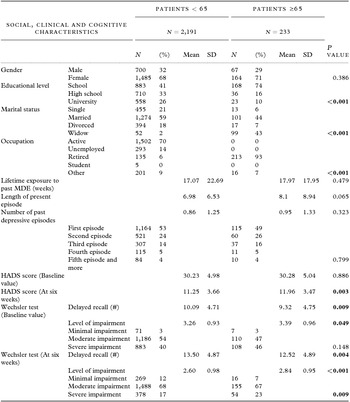
When limiting the analyses to the 2,424 patients with treatment response (Table 1), we observed at week six that the group of 233 older patients with clinical response were able to recall 12.5 items on average, whereas the 2,191 younger responders gave on average one more correct answer, this excess being significant (Table 1). A significant difference was also found using the level of memory impairment with the Russel's scale at week six. Indeed, there were more young patients without memory impairment, rather equivalent in age groups for mild to moderate abnormalities, but older patients had more frequently moderate to severe impairments (Table 1).
Clinical and cognitive specificities of 2,424 depressed outpatients with clinical response after six weeks of treatment, according to age group

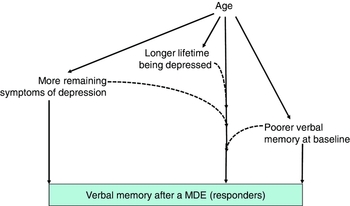
There was no significant difference between younger and older patients regarding the cumulative lifetime exposure of past depressive episodes (t = 0.71, df = 2,422, p > 0.400) (Table 1). These results tend to rule out the influence of lifetime exposure to depressive episodes on memory impairment, one of the three potentially confounding factors previously listed (Figure 1). On the other hand, older patients with treatment response had a lower baseline level of delayed memory recall (t = 2.35, df = 2,422, p < 0.010). This difference in delayed memory baseline level came without significant difference in level of depression severity at baseline, but with higher depressive score at the second visit (t = 2.95, df = 2,422, p < 0.010) (Table 1). The (1) level of baseline delayed memory recall and (2) residual symptoms of depression could therefore be considered as potential confusing factors (between age and verbal memory performance after treatment response, Figure 1), as they were both directly correlated with verbal memory performance at week 6 (r = 0.682, df = 2,326, p < 0.001; r = −0.151, df = 2,360, p < 0.001, respectively).
After six weeks of treatment, younger and older responders probably have different level of verbal memory capacities, but different intermediate factors could be involved. Indeed, more remaining depressive symptoms, poorer level of verbal memory at baseline, and longer lifetime being depressed may distinguish these two samples, and also explain the level of verbal memory after treatment response. This conceptual model describes how we tested if controlling for verbal memory at baseline, for the cumulative time being depressed and for remaining symptoms is abolishing, or not, the relationship between age and verbal memory performance after treatment response. The results demonstrate that (see results section), in treatment responders, age is not (independently) a risk factor for poorer memory performance, but rather that more remaining depressive symptoms and poorer baseline memory performance are the intermediate factors explaining the apparent association between age and poorer delayed memory.

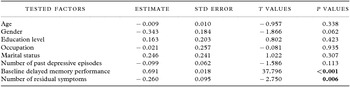
In order to assess which factors were associated with the observed lower delayed memory performance in patients older than 65 years after treatment response, we performed a multiple linear regression analysis, including gender, education level, marital status, occupation, number of past depressive episodes, baseline delayed memory performance, and presence of residual symptoms of depression. With such multivariate approach, delayed memory performance at week six was highly associated with baseline delayed memory performance and the presence of residual depressive symptoms only (Table 2). Being over 65 years of age was no longer a factor of lower delayed memory performance in treatment responders neither were the other factors (p > 0.062) (Table 2). These results were stable when introducing age as a categorical variable (using other breaks such as at 45 (p = 0.136) and 75 years old (p = 0.630)), or as a continuous variable (p = 0.204).
Linear regression analysis analyzing the factors associated with delayed memory performance after antidepressant response

Discussion
Studying a large sample of depressed outpatients after six weeks of treatment, older patients had less frequently treatment response and poorer delayed memory performance (Table 1). When limiting the analyses to patients with treatment response, age was still associated with poorer verbal memory. We therefore tested the role of three factors potentially acting as intermediate traits between age and verbal memory capacities after remission (Figure 1). A direct role of longer lifetime exposure to past depressive episodes to explain poorer verbal declarative memory could be ruled out (Table 2). On the other hand, lower baseline level of verbal declarative memory and more remaining symptoms of depression seemed to be the major confounding factors, as no significant difference persisted between young and old age responders after being controlled for through a multivariate approach (Table 2).
Depressive episodes are theoretically more soliciting of hippocampal activity (Gorwood et al., Reference Gorwood, Corruble, Falissard and Goodwin2008), and may be consequently toxic to its related cognitive functions. It may have a similar impact on both age groups, provided that they respond after six weeks of antidepressant treatment. Accordingly, the present study supports the idea that antidepressants may present neuroprotective effects on hippocampal function (Banasr and Duman, Reference Banasr and Duman2007), and further proposes that such observation may not be age-dependent.
In the literature, memory deficits may remain even after recovery from a depressive episode (Paradiso et al., Reference Paradiso, Lamberty, Garvey and Robinson1997), but patients with early-life MDE improved their memory function up to the level of healthy controls after long-term remission in longitudinal studies (Halvorsen et al., Reference Halvorsen, Waterloo, Sundet, Eisemann and Wang2011). However, in older patients, memory impairment remained in clinically recovered patients aged over 60 (Butters et al., Reference Butters2000), even after six months (O’Brien et al., Reference O’Brien, Lloyd, McKeith, Gholkar and Ferrier2004) and after three years of follow-up (Maeshima et al., Reference Maeshima2012). These data could be interpreted as contradictory with our results. But as we might have disentangled the role of age and depression in memory impairment, we propose that the decreased chances of recovering memory functions following a depressive episode in older patients should be considered as an additive, and not multiplicative, effect of age and depression. In other words, the memory impairment induced by a depressive episode seems to be rather equivalent for different age groups, providing that treatment response is obtained. Furthermore, age may be by itself a major factor explaining the difference in memory impairment at baseline.
In clinical practice, these factors are difficult to distinguish. A poorer response to treatment may have an important impact on motivation, attention span and many other cognitive functions, which may interfere with the assessment of delayed memory recall. As clinical remission frequently takes longer to settle in older patients (Gorwood et al., Reference Gorwood, Weiller, Lemming and Katona2007), residual symptoms of depression may constitute an important source of bias. Knowing that smaller hippocampal volumes seem to predict slower response to treatment, as suggested by a recent large study of patients aged over 60 years (Sheline et al., Reference Sheline2012), we suppose multiple factors have to be taken into account. In this line, future studies should examine more specifically the role of immediate recall and employ more detailed assessment of attentional aspects (such as concentration and motivation).
Furthermore, the present study may present some limits. First of all, a recruitment bias is difficult to rule out. For instance, depressed patients with higher risk of dementia, or other severe memory impairment, may ask less frequently for care, and therefore may be underrepresented in this cohort study. Furthermore, dementia, stroke, other neurological disorders, brain trauma, past history of electroconvulsive therapy (ECT), substance use disorder and anxiety disorders were not excluded at baseline, although they have an impact on memory abilities. Nevertheless, the study design was based on a network of general practitioners who assessed their own patients, increasing the chance to select a representative sample of the population. The relative importance of very old patients in our sample pleads in favor of a reasonable representativeness. A potential bias is also related to the subsample of patients that we selected. They were all responders to treatment (in order to increase the accuracy of the cognitive tests’ values), although the rate of treatment response was not comparable in both groups according to age (21% for older and 31% for younger patients). It is therefore important to remind that our results are limited to patients who obtained treatment response.
Another limit to this study may be that stroke or other somatic diseases occur more frequently in the elderly. However, excluding the subgroup of patients with “severe” impairment in the analyses did not significantly change the results (see Gorwood et al., Reference Gorwood, Corruble, Falissard and Goodwin2008).
Focusing on the Wechsler paragraph test only may likewise bear on the results obtained, since many cognitive functions are impaired in depressed patients (Lim et al., Reference Lim2013), even when treatment response is observed (Gorwood et al., 2014). Indeed, good delayed memory abilities probably require conserved concentration, motivation and attentional processes, beyond immediate memory skills. Further studies should explore the immediate recall and use attention and executive tasks to further characterize the impact of a depressive episode on working memory in the elderly; However, O’Brien et al. (Reference O’Brien, Lloyd, McKeith, Gholkar and Ferrier2004) indicated that memory impairment at recovery from late-onset depression was associated with reduced hippocampal volume. Testing ten brain regions of interest, Sheline et al. (Reference Sheline2012) also reported that only hippocampal and amygdala volumes predicted treatment response over and above baseline depression severity. Another study performed by Arnone et al. (Reference Arnone, McKie and Elliott2013) testing 32 patients before and after treatment response revealed that grey matter gain selectively in the hippocampus was correlated with improvement of depressive symptoms. Such positive treatment effects on the hippocampus, along with the reduction of symptoms, were also observed in ECT (Nordanskog et al., Reference Nordanskog, Dahlstrand, Larsson, Larsson, Knutsson and Johanson2010). Performing MRI would have been a more precise tool to assess hippocampal toxicity, but this technique is not easy to access in ordinary clinical practice.
A practice effect could also be present, modifying the relevancy of the second set of tests. But the Weschler paragraph was assessed in a subgroup of patients with identical levels of depression at both visits, and no significant difference of performance was observed (Gorwood et al., Reference Gorwood, Corruble, Falissard and Goodwin2008). We used a ten minutes delayed only (to facilitate the recruitment of a large sample), all guidelines when using the Weschler paragraph were therefore not completely followed. On the other hand, this type of assessment was sufficiently powerful to already demonstrate the role of past depressive episodes and remaining symptoms on delayed memory (Gorwood et al., Reference Gorwood, Corruble, Falissard and Goodwin2008), which are the only prerequisites of the present study focusing on the specific role of age. Furthermore, we did not use the corrections for age proposed in the guidelines for Russel's classifications, as it is problematic to control for a studied variable, namely age in the present study (analyzing if older patients were more damaged by a depressive episode).
We cannot generalize the present study to further analyze the role of major depressive episodes as a risk factor for dementia, considering that no specific neurological assessments were made. Moreover, a six weeks follow-up may not allow speculation on the evolution towards dementia in such patients. Nevertheless, this study suggests that older patients who suffered from a depressive episode have equivalent odds of recovering from their memory impairment than their younger counterparts, if treatment response is obtained. Thus, we may consider that hippocampal toxicity is independent of age in depressed patients with treatment response. A recent longitudinal study (LEILA 75+) on individuals aged 75 and over followed-up for eight years may reinforce this hypothesis. It points out that depressive symptoms are significantly correlated to increased incidence of dementia (Hazard ratio = 1.03, 95% CI (1.01–1.05)) in univariate analysis, but not after adjusting for age and baseline cognitive impairment (Luppa et al., Reference Luppa, Luck, Ritschel, Angermeyer, Villringer and Riedel-Heller2013). However, other studies should be carried out to further analyze the factors involved in the longer time needed for treatment response in older patients. Comparing memory impairment between the two age groups in responders or fully-remitted patients after several years of follow-up may give support to such hypothesis.
Conflict of interest
The sample was recruited with a support by a research grant from Servier, who had no involvement in the design, organization, analysis or preparation for publication of the study. The present analyses are the result of a one-year training of five junior psychiatrists, supervised by the last author, with the technical support of Lundbeck-France. During the last five years Philip Gorwood received, research grants from Eli Lilly and Servier, and fees for presentations at congresses or participation in scientific boards from AstraZeneca, Bristol-Myers-Squibb, Janssen, Lilly, Lundbeck, Otsuka, Roche and Servier. For the remaining authors none were declared.
Description of author's roles
The present analyses are the result of a one-year training of five junior psychiatrists, supervised by the last author (PG). Therefore, the design of the study and the supervision was made by the last author (PG), and all five co-authors were in charge of the data analyses, performed the statistics and wrote the paper.
Acknowledgments
We especially thank Doctor Cécile Durlach-Misteli for continuous interest and support.