Disaster health care workers are subject to a high risk of traumatization from repeated exposure to stressful situations. Reference McCabe, Marum and Mosley1 The prevalence of posttraumatic stress disorder (PTSD) in disaster survivors is estimated to be 7%‐12%, whereas the prevalence of PTSD in the disaster health care workers is estimated to be 10%. Reference Marsh and Cashwell2 In Korea, in particular, disaster health care workers often have a higher prevalence of mental health problems than the general population. According to a survey on the mental health of the total sample of firefighters in Korea, 39% of the firefighters suffered from mental health problems, with 11.4% of all respondents reporting PTSD symptoms, 33.1% reporting alcohol abuse, and 33.6% suffering from sleep disorders. 3 These figures indicate a relatively high prevalence of mental health problems in firefighters in Korea when compared with the prevalence of mental health problems in the general adult population (18 years and older) of 11.9%. Reference Hong, Lee and Ham4
In Korea, the evidence-based nationwide program to recover from disaster trauma and to prevent PTSD for disaster health care workers remains at a very low level. Reference Choi, Kim and Lee5 Programs such as education and counseling are provided at the institutions where individual health care workers belong, but systematic and integrated government-sponsored programs are lacking. Reference Lee, Sim and Han6 Little research exists on the effectiveness of the programs currently offered, and there is an increasing need to develop and provide programs that more fully reflect the needs of the workers themselves. To develop effective policies and programs to prevent disaster trauma and support disaster health care worker recovery, it is necessary to generate supporting data through additional studies on the mental health of disaster health care workers.
To contribute to the development of more effective disaster trauma recovery programs, this study considers how disaster health care workers actually experience disaster mental health. Developing effective psychological recovery programs for disaster health care workers requires an in-depth exploration of workers’ own experiences from an interdisciplinary perspective. Qualitative research methodologies are advantageous in that they are capable of examining a given phenomenon from the viewpoint of the participants themselves. Reference Lincoln and Guba7 Phenomenological research, a type of qualitative research method, promotes the collection of diverse and rich data by approaching phenomena from the perspective of the research participants themselves, thus enabling researchers to explore the essence of a phenomenon without prejudice. Reference Colaizzi, Valle and King8 ‐ Reference Englander10 Therefore, we set the research question for this study as, “What is the meaning and essence of disaster health care workers’ experience of disaster mental health?”
This study analyzes disaster health care workers’ experiences of disaster mental health using phenomenological research methods and provides evidence-based data for developing effective psychological recovery programs for disaster health care workers. By exploring the nature of worker experiences, this study provides initial data that can be used to tailor disaster trauma recovery programs to address the actual needs of the workers.
METHODS
Participants
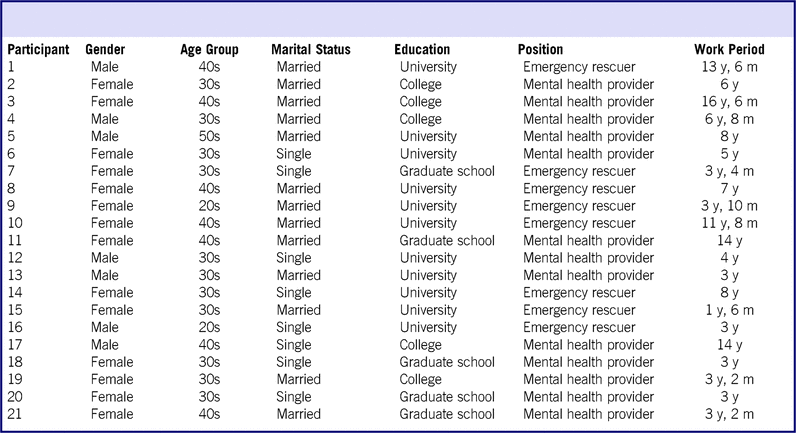
A total of 21 participants were recruited from firehouses, community mental health service centers, and disaster trauma centers in Korea. All participants were emergency rescuers or mental health providers experienced in providing disaster mental health services. The participants worked as disaster workers in a variety of disasters, including experienced fires, flooding, ferry accidents, or incidences of foot-and-mouth disease (Table 1).
Participant Characteristics

Notes: y = year, m = month.
Data Collection
Data were collected via in-depth interviews by a research assistant trained in qualitative research and experienced in working with psychiatric and mental health practitioners. The interviews started with the question, “Could you tell me what your experience of disaster mental health is?” Each interview took approximately 90 minutes and was recorded using a digital recorder. After the interview, the recorded contents were transcribed verbatim. During the interview, facial expressions or unconscious behaviors of the participants were carefully observed and written in the field notes for subsequent analysis.
Data Analysis
We used Colaizzi’s phenomenological research methodology to comprehensively understand the experiences of disaster health care workers in disaster mental health. Reference Colaizzi, Valle and King8 This analytic process centers around describing the essential structure of a common experience in a focused way by grouping common attributes found in participant statements. To ensure the quality of the data collected, this study was conducted in light of quality criteria for qualitative research established by Lincoln and Guba. Reference Lincoln and Guba7 These criteria focus on ensuring the credibility, transferability, dependability, and confirmability of research findings. Reference Lincoln and Guba7 The themes, theme clusters, and theme categories constructed during data analysis were verified by 2 participants to ensure that the interpretations of interview data reflected their experiences, thereby confirming the “credibility” of the results. To ensure “transferability,” the results were reviewed by 2 nursing faculties with regard to their applicability to other disaster mental health workers. Finally, the process of data collection, analysis, and the results of this study were evaluated for consistency and neutrality by 2 experienced qualitative researchers to determine the “dependability” and “confirmability” of the results.
Ethical Considerations
This study was approved by the Institutional Review Board of the Chung-Ang University in Korea. Participants voluntarily signed a written consent form after receiving an explanation of the study’s purposes and procedures. They understood that they could withdraw from the study at any time without any penalty. During the interview, participants monitored any uncomfortable feelings from their experiences with psychological first-aid (PFA) such as feelings of anger, sadness, or guilt. Participants were also given information regarding further mental health support if they experienced any negative feelings after the interview. Participant data were kept confidential and disposed of upon completion of the study.
RESULTS
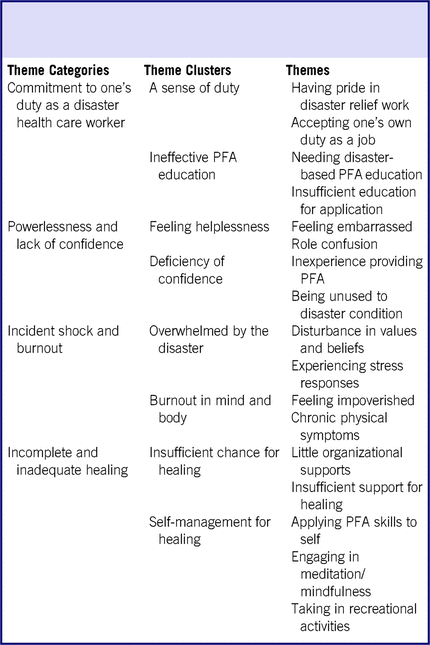
The disaster health care workers’ experiences of disaster mental health can be categorized into 17 themes, 8 theme clusters, and 4 theme categories (Table 2).
Analysis of the Disaster Health Care Workers’ PFA Experiences

Theme Category 1: Commitment to One’s Duty as a Disaster Health Care Worker
Participants in this study expressed pride in their disaster relief works and considered their duty as a kind of destiny that required determination and responsibility to fulfill. They also indicated that they were ready to take part in the education and training required to perform their duties. Participants felt that effective PFA training that can be used in disaster situations, specifically, was needed.
It is vulnerable to the dangers of disaster relief, but I do not think it stops my duty. (Participant 7)
Disaster health care work is difficult without a sense of duty. Of course, I think it’s something I should do. (Participant 8)
Theme Category 2: Powerlessness and Lack of Confidence
The relief workers reported complicated feelings of confusion and anxiety when they were placed in a disaster scene and worried about how to intervene when they met with disaster survivors. All of the participants in this study expressed a lack of confidence when providing PFA at a disaster scene:
Well, the first thing I thought was embarrassment. I should tell them something when I meet them. But I am a little uneasy about providing PFA. (Participant 12)
I was worried about what to do, and I was not sure what role I could play. And I was worried that I was making the disaster survivors rather uncomfortable. (Participant 3)
Theme Category 3: Incident Shock and Burnout
Participants in this study reported encountering fundamental questions about human dignity and emotional responses as they faced the terrible situation of the disaster area beyond their experience. Many experienced negative psychological states after returning from the disaster scene, with emotional numbness, fatigue, and other negative states further complicating the difficulties of daily life.
Human beings are very dignified, but I was disturbed by the fact that there was no difference between human bodies and the meat of animals in the disaster relief scene. (Participant 8)
I feel my emotions become numb even in disaster situations. I eat dinner as usual immediately after dealing with the damaged body of the deceased from a devastating accident scene. (Participant 7)
There is no time to rest and fatigue is piled up too much. I do not have the time to relax and I cannot afford it. My body is always tired and exhausted. (Participant 10)
Theme Category 4: Incomplete and Inadequate Healing
Participants noted their attempts to apply as much knowledge and resources as possible to ameliorate the exhaustion resulting from relief activities. They reported feeling that their mental health is relieved to some extent by these attempts but feel that existing programs are limited in their effective management of their trauma symptoms.
I think the trauma healing programs at the fire department are not helpful and the counseling to firefighters in a one-sided manner is rather stressful. (Participant 7)
I could not apply to the psychological healing program at any time because I have too many tasks to take the program. (Participant 8)
After the relief work, I surf as a pastime to recover my mental health. I want to forget stressful events of the relief work, and I feel like I feel better. (Participant 15).
DISCUSSION
In this study, disaster health care workers were found to experience lack of confidence, role confusion, and helplessness when providing PFA to survivors at disaster sites. These results are in line with previous studies that have found that disaster health care workers experience difficulties such as the burden of disaster dispatch, confusion, loss of realism, communication difficulties with clients, and countertransference from the clients. Reference Lee and Shin11 Simulated education is increasingly recommended as an educational strategy and method of improving patient safety. Therefore, it is recommended to develop systematic simulated education using new technologies for increased fidelity and apply them to the education of disaster health care workers to increase their confidence in providing PFA.
Participants in this study reported acute stress symptoms resulting from witnessing the devastating injuries and deaths of disaster victims or their colleagues. These results are similar to the analysis of the psychological state of disaster health care workers in the disaster situation. Reference Marsh and Cashwell2 In addition, participants of this study were found to experience chronic stress and exhaustion from being repeatedly deployed to disaster sites without opportunities for sufficient mental health recovery such as appropriate rest or professional treatment. In light of these results, it is necessary to develop policies and evidence-based disaster mental health recovery programs for Korean systems and cultures at a nationwide level to support disaster health care workers.
It is important to note that the generalizability of this study’s findings is limited by the convenience sampling method used to recruit participants. Replication of this study with other populations is needed to assess the generalizability of this study’s results. Nonetheless, this study suggests development of culturally sensitive disaster mental health programs that can improve the confidence of disaster health care workers, as well as support them in their mental health recovery following disaster relief activities.
CONCLUSIONS
This study explored Korean disaster health care workers’ experiences of disaster mental health via a phenomenological approach. Interview data suggest that workers experience a lack of confidence in their PFA duties and need mental health recovery programs after deployment to a disaster site. To prevent mental health problems and support the psychological health of disaster health care workers, it is necessary to develop effective mental health recovery policies and programs, such as providing PFA education.
Conflict of Interest Statement
The author has no conflict of interest to declare.
Funding Statement
This research was supported by the National Research Foundation of Korea (NRF); grant was funded by the Korean Government (MSIP) (No. NRF-2017R1A2B4004438).