Guided self-help therapy, broadly defined as a standardised psychological treatment through which individuals work more or less independently (Cuijpers & Schuurmans, Reference Cuijpers and Schuurmans2007), has the potential to address most barriers limiting access to care. Guided self-help is affordable, convenient, and requires limited professional resources. Reviews and meta-analyses support the efficacy of CBT guided self-help (CBTgsh) for the treatment of anxiety and mood disorders compared to control conditions (e.g., Andrews, Cuijpers, Craske, McEvoy, & Titov, Reference Andrews, Cuijpers, Craske, McEvoy and Titov2010; Coull & Morris, Reference Coull and Morris2011; Foroushani, Schneider, & Assareh, Reference Foroushani, Schneider and Assareh2011; Hirai & Clum, Reference Hirai and Clum2006; Lewis, Pearce, & Bisson, Reference Lewis, Pearce and Bisson2012; Newman, Szkodny, Llera, & Preworski, Reference Newman, Szkodny, Llera and Przeworski2011; Scogin, Bynum, Stephens, & Calhoon, Reference Scogin, Bynum, Stephens and Calhoon1990; van't Hof, Cuijpers, & Stein, Reference van't Hof, Cuijpers and Stein2009). Treatment guidelines issued by the National Institute for Health and Clinical Excellence (NICE) are also already recommending the use of CBTgsh for mild to moderate levels of depression, panic disorder, and generalised anxiety disorder as part of a stepped care model of treatment delivery (e.g., NICE, 2011)
A few meta-analyses have so far directly compared CBTgsh with CBTta (Andrews et al., Reference Andrews, Cuijpers, Craske, McEvoy and Titov2010; Cuijpers, Donker, van Straten, Li, & Andersson, Reference Cuijpers, Donker, van Straten, Li and Andersson2010; Hirai & Clum, Reference Hirai and Clum2006; Lewis et al., Reference Lewis, Pearce and Bisson2012). No significant differences were found between the two treatment modalities in any of these meta-analyses, with one meta-analysis providing sufficient statistical power to detect small differences (Cuijpers et al., Reference Cuijpers, Donker, van Straten, Li and Andersson2010). Gains were also maintained at follow-up (Cuijpers et al., Reference Cuijpers, Donker, van Straten, Li and Andersson2010; Hirai & Clum, Reference Hirai and Clum2006). All but one meta-analysis (Hirai & Clum, Reference Hirai and Clum2006) required that most or all participants demonstrate levels of symptomatology meeting diagnostic criteria for study inclusion. Levels of severity and chronicity among samples were found to be representative of individuals in clinical settings (Andrews et al., Reference Andrews, Cuijpers, Craske, McEvoy and Titov2010). Dropout rates did not differ significantly (Cuijpers et al., Reference Cuijpers, Donker, van Straten, Li and Andersson2010; Hirai & Clum, Reference Hirai and Clum2006; Lewis et al., Reference Lewis, Pearce and Bisson2012).
These meta-analytic findings are encouraging, but a number of limitations are present. A relatively small number of individual studies comparing CBTgsh to CBTta were included in most meta-analyses, as few such studies had been conducted until recently (≤ nine studies; Andrews et al., Reference Andrews, Cuijpers, Craske, McEvoy and Titov2010; Hirai & Clum, Reference Hirai and Clum2006; Lewis et al., Reference Lewis, Pearce and Bisson2012). The specific amount of therapist contact provided in both CBTgsh and CBTta was not reported. Andrews et al. indicated that CBTgsh reduced therapist time by 35% to 70% compared to CBTta; Lewis et al. (Reference Lewis, Pearce and Bisson2012) mentioned that the amount of guidance ranged from 3 to 7 hours in CBTgsh, but the amount of therapist contact in CBTta was not specified. Cuijpers et al. (Reference Cuijpers, Donker, van Straten, Li and Andersson2010) relied on three criteria of quality control over the implementation of CBTta (i.e., use of a manual, therapy-specific training, and integrity checks). However, individual studies only had to meet two of these criteria to be included in the meta-analysis, which was the case for a number of them. Fewer criteria of treatment quality control were used in the other meta-analyses. The duration of CBTgsh and CBTta was either unspecified or varied in terms of the number of treatment sessions (Cuijpers et al., Reference Cuijpers, Donker, van Straten, Li and Andersson2010).
In consideration of these limitations, CBTgsh's efficacy compared to gold standard CBTta for the treatment of anxiety and depression remains to be reviewed. Furthermore, limited information is available on any unique clinical benefits that CBTgsh may have over CBTta or on the use of CBTgsh as a supplement to CBTta for more chronic or severe disorders. The current article addresses each of these areas while highlighting potential benefits of CBTgsh over CBTta alone. Individual studies directly comparing CBTgsh to gold standard CBTta for anxiety and depression are reviewed. The field of eating disorders is used to illustrate how the scope of CBTgsh may gain to be widened to other disorders and levels of psychopathology, as a growing number of self-help studies are available in this field. Based on these findings and recent conceptualisations of personality pathology, CBTgsh's methods of delivery are extended to personality pathology, for which limited treatment options are available.
Method
A literature search was conducted by consulting the computer databases PsycInfo, PsycArticles, and PubMED and references from retrieved articles. This search aimed to identify individual studies and meta-analyses directly comparing CBTgsh and CBTta for mood, anxiety, and eating disorders. It also aimed to identify individual studies in which CBTgsh was used in novel ways to treat eating disorders or personality pathology. English-language articles published since 1990 were considered. Search terms included, but were not limited to, self-help therapy and internet-based CBT combined with anxiety, depression, eating disorders, and personality. Samples were limited to participants aged 18 and older. Therapies were restricted to the ones based on CBT principles, as these represent the largest body of research on guided self-help. Gold standard CBTta was defined as based on an empirically supported treatment manual (Woody & Sanderson, Reference Woody and Sanderson1998; Harwood & L'Abate, Reference Harwood and L'Abate2010) or a manual including the recommended components of a psychological treatment that has received strong research support (APA Presidential Task Force on Evidence-Based Practice, 2006) and a protocol of at least 12-week duration.
CBTgsh Compared With Gold Standard CBTta: Treatment of Anxiety Disorders and Depression
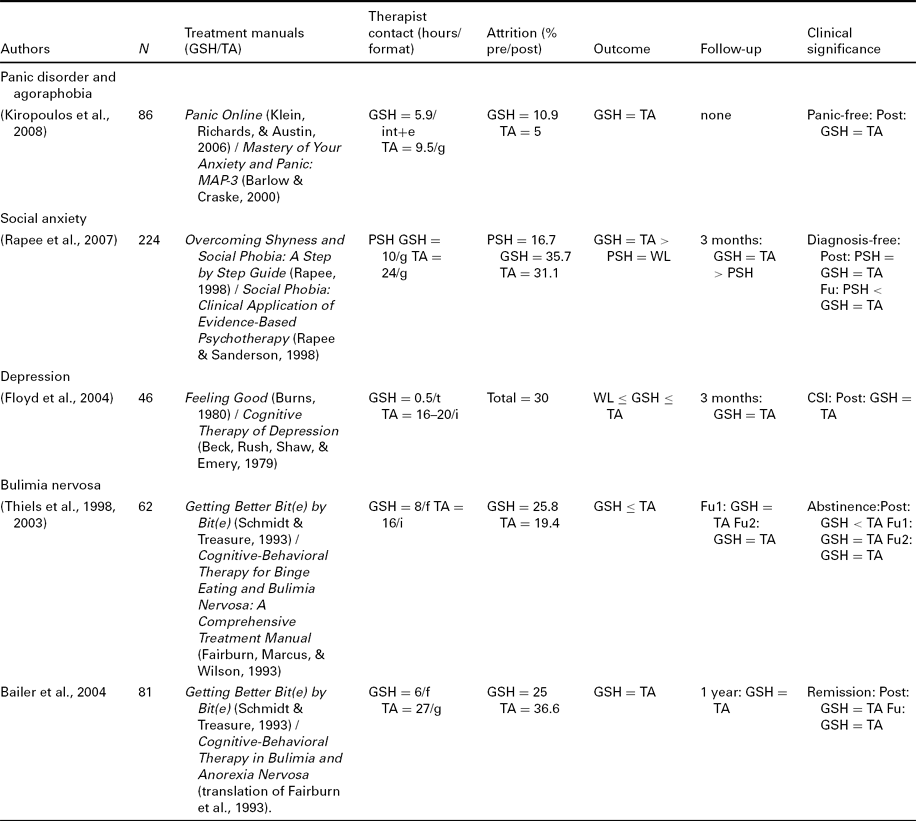
Individual randomised controlled trials directly comparing CBTgsh to gold standard CBTta were reviewed, with particular attention paid to the assessment of treatment quality, attrition rates, the clinical significance of treatment outcomes, and the maintenance of gains. Three randomised controlled trials have so far directly compared CBTgsh to gold standard CBTta for the treatment of anxiety and mood disorders (Floyd, Scogin, McKendree-Smith, Floyd, & Rokke, Reference Floyd, Scogin, McKendree-Smith, Floyd and Rokke2004; Kiropoulos et al., Reference Kiropoulos, Klein, Austin, Gilson, Pier, Mitchell and Ciechomski2008; Rapee, Abbott, Baillie, & Gaston, Reference Rapee, Abbott, Baillie and Gaston2007). Two of these studies (Floyd et al., Reference Floyd, Scogin, McKendree-Smith, Floyd and Rokke2004; Kiropolous et al., Reference Kiropoulos, Klein, Austin, Gilson, Pier, Mitchell and Ciechomski2008) were included in the previous meta-analysis but were analysed in combination with other studies of a less optimal quality (Cuijpers et al., Reference Cuijpers, Donker, van Straten, Li and Andersson2010). Table 1 provides a description of the reviewed studies, including the evidence-based manuals that were used.
Selected Characteristics of Studies Comparing CBTgsh to Gold Standard CBTta

Note: GSH = guided self-help CBT; TA = therapist-administered CBT; PSH = pure self-help CBT; f = face-to-face; g = group; i = individual; int = internet-delivered program; t = telephone contact; e = email; Fu1 = follow-up at 43 weeks; Fu2 = follow-up at 4 years; CSI = clinically significant improvement.
Kiropoulos et al. (Reference Kiropoulos, Klein, Austin, Gilson, Pier, Mitchell and Ciechomski2008) examined the effect of CBTgsh compared to gold standard CBTta for the treatment of panic disorder with or without agoraphobia. CBTgsh was based on a CBT internet-based program shown to be superior to a waitlist and was comprised of treatment methods used in standard CBT for panic disorder (Klein, Richards, & Austin, Reference Klein, Richards and Austin2006). CBTta consisted of 1-hour face-to-face weekly sessions using an evidence-based CBT program. Both interventions were offered over 12 weeks and covered similar material. Treatments were delivered by psychologists trained in CBT for panic disorder. In order to ensure treatment quality in CBTgsh, therapists recorded the sessions’ duration and any deviations from protocol. The assessment of treatment quality for CBTta was not reported. CBTgsh required just over half the amount of therapist's time per participant. Intention-to-treat analyses revealed no significant differences between the two treatment conditions. Both CBTgsh and CBTta led to significant decreases in self-reported and clinician rated panic severity ratings, self-reported panic attack frequency, panic related cognitions as well as anxious, depressive, and stress-related symptoms. A similar proportion of participants were panic-free and achieved high end state functioning, defined as one month of panic-free status plus a clinician severity rating of panic disorder ≤2 on the Panic Disorder Severity Scale (Shear et al., Reference Shear, Brown, Barlow, Money, Sholomskas, Woods and Papp1997). Quality of life significantly improved as well in both treatment conditions. Attrition did not differ significantly between groups nor did ratings of treatment credibility and satisfaction, which were elevated in both groups.
In a large treatment outcome study of social phobia, CBT pure self-help (CBTpsh), CBTgsh, and CBTta were compared to a waitlist (Rapee et al., Reference Rapee, Abbott, Baillie and Gaston2007). The two CBT guided self-help groups followed a CBT self-help manual containing similar strategies to those presented in CBTta delivered using an evidence-based treatment manual. All treatments were provided over a 12-week period. Both CBTgsh and CBTta were conducted by graduate psychology students. CBTgsh included five group sessions to assist and motivate participants in working through the self-help book. CBTta consisted of 10 weekly group sessions. Based on intention-to-treat analyses, CBTpsh showed limited efficacy compared to the waitlist. However, there were no significant differences in treatment outcomes between CBTgsh and group CBTta at post-treatment or at follow-up. Both interventions led to significant improvements, including large within-group effect sizes on a standardised composite measure of social anxiety symptoms. Diagnosis-free rates were equivalent in all three conditions at post-treatment but by follow-up were significantly higher in the CBTgsh and CBTta groups than the CBTpsh group. Overall, equivalent treatment outcomes were achieved in CBTgsh and CBTta. This is despite the fact that CBTgsh required half the amount of therapist contact. As well, these results were achieved despite elevated comorbidity rates, as 55.8% of the participants presented an avoidant personality disorder and 64.7% a secondary Axis I disorder. Similar attrition rates were found between groups.
The efficacy of CBTgsh compared to gold standard CBTta was also assessed for the treatment of major depression. Participants, aged 60 or over, were randomly assigned to 12 to 20 sessions of individual evidence-based CBTta with adaptations for older adults, a 4-week CBTgsh using a manual with content based on standard evidence-based CBT for depression, or delayed treatment after a 4-week waiting period (Floyd et al., Reference Floyd, Scogin, McKendree-Smith, Floyd and Rokke2004). Therapists were graduate psychology students trained to administer CBT. Therapist contact in CBTgsh involved brief weekly phone calls of 5 minutes or less to monitor treatment adherence, to answer questions about the book, and to assess for deteriorating mental health. Treatment quality in CBTta was assessed with a measure of treatment adherence, and all CBTta sessions were audiotaped and reviewed during weekly group supervision by a licenced psychologist experienced in delivering CBTta. Analyses of treatment outcomes for treatment completers revealed that CBTgsh and CBTta were both significantly superior to the waitlist, with large between-group effect sizes. Although CBTta produced a significant reduction in self-reported depressive symptoms compared to CBTgsh, no significant differences were found on clinician rated depression. CBTgsh, but not CBTta participants significantly improved on clinician rated depression from post-treatment to follow-up. Among the 31 treatment completers, 6 of 17 (35%) in the CBTgsh group showed a clinically significant improvement of their depressive symptoms compared to 8 of 14 (57%) in CBTta. The difference between treatments was not statistically significant. As found in the previous study, significant outcomes were obtained despite the substantial psychopathology of the sample. At pre-treatment, 70% (n = 32) of the participants were experiencing recurrent or chronic major depression, and 17% (n = 8) of participants had a previous psychiatric hospital admission. Attrition rates did not differ significantly between the active treatment groups. Although analyses were conducted among study completers only, no significant differences on demographic or pre-treatment variables were found between treatment completers and dropouts. Based on the measure of treatment adherence, treatment quality was not optimal, but as reported by the authors, depression outcomes were comparable to the ones reported in other studies on the treatment of depression among older adults.
In sum, preliminary results based on available studies that have directly compared CBTgsh to gold standard CBTta converge to suggest that CBTgsh can produce treatment outcomes similar to gold standard CBTta. Gains in these studies were reported on a number of measures, were both statistically and clinically significant and were maintained over a period of up to 3 months. Two of the three studies used intention-to-treat analyses, providing a more stringent test of treatment effects (Kiropoulos et al., Reference Kiropoulos, Klein, Austin, Gilson, Pier, Mitchell and Ciechomski2008; Rapee et al., Reference Rapee, Abbott, Baillie and Gaston2007). Despite the fact that the majority of participants were self-referred, clinical levels of depression and anxiety were reported (Floyd et al., Reference Floyd, Scogin, McKendree-Smith, Floyd and Rokke2004; Kiropoulos et al., Reference Kiropoulos, Klein, Austin, Gilson, Pier, Mitchell and Ciechomski2008; Rapee et al., Reference Rapee, Abbott, Baillie and Gaston2007). Structured diagnostic interviews were conducted in all three studies and one included a number of treatment quality checks (Floyd et al., Reference Floyd, Scogin, McKendree-Smith, Floyd and Rokke2004). Participants were required to be on a stable dose of medication during the study period. As well, the studies controlled for additional psychotherapy-seeking. Compared to CBTta, CBTgsh was found in one study to be less effective than CBTta at post-treatment but was equally effective by follow-up. The interpretation of this improvement is limited by drop-outs occurring between post-treatment and follow-up as well as by the absence of control for additional treatment-seeking in the follow-up period (Floyd et al., Reference Floyd, Scogin, McKendree-Smith, Floyd and Rokke2004). However, it remains possible that the limited therapist contact provided in CBTgsh contributed to increasing self-efficacy toward change, leading to continued improvement over time (Menchola, Arkowitz, & Burke, Reference Menchola, Arkowitz and Burke2007). CBTgsh may thus have unique benefits over CBTta.
Widening the Scope of CBTgsh: Eating Disorders
Beside anxiety and mood disorders, eating disorders represent another field showing an increased interest in the use of CBTgsh. Treatment guidelines already recommend CBTgsh for bulimia nervosa (NICE, 2004), and recent literature reviews support its use for bulimia nervosa and binge eating disorders (Perkins, Williams, Schmidt, & Williams, Reference Perkins, Williams, Schmidt and Williams2009; Wilson & Zandberg, Reference Wilson and Zandberg2012). Two individual studies have so far directly compared CBTgsh to gold standard CBTta, both for bulimia nervosa, and are reviewed in the following (Bailer et al., Reference Bailer, de Zwaan, Leisch, Strnad, Lennkh-Wolfsberg, El-Giamal and Kasper2004; Thiels, Schmidt, Treasure, Garthe, & Troop, Reference Thiels, Schmidt, Treasure, Garthe and Troop1998; see Table 1). Contrary to the previous studies on anxiety and depression, participants were predominantly recruited through medical and mental health referral sources, with treatment delivered in naturalistic settings.
In a first study, CBTgsh included 8 bi-weekly face-to-face sessions and was compared to 16 weekly individual face-to-face CBTta sessions among women with a diagnosis of bulimia nervosa (Thiels et al., Reference Thiels, Schmidt, Treasure, Garthe and Troop1998). CBTta was delivered using an evidence-based manual, while CBTgsh followed a self-help book with similar content. Therapists, including two psychologists, were trained in each intervention offered. Using intention-to-treat analyses, similar and significant improvements in both CBTgsh and CBTta were found on a number of outcome measures; including overeating, vomiting, dietary restraint as well as shape and weight concern. At post-treatment, the 1-week abstinence rate from binging and vomiting was significantly lower in the CBTgsh group than in the CBTta group. By the first follow-up at 43 weeks, an analysis of follow-up completers showed that abstinence rates improved considerably in CBTgsh and no longer differed significantly from CBTta. These rates were maintained in both CBTgsh and CBTta at an additional follow-up 4 years later (Thiels, Schmidt, Treasure, & Garthe, Reference Thiels, Schmidt, Treasure and Garthe2003). Attrition rates did not differ significantly between groups.
In a subsequent study, CBTgsh was comprised of 18 × 20-minute group sessions using the same self-help book as in the previous study (Bailer et al., Reference Bailer, de Zwaan, Leisch, Strnad, Lennkh-Wolfsberg, El-Giamal and Kasper2004). CBTta followed an evidence-based manual and was delivered over 18 weekly group sessions. Experienced therapists provided CBTta, while residents in psychiatry conducted CBTgsh. Both therapists and residents received training to deliver their respective interventions. No specific procedures were used to monitor treatment quality. No significant difference was found between CBTgsh and CBTta. Both treatments produced significant improvements in self-reported binging and vomiting frequency and eating disorder-related psychopathology, including depression. Gains were maintained at a 1-year follow-up. Intention-to-treat analyses revealed that rates of remission, defined as no longer meeting diagnostic criteria for bulimia nervosa, did not differ significantly between groups at post-treatment or at follow-up.
Findings from these two studies further support previous results for the treatment of anxiety and depression, suggesting that CBTgsh can produce results comparable to gold standard CBTta. Two additional studies further indicate that for eating disorders of greater severity, CBTgsh may also be of value as a supplementary treatment offered prior to CBTta and may show unique benefits (Mitchell et al., Reference Mitchell, Agras, Crow, Halmi, Fairburn, Bryson and Kraemer2011; Fichter, Cebulla, Quadflieg, & Naab, Reference Fichter, Cebulla, Quadflieg and Naab2008). In one study, a multicentre randomised controlled trial was conducted among 293 participants diagnosed with bulimia nervosa, predominantly purging type (96%) (Mitchell et al., Reference Mitchell, Agras, Crow, Halmi, Fairburn, Bryson and Kraemer2011). The sample presented high rates of past psychological treatment (78.5%), past diagnosis of anorexia nervosa (27.0%), past psychiatric hospitalisation (24%), comorbid personality disorder (34.5%) and depression (23.5%). Recruitment took place through clinical referrals as well as media advertisements. Participants were randomised to one of two treatment algorithms. One algorithm began with 20 face-to-face sessions of CBTta provided over 18 weeks using an evidence-based manual. The other algorithm began with CBTgsh and included 8 × 20 minutes face-to-face sessions with a therapist. Sessions in CBTgsh aimed to assist participants in working through a self-help book developed to parallel the content of CBTta. Therapists who delivered CBTta were psychologists with experience administering CBT for bulimia nervosa. CBTgsh was provided by psychologists or clinical psychiatric nurses with limited training in CBT. Weekly supervision using audio recordings of sessions ensured the quality of treatment implementation in both CBTgsh and CBTta. After 6 weeks, participants in both algorithms who did not respond to their respective first-step interventions received fluoxetine. This medication was offered as lack of progress at this point in treatment predicts treatment failure (Agras et al., Reference Agras, Crow, Halmi, Mitchell, Wilson and Kraemer2000). Participants in the algorithm which began with CBTgsh subsequently received CBTta if they responded to neither CBTgsh nor fluoxetine.
Intention-to-treat analyses showed that 28-day abstinence rates from binging and vomiting did not differ significantly between the CBTgsh and CBTta algorithms at post-treatment (11% and 15%, respectively) or at follow-up (26% and 18%, respectively). As well, rates of remission from bulimia nervosa did not differ significantly between the CBTgsh and CBTta algorithms at post-treatment (52% and 57%, respectively) and follow-up (32% and 44%, respectively). Despite the equivalent treatment outcomes of the two algorithms in terms of abstinence rates and remission, the CBTgsh algorithm significantly outperformed the CBTta algorithm at follow-up in reducing binge episodes and compensatory behaviours (laxative and diuretic abuse, excessive exercise, and vomiting). In relation to secondary outcomes, the CBTgsh algorithm was also significantly more effective than the CBTta algorithm at follow-up in reducing depressive symptomatology and eating disorder rituals. Attrition rates were similar across treatment conditions. Furthermore, among the subgroup of participants identified as being at greatest risk of non-response to treatment, the CBTgsh algorithm resulted in significantly greater 28-day abstinence rates from binging and purging than the CBTta algorithm (25% vs. 4%) at post-treatment. The CBTgsh algorithm was also significantly superior to the CBTta algorithm on a number of secondary outcome measures both at post-treatment and follow-up.
In another study, 103 participants with diagnosed anorexia nervosa, binging/purging type, were randomised to either 6 weeks of CBTgsh or a waitlist prior to inpatient treatment (Fichter et al., Reference Fichter, Cebulla, Quadflieg and Naab2008). A self-help CBT manual was developed for the study to target anorexia nervosa, binging/purging type. CBTgsh involved 30-minute weekly structured phone contacts with a clinical psychologist. At post-treatment, participants in both groups did not differ significantly in body-mass index and self-rated general psychopathology. However, the CBTgsh group showed significantly more improvements on measures of slimness ideation, body image, bulimic symptoms, and overall psychopathology compared to participants on the waitlist. Attrition rates prior to hospitalis,ation were similar in both groups (23.5% in CBTgsh; 16.4% in the waiting list). In addition, CBTgsh reduced hospital stays significantly, by an average of 5.2 days, compared to waitlist participants who did not received CBTgsh prior to hospitalisation.
In sum, preliminary evidence obtained in outpatient settings suggests that CBTgsh can be as effective as gold standard CBTta for bulimia nervosa, with gains maintained for up to four years (Bailer et al., Reference Bailer, de Zwaan, Leisch, Strnad, Lennkh-Wolfsberg, El-Giamal and Kasper2004; Thiels et al., Reference Thiels, Schmidt, Treasure and Garthe2003). As reported for the treatment of depression (Floyd et al., Reference Floyd, Scogin, McKendree-Smith, Floyd and Rokke2004), participants in CBTgsh for bulimia continued to improve from post-treatment to the 43-week follow-up while participants in the CBTta condition maintained gains (Thiels et al., Reference Thiels, Schmidt, Treasure, Garthe and Troop1998). Innovative eating disorder studies further showed how CBTgsh can be effective among individuals struggling with more severe disorders linked to substantial comorbid and chronic mental health problems. Individuals identified as being at risk for non-response to treatment or presenting severe psychopathology such as anorexia showed better outcomes in a treatment model which included a CBTgsh component prior to standard CBTta or inpatient care. Beside potentially increasing self-efficacy, as suggested previously (Menchola et al., Reference Menchola, Arkowitz and Burke2007), the addition of CBTgsh may optimise client motivation and enable therapists, within CBTta, to make optimal use of time spent in-session by devoting that time to the most critical elements of their clients’ treatment (Campbell & Smith, Reference Campbell and Smith2003).
Widening the Scope of CBTgsh: Potential Application to Personality Pathology
The results reviewed so far for the treatment of mood and anxiety disorders as well as eating disorders suggest that CBTgsh may also be effective for the treatment of personality pathology. Prevalence rates of personality disorders have been reported as 50% and higher in community mental health care settings (Keown, Holloway, & Kuipers, Reference Keown, Holloway and Kuipers2002). Despite this prevalence, limited evidence-based treatment options are available. With the exception of Dialectic Behaviour Therapy (DBT), recognised as an evidence-based treatment for borderline personality disorder (Linehan et al., Reference Linehan, Comtois, Murray, Brown, Gallop, Heard and Lindenboim2006; Neacsiu, Risvi, & Linehan, Reference Neacsiu, Risvi and Linehan2010), few controlled studies have evaluated treatment outcomes for individuals with personality pathology. This is despite the fact that CBTta treatment protocols are available (e.g., Beck, Freeman, & Davis, Reference Beck, Freeman and Davis2004; Crits-Christoph & Barber, Reference Crits-Christoph, Barber, Nathan and Gorman2007) as well as CBT-based self-help programs and client workbooks (e.g., Linehan, Reference Linehan1993; Wood, Reference Wood2010; Young & Klosko, Reference Young and Klosko1993). In the following, different CBTgsh treatment delivery models are proposed based on the severity of the personality pathology.
For milder forms of personality pathology, a stepped care model, similar to the one recommended for the treatment of anxiety and mood disorders, may be of particular relevance. In such a model, CBTgsh would be offered as a first line treatment for broad patterns of interpersonal and personality functioning, personality-related skill deficiencies, or problematic personality traits when limited in number or severity. The treatment of perfectionism offers preliminary support for this model. The efficacy of CBTgsh and CBTpsh for perfectionism was assessed in an 8-week randomised trial among 49 participants who were recruited through the media and showed levels of perfectionism comparable to those found in clinical populations (Pleva & Wade, Reference Pleva and Wade2006). The self-help book, When Perfect Isn't Good Enough: Strategies for Coping with Perfectionism (Antony & Swinson, Reference Antony and Swinson1998) was used in both groups. The CBTgsh condition included eight weekly 50-minutes sessions with a therapist; participants in the CBTpsh condition received a booklet with weekly instructions for material completion and were contacted twice during therapy to assess adherence and address questions. Both treatments led to significant improvements in perfectionism, obsessive-compulsiveness, and depressive symptoms at post-treatment and at a 3-month follow-up, with greater outcomes and large effect sizes associated with CBTgsh than with CBTpsh.
These findings suggest that CBTgsh may be effective even when used alone as a first line intervention for specific personality traits. More specifically, for personality pathology of increasing levels of severity, the use of a layered treatment model may be particularly effective. Personality disorders have recently been conceptualised as hybrid constructs comprised of a mix of more stable trait-like criteria and less stable state-like criteria or more acute problems (e.g., McGlashan et al., Reference McGlashan, Grilo, Sanislo, Ralevski, Morey, Gunderson and Pagano2005; Zanarini, Frankenburg, Hennen, Reich, & Silk, Reference Zanarini, Frankenburg, Hennen, Reich and Silk2005). Recent evidence supports such a state-trait conceptualisation of personality disorders (for a review, see Skodol et al., Reference Skodol, Clark, Bender, Krueger, Morey, Verheul and Oldham2011). Namely, McGlashan et al. (Reference McGlashan, Grilo, Sanislo, Ralevski, Morey, Gunderson and Pagano2005) examined the prevalence and stability of DSM-IV personality disorder criteria in a 2-year study as part of a prospective trial on the longitudinal course of borderline, schizotypal, avoidant, and obsessive-compulsive personality disorders (Gunderson et al., Reference Gunderson, Shea, Skodol, McGlashan, Morey and Keller2000). Among these disorders, the most stable criteria were paranoid ideation and unusual experiences for schizotypal personality disorder, affective instability and anger for borderline personality disorder, feeling inadequate and socially inept for avoidant personality disorder, and rigidity and reluctance to delegate for obsessive- compulsive personality disorder. The less stable criteria were odd behaviour and constricted affect for schizotypal personality disorder, self-mutilating behaviour and behaviours aiming to avoid real or imagined abandonment for borderline personality disorder, avoiding occupations involving significant interpersonal contact and potentially embarrassing new activities for avoidant personality disorder, and miserly behaviours and inflexibility about matters of morality for obsessive-compulsive personality disorder. McGlashan et al. hypothesised that criteria that are more stable over time may reflect features of personality pathology that are similar to temperament and traits, while those that are less stable may be similar to symptoms or disorders that are learned and stress responsive.
Based on this state/trait conceptualisation, it has been recommended that treatment first address clients’ acute problems or clinical disorders and subsequently target more stable problematic traits (Skodol et al., Reference Skodol, Clark, Bender, Krueger, Morey, Verheul and Oldham2011). CBTgsh could then be provided as an initial, supplementary intervention to CBTta to address the more acute state-like criteria, while CBTta would subsequently target more stable personality traits. Offering CBTgsh as a supplementary intervention to CBTta may shorten CBTta's duration and, in light of findings from eating disorder studies, promote continued improvement over time compared to CBTta alone. For instance, among individuals with an avoidant personality disorder, CBTgsh would target avoidance behaviours, which are more state-related, while CBTta would address feelings of social ineptness and inadequacy, the most stable features or deep-rooted traits associated with this disorder. Several studies are in fact showing that CBTgsh produces significant treatment outcomes for the treatment of social anxiety despite high rates of avoidant personality disorders, therefore providing preliminary support for the use of CBTgsh to treat state-based aspects of personality pathology (Andersson et al., 2006; Berger, Hohl, & Caspar, Reference Berger, Hohl and Caspar2009; Berger et al., Reference Berger, Caspar, Richardson, Kneubühler, Sutter and Andersson2011; Rapee et al., Reference Rapee, Abbott, Baillie and Gaston2007).
Conclusion
The current article examined how CBTgsh compares to gold standard CBTta as a standalone treatment for anxiety and depression. The use of CBTgsh for other disorders and increasing levels of psychopathology was also explored. Preliminary evidence suggests that CBTgsh can achieve results comparable to gold-standard CBTta for the treatment of panic disorder, social phobia, and major depression. Available research in the field of eating disorders further supports these findings while also pointing toward the use of CBTgsh as a supplementary intervention to CBTta for psychopathology of increasing severity. These results challenge current stepped care models in which CBTgsh is offered as a first-line treatment for individuals with mild to moderate levels of psychopathology, whereas individuals with more severe problems receive more intense forms of treatment (e.g., CBTta). CBTgsh may be of help for a wide range of disorders of varying severity with its delivery format varying accordingly, even in the case of personality pathology as postulated in the current article. Furthermore, when provided as a supplementary intervention to CBTta, CBTgsh can improve both immediate and long-term treatment outcomes over CBTta or treatment as usual alone. CBTgsh may thus contribute to treatment in unique ways (Fichter et al., Reference Fichter, Cebulla, Quadflieg and Naab2008; Mitchell et al., Reference Mitchell, Agras, Crow, Halmi, Fairburn, Bryson and Kraemer2011), which is also supported by studies showing that CBTgsh can produce significant improvements from post-treatment to follow-up, while gains from CBTta remain stable (Floyd et al., Reference Floyd, Scogin, McKendree-Smith, Floyd and Rokke2004; Thiels et al., Reference Thiels, Schmidt, Treasure, Garthe and Troop1998).
In the individual studies comparing CBTgsh to gold standard CBTta, therapist contact varied considerably, ranging from 0.5 to 10 hours. Determining the optimal level of clinical guidance to be provided in CBTgsh has been identified as a research priority (Wilson & Zandberg, Reference Wilson and Zandberg2012). However, a number of studies suggest that guidance contact is not critical for CBTgsh to produce significant treatment outcomes. Non-guidance contact — for example, in the form of weekly telephone support or emails to offer encouragement and promote treatment adherence — can also lead to significant treatment outcomes (for a review, see Talbot, Reference Talbot2012). Gains achieved with self-help CBT using non-guidance contact have been found to be comparable to standard CBTta for social phobia and panic disorder, although available studies have not yet directly compared the two treatment modalities (Talbot, Reference Talbot2012). The study by Floyd et al. (Reference Floyd, Scogin, McKendree-Smith, Floyd and Rokke2004) offers some support for these findings, as CBTgsh was as effective as gold standard CBTta, despite total therapist contact amounting to less than an hour and contact not being of a clinical nature. Future studies need to directly compare different levels of contact, including non-guidance contact, to gold standard CBTta as well as to evidence-based pharmacotherapy. More attention also needs to be paid to the assessment of treatment quality.
Future studies also need to identify predictors of treatment response and treatment retention in CBTgsh. Determining the characteristics of participants who most benefit from this treatment modality would likely result in improved tailoring of treatment, including the tailoring of therapeutic goals, level of clinical guidance, and optimal sequence of stepped care. The equivalence of CBTgsh to gold standard CBTta for the treatment of anxiety and depression in primary care settings remains to be assessed as well. The reviewed studies predominantly included participants who were self-referred or interested in participating in self-help programs. Results obtained among participants with eating disorders are nevertheless encouraging, as both the recruitment and treatments were conducted in outpatient clinics.
Widening the scope of guided self-help has important implications for increasing access to evidence-based treatments, given the barriers posed by traditional treatment models. The present review suggests that CBTgsh can be a valuable treatment option either as a standalone or a supplementary treatment to evidence-based CBTta for varying disorders and levels of severity and may show unique benefits over traditional care. As such, CBTgsh may not only facilitate access to evidence-based treatment but also enhance currently available treatment options.