



No CrossRef data available.
Article contents
The Syntax of Ditransitives: Evidence from Clitics. By Elena Anagnostopoulou. (Studies in Generative Grammar, 54). Berlin-New York: Mouton de Gruyter, 2003. Pp. xiv, 379. Hardcover. $114.40.
Published online by Cambridge University Press: 30 March 2005
Abstract
An abstract is not available for this content. As you have access to this content, full HTML content is provided on this page. A PDF of this content is also available in through the ‘Save PDF’ action button.
Information
- Type
- REVIEWS
- Information
- Copyright
- © 2005 Society for Germanic Linguistics
“The fundamental challenge of comparative linguistics is to find a way of doing justice to both the similarities and the differences without contradiction, without empty compromise, and without sacrificing one truth to the other” (Baker 2001:16). It is my belief that Anagnostopoulou has managed to do this in her book in such a way that it can only be admired. The topic that Anagnostopoulou has chosen is—to put it mildly—rather complex, and as to complicate things even more, Anagnostopoulou uses the entire theoretical apparatus provided by the Minimalist Program (Chomsky 1995), including multiple specifiers, “tucking in”, equidistance, minimal domains, EPP, long-distance agree, etc. (In fact, Boeckx (2004) criticizes Anagnostopoulou's use of the whole range of theoretical apparatus.) Nevertheless, the book is very easy to read, and Anagnostopoulou's argumentation is easy to follow. For example, it is the rule rather than the exception that she uses examples from many different languages in support of each of her claims. In this way, a reader like myself who sometimes finds it difficult to decode and understand the Greek (as well as the Romance) data, can be reassured by the fact that Anagnostopoulou usually elaborates on her claims by showing the direction the Germanic languages (Dutch, English, German and Scandinavian) choose to go. These languages sometimes follow Greek and/or Romance, and sometimes they choose an altogether different direction.
Although the central focus of the book is on Greek clitic doubling and the Greek double object construction, in this review I am mainly concerned with Anagnostopoulou's analysis of the Germanic languages, and in particular, passivization and object shift in Scandinavian and constructions with oblique (or quirky) subjects in Icelandic. First, I summarize the main theoretical claims that Anagnostopoulou makes.
The book is divided into five chapters. In the first chapter, Anagnostopoulou briefly introduces the overall embracing claim of the book that a dative (the indirect object, henceforth IO) blocks movement of a lower nominative if “(i) the dative is higher than the base position of the nominative and (ii) not contained in the same domain as the nominative […]” (p. 4). Thus, the derivation in 1 (Anagnostopoulou's 2, p. 4) is ill-formed, whereas the derivation in 2 (Anagnostopoulou's 3, p. 5) is well-formed because “the features of the dative move out of the way of the lower nominative […] and thus the higher dative argument does not count anymore for locality.”

In the second chapter, Anagnostopoulou establishes the generalization reflected in 1 and 2 that in Greek a nominative DP may not move across a dative DP unless the dative DP is realized as a clitic or a part of a clitic doubling chain. Here too, the typology of ditransitives is investigated. Anagnostopoulou argues that two different types of double object constructions should be distinguished, based on where the IO is base-generated. According to Anagnostopoulou, an IO may either be base-generated high within the VP (only this construction qualifies as a true double object construction in Anagnostopoulou's system) or it may be base-generated low within the VP (in which case it shows the characteristics of a prepositional dative).
The crucial difference is, in Anagnostopoulou's view (following Marantz 1993), that in addition to the main verbal root only the former (the true double object construction) contains a light applicative head (see 3).
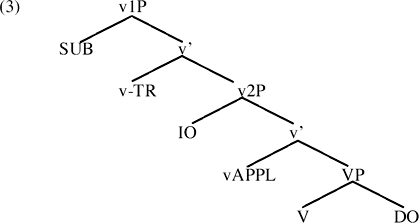
In some languages the light applicative head (vAPPL) may assign morphological case to the IO, while in other languages it may not. vAPPL is also responsible for the different types of object shift found in the Scandinavian languages. Norwegian and Swedish differ from Danish and Icelandic in that the former allow for non-parallel object shift (that is, the order of the IO and the direct object, henceforth DO, can be reversed), whereas the latter only allow for parallel object shift. According to Anagnostopoulou, this difference is due to the fact that in Norwegian and Swedish, but not in Danish and Icelandic, vAPPL allows for an additional specifier position into which the DO can move on its way to the target position of object shift (an outer specifier of vP).
The third chapter introduces the three “ingredients” that are needed for a locality-based account of ditransitives cross-linguistically; namely Case and the EPP, c-command, and minimal domains. In this chapter, Anagnostopoulou argues that equidistance (and not only closest c-command) plays a crucial role in the notion of locality. For example, A-movement of derived subjects across higher goals or experiencers is ruled out in the passive when the two arguments are not in the same minimal domain, but such movement is allowed whenever the two arguments are in the same minimal domain, that is, are equidistant from the target position.
In the fourth chapter, Anagnostopoulou shows how minimal link condition violations can be avoided if the dative DP is realized as a clitic, or if the dative DP is a part of a clitic doubling chain. In such constructions, movement is not ruled out because the cliticized or the clitic doubled argument is in the same minimal domain as the target of movement.
In the fifth chapter, Anagnostopoulou discusses φ-feature checking in environments where a dative DP enters into a Move/Agree relation with T/transitive v. In particular, Anagnostopoulou discusses two types of person restrictions: the PERSON-CASE CONSTRAINT (PC-Constraint) and the PERSON RESTRICTION ON NOMINATIVE OBJECTS (PRN-Constraint). The PC-Constraint is a restriction on clitics in Romance, Greek, Swiss German, Basque and many other languages (also known as the *me/lui or I-II constraint; see, for example, Perlmutter 1971, Kayne 1975, and Bonet 1991, 1994, among many others). Anagnostopoulou's Greek examples (p. 252, 342) are found in 4. (Note that 4d is incorrectly translated in the book as they will send you to him).

The PRN-Constraint is attested in Icelandic DAT-NOM constructions (that is, constructions where the subject is dative and the object is nominative), and in Italian impersonal si-constructions (compare D'Alessandro 2003). The PRN-Constraint prohibits agreement with nominative DPs in NOMINATIVE WITH INFINITIVE constructions (compare Sigurðsson 1989, 1996); that is, when the nominative DP is not in the same clause as the verb. The example in 5b shows that the verb can agree neither in person nor in number with the first person nominative DP. The example in 5a shows that such constructions are grammatical if the verb does not agree with the first person nominative DP.

The PRN-constraint also prohibits the occurrence of first and second person nominative objects. The example in 6 shows that nominative objects cannot be first person (the same holds for second person, but not for third person), even if the verb shows default agreement (compare Sigurðsson 1996 for a detailed discussion of the grammaticality of such examples; for me, they are ungrammatical).

Anagnostopoulou shows that although the PC-Constraint and the PRN-Constraint have many similarities, they differ in three crucial ways (p. 264). First, the PC-Constraint only holds if there is an external argument present, whereas the PRN-Constraint only holds if there is no external argument (Anagnostopoulou assumes that dative subjects are derived subjects, compare p. 275, tree 369).1
This assumption is rather appealing to me, as I think that it makes the correct predictions about the behavior of verbs in DAT-NOM constructions. For example, they cannot occur in the passive (as a consequence of one argument already having been promoted).
I turn now to what I think are the problematic aspects of Anagnostopoulou's analysis of passivization and object shift in Scandinavian and Icelandic DAT-NOM constructions. As mentioned, the PRN-Constraint does two fairly different things at the same time. First, the PRN-Constraint regulates the agreement relationship between a verb and a nominative DP, which is not an object but the subject of a small clause. Second, the PRN-Constraint prohibits the occurrence of first/second person nominative objects. In Hrafnbjargarson 2004, I show that the PRN-Constraint can be accounted for in terms of the harmonic alignment of prominence hierarchies (person, case, and grammatical relation). The advantage of such an analysis is that the PRN-Constraint will only prohibit the occurrence of first and second person pronouns as nominative objects, whereas other constraints will regulate the impoverished agreement relationship between the verb and the nominative DP in Nominative with Infinitive constructions.
Anagnostopoulou (p. 239ff.) also discusses the intervention effect of dative arguments in Icelandic. In DATIVE WITH INFINITIVE constructions, the matrix verb cannot show agreement with a nominative object in the lower clause. The example in 7 is Anagnostopoulou's example 327.

Anagnostopoulou (p. 240) also mentions that such intervention effects are not found in transitive expletive constructions where the associate of the expletive is a dative DP.

Following Chomsky 2000, 2001, Anagnostopoulou assumes that the dative DP enters into an Agree relation with T (the dative DP checks person on T) and that the nominative DP checks number on T. The intervention effect can thus be explained if one assumes that the dative does not enter into an Agree relation with T in 7. Unfortunately, the data that Anagnostopoulou presents do not show the whole picture. All her examples have plural dative arguments as the associate of an expletive, but as Holmberg and Hróarsdóttir (2003:1000) show it matters whether the intervening dative is plural or singular. When the intervening dative is singular, the verb cannot show agreement with the embedded nominative (9b), whereas if the intervening dative is plural such agreement is fine (10b).

From example 10b we cannot determine whether the verb shows agreement with the dative subject or the nominative object. However, we might conclude that the dative DP really can check number on T as well as person, and in fact there are some arguments that speak in favor of such an analysis. In my dialect, which is an obligatory agreement dialect (that is, verbs obligatorily show agreement with third person nominative objects), questions such as in 11, where the nominative element is plural and the dative subject may be interpreted as either singular or plural, have different interpretations depending on whether the verb shows default agreement or plural agreement.

In 11a, where the verb shows default agreement (third person singular), the subject is interpreted as singular. In 11b, where the verb shows number agreement, the subject is interpreted as plural.
As Anagnostopoulou discusses in detail, Icelandic ditransitive verbs fall into two classes. One class of verbs (gefa ‘give’, segja ‘tell’, sýna ‘show’, etc.) allows symmetric passives (that is, both the IO and the DO may raise to the subject position), while the other class of verbs (skila ‘return’, svipta ‘deprive’, ræna ‘rob’, etc.) only allows asymmetric passives (that is, only the IO may raise to the subject position). Following Falk 1990, Holmberg 1991, Holmberg and Platzack 1995, and Collins and Thráinsson 1996, Anagnostopoulou assumes that the verbs in the former class have a double base: one where the goal is base-generated above the theme (high in the VP, and thus a true double object construction), and another where the goal is base-generated below the theme (low in the VP, and thus corresponds to a PP-construction). As a result, with verbs like gefa ‘give’, both orders, IO > DO, and DO > IO are found. The latter word order is known as the INVERSION CONSTRUCTION. One of the characteristics of the inversion construction is that the IO must be focused or stressed, and therefore it cannot be object shifted. The examples in 12 are Anagnostopoulou's 161, originally from Collins and Thráinsson 1996:415. In 12b, I have added the negation to show the ungrammaticality of object shift.

Accordingly, these verbs have symmetric passives.

Verbs in the other class do not participate in the inversion construction, and therefore do not have the symmetric passive. Nevertheless, even though verbs in the former class all have the symmetric passive, not all of them seem to participate in the inversion construction. One of these verbs is lána ‘lend’. (Note that Anagnostopoulou, p. 199, example 171b, brings an example from Collins and Thráinsson 1996 that is parallel to 14c. My six informants and I do not share their grammaticality judgments.) The examples in 14 show that with lána ‘lend’, the IO must precede the DO even though the IO is stressed, as in 14c.

The examples in 15, however, show that the verb lána has a symmetric passive. In 15a, the dative goal, bóndanum ‘the farmer’, has raised to the subject position. In 15b the nominative theme, graðfolinn ‘the stud’, has raised to the subject position. It is necessary to embed the passive sentences in a question to avoid V2 effects, such as the possibility of topicalization. Note also that if 15b were derived from the inversion construction, the prediction would be that the dative goal should be focused or stressed. This is not the case in either 13b or 15b.

Apparently, in some respects the verb lána ‘lend’ behaves like verbs that do not allow the symmetric passive (because it does not occur in the inversion construction). However, in other respects it seems to behave like verbs that allow the symmetric passive (because both of its internal arguments may raise to the subject position). Since lána does not occur in the inversion construction, the derivation of 15b is problematic for Anagnostopoulou's analysis. As she argues (chapter 3, section 8.2.1), vAPPL does not allow for an additional specifier in Icelandic (this also explains why Icelandic does not have non-parallel object shift as found in Norwegian and Swedish). If vAPPL allowed for an additional specifier, the nominative argument and the dative argument would be in the same minimal domain and the nominative argument could move to the outer specifier of v without violating locality conditions on A-movement. After having moved to the outer specifier of v, the nominative argument could move on to T. Since vAPPL does not allow for an additional specifier in Icelandic, the movement of the nominative argument across the dative argument in constructions such as 15b violates the MLC.
Finally, let us turn to multiple specifiers and “tucking in”. I will not discuss the usual arguments against multiple specifiers; for example, that multiple specifiers pose a learnability problem as it can be difficult to figure out whether the structure is made of one projection with two specifiers or two projections with an empty head in the higher projection. Instead, I am concerned with the linear order of multiple specifiers.
Anagnostopoulou assumes (following many others) that the negation and sentence medial adverbs mark the left edge of vP in Scandinavian. Object shift is then movement into an outer specifier, above the negation. If both objects in a double object construction are object shifted, the DO “tucks in” between the IO and the negation (the tree in 16 is Anagnostopoulou's example 234, p. 155; I have added the negation). First, the IO moves to an outer specifier of v1P. Since the IO does not intervene anymore, the DO can object shift and “tuck in” below the IO.

The negation occupies an extra specifier between the specifier into which the DO has been shifted and the specifier in which the subject is base-generated. Putting aside the argument that if the negation truly marks the left edge of vP, it should precede the objects, I do not understand the mechanism that regulates the linear order of the specifiers. In theory, it should be possible for the DO to “tuck in” below the negation, creating the word order IO–NEG–DO–SUBJ, a word order that does not exist in Scandinavian (unless the subject has been heavy NP shifted). It does, however, seem that the order is always fixed. Note, for instance, that negative shift in Swedish induces a freezing effect on double object shift (Ken Ramshøj Christensen, personal communication). If the IO is negative in Swedish, the only possible order is the one in 17a; that is, IO > DO. Non-parallel object shift in the presence of a negative object, as in 17b, is ungrammatical.

The usual assumption (see Koch Christensen 1991; Christensen 2003a,b,c, and references there) is that the negative object in Scandinavian occupies the same position as the sentential negation, which evidently shows that object shift must target a position above negation, and not below it (otherwise examples such as 17b could be grammatical in Scandinavian). It therefore seems to me that some extra assumptions are needed to regulate the linear order of the specifiers. Alternatively, and perhaps also desirably, object shift should be accounted for by means other than multiple specifiers.
In spite of the problems I have touched upon here, Anagnostopoulou's study is an extremely important contribution to the understanding of the double object construction. In addition, the book is very interesting because it raises important questions about the theoretical make-up of the Minimalist Program. This book should not only be recommended to those who are interested in the syntax of ditransitives, but to all linguists; not least because it is a showcase of what solid and thorough argumentation should look like. I really enjoyed reading this book.
References
Baker Mark. C.
2001. The atoms of language: The mind's hidden rules of grammar. New York:
Basic Books.
Boeckx Cedric
2004. Review of The syntax of ditransitives: Evidence from clitics, by Elena Anagnostopoulou 2003. Journal of Linguistics
40.
149–
153.Google Scholar
Bonet Eulàlia
1991. Morphology after syntax: Pronominal clitics in Romance languages. Doctoral dissertation, MIT.
Bonet Eulàlia
1994.
The person-case constraint: A morphological approach. MIT Working Papers in Linguistics 22: The morphology-syntax connection,
33–
52.
Chomsky Noam
1995. The minimalist program. Cambridge, MA: MIT Press.
Chomsky Noam
2000. Minimalist inquiries: The framework. Step by step, ed. by
Roger Martin,
David Michaels and
Juan Uriagereka,
89–
155.
Cambridge, MA:
MIT Press.
Chomsky Noam
2001.
Derivation by phase. Ken Hale: A life in language, ed. by
Michael Kenstowicz,
1–
52.
Cambridge, MA:
MIT Press.
Christensen Ken Ramshøj.
2003a. NEG-shift and repair strategies: Pied piping vs. preposition stranding. Unpublished ms., University of Aarhus.
Christensen Ken Ramshøj.
2003b. NEG-shift in the Scandinavian languages and English. Unpublished ms., University of Aarhus.
Christensen Ken Ramshøj.
2003c. On the synchronic and diachronic status of the negative adverbial ikke ‘not’. Working Papers in Scandinavian Syntax
72.
1–
53.Google Scholar
Collins Chris and
Höskuldur Thráinsson.
1996. VP-internal structure and object shift in Icelandic. Linguistic Inquiry
27.
391–
444.Google Scholar
D'Alessandro Roberta, A. G.
2003. Impersonal si constructions: Agreement and interpretation. Doctoral dissertation, University of Stuttgart.
Falk Cecilia
1990. On double object constructions. Working Papers in Scandinavian Syntax
46.
53–
100.Google Scholar
Holmberg Anders
1991.
On the Scandinavian double object construction. Papers from the 12th Scandinavian conference of linguistics,
141–
155.
Reykjavík:
Institute of Linguistics, University of Iceland.
Holmberg Anders and
Christer Platzack.
1995. The role of inflection in Scandinavian syntax.
Oxford: Oxford University Press.
Holmberg Anders and
Thorbjörg Hróarsdóttir.
2003. Agreement and movement in Icelandic raising constructions. Lingua
113.
997–
1019. (Republished as Holmberg and Hróarsdóttir 2004.)Google Scholar
Holmberg Anders and
Thorbjörg Hróarsdóttir.
2004. Agreement and movement in Icelandic raising constructions. Lingua
114.
651–
673.Google Scholar
Hrafnbjargarson Gunnar Hrafn
2004. Oblique subjects and stylistic fronting in the history of Scandinavian and English: The role of IP-Spec. Doctoral dissertation, University of Aarhus.
Kayne Richard
1975. French syntax: The transformational cycle.
Cambridge, MA: MIT Press.
Koch Christensen Kirsti
1991. AGR, adjunction, and the structure of Scandinavian existential sentences. Lingua
84.
137–
158.Google Scholar
Marantz Alec
1993. Implications of asymmetries in double object constructions. Theoretical aspects of Bantu grammar, ed. by
Sam A. Mchombo,
113–
150.
Stanford, CA:
CSLI Publications.
Perlmutter David M.
1971. Deep and surface structure constraints in syntax.
New York: Rinehart and Winston Inc.
Sigurðsson Halldór Ármann
1989. Verbal syntax and case in Icelandic. Doctoral dissertation, Lund University.
Sigurðsson Halldór Ármann
1996. Icelandic finite verb agreement. Working Papers in Scandinavian Syntax
57.
1–
46.Google Scholar
 You have Access