A different kind of biochemistry?
The Viking Landers on Mars remain the only direct attempt to detect life on another world. All three experiments conducted by the Landers observed chemical changes that indicated the possible presence of life, although the expected signals were not as large as expected for a biological response and tapered off with time, casting doubt on a biological explanation. This led to a consensus view that Viking had detected reactive, oxidizing surface chemistry, but not biochemical metabolic processes (Klein Reference Klein1999).
We propose here a reinterpretation of the Viking results, based on the assumption that microorganisms on Mars produce hydrogen peroxide to generate an H2O–H2O2 intracellular solvent for biochemical processes selected by and adapted to the unique Martian environment.
Current environmental conditions near the surface of Mars are not incompatible with life. Various survival studies exposing terrestrial microbes to simulated near-surface conditions on Mars have revealed remarkably high survival rates below very shallow soil (Cockell et al. Reference Cockell, Schuerger, Billi, Friedmann and Panitz2005; Diaz & Schulze-Makuch Reference Diaz and Schulze-Makuch2006). With regards to oxidant tolerance, some soil bacteria survive and grow to the stationary phase in 30 000 ppm H2O2 (Mancinelli Reference Mancinelli1989). McDonald et al. (Reference McDonald, de Vanssay and Buckley1998) tested the stability of organic macromolecules subjected to oxidation stress by 30% H2O2 in water at three different temperatures relevant to Martian environmental conditions. Their data suggested that some organic macromolecules are stable against oxidation on the Martian surface, at least in the polar regions, over the entire history of Mars. Mixtures of H2O2 and H2O would have remarkably useful properties for any organism in need of adapting to Martian environmental conditions.
Mixtures of H2O2 and H2O freeze at temperatures significantly below the freezing point of water. The lower eutectic point lies at −56.5°C for a mixture with 61.2 wt% H2O2 (Foley & Giguère Reference Foley and Giguère1951). Mixtures with a high H2O2 concentration tend to supercool, sometimes resulting in the formation of glasses, down to liquid-air temperatures (Giguère & Secco Reference Giguère and Secco1954). Thus, putative Martian organisms could stay completely functional at temperatures far below the freezing point of water and even survive lower temperatures as the formation of ice crystals and piercing of cellular membranes would be prevented. H2O2–H2O mixtures are slightly acidic, with a pH of 4.5 for the 60 wt% mixture. Owing to the lower water vapour partial pressure in equilibrium with the liquid, H2O2–H2O mixtures tend to be hygroscopic compared with water, which would offer the opportunity for an organism to scavenge water molecules from the Martian atmosphere. These considerations point to at least the possibility that organisms might use H2O2, not only in storage as a convenient source of oxygen, but also as a major component of their intracellular fluid.
An intracellular H2O2–H2O mixture would not only provide a source of oxygen and be a favourable adaptation to low temperatures, but also convey hygroscopic abilities to the putative Martian organisms. At little metabolic cost they would be able to scavenge the atmosphere for the little water vapour present. It has been suggested that some lichens on Earth may also survive on water vapour only (Rothschild Reference Rothschild, Pudritz, Higgs and Stone2007). On the other hand, this hygroscopic ability would mean vulnerability for exposure to liquid water. The organisms would be susceptible to death by hyperhydration. This could occur when the organisms are exposed to liquid water or even to a relatively warm atmosphere saturated with water vapour. At death, the cellular contents would be set free releasing O2 as well as organic compounds. Furthermore, an exothermic reaction between the H2O2 and the organics is likely, resulting in ultimate transformation into CO2, O2 and water vapour (with some nitrogen and minor constituents).
The H2O2 could be produced biochemically by the organisms themselves, through energy obtained from sunlight. A gross metabolic pathway could follow

The equation would proceed to the right using sunlight as an energy source and to the left in darkness or when work is exerted. However, when exchange with the environment is to be avoided, the sugars could be oxidized to formic acid,

However, this would quickly acidify the cell, in a similar manner to lactic acid in terrestrial animals. In an alternative reaction, H2O2 could serve as a source of energy by simply decomposing into water and oxygen:

This reaction, though, is an energetically less efficient use of the H2O2, which has been produced at great metabolic cost.
Based on the freezing point of H2O–H2O2 mixtures, the organisms would be well adapted if their intracellular fluid contains a substantial concentration of H2O2. This presumes that high amounts of intracellular H2O2 would not require too high a cost in energy for the production of stabilizing compounds. Metabolic activity could theoretically occur at temperatures down to −56°C (217 K) if a eutectic mixture is used. Temperatures even lower than the freezing point of the H2O2–H2O eutectic could also be tolerated because of likely supercooling of the liquid. An upper temperature limit depends on the stabilization mechanism, which must consume energy at a faster rate at high temperatures. As the cell contents are energy-rich, higher temperatures than those that usually occur on Mars may be withstood for only brief periods of time.
The Viking life detection experiments
While the life detection experiments conducted by the Viking Landers were generally interpreted as a failure to detect life based on the biochemistry of microorganisms on Earth, doubts and inconsistencies about those results remain. In particular, the following doubts have been raised.
(1) While no organic molecules were detected by gas chromatography–mass spectrometry (GC–MS), the requisite sensitivity may not have been achieved at the time.
(2) Chemical explanations for the Viking Lander experiments (particularly the evolution of O2 upon wetting) require a strong oxidizer at sufficiently high concentration, which has still not been identified.
(3) There is no satisfactory explanation for the 30% rise in CO2, the near doubling of N2 or the surprisingly large rise of O2, from 4 nmol to about 520 nmol, in the gas exchange (GEx) experiment (Oyama & Berdahl Reference Oyama and Berdahl1977).
(4) No convincing mechanism had been proposed for the small but significant synthesis of organic material in the pyrolytic release (PR) experiment (Table 1). This amount could not come from the synthesis by ultraviolet radiation because an optical filter to screen out the ultraviolet wavelengths below 320 nm was included in the experiment.
(5) The production of gas recorded from the labelled release (LR) nutrient when it was placed on Martian soil at both Lander sites was significant (Levin & Straat Reference Levin and Straat1977). Decreases of released gas were observed at secondary injections. The reactant in the Mars soil was completely unreactive at the sterilizing temperature of 160°C. In contrast, exposure to 18°C for two Martian days did not inhibit the reaction.
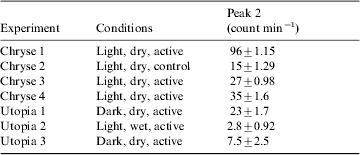
Data from the PR experiment (Horowitz et al. Reference Horowitz, Hobby and Hubbard1976). The ‘Conditions’ column indicates whether the lamp was on or off, whether or not water vapour was injected and whether the soil sample was heat-sterilized (control is 175°C for 3 h). The radioactivity of the Peak 2 column represents organic matter synthesized from the labelled gases.
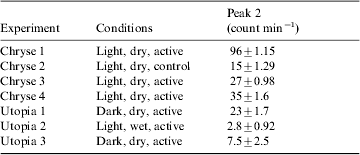
Nevertheless, the consensus view was that the Viking life detection experiments detected reactive chemistry rather than biology, which was based on a convergence of (1) the evolution of O2 upon wetting the soil, (2) the apparent absence of organic molecules in the soil and (3) the weakly positive result of the single control test in the PR experiment. With regard to the latter, the PR experiment was designed to detect carbon assimilation. The first test, Chryse 1, revealed a small but very significant incorporation of radioactive carbon in the pyrolizable organic fraction of the sample (Table 1). Unfortunately, only one control experiment was performed after the first test. In this control test (Chryse 2), in which a sample was heated for 3 h at 175°C, the reaction was absent (Klein et al. Reference Klein1976) or diminished by 88% (Horowitz Reference Horowitz1986). The test result from the control sample was 3.5σ above the baseline expectation based on previously conducted laboratory tests on terrestrial soils (Horowitz et al. Reference Horowitz, Hobby and Hubbard1976). Although the incorporation of radioactive carbon means that a presumptive biological reaction has been found, such activity also occurring in a sterilized sample would falsify the biological hypothesis. However, the baseline was derived only from a limited number of tests (N=39, with one greater than 5σ outlier being rejected), so that not a normal but at least a Student t-distribution would be appropriate to assess the statistical likelihood. Moreover, it is questionable whether these baseline tests were representative for the Martian environment and whether, in fact, the whole sample in this single case was heated to 175°C.
With regard to the control tests by the Viking experiments, we now know that some hyperthermophiles on Earth thrive at a temperature of at least 121°C (Kashefi & Lovley Reference Kashefi and Lovley2003). The temperatures to sterilize the soil samples in the Viking control tests were 145, 160 and 175°C, in the GEx, LR and PR experiments, respectively. There is no doubt that concentrated H2O2, by itself, would decompose quickly at such an elevated temperature. However, if H2O2 is of biological nature, it must be assumed that it is situated in a particular biochemical environment created by biochemical processes. The closest Earth analogy would probably be the processes occurring in the peroxisomes of most eukaryotic cells (De Duve Reference De Duve1969). Radiation tolerance as a side effect of desiccation tolerance in bacteria is generally assumed based on pioneering work on Deinococcus radiodurans by Mattimore & Battista (Reference Mattimore and Battista1996). Although speculative, the possibility should be considered that H2O2 as a major component of an intracellular fluid may require and has co-evolved with stabilization mechanisms, which have a side effect on temperature tolerance.
Temperature tolerance may have played a role in the evolution of O2 in the GEx experiment. In the active tests, oxygen would be a metabolite, concomitant with the (auto-)oxidation of the organic cellular contents. Viable organisms may well have started to decompose at or above the freezing point of water and 100% moisture. The response in the two control tests of the GEx experiment was in one case diminished to about a third, in the other to about zero (Oyama & Berdahl Reference Oyama and Berdahl1977). The diminished positive result in the first control test could mean that H2O2-based organisms do not decompose completely at 145°C, if, in fact, that temperature was imposed on the whole sample. Therefore, the results of the GEx experiment and the evolution of O2 in particular are compatible with our hypothesis.
The failure to detect organic molecules by the GC–MS during the Viking mission to Mars was surprising, especially because some 2.4×10⁸ g of reduced carbon falls on Mars each year via asteroids, comets and other planetary material (Flynn Reference Flynn1996). The common assumption is that all of the organic material near the surface is oxidized by H2O2 and other strong oxidizing compounds. In addition, a recent analysis indicates that the sensitivity of the Viking GC–MS was much less than originally thought owing to interference with minerals in the Martian soil and other factors (Navarro-González et al. Reference Navarro-González2006). Based on the reactivity of the surface measured by the Viking GEx experiment, the amount of H2O2 on the Martian surface was estimated to be between 1 ppm (Zent & McKay Reference Zent and McKay1994) and 250 ppm (Mancinelli Reference Mancinelli1989). However, photochemical processes generate H2O2 in the atmosphere at a much lower rate in the parts per billion range. Atmospheric H2O2 abundances vary between 20 and 40 ppb by volume over the planet (Encrenaz et al. Reference Encrenaz, Bezard, Greathouse, Richter, Lacy, Atreya, Wong, Lebonnois, Lefevre and Forget2004), which appears to be a maximum concentration occurring during favourable weather conditions (Atreya & Gu Reference Atreya and Gu1994). Thus, there is a case to be made not only for the missing organics but also for the missing H2O2.
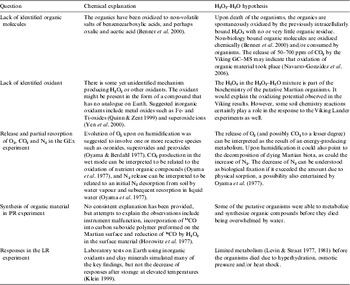
The biological explanation for the lack of detected organics by the GC–MS could be that the oxidizing inventory of the H2O2–H2O solvent well exceeded the reducing power of the organic compounds of the organisms. Upon heating, therefore, the putative organisms might have auto-oxidized catastrophically, leaving the gases as detected by the GEx experiment plus very little solid residue without or with only very little organic content. The negative result of the GC–MS (Biemann et al. Reference Biemann1977) is therefore not a very reliable estimate of an upper bound on the biomass in the soil. A reasonable alternative explanation of the missing organics using a purely chemical explanation was advanced by Benner et al. (Reference Benner, Devine, Matveeva and Powell2000), who suggested that any organics on the surface of Mars would undergo a diagenesis to metastable compounds of carboxylic acids derivatives and would not be easily detected by the GC–MS. Explanations to the five questions presented above in terms of the H2O2–H2O hypothesis and traditional chemical explanations are provided in Table 2.
Explanations for some remaining questions after Viking.

The fact that O2 evolved from soil samples upon humidification deserves particular scrutiny in order to evaluate whether this is in accordance with a biological rather than a chemical origin. The release of O2 was a surprise to the mission scientists, who then became convinced of a chemical origin as terrestrial life is not known for originating O2 upon wetting. Our interpretation, however, is that under a dry or slightly humid atmosphere the release of oxygen would be a consequence of a metabolic pathway of putative H2O2–H2O-based Martian organisms (reaction (3)), while under wet conditions it would indicate the decomposition of organisms by hyperhydration after being exposed to excess water. A similar inference can be drawn from the PR experiment. Wetting all but inhibited any organic synthesis reaction in the Utopia 2 sample and the following Utopia 3 sample (Table 1), while organic synthesis reactions did occur under dry conditions (Chryse 1, and possibly to some minor degree also for Chryse 3 and 4, and Utopia 1). The mission scientists had difficulty explaining this phenomenon. Horowitz et al. (Reference Horowitz, Hobby and Hubbard1977) called it ‘startling’, while Klein (Reference Klein1978) felt that an explanation for this phenomenon ‘remains obscure’.
With regards to a chemical explanation for these findings, the past 30 years have seen numerous proposals of what the putative oxidants might be without reaching a definitive solution. Therefore, we feel that after 30 years of chemical indecision it is appropriate to propose a biological hypothesis.
Not all results can be satisfactorily explained with our hypothesis. For example, the differences in amplitude of the response of the PR experiment remain a puzzle. However, this might be understood by assuming that the Martian surface is not covered by a homogeneous population of organisms. The apparent difference in heat resistance observed in some of the Viking experiments may also be due to a heterogeneous microbial population. In addition, some chemical reactions certainly play a role in the response to the Viking Lander experiments. From the perspective of the H2O2–H2O hypothesis on Martian life, the Viking experiments were both too warm and too wet. In particular, the combination of high temperatures (relative to average Martian conditions) and saturation with water vapour represent extremely un-Martian conditions and both the GEx and the LR experiments employed these conditions. The results of these two experiments might best be explained by a gradual failure of heterotrophic metabolism (which the experiments were designed to detect) to cope with adverse conditions. The putative Martian organisms were overwhelmed by too much water vapour, a condition against which they had no defence, so that they failed because of a fatal rise in osmotic pressure.
If we assume H2O2–H2O-based life as a working hypothesis, we may roughly estimate the biomass fraction of Martian soil. Like Mancinelli (Reference Mancinelli1989), we derive an estimate of H2O2 concentrations from the amounts of evolved gases in the GEx experiment. Here we assume the evolved O2 to originate from the decomposition of biogenic H2O2, but we also make the assumption that the evolved CO2 originated in the auto-oxidation of the microbes. The idea that the CO2 is released by desorption is neglected, because in the LR experiment released CO2 was absorbed upon further wetting of the samples (Levin & Straat Reference Levin and Straat1976). Also we neglect in our simplified calculations the evolved N2. We assume a model composition of the microbes consisting of organic macromolecules (simplified as CH2O) and equal weights of H2O and H2O2. The decomposition reactions playing a role are

and

From the GEx experiment, the maximum amounts of evolved gases, from a nominal 1.3 g sample, were 9800 nmol CO2 and 790 nmol O2. From these figures, the molecular ratio of reactions (4) and (5) follows at about 12.4 to 1. This leads to the overall equation

The molecular ratio of CH2O to H2O2, 12.4 to 26.8, leads to 17% of the microbe weight being CH2O and 41.5% of the weight being H2O2 and H2O, respectively. The evolved CO2 in the GEx was 9800 nmol, from 1.3 g of soil (Oyama & Berdahl Reference Oyama and Berdahl1977), therefore 7538 nmol g−1. This CO2 is assumed to originate from 7538 nmol g−1 CH2O or 226 μg g−1 of soil. As CH2O constitutes 17% of the biomass, the total biomass is 1330 μg g−1 or 1330 ppm.
The amount of biogenic H2O2 in our simplified model is 552 ppm, compared with a value of 25–250 ppm of adsorbed or chemically bound H2O2 as calculated by Mancinelli (Reference Mancinelli1989).
In future experiments on Mars, the detection of decomposing microbes might be attempted by measuring the heat produced from the exothermic decomposition reactions. The overall reaction (6) produces an enthalpy of 8454 kJ for 12.4 mol CH2O. As the soil contains 7538 nmol g−1 of CH2O, the enthalpy per gram of soil is 5.1 J g−1 based on the calculations above. These estimates are maximum values because we used the maximum gas evolution recorded by the GEx experiment and further assumed that all of the evolved CO2 resulted from biological decomposition. Another uncertainty is that in other locations on Mars any biomass in the soil will vary owing to nutrient availability, local temperatures and availability of water vapour in the atmosphere.
Adding water to the postulated H2O2–H2O-based life as done in the Viking life detection experiments would have ambiguous results. At the test cell temperatures of about 10°C, organisms might survive 50% humidity for some time, whereas 100% humidity at that temperature seems to be fatal within a few days at most. The hygroscopicity of the H2O2–H2O mixture and the probable lack of a mechanism to exclude too much water are the likely causes of the sensitivity for water, even as vapour. The argument that Viking detected reactive chemistry rather than biology based on the fact that there are no known Earth organisms that can be shown to reproduce all Viking results is wanting, as is the argument that Viking discovered biology because there is no known mineral or reactive Earth-analogue chemistry that produces all Viking results. Any explanation of the Viking results must be intrinsically linked to the Martian environment with its differing geochemistry and organisms, if they exist. Recent Mars missions including the Rovers Spirit and Opportunity were not capable of detecting oxidants in the Martian soil.
Terrestrial analogues
H2O2–H2O solutions are mostly known as disinfectants and sterilizing agents on Earth. Thus, the compatibility of H2O2 with biological processes might seem questionable. However, some microbial organisms produce hydrogen peroxide (e.g. certain Streptococcus and Lactobacillus sp. (Eschenbach et al. Reference Eschenbach, Davick, Williams, Klebanoff, Young-Smith, Critchlow and Holmes1989; Ryan & Kleinberg Reference Ryan and Kleinberg1995)), while other microbes utilize H2O2 (e.g. Neisseria sicca, Haemophilus segnis, H. parainfluenzae, Actinomyces viscosus and Staphylococcus epidermidis (Ryan & Kleinberg Reference Ryan and Kleinberg1995)). The microbe Acetobacter peroxidans even uses H2O2 in its metabolism (overall reaction H2O2(aq)+H2(aq)↔2H2O (Tanenbaum Reference Tanenbaum1956)). However, the high reactivity of H2O2 poses a problem to most microorganisms, which control it by the use of stabilizing compounds. Colloidal silicate and pyrophosphate are often used in commercial products, compounds such as phenacetin, an aromatic amine (N-ethoxy-acetanilide), may be more applicable to organisms. Most microbes that come into contact with H2O2 protect themselves with scavenging enzymes such as catalase, glutathione peroxidase and peroxiredoxin. H2O2 is commonly used as a defence mechanism by microbes, antibodies, immune cells and even certain insects. The Bombardier beetle, Brachinus crepitans, for example, has in its posterior a chitinous chamber in which a mix of fluids can be injected, one of which is a 25% solution of H2O2 (Eisner Reference Eisner2003). This is combined with hydroquinone and a catalyst to produce a steam explosion in the chamber, which can be directed at a pursuing predator. The uses of H2O2 in biology are surprisingly diverse. Mammalian cells are known to produce H2O2 to mediate diverse physiological responses such as cell proliferation, differentiation and migration (Sundaresan et al. Reference Sundaresan, Yu, Ferrans, Irani and Finkel1995; Rhee et al. Reference Rhee, Bae, Lee and Kwon2000), and biological redox reactions catalysed by H2O2 typically involve the oxidation of cysteine residues on proteins (Rhee Reference Rhee2006). Thus, high concentrations of H2O2 can be produced and utilized biochemically even in terrestrial organisms. There does not appear to exist a basic reason why H2O2 could not be used by living systems. On Earth, utilizing H2O2 in the intracellular fluid has little advantage with regard to temperature and availability of oxygen and water, thus the majority of Earth organisms never developed extensive adaptation mechanisms. On Mars, on the other hand, directional selection may have favoured organisms that developed on an early warm and wet Mars to adapt to the progressive cooling and desiccation. Minor sources of inorganic H2O2 produced in the Martian environment (e.g. Atreya et al. Reference Atreya, Wong, Renno, Farrell, Delory, Sentman, Cummer, Marshall, Rafkin and Catling2006) would increase the likelihood of an evolutionary trajectory using hydrogen peroxide for biochemical purposes. While for organisms on Earth it was advantageous to include large amount of salts into their intracellular fluids (e.g. Schulze-Makuch & Irwin Reference Schulze-Makuch and Irwin2004), H2O2 may have been more suitable for organisms to optimally adapt to the very dry and cold environmental conditions on Mars.
The utilization of H2O2 is not without some drawbacks. H2O2 decomposes spontaneously, thus an organism needs some stabilization mechanism. The situation is even more demanding for photoautotrophic organisms exposed to sunlight, which on Mars includes a considerable flux of ultraviolet with wavelengths down to about 200 nm. H2O2 will decompose under ultraviolet radiation and has to be protected by pigments in the cellular membrane or by an active stabilization mechanism. This does not necessarily require chlorophyll, but could involve bacteriorhodopsin embedded in the cell membrane such as in halophilic organisms, or involve some inorganic compound such as cycloocta sulphur for efficient ultraviolet protection (Schulze-Makuch et al. Reference Schulze-Makuch, Grinspoon, Abbas, Irwin and Bullock2004). However, to date, no suitable ultraviolet protection compound has been identified to exist on Mars, perhaps indicating that any such organisms, if they exist, would have to pursue an endolithic lifestyle comparable to the microbes in the Antarctic Dry Valleys (Friedmann Reference Friedmann1982). Notably, these problems are of lesser magnitude at lower temperatures requiring fewer resources.
Consequences for future Mars missions
In contrast to water-based organisms, the putative Martian autotrophs would need to avoid liquid water. However, in the generally arid environment, it is beneficial if the water vapour partial pressure is above about 50% for a significant fraction of time. Also, a generally low ambient temperature is beneficial in view of the stabilization of the cellular contents. If organisms on Mars exist that use the proposed biochemistry, they would likely be active in colder areas on Mars with high water vapour concentrations as would be expected along the polar ice fringes. As the Martian tropical areas are warmer and drier than optimum, they were not the best location for the detection of life based on a H2O2–H2O intracellular solvent.
Our hypothesis of Martian organisms that would utilize a H2O2–H2O mixture as an intracellular liquid is of great consequence for future missions searching for extant life on Mars. Rather than exploring in the equatorial belt, where temperatures might allow liquid water to exist for only brief periods of time, life may well exist in temperate or sub-arctic regions, where temperatures are colder and the atmosphere contains more water vapour. These concerns would also have to be addressed in future sample return missions to Mars and are relevant to the Mars Phoenix, ExoMars and Mars Science Laboratory missions.