Introduction
Health anxiety has increased, while psychological well-being has decreased, since the onset of the coronavirus disease-2019 (COVID-19) pandemic (Tyrer, Reference Tyrer2020). Health anxiety refers to fear and worry expressed through inappropriate or excessive attention to one's own health threat (Aue & Okon-Singer, Reference Aue and Okon-Singer2020; Axelsson et al., Reference Axelsson, Andersson, Ljótsson, Björkander, Hedman-Lagerlöf and Hedman-Lagerlöf2020). In the Diagnostic and Statistical Manual of Mental Disorders (DSM-5; APA, 2013), the concept of health anxiety is a component of two diagnostic categories. Health anxiety with somatic symptoms is classified as somatic symptom disorder, whereas health anxiety without somatic symptoms is classified as illness anxiety disorder. The main characteristics of individuals with health anxiety are persistent anxiety and worrying that they have a serious disease based on misunderstanding of one or more physical concerns (Hedman-Lagerlöf, Tyrer, Hague, & Tyrer, Reference Hedman-Lagerlöf, Tyrer, Hague and Tyrer2019). Even if a professional medical examination rules out physical problems, the evidence typically cannot eliminate persistent health anxiety. The persistent anxiety burdens patients when trying to seek help and be recognized for their suffering (Hedman-Lagerlöf et al., Reference Hedman-Lagerlöf, Tyrer, Hague and Tyrer2019), and can result in the unnecessary use of public health resources (Tyrer et al., Reference Tyrer, Cooper, Salkovskis, Tyrer, Crawford, Byford and Barrett2014; van den Heuvel, Veale, & Stein, Reference van den Heuvel, Veale and Stein2014). In the current study we are interested in health anxiety as it occurs with and without actual physical illness.
The cognitive-behavioral model of health anxiety holds that cognitive biases play an important role in the development and maintenance of health anxiety (Cooper, Gregory, Walker, Lambe, & Salkovskis, Reference Cooper, Gregory, Walker, Lambe and Salkovskis2017; Salkovskis & Warwick, Reference Salkovskis and Warwick1986). Most previous studies on this topic focused on an attentional bias to health threat stimuli (Shi et al., Reference Shi, Taylor, Witthöft, Du, Zhang, Lu and Ren2022). Interpretation bias, the tendency to judge ambiguous information as negative or threatening (Hirsch, Meeten, Krahé, & Reeder, Reference Hirsch, Meeten, Krahé and Reeder2016; Würtz et al., Reference Würtz, Zahler, Blackwell, Margraf, Bagheri and Woud2022), is also commonly seen in health anxiety. This type of bias is evident in particularly negative explanations for physical concerns, such as ‘if I have a headache, I have a brain tumor’ (Smeets, de Jong, & Mayer, Reference Smeets, de Jong and Mayer2000). A better understanding of interpretation bias in health anxiety appears crucial for identifying effective means of prevention and intervention (Chan, Takano, Lau, & Barry, Reference Chan, Takano, Lau and Barry2020; Hitchcock & Mathews, Reference Hitchcock and Mathews1992).
Previous research results are inconsistent with regard to the association between health anxiety and interpretation bias. Most studies show that individuals with health anxiety are more likely to interpret information related to illness or symptoms in catastrophic ways (Elhamiasl, Dehghani, Heidari, & Khatibi, Reference Elhamiasl, Dehghani, Heidari and Khatibi2020; Luo, Fu, Li, Xing, & Wang, Reference Luo, Fu, Li, Xing and Wang2018; Woud, Zhang, Becker, Zlomuzica, & Margraf, Reference Woud, Zhang, Becker, Zlomuzica and Margraf2016). People with health anxiety are also more likely to attribute physical symptoms to moderate or severe physical illness than to normal bodily functions (Schwind, Neng, & Weck, Reference Schwind, Neng and Weck2016; Taillefer, Kirmayer, Robbins, & Lasry, Reference Taillefer, Kirmayer, Robbins and Lasry2003).
However, some researchers have not found an association between health anxiety and interpretation bias, or found mixed results. In one study, researchers used the affect misattribution procedure to assess health-anxious individuals' implicit evaluations of symptom-related, illness-related, and neutral words, and found that health anxiety was associated with negative evaluations of only illness words but not symptom words (Schreiber, Neng, Heimlich, Witthöft, & Weck, Reference Schreiber, Neng, Heimlich, Witthöft and Weck2014). Another study used a functional magnetic resonance imaging (fMRI) adaption of a body-symptom implicit association test (body-symptom IAT) to assess health-anxious individuals' behavioral and neural responses to two concept categories (body-symptom words and neutral words) and two attribute categories (harmlessness-related adjectives and danger-related adjectives). Patients with pathological health anxiety showed aberrant processing of body-symptom words in the IAT on the neural but not on the behavioral level. To be specific, the bilateral amygdala, right parietal lobe, and other brain regions were more active in patients with pathological health anxiety than healthy participants, but there was no significant difference in scores on the body-symptom IAT between pathological health anxiety and healthy participants (Yan, Witthöft, Bailer, Diener, & Mier, Reference Yan, Witthöft, Bailer, Diener and Mier2019). Given these different views and inconsistencies in research results, the association between health anxiety and interpretation bias remains a topic of scientific debate.
There have been two meta-analyses on related topics. One meta-analysis (Marcus, Gurley, Marchi, & Bauer, Reference Marcus, Gurley, Marchi and Bauer2007) integrated studies on the dysfunctional beliefs, somatic perception, and somatic amplification in relation to hypochondriasis and health anxiety. The finding showed that health-anxious individuals have different beliefs about health and illness compared to those low in health anxiety. Leonidou and Panayiotou (Reference Leonidou and Panayiotou2018) systematically reviewed the attention, interpretation, and memory bias of illness-anxious individuals according to the cognitive-behavioral model. The review provided some support for the association between interpretation bias and health anxiety. However, the study included only 11 articles on interpretation bias. Neither study tested moderators of effect size.
Our study is the first meta-analysis to provide a quantitative estimate of the magnitude of the association between health anxiety and interpretation bias. As part of the meta-analysis we also tested whether there are study characteristics that moderate the average effect size in this literature, such as whether the participants were from clinical or non-clinical groups, and how interpretation bias and health anxiety were measured. Identifying the relationship between health anxiety and interpretation bias, and identifying moderators of this association, will provide information about the pathogenesis of health anxiety. This is especially important in the post-COVID-19 pandemic period, when there is a need for personalized and remote interventions.
The cognitive content-specificity hypothesis provides the general framework for this study. The assumption is that mood states can be distinguished according to unique cognitive content (Clark, Beck, & Brown, Reference Clark, Beck and Brown1989). For example, depression is associated with cognitions related to failure or self-deprecation (Everaert, Podina, & Koster, Reference Everaert, Podina and Koster2017; Hertel & El-Messidi, Reference Hertel and El-Messidi2006), and social phobia is associated with cognitions about being rejected or laughed at by others (Chen, Short, & Kemps, Reference Chen, Short and Kemps2020; Gutiérrez-García & Calvo, Reference Gutiérrez-García and Calvo2017). In the same way, we hypothesize that health anxiety will be associated with interpretation bias with regard health.
We also made more specific hypotheses regarding moderators of this overall effect. First, measurement paradigms for interpretation bias include offline paradigms and online paradigms (Hirsch et al., Reference Hirsch, Meeten, Krahé and Reeder2016). The offline paradigm captures the process of interpretation through self-report methods such as rating scales (Berna, Lang, Goodwin, & Holmes, Reference Berna, Lang, Goodwin and Holmes2011) or rankings of explanations (Butler & Mathews, Reference Butler and Mathews1983), and it allows participants to reflect on the ambiguous material without being required to report the first inference that comes to mind (Hirsch et al., Reference Hirsch, Meeten, Krahé and Reeder2016). In contrast, the online paradigm relies on behavioral indices, such as reaction time (Sears, Suzie Bisson, & Nielsen, Reference Sears, Suzie Bisson and Nielsen2011) and event-related potentials (Moser, Huppert, Foa, & Simons, Reference Moser, Huppert, Foa and Simons2012), to infer interpretation biases, and therefore is (more or less) able to assess the extent to which inferential processing when ambiguity is first encountered is automatic (Hirsch et al., Reference Hirsch, Meeten, Krahé and Reeder2016). The offline paradigms are prone to generating response biases and demand characteristics, which means that health-anxious individuals with dysfunctional beliefs may be inclined to report more negative explanations than they actually believe (Nieto, Robles, & Vazquez, Reference Nieto, Robles and Vazquez2020). Therefore, we hypothesized that health anxiety would be more strongly associated with interpretation bias when using the offline paradigm. Second, the type of stimulus used to assess or induce health anxiety may moderate overall effect sizes. Word, sentence, scenario, and picture stimuli are commonly used paradigms to measure the interpretation bias of people with health anxiety (Aue & Okon-Singer, Reference Aue and Okon-Singer2020). Third, health anxiety is thought to occur continuously from no health anxiety to pathological health anxiety (Williams, Reference Williams2004), so we assume individuals drawn from the clinical population are likely to report the highest levels of negative interpretation bias. Finally, we tested potential moderators that are often included in meta-analyses, such as gender, age, culture, publication year, and journal impact factor (Chen et al., Reference Chen, Short and Kemps2020; Everaert et al., Reference Everaert, Podina and Koster2017; Shi et al., Reference Shi, Taylor, Witthöft, Du, Zhang, Lu and Ren2022).
In sum, the purpose of the current meta-analysis was to estimate the average effect size across studies that have tested the association between health anxiety and interpretation bias, and to identify study characteristics that might moderate this association.
Method
The present review was conducted and reported following the PRISMA checklists (online Supplementary eMethods 1; Liberati et al., Reference Liberati, Altman, Tetzlaff, Mulrow, Gøtzsche, Ioannidis and Moher2009). The meta-analysis protocol (PRISMA-P) has been registered on PROSPERO (CRD42022298427).
Search strategy
Chinese-language databases (CNKI, VIP, and Wanfang), English-language databases (Web of Science, PubMed, PsycINFO, and Scopus), and German-language databases (Psyndex and PubPsych) were searched for relevant studies. This search was first performed on 10 December 2021 and later updated on 29 July 2022. The search terms included health anxiety OR illness anxiety OR hypochondri* OR somatic symptom disorder OR somatoform disorders OR somatization disorder AND each of the keywords listed here separately: interpret* bias, misinterpretation, attribution, misattribution, evaluation, information, inferential, judgement, cognitive appraisal*, appraisal*, cognitive misappraisal*, misappraisal*, negative cognition*, cognitive bias* (online Supplementary eMethods 2). To avoid missing articles, the reference lists of selected articles and relevant review articles were checked to identify additional studies. Two authors (XD and CS) independently searched the literature and selected studies according to the established inclusion and exclusion criteria, and disagreements were resolved through discussion until consensus was reached.
Inclusion and exclusion criteria
The following criteria were used to select the studies for this systematic review and meta-analysis. The inclusion criteria were: (a) original research published in English, Chinese, or German as an article in a peer-reviewed journal; (b) used either a between-subjects design (compared interpretation bias in health anxiety group and controls) or cross-sectional design (examined correlation between health anxiety severity and strength of interpretation bias); and (c) health anxiety was measured using clinical diagnoses (e.g. Structured Clinical Interview for DSM-5; Neng & Weck, Reference Neng and Weck2015) or self-report methods (e.g. SHAI; Chan et al., Reference Chan, Takano, Lau and Barry2020). The exclusion criteria were: (a) intervention study; (b) participants were patients whose primary diagnosis was physiological disease; (c) health anxiety was experimentally induced in healthy individuals; (d) interpretation bias occurred naturally and was measured using an experimental paradigm or questionnaire; and (e) case study, literature review, conference abstract, research protocol, or commentary on published studies.
Data extraction
The characteristics of each study were extracted and coded, and the resulting data were included in the analysis. Literature feature coding included first author (publication year), sample size, country, age, percentage of females, publication year, journal impact factor, clinical state, threat type, paradigm, and stimulus type. There were four studies for which we were unable to extract the data we needed, so we contacted the authors via e-mail to obtain as much data as possible. Two authors (XD and TZ) coded studies independently and checked for accuracy. High inter-rater reliability was found with kappa ranging from 0.88 to 1.00. Disagreements were resolved through discussion until consensus was reached.
Methodological quality assessment
The Joanna Briggs Institute (JBI) Critical Appraisal Checklist for Analytical Cross-Sectional Studies (Sabilillah, Reference Sabilillah2020) was used to assess the methodological quality of each included study (online Supplementary eTable 1). This checklist consists of eight items, each yielding a score of 0 or 1. The sum of scores ranges from 0 to 8, with higher scores indicating superior quality. Two authors (XD and TZ) independently rated the quality of each study included in the analysis. High inter-rater reliability was found with a Spearman correlation coefficient of 0.801 (p < 0.01). Disagreements were resolved through discussion until consensus was reached.
Statistical analysis
We used the meta package (Lortie & Filazzola, Reference Lortie and Filazzola2020), the metafor package (Viechtbauer, Reference Viechtbauer2010), and the dmetar package (Balduzzi, Rücker, & Schwarzer, Reference Balduzzi, Rücker and Schwarzer2019) in R software version 4.1.2 (http://www.R-project.org) to meta-analyze the included studies. All effect sizes were converted to Hedges' g before being analyzed. If there were multiple scores for interpretation bias in the same task, the average effect size of the measured values was first calculated (Everaert et al., Reference Everaert, Podina and Koster2017). Effect sizes of 0.2 indicated a small effect, 0.5 a medium effect, and 0.8 a large effect (Cohen, Reference Cohen2013). The effect sizes were coded such that positive values indicated greater interpretation bias with higher levels of health anxiety. The studies included in this meta-analysis were conducted in diverse populations and cultures, and there were different assessment methods across studies, so random effects were used to calculate the overall effect of the model (Yan, Du, Lai, Ren, & Li, Reference Yan, Du, Lai, Ren and Li2022). Homogeneity of variance of effect sizes was tested using the Q and I 2 statistics. Consider a Q statistic with a p value of <0.05 as an indication of substantial heterogeneity; I 2 > 50% also indicates significant heterogeneity (Huedo-Medina, Sánchez-Meca, Marín-Martínez, & Botella, Reference Huedo-Medina, Sánchez-Meca, Marín-Martínez and Botella2006).
We conducted moderator analyses to explore the potential sources of heterogeneity in the set of effect sizes being analyzed. Culture, clinical state, threat type, paradigm, and stimulus type were used as categorical variables for subgroup analysis, and age, percentage of females, publication year, and journal impact factor were used as continuous variables for meta-regression analysis. The minimum number of required studies was set to three studies per subgroup analysis (van Eldik et al., Reference van Eldik, de Haan, Parry, Davies, Luijk, Arends and Prinzie2020) and six studies per regression analysis (Fu et al., Reference Fu, Gartlehner, Grant, Shamliyan, Sedrakyan, Wilt and Trikalinos2011). Possible publication bias was assessed using several metrics. A highly symmetric funnel plot suggests that the publication bias is small; a lack of symmetry means that there may be publication bias (Sterne & Harbord, Reference Sterne and Harbord2004). The fail-safe number (Nfs) indicates how many studies are required to overturn the results of the meta-analysis; if Nfs is greater than 5k + 10 (k refers to the number of studies included in the meta-analysis), there is no publication bias (Rosenthal, Reference Rosenthal1995). Egger's regression test indicates publication bias when p < 0.05 (Egger, Smith, Schneider, & Minder, Reference Egger, Smith, Schneider and Minder1997), and the p curve is examined for verification (Simonsohn, Nelson, & Simmons, Reference Simonsohn, Nelson and Simmons2014). The robustness of the results was tested by sensitivity analysis.
Results
Study and participant characteristics
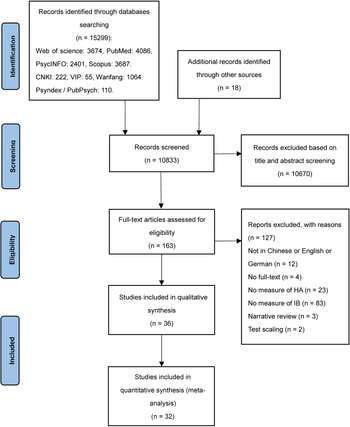
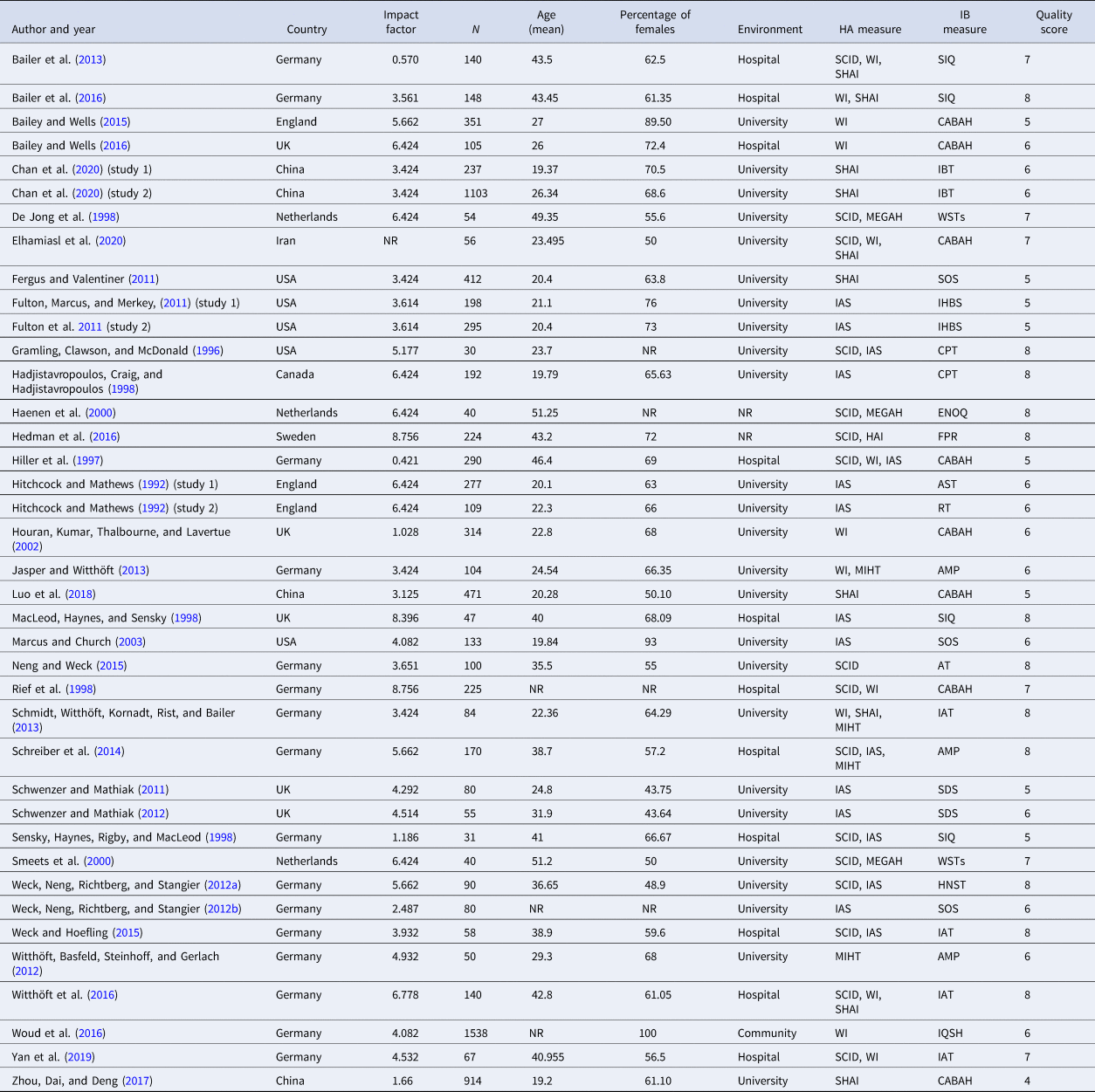
The PRISMA flow chart detailing the screening and identification of studies is shown in Fig. 1. Overall, 36 articles (39 studies) including 8984 participants were identified in a qualitative analysis; 32 articles (34 studies) of which were suitable for meta-analysis (N = 8602). The characteristics of these 39 studies are provided in Table 1. In the 39 studies, sample sizes ranged from 30 to 1538, average ages ranged from 19.2 to 51.3, and the proportion of female participants ranged from 43.6 to 100. The clinical sample size was 1755 and the subclinical sample size was 7229. There were more western studies (n = 35) than eastern studies (n = 4). The number of studies measuring health-related threat stimuli (n = 29) outnumbered those measuring non-health-related threat stimuli (n = 3), with seven studies measuring both health-related and non-health-related. The number of studies using the offline paradigm (n = 24) was greater than the number using the online paradigm (n = 15).
PRISMA diagram showing the results of the literature search. HA, health anxiety; IB, interpretation bias.

Summary of articles identified in the systematic review

WI, Whiteley index; HAI, Health Anxiety Inventory; SHAI, Short Health Anxiety Inventory; SCID, Structured Clinical Interview for the DSM; IAS, Illness Attitude Survey; MEGAH, Maastrichter Eigen Gezondheids Attitude en Hypochondrie schaal; MIHT, Multidimensional Inventory of Hypochondriacal Traits; SIQ, Symptom Interpretation Questionnaire; CABAH, Cognitions about Body and Health Questionnaire; SOS, Symptoms and Outcomes Scale; IBT, interpretation bias task; IHBS, Irrational Health Belief Scale; CPT, cold pressor task; ENOQ, Estimation of Negative Outcome Questionnaire; AST, ambiguous sentences test; AMP, affect misattribution procedure; IAT, implicit association test; AT, attribution task; RT, recognition task; FPR, facial photos ratings; SDS, Semantic Differential Scale; WSTs, Wason selection tasks; HNST, health norms sorting task; IQSH, Interpretation Questionnaire for Somatization and Hypochondriasis; NR, not reported.
Overall effect of interpretation bias in health anxiety
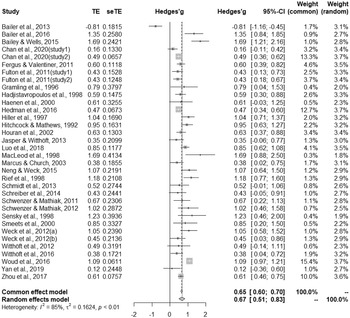
A random effects model was adopted according to the heterogeneity test results. The Q and I 2 statistics revealed significant heterogeneity in the effect sizes of the included studies: Q(33) = 222.05, p < 0.001, I 2 = 85.1%. Meta-analytic results are shown in Fig. 2. There was a medium average effect size for the association between interpretation bias and health anxiety, with Hedge's g = 0.67 [95% confidence interval (CI) 0.51–0.83, p < 0.001].
Forest plot of interpretation bias in health anxiety.

A funnel plot was constructed for the total sample of studies, as shown in online Supplementary eFig. 1. It was estimated by the fail-safe number that an additional 1081 non-significant studies would be needed to bring the p value to p > 0.05. As this is substantially larger than 5k + 10, we concluded that there was no publication bias. Egger's regression test also showed no publication bias; Egger's intercept = 0.63, p = 0.842, as shown in online Supplementary eFig. 2. The p curve plot, as shown in online Supplementary eFig. 3, revealed that there were 27 studies with p < 0.05 and 23 studies with p < 0.025. The power estimate was 99% (95% CI 99–99). The results of the p curve analysis showed that there was evidential value. In other words, the meta-analysis results are ‘real’ effect sizes, not just the product of publication bias or p hacking. The results of the methodological quality assessment are shown in online Supplementary eTable 2. Sensitivity analysis was used to investigate the stability of the overall effect size. Each study was removed one by one, and the combined effect size of the remaining studies was compared with the overall effect size. No outliers were found, and the results were robust (online Supplementary eFig. 4).
Moderator analyses
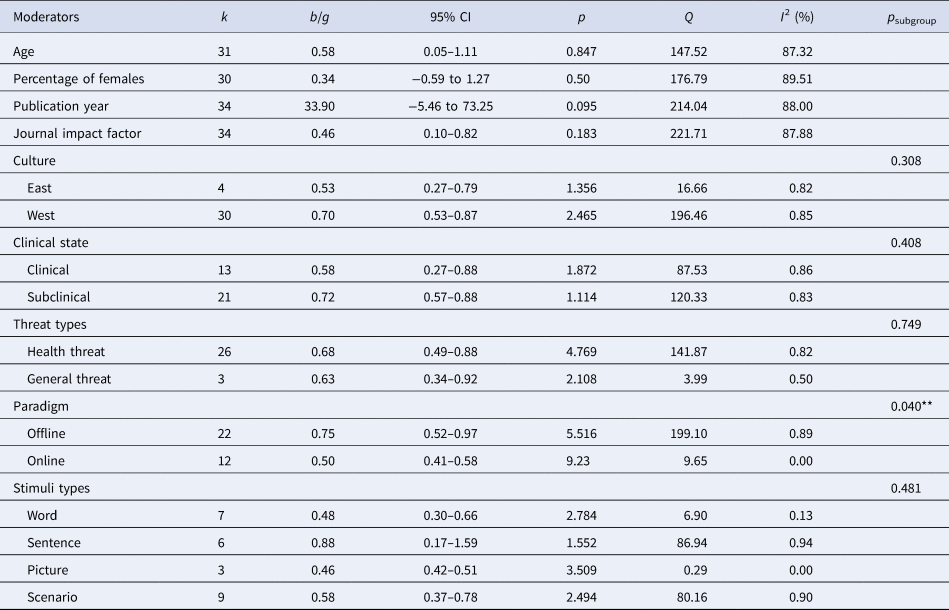
Both categorical (culture, clinical state, threat type, paradigm, and stimulus type) and continuous (age, percentage of females, publication year, and journal impact factor) variables were tested as moderators of the overall effect size for the association between health anxiety and interpretation bias. The results are displayed in Table 2. Subgroup analyses on categorical variables showed that threat type (health-threat: g = 0.68, general-threat: g = 0.63; p = 0.749) had no significant influence on the effect size of the association between health anxiety and interpretation bias. The effect size of the offline paradigm was significantly higher than that of the online paradigm between health anxiety and interpretation bias (g: 0.75 > 0.50, p < 0.05). However, culture (east: g = 0.53, west: g = 0.70; p = 0.308), clinical state (clinical: g = 0.58, subclinical: g = 0.72; p = 0.408), and stimulus type (word: g = 0.48, sentence: g = 0.88, picture: g = 0.46, scenario: g = 0.58; p = 0.481) had no significant influence on the effect size of association between health anxiety and interpretation bias. Meta-regression analyses showed no moderating effect of age (b = 0.58, p = 0.847), percentage of females (b = 0.34, p = 0.50), publication year (b = 33.90, p = 0.095), or journal impact factor (b = 0.46, p = 0.183).
Moderator analyses for interpretation bias in health anxiety

k, no. of studies; g, Hedge’ g; CI, confidence interval.
*p < 0.05, **p < 0.01, ***p < 0.001.
Methodological quality
The average overall quality score was 6.58 (s.d. = 1.21) with scores ranging from 4 to 8. The score of each study is shown in Table 1.
Discussion
The current study is the first meta-analysis of existing research on the association between health anxiety and interpretation bias, and the first among related meta-analyses to test potential moderating factors. The results showed that the negative interpretation bias seen in health anxiety occurs not only in response to health threats but also to non-health threats. At the same time, we found that interpretation bias in health-anxious people was more likely to be observed under some conditions than others.
Effect size of interpretation bias in health anxiety
The results of the current study showed that there was a moderate association between health anxiety and interpretation bias, which is consistent with previous empirical studies (Luo et al., Reference Luo, Fu, Li, Xing and Wang2018; Schwenzer & Mathiak, Reference Schwenzer and Mathiak2011) and systematic review (Leonidou & Panayiotou, Reference Leonidou and Panayiotou2018). Together, the evidence suggests that individuals with health anxiety tend to interpret ambiguous information more negatively than those without health anxiety. Our study provides supporting evidence for the comprehensive model of health anxiety: individuals with health anxiety maintain health anxiety symptoms by prioritizing benign or harmless somatosensory cues as signals of negative or threatening information rather than as neutral or positive information (Taylor & Asmundson, Reference Taylor and Asmundson2004). This may even be true in comparison with individuals with other forms of anxiety. Weck and Hofling (Reference Weck and Hoefling2015), using the IAT, found that compared to patients with anxiety disorders, patients who showed hypochondriasis showed stronger negative health attitudes toward words related to health and illness.
Moderators of interpretation bias in health anxiety
Subgroup analysis and meta-regression analysis were carried out to investigate the moderating effects of threat type, method of outcome measurement, participant characteristics, and publication characteristics on the association between health anxiety and interpretation bias. Several significant moderators emerged.
First, threat type did not affect the strength of the association between health anxiety and interpretation bias. Individuals with health anxiety not only showed biased interpretations of health-relate threat stimuli, but also showed biased interpretations of non-health-related threat stimuli. This is consistent with the results reported by De Jong, Haenen, Schmidt, and Mayer (Reference De Jong, Haenen, Schmidt and Mayer1998). Using the Wason selection tasks, researchers showed that patients with hypochondriasis showed the same reasoning in response to general threats (e.g. if mushrooms have brown stems, then they are not poisonous) and hypochondriasis-relevant threats (e.g. if people have diarrhea for several days, then they have intestinal cancer). Smeets et al.'s (Reference Smeets, de Jong and Mayer2000) results also supported the hypothesis that patients with hypochondriasis display a similar threat-confirming reasoning bias within the domain of health threats. This may be because hypochondriac attitudes have been shown to include non-illness-related cognitions in the study of cognitive processes (Schwenzer & Mathiak, Reference Schwenzer and Mathiak2012).
It appears that individuals with health anxiety do not show specific interpretation bias in response to health threat stimuli; they also show interpretation to threats that are unrelated to health. In other words, health anxiety also shows characteristics of generalized anxiety disorder. It tentatively provides little evidence that health anxiety may be classified as an anxiety disorder. The DSM-5 categorizes health anxiety as ‘somatic symptom and related disorders’ on the grounds that health anxiety is strongly focused on somatic concerns and health anxiety is most often encountered in medical settings (APA, 2013). However, many researchers have suggested reclassifying health anxiety as a distinct anxiety disorder (Olatunji, Deacon, & Abramowitz, Reference Olatunji, Deacon and Abramowitz2009; Weck, Bleichhardt, Witthöft, & Hiller, Reference Weck, Bleichhardt, Witthöft and Hiller2011), because health anxiety shows high comorbidity with anxiety disorders (Barsky, Barnett, & Cleary, Reference Barsky, Barnett and Cleary1994; Lee, Lam, Kwok, & Leung, Reference Lee, Lam, Kwok and Leung2014) and shares common symptoms and underlying psychological mechanisms (Olatunji et al., Reference Olatunji, Deacon and Abramowitz2009). Creed (Reference Creed2006) also argues that knowledge about the cognition of non-illness-related features may help to identify hypochondriac tendencies and shorten the path to appropriate treatment.
Second, paradigm type moderated the effect sizes of the association between health anxiety and interpretation bias. The association is more obvious in the offline paradigm than the online paradigm, a pattern that is consistent with the results of meta-analyses on interpretation bias in relation to other psychiatric disorders such as depression (Everaert et al., Reference Everaert, Podina and Koster2017) and social anxiety (Chen et al., Reference Chen, Short and Kemps2020). This might be attributable to the fact that the offline paradigm is subject to demand, selection, and response bias effects (Hirsch et al., Reference Hirsch, Meeten, Krahé and Reeder2016). According to the information processing model of anxiety (Beck & Clark, Reference Beck and Clark1997), automated and uncontrolled unconscious processes are often pre-captured by the online paradigm, while the offline paradigm measures the product of constructive thinking and secondary elaboration.
Third, clinical state did not significantly regulate the association between health anxiety and interpretation bias. This finding is inconsistent with the theory of health anxiety and previous research conclusions (Bailer et al., Reference Bailer, Kerstner, Witthöft, Diener, Mier and Rist2016; Hayter, Salkovskis, Silber, & Morris, Reference Hayter, Salkovskis, Silber and Morris2016). This inconsistency may be due to low reliability in measures of health anxiety, making it difficult to distinguish clinical from non-clinical levels of distress. Scoring standards and grouping standards are also not uniform, further reducing reliability. Fourth, culture did not significantly regulate the association between health anxiety and interpretation bias, possibly because there were too few studies to compare. The small number of studies may have reduced statistical power to detect the moderating effect of culture. However, previous research has shown that health anxiety is associated with interpretation bias about physical sensations that differ by culture. For example, people in the UK focus more on gastrointestinal sensations, Germans seem to focus more on cardiopulmonary symptoms, and those with health anxiety in the USA and Canada seem to pay special attention to immune-based symptoms (Taylor & Asmundson, Reference Taylor and Asmundson2004).
Clinical implications
This systematic review and meta-analysis may help to improve the clinical models and interventions for interpretation bias in health anxiety. First, there is no difference in the degree of interpretation bias toward health-related threat information and non-health-related threat information in individuals with health anxiety. This suggests the possibility that while health anxiety has the specificity of health information, there are also some commonalities with anxiety disorders. In other words, individuals with health anxiety over-interpret all stimulus sources as dangerous, suggesting that it should be included as an anxiety disorder in the DSM. So health anxiety may, in part, be classified as an anxiety disorder in diagnosis. In clinical practice, in addition to identifying patients with health anxiety based on physical sensation or health-related information, we may also need to pay attention to identifying patients who show interpretation bias regarding non-disease-related characteristics or who show signs of general anxiety. Second, most of the current intervention studies use the offline paradigm, which measures conscious processing, rather than unconscious processing, to evaluate change in interpretation bias (Haenen, de Jong, Schmidt, Stevens, & Visser, Reference Haenen, de Jong, Schmidt, Stevens and Visser2000; Luo et al., Reference Luo, Fu, Li, Xing and Wang2018; Rief, Hiller, & Margraf, Reference Rief, Hiller and Margraf1998). Clinical intervention studies should combine the offline and online paradigms to more comprehensively measure the interpretation bias in health anxiety, which will further help to discover the intervention mechanism that may be involved in interpretation bias. Finally, a significant proportion of patients with health anxiety are health profession avoiders, and interventions that provide individualized web-based interventions for interpretation bias can be developed to better help them.
Limitations and future prospects
The current systematic review and meta-analysis have some limitations. First, the included studies do not represent all studies investigating the association between health anxiety and interpretation bias, and unpublished studies were not included. Fortunately, tests of publication bias showed that this was not a major problem. Second, the effect sizes across studies showed significant heterogeneity. However, the predetermined moderator variables may not fully explain this heterogeneity, and there are still more moderators to be investigated. Third, there were not enough studies in some subgroups to test moderation, limiting the interpretation of the results. For example, the number of studies using non-health threat information as stimuli was too small to identify moderation, and the non-significant moderating effect of threat type may be due to low statistical power. The reliability of the results based on the threat type subgroup needs to be further studied. Fourth, most of the included studies were conducted in a university setting, using student populations as samples. Hence, researchers need to examine whether the findings are fully generalizable to patients in clinical samples. Fifth, there was a deviation from pre-registration in the current study, meaning that the moderators were not specified in advance and risk of bias assessment tool was not used as previously specified. Finally, in addition to the group comparisons, the current meta-analysis provides evidence from cross-sectional studies on the association between health anxiety and interpretation bias. However, correlational studies cannot be used to infer the causal impact of interpretation bias on the maintenance of clinical symptoms of health anxiety, so the causal association between health anxiety and interpretation bias is not clear.
Future research can be promoted in the following ways. First, the substantial heterogeneity reminds us of the need to develop a more appropriate measurement paradigm with more ecological validity, which can be achieved by unifying the operational definition of interpretation bias in health anxiety and standardizing the task of assessing interpretation bias more reliably. At the same time, the combination of biological methods (e.g. event-related potentials; Hirsch et al., Reference Hirsch, Meeten, Krahé and Reeder2016) and neural correlation tasks (e.g. fMRI; Yan et al., Reference Yan, Witthöft, Bailer, Diener and Mier2019) can enable us to determine whether the interpretation bias arises spontaneously. Second, as to whether individuals with health anxiety have specific interpretation biases for health-related content, the results of our study are not very convincing, and more empirical studies are needed to verify them in the future. Finally, more empirical studies that aim to experimentally modify interpretation bias are needed to examine its causal effect on the maintenance of health anxiety symptoms.
Conclusion
This meta-analysis supports the following conclusions. First, there is evidence that health anxiety is moderately correlated with interpretation bias. Second, there is no evidence that individuals with health anxiety differ in the degree of interpretation bias when presented with health-related and non-health-related threat information. Third, the association between health anxiety and interpretation bias was significantly moderated by measurement paradigm, whereas stimulus type, clinical state, age, gender, year, culture, and journal impact factor were not significant moderators. These results provide information for further research and treatment of individuals with elevated health anxiety.
Supplementary material
The supplementary material for this article can be found at https://doi.org/10.1017/S0033291722003427
Financial support
Our work was supported by the Major Program of the National Social Science Foundation of China (grant No. 22&ZD187).
Conflict of interest
None.