Introduction
The Emergency Medical Treatment and Active Labor Act (EMTALA), passed in 1986, has profound implications for the transport of patients among health care facilities in the United States. It regulates when, and under which conditions, transfers are permitted, and how an actual patient transfer will be conducted. It also highlights the legal obligation of facilities to provide medical screening examinations and emergency medical stabilization, regardless of a patient’s insurance status or ability to pay. 1 If disregarded, significant financial penalties and legal risks may ensue. 2 In addition, knowledge of the particularities of the local Emergency Medical Services (EMS) systems, such as available equipment and provider qualification, are important to allow for an appropriate use of resources and to ensure patient safety. This includes communication with prehospital providers and the physicians at the receiving facility.
Despite patient transfers occurring frequently in emergency medicine and critical care, there is minimal formal instruction, if any, during Emergency Medicine (EM) residency and Critical Care (CC) fellowship training in the United States. In fact, the word “transport” cannot be found in the 2011, nor its recently updated 2013, version of the “Model of the Clinical Practice of Emergency Medicine” document.Reference Perina, Brunett and Caro 3 , Reference Counselman, Borenstein and Chisholm 4 No specific objectives are defined with regard to EMTALA, despite this document commonly being regarded as the most comprehensive list of curricular topics relevant to emergency physician training.Reference Perina, Brunett and Caro 3 , Reference Counselman, Borenstein and Chisholm 4
The authors of this study hypothesized that a brief, educational intervention would improve the knowledge base of EM residents and CC fellows with regard to the clinical and medicolegal concerns in the practice of interfacility patient transfers.
Material and Methods
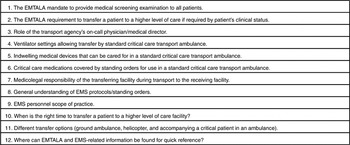
The authors reviewed EMTALA, as well as local EMS protocols. 1 , 5 Using a simplified Delphi method, a group comprised of the regional EMS medical director, two senior paramedics, two EM residents pursuing an EMS mini-fellowship during residency (“EMS Track”), and the faculty physician responsible for the EMS Track identified the 12 topics thought to be most relevant to EM and CC physician training, as defined as relevant in every day practice. These items cover both legal aspects of patient transfers (eg, EMTALA-mandate to have an accepting physician at the receiving facility), as well as administrative and medical aspects (eg, different levels of care that can be provided in transports; Table 1).
Topics Covered in the Educational Intervention and in the Pre- and Post-intervention Tests

Abbreviations: EMS, Emergency Medical Services; EMTALA, Emergency Medicine Treatment and Active Labor Act.
Emergency Medicine resident physicians and physicians in CC fellowship training (sub-specialties of internal medicine, anesthesiology, surgery, and pediatric surgery) at the authors’ institution, the University of Michigan (Ann Arbor, Michigan USA), a tertiary academic medical center, participated in the study.
A pre-intervention test was designed using multiple choice, multiple response item answers to case-based and traditional questions covering the 12 topical areas. This was followed by a one hour, interactive lecture given either during the physicians’ regular weekly conference or as a special conference outside of their weekly educational didactics, based on the training programs’ schedules and preferences. Between two and four weeks after the initial session, a post-intervention test in a format identical to the pre-intervention test, but with modified questions, was used to assess the intervention’s efficacy and cognitive processing of its content. Case-based scenarios were again used to simulate real-life situations rather than mere knowledge retention.Reference Dolmans and Schmidt 6 This follow-up test was conducted during regular weekly conference time. The pre- and post-intervention tests are available as Appendix A and Appendix B (available online only).
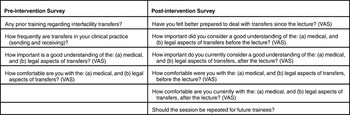
After completing the pre- and the post-intervention tests, the participants also answered a survey regarding their prior training with regard to patient transfers and the role patient transfers play in their daily practice. They were also asked how important they consider the medical and legal aspects of interfacility transfers, and how comfortable they feel with these concepts using the visual analogue scale (VAS; Table 2). The post-intervention test asked participants to again rate their pre-intervention perceptions to account for a possible Dunning-Kruger effect.Reference Kruger and Dunning 7 Participants were also given the opportunity to provide free-text comments about any possible impact the educational session had on their clinical practice.
Pre- and Post-intervention Survey Questions

Abbreviation: VAS, visual analogue scale (1 to 10).
All tests were conducted anonymously, and the participants were allowed to participate in the educational session regardless of their participation in the pre-intervention test. Participants were free to choose whether or not they wanted to complete the post-intervention test. No financial or other incentive for participation was provided. The study was reviewed by the University of Michigan’s institutional review board, and was deemed exempt from full and ongoing review. Statistical analysis was performed using Microsoft Excel (Microsoft Corp.; Redmond, Washington USA).
Results
Thirty-three EM residents and 17 CC fellows completed the pre-intervention test and participated in the educational intervention. Twenty (60.6%) EM residents and 12 (70.6%) CC fellows completed the post-intervention test.
Only three (9.1%) EM residents and one (5.9%) CC fellow reported that they had received any formal training on interfacility patient transfers prior to this study. A total of 35.7% of CC fellows had at least one patient transfer per shift, while 64.3% reported less than one transfer per shift. In contrast, 39.1% of EM residents reported at least two transfers per shift, with another 39.1% stating they averaged one patient transfer per shift, while the remaining 21.8% reported less than one transfer per shift. When asked how strongly EM residents felt well-prepared for patient transfers after the educational intervention, they rated this as a six (mean) on the VAS (scale of one to 10). Critical Care fellows rated the same question as a seven (mean). A significant 58.3% of CC fellows and 93.4% of EM residents desired the educational intervention to be incorporated within their mandatory educational core curriculum, while only 16.6% and 6.3%, respectively, stated they would like to see it offered as an optional session.
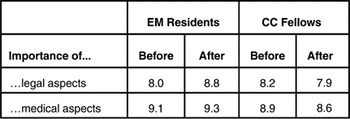
Both EM residents and CC fellows considered knowledge regarding the legal and medical aspects of patient transfers important, with no significant change before and after the intervention (Table 3).
Importance of Good Understanding of Legal and Medical Aspects of Patient Transfers, as Rated on the Visual Analogue Scale

Abbreviations: CC, Critical Care; EM, Emergency Medicine.
Mean VAS score for comfort level regarding the legal aspects of transfers increased significantly after the intervention (4.1 to 7.1 (P=.048) for CC fellows and 3.2 to 6.0 (P=.017) for EM residents). In regards to medical aspects of patient transfers, EM residents’ mean VAS score increased from 4.4 to 6.4 (P=.034), whereas CC fellows increased from 6.5 to 8.0 (P=.063). There was no significant variance in pre-intervention comfort levels in regards to patient transfers when evaluated during the pre- and post-intervention assessment.
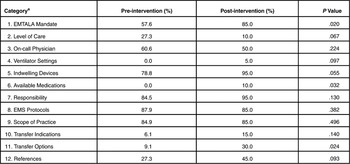
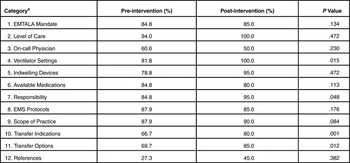
Table 4 illustrates the EM residents’ performance on the pre- and post-intervention tests, and areas of statistically significant improvement are highlighted. Table 5 contains the same data for CC fellows. Select free-text comments provided by the participants on their post-intervention surveys are listed in Table 6.
Pre- and Post-intervention Results (Correct Answers) for Emergency Medicine Resident Physicians

Abbreviations: EMS, Emergency Medical Services; EMTALA, Emergency Medicine Treatment and Active Labor Act.
a Number refers to corresponding full-length description in Table 1.
Pre- and Post-intervention Results (Correct Answers) for Physicians in Critical Care Fellowship Programs

Abbreviations: EMS, Emergency Medical Services; EMTALA, Emergency Medicine Treatment and Active Labor Act.
a Number refers to corresponding full-length description in Table 1.
Free-text Comments Provided by the Participants on the Post-intervention Survey

Abbreviation: EMS, Emergency Medical Services.
Discussion
The “An Educational Measure to Significantly Increase Critical Knowledge Regarding Interfacility Patient Transfers” (EMS-SICK-PT) study demonstrated that formal instruction in the clinical and medicolegal aspects of interfacility patient transfers is lacking and infrequent. In a changing health care environment, with an anticipated increase in the number and acuity of patient transfers, it is more important than ever to prepare adequately the next generation of emergency physicians and intensivists for this aspect of their daily practice.Reference McCallion 8 In this study cohort, transfers are already encountered on a daily basis. All participants agreed that having a good understanding of the medical and legal aspects of interfacility patient transfers is very important. After the intervention, they felt much more comfortable with these issues, reaching statistical significance between pre- and post-intervention ratings, with the exception of only a trend towards difference for the medical comfort level among CC fellows. A reason for this could be that CC fellows (postgraduate year 4-9) already rated their medical comfort level relatively high, (6.5 on the VAS) compared to EM residents (4.4 on the VAS; postgraduate year 1-4). The difference between the two groups did not resolve completely after the educational intervention, as reflected by the still higher post-test rating given by CC fellows. Of note, the pre-test comfort levels did not vary significantly when compared to the assessment of pre-intervention comfort levels on the post-test, suggesting that the Dunning-Kruger effect was not present.
The actual test items showed statistically significant improvement in approximately one-third of the tested categories. The modalities of organizing a transfer, acceptable ventilator settings, and available medications during transport were among the categories showing improvement. This was also emphasized in the free-text comments as a valuable aspect of the educational intervention.
Despite multiple position statements and guidelines from both the American College of Emergency Physicians (Irving, Texas USA) and the American College of Critical Care Medicine Society of Critical Care Medicine (Mount Prospect, Illinois USA) on the principles of interfacility transfers, there is little to no formal guidance as to the educational goals for EM residency and CC fellowship training programs in the US.Reference Perina, Brunett and Caro 3 , Reference Warren, Fromm, Orr, Rotello and Horst 9 - 12
The EMS-SICK-PT study demonstrated that postgraduate physician training in the clinical and medicolegal aspects of patient transfers at a tertiary care, academic institution is still extremely limited, despite the well-known fact that patient transfers are a high-risk situation for patients.Reference Olson, Jastremski, Vilogi, Madden and Beney 13 - Reference Singh, MacDonald and Ahghari 15 Human-based factors have been associated previously with 42% of all adverse events during transport, a possibly modifiable risk through enhanced education.Reference Flabouris, Runciman and Levings 16 Furthermore, physician understanding of the unique aspects and challenges of patient transfers has been linked to both the appropriateness and outcomes of transfers.Reference Nacht, Macht and Ginde 17 , Reference Li, Monuteaux and Bachur 18
Limitations
Not all areas tested were noted to show statistically significant improvements on the post-intervention test. However, a trend to statistical difference is noted in several of these categories. This trend suggests that the study may have been underpowered to demonstrate a significant difference in these categories. Unfortunately, the number of participants was limited by the number of physicians in the EM and CC training programs. The follow-up participation could have been increased by altering the follow-up time frame (ie, both by earlier and later attempts at follow-up). It is likely, however, that assessing knowledge retention within a week of the intervention would have not accurately represented the long-term educational effect of the intervention.
It is also noted that CC fellows demonstrated a relatively high number of correct answers in almost all categories. Unfortunately, the majority of CC fellows participated in sessions outside of their regular didactic curriculum, which may have introduced bias as these self-selected groups may have consisted of individuals with a particular interest in transport medicine.
The use of multiple response items, while allowing for assessment of higher cognitive processing in comparison with single response items, may also have impacted the assessment tools’ ability to differentiate between partial and full knowledge retention negatively.Reference Burton, Sudweeks, Merrill and Wood 19
Conclusions
Patient transfers among medical facilities are high-risk situations. Despite this, there is very little postgraduate physician training in the US regarding the medical and legal aspects of transport medicine and a lack of formal recommendations to guide such training. A one hour, educational intervention objectively increased EM and CC physician trainees’ understanding of some of the medicolegal aspects of interfacility patient transfers. The participants felt more comfortable with patient transfers in their daily practice after the educational session, and they recommended its content be incorporated into their program’s educational core curriculum.
Supplementary Materials
To view Supplementary Materials for this article, please visit http://dx.doi.org/10.1017/S1049023X15000266