A large body of research has documented the association between maternal depression and adverse child outcomes at various ages (Beardslee, Gladstone, & O'Connor, Reference Beardslee, Gladstone and O'Connor2011; Field, Reference Field1995; Goodman & Gotlib, Reference Goodman and Gotlib1999; Hay, Pawlby, Waters, & Sharp, Reference Hay, Pawlby, Waters and Sharp2008; Murray et al., Reference Murray, Arteche, Fearon, Halligan, Croudace and Cooper2010). Even infants of a few months old react negatively to signs of maternal depression as reflected in cognitive and motor developmental delays, negative emotionality, and insecure attachment relationship (Field, Reference Field1995; Tronick & Reck, Reference Tronick and Reck2009; Wan & Green, Reference Wan and Green2009; Weinberg & Tronick, Reference Weinberg and Tronick1998). During childhood and adolescence, maternal depression is consistently associated with cognitive and language delays (Brennan et al., Reference Brennan, Hammen, Andersen, Bor, Najman and Williams2000; Hay & Kumar, Reference Hay and Kumar1995), decreased academic achievement (Murray et al., Reference Murray, Arteche, Fearon, Halligan, Croudace and Cooper2010), interpersonal difficulties (Murray et al., Reference Murray, Sinclair, Cooper, Ducournau, Turner and Stein1999), and psychiatric disorders (Goodman et al., Reference Goodman, Rouse, Connell, Broth, Hall and Heyward2011). The above studies included both clinical and nonclinical samples of women. Although effects seem to be stronger for the clinically depressed, studies of community samples of women with self-reported depressive symptoms have also shown adverse outcomes in children (Downey & Coyne, Reference Downey and Coyne1990). For convenience, the term “maternal depression” is used throughout the paper to refer to both types of studies. However, for our study, we apply a more stringent terminology in reference to maternal depressive symptoms.
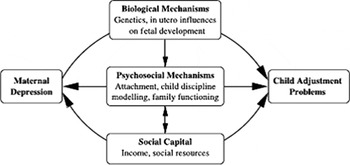
Empirical reviews have proposed several models to help organize and interpret the multifaceted links between maternal depression and child adjustment problems (e.g., Cummings & Davies, 1994; Goodman & Gotlib, Reference Goodman and Gotlib1999). We focus on the model provided by Elgar, McGrath, Waschbusch, Stewart, and Curtis (Reference Elgar, McGrath, Waschbusch, Stewart and Curtis2004) because it accounts for mutual influences between maternal depression and child outcome, thus providing the most complete theoretical model of the mechanisms involved. According to Elgar et al. (Reference Elgar, McGrath, Waschbusch, Stewart and Curtis2004), most transmission mechanisms can be grouped into three sets of interrelated, mediating factors (Figure 1). The first one involves biological mechanisms such as genetic and in utero environmental influences, which run unidirectionally from mother to child. The second factor includes psychosocial mechanisms such as exposure to negative cognitions and behaviors, interaction between mother and child, parenting, family functioning, and modeling. These mechanisms are considered bidirectional with the capacity for mutual influences. The third group of mechanisms represents moderating, contextual factors such as social disadvantage or resources, which indirectly transmit mutual influences on maternal and child functioning. The present study focuses on the second group of mechanisms, more specifically on maternal sensitivity, because this is an important determinant of the quality of mother–child interactions (De Wolff & van IJzendoorn, Reference De Wolff and van IJzendoorn2006). Given the significance of maternal responsiveness for children's optimal socioemotional development, it is not surprising that central to most theoretical proposals is the theory that maternal depressive symptoms, particularly early in the child's life, have adverse effects on the mother–child interaction (Murray, Reference Murray1992). It has been shown that depressed women are often less sensitive and responsive in their parenting skills than are nondepressed women (Field, Healy, Goldstein, & Guthertz, Reference Field, Healy, Goldstein and Guthertz1990). They usually spend less time looking at their infants, touching them, and talking to them relative to nondepressed women (Cohn, Campbell, Matias, & Hopkins, Reference Cohn, Campbell, Matias and Hopkins1990). In addition, they tend to exhibit less positive and more flat or negative emotions toward their children than do nondepressed women (Campbell, Cohn, & Meyers, Reference Campbell, Cohn and Meyers1995; Hamilton, Jones, & Hammen, Reference Hamilton, Jones and Hammen1993). Even though depressed women can substantially vary in their interaction styles with their children (Field, Hernandez-Reif, & Diego, Reference Field, Hernandez-Reif and Diego2006), there is converging evidence that postpartum depression has adverse effects on mother–child interaction (see reviews by Beck, Reference Beck1995; Lovejoy, Graczyk, O'Hare, & Neuman, Reference Lovejoy, Graczyk, O'Hare and Neuman2000). Therefore, it is not surprising that some researchers hypothesized it is mothers’ interaction style rather than the exposure to maternal depression per se that carries the adverse effect on child functioning (Murray & Cooper, Reference Murray and Cooper1997a; Murray, Fiori-Cowley, Hooper, & Cooper, Reference Murray, Fiori-Cowley, Hooper and Cooper1996) or accounts for this association in part (Goodman & Gotlib, Reference Goodman and Gotlib1999; NICHD ECCRN, 1999).
Elgar et al.’s (Reference Elgar, McGrath, Waschbusch, Stewart and Curtis2004) theoretical model of mutual influences on maternal depression and child adjustment. Reprinted from “Mutual Influences on Maternal Depression and Child Adjustment Problems,” by F. J. Elgar, P. J. McGrath, D. A. Waschbusch, S. H. Stewart, and L. J. Curtis, Reference Elgar, McGrath, Waschbusch, Stewart and Curtis2004, Clinical Psychology Review, 24, 441–459. Copyright 2004 by Elsevier. Reprinted with permission.

A crucial yet underexamined area is to investigate whether maternal depression and sensitivity also impact on children's ability to process emotional facial expressions. Processing emotional cues, for example, facial expressions of others, is an important aspect of social functioning in humans (Haxby, Hoffman, & Gobbini, Reference Haxby, Hoffman and Gobbini2002; Philippot & Feldman, Reference Philippot and Feldman1990). Younger children rely on facial expressions for information on the emotional state of others to a greater extent than on situational cues (Hoffner & Badzinski, Reference Hoffner and Badzinski1989). Altered patterns in facial expression recognition (FER) have been reported in a wide range of child and adult clinical populations (for reviews, see Monk, Reference Monk2008; Phillips, Drevets, Rauch, & Lane, Reference Phillips, Drevets, Rauch and Lane2003). Furthermore, biases in processing emotional stimuli are often regarded as an early marker of cognitive vulnerability for psychiatric disorders, such as depression (Joormann & Gotlib, Reference Joormann and Gotlib2007; Kujawa et al., Reference Kujawa, Torpey, Kim, Hajcak, Rose and Gotlib2011; for review, see Leppänen, Reference Leppänen2006). Studies have shown that both negative and positive early experiences have an important role in shaping children's ability to recognize facial expressions (De Haan, Belsky, Reid, Volein, & Johnson, Reference De Haan, Belsky, Reid, Volein and Johnson2004; Pollak, Cicchetti, Hornung, & Reed, Reference Pollak, Cicchetti, Hornung and Reed2000; Pollak, Messner, Kistler, & Cohn, Reference Pollak, Messner, Kistler and Cohn2009). Children of depressed mothers experience an atypical emotional environment characterized by a high exposure to sad, angry, or neutral expressions and a low exposure to happy expressions compared with children of nondepressed mothers (Dawson et al., Reference Dawson, Ashman, Panagiotides, Hessl, Self and Yamada2003; Field, Reference Field1995). Maternal depression during the first years of a child's life occurs at a time when mothers have an important role in the socialization of emotion regulation and expression (Denham, Reference Denham1998). Thus, maternal depression during the preschool years may play an important role in the development of children's emotion perception (De Haan et al., Reference De Haan, Belsky, Reid, Volein and Johnson2004; Montague & Walker-Andrews, Reference Montague and Walker-Andrews2002).
Only a few studies have investigated the potential role of maternal depression and sensitivity on children's ability to recognize facial expressions. Prior studies showed that although infants of depressed mothers were less likely to look at facial expressions displayed by their mother or a stranger, their elevated cortisol levels after such experimental situations indicated that they may have found these situations more stressful than did infants of nondepressed mothers (Diego et al., Reference Diego, Field, Jones, Hernandez-Reif, Cullen and Schanberg2004; Pickens & Field, Reference Pickens and Field1995). Other studies found that infants of depressed mothers discriminated sad from happy expressions but did not perceive sad expressions as novel (Hernandez-Reif, Field, Diego, Vera, & Pickens, Reference Hernandez-Reif, Field, Diego, Vera and Pickens2006). In addition, they discriminated less well between neutral and happy expressions than did infants of nondepressed women (Bornstein, Arterberry, Mash, & Manian, Reference Bornstein, Arterberry, Mash and Manian2011). Diego et al. (Reference Diego, Field, Hart, Hernandez-Reif, Jones and Cullen2002) assessed the effect of interaction style of depressed mothers on infants’ perception of facial expressions. They observed that infants of depressed mothers with an intrusive interaction style showed more differential responding to facial expressions of a stranger than did infants of depressed mothers with a withdrawn interaction style. In childhood and early adolescence, following a negative mood induction daughters of depressed women exhibited attentional biases for negative emotions as well as experienced difficulties at recognizing negative emotions relative to children of nondepressed women (Joormann, Gilbert, & Gotlib, Reference Joormann, Gilbert and Gotlib2010; Joormann, Talbot, & Gotlib, Reference Joormann, Talbot and Gotlib2007; Kujawa et al., Reference Kujawa, Torpey, Kim, Hajcak, Rose and Gotlib2011). In contrast, without a mood prime, children of mothers with a history of depression showed attentional biases away from negative emotions compared to children of mothers with no history of depression (Gibb, Benas, Grassia, & McGeary, Reference Gibb, Benas, Grassia and McGeary2009).
There is some suggestion that boys may be particularly vulnerable for the effects of maternal depression (for reviews, see Downey & Coyne, Reference Downey and Coyne1990; Grace, Evindar, & Stewart, Reference Grace, Evindar and Stewart2003; Murray & Cooper, Reference Murray and Cooper1997b). Much of this knowledge comes from studies that have tended to focus on outcomes such as children's emotional and behavioral problems, cognitive functioning, or language abilities. Among the few studies that have looked at children's ability to process emotional expressions in relation to maternal depression, two included only female offspring (Joormann et al., Reference Joormann, Talbot and Gotlib2007, Reference Joormann, Gilbert and Gotlib2010), one found attentional biases for sad faces only in daughters and not in sons of depressed mothers (Kujawa et al., Reference Kujawa, Torpey, Kim, Hajcak, Rose and Gotlib2011), and one did not find that sex moderated the effect of maternal depression on attentional biases for sad faces in the offspring (Gibb et al., Reference Gibb, Benas, Grassia and McGeary2009). Of these studies, only the one by Gibb et al. (Reference Gibb, Benas, Grassia and McGeary2009) did not deploy sad mood induction.
The aim of the present study was to investigate the independent and mediated effects of mothers’ depressive symptoms and observed sensitivity on young children's FER. Based on the literature, we hypothesized the following: (a) higher levels of maternal depressive symptoms will be associated with lower levels of observed sensitivity; (b) children of mothers with high levels of depressive symptoms will recognize positive emotions (i.e., happiness) less accurately and negative emotions (i.e., sadness, anger, and fear) more accurately than will children of mothers with no or low levels of depressive symptoms; (c) children of mothers with higher levels of observed sensitivity will recognize facial expressions, in general, more accurately than will children of mothers with lower levels of observed sensitivity; and (d) observed maternal sensitivity will partially mediate the association between maternal depressive symptoms and children's FER. Finally, we did not expect that sex will moderate the effect of maternal depression on children's FER, because no mood induction was used in the present study.
Method
Setting
The current investigation pertained to a subsample of children participating in the Generation R Study, a population-based prospective Dutch cohort from fetal life onward (Jaddoe et al., Reference Jaddoe, van Duijn, Franco, van der Heijden, van IJzendoorn and de Jongste2012). The subsample, known as the Generation R Focus Cohort, is ethnically homogeneous to exclude possible confounding or effect modification by ethnicity. All children were born between February 2003 and August 2005, and form a prenatally enrolled birth cohort (Jaddoe et al., Reference Jaddoe, van Duijn, van der Heijden, Mackenbach, Moll and Steegers2008). The study was conducted in accordance with the guidelines of the World Medical Association Declaration of Helsinki and approved by the medical ethics committee of the Erasmus Medical Center. Parental written informed consents were obtained for all participants.
Participants
The subgroup for the present study consisted of the 862 children and their mothers who attended the Focus Cohort assessments in our research center when children were approximately 3 years old. In 838 mothers, we had information on maternal depressive symptoms at one or more time points: in 796 during the early postnatal period (2 and 6 months postpartum) and in 747 at the child's age of 3 years. Information on maternal sensitivity when the child was 3 years old was available for 820 of the 838 women. At age 3 years, 673 children had usable accuracy data for emotion matching and 770 for emotion labeling.
Measures
Maternal depressive symptoms
Information on maternal depressive symptoms was obtained by postal questionnaires. Depressive symptoms were assessed using the depression scale of the Brief Symptom Inventory (BSI), the short version of the Symptom Checklist-90-R (Derogatis & Melisaratos, Reference Derogatis and Melisaratos1983). The BSI is a 53-item validated self-report inventory, in which participants rate the extent to which they have been bothered (0 = not at all, to 4 = extremely) in the past week by various symptoms. The instrument is widely used to assess psychological distress (De Beurs, Reference De Beurs2004; Derogatis, Reference Derogatis1993). The BSI depression scale includes the following 6 items: feeling suicidal, feeling lonely, feeling blue, having no interest in anything anymore, feeling hopeless about the future, and feeling worthless. Summed scores were divided by the number of completed items, with a maximum of 1 missing item allowed as recommended in the manual (De Beurs, Reference De Beurs2004). Because we wanted to test the hypothesis that mothers’ observed sensitivity would mediate the associations between maternal depressive symptoms and children's FER, we focused on assessing maternal depressive symptoms during the child's lifetime. Previous literature emphasized the importance of both postpartum and concurrent depressive symptoms in relation to adverse child outcomes (Brennan et al., Reference Brennan, Hammen, Andersen, Bor, Najman and Williams2000; Brockington, Reference Brockington2004; Josefsson & Sydsjö, Reference Josefsson and Sydsjö2007). Therefore, in the present study we included assessments of maternal depressive symptoms at both time points. To define postpartum depressive symptoms, we computed an average score based on BSI depression scores assessed at 2 and 6 months postpartum (the correlation between the two measures was r = .48, p < .001). To define concurrent maternal depressive symptoms, we used maternal BSI depression scores assessed when the child was 3 years old (correlations between mothers’ concurrent and postpartum BSI depression scores were r = .37 at 2 months postpartum, and r = .31 at 6 months postpartum; p < .001). Correlations between maternal BSI depression scores across the different time points were similar to those reported by Josefsson, Berg, Nordin, & Sydsjö (Reference Josefsson, Berg, Nordin and Sydsjö2001). Internal consistencies of the BSI depression scale for the present study were 0.80 at 2 months, 0.83 at 6 months, and 0.75 at 3 years. To test whether the BSI depression scale accurately tapped maternal depressive symptoms, we compared women's BSI depression score at 2 months postpartum to their score on the Edinburgh Postnatal Depression Scale (Cox, Holden, & Sagovsky, Reference Cox, Holden and Sagovsky1987), which was also administered at the same time (Blom et al., Reference Blom, Jansen, Verhulst, Hofman, Raat and Jaddoe2010). The correlation between the two measures was r = .67, p < .001. In analyses of maternal depression, we focused on examining women with high and clinically significant levels of symptoms compared to those with no or only mild depressive symptoms during their child's early years. According to the available norms for Dutch female nonpatient groups, a raw BSI depression score between 0.67 and 1.79 corresponds to “high levels” and between 1.80 and 4.00 to “very high levels” of depressive symptoms. Women with a score >0.80 typically meet criteria for clinically significant depression (De Beurs, Reference De Beurs2009). Therefore, women with BSI depression scores of ≥0.67 at postpartum and/or in the preschool period were regarded as “ever” experiencing high or clinically significant depressive symptoms, whereas women with BSI depression scores <0.67 both at postpartum and in the preschool period were considered as having none or steady low levels of depressive symptoms. According to this, 39 of the 770 women included in the analyses reported high or clinically significant levels of depressive symptoms at postpartum (n = 24), in the preschool period (n = 12), or at both times (n = 3). To examine the effect of subclinical symptoms of depression and the presence of a potential dose–response relationship between maternal depressive symptoms and other variables, we also analyzed continuous scores of maternal depressive symptoms. To this end, BSI depression scores in the postnatal and preschool period were combined into an average score (z-standardized) to reflect the general tendency of mothers to experience depressive symptoms during their child's early preschool years.
Maternal sensitivity
At 3 years postpartum, maternal sensitivity was observed in our research center while mother–child dyads performed two tasks that were designed to be too difficult for the child: building a tower and an Etch-a-Sketch task. Mothers were instructed to help their children as they would normally do. Maternal sensitivity was coded from DVD recordings with the revised Erickson 7-point rating scales for supportive presence and intrusiveness (Egeland, Erickson, Clemenhagen-Moon, Hiester, & Korfmacher, Reference Egeland, Erickson, Clemenhagen-Moon, Hiester and Korfmacher1990). The subscales supportive presence and intrusiveness were coded for each task. An overall sensitivity score was created by reversing the intrusiveness scale, standardizing the scores on the subscales, and creating an average over both subscales and both tasks. A similar procedure was used by Alink et al. (Reference Alink, Mesman, Van Zeijl, Stolk, Juffer and Bakermans-Kranenburg2009). The two tasks were independently coded by 13 trained coders. Coders were blind to maternal reports of depressive symptoms and children's performance on the FER tasks. Coders were extensively trained and regularly supervised. Reliability of coding was assessed directly after the training and at the end of the coding process to detect possible rater drift. For the tower task, the intercoder reliability (intraclass correlation coefficients, ICC) for both subscales was 0.68 on average directly after the training (n = 20) and 0.80 on average at the end of the coding process (n = 33), resulting in an overall ICC of 0.75 (n = 53). For the Etch-a-Sketch task, the ICC for both subscales was 0.84 on average directly after the training (n = 15) and 0.77 on average at the end of the coding process (n = 40).
FER
At age 3 years, children's FER was assessed in our research center during the same visit when maternal sensitivity was observed. A nonverbal emotion-matching task and a verbal emotion-labeling task were used to assess how accurately children recognize facial expressions of basic emotions. Color images of four basic emotions (happiness, sadness, anger, and fear) were presented on a screen, and children responded using a touch-sensitive monitor. Stimuli were selected from a widely used facial stimulus set, the NimStim, on the basis of which identities demonstrated the best recognized pose for a particular emotion category (Tottenham et al., Reference Tottenham, Tanaka, Leon, McCarry, Nurse and Hare2009). Prior to the FER tasks, children were introduced to the idea of emotions and facial expressions by a trained experimenter. Further specifications of the task and stimulus material can be found in Székely et al. (Reference Székely, Tiemeier, Arends, Jaddoe, Hofman and Verhulst2011).
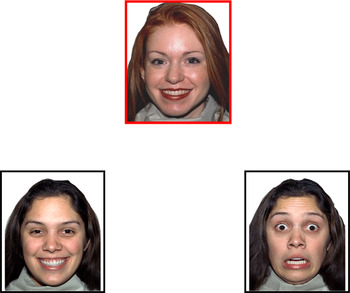
In the emotion-matching task, children had to match the emotion of the target face with one of the two other faces (Figure 2). Sixteen trials of emotion matching with two female and two male identity pairs and four basic emotions were included. Stimuli presentation was counterbalanced and randomized for emotion and identity. Prior to the emotion-matching task, a shape-matching task was presented as a screening for children's basic matching ability. The shape-matching task had the same parameters and layout as the emotion-matching task; only instead of emotions, children had to match geometrical shapes. A practice trial and four test trials with different target shapes were included in a fixed order. Similar paradigms have been used previously by Hariri, Bookheimer, and Mazziotta (Reference Hariri, Bookheimer and Mazziotta2000) and Herba, Landau, Russell, Ecker, and Phillips (Reference Herba, Landau, Russell, Ecker and Phillips2006).
(Color online) The emotion-matching task. Children were instructed to match “who feels the same” by pointing to the face (bottom) that displayed the same emotion as the target face (top) on a touch-sensitive monitor.

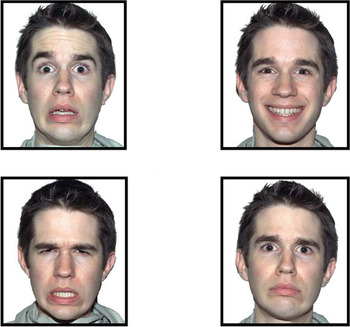
In the emotion-labeling task, all four emotions (displayed by the same identity) were shown in each trial, and children heard a voice bit asking in a neutral voice which person was feeling happy, sad, angry, or scared. Children were asked to point at the expression that matched this label (Figure 3). Sixteen trials were presented, four items for each of the four emotion categories using two female and two male identities. Stimuli presentation was counterbalanced and randomized for emotion and identity. A similar paradigm has been used previously by Fries and Pollak (Reference Fries and Pollak2004). To screen for children's basic labeling ability, an animal-labeling task was included. This task was administered to children by their parent at age 30 months, 6 months preceding the FER assessments. Children were presented with six black-and-white photos of animals and had to indicate which one of the six pictures matched the name of an animal read out by a parent. There were six trials in total with a fixed stimulus order. Similar paradigms have been previously used by Widen and Russell (Reference Widen and Russell2003).
(Color online) The emotion-labeling task. Children heard an emotion label (e.g., “Who feels happy?”) and were required to point to the face whose affect corresponded with the label.

Statistical analyses
Relations between maternal depressive symptoms and sensitivity were first explored using linear regression models. Independent effects of maternal depressive symptoms and sensitivity on children's FER were examined using repeated measures analyses of variance. Outcome variables were accuracy scores (mean proportion correct) for matching and labeling happy, sad, angry, and fearful faces. Main predictors were maternal depressive symptoms and sensitivity. Dichotomous predictor variables were entered as between-subjects factors, and continuous predictor variables were entered as covariates in the model. In case of a significant interaction effect between the predictor and emotion category, separate linear regression analyses were run for each emotion to examine specificity of effect of the predictor. For these analyses, we applied a Bonferroni correction to reduce errors owing to multiple testing (α = 0.05/4 = 0.01).
Interaction between the predictors and child sex was tested in all models. When this was not significant, we reported results from the model without the interaction term.
To examine whether the effect of maternal depressive symptoms on children's FER was mediated by sensitivity, we tested indirect effects of maternal depressive symptoms on children's FER via sensitivity using bootstrapping, a nonparametric resampling procedure. This method is preferred to alternative mediation tests (e.g., causal steps or normal theory approaches) becaise it respects the nonnormality of the sampling distribution of the indirect effect (Preacher & Hayes, Reference Preacher and Hayes2008; Shrout & Bolger, Reference Shrout and Bolger2002). In addition, it has lower Type I error rates and greater power to detect indirect effects than do alternative mediation tests (MacKinnon, Lockwood, Hoffman, West, & Sheets, Reference MacKinnon, Lockwood, Hoffman, West and Sheets2002). In the present study, we investigated the significance of mediation using 95% bias-corrected bootstrap confidence intervals for indirect effects and contrasts of indirect effects applying 5,000 bootstrap samples. Analyses were carried out in Statistical Package for the Social Sciences using a macro developed by Preacher and Hayes (Reference Preacher and Hayes2008). Confidence intervals were used to determine indirect relationships between maternal depressive symptoms and children's FER, including maternal sensitivity as a potential mediator. Indirect effects are present when the confidence intervals do not include 0. In our case, this meant that the indirect effect was significant at p < .05.
Covariates
Analyses including children's FER as outcome were adjusted for child's age, sex, shape-matching/animal-labeling accuracy, gestational age at birth, maternal age at intake, maternal education, marital status, parity, and maternal smoking during pregnancy. Most covariates were selected based on previous literature (Brennan et al., Reference Brennan, Hammen, Andersen, Bor, Najman and Williams2000; Campbell, Matestic, Stauffenberg, Mohan, & Kirchner, Reference Campbell, Matestic, von Stauffenberg, Mohan and Kirchner2007). Shape-matching and animal-labeling accuracies were included to account for children's basic matching and labeling ability. Information on child's sex and gestational age at birth was obtained from midwives and obstetricians. Information on maternal education, marital status, parity, and maternal smoking during pregnancy was collected via questionnaires. Child's age and shape-matching accuracy were assessed when the outcome, FER, was measured. Animal-labeling accuracy was assessed by the parent at age 30 months. Maternal education was coded as “low” (primary education or no education), “medium” (secondary education), or “high” (college or university degree). Because there were only eight mothers (1%) in the low category, low and medium categories were collapsed for further analyses. Marital status was dichotomized into “married or living with a partner” and “living alone.” Parity was dichotomized into “primiparous” and “multiparous.” Maternal smoking was assessed in the first, second, and third trimesters and summarized as “yes, at least sometime during pregnancy” and “never during pregnancy.” Percentages of missing data on the covariates ranged from 0.1% to 2.5%.
Nonresponse analysis
To examine patterns of nonresponse, we compared basic characteristics of children in the present sample (N = 770) to children who visited our research center at 3 years but were not included in the analyses owing to missing data (N = 92). This latter group included 29 children to whom FER tasks were not administered owing to time constraints, 7 children with incomplete FER data, and 56 children who had available FER data but were not included in analyses owing to the following reasons: 6 children were tested at the beginning of the assessments using a different test procedure; 1 child was older than 45 months at the time of visit; 7 twins were randomly excluded from each participating twin pair to avoid biases owing to paired data; 24 children were without available information on maternal depressive symptoms; and 18 children were without available information on maternal sensitivity. Children not included in the analyses were on average 0.48 months older, t (860) = 2.92, p = .004, and were born 0.63 weeks earlier, t (105.17 corrected for unequal group variances) = –2.77, p = .007, than our participants. Furthermore, mothers of nonparticipants were slightly younger (mean difference = 0.84 years), t (860) = –2.02, p = .044, and less highly educated (54.5% vs. 67.7%), χ2 (1) = 5.87, p = .015, than mothers of our participants. The two groups were comparable in terms of distribution of boys and girls, marital status, parity, and smoking during pregnancy (all ps > .05). Depressive symptoms and maternal sensitivity did not affect nonresponse (all ps > .05).
Results
Descriptive statistics
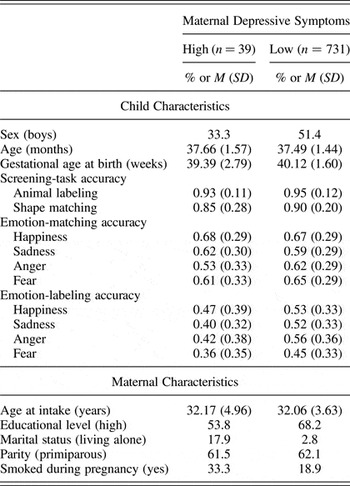
Sample characteristics are presented in Table 1 separately for mothers with high and low levels of depressive symptoms. Mothers with high levels of depressive symptoms were more often living alone, χ2 (1) = 24.45, p < .001, and smoking during pregnancy, χ2 (1) = 4.86, p = .027, than mothers with low levels of depressive symptoms. Given that the animal-labeling task was mostly administered to children by their mothers at home, we examined whether maternal depressive symptoms (as assessed in the present study) were associated with children's animal-labeling accuracy. Results indicated that children's scores for animal labeling were comparable between those children whose mothers experienced high levels of depressive symptoms (at postpartum and/or in the preschool period) and children whose mothers reported no or only mild depressive symptoms (mean difference = 0.01), t (761) = 0.632, p = .528. There was a significant but very weak negative correlation between mothers’ continuous postpartum depression scores and children's animal-labeling accuracy (N = 725, r = –.093, p = .012), while mothers’ concurrent depressive symptoms scores were not significantly correlated with children's animal-labeling accuracy (N = 686, r = .016, p = .674).
Sample characteristics according to high and low levels of maternal depressive symptoms
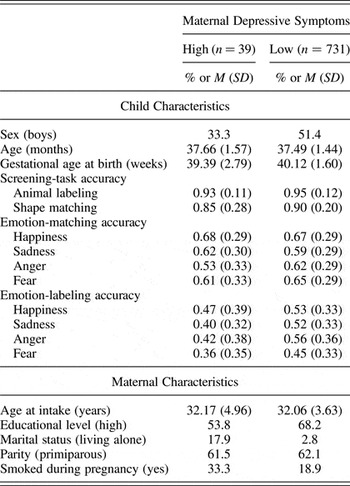
As shown in Table 1, children's performance for shape matching and animal labeling was close to ceiling level. In the present study, a ceiling-level performance on these screening tasks was desired, because it indicated that most children were able to understand and perform basic matching and labeling. This was necessary to be able to complete our FER tasks. It also meant that a lower score on the FER tasks was not due to children's inability to match or label.
Maternal depressive symptoms and sensitivity
Mother's depressive symptoms predicted their observed sensitivity. Women with high levels of depressive symptoms were less sensitive when interacting with their children in a laboratory setting than were women with no or mild depressive symptoms (B = –0.246, SE = 0.111, p = .027). In addition, there was also a dose–response relationship between mothers’ depressive symptoms and observed sensitivity, because higher levels of depressive symptoms also continuously predicted lower observed sensitivity (B = –0.065, SE = 0.029, p = .027).
Single time-point analyses of maternal depression scores revealed that this association was primarily driven by postpartum levels of depressive symptoms (high vs. low: B = –0.311, SE = 0.133, p = .020; continuous scores: B = –0.072, SE = 0.027, p = .007). The concurrent association between mothers’ depressive symptoms and observed sensitivity was in the same direction but did not reach statistical significance (high vs. low: B = –0.210, SE = 0.174, p = .230; continuous scores: B = −0.019, SE = 0.028, p = .501).
Maternal depressive symptoms and FER
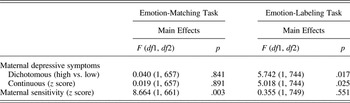
Maternal depressive symptoms did not predict children's emotion-matching accuracy. However, maternal depressive symptoms significantly predicted children's emotion-labeling accuracy (Table 2). Children of mothers with high levels of depressive symptoms were less accurate at labeling emotions than were children of mothers with no or mild symptoms. Analyses using continuous scores of maternal depressive symptoms confirmed this finding (Table 2). There were no significant interaction effects between maternal depressive symptoms and emotion category on children's emotion-matching or emotion-labeling accuracies (all ps > .05). Likewise, there was no significant interaction effect between mothers’ depressive symptoms and child sex for emotion-matching or emotion-labeling accuracies (all ps > .05).
Main effects of maternal depressive symptoms and maternal sensitivity on children's facial expression recognition
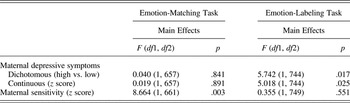
Note: Main effects are between-subjects effects of predictors examined separately using repeated measures analyses of variance. All models were adjusted for child's age, sex, basic matching/labeling ability, gestational age at birth, maternal age, education, marital status, parity, and prenatal smoking.
Next, we also ran separate regression models to determine whether the observed association between maternal depressive symptoms and children's emotion-labeling accuracy was driven by mothers’ postnatal or concurrent depressive symptoms. Outcomes were children's accuracy scores for emotion labeling, and predictors were either postpartum or concurrent maternal depressive symptoms. Models were adjusted for the same covariates as analyses including the composite maternal depression measure. Results indicated that the observed link between the composite maternal depression score and children's overall emotion-labeling accuracy was mainly due to mothers’ concurrent depressive symptoms dichotomous BSI depression scores: F (1, 670) = 4.436, p = .036; continuous BSI depression scores: F (1, 670) = 5.976, p = .015. The effect of maternal postpartum depressive symptoms on children's emotion-labeling accuracy did not reach statistical significance dichotomous BSI depression scores: F (1, 708) = 2.709, p = .100; continuous BSI depressions cores: F (1, 708) = 1.969, p = .161.
Maternal sensitivity and FER
Observed maternal sensitivity had a significant main effect on children's emotion-matching accuracy (Table 2). Children whose mothers were more sensitive generally matched emotions more accurately. In addition, the interaction effect of maternal sensitivity by emotion category was also significant for emotion-matching accuracy, F Greenhouse–Geisser (2.9, 1,912.6) = 8.648, p = .003. To specify the nature of the effect of maternal sensitivity on the different emotions, separate linear regressions were run for each emotion. Results indicated that children with more sensitive mothers especially matched sad faces (B = 0.046, SE = 0.017, p = .008) and angry faces (B = 0.061, SE = 0.017, p < .001) more accurately. Maternal sensitivity was not associated with children's emotion-labeling accuracy (all ps > .05). There was no significant interaction effect of maternal sensitivity by child sex on emotion-matching or emotion-labeling accuracy (all ps > .05).
Maternal depressive symptoms, maternal sensitivity, and FER
Results of the bootstrap analyses for emotion-matching accuracy are included in Appendix A and for emotion-labeling accuracy in Appendix B. Because all confidence intervals included 0, there was no evidence in the present sample that maternal sensitivity mediated the relationship between mothers’ depressive symptoms and children's FER.
Discussion
Despite the prevalence of maternal depression and its known negative effect on the offspring's emotional development, surprisingly few studies have examined the link between maternal depressive symptoms and young children's ability to accurately recognize emotional expressions. Furthermore, even fewer studies have incorporated measures of maternal sensitivity to further tease apart whether it is the depressive symptoms per se or the associated impact via maternal sensitivity that affects children's developing emotion-processing abilities. Thus, using data from a large-scale prospective longitudinal study, we examined the links among maternal depressive symptoms, observed maternal sensitivity, and preschoolers’ ability to process emotional facial expressions.
In line with our first hypothesis, maternal depressive symptoms were negatively associated with maternal sensitivity as observed in a laboratory setting. Other large-scale epidemiological studies have also reported negative associations between maternal depressive symptoms and observed sensitivity (Campbell et al., Reference Campbell, Brownell, Hungerford, Spieker, Mohan and Blessing2004, Reference Campbell, Matestic, von Stauffenberg, Mohan and Kirchner2007; NICHD ECCRN, 1999). In addition, our results also supported the finding of a previous meta-analysis that even subclinical levels of depressive symptoms are related to less sensitive maternal behavior (Lovejoy et al., Reference Lovejoy, Graczyk, O'Hare and Neuman2000). In the present study, this association was mainly explained by women's postpartum depressive symptoms. The negative impact of postpartum depression on mother–child interaction is well established in the literature (Beck, Reference Beck1995). The present results extend this literature by suggesting that symptoms of postpartum depression, whether or not they reach diagnosable levels, may have long-term consequences for how women interact with their offspring.
Our second hypothesis that maternal depressive symptoms would be associated with lower recognition accuracy for positive emotions and higher recognition accuracy for negative emotions in the offspring was not supported by the results. Instead, maternal depressive symptoms were linked to reduced accuracy in the offspring for labeling all emotions even after controlling for basic labeling ability. This association was mainly driven by concurrent assessment of maternal depressive symptoms. Most developmental studies have examined children's attentional biases in viewing emotional stimuli in relation to maternal depression. These studies all supported the presence of attentional biases for negative emotions, although the direction of this bias is still debated. Studies that used a negative mood induction found biased attention toward sad faces (Joormann et al., Reference Joormann, Talbot and Gotlib2007; Kujawa et al., Reference Kujawa, Torpey, Kim, Hajcak, Rose and Gotlib2011), while those without a mood induction reported attentional biases away from sad faces (Gibb et al., Reference Gibb, Benas, Grassia and McGeary2009). These studies typically included two categories of emotion (i.e., happiness and sadness) except for the one by Gibb et al. (Reference Gibb, Benas, Grassia and McGeary2009), which also included anger. In addition, they all examined school-aged children and young adolescents, while our participants were all of preschool age. One study that compared daughters of depressed women to daughters of never-depressed women in their ability to correctly identify happy, sad, and angry expressions of varying intensities reported that daughters of depressed women required greater intensities to correctly identify sad faces and made more errors in identifying angry faces than did daughters of never-depressed women (Joormann et al., Reference Joormann, Gilbert and Gotlib2010). In the present study, we used full-intensity expressions given the young age of our participants. The above-mentioned differences in study design make it difficult to compare our findings with these studies. Our observation of a generally reduced accuracy for labeling facial expressions fits with the results of a recent meta-analysis that reported robust global FER deficits among patients with major depression relative to healthy controls (Demenescu, Kortekaas, den Boer, & Aleman, Reference Demenescu, Kortekaas, den Boer and Aleman2010).
Single time-point analyses revealed that the effect of maternal depressive symptoms on children's emotion-labeling accuracy was concurrent rather than long lasting, at least in the present sample where the percentage of women reporting high or clinically meaningful levels of depressive symptoms was very low. The negative effect of concurrent maternal depression on the offspring is well documented in the literature (Brennan et al., Reference Brennan, Hammen, Andersen, Bor, Najman and Williams2000; Korhonen, Luoma, Salmelin, & Tamminen, Reference Korhonen, Luoma, Salmelin and Tamminen2012; Trapolini, McMahon, & Ungerer, Reference Trapolini, McMahon and Ungerer2007). Although the adverse consequences of postnatal depression for the child have also been widely shown, there is still contradiction as to whether these consequences are long term or diminish over time along with the reduction or remission of maternal depressive symptoms (Luoma et al., Reference Luoma, Tamminen, Kaukonen, Laippala, Puura and Salmelin2001). Some studies suggested a long-term impact only when the depression is chronic (Brennan et al., Reference Brennan, Hammen, Andersen, Bor, Najman and Williams2000; NICHD ECCRN, 1999). Our lack of finding of a longitudinal effect for postnatal maternal depressive symptoms might be because these symptoms were largely transient in the present low-risk sample (only three women reported high levels of depressive symptoms at both time points).
Noteworthy is that effects of maternal depressive symptoms emerged only on the verbal FER task. There is evidence that verbal and visuospatial FER abilities may follow different developmental trajectories in childhood (Vicari, Reilly, Pasqualetti, Vizzotto, & Caltagirone, Reference Vicari, Reilly, Pasqualetti, Vizzotto and Caltagirone2000). One potential explanation for this differential development lies in the underlying neurobiology of verbal and nonverbal or visuospatial FER. Studies using task paradigms similar to our nonverbal FER task have consistently reported increased bilateral amygdala activation (Hariri et al., Reference Hariri, Bookheimer and Mazziotta2000, Hariri, Mattay, Tessitore, Fera, & Weinberger, Reference Hariri, Mattay, Tessitore, Fera and Weinberger2003; Phillips et al., Reference Phillips, Williams, Heining, Herba, Russell and Andrew2004), whereas paradigms similar to our verbal FER task have been associated with increased prefrontal activation (Guyer et al., Reference Guyer, Monk, McClure-Tone, Nelson, Roberson-Nay and Adler2008, Phan, Wager, Taylor, & Liberzon, Reference Phan, Wager, Taylor and Liberzon2002). Prefrontal brain structures modulate emotional behavior through shaping the activation of the amygdala (Herba & Phillips, Reference Herba and Phillips2004). One study found that maternal depression was related to lower frontal brain activation in the offspring, which partly mediated the link between maternal depression and child behavioral problems at age 3 years (Dawson et al., Reference Dawson, Ashman, Panagiotides, Hessl, Self and Yamada2003). Although we did not examine brain activation patterns in the present study, it is plausible that maternal depressive symptoms lead to lower levels of prefrontal activation in children and that our verbal FER task was more sensitive to such differences than our nonverbal FER task. This hypothesis should be tested in future studies. Alternatively, it could be that children of mothers with depressive symptoms had difficulties connecting appropriate verbal labels to facial displays of emotion. Murray, Kempton, Woolgar, and Hooper (Reference Murray, Kempton, Woolgar and Hooper1993) found that the speech of depressed mothers was less focused on infant experience than that of well mothers. This may make it difficult for the developing child to create links between emotional experiences and appropriate verbal labels.
In the present study, we did not find evidence for a differential effect of maternal depressive symptoms on boys and girls in relation to their FER. Although gender differences have not been observed in rates of major depression during childhood, by adolescence girls are twice as likely to develop depressive disorders as boys (Lewinsohn, Clarke, Seeley, & Rhode, Reference Lewinsohn, Clarke, Seeley and Rohde1994). In parallel, a view emerging from previous reports on the effect of maternal depression on child outcome is that boys may be particularly vulnerable to the adverse effects of maternal depression from infancy through adolescence in terms of cognitive development (Hay et al., Reference Hay, Pawlby, Waters and Sharp2008; Kurstjens & Wolke, Reference Kurstjens and Wolke2001; Murray et al., Reference Murray, Arteche, Fearon, Halligan, Croudace and Cooper2010), reaction to less efficient maternal interactions associated with the disorder (Murray et al., Reference Murray, Kempton, Woolgar and Hooper1993), as well as school dropout (Ensminger, Hanson, Riley, & Juon, Reference Ensminger, Hanson, Riley and Juon2003). However, a recent review suggests that maternal depression may signal differential risk for boys and girls depending on the outcome (Beardslee et al., Reference Beardslee, Gladstone and O'Connor2011). As discussed in the introductory section, gender differences in children's emotion processing in relation to maternal depression are quite inconsistent. Two studies focused only on girls (Joormann et al., Reference Joormann, Talbot and Gotlib2007, Reference Joormann, Gilbert and Gotlib2010): one found an effect of maternal depression only for girls and not for boys (Kujawa et al., Reference Kujawa, Torpey, Kim, Hajcak, Rose and Gotlib2011), and one did not find sex differences at all (Gibb et al., Reference Gibb, Benas, Grassia and McGeary2009). Our study is consistent with the latest, which was incidentally the only study that, similar to ours, did not deploy negative mood induction.
Our third expectation, that observed maternal sensitivity would be associated with more accurate FER in children, was partially supported by the results. Children of more sensitive mothers performed better on our nonverbal FER task, especially at identifying sad and angry expressions. The NICHD ECCRN study (1999) also reported beneficial effects for maternal sensitivity on children's cognitive and social outcomes. Campbell et al. (Reference Campbell, Matestic, von Stauffenberg, Mohan and Kirchner2007) identified maternal sensitivity as an important, independent predictor of child outcome. Our finding that maternal sensitivity had a positive effect especially on identifying sad and angry faces may seem surprising at first glance. However, in one of our previous studies using the same sample (Székely et al., Reference Székely, Tiemeier, Arends, Jaddoe, Hofman and Verhulst2011) we reported that children found sad and angry faces the most difficult to identify on our nonverbal FER task. Thus, it may be that sensitive maternal behavior provides a more stimulating emotional environment, which in turn may further advance the development of nonverbal FER in children (De Haan et al., Reference De Haan, Belsky, Reid, Volein and Johnson2004).
For our fourth hypothesis, although we had expected that, to some extent, maternal sensitivity would explain the link between maternal depressive symptoms and children's FER, our results did not provide evidence for this hypothesis. This is in contrast with studies that reported a mediating role for maternal sensitivity in the association between maternal depression and poor child outcome (Campbell et al., Reference Campbell, Matestic, von Stauffenberg, Mohan and Kirchner2007). Nevertheless, our result is consistent with previous studies suggesting that maternal sensitivity does not explain the link between maternal depression and child outcome (Murray et al., Reference Murray, Sinclair, Cooper, Ducournau, Turner and Stein1999; NICHD ECCRN, 1999). Risk from depressed mother to child can also be transmitted via alternative pathways (Figure 1). Because the present study included a relatively low-risk sample and analyses were adjusted for contextual risk factors, we cannot comment on the role of contextual adversity in the transmission mechanism. Environmental factors, however, do not fully account for the risk posed to children of depressed mothers. Twin and adoption studies have suggested that genetics explain approximately 30% to 40% of the variance in adult major depression (Beardslee et al., Reference Beardslee, Gladstone and O'Connor2011). Risk for depression is significantly higher among first-degree relatives and the highest among the offspring of depressed parents (Rice, Harold, & Thaper, Reference Rice, Harold and Thaper2002). In addition to the notion that children of depressed parents inherit the likelihood for depression per se, heritability also contributes significantly to vulnerabilities to depression (Goodman, Reference Goodman2007; Goodman & Gotlib, Reference Goodman and Gotlib1999). Biased processing of emotional expressions is often implicated as a vulnerability marker of depression (Leppänen, Reference Leppänen2006) and is subserved by the same neural circuitry in the brain that is thought to be dysregulated in depression (Ressler & Mayberg, Reference Ressler and Mayberg2007).
In summary, maternal depressive symptoms and sensitivity both affected children's developing FER, but in different ways: maternal depressive symptoms had an overall negative effect on children's accuracy to label emotions, whereas sensitivity exerted more positive emotion-specific effects that were seen for the nonverbal FER task. The ability to accurately recognize emotional expressions is important for smooth social interaction and general well-being throughout life. For instance, in the same sample, we found that children who labeled angry expressions more accurately at age 3 years were rated by their parents as more prosocial on the corresponding scale of the Strengths and Difficulties Questionnaire (Goodman, Reference Goodman1997) at age 5 (unpublished data). Identifying early predictors and correlates of young children's FER is important to increase our understanding of normal and pathological socioemotional development.
Limitations
There are several strengths of the current study: it includes a large group of very young, typically developing children; maternal depressive symptoms were assessed prospectively from birth until the child's age of 3 years when the outcome, children's FER, was measured; maternal sensitivity was observed in our laboratory using structured interaction tasks; the outcome, children's FER, was assessed using computerized tasks specifically developed for this age group. However, despite these strengths we were faced with a number of limitations. First, although an important strength of our investigation is that our hypotheses were tested within the context of a prospective longitudinal study with data on a range of important variables covering the first years of life for a large number of children, high or clinically relevant depressive symptoms were generally rare and predominantly transient. This strongly limits the generalizability of our findings to clinical populations. Nevertheless, addressing our research questions within a less severely depressed population also allows for a more direct test of the influence of maternal depressive symptoms, because the effects of contextual stressors (e.g., poverty and very low maternal education) are minimized. Furthermore, the fact that we found negative associations even between subclinical levels of maternal depressive symptoms and children's emotion-labeling accuracy emphasizes the importance of studying the links between maternal depression and children's FER in the general population, thereby providing a conservative test of our hypotheses. Second, we relied on maternal self-reports of depressive symptoms. There are indications that self-report measures in community samples are more reflective of general “distress” rather than “true depression” (Atkinson et al., Reference Atkinson, Paglia, Coolbear, Niccols, Parker and Guger2000). However, self-report measures are commonly used in epidemiological studies, and the fact that maternal sensitivity and our outcome measures were independently assessed or observed minimizes any problems owing to shared methods variance. Third, we lacked information on maternal depressive symptoms between the first and third years of the child's life. Given the episodic nature of depression, we may have missed some women who experienced elevated levels of depressive symptoms only during this time period (Brennan et al., Reference Brennan, Hammen, Andersen, Bor, Najman and Williams2000). Nevertheless, in the current study we had information on postpartum and concurrent symptoms of depression, both of which have been shown to have important implications for poor child outcomes (Beck, Reference Beck1998; Brennan et al., Reference Brennan, Hammen, Andersen, Bor, Najman and Williams2000; Korhonen et al., Reference Korhonen, Luoma, Salmelin and Tamminen2012; Murray et al., Reference Murray, Sinclair, Cooper, Ducournau, Turner and Stein1999; Teti, Gelfand, Messinger, & Isabella, Reference Teti, Gelfand, Messinger and Isabella1995; Trapolini et al., Reference Trapolini, McMahon and Ungerer2007). Fourth, no information was available on children's verbal ability; therefore, analyses including emotion-labeling accuracy were not adjusted for this variable. Previous studies found that maternal depression is associated with lower vocabulary scores in children (Brennan et al., Reference Brennan, Hammen, Andersen, Bor, Najman and Williams2000), which, in turn, may affect the identification of more subtle emotional expressions (Camras & Allison, Reference Camras and Allison1985). However, the present study assessed the recognition of basic emotional expressions, and prior to the emotion-labeling task, experimenters made sure that children understood the emotion labels, referring to the four facial expressions they had to recognize throughout the task. Fifth, we had only cross-sectional observations of maternal sensitivity. In an ideal situation, the mediating variable is assessed before the outcome. In the present study, maternal sensitivity and children's FER were observed independently but during the same laboratory visit. However, possible reverse causality is generally less of a problem in negative studies.
Conclusion
Concurrent maternal depressive symptoms negatively impact young children's ability to verbally identify emotional expressions, while concurrent maternal sensitivity exerts a beneficial effect on children's ability to nonverbally identify emotional expressions. Given that maternal depressive symptoms and sensitivity affected nonoverlapping areas of children's FER and maternal sensitivity did not explain the association between mothers’ depressive symptoms and children's FER, prevention and intervention efforts should focus on both alleviating maternal depressive symptoms and improving maternal sensitivity at the same time in order to maximize benefit.
Appendix A
Mediation analyses: Testing indirect effects of maternal depressive symptoms on children's emotion-matching accuracy including maternal sensitivity as a potential mediator

Appendix B
Mediation analyses: Testing indirect effects of maternal depressive symptoms on children's emotion-labeling accuracy including maternal sensitivity as a potential mediator