Major depressive disorder with seasonal pattern (seasonal affective disorder, SAD) typically recurs in fall and winter and spontaneously remits in spring and summer (American Psychological Association, 2013). Seasonal changes in light exposure are thought to result in circadian misalignment and disturbed sleep patterns in SAD (Lewy, Sack, Singer, Whate, & Hoban, Reference Lewy, Sack, Singer, Whate and Hoban1988) including hypersomnolence, an excessive quantity of nighttime sleep (i.e. hypersomnia), daytime sleepiness, and/or sleep inertia (i.e. diminished sensory, motor, and cognitive function upon waking; American Psychological Association, 2013). Hypersomnia is considered a prominent symptom in SAD (Kaplan & Harvey, Reference Kaplan and Harvey2009; Rosenthal, Reference Rosenthal1984), despite discrepancies between self-report and behavioral measures of winter total sleep time (Kaplan & Harvey, Reference Kaplan and Harvey2009). It remains unclear whether hypersomnolent presentations are symptoms of winter depressive episodes or residual symptoms during summer remission. Hypersomnolence in mood disorders has been associated with treatment resistance and episode recurrence (Breslau, Roth, Rosenthal, & Andreski, Reference Breslau, Roth, Rosenthal and Andreski1996; Kaplan, Gruber, Eidelman, Talbot, & Harvey, Reference Kaplan, Gruber, Eidelman, Talbot and Harvey2011; Plante, Finn, Hagen, Mignot, & Peppard, Reference Plante, Finn, Hagen, Mignot and Peppard2017; Zimmerman et al., Reference Zimmerman, McGlinchey, Posternak, Friedman, Boerescu and Attiullah2005), underscoring the importance of understanding hypersomnolence in SAD. Multiple sleep measurements in-and-out of depressive episodes are critical for determining both the magnitude and time course of hypersomnolence in SAD.
Our current understanding of hypersomnolence in SAD may be inaccurate and primarily focuses on excessive sleep duration (i.e. hypersomnia). Although a majority (64–87%) of SAD participants report a winter increase in total sleep time (Kaplan & Harvey, Reference Kaplan and Harvey2009; Roecklein et al., Reference Roecklein, Carney, Wong, Steiner, Hasler and Franzen2013; Winkler et al., Reference Winkler, Willeit, Praschak-Rieder, Lucht, Hilger, Konstantinidis and Kasper2002) on questionnaires (e.g. Seasonal Pattern Assessment Questionnaire; Magnusson, Reference Magnusson1996) and clinical interviews [e.g. Structured Interview Guide for the Hamilton Depression Rating Scale, Seasonal Affective Disorder Version (SIGH-SAD); Williams, Link, Rosenthal, Amira, and Terman, Reference Williams, Link, Rosenthal, Amira and Terman1992], these metrics are mood-state dependent and vulnerable to retrospective recall bias. Prospective sleep diaries have similar limitations and show mixed findings of winter hypersomnia (Anderson et al., Reference Anderson, Rosen, Mendelson, Jacobsen, Skwerer, Joseph-Vanderpool and Rosenthal1994; Shapiro, Devins, Feldman, & Levitt, Reference Shapiro, Devins, Feldman and Levitt1994). Using actigraphy (Sadeh, Reference Sadeh2011), an underutilized and behavioral sleep metric in SAD, individuals with SAD (n = 17) had shorter winter sleep durations than controls and more fragmented sleep, with no differences in total sleep time (Winkler et al., Reference Winkler, Pjrek, Praschak-Rieder, Willeit, Pezawas, Konstantinidis and Kasper2005). Seasonal comparisons of rest–activity rhythms in SAD showed winter early evening settling (down-mesor), which correlated with greater fatigue (Smagula et al., Reference Smagula, DuPont, Miller, Krafty, Hasler, Franzen and Roecklein2018). Notably, self-reported hypersomnia in depression may be a function of long total sleep time, daytime sleepiness, fatigue, increased time in bed, maladaptive sleep cognitions, and/or fragmented sleep (Harvey, Reference Harvey2011; Kaplan & Harvey, Reference Kaplan and Harvey2009; Roecklein et al., Reference Roecklein, Carney, Wong, Steiner, Hasler and Franzen2013). It is possible that multiple sleep disruptions may be conflated with self-reported hypersomnia in SAD. To systematically characterize the extent and nature of hypersomnolence in SAD we employed a comprehensive assessment of actigraphy, sleep diaries, and retrospective self-reports during winter depressive episodes and summer remission.
Self-reported hypersomnolence in SAD may be an artifact of delayed circadian timing. Low winter environmental light levels are hypothesized to delay circadian timing in SAD leading to misalignment with the sleep/wake cycle (Lewy, Lefler, Emens, & Bauer, Reference Lewy, Lefler, Emens and Bauer2006). Misalignment resulting from delayed circadian timing can manifest behaviorally as sleep onset insomnia and morning sleep inertia. After a night of difficulty initiating sleep, individuals might sleep-in the next morning, nap, or sleep longer the following night (Bond & Wooten, Reference Bond and Wooten1996), which may be experienced subjectively as excessive sleep duration and/or daytime sleepiness.
The current study aims to address discrepancies surrounding hypersomnolence in SAD by characterizing sleep in SAD using multiple metrics, across seasons, and relative to nonseasonal, never-depressed controls. Our first aim compared seasonal changes in total sleep time, time in bed, sleep fragmentation, sleep midpoint, regularity, and sleepiness between participants with SAD and controls on actigraphy, sleep diaries, and retrospective self-report measures. We included sleep midpoint as a proxy for circadian timing, and regularity of total sleep time to measure oscillations of nightly sleep length. Our second aim examined correlates of self-reported winter hypersomnia in SAD. Our third aim measured agreement between self-report and actigraphic measures of total sleep time.
Methods
Participants
We recruited participants aged 18–65 through the Pitt+Me® Research Participant Registry, an institutional research participant registry in Pittsburgh, Pennsylvania (latitude: 40°26′N) from 2013 to 2019. Study procedures were explained prior to obtaining and documenting informed consent. The University of Pittsburgh Institutional Review Board approved all study procedures prior to participant recruitment, and the research was conducted in accordance with the Helsinki Declaration as revised in 1989. Individuals with a substance-induced mood disorder, psychotic disorders, bipolar disorder, sleep disordered breathing, narcolepsy, or shift-workers were excluded. Participants completed a health questionnaire that assessed retinopathology (as part of a larger study looking at retinal responsivity in SAD) and sleep disorders. Both controls and individuals with SAD were invited to complete a semi-structured interview, questionnaires, and sleep diaries and actigraphy measures. Participants were assessed in the winter (21st December to 21st March) during a major depressive episode and during spontaneous summer remission (21st June to 21st September). The following assessments were used to assess inclusion and exclusion criteria.
Clinical assessments
SCID
The Structured Clinical Interview for DSM-V, Research Version, Patient Edition With Psychotic Screen was used to assess for a lifetime mood disorder diagnoses and to screen for select comorbid Axis I disorders (SCID-I/P; First, Reference First2015). Individuals in the SAD group were diagnosed with Major Depressive Disorder with Seasonal Pattern. Individuals in the control group had no lifetime history of any mood disorder.
SIGH-SAD
The Structured Interview Guide for the Hamilton Rating Scale for Depression-Seasonal Affective Disorder Version (SIGH-SAD) is the most commonly used clinical assessment for measuring SAD symptoms (Williams et al., Reference Williams, Link, Rosenthal, Amira and Terman1992) and has been shown to have high inter-rater reliability (0.923–0.967; Rohan et al., Reference Rohan, Rough, Evans, Ho, Meyerhoff, Roberts and Vacek2016). The SIGH-SAD is a 29-item semi-structured interview that includes the 21-item Hamilton Rating Scale for Depression (HAM-D) and eight items assessing atypical symptoms of depression. Inclusion criteria for SAD were a total SIGH-SAD score of ⩾20 with ⩾5 on the atypical depressive symptom subscale (Terman, Terman, & Rafferty, Reference Terman, Terman and Rafferty1990). Individuals in the control group did not meet criteria for a current episode in either season.
Reports from SIGH-SAD item A6 were used to characterize self-reported hypersomnia in aim 2. The SIGH-SAD assesses hypersomnia by asking individuals: ‘Have you been sleeping more than usual this past month? How much more?’ with responses selected from (0) no increase in sleep length, (1) at least one hour longer, (2) at least two hours longer, (3) at least three hours longer, or (4) four or more hours longer. Interviewers must first establish euthymic (i.e. summer) total sleep time, as well as current total sleep time, and include naps in the estimate of total daily total sleep time averaged across the past week when scoring this item.
Self-report questionnaires
Pittsburgh sleep quality index (PSQI)
The PSQI is a self-report measure of sleep characteristics and quality (Buysse, Reynolds, Monk, Berman, & Kupfer, Reference Buysse, Reynolds, Monk, Berman and Kupfer1989). It distinguishes ‘good sleepers’ from ‘poor sleepers’ with high specificity and has a high internal consistency (Cronbach α = 0.85; Buysse et al., Reference Buysse, Reynolds, Monk, Berman and Kupfer1989). The global PSQI score ranges from scores of 0 to 21 with higher scores being more indicative of disturbed sleep. We extracted self-reported measures of total sleep time and time in bed from the PSQI for analyses.
Chalder fatigue measure (CFM)
The CFM is a self-report measure of the severity of physical and mental fatigue (Chalder et al., Reference Chalder, Berelowitz, Pawlikowska, Watts, Wessely, Wright and Wallace1993). Participants rate 11-items as being less than usual = 0, no more than usual = 1, worse than usual = 2, or much worse than usual = 3 (Chalder et al., Reference Chalder, Berelowitz, Pawlikowska, Watts, Wessely, Wright and Wallace1993). All items are summed for a total CFM score. The CFM has high internal consistency (Cronbach's α = 0.89), and internal reliability (r = 0.86 for physical fatigue, and r = 0.85 for mental fatigue; Chalder et al., Reference Chalder, Berelowitz, Pawlikowska, Watts, Wessely, Wright and Wallace1993). Total scores for the CFM were used to predict hypersomnia in aim 2.
Epworth sleepiness scale (ESS)
The ESS is a self-report scale in which participants rate their likelihood of dozing off under various circumstances from 0 (no chance) to 3 (high chance; Johns, Reference Johns1991). Scores range from 0 to 24, with higher scores indicating greater daytime sleepiness. The ESS has a high test–retest reliability in healthy individuals over a 5-month period (r = 0.82) as well as a high internal consistency (Cronbach's α = 0.88; Johns, Reference Johns1991). The ESS total score was compared across groups and seasons in aim 1 and used as a predictor of self-reported hypersomnia in aim 2.
Composite scale of morningness (CSM)
The CSM is a 13-item self-report scale of circadian preference, in which participants rate their propensity for sleep and activity timing (Smith, Reilly, & Midkiff, Reference Smith, Reilly and Midkiff1989). Scores range from 13 to 55, with higher scores indicative of earlier circadian preference (13–26 evening-preference; 27–41 intermediate-preference; 42–55 morning-preference; Natale & Alzani, Reference Natale and Alzani2001). The CSM total score was used as a predictor of self-reported hypersomnia in aim 2.
Sleep diaries
Participants completed daily sleep diaries (Buysse et al., Reference Buysse, Reynolds, Monk, Berman and Kupfer1989) for 5–20 nights (average of 8.41 nights). The sleep diary variables reported include: (1) Time in bed: the duration between ‘went to bed time’ and ‘woke up time’, (2) Total sleep time: the duration of sleep between ‘lights out time’ and ‘woke up time’ after accounting for both sleep onset latency and nighttime awakenings, (3) Wake time after sleep onset (WASO): the number of minutes participants reported being awake during the night, (4) Sleep midpoint: a proxy for circadian timing to determine if self-reports of hypersomnolence are a function of delayed sleep timing, and (5) 24-h total sleep time: total sleep time plus the duration of daytime naps.
Actigraphy
Participants wore an Actiwatch Spectrum (Philips Respironics, Bend, OR, USA) on their non-dominant wrist for 5–26 days (average of 10 nights). Actigraphy data were recorded continuously and sampled in 30-s epochs. The actigraphy-based sleep–wake variables were determined using Actiware software program (Philips Respironics) with total activity counts above the threshold sensitivity value of 40 counts/per epoch. Rest intervals were manually set using sleep diary information, event markers, and/or a cutoff of activity below 40 counts. These rest intervals bookended our determination of time in bed. The actigraphy variables being reported include: (1) Time in bed: the duration between onset and offset of the rest interval, (2) Total sleep time: the number of minutes scored as sleep during the primary sleep period, (3) Wake time after sleep onset (WASO; the number of minutes scored as wake during the sleep period, (4) Regularity: the variability of each participant's total sleep time calculated as the standard deviation (s.d.) of total sleep time for each individual, (5) Sleep midpoint: the halfway point between sleep onset and sleep offset; a proxy for circadian timing, and (6) 24-h total sleep time: total number of minutes in a 24-h period scored as sleep, includes daytime naps.
Statistical analysis
All statistical procedures were conducted using R Studio 1.1.463 (R Core Team, 2017). Unadjusted means and s.d.s of sleep and circadian variables were calculated, and group differences in age and gender were tested using multilevel regression and chi-square analyses, respectively. Seasonal changes in depressive symptoms measured by the SIGH-SAD were tested using a mixed-effects negative binomial model with the glmmTMB package (Brooks et al., Reference Brooks, Kristensen, van Benthem, Magnusson, Berg, Nielsen and Bolker2017).
Aim 1: seasonal sleep changes across diagnostic groups
We fit three linear mixed-effects models (actigraphy, sleep diaries, and PSQI) comparing sleep variables between diagnostic group (SAD v. controls), season (winter v. summer), and the group by season interaction adjusting for age and gender, with a random intercept. Sleep-dependent variables included time in bed, total sleep time, 24-h total sleep time, sleep midpoint, WASO, regularity, and sleepiness. Initial examination of the raw data indicated high frequencies of naps on both actigraphy and sleep diaries. Given that self-reported hypersomnnia on the SIGH-SAD includes daytime nap duration in addition to nightly total sleep time, we included 24-h total sleep time as a separate analysis. Linear mixed-models account for both multiple nightly measures (actigraphy and diaries) and repeated seasonal assessments while retaining all available data. Models were fitted with the lme4 package (Bates, Mächler, Bolker, & Walker, Reference Bates, Mächler, Bolker and Walker2015) using restricted maximum likelihood. We used Satterthwaite approximations from lmerTest (Kuznetsova, Brockhoff, & Christensen, Reference Kuznetsova, Brockhoff and Christensen2017) to derive p values and degrees of freedom as these approximations have shown to produce acceptable type 1 error rates in previous simulations (Luke, Reference Luke2017). To control for multiple comparisons, we used the adaptive Benjamini–Hochberg procedure (Benjamini & Hochberg, Reference Benjamini and Hochberg2016; Glickman, Rao, & Schultz, Reference Glickman, Rao and Schultz2014; Stevens, Masud, & Suyundikov, Reference Stevens, Masud and Suyundikov2017).
Aim 2: explaining self-reported hypersomnia
We examined which factors best account for self-reported winter hypersomnia (question A-6 of the SIGH-SAD). We first dichotomized A-6 into (1) no increase in sleep length and (2) at least an hour increase and compared it across diagnostic groups in winter. Multiple logistic regression included the following predictors: total sleep time, time in bed, age, gender, sleepiness, fatigue, circadian preference, actigraphic average nap duration, sleep midpoint, and depression severity measured by the total SIGH-SAD score excluding sleep and fatigue items. To separate the unique contributions of naps and total sleep time, 24-h total sleep time was not included in this analysis. Models were examined for multicollinearity using variance inflation factors, which led us to analyze total sleep time and time in bed separately. Goodness of fit between the total sleep time and time in bed models was compared using a likelihood ratio test (Hu, Pavlicova, & Nunes, Reference Hu, Pavlicova and Nunes2011). McFadden's pseudo-R 2 was calculated to determine the improvement in model likelihood over the null model for each model (Hemmert, Schons, Wieseke, & Schimmelpfennig, Reference Hemmert, Schons, Wieseke and Schimmelpfennig2018). Both crude and adjusted odds ratios (ORs) and 95% confidence intervals (CIs) were calculated.
Aim 3: agreement between self-report and actigraphic measures of total sleep time
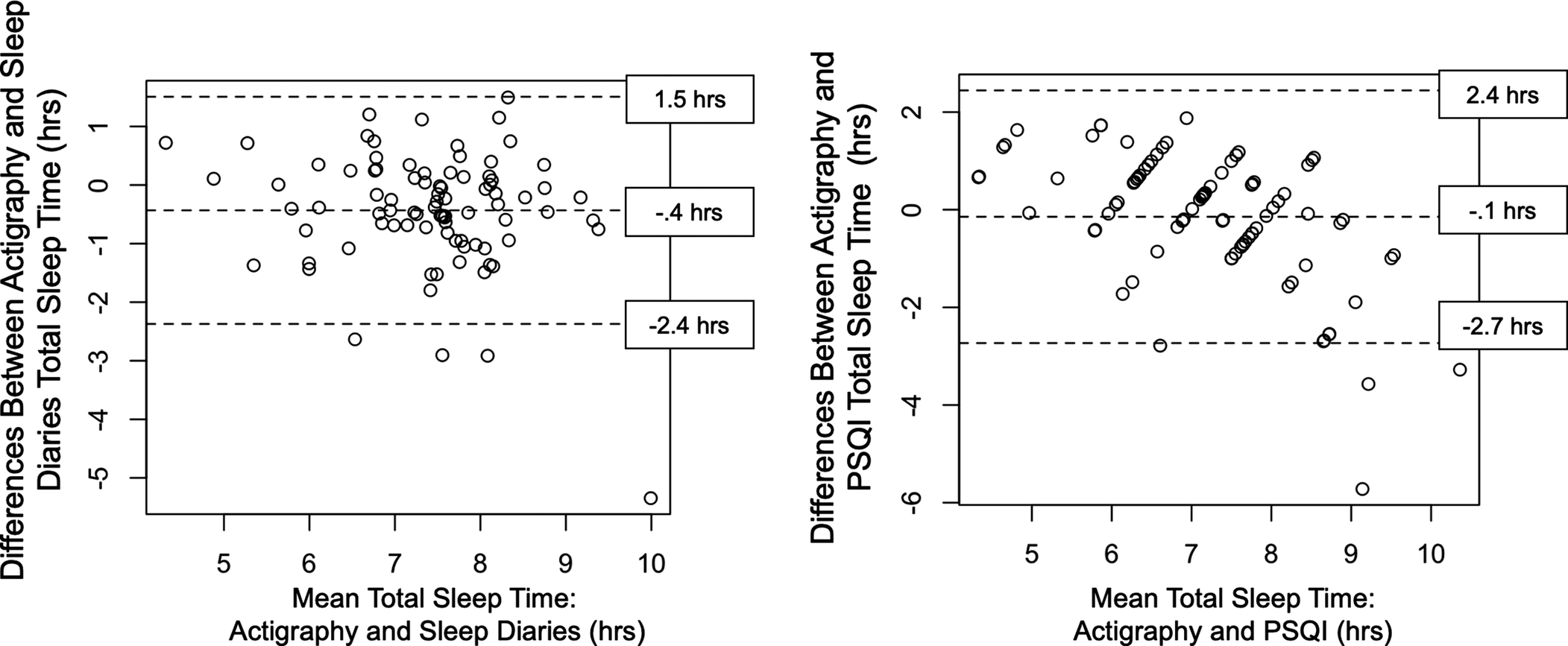
We used a Bland–Altman analysis to assess the degree of measurement agreement between total sleep time assessed via actigraphy compared to self-reported total sleep time from sleep diaries and the PSQI in SAD (Bland & Altman, Reference Bland and Altman1986). Horizontal lines were drawn at the mean difference and at the limits of agreement, defined as the mean difference ±1.96 times the s.d. of the differences (Bland & Altman, Reference Bland and Altman1986).
Results
Sample description
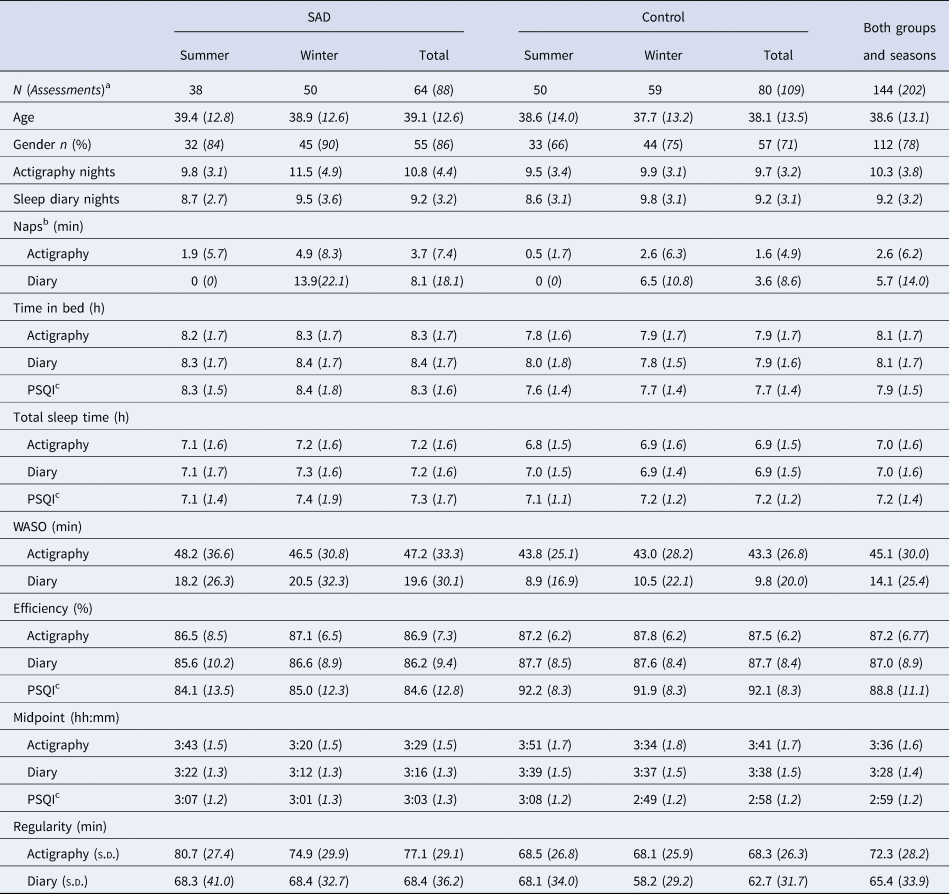
Our total sample comprised of 64 individuals with SAD and 80 nonseasonal controls with no history of depression (N = 144). Some participants attended both summer and winter assessments, yielding 92 SAD and 110 control assessments for 202 total assessments across 144 unique participants (Table 1). Age did not differ between groups (F 1,122.39 = 0.004, p = 0.947), but there were significantly more women in the SAD group than in the control group (χ2 = 4.4, p = 0.035). Age and gender were included as covariates in all analyses below. Consistent with diagnostic criteria, depression severity measured by the SIGH-SAD was significantly higher in the SAD group during the winter (b = 0.94, s.e. = 0.23, p < 0.001) compared to controls. On average, participants completed 10.3 nights of actigraphic monitoring and 9.2 nights of sleep diaries. Groups did not differ on number of actigraphic nights (F 1,141.41 = 3.3, p = 0.073) or number of sleep diary assessments (F 1,122.39 = 0.004, p = 0.947).
Demographic and sleep characteristics of the sample presented as mean (s.d.) except where indicated

a Not all participants came for both a summer and winter visit. ‘Assessments’ represents the total number of visits in the study.
b Weighted average nap duration.
c Pittsburgh Sleep Quality Index.
Aim 1: seasonal sleep changes across diagnostic groups
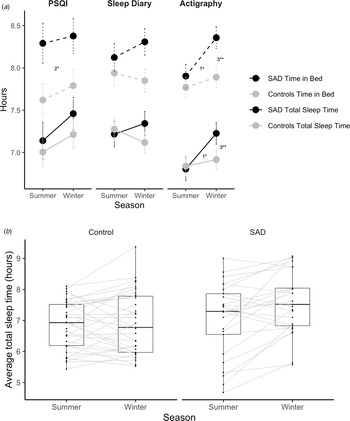
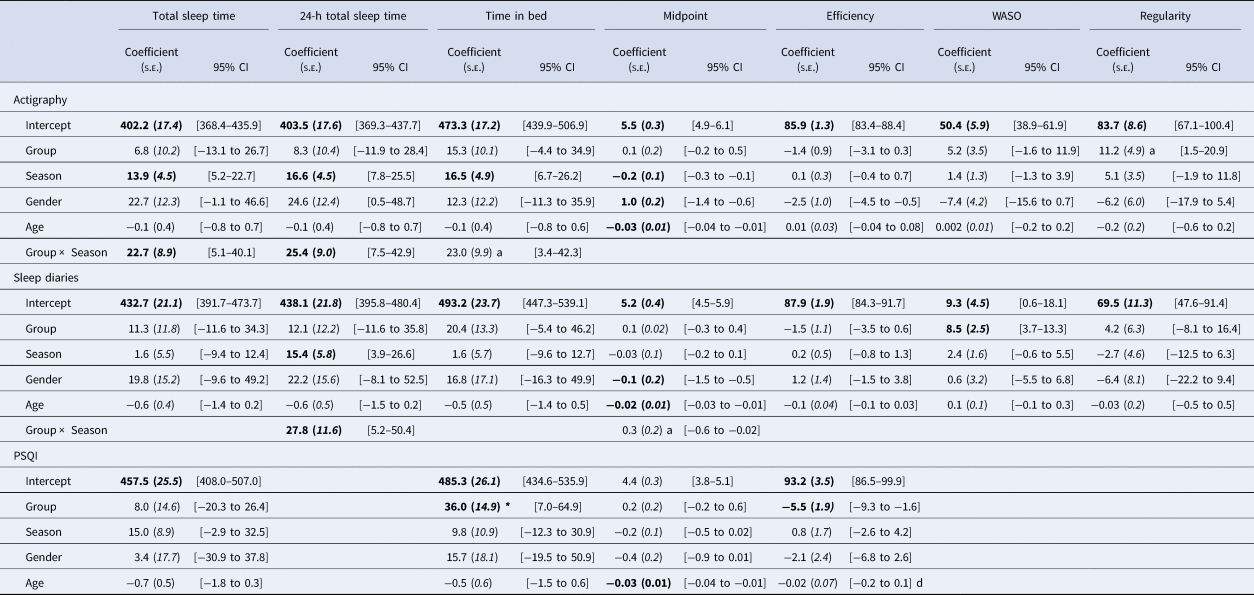
Unadjusted means and s.d.s of sleep and circadian variables from actigraphy, sleep diaries, and the PSQI are shown in Table 1. Results of the mixed-effects models are shown in Table 2. Of the 202 individual actigraphic assessments across seasons, 192 participants (95%) had complete PSQI data and 158 participants (78%) completed sleep diaries for at least five nights. Figure 1a provides a visual depiction of both time in bed and total sleep time for actigraphy, sleep diaries, and the PSQI across groups and seasons. Figure 1b depicts seasonal changes in total sleep time.
(a) Conditional means for total sleep time and time in bed across seasons for both diagnostic groups to account for repeated nights and seasons of participants. Error bars represent standard errors. There was a significant group by season interaction for actigraphic total sleep time (b = 23 min; p = 0.011). The group by season interaction for actigraphic time in bed did not survive corrections for multiple comparisons (b = 23 min; p = 0.020). In both seasons, individuals with SAD reported spending 36 min longer in bed on the PSQI (p = 0.017). 1Group by season interaction; 2group main effect; 3season main effect. *p < 0.05; **p < 0.01. aNot significantly different after adjusting for BH. (b) Spaghetti plots showing individual change in mean actigraphic total sleep times for participants with both winter and summer assessments.

Mixed-effects models comparing measures of sleep and rhythms by diagnostic groups and seasons

Estimates represent unstandardized beta coefficients. Bold = p < 0.05.
a Not significant BH correction.
There was a significant interaction for actigraphic total sleep time between diagnostic group (SAD v. controls) and season (winter v. summer). Individuals with SAD slept 23 min longer during the winter than in the summer, with no seasonal effect for controls (p = 0.011). A similar interaction was shown using both actigraphy and sleep diaries predicting 24-h total sleep time. Actigraphic total sleep time during a 24-h period was 25 min longer on actigraphy (p = 0.005) and 27 min longer on sleep diaries (p = 0.016) in the SAD group in winter than in summer with no seasonal effect in controls. The group by season interaction for actigraphic time in bed did not survive corrections for multiple comparisons (b = 23 min; p = 0.020). However, individuals with SAD reported spending 36 min longer than controls in bed on the PSQI when data were collapsed across seasons (i.e. main effect of group; p = 0.017).
When examining other dimensions of sleep, both groups had earlier sleep midpoints on actigraphy in winter compared to summer by an average of 11 min (p = 0.004). The group by season interaction for sleep diary midpoint did not withstand correction for multiple comparisons (b = −0.29; p = 0.035). Furthermore, individuals with SAD reported 9 min more WASO on sleep diaries than controls in both seasons (p < 0.001). Individuals with SAD had more irregularity in their night-to-night sleep length; however, this finding did not survive correction for multiple comparisons (b = 12 min; p = 0.026). Individuals with SAD had global PSQI scores (M = 7.3; s.d. = 3.5) above the clinical cut-off of 5 (Buysse et al., Reference Buysse, Reynolds, Monk, Berman and Kupfer1989), and higher than controls (M = 3.2, s.d. = 2.2). PSQI-assessed global sleep quality was 3.8 points higher in individuals with SAD compared to controls when data were collapsed across seasons (i.e. main effect of group; p < 0.001). Similarly, individuals with SAD reported greater daytime sleepiness (M = 8.9; s.d. = 4.4) than controls (M = 5.6; s.d. = 3.8; i.e. main effect of group; b = 2.6; p < 0.001), although this fell within the normal range of daytime sleepiness (Johns, Reference Johns1991).
Aim 2: explaining self-reported hypersomnia
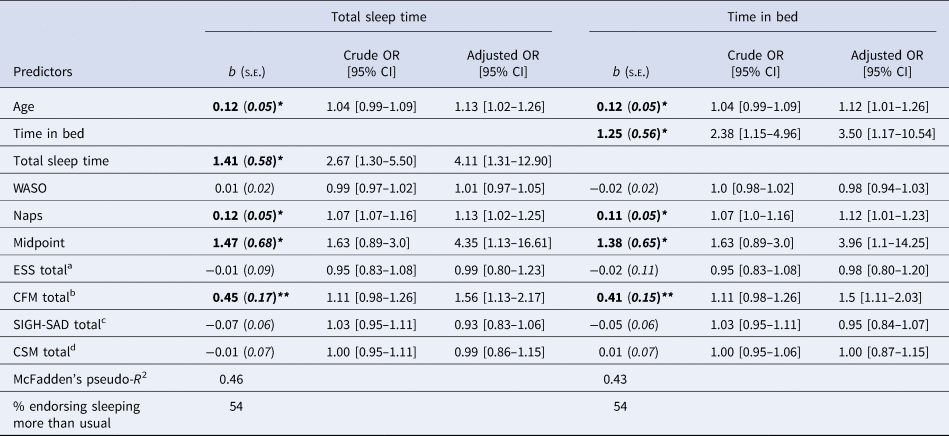
Consistent with previous reports, participants with SAD differed from controls on clinician-rated interviews of self-reported presence of winter hypersomnia (question A6 of the SIGH-SAD) endorsing hypersomnia more frequently than controls (b = 2.04; s.e. = 0.499; p < 0.001). Individuals with SAD reported sleeping an average of 1.2 h longer than usual (s.d. = 1.35 h), while the control group reported sleeping an average of 0.23 h more than usual (s.d. = 0.69 h). There were 48 SAD participants (86%) with complete winter actigraphy, sleepiness, and fatigue data available for this analysis and over half (26 participants) endorsed hypersomnnia.
In the total sleep time model, age (AOR = 1.13, p = 0.042), total sleep time (AOR = 4.11, p = 0.015), naps (AOR = 1.13, p = 0.020), sleep midpoint (AOR = 4.35, p = 0.033), and fatigue (AOR = 1.56, p = 0.008) all significantly predicted endorsement of self-reported winter hypersomnia. In the time in bed model, age (AOR = 1.12, p = 0.03714), time in bed (AOR = 3.50, p = 0.026), sleep midpoint (AOR = 3.96, p = 0.035), naps (AOR = 1.12, p = 0.026), and fatigue (AOR = 1.50, p = 0.008) all significantly predicted endorsement of self-reported winter hypersomnia. Fatigue, later sleep midpoints and longer actigraphic total sleep time, time in bed and naps were all statistically associated with self-reported winter hypersomnia in SAD (Table 3).
Logistic regression of self-reported hypersomnolence during the winter months in SAD

a Epworth Sleepiness Scale.
b Chalder Fatigue Measure.
c Structured Interview Guide for the Hamilton Rating Scale for Depression – Seasonal Affective Disorder Version total score.
d Composite Scale of Morningness.
*p < 0.05; BH correction applied.
Aim 3: self-report v. actigraphy measurement agreement in SAD
Among participants with SAD, differences in agreement between actigraphy total sleep time and sleep diary or PSQI total sleep time are depicted with Bland–Altman plots (Fig. 2). Mean differences were calculated by subtracting either sleep diary or PSQI reported total sleep time from actigraphic total sleep time. Positive mean differences depict greater actigraphic total sleep time relative to sleep diaries or PSQI reports. Sleep diary total sleep time was greater than actigraphy by 24 min with limits of agreement varying by ±1.95 h. PSQI total sleep time was greater than actigraphy by 6 min with limits of agreement ranging from ±2.5 h. However, individuals with longer average total sleep time on both actigraphy and the PSQI reported longer total sleep times on the PSQI compared to actigraphy whereas individuals with shorter average total sleep time on both actigraphy and the PSQI reported shorter total sleep times on the PSQI compared to actigraphy. Both self-report measures yielded higher total sleep time compared to actigraphy, as shown by a higher prevalence of negative mean differences in Fig. 2.
Bland–Altman plots comparing actigraphy and sleep diaries (left panel) and comparing actigraphy and the Pittsburgh Sleep Quality Index (PSQI; right panel) for total sleep time in SAD. The middle-dashed line indicates the means of the differences (in h) between the two methods. The dashed lines above and below those means indicate the 95% limits of agreement (1.96 × the s.d. of the mean difference). Positive values indicate greater total sleep time measured by actigraphy.

Discussion
Hypersomnolence has largely been accepted as the prototypical sleep disturbance in SAD; however, the present findings provide mixed evidence for hypersomnolence which depends, in part, on the assessment method. During winter depressive episodes, participants with SAD reported sleeping 1.2 h longer than in summer based on the SIGH-SAD clinical interview and had a seasonal increase in total sleep time that was not evident in controls when measured using actigraphy. Yet, participants with SAD did not report longer winter sleep times on either prospective sleep diaries or retrospective self-reports (PSQI). Despite a seasonal increase in actigraphic sleep, the mean actigraphy-based total sleep time during the winter in SAD (7.2 h) was well below the clinical cut-off for the duration criterion of hypersomnolence (>9–10 h; American Psychological Association, 2013) and the average level of daytime sleepiness (8.9, ESS) was also below threshold (>11; Johns, Reference Johns1991), suggesting that the majority of participants with SAD do not exhibit a clinically significant degree of hypersomnolence. Furthermore, individuals reporting a winter increase of sleep on the SIGH-SAD averaged between 6 and 9 h on actigraphy, underscoring the need for multiple measures of sleep duration when assessing hypersomnia in mood disorders.
Assessing self-reported winter hypersomnolence in SAD with daily diaries and/or actigraphy would be critical for informing treatment choice (Kaplan & Harvey, Reference Kaplan and Harvey2009). Although self-reported winter hypersomnia was not correlated with depression symptom severity, it was associated with increased actigraphic time in bed, napping, and fatigue. These factors may reflect a desire for more restful sleep, anhedonia, or behavioral inactivation. Given the low rates of clinical hypersomnia in this sample, and greater total sleep times, naps, and sleep fragmentation during the winter, individuals with SAD reporting hypersomnia should be further assessed for napping, sleep fragmentation, and fatigue rather than exclusively assessed on nightly total sleep time. Potential underlying comorbidities, such as restless leg syndrome, periodic limb movement disorder, and/or sleep apnea, should be considered to disentangle greater winter total sleep times, naps, and sleep fragmentation in SAD. Furthermore, the longest sleepers with SAD reported even greater total sleep time on the PSQI relative to their actigraphy total sleep time whereas the shortest sleepers with SAD reported sleeping even less on the PSQI compared to their actigraphy total sleep time. This biphasic relationship resembles sleep discrepancies commonly seen in insomnia (Harvey & Tang, Reference Harvey and Tang2012), and is extended here to longer sleepers. For the average SAD participant, cognitive behavioral therapy for insomnia (CBT-I) or behavioral activation interventions may be more helpful than hypersomnia-focused interventions. A particular focus may be placed on limiting time in bed, which could lead to more consolidated sleep by increasing homeostatic sleep pressure (Maurer, Espie, & Kyle, Reference Maurer, Espie and Kyle2018). We recommend using multiple measures of sleep duration for those reporting hypersomnia to inform treatment choice while weighing participant burden against retrospective recall bias.
Although later winter sleep midpoints were associated with endorsing hypersomnia, both groups had earlier sleep midpoints during the winter months suggesting that neither late nor early sleep timing is the predominant phenotype in SAD during winter depressive episodes. Although the phase-shift hypothesis presumes a winter phase-delay in circadian rhythms that are out of sync with the sleep/wake cycle (Lewy et al., Reference Lewy, Sack, Singer, Whate and Hoban1988), this is not true for all participants (Burgess, Fogg, Young, & Eastman, Reference Burgess, Fogg, Young and Eastman2004; Eastman, Gallo, Lahmeyer, & Fogg, Reference Eastman, Gallo, Lahmeyer and Fogg1993). This heterogeneity of sleep and circadian timing in SAD could explain non-responders to morning bright light therapy – the current gold standard treatment of SAD (Burgess et al., Reference Burgess, Fogg, Young and Eastman2004; Lewy et al., Reference Lewy, Lefler, Emens and Bauer2006; Wescott, Soehner, & Roecklein, Reference Wescott, Soehner and Roecklein2020). However, it is still possible that markers of circadian phase such as dim-light melatonin release onset (DLMO) may be delayed relative to the sleep/wake cycle in winter in the current sample.
Although our group-means analytic approach was not designed to elucidate subgroups, our findings indicated significant heterogeneity of winter sleep in SAD. Almost half (43%) of participants with SAD did not endorse self-reported winter hypersomnia on the SIGH-SAD and the majority (68%) did not have any winter naps. Means-focused analyses obscure the range of presentations or subgroups (Wescott et al., Reference Wescott, Soehner and Roecklein2020). Efforts to identify and characterize sleep subgroups associated with recurrence and/or symptom severity are needed to guide sleep-focused interventions in SAD.
Strengths and limitations
This study benefitted from the use of multiple metrics of sleep assessment during both winter depressive episodes and summer remission, and is the largest actigraphic study in SAD compared to nonseasonal, never-depressed controls. One limitation is the use of a single-item assessment of self-reported hypersomnia, although this was done intentionally as it is the most common measurement of sleep duration in SAD. Incorporating a more granular assessment of hypersomnolence, including objective measures of daytime sleepiness such as the multiple sleep latency test (Arand et al., Reference Arand, Bonnet, Hurwitz, Mitler, Rosa and Sangal2005), would be informative. Lack of objective assessments of comorbid sleep disorders such as sleep apnea and narcolepsy was another limitation of this study. Additionally, actigraphy-based sleep midpoint is at best a proxy for circadian timing and also reflects the behavioral sleep/wake cycle, thus limiting our ability to assess circadian misalignment. Future assessments should include physiological measures of circadian timing, such as DLMO or core body temperature nadir.
Conclusions and future directions
Despite a winter increase in total sleep time and elevated daytime sleepiness, the majority of participants with SAD do not sleep longer than 9 h and did not endorse abnormal levels of daytime sleepiness making hypersomnolence a poor general characterization of SAD. Sleep-targeted interventions have been effective in nonseasonal depression (Manber et al., Reference Manber, Edinger, Gress, Pedro-Salcedo, Kuo and Kalista2008), often focusing on insomnia. Future research directions include measuring targets of behavioral treatments such as Transdiagnostic Intervention for Sleep and Circadian Dysfunction (Harvey et al., Reference Harvey, Hein, Dong, Smith, Lisman, Yu and Buysse2016), and/or CBT-I, and prospective measurement of sleep during spontaneous remission to predict subsequent depression recurrence and severity. We recommend following up self-reports of hypersomnolence with multimodal assessments of sleep and rest–activity rhythms to accurately identify treatment targets.
Data
The data underlying this article will be shared on a reasonable request to the corresponding author.
Financial support
This research was supported by the National Institute of Health (R03MH 096119-01A1; R01MH 103313-02; and T32 HL082610).