Introduction
Fungi that occur obligately on lichens, lichen-inhabiting or lichenicolous fungi, are a specialized ecological and species-rich group. Almost all are restricted to particular lichen hosts, commonly to individual lichen-forming families, genera or species, and biologically they tend to be commensals or gall-formers rather than pathogens (Hawksworth Reference Hawksworth2003, Lawrey & Diederich Reference Lawrey and Diederich2003). These fungi might be expected to be well-represented in Antarctica in view of the predominance and variety of lichens on rocks in the continent which extend to 86°29'S (Øvstedal & Smith Reference Øvstedal and Smith2001), but have received scant attention from recent researchers (e.g. Etayo Reference Etayo2006). Only ten lichenicolous species were included in the catalogue of the fungi of Antarctica, the sub-Antarctic zone and Falkland Islands (Pegler et al. Reference Pegler, Spooner and Smith1980), and reports of subsequently discovered species are included under their host lichens in Øvstedal & Smith (Reference Øvstedal and Smith2001). The list of fungal genera known from the Antarctic compiled by Bridge & Spooner (Reference Bridge and Spooner2012) includes 12 obligately lichenicolous genera. Several species described as new to science from Antarctica by early researchers, however, remained of uncertain status, but were subsequently re-investigated and several were confirmed as apparently restricted to the continent (Hawksworth & Iturriaga Reference Hawksworth and Iturriaga2006).
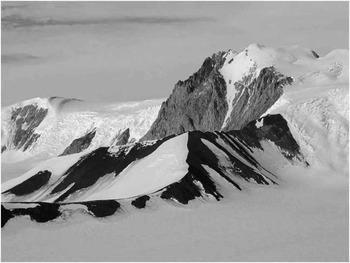
In 2003 and 2011, lichenological studies were conducted on Mount Kyffin (83°48'S, 171°38'E), one of the most southerly areas in which rocks are exposed in Antarctica. The mountain is located at the southern side of Beardmore Glacier, not far from the confluence with the Ross Ice Shelf. Mount Kyffin stands out in the coastal landscape because of its altitude and its unique shape. The mountain summit resembles a boat prow, with a vertical cliff rising hundreds of metres above the glacier. The substrate is formed mainly by dark greywacke and brown or red-brown granite intrusions. The mountain has a number of ridges that gently penetrate through the ice allowing easy access to the rocky exposures. One of the main ridges, Ebony Ridge (Fig. 1), has a rich lichen assemblage, originally detected by the first New Zealand Alpine Club Antarctic Expedition to the region in the 1959–60 season (Cawley Reference Cawley1960, Tyndale-Biscoe Reference Tyndale-Biscoe1960). This century, the area has been carefully explored by lichenologists who have detected an amazing diversity of lichens that can only be compared in Antarctica with the open sea coast of Cape Hallett, over 1200 km north (Green et al. Reference Green, Sancho, Türk, Seppelt and Hogg2011, Colesie et al. Reference Colesie, Green, Türk, Hogg, Sancho and Büdel2014). Most of this diversity appears at between 600 and 900 m a.s.l. More than 40 lichen species have been identified from the area, including macrolichens such as Pseudephebe minuscula (Arnold) Brodo & D. Hawksw., P. pubescens L.M. Choisy, Umbilicaria decussate (Vill.) Zahlbr., U. aprina Nyl. and Usnea lambii (Imshaug) Wirtz & Lumbsch. An interesting assemblage of endemic lichen species only otherwise present in the Antarctic Peninsula has been recognized. This finding raises questions about a possible former open sea connection between the areas as a consequence of the so-called West Ice Shelf Collapse that could have happened during warming Quaternary events (Green et al. Reference Green, Sancho, Türk, Seppelt and Hogg2011).
Looking south to Ebony Ridge (the ridge in the foreground) from the slopes of Mount Kyffin.

In expeditions to Mount Kyffin in 2003 and 2011, a distinctive conidial fungus was found to be well-developed on the surfaces of the thalli of a sterile crustose lichen. Critical examination of the material established that it represented a hitherto unrecognized genus of lichenicolous fungi, which is described here for the first time. Apart from Thelidiola, which proved to be a synonym of the widespread genus Muellerella (Alstrup Reference Alstrup2002), this is the first genus of lichenicolous fungi to be described as new from Antarctica and, as far as we could ascertain, the most southerly report of any lichenicolous fungus.
Methods
Specimens collected in the field were placed in brown paper packets and returned to Madrid where they were kept in a freezer at -19°C until examined. Repeated attempts were made to culture the fungus by specialists in rock-inhabiting fungi in extreme environments, Sybren de Hoog (CBS/KNAW Fungal Biodiversity Centre in Utrecht, The Netherlands) and Laura Selbmann (University of Tuscia, Italy), in order that DNA could be extracted. These attempts at culturing were unsuccessful and DNA could not be obtained from the fungus as cloning facilities were not available.
The material of the new species was examined and described, mounted in distilled water, by light microscopy (Olympus BX 50, Hamburg, Germany), without any staining since all structures of the fungus are pigmented. Microscopic observations were made with oil immersion (1000×). Digital pictures were made with a Zeiss Axioskop 2 with Zeiss AxioCam HR and occasionally optimized with the software Zeiss AxioVision. Freehand drawings were carried out on the basis of microscopic preparations.
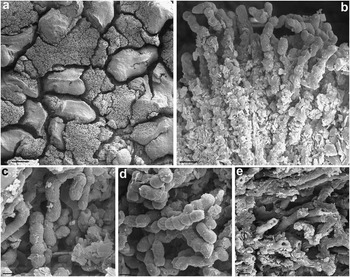
Scanning electron microscopy (SEM) was performed at the Museo Nacional de Ciencias Naturales-CSIC in Madrid in a Zeiss DSM 940A. The material was dried at 60°C, coated in gold (40 nm thick), and examined in secondary electron mode (SEM-SE). In addition, uncoated portions were studied in backscattered electron mode (SEM-BSE) and by energy dispersive spectroscopy of X-rays (SEM-EDS) for mineralogical analysis.
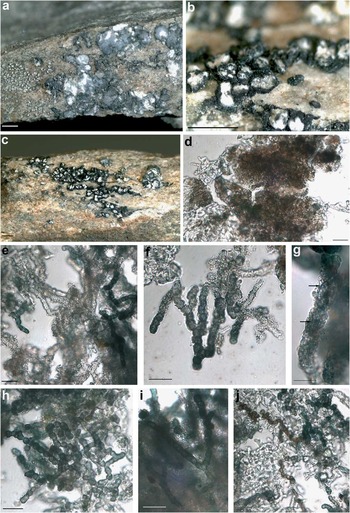
Bicoloromyces kyffinensis (unstained in distilled water). a. Macroscopical overview of young colonies. b. & c. Macroscopical overview of older colonies. d. Stromata. e. Branched, encrusted hyphae. f. & h. Encrusted hyphae and adhering branched chains of conidia. g. Encrusted hyphae, arrows pointing to the hyphae. i. Basal ramification. j. Brown fructification. Scale bars: 100 µm (a.–c.), 20 µm (d.–f., h.–j.), 10 µm (g.).

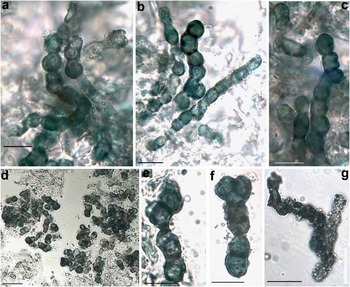
Bicoloromyces kyffinensis (unstained in distilled water). a. & b. Aeruginose to dark black-blue chains of conidia with reduced cell plasma and distosepta. c. Chains of conidia with irregular, patchy colouration. d. Immature colony (overview). e. & f. Fragments of conidial chain with dark septa. g. Encrusted hyphae with squamous wall. Scale bars: 20 µm (d.), 10 µm (a.–c., e.–f.).

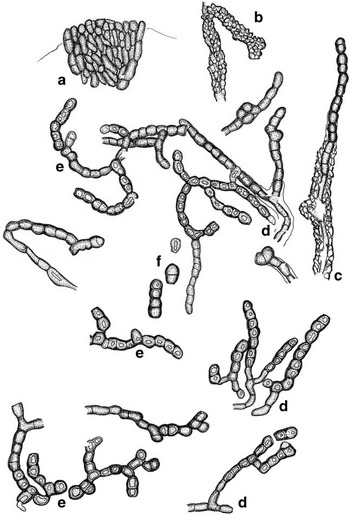
Bicoloromyces kyffinensis. a. Stromata. b. Branched, encrusted hyphae. c. Encrusted hyphae with adhering branched chains of conidia. d. Branched chains of conidia adhering at basal hyphae. e. Conidial chain resembling monilioid hyphae. f. Conidia. Scale bar: 10 μm.

Bicoloromyces kyffinensis, SEM–SE micrographs. a. Overview of colonies. b. Encrusted hyphae with firm branched chains of conidia. c. & d. Branched and unbranched chains of conidia. e. Hyphae and basal parts of conidial chains with irregularly rugose to rimulose wall. Scale bars: 200 µm (a.), 10 µm (b.), 5 µm (c.–e.) (photos: Jacek Wierzchos).

Taxonomy
Bicoloromyces kyffinensis Heuchert, U. Braun & D. Hawksw., gen. sp. nov.
MycoBank MB811365 (genus) and MB811366 (species) (Figs 2–5)
Etymology: Bicoloromyces composed of bicolor (two-coloured) and -myces (a fungus), kyffinensis from the name of the type locality, Mount Kyffin (Antarctica).
Diagnosis: Resembling lichenicolous species referred to Trimmatostroma and saxicolous species of Catenulomyces, but distinguishable by its hyphae encrusted by crystalline squamules of calcium oxalate, conidia which are extremely thick-walled, bicolorous and range from pale aeruginose to dark black-blue or almost blackish to brown or dark brown, and frequently distoseptate.
Type: Antarctica: Transantarctic Mountains: Mount Kyffin, Ebony Ridge, 83°46'S, 172°40'E, altitude 550 m, on an unidentified white sterile crustose lichen, 10 January 2003, R. Türk et al. (MAF 19121).
Description: Colonies associated with the thallus of a white sterile crustose lichen on rock, covering the surface of the host thallus, often initiated at the margin of areoles, sometimes developed from inner parts of individual areoles, although they are sometimes unaffected, in early stages thallus still grey, later turning black due to the developing fungal colonies, effuse, caespitose. Mycelium immersed; hyphae branched, 3–5 µm wide, septate, slightly constricted at the septa, subhyaline to pale brown, walls barely thickened, 0.25 µm, smooth or slightly rugose, often encrusted by a sheath of crystalline structures (formed of calcium oxalate), crystalline squamules densely arranged, squamulose sheath visible when viewed by light microscopy, subhyaline to pale brown, irregularly rugose, squamose to rimulose, to 4 µm thick, individual scales irregularly shaped, ranging from rounded to oblong, 1–5 µm diameter. Stromata cushion-like, 35–120×40–50 µm, composed of swollen hyphal cells or stromatic cells of variable size and shape, subglobose, ellipsoid, elongated to isodiametric, 3–13×2–7 µm, brown to dark brown, wall thickened, 0.5–1 µm, smooth. Conidiophores immersed, occasionally somewhat erumpent, micronematous or semi-macronematous, erect, 6–10×4–5 µm, subcylindrical, doliiform, unbranched, aseptate, hyphal filaments gradually developing into fertile threads by becoming somewhat wider and coloured, ranging from subhyaline to aeruginose, sometimes pale brown, wall slightly thickened, 0.25 µm, rarely smooth, usually slightly rough and rimulose, but differentiation between hyphae and conidiophores very difficult, often with a sheath of crystalline squamules at the base of chains of conidia and around conidiophores, but then fragmentary, conidiophores reduced to conidiogenous cells or conidiogenous cells integrated, terminal, little differentiated, with a single conidiogenous locus, barely differentiated, ± truncate, to 5 µm diameter, conidiogenesis holoblastic. Conidia in simple or multi-branched basipetal chains, adhering for a long time, reluctantly liberating, chains 10–80 µm long, straight or curved, erect to decumbent, distinction of individual conidia within the chain sometimes difficult, aseptate conidia usually subglobose to obovoid, 6–10×5–7 µm, 1-septate ones ellipsoid or subcylindrical, 10–13×5–7 µm, usually distoseptate, occasionally euseptate, wall 0.25–0.5 µm thick, irregularly rugose, rimulose, usually lighter than cell contents, cell plasma mostly reduced, with a central vacuole-like cavity, surrounding plasma giving the impression of very thick, three-layered walls, to 2 µm thick, rarely with oblique and longitudinal septa, sometimes within the chain irregularly arranged cells forming multicellular conidia, to 10 µm diameter, the colour of conidia and conidial chains ranging from pale aeruginose to dark black-blue or blackish, pigmentation often variable and patchy, often more intensive at edges or near septa, often strongly darkened and light-absorbing in portions with distosepta, so that septa and inner structures are not very evident, in other portions of the colonies conidia and conidial chains distinctly pigmented, brown to dark brown, differentiation of the colouration gradually changing, outer wall of brown conidia often smoother and less rough-rimulous, apex rounded in primary conidia, truncate in secondary ones, base truncate, hila unthickened, not darkened, 1.5–3 µm diameter.
Host and distribution: On a white sterile crustose lichen, Antarctica. The infected host thalli are grey in the early stages of infection, later turning black by abundant colonies overgrowing the areoles of the host lichen. The lichen thallus is barely damaged so the fungus appears to be commensalistic. The identity of the host lichen could not be determined conclusively, but it is probably either Lecanora fuscobrunnea C.W. Dodge & G.E. Baker or a species of Lecidella. The identity of the putative host lichens in this site was confirmed by molecular sequence data.
Additional specimen: Antarctica: Transantarctic Mountains: Mount Kyffin, Ebony Ridge (called ‘Black Ridge’ by 1959 group), 83°46.485'S, 171°49.655'E, altitude 859 m, on an unidentified white sterile crustose lichen, 18 January 2011, L. G. Sancho (MAF19122).
Notes: At first glance, the present Antarctic fungus might be confusable with lichenicolous species currently referred to the genus Taeniolella, but that genus can be easily ruled out as a potential generic home as it has semi-macronematous conidiophores and conidia formed in acropetal chains (Ellis Reference Ellis1971, Hawksworth Reference Hawksworth1979, Seifert et al. Reference Seifert, Morgan-Jones, Gams and Kendrick2011). Taeniolella is in its current circumscription heterogeneous and polyphyletic (unpublished data and results). On the other hand, the new Antarctic fungus resembles some lichenicolous species placed in Trimmatostroma (Diederich et al. Reference Diederich, Braun, Heuchert and Ertz2010), above all with regard to micronematous conidiophores and the formation of basipetal conidial chains, but it is distinct by a combination of encrusted hyphae, bicolorous conidial chains, and conidia with distoseptation. Furthermore, placing this species in Trimmatostroma would only be a temporary solution since lichenicolous species have only tentatively been assigned to Trimmatostroma, and they are undoubtedly not congeneric in terms of a phylogenetic generic concept (Diederich et al. Reference Diederich, Braun, Heuchert and Ertz2010). Trimmatostroma is probably confined to its type species, the saprobic, sporodochial, bark-inhabiting T. salicis Corda, which clusters in Helotiales (Crous et al. Reference Crous, Braun and Groenewald2007). Lichenicolous species of Trimmatostroma have recently been described, illustrated, keyed out and discussed in detail in Diederich et al. (Reference Diederich, Braun, Heuchert and Ertz2010), and an additional species, T. cetrariae Brackel, has since been introduced in Zhurbenko & von Brackel (Reference Zhurbenko and von Brackel2013). Heuchert & Braun (Reference Heuchert and Braun2014) recently added T. umbilicariicola and T. varicellariae Heuchert & U. Braun and provided an updated key to lichenicolous Trimmatostroma species; however, no species placed in that genus has the characteristic features of Bicoloromyces kyffinensis.
The SEM-EDS studies established that the encrustations on the surfaces of the conidiophores and conidia were of calcium oxalate.
The fungus from Mount Kyffin belongs to a large assemblage of saxicolous ‘black fungi’ which are either lichen-associated (Muggia et al. Reference Muggia, Gueidan, Knudsen, Perlmutter and Grube2013, Selbmann et al. Reference Selbmann, Grube, Onofri, Isola and Zucconi2013) or saxicolous (Selbmann et al. Reference Selbmann, de Hoog, Mazzaglia, Friedmann and Onofri2005, Reference Selbmann, Isola, Egidi, Zucconi, Gueidan, de Hoog and Onofri2014, Ruibal et al. Reference Ruibal, Gueidan, Selbmann, Gorbushina, Crous, Groenewald, Muggia, Grube, Isola, Schoch, Staley, Lutzoni and de Hoog2009, Egidi et al. Reference Egidi, de Hoog, Isola, Onofri, Quaedvlieg, de Vries, Verkeley, Stielow, Zucconi and Selbmann2014). Such fungi are abundant and diverse under Antarctic conditions. Egidi et al. (Reference Egidi, de Hoog, Isola, Onofri, Quaedvlieg, de Vries, Verkeley, Stielow, Zucconi and Selbmann2014) introduced a large number of new genera belonging to this heterogeneous assemblage. Due to its general habit and the formation of multicellular intercalary propagules, Catenulomyces (Egidi et al. Reference Egidi, de Hoog, Isola, Onofri, Quaedvlieg, de Vries, Verkeley, Stielow, Zucconi and Selbmann2014) is the only comparable and superficially similar genus among them. However, it differs in having consistently euseptate conidia with two or more longitudinal or oblique septa, uniform pigmentation and lacks incrustation. The original description of this genus is rather meagre with regard to conidiogenous cells, conidial formation and secession. It was not stated if the conidia were formed in actual chains or if the hyphae disarticulated into arthroconidia, but the description and illustration rather suggest the latter method of conidiation. Other genera described by Egidi et al. (Reference Egidi, de Hoog, Isola, Onofri, Quaedvlieg, de Vries, Verkeley, Stielow, Zucconi and Selbmann2014) are easily distinguishable: Constantinomyces, Hyphoconis, Lapidomyces and Ramimonilia are all based on sterile mycelia (conidiophores and conidia unknown) and the characteristics of the mycelia do not match those of the new Antarctic fungus. Artrocatena, Incertomyces, Meristemomyces and Monticola are distinct in forming arthroconidia by disarticulation, which are reluctantly liberated in the latter genus. In Incertomyces and Meristemomyces, the conidia are pyriform to reniform. Perusta and Petrophila have semi-macronematous conidiophores with intercalary conidiogenous cells. Oleoguttula is quite distinct in having phialidic conidiogenous cells. Vermiconia can be readily excluded as a generic candidate as it forms conidia in acropetal chains and the conidia have multiple longitudinal and oblique eusepta.
Saxomyces (Selbmann et al. Reference Selbmann, Isola, Egidi, Zucconi, Gueidan, de Hoog and Onofri2014) was introduced as a saxicolous genus for species with hyphae composed of torulose, thick-walled cells, proliferating enteroblastically and very thick-walled, incrusted conidia formed by enteroblastic proliferation, and in any case the name was not validly published. In Cryomyces, a genus introduced for two species isolated from rocks in Antarctica, the conidia have some incrustations, but such massively thickened walls, the aeruginose colour, and there is no indication they form stromata (Selbmann et al. Reference Selbmann, de Hoog, Mazzaglia, Friedmann and Onofri2005). Sert et al. (Reference Sert, Sümbül and Sterflinger2007) examined ‘black fungi’ on marble in archaeological sites in Turkey and frequently found saxicolous collections of Capnobotryella spp. which superficially resemble the new Antarctic fungus. However, the conidia in Capnobotryella are formed in short acropetal chains, are aseptate to 1-euseptate, multicelled propagules are not produced, and the conidiophores are monilioid, fragmenting into arthroconidia.
No other fungus recalling Bicoloromyces kyffinensis could be found in the illustrated account of Continental Antarctic non-lichenized fungi of Onofri et al. (Reference Onofri, Zucconi and Tosi2007).
After exhaustive studies of the mycological literature, we conclude that there is no available generic name to accommodate the new lichenicolous fungus from Antarctica. Characteristics in vitro and the phylogenetic position of this fungus remain unknown. The results of direct sequencing from field samples or specimens may also be problematic in lichenicolous fungi even using cloning techniques as fungi other than, or as well as, the target or the lichen host may be recovered (Hawksworth et al. Reference Hawksworth, Millanes and Wedin2010). However, this fungus is unique in a set of striking characters, which discriminate it from all comparable genera; therefore, it can confidently be described as new without molecular data. Encrustation of hyphae by crystalline structures is not in itself unique and was, for example, described in detail from hyphae of Piloderma forming ectomycorrhizas with spruce (Arocena et al. Reference Arocena, Glowa and Massicotte2001). Those authors discussed the role of mycorrhizal fungi in mineral weathering and nutrient cycling. Adamo & Violante (Reference Adamo and Violante2000) examined the weathering action of lichens, described calcium, magnesium, manganese and copper oxalate crystals at the rock/lichen interface and in lichen thalli, and discussed the role of ‘lichen acids’ secreted by the mycobiont. Therefore, the occurrence of calcium oxalate encrustations in Bicoloromyces kyffinensis is of ecological interest. However, in ‘black fungi’ isolated from rocks such crystalline coverings are unusual. Amongst those fungi, encrustation was only mentioned for the conidia of Saxomyces (Selbmann et al. Reference Selbmann, Isola, Egidi, Zucconi, Gueidan, de Hoog and Onofri2014). Bicolorous fructification and distoseptation are also unusual traits in this ecological fungal group, and the distinctive aeruginose colour is unknown in all other lichenicolous hyphomycetes. The aeruginose pigmentation does recall that of species of the lichenicolous coelomycete genus Vouauxiella, which occurs primarily in the apothecia of Lecanora species (see http://www.lichens.lastdragon.org/lichenicolous/Vouauxiella_lichenicola.html); the conidia of that genus are thick-walled as in Bicoloromyces, but broadly doliiform with truncated ends, and they are encrusted in V. verrucosa (Vouaux) Petr. & Syd. but smooth-walled in V. lichenicola (Linds.) Petr. & Syd. (Hawksworth Reference Hawksworth1976).
Based on the unique combination of characters, we feel justified in introducing a new generic name for this unusual fungus, the only lichenicolous fungus to be recorded so far south, even though its phylogenetic position is still unknown. Fresh collections, ideally cultured prior to shipment, will be needed to enable the fungus to be isolated into pure culture and sequenced, as in our experience sequences obtained directly from field samples of infected lichens often prove to be of contaminants rather than the target fungus.
Acknowledgements
The expeditions on which the fungus described here was collected were organized and supported by Antarctica New Zealand and partially funded by grants from the Ministerio de Educación y Ciencia of Spain (project CGL 2006-12179-C02-01) and the Ministerio de Economía y Competitividad of Spain (project CTM2012-38222-C02-01). Very special thanks go to Allan Green, for planning and making the Antarctic expeditions possible and to Ian Hogg, head of the 2011 field trip. We are indebted to Sybren de Hoog and Laura Selbmann for repeated attempts to culture the fungus for us so it could be sequenced, to Jacek Wierzchos for preparing the scanning electron micrographs, and to Sergio Pérez Ortega for discussions on the identity of the host lichen, including obtaining molecular sequences of the putative host lichens from the type locality. We also appreciated comments of two anonymous referees on our original submission. Studies on the lichenicolous fungus were carried out while D.L.H. was in receipt of grants from the Ministerio de Educación y Ciencia of Spain (project CGL 2007-64635) and the Ministerio de Economía y Competitividad of Spain (project CGL2011-25003).
Author contribution
B.H. prepared the description, drawings, and plates of the fungus; L.G.S. carried out the field work, including re-collection of the fungus, recognized it as meriting further study, arranged for the scanning electron micrographs, and supplied the habitat information; D.L.H. recognized it as new; B.H., U.W. and D.L.H. all contributed to the texts explaining how the fungus differed from those previously described; and the text was finalized for publication by D.L.H.