INTRODUCTION
In the United States, Hispanics/Latinx/Latinos/as, hereafter referred to as Latinos, comprise the largest ethnic/racial minority group (US Census Bureau 2018). Most Latinos are of Mexican heritage (63%; Noe-Bustamante, Flores, & Shah, Reference Noe-Bustamante, Flores and Shah2019), with approximately half of the 52 million Latinos in the US living in the US borderland region with Mexico (Brown & Lopez, Reference Brown and Lopez2019; Krogstad, Reference Krogstad2020; Stavans, Reference Stavans2018). Seventy percent of Latinos speak Spanish, with more than half also reporting speaking English “very well” (US Census American Fact Finding, 2017). While there are many characteristics that unite the US Latino experience, considering the heterogeneity within the Latino population may be important for the accurate identification of underlying brain dysfunction via neuropsychological testing.
Demographic factors such as age, education, and sex impact cognitive performance in healthy individuals across racial/ethnic groups (Acevedo et al., Reference Acevedo, Loewenstein, Agrón and Duara2007; Gasquoine, Croyle, Cavazos-Gonzalez, & Sandoval, Reference Gasquoine, Croyle, Cavazos-Gonzalez and Sandoval2007; González et al., Reference González, Tarraf, Gouskova, Gallo, Penedo, Davis and Mosley2015; Heaton, Miller, Taylor, & Grant, Reference Heaton, Miller, Taylor and Grant2004; Matallana et al., Reference Matallana, Santacruz, Cano, Reyes, Samper-Ternent, Markides and Reyes-Ortiz2010; O’Bryant et al., Reference O’Bryant, Edwards, Johnson, Hall, Gamboa and O’jile2018; Rivera Mindt, Byrd, Saez, & Manly, Reference Rivera Mindt, Byrd, Saez and Manly2010; Rivera Mindt et al., Reference Rivera Mindt, Marquine, Aghvinian, Scott, Cherner, Morlett Paredes and Heaton2020; Touradji, Manly, Jacobs, & Stern, Reference Touradji, Manly, Jacobs and Stern2001). In order to parcel out the impact of these variables on cognitive test performance, they are typically adjusted for in neuropsychological normative corrections. Among non-Hispanic Whites and Blacks, other factors such as quality of education and literacy (Glymour, Kawachi, Jencks, & Berkman, Reference Glymour, Kawachi, Jencks and Berkman2008; Glymour & Manly, Reference Glymour and Manly2008; Manly et al., Reference Manly, Byrd, Touradji and Stern2004), school environment, and types of resources available (Glymour, Reference Glymour2004; Glymour & Manly, Reference Glymour and Manly2008; Sisco et al., Reference Sisco, Gross, Shih, Sachs, Glymour, Bangen and Manly2015) have shown to impact cognitive test performance beyond these demographic adjustments. Aspects of early life such as childhood socioeconomic status (SES), maternal and paternal years of education and occupation, family financial status, and childhood health have shown to influence cognition in adulthood in non-Hispanic Whites and Blacks (Boone, Victor, Wen, Razani, & Pontón, Reference Boone, Victor, Wen, Razani and Pontón2007; Gonzalez, Tarraf, Bowen, Johnson-Jennings, & Fisher, Reference González, Tarraf, Bowen, Johnson-Jennings and Fisher2013; Kaplan et al., Reference Kaplan, Turrell, Lynch, Everson, Helkala and Salonen2001; Lou & Waite, Reference Luo and Waite2005; Zhang, Hayward, & Yu, Reference Zhang, Hayward and Yu2016). Studies in children across Latin America have reported that parental levels of education were positively associated with cognition (Arango-Lasprilla et al., Reference Arango-Lasprilla, Rivera, Ramos-Usuga, Vergara-Moragues, Montero-López, Díaz and Ferrer-Cascales2017; Olabarrieta-Landa et al., Reference Olabarrieta-Landa, Rivera, Galarza-Del-Angel, Garza, Saracho, Rodríguez and Arango-Lasprilla2015; Rivera et al., Reference Rivera, Morlett-Paredes, Guia, Escher, Soto-Añari, Arelis and Arango-Lasprilla2017). However, research on the impact of culture-specific variables on cognition among Latino adults living in the US has been limited (Boone et al., Reference Boone, Victor, Wen, Razani and Pontón2007; Luo & Waite, Reference Luo and Waite2005), and mostly focused on language and education.
Language use and its potential impact on cognitive test performance is an important consideration in this population (Artiola i Fortuny & Mullaney, Reference Artiola i Fortuny and Mullaney1997; Echemendia & Harris, Reference Echemendia and Harris2004; Flores et al., Reference Flores, Casaletto, Marquine, Umlauf, Moore, Mungas and Heaton2017; Gollan, Montoya, & Werner, Reference Gollan, Montoya and Werner2002; Suarez et al., Reference Suárez, Marquine, Díaz-Santos, Gollan, Artiola i Fortuny, Rivera Mindt and Cherner2020b). There is a lack of a gold-standard, objective, or performance-based assessment of this construct, which may be a driving factor behind mixed findings when relating bilingualism to cognitive performance (Gollan, Salmon, Montoya, & Galasko, Reference Gollan, Salmon, Montoya and Galasko2011; Gollan, Montoya, Cera, & Sandoval Reference Gollan, Montoya, Cera and Sandoval2008; Harris & Llorente, Reference Harris, Llorente, Prifitera, Saklofske and Weiss2005; Rivera Mindt et al., Reference Rivera Mindt, Arentoft, Germano, D’Aquila, Scheiner, Pizzirusso and Gollan2008, Reference Rivera Mindt, Byrd, Saez and Manly2010). Performance-based assessments have been recommended as best practices to assess degree of bilingualism in Latinos (Artiola i Fortuny et al., Reference Artiola i Fortuny, Hermosillo, Heaton and Pardee1999; Ostrosky-Solis et al., Reference Ostrosky-Solís, Gomez-Perez, Matute, Rosselli, Ardila and Pineda2007; Pontón, Reference Pontón, Pontón and León-Carrión2001), as compared to self-report of bilingualism. However, while performance-based tests have been positively associated with cognition (Bialystok, Craik, Green & Gollan, Reference Bialystok, Craik, Green and Gollan2009; Bialystok, Abutalebi, Bak, Burke, & Kroll, Reference Bialystok, Abutalebi, Bak, Burke and Kroll2016), they are also positively associated with more years of education and higher SES (Suarez et al., Reference Suárez, Marquine, Díaz-Santos, Gollan, Artiola i Fortuny, Rivera Mindt and Cherner2020b). These findings may reflect how the effect of bilingualism on cognition may be an indirect measure of educational attainment and social class (Acevedo et al., Reference Acevedo, Loewenstein, Agrón and Duara2007; Luo & Waite, Reference Luo and Waite2005; Rosselli & Ardila, Reference Rosselli and Ardila2003; Saez, et al., Reference Saez, Bender, Barr, Mindt, Morrison, Hassenstab and Vazquez2014). Lack of independent implications of English-Spanish bilingualism on cognitive performance when considered with other relevant social and educational factors specific to US Latinos poses a need for a more detailed analysis.
The overall goal of the present study was to examine the influence of culturally relevant educational, childhood socioeconomic, and linguistic characteristics specific to Spanish-speaking adults living in the US–Mexico border region on global cognitive test performance. The present study expands the findings from the Neuropsychological Norms for the US–Mexico Border Region in Spanish (NP-NUMBRS) Project by quantifying the effect of culturally relevant background factors (beyond basic demographics) on global cognitive functioning in this group. We hypothesized that (1) markers of better educational quality and access, higher childhood socioeconomic environment, and being bilingual would be associated with higher global cognitive test scores unadjusted for demographics; and that (2) these diverse culturally relevant characteristics would also independently explain variance in cognitive test scores above and beyond region-specific demographic normative adjustments.
METHODS
Participants
Participants included 254 native Spanish-speaking adults between 19 and 60 years old living in the US–Mexico border regions of Tucson, Arizona (n = 102) and San Diego, California (n = 152), enrolled in the Neuropsychological Norms for the US–Mexico Border Region in Spanish (NP-NUMBRS) Project. Participants were recruited via flyers and in-person presentations by study staff in community settings in Latino-serving organizations in the border cities. Data were gathered between 1998 and 2009. Inclusion criteria were the following: being between 19 and 60 years of age, being a native Spanish speaker, and living and/or spending time in the US on a regular basis. Exclusion criteria were the following: being English-dominant (based on a higher ratio of English words recounted using the Controlled Oral Word Association tests in English (letters F-A-S) and Spanish (letters P-M-R) on the Controlled Oral Word Association Test [FAS/(FAS + PMR)] (Cherner, Marquine et al., Reference Cherner, Marquine, Umlauf, Morlett Paredes, Rivera Mindt, Suárez and Heaton2020), having a history of neurological, medical, or psychiatric conditions known to impact the central nervous system or influence test performance (i.e. neurological/other medical conditions with potential CNS effects, significant injuries or disabilities, serious psychiatric conditions such as current psychosis). For further details on participants and methodology of the NP-NUMBRS project, see Cherner, Marquine et al., Reference Cherner, Marquine, Umlauf, Morlett Paredes, Rivera Mindt, Suárez and Heaton2020.
MATERIALS AND PROCEDURES
Neuropsychological assessment
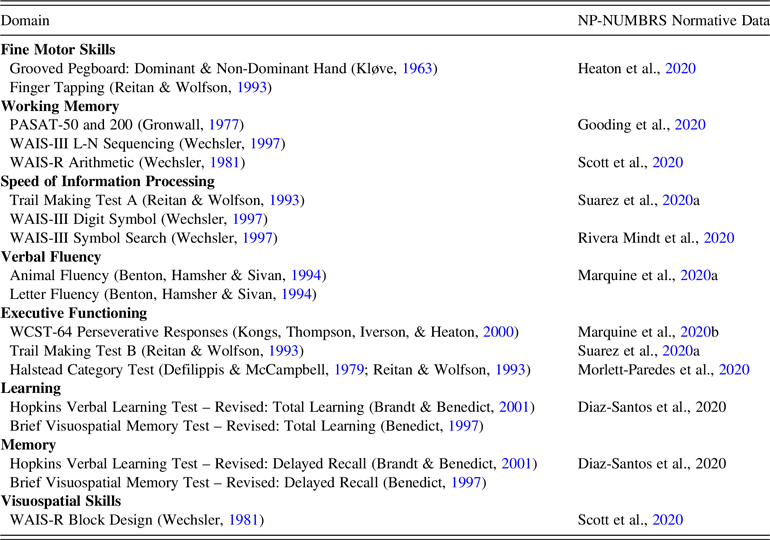
Participants completed comprehensive neuropsychological assessments in Spanish, assessing domains of verbal fluency, speed of information processing, attention/working memory, executive function, learning and memory, visuospatial, and fine motor skills (Table 1). Cognitive tests were administered by trained bilingual (English-Spanish) staff. Individual raw test scores were converted to unadjusted scaled scores, and then to demographically adjusted (age, years of education, and sex) T-scores based on the current sample. Individual T-scores were averaged by domain to create domain T-scores. Individual test scaled scores and T-scores were averaged respectively to compute measures of overall cognition unadjusted (Global Mean Scaled Score) and adjusted for basic demographic factors (i.e., Global Mean T-score). Further details on the methods followed in the adaptation of tests from English to Spanish and the development of scaled scores and demographically adjusted T-scores are available in Cherner, Marquine et al. (Reference Cherner, Marquine, Umlauf, Morlett Paredes, Rivera Mindt, Suárez and Heaton2020).
Comprehensive neuropsychological test battery and normative data

Note. NP-NUMBRS = Neuropsychological Norms for the US–Mexico Border Region in Spanish; L-N = Letter-Number; PASAT = Paced Auditory Serial Addition Test; WAIS-R = Wechsler Adult Intelligence Scale-Revised; WAIS-III = Wechsler Adult Intelligence Scale-Third Edition; WCST = Wisconsin Card Sorting Test.
Demographic, educational quality/access, childhood socioeconomic, and language use factors
Demographic factors, including age, total years of education, and sex were assessed by self-report.
Educational quality and access indicators included: years of education completed in the US and in the country of origin, type of school attended (i.e., [1] large: school with multiple classrooms per grade and room to play; [2] regular: a school with at least one classroom per grade and room to play; or [3] small: school with less than one classroom per grade and no room to play), the typical number of students in a class (i.e., <30 and ≥31 students), and any history of need to discontinue school in order to work. Due to small numbers in certain levels of these variables, type of school attended was recoded into two categories (Good Physical Resources = large type of school, and Limited Physical Resources = regular and small types of school).
Childhood socioeconomic background was ascertained via questions regarding maternal and paternal years of education, years spent living in the country of origin and in the US, perceived childhood SES (i.e. “as a child, your family was: very poor, poor, middle class or upper class”), overall health status as a child (i.e. “poor physical health” [“very sick” or “sick”] and “good physical health”[“regular”, “healthy”, or “very healthy”]), lack of access to basic resources in childhood (i.e., lacking one or more of the following: running water, electricity in the home and/or history of food insecurity as a child), and childhood work history (i.e., having to work as a child and if so, for what reason – to help one’s family financially or for one’s own benefit – and the age that started working as a child).
Language use was assessed in three ways: participant self-report, examiner report, and an objective measure of performance-based fluency in English and Spanish. Participants were asked which language they currently understood and spoke better (i.e., “Spanish better than English”, “Both languages with similar ease”, or “English better than Spanish”). They also rated their current language use during various daily life activities (i.e., listening to the radio, watching TV, reading, speaking with family and friends, praying, solving math problems, thinking, expressing angry/upset emotion) utilizing a scale from 1 “Always in Spanish” to 5 “Always in English”, with 3 being “similarly in English and Spanish”. Daily average language use was derived by averaging responses to the items for daily life activities. Examiners were asked to rate the participant’s degree of fluency in Spanish and English (i.e., “Spanish better than English”, “Both languages with similar ease”, or “English better than Spanish”), and whether or not the participant was bilingual based on a single question (i.e., “In your opinion, is the participant bilingual?” with response options being “Yes; No”). Examiners were provided no further guidelines, and they responded these questions based on their interaction with the participant during the study visit. Performance-based fluency was calculated using the Controlled Oral Word Association Test with letters F-A-S in English (Strauss, Sherman, & Spreen, Reference Strauss, Sherman and Spreen2006) and P-M-R in Spanish (Artiola i Fortuny et al., Reference Artiola i Fortuny, Hermosillo, Heaton and Pardee1999; Strauss et al., Reference Strauss, Sherman and Spreen2006). We estimated Spanish fluency as the ratio of FAS to total words in both languages [FAS/(FAS + PMR)], a published method that uses timed lexical retrieval to operationalize degree of Spanish-English bilingualism (Suarez et al., Reference Suárez, Marquine, Díaz-Santos, Gollan, Artiola i Fortuny, Rivera Mindt and Cherner2020b; Suarez et al., Reference Suarez, Gollan, Heaton, Grant and Cherner2014). Higher scores correspond to higher English fluency, with scores higher than .66 indicating strong English dominance. Participants with scores less than .34 were considered monolingual Spanish speakers, and those with scores between .34 and .66 were considered bilingual. Unfortunately, FAS scores were mistakenly discarded for a subset of participants after they were classified as monolingual or bilingual at their screening visit for the purposes of that study. As a result, while we were able to judge a majority of participants (n = 203) on their level of bilingualism, English fluency scores are unfortunately only available for a subset of participants (n = 170) and therefore the degree of fluency was not considered in analyses (see Suarez et al., (Reference Suárez, Marquine, Díaz-Santos, Gollan, Artiola i Fortuny, Rivera Mindt and Cherner2020b) and Cherner, Marquine et al., (Reference Cherner, Marquine, Umlauf, Morlett Paredes, Rivera Mindt, Suárez and Heaton2020), for further details).
Statistical Analyses
We computed descriptive statistics for demographics, indicators of educational quality and access, childhood socioeconomic background and language-use characteristics. Distributions of sample characteristics of continuous measurement scales were examined for normality. To test Hypothesis 1, associations of Global Mean Scaled Scores with indicators of educational quality and access, childhood socioeconomic, and language-use characteristics were run using a series of univariable analyses. Continuous variables were correlated with Global Mean Scaled Scores using Pearson product–moment correlations. Global Mean Scaled Scores were compared between levels of categorical variables using either two-way independent sample t-tests (for two-level categorical variables) or analyses of variance (ANOVA) followed by pairwise comparisons with Tukey’s adjustments if significant (for categorical variables with more than two levels). To examine whether culturally relevant characteristics would independently explain variance in cognitive test performance above and beyond region-specific demographic adjustments in this group (Hypothesis 2), we first ran comparable univariable analyses on Global Mean T-scores using the same methods as described above for analyses of Global Scaled Scores. Then we ran separate multivariable linear regression models to test for all possible two-way interactions between factors that showed univariable association with Global T-scores. Finally, we ran a multivariable linear regression model on Global T-scores entering variables that were univariably associated with Global Mean T-scores at α < .10 and any significant two-way interactions among these variables. JMP version 13.0.0 was used for all analyses.
RESULTS
Demographic, Educational Quality/Access, Childhood Socioeconomic, and Language Use Characteristics of the Study Sample
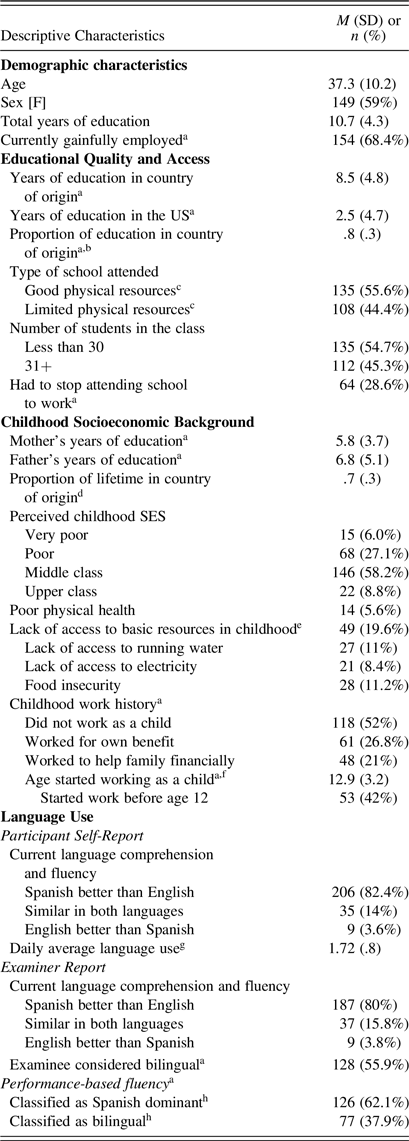
Table 2 lists demographic, educational quality and access, childhood socioeconomic, and language-use characteristics of the study sample. Participants ranged from 19 to 60 years old, over half were female, had between 0 and 20 years of education, and about 70% were gainfully employed at the time of data collection. The majority of participants completed more years of education in their country of origin than in the US, a little over half attended a school with good physical resources and with class sizes of less than 30 students, and almost a third of the sample had to stop attending school in order to work. The total average years of parental education ranged from six to seven years. Participants had lived the majority of their lives in their country of origin, most participants described their childhood SES as middle class, and about a third reported having been poor or very poor as a child. About 5% of participants reported poor physical health as a child, and 20% reported lack of access to two or more basic resources as a child (i.e., lack of running water or electricity, or food insecurity). Roughly half of the sample reported not working as a child, 20% reported working as a child to help their families financially, and 30% worked for their own benefit. The majority reported Spanish as the language they better understood. The daily average language used in various everyday activities indicated that Spanish was the predominant language used in daily life. Examiners reported that 80% of the sample understood and spoke Spanish better than English, and considered about 56% of the sample bilingual. Performance-based fluency measures indicated 62% of 203 participants with available data as monolingual Spanish-speaking or strongly Spanish dominant, with the remaining 38% as being bilingual. Of note, 181 participants had data on both examiner- and performance-based measures of bilingualism.
Demographic, educational quality and access, childhood socioeconomic, and language-use characteristics (N = 254)

a 10% or more of the overall sample’s data was not available for this item.
b Years of education in country of origin/total years of education.
c “Good physical resources” refers to large school that had many classrooms and room to play; “limited physical resources” refers to a school of smaller size that had at least one classroom per grade and room to play and/or a small school with less than one classroom per grade.
d Years lived in country of origin/age.
e Comprised of whether individuals did not have two or more of the following as a child: running water, electricity, and/or remember going hungry.
f Of those reported having worked as a child, n = 131.
g Average of language used for radio, TV, media, praying, expressing anger/disgust, thinking, doing math, and speaking with family in Spanish, on a scale of 1–6, lower scores indicating always Spanish, higher scores indicating always English.
h Spanish Dominant: FAS/FAS + PMR value < .33; Bilingual: .34 < FAS/FAS +PMS value < .66.
Univariable Associations with Global Mean Scaled Scores and T-Scores
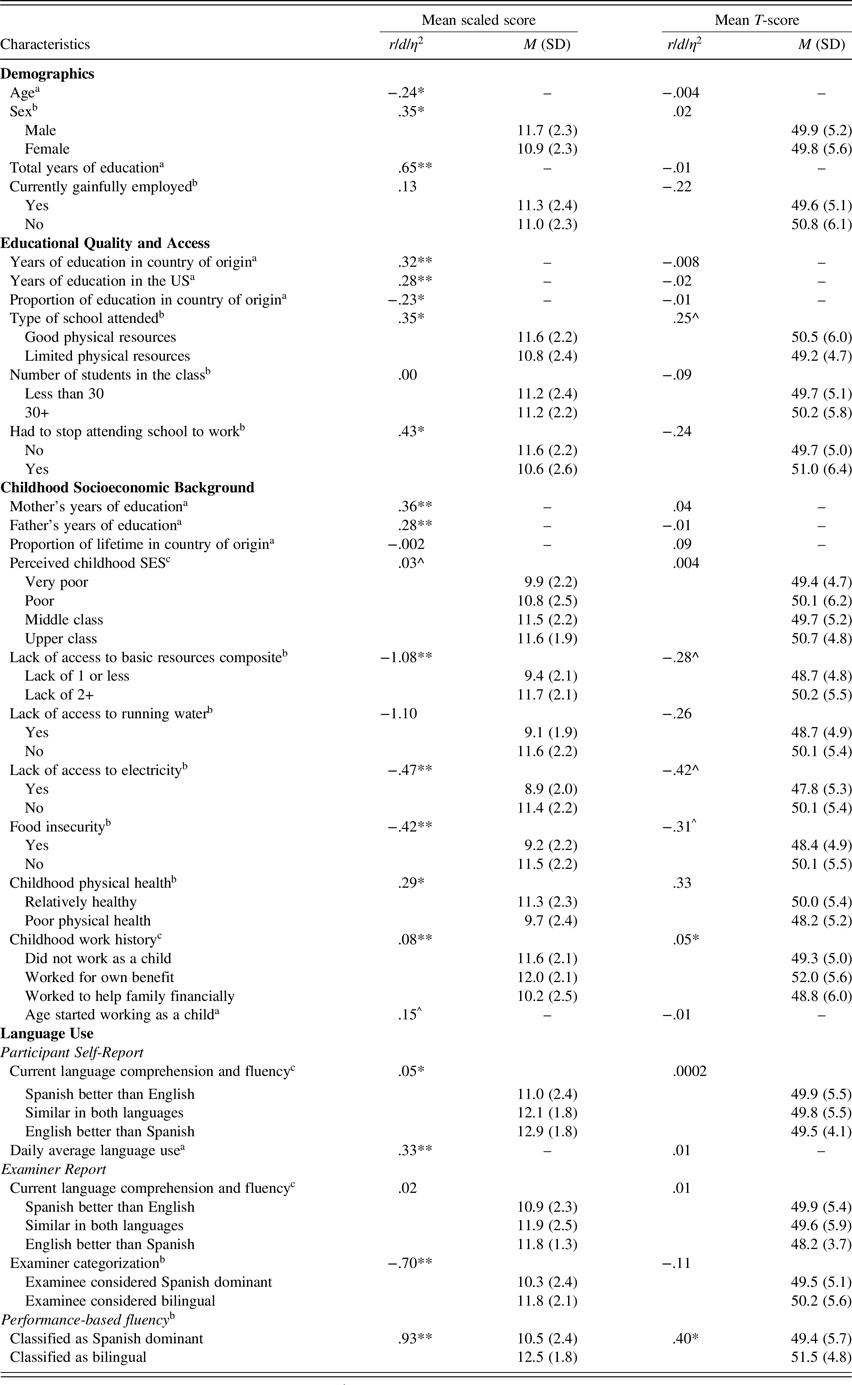
Univariable analyses examining the association of demographic, educational quality and access, childhood socioeconomic, and language-use characteristics with Global Scaled Score and Global T-score) are depicted in Table 3. Regarding analyses investigating the association of demographic variables with Global Mean Scaled Scores, younger age, male sex, and higher years of education were significantly associated with higher scores (ps < .02), with no significant differences by current gainful employment (p = .48). Analyses on indicators of educational quality and access showed that more years of education in the country of origin and in the US were associated with higher Global Scaled Scores (ps < .01), but having completed a higher proportion of one’s education in the country of origin was associated with lower Global Scaled Scores (p = .0004). Attending a school with good physical resources was associated with higher Global Scaled Scores (p = .007), and having to stop attending school to work was associated with lower Global Scaled Scores (p = .008), with no differences based on a number of students in a class (p = .96). Regarding childhood socioeconomic characteristics, more years of parental education was associated with higher Global Scaled Scores (ps < .01), with no differences based on the proportion of lifetime residing in the country of origin (p = .99). While an ANOVA examining the association between perceived childhood SES and Global Scaled Scores was significant, follow-up pairwise comparisons with Tukey’s correction showed no significant differences by levels of this variable. Lacking running water, electricity, or food as a child was associated with lower Global Scaled Scores (ps < .0001), as was lacking 2 or more these basic resources compared to lacking 1 or less (p < .0001). Poor physical health as a child was also associated with lower Global Scaled Scores (p = .03). There were also significant differences in Global Scaled Scores based on childhood work history (p < .0001), with participants who worked to help the family financially as children obtaining lower scores than those who reported working for one’s own benefit and those who did not work as children (ps < .001). Among those who reported working as children, higher age at which participants started working as a child was not significantly associated with Global Scaled Scores (p = .10). Regarding language-use variables, Global Scaled Scores differed significantly based on self-report of current language comprehension and fluency, with participants who reported having better comprehension and fluency in Spanish than English obtaining lower scores than those who reported English better than Spanish or similar comprehension/fluency across languages (ps < .05). However, similar comparisons based on examiner’s self-report showed no significant differences (p = .22). Participants who were considered bilingual based on examiner’s report or performance-based measures obtained higher Global Scaled Scores than those who were monolingual (ps < .0001).
Univariable associations of demographic, educational quality and access, childhood socioeconomic, and language-use characteristics with global mean scaled scores and demographically adjusted global mean T-scores

Note: Effect sizes determined by aPearson r correlations tests, btwo-sample t-tests, and cANOVA.
^indicates p < .10, *indicates p < .05, **indicates p < .001.
Comparable univariable analyses examining the association of demographic, indicators of educational quality and access, childhood socioeconomic, and language-use characteristics with demographically adjusted Global Mean T-scores revealed many of the associations presented above were no longer significant except for childhood work history (p = .002) and performance-based bilingualism (p = .004). Similar to findings on Global Scaled Scores, individuals who worked as a child for their own benefit had higher Global Mean T-scores as compared to those who did not work as a child (p = .006) and to those who worked to help their family financially (p = .006), and being bilingual (based on performance-based assessments) was associated with higher Global Mean T-scores.
Multivariable Associations of Global and Domain Mean T-Score
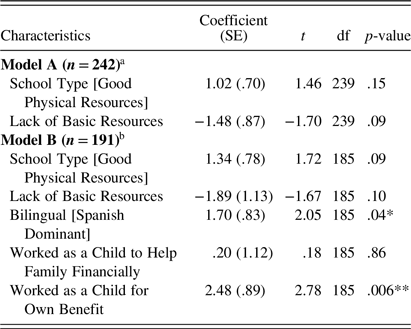
Analyses investigating the two-way interaction of variables associated with Global Mean T-scores in univariable analyses at p < .05 (i.e., type of school attended, lack of basic resources composite, childhood work history, and performance-based bilingualism), showed no significant interactions. Since there was data missing for more than 10% of the sample on bilingualism and childhood work history, we first ran a model in the overall sample (Table 4, Model A), using as variables type of school attended and lack of basic resources composite. Results showed that neither was significantly associated with Global Mean T-scores when considered together (ps > .05).
Educational quality and access, childhood socioeconomic and language-use correlates of demographically corrected global mean T-scores

Note. Results based on multivariable linear regression models including culturally relevant factors that were associated with Global Mean TS at p < .10 in univariable analyses.
a F 1,238 = 3.42, p = .06; R 2 adj = .01.
b F 5,185 = 4.97, p = .0003; R 2 adj = .09.
Reference group for Model B is Did Not Work as a Child.
*Indicates p < .05, **indicates p < .0001.
Analyses in a subset of individuals with available childhood work history data (n = 191) and performance-based language use showed that being bilingual (p = .04) and working as a child for one’s own benefit (compared to not working as a child) (p = .006) were significantly and independently associated with higher Global Mean T-scores, while the type of school attended and lack of basic resources were not (ps > .09) (Table 4, Model B). This model accounted for an additional 9% of the variance in global cognition.
In post hoc analyses, we examined whether correlates of global cognition were associated with specific cognitive domains (Table 5). We ran separate linear regression models on cognitive domain T-scores with the same variables that were included in the multivariable model on Global Mean T-scores presented in Table 4, Model B. As shown in Table 5, attending a school with more resources (p = .03), being bilingual (p = .001), and working as a child for one’s own benefit (p = .0004) were significantly associated with higher processing speed T-scores. Being bilingual (p = .04) and working as a child for one’s own benefit (p = .04) were also associated with higher executive functioning T-scores. Attending a school with more resources was significantly associated with higher learning T-scores (p = .03). Working as a child for one’s own benefit was also significantly associated with working memory (p = .01) and higher visuospatial T-scores (p = .005). None of the factors were significantly associated with memory, verbal fluency or fine motor skills (ps > .05).
Educational quality and access, childhood socioeconomic and language-use correlates of demographically corrected domain-specific T-scores

Note: Values represent B (SE); ** indicates p < .05, ***indicates p < .001.
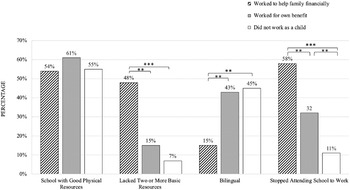
To further investigate whether the group of individuals who worked as a child for their own benefit differed on other culturally relevant factors, post hoc analyses examined associations between childhood work history and culturally relevant variables that were significantly associated with Global Mean T-scores in univariable analyses. We also included stopped attending school to work as it may be theoretically linked to childhood work history. Results from Chi-Square tests (Figure 1) showed that participants who reported working to help their family financially were significantly more likely to lack access to two or more basic resources, be monolingual Spanish-speaking and report having stopped attending school to work, compared to both those who did not work and those who worked for their own benefit (ps < .01).
Chi-Square tests investigating the association of childhood work history with other related culturally relevant factors (n = 248). ** indicates p < .01, *** indicates p < .0001.

DISCUSSION
The Neuropsychological Norms for the US–Mexico Border Region in Spanish (NP-NUMBRS) Project developed region-specific demographically adjusted norms for Spanish speakers living in the US–Mexico borderland on a comprehensive neuropsychological test battery. The present study expands the NP-NUMBRS findings by quantifying the effect of other culturally relevant background factors (beyond basic demographics) on global and domain cognitive functioning in this group. Partially consistent with our hypotheses, present findings showed that several culturally relevant indicators of educational quality and access, childhood environment, and language factors were univariably associated with levels of global cognition in Spanish-speaking adults enrolled in the NP-NUMBRS project. However, the effects of these variables were considerably reduced when utilizing region-specific cognitive T-scores adjusted for demographics (i.e., age, years of education, sex). In multivariable analyses, being bilingual and working as a child for one’s own benefit (as opposed to not working at all) were independently and significantly associated with higher demographically adjusted global T-scores. Furthermore, culturally relevant factors were differentially associated with specific domain T-scores. Working as a child for one’s own benefit was significantly and positively associated with higher T-scores on four of seven domains (i.e., processing speed, executive functioning, working memory, and visuospatial skills), being bilingual was significantly associated with higher processing speed and executive functioning T-scores, and attending a school with good resources was significantly and positively associated with processing speed and learning T-scores.
The use of population-specific demographically adjusted normative data is an important tool for accurate identification of brain dysfunction via neuropsychological tests (Cherner, Marquine et al., Reference Cherner, Marquine, Umlauf, Morlett Paredes, Rivera Mindt, Suárez and Heaton2020; Daugherty, Puente, Fasfous, Hidalgo-Ruzzante & Pérez-Garcia, Reference Daugherty, Puente, Fasfous, Hidalgo-Ruzzante and Pérez-Garcia2017; Kamalyan et al., Reference Kamalyan, Hussain, Diaz, Umlauf, Franklin, Cherner and Marquine2021). Our results showed that region-specific demographically adjusted cognitive scores accounted for much of the variance of culturally relevant factors on cognitive test performance. This is particularly important because many of these additional culturally relevant factors can be more difficult to ascertain compared to demographic characteristics. There is a lack of standard assessments for many of these sociocultural constructs, and some might be more time consuming to assess or require the collection of sensitive data. Controlling for the influence of culturally relevant factors on cognitive test performance for this population may at least partly be accomplished by accounting for age, sex, and years of education.
Of note, while our findings underscore the utility of adjustments of demographic characteristics, they do not necessarily indicate that demographic characteristics are more important than sociocultural factors to cognitive performance. Population-specific norms that correct for basic demographics reflect a constellation of characteristics and can help “adjust” for the impact of such factors. Global cognition and performance in certain domains, particularly executive functioning and processing speed, were impacted by cultural variables over and above demographic adjustments, suggesting their inclusion is important when interpreting overall test performance. The incorporation of additional culturally specific variables (i.e., bilingualism, and childhood work history) explained an additional 9% of the variance in global cognition for this population. In comparison, a study investigating the impact of quality of education using a measure of reading ability on test performance among older Blacks indicated that this variable accounted for 9%–40% of the variance on demographically unadjusted individual test scores (Manly, Byrd, Touradji, & Stern, Reference Manly, Byrd, Touradji and Stern2004). Our results showcase that certain culturally relevant constructs (beyond normative adjustments) might be considered when interpreting cognitive data for the identification of underlying brain dysfunction among Spanish speakers in the US borderland region with Mexico.
In the multivariable model that included notable culturally relevant factors, participants classified as bilingual via performance-based English and Spanish fluency tests scores obtained higher demographically adjusted cognitive test scores than those who were monolingual Spanish-speaking. While prior studies have yielded mixed findings (De Bruin, Treccani, & Della Sala, Reference De Bruin, Treccani and Della Sala2015; Naeem, Filippi, Periche-Tomas, Papageorgiou & Bright, Reference Naeem, Filippi, Periche-Tomas, Papageorgiou and Bright2018; Samuel, Roehr-Brackin, Pak & Kim, Reference Samuel, Roehr-Brackin, Pak and Kim2018), present results lend support to the notion that bilingualism might provide a cognitive advantage among native Spanish speakers living in the US borderland. Some of the purported mechanisms of this advantage include that the cognitive control processes involved in managing and switching between two languages may strengthen executive skills to be more efficient (Prior & Gollan, Reference Prior and Gollan2011; Zahodne, Schofield, Farrell, Stern & Manly, Reference Zahodne, Schofield, Farrell, Stern and Manly2014), which is consistent with our findings showing significant positive associations of bilingualism with executive functioning and processing speed. Suarez and colleagues (Reference Suárez, Marquine, Díaz-Santos, Gollan, Artiola i Fortuny, Rivera Mindt and Cherner2020b) specifically investigated whether the degree of English-Spanish bilingualism among this same sample impacted individual test scores, finding that higher degree of bilingualism remained independently associated with better T-scores on some tests, even after correcting for differences in education and SES (Suarez et al., Reference Suárez, Marquine, Díaz-Santos, Gollan, Artiola i Fortuny, Rivera Mindt and Cherner2020b). Our analyses add to these findings by incorporating other culturally relevant factors in the model, and showing that the positive association between bilingualism and global and domain cognitive T-scores continued to be significant after including these additional variables. Although we investigated how bilingualism is associated with cognition in conjunction with other culturally relevant factors, it is important to note that the NP-NUMBRS project was not originally designed to study the effects of bilingualism on cognition and that we included only primarily Spanish-speaking individuals. Future studies including Latinos along the spectrum of bilingualism (i.e., from primarily Spanish-speaking to primarily English-speaking) along with assessments of culturally relevant factors would be best suited to determine the potential advantage of bilingualism on cognition in this population. Finally, the objective measure of bilingualism calculated using data from FAS/PMR was the only language-use factor significantly associated with global cognition. Verbal fluency measures are commonly administered in standard cognitive assessments (Marquine et al., Reference Marquine, Morlett Paredes, Madriaga, Blumstein, Umlauf, Kamalyan and Cherner2020a; Suarez et al., Reference Suárez, Marquine, Díaz-Santos, Gollan, Artiola i Fortuny, Rivera Mindt and Cherner2020b), and as such, might be relatively easy to incorporate as performance-based assessments of bilingualism in clinical and research settings. We found a discrepancy between examiner report of bilingualism (56%) and performance-based bilingualism (38%), which is likely partly driven by the way these variables were measured. Examiner report of bilingualism was based on a single question, and it was left to the examiner to determine what “bilingual” meant. Further, while the monolingual-bilingual categorization utilized in our analyses was based on a continuous measure, issues with the data precluded us from considering it as a continuous variable in the present paper. It is possible that if we had used a different cutoff score for determining bilingualism, this might have more closely aligned with the examiners’ ratings. Further, there were data missing in both the examiner report measure of bilingualism and the performance-based measure of bilingualism, with 181 participants having data in both variables. The important question of disentangling which type of measure might more accurately capture the effect of bilingualism on cognition (Gollan et al., Reference Gollan, Weissberger, Runnqvist, Montoya and Cera2012, Reference Gollan, Salmon, Montoya and Galasko2011; Rivera Mindt et al., Reference Rivera Mindt, Arentoft, Germano, D’Aquila, Scheiner, Pizzirusso and Gollan2008; Suarez et al., Reference Suarez, Gollan, Heaton, Grant and Cherner2014; Surrain & Luk, Reference Surrain and Luk2019) would be best addressed in future research that includes bilingualism assessments that have been validated and allow for the consideration of bilingualism in a continuous fashion.
Participants who reported working as children for one’s own benefit obtained higher demographically adjusted global cognitive scores (and higher scores on several cognitive domains, including processing speed, executive function, working memory, and visuospatial skills), as compared to those who reported not working as children and those who reported working during childhood to help their family financially, when several other culturally relevant factors were also considered. The reasons why working in childhood for one’s own benefit is associated with better cognition in adulthood are likely to be varied and difficult to ascertain based on present findings. One hypothesis worth investigating in future work might be that choosing to work as a child for one’s own benefit is a potential indicator of grit, conscientiousness, or a motivation for one to “do their best”, which may have implications for the development of cognitive capacity or reserve (Rhodes, Devlin, Steinberg, & Giovannetti, Reference Rhodes, Devlin, Steinberg and Giovannetti2017). Though not analyzed in our study, working for one’s own benefit may be related to personality characteristics such as self-reliance and desire to improve one’s lot in life through personal effort, while working to help support the family may be less of a choice, and may prevent or interfere with learning in other contexts. Consistently, we found that those who worked to help their family financially were more likely to report having stopped attending school. These are empirical questions that remain open to further data collection and analysis. Importantly, these results may not generalize to other subpopulations in the US warranting further study. Our findings indicate additional investigation is needed into how individual personality factors may play a role in cognitive test performance particularly in diverse Latino populations living in the US (Soubelet & Salthouse, Reference Soubelet and Salthouse2011).
Importantly, present findings relating work history with cognitive performance indicate that merely asking whether one worked as a child would not fully capture the complexity of this construct among native Spanish speakers living near the US–Mexico border. Rather, understanding the reasons for working during childhood may provide important information that reflects the intersection of early socioeconomic circumstances associated with cognitive performance in adulthood (Fujishiro, Xu, & Gong, Reference Fujishiro, Xu and Gong2010; Ritchie et al., Reference Ritchie, Jaussent, Stewart, Dupuy, Courtet, Malafosse and Ancelin2011). This notion is further supported by post hoc analyses investigating differences in other cultural factors relevant to cognitive performance by childhood work history. These analyses showed that participants who worked for one’s own benefit were comparable to those who did not work during childhood in terms of access to basic resources and being bilingual. In contrast, those who worked during childhood to help their family financially had less access to basic resources and were less likely to be bilingual than both participants who did not work in childhood, and those who did so for their own benefit.
Two other factors (i.e., school type and lack of two or more basic resources) were associated with demographically adjusted global cognitive scores in univariable analyses but did not independently contribute to variance in global cognition when considered together with bilingualism and childhood work history. Of note, analyses on cognitive domains showed that attending a school with better resources was associated with higher processing speed and learning T-scores. Type of school attended was conceptualized as an indicator of educational quality, which is a construct that has been associated with cognition in prior studies (Artiola i Fortuny, Heaton, & Hermosillo, Reference Artiola i Fortuny, Heaton and Hermosillo1998; Luo & Waite, Reference Luo and Waite2005; Ostrosky-Solis, Ardila, Rosselli, Lopez-Arango, & Uriel-Mendoza, Reference Ostrosky-Solis, Ardila, Rosselli, Lopez-Arango and Uriel-Mendoza1998). Not many individuals in our sample reported attending small schools with less than one classroom per grade (n = 11). If we had a greater proportion of individuals who attended smaller schools with fewer resources, we might have been able to capture a greater range of educational quality and this factor might have had a broader impact on cognition. Furthermore, the item asked about both “room to play”, which can be fairly subjective, and number of grades per classroom, which is a more objective criterion. It is possible that this item did not fully capture important aspects of educational quality for Spanish speakers living in the US–Mexico border region and requires additional study.
Our study had several limitations. We used a non-validated self-report measure to capture childhood background experiences. At the time of data collection (1998 and 2009), the inclusion of this self-report measure served the authors’ current appreciation of potentially important culturally relevant background information. As our field moves forward, future studies should work to develop standardized assessments that accurately measure educational quality, access to socioeconomic resources, adverse childhood experiences, and language use. Additionally, our culturally relevant characteristics required participants to retrospectively recall details from their childhood. This can introduce bias in the interpretations of items and may not entirely capture their environment well (Raphael, Reference Raphael1987). As an example, a small proportion of the sample responded “yes” to the item “did you ever go hungry as a child” (n = 28), but we do not know the degree nor duration of food insecurity for these respondents. Similarly, while about half of our sample reported working as children (n = 131), we do not know what job they held and for how long, how much income they earned, at what level of education they began to work, if the job prevented consistent attendance at school, etc. Relatedly, perception of childhood SES was ascertained with a single question with response options being “very poor, poor, middle class or upper class”. The ranges for these SES levels may not have been uniformly understood by participants. Providing anchors for each of these levels might help assure that perceptions are uniformly rated across participants. Further research should explore the potential complexities of childhood work history, lack of basic resources, SES, and educational quality with more thorough items. Furthermore, our performance-based bilingualism fluency measure was only available for a subset of the sample and some of the collected data were not available for analyses, which precluded us from investigating the influence of the degree of Spanish/English fluency. Finally, the large number of univariable predictors of cognition carries an increased probability for Type I error. For full transparency, we report all p-values, significant and nonsignificant.
Crucially, Latinos living in the US are a highly heterogenous group, therefore, caution should be taken when applying the NP-NUMBRS norms or extending these associations with cognition to other subgroups of Spanish speakers living in the US. Furthermore, our study was cross-sectional in design, and causal predictions of poor cognitive performance from sample characteristics cannot be inferred. Future longitudinal research on life-course factors and their relation to cognitive changes among diverse samples of Spanish-speakers across the socioeconomic spectrum would further clarify this significant association and elucidate any potential causal relationships.
Strengths of our study include identifying the unique and combined effects of culturally relevant variables such as educational quality and access, bilingualism, and socioeconomic disadvantage (Echemendia & Harris, Reference Echemendia and Harris2004; Flores et al., Reference Flores, Casaletto, Marquine, Umlauf, Moore, Mungas and Heaton2017; Suarez et al., Reference Suárez, Marquine, Díaz-Santos, Gollan, Artiola i Fortuny, Rivera Mindt and Cherner2020b) on adjusted cognitive performance. Additionally, we employed the use of a comprehensive neuropsychological battery and region-specific demographic adjustments that were created based on the sample included in these analyses (Cherner, Marquine et al., Reference Cherner, Marquine, Umlauf, Morlett Paredes, Rivera Mindt, Suárez and Heaton2020). Investigating the relationship of these variables at both the unadjusted scaled score and adjusted global mean T-score levels increases confidence in the utility of these population-specific corrections as they significantly account for the influence of cultural factors in this population. Nevertheless, clinicians and researchers are encouraged to consider other relevant sociocultural factors, particularly the psychological and language-use factors identified here, in the interpretation of cognitive test results, as these factors explained an additional 9% variance in demographically adjusted cognitive test scores.
In conclusion, adjusting for the effect of a small number of demographics (i.e., age, years of education, and sex) accounted for the impact of several culturally relevant characteristics (i.e., indicators of educational quality and access, childhood socioeconomics, and language use) on cognitive test performance in Spanish-speaking adults living in the US–Mexico border. This highlights the utility of basic demographic adjustments in accounting for the effect of a host of factors that are often difficult to ascertain and that impact test performance, but are not the result of an underlying brain disorder. Our findings also underscore the utility of adopting a culturally informed approach in the development of neuropsychology test norms and the application of existing normative data (Marquine et al., Reference Marquine, Rivera Mindt, Umlauf, Suárez, Kamalyan, Morlett Paredes and Cherner2021). While normative adjustments represent an important tool, their use requires careful consideration of aspects of a patient’s background that might impact cognitive test performance that are not represented in normative adjustments. In our study, bilingualism (as assessed by a performance-based measure) and childhood work history (whether and why a person worked as a child) emerged as important factors to consider when evaluating Spanish speakers living in the US–Mexico border region. It is our aspiration that the utilization of NP-NUMBRS normative data along with the consideration of important sociocultural background data will help enhance the practice of clinical neuropsychology in this group. Identifying which are the most important factors that ought to be considered in normative adjustments across cultural/linguistic groups is an important step of future research aimed at developing diagnostic tools for the accurate identification of underlying brain dysfunction via neuropsychological data.
FINANCIAL SUPPORT
This work was supported by grants from the National Institutes of Health (The HIV Neurobehavioral Research Center (HNRC): P30MH062512, R01MH064907, K23MH105297, P30AG059299, and T32AA013525) and the UCSD Hispanic Center of Excellence.
The HIV Neurobehavioral Research Center (HNRC) is supported by Center award P30MH062512 from NIMH. The San Diego HIV Neurobehavioral Research Center [HNRC] group is affiliated with the University of California, San Diego, the Naval Hospital, San Diego, and the Veterans Affairs San Diego Healthcare System, and includes: Director: Robert K. Heaton, Ph.D., Co-Director: Igor Grant, M.D.; Associate Directors: J. Hampton Atkinson, M.D., Ronald J. Ellis, M.D., Ph.D., and Scott Letendre, M.D.; Center Manager: Jennifer Iudicello, Ph.D.; Donald Franklin, Jr.; Melanie Sherman; NeuroAssessment Core: Ronald J. Ellis, M.D., Ph.D. (P.I.), Scott Letendre, M.D., Thomas D. Marcotte, Ph.D., Christine Fennema-Notestine, Ph.D., Debra Rosario, M.P.H., Matthew Dawson; NeuroBiology Core: Cristian Achim, M.D., Ph.D. (P.I.), Ana Sanchez, Ph.D., Adam Fields, Ph.D.; NeuroGerm Core: Sara Gianella Weibel, M.D. (P.I.), David M. Smith, M.D., Rob Knight, Ph.D., Scott Peterson, Ph.D.; Developmental Core: Scott Letendre, M.D. (P.I.), J. Allen McCutchan; Participant Accrual and Retention Unit: J. Hampton Atkinson, M.D. (P.I.) Susan Little, M.D., Jennifer Marquie-Beck, M.P.H.; Data Management and Information Systems Unit: Lucila Ohno-Machado, Ph.D. (P.I.), Clint Cushman; Statistics Unit: Ian Abramson, Ph.D. (P.I.), Florin Vaida, Ph.D. (Co-PI), Anya Umlauf, M.S., Bin Tang, Ph.D.
The views expressed in this article are those of the authors and do not reflect the official policy or position of the Department of the Navy, Department of Defense, nor the United States Government.
CONFLICTS OF INTEREST
The authors have no conflict of interests to disclose.
ETHICAL STANDARDS
All data included in this manuscript were obtained in compliance with the Helsinki Declaration and approved by the ethics committee of the UCSD Institutional Review Board.