

Introduction
Contrary to deeply entrenched stereotypes (Byers Reference Byers1983; González Reference González2007), most older adults express an interest in romance and remain sexually active and satisfied well into old age (Brown and Lin Reference Brown and Lin2012; DeLamater Reference DeLamater2012; Katz and Marshall Reference Katz and Marshall2003; Thomas, Hess and Thurston Reference Thomas, Hess and Thurston2015; Wu and Schimmele Reference Wu and Schimmele2007). At the same time, older adults’ sexuality is increasingly being positioned as essential to ageing successfully (Gott Reference Gott2005; Katz Reference Katz2001, Reference Katz2013). Biomedical advancement has resulted in the medicalisation of sexuality (e.g. pathologising and ‘fixing’ it). As the stereotype of the post-sexual or non-sexual older adult is eclipsed by the ‘sexy oldie’ (Gott Reference Gott2005: 34), sexuality has become an important way for older adults to present themselves as being in the Third Age of youthful vitality, rather than in the Fourth Age of debilitation and dependence (Bayer Reference Bayer2005; Calasanti and King Reference Calasanti and King2005; Gilleard and Higgs Reference Gilleard and Higgs2000; Katz and Marshall Reference Katz and Marshall2003).
Like their younger counterparts, older adults are increasingly turning to the internet as a means of meeting and dating potential partners with whom they can establish romantic and sexual relationships (Smith and Duggan Reference Smith and Duggan2013). While the bulk of online dating research has investigated the experiences or self-presentations of adults at a young age or in a wide age range (e.g. 18−96, <60 or ⩾40) (e.g. Alterovitz and Mendelsohn Reference Alterovitz and Mendelsohn2013; Whitty Reference Whitty2008), little research has focused exclusively on older adults (Alterovitz and Mendelsohn Reference Alterovitz and Mendelsohn2009; Frohlick and Migliardi Reference Frohlick and Migliardi2011; McWilliams and Barrett Reference McWilliams and Barrett2014; Whitty Reference Whitty2008). In addition, scant research has investigated racial/ethnic differences in older adults’ engagement in online dating. To understand how older adults participate in online dating, it is important to take into account how their presentation of self in their online profiles differs when broken down by age, gender and culture. In this paper, we examine how older adults present themselves in online dating profiles, paying particular attention to how their use of language reflects and reinforces idealised images of ageing and gender.
Online dating: gender, age and the presentation of self
On the presentation of self, Goffman (Reference Goffman1959: 15) commented that ‘when an individual appears before others he will have many motives for trying to control the impression they receive of the situation’. Through self-presentation, an individual attempts to manage others’ impressions by performing in a way that incorporates and manifests socially and culturally shared values. It is becoming increasingly understood and accepted that the definitions, views and meanings that older adults attribute to ageing are products of cultural context (Twigg and Martin Reference Twigg, Martin, Twigg and Martin2015). For example, in Western culture, ageing well for women is understood in part as maintaining an appearance of youthfulness and beauty – both of which are idealised and normative standards of femininity. If older women feel that they are losing these characteristics, they may feel that their ability to maintain their feminine sense of self is challenged (Calasanti and Slevin Reference Calasanti, Slevin, Calasanti and Slevin2006; Hurd Clarke Reference Hurd Clarke2011). For men in a Western context, idealised masculinity in later life has been linked to engagement in leisure (e.g. sports and travel) and sexual activity (Calasanti and King Reference Calasanti and King2005). Such Western masculine norms and ideals connecting men and sports may not necessarily resonate with Asian men or explain their physical activity engagement (Oliffe et al. Reference Oliffe, Grewal, Bottorff, Hislop, Phillips, Dhesi and Kang2009). In terms of general appearance, previous research has revealed that body weight is perceived as less of a concern among older African-American men and women than among those of European descent (Aruguete, Nickleberry and Yates Reference Aruguete, Nickleberry and Yates2004; Schuler et al. Reference Schuler, Vinci, Isosaari, Philipp, Todorovich, Roy and Evans2008). Winterich (Reference Winterich2007) found that middle-aged and older women of colour were more accepting than their Caucasian counterparts of their grey hair. The variety of meanings and experiences of ageing may inform older adults’ self-presentations.
The way people present themselves online appears to vary by age and gender. For example, younger adults tend to focus on achievement and career (Davis and Fingerman Reference Davis and Fingerman2016), while older adults emphasise their positive health status (Alterovitz and Mendelsohn Reference Alterovitz and Mendelsohn2013; Davis and Fingerman Reference Davis and Fingerman2016), as well as their sense of humour, playfulness and positive attitudes (Davis and Fingerman Reference Davis and Fingerman2016; Jagger Reference Jagger2005; Jönson and Siverskog Reference Jönson and Siverskog2012). In this way, older adults actively distance themselves from negative stereotypes of old age as a time of frailty and pessimism (Davis and Fingerman Reference Davis and Fingerman2016; Jagger Reference Jagger2005). In addition, online dating profiles often reflect idealised standards of masculinity and femininity (Frohlick and Migliardi Reference Frohlick and Migliardi2011; Jagger Reference Jagger2005), suggesting that the older adults may be adhering to a gender script that is both approved by and relevant to their particular culture in order to attract a future partner (Stockard Reference Stockard and Chafetz2006). According to such scripts, an idealised feminine image is based primarily on youthfulness and beauty (Woodward Reference Woodward2006), whereas social and economic status typically represents masculinity because it corresponds to power (Calasanti and King Reference Calasanti and King2005; Hurd Clarke, Bennett and Liu Reference Hurd Clarke, Bennett and Liu2014). Research found that regardless of their age, women generally depict themselves in online dating profiles as glamorous, slim and youthfully attractive (DeAndrea et al. Reference DeAndrea, Tong, Liang, Levine and Walther2012; McWilliams and Barrett Reference McWilliams and Barrett2014; Toma, Hancock and Ellison Reference Toma, Hancock and Ellison2008; Whitty Reference Whitty2008), while men emphasise their social power and vitality by calling attention to their financial assets and educational attainment (Alterovitz and Mendelsohn Reference Alterovitz and Mendelsohn2009; Jagger Reference Jagger2005).
An online dating site can be regarded as a field in the Bourdieusian sense (Bourdieu Reference Bourdieu1984) – that is, a social arena in which people compete to obtain the most desirable partners. As such, it has its own internal logic to determine the most desirable partners and rules about how potential partners may be solicited. A carefully constructed profile that stands out from the competition is essential to attract partners. To create an effective profile, it is insufficient merely to list the kinds of capital (e.g. economic, social, cultural, physical resources) that a person possesses. Rather, it is the manner in which this capital is presented and alluded to that is critical for success. Those who have better access to capital have likely acquired dispositions and habits that not only make them more desirable, but also provide them with better skills to compete for partners – skills that likely facilitate the creation of more appealing profiles. These preferences and behaviours represent what Bourdieu (Reference Bourdieu1990) describes as habitus, a system of perceptions, thoughts and actions that social agents acquire through experience in various places over time and that allows social agents to (re)produce social conditions in their favour. Such a system enables them as social agents to navigate their actions in a field. Thus, accessibility to capital both creates and reproduces societal power relations through habitus, which in this particular context is manifested in terms of relative attractiveness. Although the virtual nature of this online environment may give people licence to embellish their capital – that is, to develop and present a self that has been socially created – they require the habitus to do so in a way that will not be perceived as pretentious, and thus potentially unattractive, by the very people they are seeking to attract.
Misrepresentation is relatively common in online profiles as individuals strive to manage others’ impressions of themselves (Goffman Reference Goffman1959; Leary Reference Leary1995; Whitty Reference Whitty, Whitty, Baker and Inman2007, Reference Whitty2008), maximise their chances of receiving a response from a desirable potential partner (Walther Reference Walther1996), and present a positive and culturally valued self (Choi, DiNitto and Kim Reference Choi, DiNitto and Kim2014; Jagger Reference Jagger2005; Ward Reference Ward2010, Reference Ward2013). For example, men and women over the age of 50 often misrepresent their age (Hall et al. Reference Hall, Park, Song and Cody2010), by referring to their age in vague terms (Coupland Reference Coupland2000; McWilliams and Barrett Reference McWilliams and Barrett2014), or emphasising their youthful mindset and optimal health. Similarly, several studies have found that women often used retouched, out-of-date or professionally taken photographs in their online profiles, with the goal of appearing younger and more physically attractive (Hancock and Toma Reference Hancock and Toma2009; Lo, Hsieh and Chiu Reference Lo, Hsieh and Chiu2013). Additionally, women frequently under-report their body weight in an effort to appear more sexually desirable (Hall et al. Reference Hall, Park, Song and Cody2010). In contrast, men often describe themselves as taller than they actually are (Toma, Hancock and Ellison Reference Toma, Hancock and Ellison2008) and emphasise or strategically misrepresent their social status, including income, employment and educational background (Alterovitz and Mendelsohn Reference Alterovitz and Mendelsohn2009; Hall et al. Reference Hall, Park, Song and Cody2010; McWilliams and Barrett Reference McWilliams and Barrett2014). Highlighting employment status in online profiles appears to be particularly important to younger men (Davis and Fingerman Reference Davis and Fingerman2016), and corresponds to the value placed by society on engaging in the development and maintenance of the market economy as a citizen (Pancer Reference Pancer2015). Men are also more likely than women to misrepresent their personal interests (e.g. liking a particular television programme) and personality traits (e.g. politeness) to create a positive, marketable self (Hall et al. Reference Hall, Park, Song and Cody2010).
Online dating: what older adults want in a relationship and potential partners
Previous, albeit sparse, research has investigated the types of relationships and personal qualities that older adults look for when they go online in search of partners. The research has found that older adults tend to identify friendship, partnership or companionship for holidays and activities as relational goals in their profiles (Alterovitz and Mendelsohn Reference Alterovitz and Mendelsohn2013; Coupland Reference Coupland2000). Compared to younger adults, older adults (women in particular) are selective about the age, race, religion, income and height of a potential partner (McIntosh et al. Reference McIntosh, Locker, Briley, Ryan and Scott2011). McWilliams and Barrett (Reference McWilliams and Barrett2014) found that men seek a committed relationship that provides them with practical and emotional support. Having a youthful partner is also consistently preferable for men because, according to a masculine ideal, this is a symbol of success (McIntosh et al. Reference McIntosh, Locker, Briley, Ryan and Scott2011; McWilliams and Barrett Reference McWilliams and Barrett2014). Men generally rate youthfulness, physical attractiveness and an affectionate personality highly when considering potential female partners (Alterovitz and Mendelsohn Reference Alterovitz and Mendelsohn2009; Bartling, LeDoux and Thrasher Reference Bartling, LeDoux and Thrasher2005; Frohlick and Migliardi Reference Frohlick and Migliardi2011; Jagger Reference Jagger2005; McWilliams and Barrett Reference McWilliams and Barrett2014). In contrast, women express a preference for intimacy and companionship that does not compel them to assume a traditionally feminine role (McWilliams and Barrett Reference McWilliams and Barrett2014). This attitude leads them to seek men who value equality between partners in a relationship and who can manage their domestic responsibilities themselves rather than relying on a female partner to do so. Although some studies have found that women tend to look for a male partner who is older than themselves (Alterovitz and Mendelsohn Reference Alterovitz and Mendelsohn2009; Bartling, LeDoux and Thrasher Reference Bartling, LeDoux and Thrasher2005; Jagger Reference Jagger2005), having a youthful partner is preferable for middle-aged and older women because of the greater likelihood that the couple will enjoy a longer active lifestyle together (McIntosh et al. Reference McIntosh, Locker, Briley, Ryan and Scott2011; McWilliams and Barrett Reference McWilliams and Barrett2014). In addition, women identify financial security, occupational success and an ambitious personality as important qualities in a potential male partner (Alterovitz and Mendelsohn Reference Alterovitz and Mendelsohn2009; Bartling, LeDoux and Thrasher Reference Bartling, LeDoux and Thrasher2005; McWilliams and Barrett Reference McWilliams and Barrett2014). Both men and women seek honesty, a sense of humour and open-mindedness in a future partner (Bartling, LeDoux and Thrasher Reference Bartling, LeDoux and Thrasher2005). Although Bartling, LeDoux and Thrasher (Reference Bartling, LeDoux and Thrasher2005) did not find significant differences among Asian, Hispanic, Black and White adults in the presentation of desired attributes, to date little research has compared and contrasted the qualities that individuals from different racial/ethnic backgrounds identify as important in a partner in online dating settings.
Other online forums and older adults’ self-presentation
Scant research has investigated how older adults present themselves in other venues such as online social network and communication forums. Specifically, two studies have considered older adults’ practices on MySpace. Pfeil, Arjan and Zaphiris (Reference Pfeil, Arjan and Zaphiris2009) found that older adults were more likely than their younger counterparts to use longer or multisyllabic words and to describe themselves in a more formal manner in their profiles. Boyle and Johnson (Reference Boyle and Johnson2010) reported that older adults were less likely than younger individuals to reveal detailed personal information. These studies also found that older adults tended to interact less with others and to exhibit connections with a smaller group, albeit one comprising a wider age range, compared to younger adults. Lehtinen, Nasanen and Sarvas (Reference Lehtinen, Nasanen and Sarvas2009: 50) explored older adults’ approaches to social networking sites and found that they were very careful about how they portrayed themselves and how much personal information they revealed, not only because they were concerned about their safety but also because they perceived their intentional self-presentation as ‘a little silly’, ‘empty-headed’ or ‘self-conceited’. While some older adults use social networking sites such as Facebook because they recognise that they are useful for staying in touch with family members and old friends and for building social connections, others hesitate to do so due to privacy concerns, lack of confidence about their technology skills or a perception that the sites are irrelevant to their lives (Jung et al. Reference Jung, Walden, Johnson and Sundar2017; Lehtinen, Nasanen and Sarvas Reference Lehtinen, Nasanen and Sarvas2009; Vroman, Arthanat and Lysack Reference Vroman, Arthanat and Lysack2015; Xie et al. Reference Xie, Watkins, Golbeck and Huang2012).
Building on the existing research and addressing the aforementioned gaps, the aim of this study was to analyse how a diverse group of Canadian heterosexual older adults portrayed themselves. Exploration of older adults’ self-presentation would advance our understanding of how ageing is being constructed and how these constructions vary according to groups of intersecting characteristics. As such, we examined differences with a focus on how age, gender and race/ethnicity combined to influence the ways that older adults portrayed themselves online. We exclusively explored heterosexual older adults so that we could examine how and to what extent masculinity and femininity that are typically presented in heteronormative interactions across age were reflected in older adults’ self-portrayals.
Methods
We drew on data from a larger quantitative study (Wada, Mortenson and Hurd Clarke Reference Wada, Mortenson and Hurd Clarke2016) that included a random sample of 20 profiles (posted by older adults, age 60+) from 16 groups (stratified on the basis of age, gender and race/ethnicity) (N = 320). We obtained ethical approval from the University of British Columbia.
Data collection
The online profiles examined in this study were retrieved from the website Plenty of Fish (www.pof.com). We chose this site because it is one of the most popular free online dating sites (Oliveira Reference Oliveira2012), claiming to have over 90 million registered users worldwide (www.pof.com) and ranking in the top five dating sites (eBizMBA 2017). To be included, the profiles had to be written in English and indicate that the person posting his or her profile was heterosexual, Canadian, 60–99 years of age, and ‘Asian’, ‘Black’, ‘Caucasian’ or ‘Native American’ (categories used by Plenty of Fish). The criterion for race/ethnicity was informed by the 2011 Canada National Household Survey (Statistics Canada 2014b), which identified Caucasian, Asian, Native American, Indian and African as the primary ethnic origins of Canadians. The category Indian was not included in this study as there were insufficient profiles for stratification. To ensure that we had sufficient textual data for analysis, we excluded the profiles that included fewer than 16 words in the open-ended section of the profile – ‘About Me’ – where users described their ‘hobbies, goals and aspirations, unique aspects, and taste in music’. The average number of words in that section of the profiles examined in this study was 105.
To create a sampling frame, profiles that were available between April 2014 and May 2014 and met the above-mentioned criteria were collected and stratified into 16 groups based on a combination of the following three characteristics: age (two groups: 60–69 and 70+ years), gender (two groups: men and women) and race/ethnicity (Asian, Black, Caucasian and Native American). We created two age groups because the majority of older adults (60+) who posted their profiles were younger than 80 years old. We therefore divided the range of 60–80 in half for the sampling. All user IDs were retrieved from profiles that met the criteria for each age–gender–racial/ethnic group. The fundamental sample size for each group was determined because there were only 20 profiles from older Native American men available. To keep all of the group sizes the same for statistical analysis, the same number of profiles were randomly selected from the remaining 15 groups. Stratifying the profiles into 16 groups according to age, gender and race/ethnicity allowed us to compare patterns in self-representation among the groups in the current qualitative study. We randomly sampled from among all of the profiles for the Asian, Black and Native American groups, but the number of Caucasian older adults’ profiles that met the inclusion criteria exceeded Plenty of Fish's capacity to display them, which led us to randomly sample from among those that were displayed. Our total sampling frame comprised 3,634 profiles.
We collected a total of 320 profiles categorised into four groups based on self-reported race/ethnicity: 80 Asian, 80 Black, 80 Caucasian and 80 Native American. The mean age of the sample was 68.7 ± 7.0 years old. More than 40 per cent of the profiles reported that the users had a high school education. About 40 per cent of the users identified them as residents in the Canadian province of Ontario. Different data from the same set of profiles was analysed for another study (Wada, Mortenson and Hurd Clarke Reference Wada, Mortenson and Hurd Clarke2016).
Data analysis
We conducted a thematic analysis of the texts in the ‘About Me’ and ‘Interests’ sections using Braun and Clarke's (Reference Braun and Clarke2006) constructionist approach based on Burr's (Reference Burr1995) assumption that meaning and experience are culturally and historically created and recreated. We repeatedly read the retrieved profiles so that we could become intimately familiar with their content (Braun and Clarke Reference Braun, Clarke, Cooper, Camic, Long, Panter, Rindskopf and Sher2012). Initial codes were inductively generated based on the detailed coding of small segments of data (e.g. names of activities identified as an interest, personality traits, description of physical appearance, description of age and health status). We collated those initial codes into categories that described the semantic content of the data and discussed interpretations of the content to ensure that they were both culturally and semantically accurate. We then clustered the categories to generate overarching themes that addressed the study objectives (Braun and Clarke Reference Braun, Clarke, Cooper, Camic, Long, Panter, Rindskopf and Sher2012); had ongoing discussions to facilitate the development, modification and refinement of categories and themes (Braun and Clarke Reference Braun and Clarke2006), which increased the rigour of the analysis; and named and defined each theme in a way that captured its essence. We then compared and contrasted data within each theme and category to explore differences in ways of self-presentation and indicated the proportion of the profiles based on the self-presentation according to age, gender and racial/ethnic origin, and across the 16 groups characterised by the intersection of these characteristics.
Findings
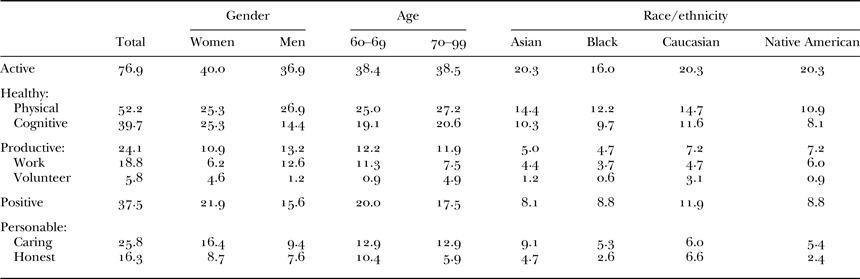
Our thematic analysis identified five primary ways in which older adults portrayed themselves in their online dating profiles, namely (a) active (in terms of adventurous, cultural/artistic and social activities); (b) healthy (physically healthy and intellectually engaged); (c) productive (e.g. engaged in work and volunteer activities); (d) positive (happy, fun-loving and humorous); and (e) personable (e.g. trustworthy and caring). The percentage of profiles that included these ways of self-presentation was fairly consistent across the 16 groups. However, when the profiles were examined regarding discrete characteristics, the differences were more pronounced (Table 1). Being active was portrayed most frequently, while being productive was least prevalent (approximately 77 and 24%, respectively). The names of the older adults who posted the profiles have been replaced here with pseudonyms.
Percentage of profiles that presented any of the primary five themes: active, healthy, productive, positive and personable (broken down by gender, age and race/ethnicity)

Active: ‘I … like to be active and have many interests and hobbies’
Often using words such as ‘busy’, ‘active’ and ‘on the go’, many profiles emphasised the myriad ways in which the older adults were socially engaged in their communities. Some older adults described themselves as enjoying a busy or active lifestyle. Caroline, a 78-year-old Caucasian woman, introduced herself in this way: ‘I am a very outgoing lady that loves to be busy … My main hobby is singing in an a cappella group.’ Other profiles contained a reference not only to living a busy and active lifestyle but also to being a ‘senior’ or ‘retiree’. For example, Alison, a 70-year-old Asian woman, put it this way: ‘I am retired but I remain very active with sports, travelling to Europe and other interesting destinations.’ Neil, a 74-year-old Native American man, wrote: ‘I am an on the go senior, I am always doing something. I volunteer in our community and belong to a couple of organizations.’
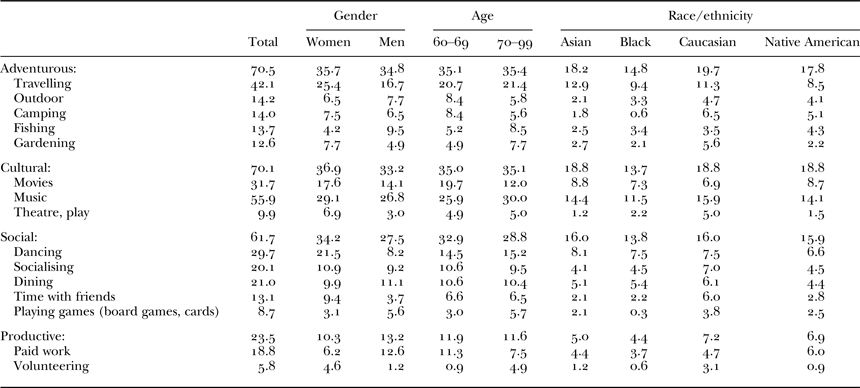
Many participants followed descriptions of their engaged personalities and busy lives with lists of preferred activities. The activities that they listed as interesting or engaging are shown in Table 2. In approximately 70 per cent of the profiles, older adults highlighted their interests in and passion for cultural or artistic activities such as listening to music, watching movies, and going to the theatre and opera. Adam, an Asian man aged 71, said: ‘I enjoy … listening to music, playing piano, … the arts, concerts, theatre.’ Listening to music was the most commonly cited cultural activity that older adults identified as enjoyable. Almost two-thirds referred to interests in a wide range of music, potentially demonstrating their openness to engaging in music-related activities with a future partner: ‘[M]y taste in music is easy’ (Neil, Native American man, age 74) and ‘I love all kinds of music; even rap!’ (Brianna, Black woman, age 73). Watching or going to movies was also a commonly cited activity. Although we did not identify differences in presentations of interests in music and movies among the racial/ethnic groups, Caucasians most frequently reported being interested in traditionally middle- and upper-class pursuits such as the media, performing and visual arts. Chloe, a 77-year-old Caucasian woman, noted:
Percentage of profiles that referred to being interested or engaged in particular activities (broken down by gender, age and race/ethnicity)

For hobbies, I keep busy with acrylic painting – landscapes, people, animals etc. Like to take a drive and photograph the surrounding area … Once a month I attend the … Cultural Center for a play, musical event or ballet … Comfortable in jeans or fancy gown, sweats or silk. I'm easy-going and love life and all the possibilities it holds. Have done some travel, love cruises, etc.
In her profile, Chloe showcased her economic and cultural capital (e.g. her interest in painting, photography and the arts, as well as her relaxed attitude to wearing fancy clothes) but also presented her casual side, possibly for the purpose of attracting men in a broader economic status range.
Approximately two-thirds of the older adults presented themselves as being interested and engaged in social activities. The primary social activities referred to in the profiles are dining out or dining with others, general socialising and spending time with friends: ‘[I] like good music[,] good restaurant, go at the club, chilling with my friends’ (Brian, a 76-year-old Black man). Dancing was a commonly reported interest and presented as an activity through which older adults socialise: ‘My hobbies, because I am aboriginal, love to … Pow Wow, dance and see old and new friends’ (Natalie, a 63-year-old Native American woman) and ‘I just like to mingle with friends in the parties … singing, dancing and chatting’ (Andrea, a 61-year-old Asian woman). The emphasis in the profiles was on the pleasure of companionship and the sociality of the profilers: ‘[E]njoy cooking if there's company, enjoy good conversation on a wide range of subjects’ (Benjamin, a 61-year-old Black man). Bailey, a 70-year-old Black woman, emphasised not only how much she enjoys being social and how good she is at it, but also how much value she places on it: ‘Being among friends and family is so pleasurable, I consider it one of the most rewarding aspects of life. Makes friends very easily.’
More than 40 per cent of the older adults also described themselves as being interested in travelling. In some profiles, older adults included a long list of countries they had visited or were keen to travel to with a partner: ‘I really love travelling to Cuba, Mexico Cancun, Florida, and Pacific Ocean in Tofino, Canada. I love the ocean very, very much. I love and hope to travel to Paris, Vienna, Salzburg, and London again’ (Amelia, Asian woman, age 76, emphasis added). Likewise, Caden, a 61-year-old Caucasian man, highlighted his desire:
Would love to have a travel partner. Hopefully in a couple of years do some long bike trips, love traveling in the southern B.C. every summer. Then hopefully all over the United States for starters. Would love to travel to Mexico, Australia.
In this way, the men and women not only conveyed a passion for travel but also indirectly indicated that they had the health and financial resources necessary for travel abroad.
Additionally, several profiles referenced outdoor activities such as camping and fishing. Norris, a 60-year-old Native American man, said: ‘[L]ove the outdoors camping, hunting, fishing, campfires, barb[e]cues, all the good stuff.’ Catherine, a 62-year-old Caucasian woman, wrote: ‘I love to be outdoors, especially in/on near the water, picnic[k]ing, swimming, walking … I enjoy a good movie … reading … I like a wine tour in Niagara and like to bicycle as well for short distances.’ As in Catherine's profile, a passion for outdoor activities was sometimes presented in parallel with an expressed interest in a variety of inside and outside activities, thereby highlighting flexibility and well-roundedness.
Healthy: ‘I do walk daily and the gym is not a stranger to me. I try and lead a healthy lifestyle’
More than a half of the profiles referred to physical health – whether as an interest in physical activities or as a statement of being physically healthy. For example, many of the profiles described an interest in walking, whether it is athletic (e.g. ‘walk every day’, ‘the pleasures of … pole-walking’) or leisurely and romantic (e.g. ‘long walks on sandy beaches’). While many older adults simply portrayed physical activities as enjoyable, some older adults emphasised their commitment to regular exercise. Chris, a Caucasian man aged 68, stated: ‘I am … healthy, young thinking, and I really DO treadmill every day.’ As was observed in this profile, engagement in regular exercise was often positioned as an important means of maintaining health: ‘I really nee[d] to maintain my physical health now[a]days. I have my Pilates exercise 3 to 4 times a week and sometimes I do swimming’ (Audrey, Asian woman, age 66). Similarly, Nathan, a 61-year-old Native American man, wrote: ‘I also like working out. I try to keep myself in good physical condition as my job requires that.’
At the same time, almost 10 per cent of the profiles included direct statements concerning the health status of the profiled individuals. While half declared that they were ‘healthy’, ‘in good health’ or ‘disease free’, the other half described their figures as ‘fit’, ‘in good shape’, ‘slim’ or ‘slender’. Others used references to health and physical activity to mitigate a potentially negative impression that reporting ‘several extra pounds’ might cause. For example, Brooklyn, a 73-year-old Black woman, reported: ‘Though I carry several extra pounds, I'm active and healthy. I'm in the gym a couple of times a week.’ Camila, a 65-year-old Caucasian woman, portrayed her ongoing efforts to pursue a higher goal: ‘I enjoy healthy eating, going to the gym and am in the process of becoming more fit.’
Approximately two-fifths of the profiles, primarily Caucasian women, indicated an interest or engagement in cognitive or intellectual activities such as reading (30 per cent) and playing solitary games (7 per cent). Some older adults mentioned a joy of reading in particular physical settings: ‘[I] like … curling up with a good book on a stormy day’ (Bethany, Black woman, age 60) and ‘reading a good book at the beach’ (Connor, Caucasian man, age 71). The solitary games that older adults identified as interests included crossword puzzles, Sudoku and computer games, and were presented as training tools to sustain or promote their cognitive function. Alice, a 63-year-old Asian woman, reported: ‘I like to play i-pad games at night before I go to bed (it trains my brain [to] think faster).’
Productive: ‘Though I am 73 years old, financially stable. I still work to occupy myself’
Approximately one-quarter of the profiles described involvement in or enjoyment of productive activities (e.g. paid work, volunteering and care-giving). Amy, a 72-year-old Asian woman, wrote: ‘In spite of my busy schedule, I do some volunteer work. I volunteer with the elderl[y], children, people with medical condition, my church … I find volunteering enhances my life.’ In many cases, engaging in productive activities was presented not only as a means of demonstrating social responsibility but also as an opportunity to express creativity, dedication and passion. Nelson, a 62-year-old Native American man, described his passion for his work in this way: ‘I have been in the coffee industry for 18 years and am very passionate about the people and the bean itself.’ Similarly, Bailey (Black woman, age 70) had this to say: ‘Designing fashions allows my creative juices to flow. I am a fashion designer of [b]ridal gowns and formal attire creating whatever remarkable fashions my clients conceive. I am enjoying this very exciting business venture.’ In some cases, descriptions of employment were followed by a statement highlighting resultant physical, emotional and financial independence. For example: ‘I am a contractor for one of the major home builders [here in] Calgary and [I] am emotional[l]y and financially secure and will retire very comfortably whenever [I] want’ (Colin, Caucasian man, age 67). A 66-year-old Native American woman, Natasha, noted: ‘I work, live in my own house, drive my own car, and am basically a happy person. I am very independent.’ In presenting their independence, some women emphasised that their desire for a partner was not the result of financial or emotional dependence and insecurity: ‘I work with youth and love my job. I have the things I need so I am not looking to be taken care of’ (Claire, Caucasian woman, age 60).
Positive: ‘I love to laugh, have fun … I have humour’
While almost 40 per cent of the older adults described their personalities in ways that emphasised their positive outlook on life, approximately 20 per cent stated that they sought partners with an equally positive attitude towards life. In particular, the men and women frequently highlighted their sense of humour, optimistic attitudes and fun-loving natures. For example, Chelsea, a Caucasian 65-year-old woman, stated: ‘I am a happy … generally an optimistic person with a great sense of humor.’ Likewise, Abraham, a 70-year-old Asian man, wrote: ‘I am a pos[i]tive person, easy and outgoing, fun loving.’ Cala, a 63-year-old Caucasian woman, wrote: ‘I love to laugh (you must have a sense of humour!).’ Nick, a 72-year-old Native American man, noted: ‘[T]he women I would like to meet should be … witty and can take a joke.’ Some older adults demonstrated their positive outlook by describing their beliefs about happiness and life. Charlotte, a Caucasian woman aged 70, wrote, ‘My philosophy: I believe happiness is a choice and joy comes from within’, and a 61-year-old Caucasian man, Charlie, mentioned: ‘I'm at a point in my life where I realize happiness is in the journey, not the destination.’ In this way, many of the participants emphasised the importance of enjoying life and being contented. Bob, a 75-year-old Black man, put it this way: ‘I enjoy the simple things in life and live every moment to its fullest.’ For some participants, an emphasis on being happy and living life ‘fully’ represented a shift in outlook that only came in later life, as expressed by Anna, a 69-year-old Asian woman: ‘I had been working so busy earning a living that I forgot to make a life. But then I feel that it's not too late, and I believe that life is too short to spend it unhappy.’
Personable: ‘I am a Christian country gentleman with a loving, kind, honest, generous and humorous personality’
Twenty-six per cent of the older adults self-identified as being ‘caring’, ‘loyal’ or ‘kind’ in their profiles, and more women than men portrayed themselves in this way. Some older adults, like Carter, a 62-year-old Caucasian man, portrayed his caring personality traits in the context of a relationship: ‘I'm a kind, sensitive type of person, I care about another person's feelings and try to take the time to listen to another's goals and desires in life.’ Others (particularly women) emphasised that they were compassionate, considerate and kind-hearted in nature. Alice, a 63-year-old Asian woman, described herself by referring to her friends’ opinions: ‘I'm a sunshine person. My f[r]iends told me that I am optimistic, honest, kind hearted and caring for others.’ Naomi, a Native American woman aged 72, highlighted her inclusive approach: ‘[I] always give a helping hand out to whomever no matter the color of skin.’
Additionally, approximately 16 per cent either described themselves as ‘honest’ or ‘trustworthy’ or emphasised the value of being forthright in relationships. For example, Cala, a 63-year-old Caucasian woman, declared, ‘My highest value is honesty; second is compassion’, and Andrew, a 60-year-old Asian man, wrote: ‘I am an honest person, jolly, sincere esp[ecially] to the one I love.’ As well as emphasising their own sincerity, some older adults stressed the importance of finding partners who were similarly genuine. Noah, a 68-year-old Native American man, wrote: ‘I live a pretty honest life, been burned once or twice in the past, so honesty is very important to me.’ Clara, a 67-year-old Caucasian woman, emphasised her need for authenticity in a future partner: ‘I have no time for “fake” people, much prefer people who are honest about themselves and let others see them as they really are.’
Age, gender and racial/ethnic differences in self-presentation
Although the ways in which older adults presented themselves were similar between the two age groups, there were some notable gender and racial/ethnic differences. More women than men mentioned an interest in travel and dancing (Table 2). An interest or engagement in cognitive and intellectual activities was reported by 1.8 times as many women as men (Table 1). Women also identified reading as a preferred pastime more often than men (21.3 and 9.1%, respectively). While the proportion of men and women who reported that they enjoyed or engaged in physical activities was similar, it is notable that about 1.3 times as many women as men referred to their interests or engagement in walking (17.2 and 12.8%, respectively). Men referred to their interests and engagement in sports that require strength (e.g. biking) more frequently than women, which equalised the proportion of total references of physical activities between men and women. Caucasians mentioned interests or engagement in both physical and cognitive and intellectual activities most among the four racial/ethnic groups, and Native Americans did so the least. In terms of productive activities, employment status was mentioned most often in profiles posted by Native Americans and least often among those identifying themselves as Black. Additionally, twice as many older men as older women indicated that they were working.
Women more often conveyed a positive outlook (Table 1). Alison, a 70-year-old Asian woman, emphasised her positive attitude: ‘I believe my unique qualities are my optimism and my upbeat attitude.’ Natasha, a 66-year-old Native American woman, described herself as ‘basically a happy person’. At the same time, some of the women, particularly those with Black and Native American backgrounds, counterbalanced their descriptions of themselves as optimistic and playful with assertions that they were also responsible, organised, hard-working individuals. For example, Ninah, a 66-year-old Native American woman, wrote, ‘I am a humorous person once you get to know me – I like a lot of laughter … But I do have my serious moments when I am at work or in making decisions’ (emphasis added). In this way, these women underscored that their fun-loving personalities did not mean that they lacked important qualities.
The proportion of older adults who presented themselves as caring differed by gender and racial/ethnic background (Table 1). More women than men described themselves as caring, loyal, kind, understanding or compassionate. In most of the profiles, older adults simply noted their caring personality, as Nobu, a 66-year-old Native American man, did: ‘I am a caring person, enjoy helping people.’ In contrast, some, like Brenda, a 65-year-old Black woman, emphasised their considerate personality: ‘I enjoy a lot of things that make others happy. I take care of a lot of people day and night.’ The tendency to present in this way was particularly common among Asian women aged 70−99. Likewise, almost twice as many women expressed a preference for caring qualities in a future partner as compared to men (7.8 and 4.1%, respectively). For example, Andrea, a 73-year-old Asian woman, noted: ‘I'm looking for a man who is honest, caring, thoughtful and likes to laugh.’
Discussion
In this paper, we examined how Canadian heterosexual older adults (age 60+) presented themselves in their online dating profiles. One of the few studies to explore this issue, our paper focuses specifically on how the older adults portray themselves differently according to age, gender and race/ethnicity, which individually and collectively determine their access to capital and hence create power relations that influence how attractive they appear to their pool of potential partners (Bourdieu Reference Bourdieu1990). Our analysis of the online dating profiles revealed that older adults depicted themselves as members of the Third Age (Gilleard and Higgs Reference Gilleard and Higgs2013) and thus as active, healthy, productive, youthful and happy individuals. Central to their self-descriptions was the message that they were ‘busy bodies’ (Katz Reference Katz2000: 142) who were ‘continuously on the move’ (Hasmanová Marhánkova Reference Hasmanová Marhánkova2011: 22) and ready to ‘play hard’ (Calasanti and King Reference Calasanti and King2005: 10) with a suitable mate. As such, their self-presentations reflected societal interpretations of ideal ageing (Bassett, Bourbonnais and McDowell Reference Bassett, Bourbonnais and McDowell2007; Iwamasa and Iwasaki Reference Iwamasa and Iwasaki2011; Phelan et al. Reference Phelan, Anderson, Lacroix and Larson2004; Reichstadt et al. Reference Reichstadt, Depp, Palinkas, Folsom and Jeste2007, Reference Reichstadt, Sengupta, Depp, Palinkas and Jeste2010; Troutman, Nies and Mavellia Reference Troutman, Nies and Mavellia2011) as the older adults actively distanced themselves from ageist stereotypes that position later life as a time of frailty, decline and dependence (Laslett Reference Laslett1996). In so doing, their self-presentations strategically highlighted their optimal health as capital (Bourdieu Reference Bourdieu1990), giving them an advantage over potential rivals and making them more attractive to potential partners, because the status of being able-bodied signifies social power and bestows prestige on those who are healthy and capable of enjoying an active lifestyle (Edwards and Imrie Reference Edwards and Imrie2003).
In addition to emphasising social engagement, the profiles subtly located the older adults in the middle and upper classes as they highlighted their interests in and experiences of travel and various social and cultural pursuits. In this way, the profiles framed the men and women as financially comfortable and independent, thereby further contributing to an image of ageing well (Duay and Bryan Reference Duay and Bryan2006; Iwamasa and Iwasaki Reference Iwamasa and Iwasaki2011; Reichstadt et al. Reference Reichstadt, Depp, Palinkas, Folsom and Jeste2007). Notably, the highest proportion of profiles containing references to interests in high-end cultural activities (e.g. travelling, going to the opera and theatre, etc.) were posted by Caucasians, which may be explained in two ways. First, the Caucasians who identified such interests may have been more affluent, which is possible given that studies show that Caucasians, particularly those born in Canada, earn more than Canadian-born visible minorities and immigrants (Pendakur and Pendakur Reference Pendakur and Pendakur2011; Statistics Canada 2014a). Previous research found that attendance at cultural events like the theatre is associated with income and educational attainment (Veenstra Reference Veenstra2010), which suggests that better access to educational and economic capital could grant admission to cultural capital. Second, Caucasians might have been more likely than older people from the other racial/ethnic groups to perceive high-end cultural practices as increasing their attractiveness. The habitus shaping their self-presentation might have not only reflected their engagement in and regard for higher-end cultural practices, but also provided them with a platform that allowed them as social agents to acquire a ‘feel for the game’ (Bourdieu Reference Bourdieu1990: 9) in the online dating field – that is, effectively to present and emphasise, consciously or unconsciously, their cultural capital and practices in their profiles in order to attract potential dates.
Our findings also revealed that older adults’ self-portrayals in their profiles conformed to socially entrenched ideas about ideal masculine and feminine characteristics. The men tended to place an emphasis on their interests and engagement in paid work, creating an image of a masculine individual who was competent at pursuing, amassing and maintaining economic capital (Calasanti and King Reference Calasanti and King2005; Hurd Clarke, Bennett and Liu Reference Hurd Clarke, Bennett and Liu2014). In contrast, the women highlighted their cheerful attitudes, sociability and other-focused nature, thereby underscoring qualities that have been traditionally associated with femininity (McWilliams and Barrett Reference McWilliams and Barrett2014). The economic capital for men and the caring, cheerful, sociable personality for women can be converted into symbolic capital that signifies masculine and feminine traits. In the Bourdieusian sense (Bourdieu Reference Bourdieu1984), habitus in the field of online dating entails recognising what traits (e.g. capital) can attract potential partners and mastering how to present them effectively in the online field. This habitus ‘enables an intelligible and necessary relation to be established between practice and a situation’ (Bourdieu Reference Bourdieu1984: 101).
At the same time, both men and women stressed their positive outlook in their profiles, reflecting findings from previous research (Davis and Fingerman Reference Davis and Fingerman2016; Jagger Reference Jagger2005; Jönson and Siverskog Reference Jönson and Siverskog2012). Distancing themselves from the negative stereotype of an ‘ill-tempered’ and ‘complaining’ older adult (Blaine Reference Blaine2013: 177), the older men and women emphasised their general optimism, which has been identified as an important signifier of ageing well (see e.g. Hilton et al. Reference Hilton, Gonzalez, Saleh, Maitoza and Anngela-Cole2012; Reichstadt et al. Reference Reichstadt, Sengupta, Depp, Palinkas and Jeste2010). Additionally, a positive outlook has been linked to sociability and having an agreeable personality, which in turn are often seen as attractive characteristics (Meier et al. Reference Meier, Robinson, Carter and Hinsz2010). Because dating in and of itself is social behaviour, individuals who strategically present themselves as being affable may therefore be viewed as inherently more attractive. It is worth noting that a positive outlook in later life might be inversely correlated with certain negative personality traits (e.g. being careless or undependable), some of which may be ascribed to specific groups, including Black and Native American people. Older adults in those groups might therefore have sought to counteract such negative stereotyping by emphasising in their profiles that they were also responsible, organised and hard-working.
Gender differences in older adults’ self-presentation of interests and engagement in both physical activities and intellectual activities merit discussion. Reading for pleasure has traditionally been seen as a more feminine pursuit, and so for women, highlighting an enjoyment of reading may be a way to inject some femininity into their profiles (McGeown et al. Reference McGeown, Goodwin, Henderson and Wright2012). Previous research also found that older men were more likely than older women to participate in physical activities, while women were more likely to participate in hobbies, such as arts and crafts (Agahi and Parker Reference Agahi and Parker2005). Competence in physical activities, particularly physically demanding sports, has traditionally been equated with masculinity (Donaldson Reference Donaldson1993). However, older women may emphasise this in their profiles to convey their physical capital and create an image of themselves as physically healthy and active (Edwards and Imrie Reference Edwards and Imrie2003; Shilling Reference Shilling1991).
One-quarter of the total number of profiles contained a reference to being involved in any form of civic engagement, including various volunteer and employment activities. Highlighting an ability and passion to engage in such activities, the older men and women portrayed themselves as productive individuals who made valuable contributions to their families and communities (Pancer Reference Pancer2015). Notably, patterns of civic engagement were gendered, as the men conveyed their interest and engagement in employment while the women described volunteer activities focused on helping others. In this way, the online profiles reflected persistent gender norms and role segregation, which position men as financial providers and women as carers (Kan, Sullivan and Gershuny Reference Kan, Sullivan and Gershuny2011). The gender gap in self-presentation might have also resulted from the educational background of the older adults who posted the profiles, in line with previous research that has found a negative association between a perspective on non-traditional gender roles and educational level (Davis and Greenstein Reference Davis and Greenstein2009).
This study has implications for future research on older adults’ self-presentation and idealised images of older adults. First, semi-structured interviews and/or focus groups with older adult online daters from various racial/ethnic backgrounds might help us understand how they decide what features to include, exclude and highlight in their online profiles, and what cultural assumptions underlie their self-presentations. Second, comparing self-presentations between younger and older adults and among different sexual orientations may signify particular ways in which older heterosexual adults present themselves differently from their younger counterparts, thus helping to identify more explicitly the ideal images of heterosexual older adults and the assumptions that underlie the images. Third, examining self-presentation of mixed race/ethnic older adults may provide insight into how dominant and marginalised racial/ethnic identities within a bi- or multi-race/ethnic individual influence the way they present themselves. Fourth, further examination of how capital is conveyed is warranted in order to develop a more nuanced understanding of the self-images that older adults aim to form.
This study had two main strengths and four limitations. Random sampling increases the transferability of the findings. However, the findings may not be transferable to profiles posted on other online dating sites, as older adults on other sites may have specific religious beliefs (e.g. Christian, Muslim) or different ethnic backgrounds, for example, and thus present themselves differently. This study did not include profiles posted by mixed race/ethnic individuals, who might have presented themselves differently from mono-racial/mono-ethnic individuals (Townsend, Markus and Bergsieker Reference Townsend, Markus and Bergsieker2009). In addition, it should be noted that the profiles were the product of self-curation – selection and highlights, whether deliberate or otherwise, of characteristics that would present a self that older adults considered most appealing to their ideal partners (Ibrahim Reference Ibrahim2015). Some older adults might have minimised self-disclosure due to privacy concerns or hesitated to intentionally highlight certain traits for fear of being seen as conceited (Jung et al. Reference Jung, Walden, Johnson and Sundar2017; Lehtinen, Nasanen and Sarvas Reference Lehtinen, Nasanen and Sarvas2009; Vroman, Arthanat and Lysack Reference Vroman, Arthanat and Lysack2015; Xie et al. Reference Xie, Watkins, Golbeck and Huang2012). Therefore, the findings of this study resulted from a very specific set of data, and thus may not necessarily authentically represent the whole, true selves of those whose profiles were analysed. The initial inductive coding process allowed us to generate the themes that closely match the content of the data. However, the text in the profiles was short, which limited in-depth analysis and interpretation of the data.
Conclusion
Exploring how older adults presented themselves in online dating profiles, this study contributes to an understanding of ideal images of older adults, as perceived by both themselves and by others. When considering online dating profiles as a form of self-presentation that is intended to first attract the attention of an idealised future partner and subsequently establish a connection with that person, the positive image of the Third Age highlighted by older adults warrants attention. The Third Age has been (re)created and solidified by the medicalisation of ageing, biomedical and pharmaceutical advancement, and consumer culture, and signified as ageless or ‘never-ageing’ later life. An exclusive emphasis on the Third Age as an ideal later-life image reinforces the risk of distorting the idea of ageing as a natural process, thus exacerbating ageism and reinforcing prejudice against those older adults who do not have access to physical, economic, cultural and social capital.
Acknowledgements
This work was supported by the Social Sciences and Humanities Research Council of Canada (410-2011-1397). All authors contributed to designing and conceptualising the described study; analysing and interpreting data; drafting, critically revising and editing the manuscript; and approving the submitted version for publication.