


Introduction
Despite many years of dedicated research on the nature of Glaciol marine sedimentation across the Antarctic continental shelf, depositional models have yet to be developed that can be applied to a wide range of settings in Antarctica. This is because many, but not all (Reference PowellPowell, 1994; Reference Powell, Dawber, McInnes and PynePowell and others, 1996), of the processes associated with ice-shelf sedimentation have not been directly observed and must therefore be inferred from sediment cores or theoretical studies (Reference Drewry and CooperDrewry and Cooper, 1981; Reference Barrett, Elston, Harwood, MrKelvey and WebbBarrett and others, 1987; Reference Alley, Blankenship, Rooney and BentleyAlley and others, 1989; Reference Kennedy and AndersonKennedy and Anderson, 1989; Reference Anderson, Kennedy, Smith, Domack, Anderson and AshleyAnderson and others, 1991; Domack and others, 1995). This approach is hampered by the incomplete recovery of past strati-graphic successions that can be most readily related to modern settings via Walther's law (e.g. Reference Bennett and GlasserBennett and Classer, 1996). Because of this lack of information, our ability to reconstruct the history of ice-sheet movements across the Antarctic continental shelf is limited to inferences derived from seismic stratigraphie studies that have advanced well beyond our ability to sample submarine sections directly.
Map of Antarctica, showing the locations of the core sites and geographic areas described in the text The distribution of present floating ice shelves is indicated by the grey shading.
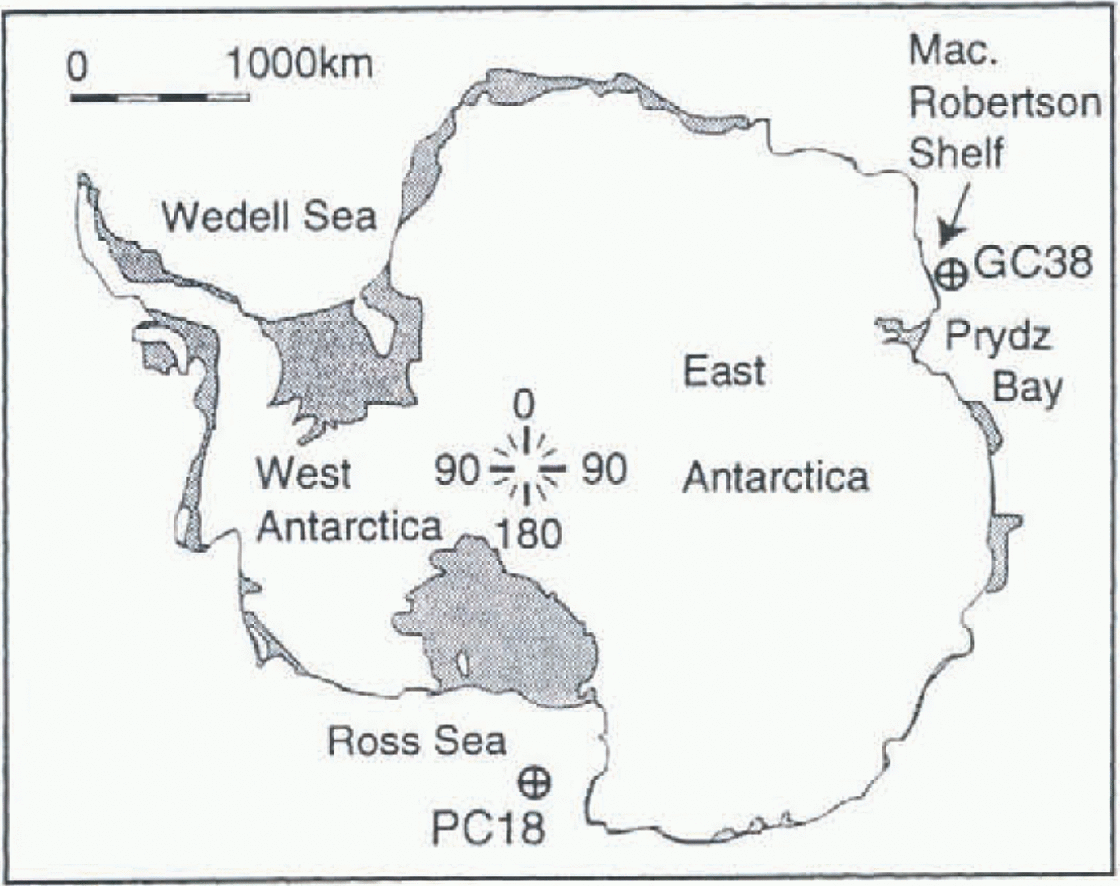
This paper serves to relate specific depositional regimes thought to exist beneath and beyond ice shelves to strati-graphic lithofacies successions recovered in short gravity-cores in two vastly different regimes, the inner Ross Sea continental shelf and the narrow MaC. Robertson shelf of East Antarctica (Fig. 1). Similarities between these two areas are related to the dominance of ice-shêlf environments during deglaciation.
Stratigraphic Description of Cores
NBP95-1 TC 18
Trigger (gravity) core NBP95-1 TC 18 (hereafter referred to as coreTC 18) was recovered in the south central Ross Sea in a water depth of 819 m. With in the 73 cm of sediment sampled in this core, we recognise five distinct lithofacies (Fig. 2), employing Reference Folk and WardFolk and Ward's 1957) nomenclature, as modified by MoncriefF (1989):
-
(1) grey to brown, diatomaceous, clast-poor mud (0-25 cm);
-
(2) brown, diatomaceous, clast-rich mud (25-29 cm);
-
(3) structureless, bioturbated mud (29-45 cm);
-
(4) laminated to cross-bedded sandy mud and poorly sorted sand (45-62 cm; Fig. 3); and
-
(5) a structureless, water-saturated, clast-rich sandy to intermediate diamicton, exhibiting a “granulated” texture (62-73 m).
X-ray photograph of core TC18, showing Glaciol marine muds with minor ice-rafted debris ( IRD) from bottom to 62cm, laminated to bedded sand and mudfrom 62 to 29 cm, abundant IRD gravel from 29 to 25 cm, and bioturbated S MO with minor IRD gravelfrom 25 cm to core top.

The “granulated” texture has previously been recognised in Antarctic marine sediments as a “brecciated” (O'Brien and Harris, 1996) or a “pelletised” texture (Domack and others, 1996). The granules have a grain-supported matrix of sandy mud, with cohesive granules of silty clay, and/or diamicton matrix. They are angular and very loosely compacted, lack observable grading but are size-sorted. Similar textures within cores from the Ross Sea were interpreted by Domack and others (1996) as a transitional-ice-shelf, rafted facies, de-posited beneath basal debris zones and above till units. The internal texture of the granules is similar to that of “mud clots” described from basal debris zones of the Greenland and West Antarctic ice sheets (Reference Gow, Epstein and SheehyGow and others, 1979; Reference Gow and MeeseGow and Meese, 1996).
X-ray photograph of core 38, showing Glaciol marine muds with minor IRD from bottom to 150 cm, laminated to bedded sand and mud with abundant IRD gravel from 150 to 100 cm, and ripple cross-bedded SMO from 100 cm to core top.

NBP95-1 PC 18
This piston core was collectée) at the same time as core TC 18. Because of the force of impact with the piston core, much of the stratigraphy described above is missing from core PC 18. However, the following three units are recognised:
-
(1) disturbed brown diatomaceous mud (0-10 cm);
-
(2) structureless, granulated, water-saturated, clast-poor intermediate diamict (10-18 cm); and
-
(3) grey, structureless, cohesive clast-rich muddy diamicton (18-55 em).
149 39GC38
Gravity core GC 38 was recovered from the MaC. Robertson shelf (Fig. 1) in 722 m water depth from a shelf valley system I Harris and others, 1996). It contained about 265 cm of sediment (Fig. 3) that can be divided into three different litho-facics:
-
(1) olive-green, stratified and cross-stratified siliciclastic and diatomaceous mud with intense bioturbation near the base (0-110 cm);
-
(2) stratified, diatomaceous, clast-poor muddy diamict (110— ~ 145 cm); and
-
(3) massively bedded mud with rare clasts and common subvertical burrows (~145-265cm).
Facies Interpretation of Cores
Despite the widely separated locations of the two core sections described above, there are common lithofacies successions which we interpret as representing the retreat of an ice shelf. Ross Sea cores PC 18 andTC 18 are condensed sections and contain a complete succession of facies, while core 38, from the MaC. Robertson shelf, is an expanded section that sampled only three of the facies. We focus our interpretation around the inferred depositional processes beneath and in front of an ice shelf (Fig. 4).
The ice shelf and open marine system act together to produce a diversity of depositional rates and processes (Fig. 4) that we consider to be responsible for the stratigraphy observed in the cores described above. Most of the Glaciol sediment is supplied at the grounding line of the ice shelf. Landward of this zone, beneath the grounded ice sheet, structureless tills (diamictons) are deposited. This is represented by the basal unit in core PC 18, and in many other cores from the Ross Sea (Anderson and others, 1991; Domack and others, 1996).
At the grounding line, where the ice shelf lifts off the substrate, sea water intrudes beneath the ice shelf to form a thin layer of water that expands in a seaward direction. Debris in the base of the ice shelfis transported over this water column and as it melts it passively releases the entrained debris, of all particle sizes. Aggregates or granules of silty clay and sometimes sand can be found in the basal debris of polar ice sheets (Gow and Meese, 1996) and these are also released to the sea floor beneath the basal debris zone. The coarse, granulated facies found in cores PC 18 andTC 18 represent this grounding-line proximal zone. Powell and others (1996) observed that a similar zone extended about 1.5 km seawards of the grounding line at one location in the Ross Sea.
Currents, driven by tidal forcing or recirculation in the water column under the ice-shelf basal debris zone (Reference JenkinsJenkins, 1991), induce lateral advection of fine grain-sizes SO that mud and fine sand is winnowed, leaving a coarse, granulated diamict facies; currents are probably strongest proximal to the grounding line, due to the reduced cross-sectional area of the water column. The granulated diamict reaches its greatest thickness near the grounding line and thins and becomes finer-grained seawards (Fig. 4), as the basal debris zone loses its sediment load. Fine-grained sediments are transported by-currents into a sub-ice-shelf zone that is distal to the grounding line. Seawards of the zone influenced by raining basal debris, coarse material is rare, although some well-sorted, very fine sand may occur. Facies characteristic of this zone of sorted Glaciol marine muds (Fig. 4) are represented by the laminated to massively bedded mud found in cores TC 18 and GC 38 (figs 2 and 3). Cross-bedding, as seen in core TC-18, may reflect the action of tidal currents within and near the grounding-line cavity (see also Nishimura and others, 1997).
Conceptual model showing facies deposited under a floating ice shelf, and generalised facies succession resulting from ice-shelf retreat.

With increasing distance seawards of the grounding line, and ifthe floating ice shelfis wide (>5~10 km), a “null zone” in sedimentation is eventually reached. At this null zone, only the finest particles are deposited and no ice-rafting occurs, presumably because most ice shelves are barren of debris at this distance seawards (Fig. 4). However, finegrained hemipelagic sediment is advected landwards under the ice shelf by recirculating currents, and this marine influence increases in a seawards direction (Fig. 4).The advected marine sediment includes diatoms and other phytoplank-ton, together with fine-grained, iceberg-rafted debris released in the open marine setting. The null zone is represented by well-sorted, fine-grained, massively bedded sediments which occur in corcTC 18 at about 35—40 cm and in core GC 38 at about 170-220 cm (figs 2 and 3).
At the calving line, a concentration of coarse, iceberg-rafted debris is deposited (Fig. 4). This is a widespread facies believed to be related to the concentration of icebergs by winds at the calving line and/or acolian transport of material from inland across the ice shelf, with consequent deposition in the sea. Iceberg residence time is clearly greater at an ice-shelf barrier under favourable winds than it is in the open marine setting, and so a high concentration of debris is deposited (Domack and Ishman, 1993; Domack and others, 1995). Often this debris is of a provenance distinct from the basal debris. in the Ross Sea, iceberg detritus is dominated by volcaniclastic material derived from Ceno-zoic volcanic rock, whereas the basal debris is Mcsozoic to Palaeozoic crystalline rock (Anderson and others, 1991; Domack and others, 1996). This facies is found in corcTC 18 at 25-30 cm and in core GC 38 at 110-145 cm ( figs 2 and 3).
Seawards of the ice shelf, the open marine setting dominates and siliceous mud and ooze (SMO), with rare ice-berg-rafted detritus, accumulates. Some of this SMO is redeposited by dilute gravity flows or density currents (note ripple cross-bedding at 0-80 cm in GC 38; Fig. 3), although it mainly accumulates as a massively bedded pelagic and hemipelagic unit (TC 18). The SMO is variable in its thickness across the shelf, being thickest (>5 m) in deep troughs and thin (<1 m) over banks. Its age is Holocenc, as demonstrated by a number of studies (Domack and others, 1991; Reference Pudsey, Barker and LarterPudsey and others, 1994; Harris and others, 1996).
Summary and Conclusions
The importance of the facies model presented herein is that it can be tested against an increasing data base of shelf sediment cores being collected by various national programmes. in particular, it allows for the recognition of a distinct facies succession ( Fig. 4) related to ice-shelf retreat that can be used to assess the dynamics of ice-sheet and ice-shelfsyslems when coupled with age-dating techniques (Anderson and Molnia, 1989; Kennedy and Anderson, 1989; Anderson and others, 1991; Domack and others, 1995; Harris and others, 1996). It is based upon a sound observational data base and theoretical considerations of the depositional environments that are to be expected in an ice-sheet/shelf system.
Acknowledgements
The work was financially supported by the U.S. National Science Foundation grant No. OPP91-18462, by the Cooperative Research Centre for the Antarctic and Southern Ocean Environment, University of Tasmania, and by the Australian Geological Survey Organisation. Thanks to R. Powell and J. Anderson for critical comments on an earlier version of this paper. P.T.H. publishes with the permission of the Executive Director, Australian Geological Survey Organisation.



