IntroductionFootnote 1
An abstract is a brief summary of a research paper, review or conference proceeding, which can be considered as a sub-register of academic writing and is often used to help readers quickly ascertain the paper's purpose, thesis, main results and conclusions. With the development of international academic communication, English abstracts play an increasingly vital role in international publishing and academic papers, being the basis for international academic citation indexes. UNESCO prescribes that all published scientific articles, no matter in which language, require a succinct English abstract. Most literature database search engines, such as the EI index, only display abstracts rather than providing the full text of the paper. Since an unsuccessful English abstract would be detrimental to the whole paper as well as to the general quality of the journal, no academic authors would want to lower their guard. In this context, the study of linguistic features of academic abstracts has attracted more and more attention of EAP scholars. The studies on English abstracts in China mainly focus on the writing paradigm as well as such linguistic features as stylistics, textual coherence, grammatical patterns, tense, voice and usage of prepositions (Xiong, Reference Xiong2002; Li et al, Reference Li, Wang, Bai and Ma2004; Wang, Reference Wang2005; Fan, Reference Fan2006; Li, Reference Li2008; He & Cao, Reference He and Cao2010).
While paying attention to the writing paradigm of English abstracts, Chinese authors also value their training in English writing skills, the effort of which has already partly paid off with the good performance of Chinese academic papers in the world. However, given the smooth sentences and correct grammar of English writing, careful readers would still find a subtle difference between the English abstracts written by Chinese scholars and their native English counterparts. After all, ‘there is undisputed evidence that the physical and cultural environment in which it develops influences the vocabulary and grammar of a language’ (Holmes, Reference Holmes2013: 358). While improving their writing skills according to the standard with few grammatical errors, Chinese authors are forming their own style in writing academic abstracts. In China, contemporary studies on English abstracts mostly focus on the writing standard (Ren, Reference Ren2004; Li & Mu, Reference Li and Mu2005) or confine their investigation to some specific disciplines, such as medicine (Fan, Reference Fan2006), agriculture (Gao et al, Reference Gao, Ji, Wang and Liu2011), psychology (Li & Mu, Reference Li and Mu2005), aeronautics and astronautics (He & Cao, Reference He and Cao2010). Few researches have regarded the English academic abstracts written by Chinese scholars as a kind of English variety to study as a whole.
In text analysis, modality has always been a hot topic, and modality in English has long been discussed by scholars because of its special function in grammar and semantics (Halliday, Reference Halliday1985; Quirk et al, Reference Quirk, Greenbaum, Leech and Svartvik1985; Mindt, Reference Mindt1993; Hunston, Reference Hunston2004). The choice of modality and its meaning representation also play an important role in academic abstract writing.
In my study I conducted a comparative analysis of the use of modality and modal sequences in the academic English abstracts written by Chinese and native English speakers, by establishing the Academic Abstracts Corpus (AAC). The following sections first explain the method used in the analysis. Then I study the linguistic features shown in the modality and modal sequences in the English abstracts written by Chinese and native speakers. Finally, I use the modal verb should as a case study to further illustrate this typical linguistic feature in China English, and attempt to explore the possible reasons for making should an emerging indicator of that language variety. The results of the study can provide more first-hand contrastive data for Chinese academic writers to enhance their language proficiency in using English in the global context.
Methodology and procedures
In order to answer my research questions I created a corpus of academic abstracts (AAC) containing 2000 texts. I chose abstracts in law and communication studies (the arts subjects), biology and computer science (science subjects), and computational linguistics from cross-disciplinary subjects to build five sub-corpora. In each sub-corpus, there are 200 texts of English academic abstracts written by Chinese scholars and another 200 texts written by native-English-speaking scholars.
The 1000 abstracts by Chinese authors were randomly chosen from Chinese academic papers in the biggest Chinese journal corpus CNKI (Chinese National Knowledge Infrastructure). I can guarantee the authors' Chinese origin according to their names. The other 1000 abstracts were from such international journal databases as EBSCO, Springer and SAGE. In establishing the nativeness of authors of the English abstracts, I adopted the following two approaches: (1) to examine the authors' correspondence information to ensure that they worked in English-speaking countries; (2) to judge the names of the authors to check if they were of Germanic and Romance origin, excluding non-typical English names, such as Werner Schneider, Magdalena Zoeppritz, Fernando Pereira, Randall J. Calistri-Yeh, Lee-Feng Chien, James Huang, Bonnie J. Dor, Jye-hoon Lee, Dekang Lin, Sungki Suh, Megumi Kameyama, Hang Li, Naoki Abe, Jorg Tiedemann, Cem Bozsahin, Sabine Schulte Walde, Samir S. Patel and Afra Alishahi. If I could not ensure their origin according to the above approaches, the data had to be given up. All the headers from the 2000 English abstracts have been retained, including titles, authors' background information, sources of the papers and publishing time.
The original texts were filtered by the self-made DelHeaders program in C# language, and I obtained content-only texts. I employed the concordance tool AntConc 3.3.5w to count word frequency, get the keywords list and to segment sentences.
Modality and modal sequences in English academic abstracts
Modal verbs are mainly used to express two types of modality, i.e. deontic modality and epistemic modality (Quirk et al, Reference Quirk, Greenbaum, Leech and Svartvik1985; Sweetser, 1990; Palmer, Reference Palmer2001). Deontic modality indicates the obligation, need or the behavior allowed of the subject in such modal sequences as ‘animate subject + must + action verb’. Epistemic modality expresses the speaker's judgment about the true value of a statement, and its modal sequence includes ‘modal verb + perfect tense’, or ‘must + static verb’.
There have been a number of studies about the different modality preferences of native English users and EFL learners in their writing registers. Hu et al. (Reference Hu, Brown and Brown1982) compared the writings of Chinese English majors and Australian students, finding that the former overused should and must in raising requirements or suggestions to others. Hinkel (Reference Hinkel1995: 333–35) discovered that South Asian immigrants overused more deontic modal verbs in their English writing such as must, should, have (got) to, and ought to. Liu (Reference Liu2006) analyzed the use of should and must by Chinese senior English majors and found the same overuse compared with English native speakers, especially with should, where its standard frequency was five times greater than that in the FLOB corpus. Cheng and Qiu (Reference Cheng and Qiu2007) and Liang (Reference Liang2008) also found the similar overuse of such modal verbs as can, must and should by Chinese non-English major college students compared with native English college students.
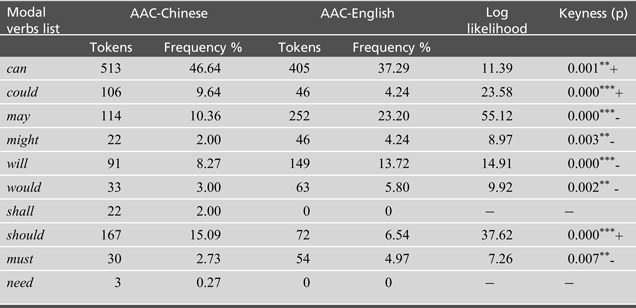
In the EditPad Pro environment, I used the regular expression ‘\S+_VM\s' to search the frequencies of modal verbs used in AAC-Chinese (AACC) and AAC-English (AACE). Then I used AntConc to search the use of modal verbs in the two sub-corpora. After that, with the help of a self-made log-likelihood and chi-square calculator, I obtained the p-values of significance, and the results are presented in Table 1.
Overview of the use of modal verbs in the AAC
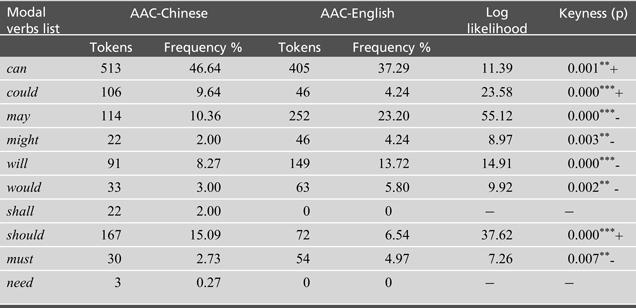
* When the log-likelihood value is bigger than 3.84, and the corresponding p-value is smaller than 0.05, it can be considered significant: *** drastically significant; ** very significant; ‘+’ positively significant (indicating that the former value is bigger than the latter one, i.e. Chinese authors tend to use more of the modal verb); ‘-’ negatively significant (meaning Chinese authors tend to use less of the modal verb).
Table 1 is an overview of the use of modal verbs in the AAC. The results show some significant differences in the choice of modal verbs between AAC-Chinese and AAC-English. According to Table 1, Chinese authors prefer should, could and can in writing abstracts with a sense of judgment and obligation, while native English-speaking authors, apart from using can with the highest frequency as Chinese authors do, tend also to use may, might, will and would. In all the modal verbs used, should enjoys the second highest frequency (15.09%) in the abstracts written by Chinese authors, while L1 English authors seem to favor may in their abstracts. There are no tokens of shall and need occurring in the AACE.
Liang (Reference Liang2008), in his contrastive study of modal sequences in Chinese tertiary EFL learners' written production, found that Chinese English learners overuse deontic modals such as can, will, must and should, and are not accustomed to use such modal verbs as could or would in their epistemic sense. Comparing Liang's (2008) finding with the use of modal verbs in the AACC, I found that Chinese writers did overuse can and should, but did not use so much will or must as in Liang's research. On the other hand, although there is comparatively less use of would in its epistemic sense (p = 0.002), there is more use of could in AAC-Chinese than in AAC-English, which also shows a discrepancy from Liang's research. The possible reasons for this may be related to the English proficiency of the writers in the two corpora, the content of the texts (abstracts vs. argumentative writing during exams), the different scales of the two corpora (128641 tokens in AACC vs 381477 tokens in Liang's (2008) research corpus), and the different times when the texts were written (for it is possible that as time goes by, Chinese learners' English proficiency could be enhanced and the pragmatic use of English in China could have changed).
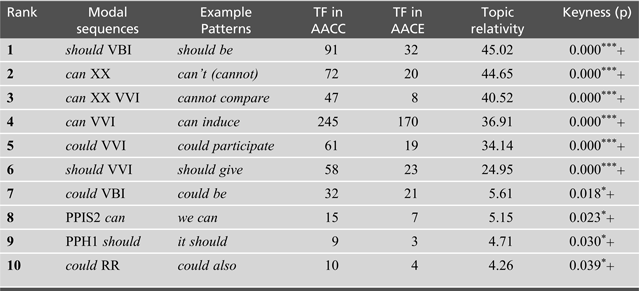
Apart from the above reasons, it is also worth noticing that some modal verbs can denote not only deontic sense but also epistemic sense, and we cannot see the whole picture only by examining the frequency of modal verbs. Therefore, it is necessary to investigate the collocation of modal verbs in context. In doing this, I listed all the possible modal sequences, and obtained the top ten most frequently used modal sequences by Chinese authors, as shown in Table 2.
The top 10 frequently used modal sequences in AACC with their respective token frequencies (TF)
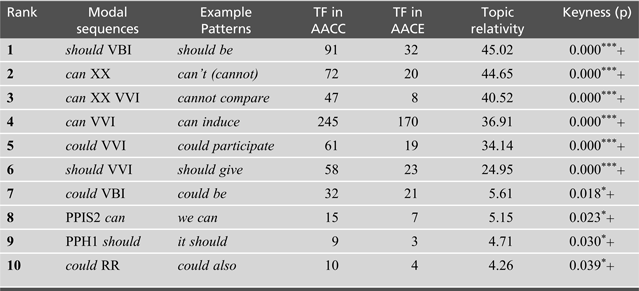
* With reference to the specification in CLAWS (Constituent Likelihood Automatic Word-tagging System), VBI refers to ‘be, infinitive’; XX refers to ‘not, n‘t’; VVI refers to ‘infinitive’; PPIS2 refers to ‘1st person plural subjective personal pronoun (we)’; PPH1 refers to ‘3rd person sing. neuter personal pronoun (it)’; and RR refers to ‘general adverb’.
According to Table 2, of the top ten frequently used sequences, the ones with should and can take up 70% of those with deontic sense and judgment sense in the Chinese academic abstracts, which corresponds to my earlier observations on the use of modal verbs.
The results also indicate that the modal sequences used by Chinese authors are mostly simple and colloquial, with less possibility of making grammatical mistakes, such as: ‘modal verb + notional verb’ (unmarked and neutral in terms of voice) and ‘personal pronoun + modal verb’. The tendency is related to Chinese learners' English proficiency in writing, and it is likely that deontic modality is acquired earlier than epistemic modality.
Deontic should is predominant in Chinese academic abstract writing
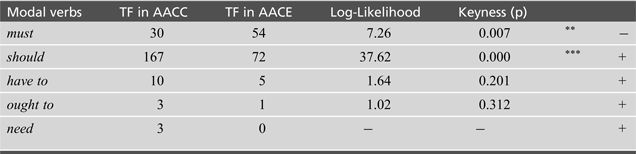
In English, the modal verbs with deontic sense include: must, have (got) to, need, should, ought to (Quirk et al, Reference Quirk, Greenbaum, Leech and Svartvik1985).The use of those deontic modalities in AAC is as follows in Table 3.
Comparative overview of the token frequency (TF) of deontic modal verbs in AAC
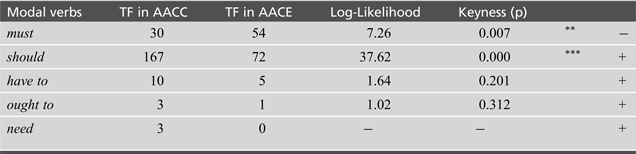
Table 3 shows that have to, ought to and need do not significantly occur in AAC, and the deontic sense is mainly conveyed through must and should. While neither AACC nor AACE tend to use must too frequently in academic abstracts, Chinese writers definitely prefer to use should, which is very consistently found in recent related studies. The top ten modal sequences in Table 2 also illustrate this point. In AACC, such sequences as ‘should XX VBI’ (e.g. should not be), ‘should VVI’ (e.g. should give), and ‘PPH1 should’ (e.g. it should) are quite salient, with all of those sequences denoting deontic modality.
Data in Tables 2 and 3 indicate that the modal verb should stands out as prominent in the academic abstracts written by Chinese writers. Compared with must, which is quite strong in modality, Chinese writers would like to choose the moderate modal verb should to denote obligation, and in doing so, their academic writing sounds comparatively serious, rigid and direct in style.
As we know, different social groups develop and modify shared norms of the varieties of language according to different occasions. Hinkel (Reference Hinkel1995: 327) believes that the use of deontic modal verbs is closely related to the social and cultural value particular for the speakers (writers). As far as Chinese users of English are concerned, they have heavily shouldered the obligation to and responsibility for their families, their communities and their nation ever since they were little children, and that cultural value will orient their preference for deontic modality usage. The reasons for the Chinese preference of using should can fall into the following three categories.
The most important reason could be the limited language sources available. While Chinese EFL learners mainly use should to express deontic sense, the native English speakers enjoy wider and richer language resources to express a similar sense. Instead of using should, they can use such modal supplements as ‘be + required/allowed/supposed’, or extended predicates such as ‘is/are/was/were/has been/have been + to’. Chinese writers therefore can only use their familiar modal verbs to express obligation or necessity, thus leading to the overuse of should.
Another reason may possibly be the negative mother tongue transference. Chinese culture values persuasion and obligation very much. When people are providing help and suggestions, they are allowed, or even encouraged, to use the direct subjective modality without hedging elements. In Chinese, people often use yinggai (should) or yao (will) to provide suggestions, thus the negative transference of the Chinese mother tongue causes the overuse of should as a deontic modal verb. That transferring effect can be demonstrated in the typical Chinese writing pattern, in which Chinese writers have been so accustomed to end their argumentation by using wo men ying gai - ‘we should’. In fact, in the mainstream mass media discourse, abundant use of modal verbs denoting obligation and responsibility can be found:
-
• “All the Party members should keep in mind the people's confidence and trust, be more enthusiastic, and hardworking … to complete honorable and arduous task bestowed by the times.” (Hu, Jintao in The 18th CCP Congress report, 2012: 1–2)
-
• “How should China defend her sovereignty? Today, we invite two guests to comment on this.” (CCTV/Focus Today/jrgg1110722.txt, 2011, National Broadcast Media Corpus)
-
• “The respect for the law should be a prerequisite before we discuss all issues.” (Beijing Youth Daily/Daily News/Daily Commentary/20110103-01.txt, 2011 National Newspaper Media Corpus)
-
• “China should boost consumption by lowering taxes or increasing wages, etc., to improve the ratio of consumption to GDP.” (Sina International News/20110118_11952_211021836005.txt, 2011 National Web Media Corpus)
What is worth noticing is that Aijmer (Reference Aijmer, Granger, Hung and Petch-Tyson2002: 64–5) found in his study that English learners in Sweden also preferred the use of should. It is possible that the overuse of deontic modal verbs is a common characteristic possessed by EFL learners, and that may be a reflection of certain cultural values, but it is only a hypothesis which needs our further investigation of EFL learners from different national and cultural background to make a sound judgement. In the Chinese society, strongly influenced by Confucianism, Chinese prefer not going to extremes or being radical, they tend to do things in a moderate way. So as far as Chinese learners are concerned, they choose the moderate degree modal verb should instead of the high degree must in academic writing.
A third reason for preferring should may be related to the habit of modality acquisition. Sweester (1990) found that native English children acquired deontic modality earlier than epistemic modality. Papafragou (Reference Papafragou1998) discovered that deontic modal verbs such as should, have to and must were actually acquired and used earlier than may and might, which indicate possibility. She also pointed out that for the same modal verb, children began with the acquisition of its deontic sense and then extended to its epistemic sense. For example, children acquire the ‘obligation’ sense of should earlier than its ‘necessity’ sense. Following that string of reasoning, Chinese EFL learners might also acquire the deontic modality earlier than the epistemic modality as the native English speakers do. They would also acquire the ‘obligation’ sense of should earlier than its ‘necessity’ sense and use it more frequently. This is shown in the discussion of findings presented in Tables 1 and 3. Chinese learners also tend to use more deontic modal sequences than epistemic ones. The preference for deontic modal sequences greatly affects the quality of learners' language use, and they do not flexibly adopt other more complicated sequences like ‘may + also’ when they need to do so. In their discourse logic, maybe they ‘should’ Sinicize the English language.
Conclusion
The study reported in this paper investigated the modality of academic abstracts through an examination of 2000 texts. The results indicate that the abstracts written by the native-English-speaking scholars show a varied use of modal verbs and modal sequences. By contrast, Chinese scholars try to keep to the basic and standard rules of English, but lack the flexibility in the choice of words used to express modality due to their limitations as EFL learners.
The findings also have pedagogical implications for academic writing. The typical modal verbs and modal sequences in AACC are studied, which is helpful for college English teachers to call students' attention to the overuse of certain modal verbs. On the other hand, the study also sheds important light on EAP teaching in academic writing and evaluation. The teachers can lead the students to acknowledge the characteristics of academic abstracts, training them to write more vivid academic papers by using varied modal patterns, giving them more confidence to take part in international academic communication.
Future research is expected to expand the corpus as much as possible. In addition, more comprehensive research based on the contrastive inter-English-variety analysis is needed. Only by doing so can we address students' needs specifically and thus achieve effective EAP teaching and learning in the EFL teaching and learning context.
 WEINA LI received her PhD in applied linguistics from Communication University of China. She is now an Associate Professor in the School of Applied English, Beijing International Studies University, China. Her research interests include computational linguistics, English for academic purposes and academic literacy development. She has published articles on the comparison of linguistic features between the English abstracts of computational linguistics papers written by Chinese scholars and their native English counterparts, and the development and application of Zipf's Law. Email: francisli@163.com