The idea that female and male speakers exhibit distinct patterns of language use is a common one. Popular literature (famously Tannen, Reference Tannen1991; and Gray, Reference Gray1992) has often proposed that there are huge psychological differences between men and women that are especially demonstrated in the realm of language use (see academic discussions in Baker, Reference Baker2008:41–44; Cameron, Reference Cameron2007:1; Canary & Hause, Reference Canary and Hause1993:136–137; Grob, Meyers, & Schuh, Reference Grob, Meyers and Schuh1997:284–285; and Hyde, Reference Hyde2005:581; Reference Hyde2006). Countering the notion that female and male speakers speak quite different “genderlects,” however, is research that has tended to suggest that differences are small in the context of variation between individual speakers more generally (Cameron, Reference Cameron2007:41–44; Canary & Hause, Reference Canary and Hause1993:131–133; Grob et al., Reference Grob, Meyers and Schuh1997:287; Hyde, Reference Hyde2005:581–586; Kiełkiewicz-Janowiak, Reference Kiełkiewicz-Janowiak, Hernández-Campoy and Conde-Silvestre2012:317). Nevertheless, both the nature and extent of gendered usage can inform us about gender roles and cultural constructions of gender (Baker, Reference Baker2008:49; Sunderland, Reference Sunderland2004:16–17).
It has been observed that linguistic features that are associated with gender also have some other communicative purpose or are associated with some other external factor such as power possessed by the speaker (Baker, Reference Baker2008:33–36; Cameron, Reference Cameron2007:48–49, 125–130, 133–140; Grob et al., Reference Grob, Meyers and Schuh1997:195), even if the social-communicative purposes of such variables are not clear from their surface forms (Cameron, Reference Cameron2007:46–47). These observations are suggestive of the ways in which gendered language can illuminate the society behind it.
Two general principles have emerged from research into the role of gender in language variation and change. These were summarized with particular clarity by Labov (Reference Labov1990:205–206):
(I) In stable sociolinguistic stratification, men use a higher frequency of nonstandard forms than women.
(II) In the majority of linguistic changes, women use a higher frequency of the incoming forms than men.
This paper will present an investigation into the role of gender in variation and change in Old Norse with particular reference to the second of these principles. The Theoretical Background section will summarize earlier sociolinguistic research into gender on the basis of historical data and data from fiction. The Language-specific Background section will discuss language- and corpus-specific background. The Variables Investigated and Negation in West Nordic sections will present the variables under consideration, and the Evaluation section will present a detailed analysis of one variable. The discussion will deal with the wider context of the work. All raw data is given in the appendices.
THEORETICAL BACKGROUND
Gendered language in historical varieties
In principle, it should be possible to use the same methodology to examine the effect of gender in conditioning variation in historical varieties as that used with modern languages. Some research into the earliest audio recordings has demonstrated this: for example, research into the first recordings of New Zealand English has shown female speakers born as early as the 1860s leading language change (Maclagan, Reference Maclagan and Holmes2000). However, in practice, most data from historical varieties present many particular challenges.
Historical datasets are typically closed. Even where additional historical texts exist awaiting preparation for use or where new discoveries occur, it is rarely possible to gather more data from a specific target register or variety of interest or to elicit more data from a specific group of speakers. Thus, creating balanced, focused samples or corpora is problematic. Additionally, metatextual information concerning historical texts is often obscure. Signatures or other intratextual features by which authors and scribes can be identified are rare in ancient and medieval manuscripts and, without such access to extralinguistic data, hypotheses about social distribution cannot be tested (Winter, Reference Winter and Jahr1999:75–79). Worse still, on the basis of the distribution of literacy in many ancient and medieval societies, we can reasonably assume that in most cases the available sample is hugely biased toward certain social groups: in short, wealthy, powerful men (Winter, Reference Winter and Jahr1999:76).
Historical data are further complicated by admixture between varieties. Mørck (Reference Mørck and Jahr1999:270), writing about the Norwegian Medieval Charters, notes that “many of the extant medieval texts are transcripts [of earlier written texts], and to a great extent the language of such a text is obviously dependent on the original. . . . Yet the scribes did not always painstakingly copy the original in ever fine detail—in fact it seems they felt quite at liberty to deviate from it.” These comments are widely applicable to medieval texts of various genres and in various languages. Additionally, texts may contain formulaic phraseology that relate them to others (Mørck, Reference Mørck and Jahr1999:270–271). The best that can be said in limiting the possible effects of these interactions is that “it is usually assumed that scribes more or less retained the word order and other syntactic features of the manuscript they were copying” (Rögnvaldsson, Ingason, Sigurðsson, & Wallenberg, Reference Rögnvaldsson, Ingason, Sigurðsson, Wallenberg, Calzolari, Choukri, Declerck, Doğan, Maegaard, Mariani, Odijk and Piperidis2012:1979).
Despite these problems, significant success has been achieved in identifying the role of gender in the history of English, for which corpus resources are particularly well-developed. Studies have shown female writers leading change in morphological variables such as the change of present third-person singular -eth to -es in lexical verbs (Kytö, Reference Kytö1993:128–129; Nevalainen & Raumolin-Brunberg, Reference Nevalainen and Raumolin-Brunberg2003:122–124, 195) and in the auxiliaries have and do (Nevalainen, Reference Nevalainen, Nevalainen and Raumolin-Brunberg1996:83–84), the change from subject ye to you (Nevalainen, Reference Nevalainen, Nevalainen and Raumolin-Brunberg1996:81–82; Nevalainen & Raumolin-Brunberg, Reference Nevalainen and Raumolin-Brunberg2003:118–119, 194–195), the change from prevocalic mine and thine to my and thy (Nevalainen & Raumolin-Brunberg, Reference Nevalainen and Raumolin-Brunberg2003:119–120, 195–196), the introduction of genitive its (Nevalainen & Raumolin-Brunberg, Reference Nevalainen and Raumolin-Brunberg2003:120), the replacement of indefinite pronouns in -man with forms in -body and -one (Nevalainen & Raumolin-Brunberg, Reference Nevalainen and Raumolin-Brunberg2003:124–125), and the change from univerbated methinks to analytic I think (Palander-Collin, Reference Palander-Collin1999:245–246). Similarly, female writers have been shown to have led syntactic changes including the loss of subject-verb inversion after sentence-initial adverbs (Nevalainen, Reference Nevalainen, Nevalainen and Raumolin-Brunberg1996:85–88), the expansion of the present progressive at the expense of the simple present (Arnaud, Reference Arnaud1998:130, 139–140), the introduction of prop-word one (Nevalainen & Raumolin-Brunberg, Reference Nevalainen and Raumolin-Brunberg2003:120–121), a temporary expansion of unemphatic affirmative do in the mid-17th century (Nevalainen & Raumolin-Brunberg, Reference Nevalainen and Raumolin-Brunberg2003:125–126), the introduction of unemphatic negative do (Nevalainen & Raumolin-Brunberg, Reference Nevalainen and Raumolin-Brunberg2003:126–127, citing Nurmi, Reference Nurmi1999:157), and the expansion of zero relatives (Huber, Reference Huber2012). Several of these studies, in particular those of Nevalainen and Raumolin-Brunberg (Reference Nevalainen and Raumolin-Brunberg2003), were able to show a statistically significant effect of gender consistently across multiple stages of a change. In most of these cases, the pattern is most clearly visible (and often only visible) once the incoming variant has reached a threshold of 20 to 30 percent and the change is in its fastest, most vigorous stage (Nevalainen & Raumolin-Brunberg, Reference Nevalainen and Raumolin-Brunberg2003:130).
Male writers have been identified leading in a much smaller number of changes, including the increase of the auxiliary have in the perfects of intransitive verbs from the 18th century (Kytö, Reference Kytö, Rissanen, Kytö and Heikkonen1997:69–70; Rydén & Brorström, Reference Rydén and Brorström1987:200–207), the replacement of relative the which with which (Nevalainen, Reference Nevalainen, Nevalainen and Raumolin-Brunberg1996:80–82; Nevalainen & Raumolin-Brunberg, Reference Nevalainen and Raumolin-Brunberg2003:129–130, 197–198), the loss of multiple negation (Nevalainen & Raumolin-Brunberg, Reference Nevalainen and Raumolin-Brunberg2003:128–129), the introduction of verb-subject inversion following negative conjunctions (Nevalainen & Raumolin-Brunberg, Reference Nevalainen and Raumolin-Brunberg2003:129), and the early stages of the change from focusing adverbial but to only (Nevalainen, Reference Nevalainen1991:178–181). The generalization across these studies is that male writers lead changes that began in educated or professional speech, domains to which women presumably had little access (Nevalainen, Raumolin-Brunberg & Mannila, Reference Nevalainen, Raumolin-Brunberg and Mannila2011:13); the unusual status of these changes is confirmed by the finding of Nevalainen and Raumolin-Brunberg (Reference Nevalainen and Raumolin-Brunberg2003:130–131) that the gender “affiliation” of these changes, unlike those led by female speakers, is typically visible from the very earliest stages of the change. Thus the principle that female speakers tend to lead in ongoing changes appears to hold for historical stages of English (Nevalainen et al., Reference Nevalainen, Raumolin-Brunberg and Mannila2011:13), at least as regards changes from below. However, no such detailed, quantitative work has been carried out on other historical varieties.
Gendered language in fiction
One solution to some of the challenges of historical sociolinguistics is to examine texts that project their own social contexts and present a variety of different voices: works of fiction (Culpeper, Reference Culpeper2009:186). By examining differences in the represented speech of groups of fictional characters instead of differences between the writings of different authors, the problems of sparse metatextual information and a skewed dataset can be addressed. Using data from fiction texts obviously entails its own particular problems. There is still likely to be interaction among the varieties used by the character, the author, and the scribe(s), in part as a result of intentional artistic expression (Kiełkiewicz-Janowiak, Reference Kiełkiewicz-Janowiak and Jahr1999:58); more fundamentally, the language examined is not actually that of the characters in question but a fictional representation of it created by the author. Nevertheless, such data may also have some advantages. Direct speech in fiction is often designed to highlight the very expressions of social categories in which we are interested and such expressions may represent an important literary tool to give a narrative a sense of reality and immediacy. We can be thus confident that there is likely to be variation to be found (Culpeper & Kytö, Reference Culpeper and Kytö2010:81, 307; Kiełkiewicz-Janowiak, Reference Kiełkiewicz-Janowiak and Jahr1999:59). Furthermore, as direct speech in fiction purports to be an attempt to represent spoken language, it is likely to represent a register closer to that of spoken language than that found in prototypically written genres, such as religious prose or legal texts. Work by Poplack and Malvar (Reference Poplack and Malvar2007:155–156) on the expression of futurity in Brazilian Portuguese provides an encouraging confirmation of this; their study demonstrates not only that variation in represented speech in fiction is conditioned by the same range of language-internal factors as in real speech, but that the coefficients of those factors match remarkably closely.
Work on Japanese sitcoms and novels has shown that many of the same features that are gendered in real speech are gendered in the represented speech of fictional characters, although stereotyping may play a role in this (Occhi, SturtzSreetharan, & Shibamoto Smith, Reference Occhi, SturtzSreetharan and Shibamoto Smith2010; Shibamoto, Reference Shibamoto, Philips, Steele and Tanz1987; Shibamoto Smith, Reference Shibamoto Smith, Okamoto and Shibamoto Smith2004). However, this work also highlights the complex range of factors that may be at work in conditioning variation in fiction. Interactions are found between features of the narratives and of the characters; for example, some fiction distinguishes the speech of the heroine from that of other female characters by more markedly gendered features (Shibamoto Smith, Reference Shibamoto Smith, Okamoto and Shibamoto Smith2004; Shibamoto Smith & Occhi, Reference Shibamoto Smith and Occhi2009:524). Another complication is introduced in modern language varieties by the fact that, in a media-saturated life, real language, fictional language, and language ideology all mutually shape and inform one another (Shibamoto Smith, Reference Shibamoto Smith, Okamoto and Shibamoto Smith2004:127–128; Shibamoto Smith & Occhi, Reference Shibamoto Smith and Occhi2009:525–528). In contrast, in a medieval society, the influence of fictional representations of language on real language ideologies and use was probably minimal.
Research into gendered language in fiction in historical varieties has examined languages other than English, but with far less success than the previously discussed work on nonfiction texts in English in obtaining large samples, demonstrating statistical significance, or examining variables undergoing change. Research on Latin texts seems to show gendered tendencies of lexical choice in the speech of male and female characters (Adams, Reference Adams1984) and perhaps when dealing with stereotypically gendered topics (Adams, Reference Adams2005). Work on Classical Greek drama has shown linguistic differences between male and female characters in the areas of lexical choice (Bain, Reference Bain1984; Sommerstein, Reference Sommerstein, de Martino and Sommerstein1995), choice of topics, the rhetorical structures of utterances (Mossman, Reference Mossman2001), and frequencies of pronoun usage (Meluzzi, Reference Meluzzi, Hill and Schumacher2010). Willi's work on syntactic and lexical differences between male and female speech in Classical Greek comedy has furthered this research by demonstrating that those differences that do occur are closely in line with our expectations for gendered differences in modern languages: in addition to a greater frequency of politeness strategies, female characters used higher rates of innovative features which would later become general (Willi, Reference Willi2003:176–195), and gendered features of speech were more pronounced in single-gender than in mixed groups (Meluzzi, Reference Meluzzi, Hill and Schumacher2010:96–98; Willi, Reference Willi2003:196). Other features, such as the greater use by female characters of colloquial and affective language, instead seemed to point toward the stereotypes held by male authors (Willi, Reference Willi2003:195); research into the language of Early Modern English drama presented similar findings (Nevalainen, Reference Nevalainen, McCafferty, Bull and Killie2005:139–141). In the Classical Greek data, as in the case of Modern Japanese, there appeared to be interaction between features of gendered speech and the literary demands of the narrative (Willi, Reference Willi2003:196). However, the work by Willi on Classical Greek provides only a snapshot of a relatively small corpus in a single time period, and the variables were not additionally indexed against real or apparent time within the corpus to confirm that the change was ongoing. The nature of the historical data means that we can never be entirely sure that the changes in question were really taking place in the specific speech community and time period of interest unless they can be shown in the dataset itself.
In summary, while the historical sociolinguistic research that we have discussed has dealt with the effect of gender in language change, it has all focused overwhelmingly on the history of English. Work by Willi on Classical Greek data has demonstrated female characters selecting what is thought to be an innovative variant more frequently than male characters do; however, this is only a snapshot of a relatively small corpus in a single time period and the variables were not additionally indexed against real or apparent time within the corpus to confirm that the change was ongoing. The nature of the historical data mean that we can never be entirely sure that the changes in question were really taking place in the specific speech community and time period of interest unless they can be shown in the dataset itself.
LANGUAGE-SPECIFIC BACKGROUND
Medieval Iceland, Old Norse, and the Íslendingasögur
The work discussed here was carried out on Old Norse fiction, primarily the Íslendingasögur or ‘Family Sagas’. These are narrative prose texts ranging from 10,000 to 100,000 words in length that functioned as genealogical and historical records for their composers as well as a source of entertainment. They concern the first few centuries after the settlement of Iceland in the late ninth century, but they were written primarily in the thirteenth and fourteenth centuries; their language can be considered representative of this later period. They depict a wide variety of characters, both male and female, of varying social ranks, although the main characters tend to be relatively wealthy, high-born Icelanders.
Icelandic society in this period was profoundly patriarchal, but in a way structurally dissimilar to modern Western cultures. Historian Jenny Jochens (Reference Jochens1995:162–163) described a conception of society as comprising two types of individuals: the admired (strong, powerful, and wealthy men and the very wealthiest and most powerful women) and the rest (children, most women, and the weak and disabled). Old Icelandic gender roles should be seen in light of this conception. Women had certain material rights, including the right to inherit property, and so could occasionally occupy positions of influence; however, they had to rely on their male relatives for land administration, were limited in the rate at which they could acquire further property, and had no rights to participate in political or juridical processes (Jochens, Reference Jochens1995:162–163). Through the influence of Christianity, women were also increasingly excluded from religious roles (Jochens, Reference Jochens1995:163–164). Unlike in many other medieval European cultures, divorce was relatively common and women could initiate divorce proceedings. However, they had relatively few other sexual rights, and the bride's consent was not required for marriage until late in the 13th century (Jochens, Reference Jochens1995:162, 166–168). Medieval Iceland thus presents a quite different situation as regards gender roles from that found in modern Western societies as well as some differences from those gender roles found in other societies that have been subject to historical sociolinguistic research.
It has been argued that the genre most suitable for undertaking sociolinguistic analysis of written texts is drama (Biber & Finegan, Reference Biber, Finegan, Nevalainen and Kahlas-Tarkka1997:260), as drama texts comprise “interactive, face-to-face, speech-related data, which has only a minimum of narratorial intervention” (Archer & Culpeper, Reference Archer, Culpeper, Wilson, Rayson and McEnery2003:43) and because the language of drama has been demonstrated in various languages to contain features characteristic of speech (Lutzky, Reference Lutzky, Markus, Iyeiri, Heuberger and Chamson2012:178). Culpepr and Kytö (Reference Culpeper and Kytö2010:401) demonstrated that drama texts are the most “speech-like” of several examined Early Modern English genres along several axes; however, they also show that “no speech-related text-type is speech-like on every count,” and speech in prose fiction also exhibits speech-like properties. In the particular case of Old Norse, no drama texts exist. However, the Íslendingasögur are highly suitable for sociolinguistic analysis due to their extensive use of direct speech, their wide variety of characters, and the very large total dataset which they represent.
Several dialects of Old Norse existed in a continuum stretching across mainland Scandinavia, the Faroe Isles, the British Isles, and Iceland (Sandøy, Reference Sandøy, Bandle, Jahr, Karker, Naumann, Teleman and Braunmüller2005:1856; Schulte, Reference Schulte, Bandle, Jahr, Karker, Naumann, Teleman and Braunmüller2005:873), although, as “Icelanders took the lead in the new literary culture of medieval Scandinavia” (Schulte, Reference Schulte, Bandle, Jahr, Karker, Naumann, Teleman and Braunmüller2005:873), a disproportionate number of extant texts represent the speech of Iceland. Variation identified in Old Norse has traditionally been put down to these dialect distinctions without attention to explanations on the basis of other social factors (Thelander, Reference Thelander, Bandle, Jahr, Karker, Naumann, Teleman and Braunmüller2005:1897), thus this research begins to address a gap in existing work on the language.
The corpus
The corpus used for this research was the Fornrit subcorpus of the Mörkuð íslensk málheild (Tagged Icelandic Corpus) (Helgadóttir, Valsdóttir, Rögnvaldsdóttir, & Stefánsdóttir, Reference Helgadóttir, Valsdóttir, Rögnvaldsdóttir and Stefánsdóttir2007–present). Fornrit contains all of the Íslendingasögur, as well as some texts of related genres (the Old Icelandic þættir, Landnámabók, the Sturlungasaga, and Heimskringla); these are in Modern Icelandic orthography (Rögnvaldsson & Helgadóttir, Reference Rögnvaldsson, Helgadóttir, Sporleder, van den Bosch and Zervanou2011:65) in order to facilitate comparison with Modern Icelandic. This orthography little resembles the manuscript orthographies of the time and so precludes undertaking any investigation of orthographic, phonological, or morphological variables. The corpus editions are based on the modernized Svart á Hvítu editions, themselves based on the normalized (but not modernized) Íslenzk fornrit editions that were based on earlier diplomatic editions. Thus these data have undergone at least three stages of textual transmission in the modern period, each introducing new opportunities for transmission errors. These caveats must be remembered when investigating this dataset.
Due to errors discovered in the corpus while tagging stretches of speech, Heimskringla and the Sturlungasaga were omitted. With these two texts omitted, the remaining corpus is made up solely of the Íslendingasögur and closely related Icelandic þættir and Landnámabók. It constitutes 1,140,925 tokens (words) of text. For this research the corpus was reencoded into the TEI XML encoding (TEI Consortium, 2007). All speech was tagged for the gender of the speaker. Plural speakers were tagged separately, as were occasional instances of supernatural beings; this speech associated with plural, indeterminate, and nonhuman characters represented too small a sample for investigation and was thus excluded. There were 13,561 utterances (comprising 281,229 tokens) tagged as male, 1596 (comprising 34,932 tokens) as female, and 259 as plural; the remaining 60 were tagged either as indeterminate or as nonhuman.
VARIABLES INVESTIGATED
Three variables likely to have been undergoing change in the period in question were identified: subject-like argument of impersonal verbs, the forms of complex prepositions, and the expression of sentential negation.
First, Old Norse is known to have a series of verbs that, under some analyses, have non-nominative subjects. In Modern Icelandic these remain but are subject to variation and appear to be undergoing diachronic change: accusative and genitive subjects tend to shift to become dative (‘þágufallssýki’) and all nonnominative subjects tend to shift to become nominative (see Eythórsson, Reference Eythórsson2000, Reference Eythórsson and Lightfoot2002a; Smith, Reference Smith1994). In the continental Scandinavian languages, these verbs shifted to take nominative subjects. Accordingly, it seemed likely that they might show signs of this variation already in Old Norse. However, very little case variation was identified in instances in represented speech, and what variation occurred was not significantly associated with gender.
Second, a grammaticalization cline can be seen in Old Norse prepositions. Its stages of development are as follow: preposition + noun > preposition + noun with conventionalized meaning > complex preposition > simple preposition (only the original noun remains but functions as a preposition). Five such prepositions were identified that exhibited variation between complex and simple forms in the corpus. One example of these is á/í/Ø milli ‘between’. It was found that female characters used the simple forms more frequently than male characters did.Footnote 1 However, this distribution was the result of different relative frequencies of the different lexical items investigated in male and female speech, and there were no significant differences in rates of simple and complex forms between female and male speech for any single lexical item. The third variable turned out to be promising. A series of changes are known to have taken place in the expression of sentential negation in Old Norse; these are discussed in Eythórsson (Reference Eythórsson2002b) and in Willis, Breitbarth, and Lucas (Reference Willis, Breitbarth and Lucas2013:10–11), and are summarized herein. It was noted that a highly frequent negative adverb, ekki, occurred proportionately more frequently in female than in male speech in the corpus: of 1840 instances of ekki, 255, or 13.9%, occurred in female speech, whereas of 319,161 tokens of speech, 34,932, or 10.9%, are female speech (p = .0000). The remainder of this paper focuses on the distribution of negative adverbs over time in male and female speech.
NEGATION IN WEST NORDIC
Several negative verb phrase adverbs occurred in Old Norse: eigi, ekki, the vanishingly rare þeygi and the more emphatic aldrei ‘never’. Ei, a contracted form of eigi, also occurred. A further negative adverb (or possibly prefix), ne, occurred in earlier Old Norse, but by the period of interest it had become archaic and occurred only in poetry. Two archaic suffixed negatives occurred, -a and -at, but were rare in prose (Eythórsson, Reference Eythórsson2002b:193–198). Ekki was also the neuter nomimative/accusative singular form of the negative pronoun/adjective engi(nn) ‘nothing’; thus, unlike the other negatives mentioned, ekki was a nominal as well as verbal negator. Of these two uses of ekki, the nominal use was historically primary and the use as an adverb was innovative (Cleasby, Vigfússon & Dasent, Reference Cleasby, Vigfússon and Dasent1894:120–121; Magnússon, Reference Magnússon1989:149). The frequencies of occurrence of all of these negatives in each text in the corpus were calculated; these data are found in the appendix. Examples from the corpus demonstrating the use of the main two negative adverbs ekki and eigi are given in (1) and (2).
(1) Ekki dyl-st eg við skuldleik-a okkr-a.
neghide.prs-refl.1sg1sg.nomregarding relationship-m.acc.plour.du-m.acc.pl
‘I don't deny our relationship.’ (Laxdæla saga, chapter 14)
(2) Eigi þyk-ir mér þetta of miki-ð.
negseem.prs-3sg1sg.datthis.n.nom.sgtoo much-n.nom.sg
‘This doesn't seem too much to me.’ (Brennu-Njáls saga, chapter 43)
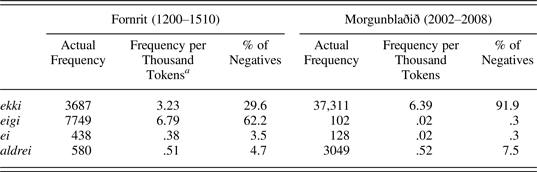
In Modern Icelandic, ekki functions only as a negative adverb, no longer appearing as a nominal negator; eigi, ei, and aldrei also still occur (Magnússon, Reference Magnússon1989:10, 146, 149). However, querying the Morgunblaðið newspaper subcorpus of the Mörkuð íslensk málheild, a corpus of 5,840,345 tokens of text from issues of Morgunblaðið published between 2002 and 2008 (Helgadóttir et al., Reference Helgadóttir, Valsdóttir, Rögnvaldsdóttir and Stefánsdóttir2007–present), demonstrated that these lexical items have a very different distribution in Modern Icelandic than in Old Norse. This is shown in Table 1. While the rate of aldrei has stayed relatively stable, the use of ekki has expanded, apparently at the expense of functionally equivalent eigi and ei almost to the point of replacing these adverbs altogether.
Frequencies of sentential negatives in the Fornrit and Morgunblaðið corpora
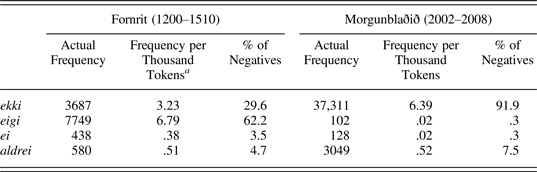
aThroughout, frequencies of lexical items over stretches of text are given in instances per thousand tokens.
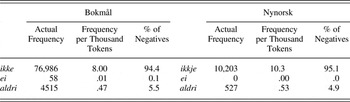
In Modern Norwegian, the reflex of ekki, ikke (Bokmål) or ikkje (Nynorsk), occurs only as an adverb. The reflex of aldrei, aldri, does occur, as does the reflex of syncoped ei, but no reflex of unsyncoped eigi is found (Torp, Reference Torp1919:84, 241); ei is restricted to poetic use and fixed expressions (Hellevik, Reference Hellevik1966:447). An examination of frequencies of these adverbs in corpora of Bokmål and Nynorsk newspapers and magazinesFootnote 2 confirms that the reflexes of ekki have expanded still further relative to the other negatives; these frequencies are given in Table 2. Even when it is normalized, frequency over a stretch of text is a relatively poor measure as it is sensitive to distortion by effects of topic, genre, and other factors. However, if instead the proportion of negative adverbs represented by ekki is calculated, we find confirmation of the impressions given by the raw frequencies.
Frequencies of sentential negatives in the Oslo Corpus of Tagged Norwegian Texts

Modern Faroese also continues a reflex of ekki, ikki, as its main sentential negative (Eythórsson, Reference Eythórsson2002b:196–197) and retains a reflex of ei but not eigi (Magnússon, Reference Magnússon1989:146). Thus it appears that in the West Nordic languages there is a consistent trend in which ekki expands at the expense of the other sentential negatives eigi and ei and eventually replaces them. In this scenario, Old Norse represents the most conservative position, Modern Icelandic an intermediate position and Modern Norwegian the most innovative position.
EVALUATION
Assessing the effect of orthography
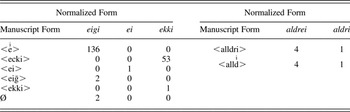
The orthography of the corpus has undergone multiple stages of normalization. Once the variable of interest had been identified, a check was undertaken to determine to what extent this interfered with the data. All instances of ekki, eigi, ei, and forms of aldrei in Droplaugarsonar and Kormáks sögur were checked against a diplomatic edition of their main manuscript, Möðruvallabók (Leeuw van Weenen, Reference Leeuw van Weenen1987) to identify the range of manuscript orthographies represented by each. The results are shown in Table 3. These data demonstrate that the distinction between ei(gi) and ekki is preserved consistently in the normalized editions: all instances of <ecki> and <ekki> in the manuscript are represented by ekki in the normalized editions and all instances of ekki in the normalized editions reflect <ecki> or <ekki> in the manuscript. However, the distinction between eigi and ei is not straightforwardly maintained. The normalized editions show ei only when the manuscript shows <ei>; <eiḡ>, and < $ \mathop {\rm e}\limits^{\rm i} $> are always expanded as eigi, in the latter case relying on the assumption that the superscript <i> would not be used in place of normal <i> except to indicate that the word was also otherwise truncated. This assumption does not seem entirely unquestionable, and without it, the relative frequencies of ei and eigi in the normalized texts would be reversed. Accordingly, it is not possible to treat the distinction between ei and eigi as meaningful in the normalized texts. Similarly, no distinction between manuscript forms of aldrei is maintained in the normalized edition, and thus these distinctions must be ignored.
Manuscript orthographies of negative adverbs

Excluding alternative scenarios
The finding that female characters in the corpus used ekki slightly more frequently than male characters did seems to suggest an effect of gender in language change. However, before this conclusion can be accepted, the reality of the change in the period of interest must be demonstrated and several other scenarios must be excluded:
1. that female characters produced more negative clauses than male characters;
2. that female characters produced negated noun phrases more frequently than male characters did; and
3. that the use of ekki was correlated with another grammatical feature associated with the speech of female characters.
To investigate the possibility that female characters produced negative clauses more frequently than male characters did, the distributions of the other common negative adverbs, ei(gi) and aldrei, were considered. It was found that neither of these nor any grouping of them occurred disproportionately frequently in female or male speech: of 4491 instances of ei(gi), 478 (10.6%) are in female speech (whereas of 319,161 tokens of speech, 4491 [10.9%] are female speech [p = .5205]); of 252 instances of aldrei, 31 (12.3%) are in female speech (p = .49). Accordingly, this explanation could be excluded. To investigate the possibility that female characters produced more negated noun phrasesFootnote 3 than male characters did, frequencies of the other forms of the negative adjective were examined. These also were found not to be used significantly more frequently by female or male characters. Of 741 instances of engi(nn) (excluding ekki), 82 (11.1%) are in female speech (p = .92). The collocates of ekki and eigi (the other negative adverb of comparable frequency) were considered in order to identify any grammatical or lexical features that might correlate with adverb choice. This analysis was undertaken using the AntConc concordance analysis software (Anthony, Reference Anthony2012). Personal pronoun collocates for male and female characters suggested no difference in rate of occurrence with a particular subject person. A copy of the corpus was created in which verbs were reduced to tense-aspect-mood annotation only and the collocates of these were examined. Neither did this show an association between any verbal feature and either ekki or eigi.
The language change account
The hypothesis that ekki was expanding at the expense of other negators over the period covered by the corpus entails two predictions. First, there should be a positive correlation between the frequency of ekki and either dates of composition or of manuscript production. Second, there should be a negative correlation between the frequencies of ekki and the strategies of negation it was replacing.Footnote 4
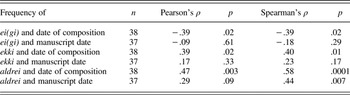
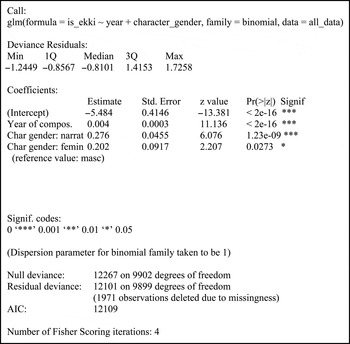
Dates of composition and manuscript production for each text were taken from the literature; these are given in the appendix. The Spearman and Pearson correlation coefficients were calculated between the normalized rates of ekki and of ei(gi) per thousand tokens and the estimated dates of textual composition and manuscript production of each text; pairwise deletion was used. The results are shown in Table 4. Table 4's figures show that frequency of ei(gi) is negatively correlated with textual dates and frequency of ekki positively correlated with textual dates; in both cases, the correlation is significant only with dates of composition, not dates of manuscript production. Rates of correlation were calculated between each of the different negatives. The results are shown in Table 5. Table 5's figures indicate, as predicted, that ekki is significantly negatively correlated with eigi. In combination with the correlations between the frequencies of negatives and dates of textual composition, this suggests that the use of ekki as a sentential negative was increasing at the expense of ei(gi) over the period represented by these texts. This is unsurprising, as ei(gi) is the most frequent negative overall and the only negative adverb that occurs with a frequency comparable to ekki in the corpus. The figures also show that aldrei was increasing in frequency over the period covered by the corpus. As aldrei cannot be treated as a strictly comparable variant of the sentential negation variable (as it means ‘never’ as opposed to simply ‘not’) and as its frequencies are too low to show significant association with male or female speech, it will not be dealt with further here. Binomial regression where the dependent variable is the occurrence of ekki versus ei(gi) confirms that later date of composition favors ekki over ei(gi) as does represented female speech compared with male speech (see the appendix).
Correlation coefficients between frequencies of negatives and textual dates

Correlation coefficients between frequencies of negatives

Visual representation of data
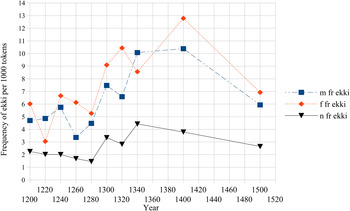
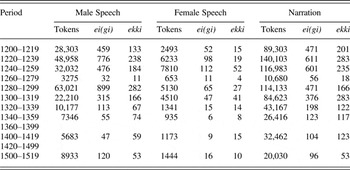
To investigate whether the relationship between the choice of negative adverb and character gender remained constant throughout the time period covered by the corpus, scaled frequencies of ekki and ei(gi) in female and male speech and in the framing narration (that is, the text outside represented speech) were charted against date of composition, grouped into 20-year periods as shown in Figure 1. These visualizations relatively clearly confirm the hypothesis that frequency of ekki is increasing overall; it appears, however, that this change does not begin until the period 1280–1299 or perhaps 1260–1279. There is also evidence to support the hypothesis that female characters are represented leading this change once the change has begun. Note that the two periods that show results outside these overall patterns (1340–1359 and 1500–1519) each represent relatively little data: two texts with only seven negative adverbs in female speech in 1340–1359, and only a single text in 1500–1519.
Normalized frequency of ekki per 1000 tokens in 20-year periods by year of composition and character gender.

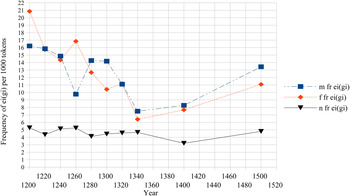
Throughout all periods, frequency of ekki in narration is lower than in represented speech. Examination of the frequency of ei(gi) in narration and speech suggests that this does not reflect narration lagging in the change from ei(gi) to ekki but instead is an artifact of the fact that frequencies of all negative adverbs are lower in narration than speech; these frequencies are shown in Figure 2.
Normalized frequency of eigi per 1000 tokens in 20-year periods by year of composition and character gender.

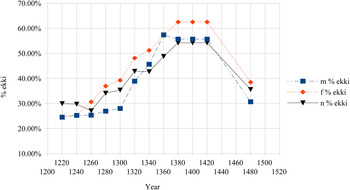
Examination of the proportion of negative adverbs represented by ekki removes the large difference between narration and speech; this can be seen in Figure 3, which shows the frequency of ekki as a proportion of ekki and ei(gi) in moving 60-year windows to effect greater smoothing than that of 20-year-period groupings. This figure again relatively clearly confirms the two main hypotheses. Generally there is not sufficient data from each individual period to achieve statistical significance, but it is worth noting that the difference in ekki:ei(gi) ratio between male and female speech is significant in the periods 1260–1319, 1280–1339, and 1300–1359.Footnote 5i As this is exactly the period in which the change appears to have been progressing most quickly, this is in line with the findings of Nevalainen and Raumolin-Brunberg (Reference Nevalainen and Raumolin-Brunberg2003) for changes in the history of English that gendered differences tend to emerge in the most vigorous stage of an ongoing change.Footnote 6
Frequency of ekki as a proportion of ei(gi) and ekki in moving 60-year windows by year of composition and character gender.

DISCUSSION
Language and gender and the second principle
Numerous studies of language variation have shown two relatively consistent principles regarding the effect of gender. First, in stable variation, male speakers are found to use fewer standard, prestige forms than female speakers do. Two famous examples are found in variation in the progressive suffix between nonstandard /ɪn/ and standard /ɪŋ/ in studies of New York City English (Labov, Reference Labov1966) and Norwich English (Trudgill, Reference Trudgill1974). Second, in ongoing change, the incoming variant tends to occur more often in female than in male speech; that is to say, female speakers usually lead language change. Examples can be found in changes from above, such as in the introduction of rhoticity to New York City English (Labov, Reference Labov1966). In such cases, this effect of gender might be explained as an instance of the first principle, in which female speakers tend to use a variety closer to the prestigious standard. However, many other cases are found of female speakers leading in change from below. Examples include the monophthongization of /aw/ in one of the earliest investigations into linguistic change in progress, Gauchat's study of Charmey French (Gauchat, Reference Gauchat1905); (ae)-tensing in New York City English (Labov, Reference Labov1966); the change of /m̩/ to /ŋ̩/ in Hong Kong Cantonese (Bauer, Reference Bauer1982); and glottal-stopping of /t/ in Newcastle English (Docherty & Foulkes, Reference Docherty, Foulkes, Docherty and Foulkes1999:293–294; Milroy, Milroy, Hartley & Walshaw, Reference Milroy, Milroy, Hartley and Walshaw1994:340–341). Only a small minority of studies have identified cases of male speakers leading language change; one example is the unrounding of /ɒ/ to [ɑ] in Norwich English (Trudgill, Reference Trudgill1974). Other examples and exceptions identified in the history of English were noted in the Gendered Language in Historical Varieties section.
Both biological and social explanations have been put forward for this second principle; the type of explanation a scholar favors may often be related to whether they subscribe to a social-constructionist view of gender (see Brickell, Reference Brickell2006). Chambers (Reference Chambers1992, Reference Chambers2003:147–153) proposed that the pattern is associated with biological sex and results from an inherent psychological advantage of women in (socio)linguistic processing that produces greater stylistic flexibility in female speakers’ speech. Other scholars have put forward social explanations, either proposing that the pattern is a direct property of gender roles or that it is an indirect effect of another such property. Labov suggested that “the mechanism of change is not linked to sex differences in any clear and simple way” (Reference Labov2001:284) and argued that the pattern is a result of the greater role that women play in child-rearing in many societies (Reference Labov1990:219–220, Reference Labov2001:306–307); thus he presented the pattern of female speakers leading change as an indirect effect of a (highly consistent) feature of the female gender role. In their account of the phenomenon, Tagliamonte and Darcy (Reference Tagliamonte and D'Arcy2009:63–64) suggested that once an incoming form becomes associated with women, men resist or retreat from it, although they do not explain why it would be the case that most incoming forms become associated with women. Maclagan (Reference Maclagan and Holmes2000:87) argued that “part of the female gender role is . . . setting new standards for language.” In contrast to Labov's account, this theory sees the phenomenon of female speakers leading change (and also that of female speakers using a greater proportion of standard forms) as a direct feature of gender roles. This can be compared to Holmes's discussion of women leading change in New Zealand English. Holmes (Reference Holmes1997:131–132) noted that women have historically been expected to provide models for proper behavior and suggests that in Maori society, where different conceptions of the relationship among language, behavior, and gender have applied, men tend to lead in the introduction of innovative linguistic forms. However, this suggestion is not backed up by evidence. Much attention has focused on the first principle, the greater use of standard forms by female speakers. Cameron (Reference Cameron2003:191) gave a social account that implicates the fact that women tend be positioned as social subordinates, comparatively lacking in physical capital, and thus tend to be more reliant on symbolic social capital (such as self-presentation through language-use and dress) than men are. Such accounts have a long history in the literature; scholars including Trudgill (Reference Trudgill1972:182–183), Eckert (Reference Eckert and Coates1998:67) and Eckert and McConnel-Ginnet (Reference Eckert and McConnel-Ginnet1999:192–197) have discussed similar explanations. A related observation is that the modern labor market tends to place women in roles with a strong emphasis on communication skills and standard language competence (teaching, nursing, customer service, etc.), which could further embed the pattern (Cameron, Reference Cameron2003:191; Eckert & McConnel-Ginnet, Reference Eckert and McConnel-Ginnet1999:193–195). All of these accounts can offer a partial explanation for the second principle in that they can explain instances of female speakers leading in changes from above. As in the case of Labov's account, they see such patterns as indirect effects of the female gender role as constructed in certain societies.
Different accounts of these principles, whether biological or social, make different predictions about their universality. A biological explanation implies a uniform effect across societies and across time. Social explanations that see these phenomena as the indirect effects of other features of gender roles must predict that they would not occur in societies in which gender roles were constructed without those features. In particular, if the second principle is seen as an indirect effect of the position of women as social subordinates, mediated via the first principle, consider historical societies in which the position of women was still further subordinated but in which men and women also had differential access to education. In such cases it would be predicted that the second principle be even stronger for most changes while not applying at all to those stemming from educated speech (cf. the findings of Nevalainen et al. [Reference Nevalainen, Raumolin-Brunberg and Mannila2011] and Nevalainen and Raumolin-Brunberg [Reference Nevalainen and Raumolin-Brunberg2003], as well as those in the Gendered Language in Historical Varieties section).
By contrast, if these patterns are a direct feature of gender roles as constructed in particular societies, we might expect them to vary significantly from society to society independently of other social factors, as other elements of constructions of gender vary. In particular, under such social explanations, it must remain a possibility that these patterns are particular features of modern (perhaps Western) gender roles. As modern sociolinguistic research in this area has focused somewhat disproportionately on English and other Indo-European languages, and historical sociolinguistic research highly disproportionately on English (as discussed), it is clear that searching for these patterns in additional languages of societies both historical and modern can provide further evidence to distinguish between different potential explanations.
CONCLUSIONS
This research has clearly demonstrated a gendered pattern in which an incoming variant occurs more frequently in female than in male represented speech in Old Norse fiction. Female characters could be seen leading the increase in frequency of the negative adverb ekki; other negative adverbs, most particularly ei(gi), were also involved in this change, but did not clearly exhibit gendered patterns.
As the data used were taken from fiction texts, this result relies on the assumption that authors were able to represent changing patterns of male and female speech with considerable accuracy. However, there is good reason to believe this. Consistent differences in the frequencies of the negative adverbs examined were found between represented speech and narration; this points to a register difference between speech and narration. Furthermore, the very fact that a gendered pattern emerged from the data provides evidence that authors made an effort to characterize male and female speech. This fits the picture from earlier literature that suggests that such linguistic characterization is an important literary tool to render dialogue believable and can be expected in works of prose fiction. Finally, studies of speech in modern fiction have demonstrated patterns of gendered language reflecting those of spontaneous speech. Such evidence from modern varieties encourages us to take these findings for a historical variety seriously. Thus, this research has shown the effectiveness of examining represented speech in fiction where the extant data for a historical variety does not allow more direct consideration of external factors in language change and in doing so has expanded the range of historical varieties in which the effect of gender can be examined.
In demonstrating a pattern in which female characters lead language change in fiction in a historical variety, this study has made two advances over previous, similar studies (e.g., Willi, Reference Willi2003). First, the dataset contains enough data spread over a sufficient time period that it has been possible to show ongoing change within it, rather than identifying variables undergoing change on the basis of other datasets. This is important to exclude the possibility of short-term shifts in direction of change that would introduce doubt as to whether a change was necessarily taking place in the particular speech community and period of interest. Second, the dataset is of a sufficient size to have allowed the use of statistical tests of significance, and both the ongoing change and the association with gender have been shown to be significant.
As the finding concerned only a single variable it cannot be considered conclusive evidence that Labov's second principle applied more generally in Old Norse. However, it represents a valuable first indication on this point. Finding that this principle applied in societies quite distant from the modern Western societies in which it was first identified and has been most thoroughly investigated may be seen as evidence against the view that it is a direct feature of socially constructed gender roles, which might be expected to vary freely. It leaves open the possibility that it is the indirect effect of another property of gender roles common to all the societies studied, such as the greater role played by women in child-rearing or gendered differential access to physical capital.
APPENDIX
Raw data
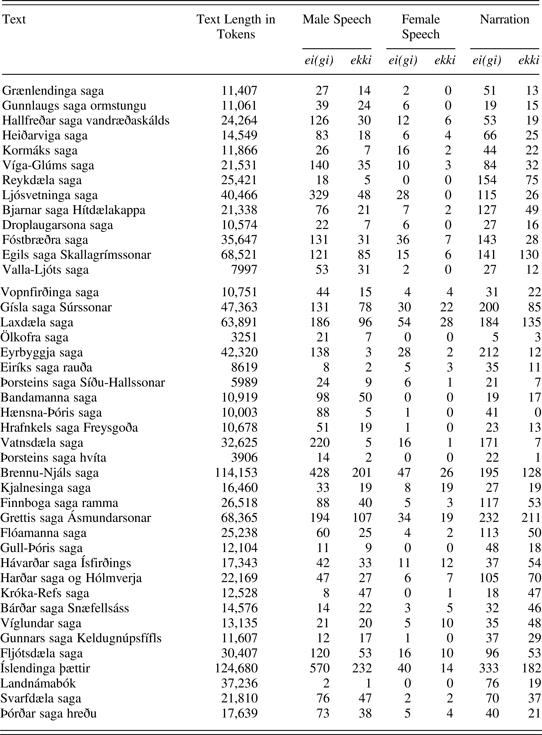
The sizes in tokens of the individual texts and the frequencies of the different negatives in those texts are given in Table 6, and the data grouped into periods are given in Table 7.
Frequencies of negatives by text in Fornrit corpus

Frequencies of negatives in speech by period and character gender

Textual dates
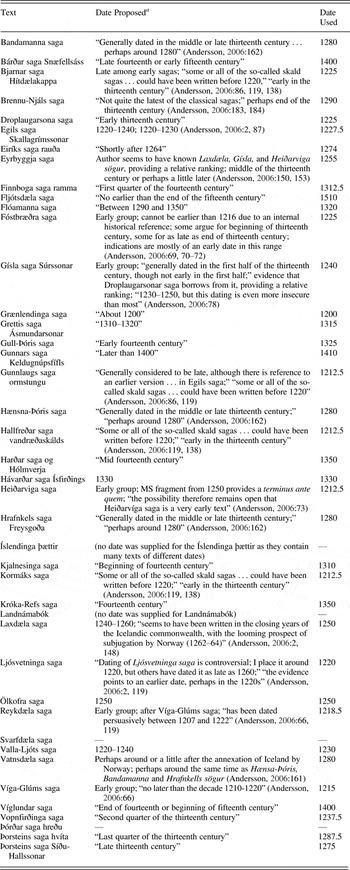
Estimated dates of textual composition were identified for each text on the basis of Andersson (2006); where Andersson offered no comment on the dating of a particular text, articles in Pulsiano, Wolf, Acker, and Fry (1993) were used; these articles were also used to identify dates of the earliest major manuscript for each text. Composition dates are given in Table 8; for manuscript dates, see Blaxter (Reference Blaxter2013:43–45).
Composition dates of texts in the Fornrit corpus

Regression model
A binomial regression was used to model the choice between ekki and ei(gi). Footnote 7 The dependent variable is the occurrence of ekki (TRUE) versus ei(gi) (FALSE) and the other factors were the estimated date of textual composition (a number or NA) and the gender of the character (masculine, feminine, or narrative; masculine was the reference value). The output of the model is given in Figure 4. Here it can be seen that all of the factors tested had a significant effect (for at least p < .05) on the outcome (running the regression again treating narrative as the reference value for character gender demonstrates that the distinction between narrative and feminine is not significant).
Binomial regression model output for occurrence of negative ekki vs ei(gi) in Old Norse.