Introduction
Much research and theory have considered affect, behavior, and cognition as the basic building blocks that dictate human functioning, with intricate and bi-directional relationships among them. Persons with advanced dementia present a unique opportunity and challenge to researchers who examine those relationships in conditions where cognitions are most often not accessible. Behavior of persons with dementia can be divided into “positive” behavior (i.e. appropriate engagement with the environment), “problem” behavior, also termed “agitation” (i.e. behavior perceived by caregivers to be inappropriate and often disruptive) (Cohen-Mansfield, Reference Cohen-Mansfield2001), and apathy, in which behavior is neither positive nor agitated. Apathy is a common symptom of dementia (Clarke et al., Reference Clarke2008).
In this paper, engagement is defined as motor or verbal behaviors in response to activity (Orsulic-Jeras et al., Reference Orsulic-Jeras, Judge and Camp2000) or the act of being occupied or involved with an external stimulus, and includes the dimensions of duration, attention, and attitude (Cohen-Mansfield et al., Reference Cohen-Mansfield, Dakheel-Ali and Marx2009). Affect refers to expressed or observed emotional response. In persons with dementia who have a diminished ability to express their emotions verbally, affect is often inferred from facial, vocal, or gestural behavior. Several research studies have supported a two-dimensional structure of affect that includes dimensions of positive and negative affect, which are at least partially independent of each other (Lawton et al., Reference Lawton, Haitsma and Klapper1996). Agitated behaviors in persons with dementia have been characterized as syndromes, including: an aggressive syndrome (e.g. hitting), a physically non-aggressive syndrome (e.g. pacing), and a vocal/verbal syndrome (e.g. repeated requests for attention) (Cohen-Mansfield et al., Reference Cohen-Mansfield, Marx and Rosenthal1989a; Rabinowitz et al., Reference Rabinowitz, Davidson, Deyn, Katz, Brodaty and Cohen‑Mansfield2005).
Nursing home facilities present a unique setting in which relationships among the constructs of affect, behavior, and cognitive functions are discernible. This is primarily due to the high rates of cognitive impairment as well as the fact that organized activities often occupy only small portions of the day (Burgio et al., Reference Burgio1994) and are often group activities that do not accommodate varying ability levels (Buettner and Fitzsimmons, Reference Buettner and Fitzsimmons2003). Reports that nursing home residents with dementia are faced with unstructured time for two-thirds of the day or more (Burgio et al., Reference Burgio1994; Lucero et al., Reference Lucero, Pearson, Hutchinson, Leger-Krall and Rinalducci2001) indicate a significant cause for concern, as inactivity in this population is known to decrease quality of life by contributing to boredom, depressed affect, and agitated behavior (Cohen-Mansfield and Werner, Reference Cohen-Mansfield and Werner1995).
The relationship between engagement and affect
Research pertaining to persons with dementia has shown that engagement in appropriate activities can cause a marked increase in measured happiness, elevated interest and alertness, a decrease in boredom, and increased quality of life (Schreiner et al., Reference Schreiner, Yamamoto and Shiotani2005). Moreover, engagement has been linked with improved affect (Orsulic-Jeras et al., Reference Orsulic-Jeras, Judge and Camp2000; Gigliotti et al., Reference Gigliotti, Jarrott and Yorgason2004; Cohen-Mansfield et al., Reference Cohen-Mansfield, Libin and Marx2007; Lin et al., Reference Lin, Yang, Kao, Wu, Tang and Lin2009; Cohen-Mansfield et al., Reference Cohen-Mansfield, Marx, Thein and Dakheel-Ali2011), and decreased anxiety and fear (Orsulic-Jeras et al., Reference Orsulic-Jeras, Judge and Camp2000).
The relationship between engagement and agitated behavior
Engagement has been found to decrease problem behaviors. For example, social engagement (e.g. one-on-one interaction, simulated presence therapy, pet therapy, robotic therapy) can help diminish agitated behavior (Cohen-Mansfield, Reference Cohen-Mansfield2001; Cohen-Mansfield et al., Reference Cohen-Mansfield, Marx, Thein and Dakheel-Ali2010b), while personalized non-pharmacological interventions have been shown to reduce agitated behavior significantly in nursing home residents with dementia (Cohen-Mansfield et al., Reference Cohen-Mansfield, Libin and Marx2007; Feliciano et al., Reference Feliciano, Steers, Elite-Marcandonatou, McLane and Arean2009). Lin et al (Reference Lin, Yang, Kao, Wu, Tang and Lin2009) found that the implementation of Montessori-based activities and acupressure led to decreases in both aggressive behaviors and physically non-aggressive behaviors.
The relationship between agitated behavior and affect
Depressed affect has been linked with physically aggressive agitation (Talerico et al., Reference Talerico, Evans and Strumpf2002) and with verbal and vocal agitated behaviors (Dwyer and Byrne, Reference Dwyer and Byrne2000). While depressed affect may lead directly to vocal agitation (such as crying), at other times there may be another variable, such as pain, underlying both the agitation and depressed affect (Feliciano et al., Reference Feliciano, Steers, Elite-Marcandonatou, McLane and Arean2009).
In the aforementioned publications, the three constructs were examined in the context of interventions that aimed to improve affect or decrease agitation. The importance of enhancing the understanding of constructs and measures of engagement, agitation, and affect in people with dementia lies in the pivotal role of such assessments in the evaluation of whether interventions for people with advanced dementia impact their quality of life. In this paper, we take a theoretical rather than clinical approach and clarify the constructs and their inter-relationships by examining these concurrently in different samples and under different conditions. A limitation sometimes described in the literature pertains to the failure to capture agitation, thereby preventing analysis of agitation with engagement or affect. For this reason, we included a group of participants with documented agitation.
Our hypotheses were:
Engagement and affect
1. Since engagement is conducive to positive feelings and increased interest, we hypothesized a positive correlation of engagement with pleasure (positive affect) and interest, whereas a lack of engagement would be related to boredom and in turn, negative affect.
Agitated behavior and engagement
2. Since some syndromes of agitated behavior (especially physically non-aggressive) are related to boredom (Cohen-Mansfield and Libin, Reference Cohen-Mansfield and Libin2005), we hypothesized a negative correlation between engagement and agitated behavior.
Agitated behavior and affect
3. Given that many syndromes of agitated behavior are based on unmet needs and can indicate discomfort, we anticipated a positive relationship between agitated behavior, especially verbal agitation, and negative affect (Cohen-Mansfield and Libin, Reference Cohen-Mansfield and Libin2005).
4. Since the alleviation of agitated behavior is associated with increased interest and pleasure (Cohen-Mansfield et al., Reference Cohen-Mansfield, Libin and Marx2007), we hypothesized that agitated behavior will be negatively correlated with interest and pleasure.
In order to examine these four hypotheses, we first looked at a data set containing direct observations of agitation, engagement, and affect from a sample of nursing home residents in which the sole criterion for inclusion was a diagnosis of dementia. Given the low levels of agitation in that sample, we decided to examine a second sample in which participants were selected on the basis of frequent manifestations of agitation as well as having a diagnosis of dementia. Sample 2 data (from Cohen-Mansfield et al., Reference Cohen-Mansfield, Libin and Marx2007) were obtained through direct observations of agitation and affect (but did not include engagement). In both samples, nursing home residents had advanced dementia and low MMSE scores.
Methods
Participants
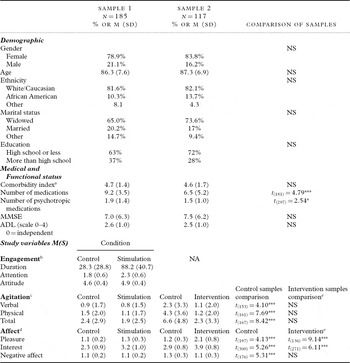
Participants were recruited from ten nursing homes in Maryland, USA. Four of these nursing homes provided participants for both Samples 1 and 2. Three nursing homes provided participants for Sample 1 only, and three nursing homes provided participants for Sample 2 only. Sample 1 contained 185 residents and Sample 2 contained 117 residents (Table 1). The characteristics of the study participants of the two samples and comparisons between them are shown in Table 1. The two samples were quite similar with regard to demographics such as age (Sample 1 mean age = 86.3 years; Sample 2 mean age = 87.3 years), gender, ethnicity, marital status, and education, the exception being that there was a significant difference in the number of medications (t (181) = 4.79, p < 0.001) and number of psychotropic medications (t (297) = 2.54, p < 0.05). Additionally, differences between samples emerged for affect and agitation (see Table 1). This is not surprising since those in Sample 2 were selected for study because they manifested agitated behavior several times a day.
Characteristics of the two samples: demographic, health and function, engagement, agitation, and affect

a Comorbidity index = the number of diagnostic categories (out of these possible 11: Cardiovascular disease, Respiratory disease, Neurological disease, Musculoskeletal disease, Digestive system disease, Genitourinary disease, Blood disease, Endocrine system disease, Psychiatric disorder, other diseases (e.g. allergy, eye disorder, cancer, skin diseases), and Dementia).
b Duration measured as seconds of engaged behavior; Attention measured on this 4-point scale: not attentive, somewhat attentive, attentive, very attentive; Attitude measured on a 7–point scale ranging from very negative to very positive.
c Agitation measured as number of times agitated behaviors occurred during the observation.
d Pleasure, interest, and negative affect were measured on this 6-point scale: 1 = never, 2 = less than 16 seconds, 3 = half of the 3-minute observation, 4 = more then half of the observation, 5 = all or nearly all of the observation.
e Comparison of Sample 1 under the stimulation condition to Sample 2 under the intervention condition.
NS = not significant, NA = not applicable
*p ≤ 0.05, **p ≤ 0.01, ***p ≤ 0.001
The main criterion for inclusion in either sample was a diagnosis of dementia. For both samples, residents were excluded if they were younger than 60 years and if they had a diagnosis of bipolar disorder or schizophrenia. As 22 of the 24 stimuli presented to participants in Sample 1 were standardized and some of these required sitting or the use of one's hands, we included the following additional exclusion criteria for this group to reduce the occurrence of missing data: residents were excluded if they had no dexterity movement in either hand and if they could not be comfortably seated in a chair/wheelchair. In addition, for Sample 2, residents were excluded if they were new to the facility (<3 weeks) and nursing assistants could not accurately assess them, they had a life expectancy of <3 months, and they exhibited agitation fewer than several times a day.
Assessments
Background assessment
Data pertaining to background variables were retrieved from the residents’ charts at the nursing homes. For each participant, mean ADL performance (ADL-MDS) (Morris et al., Reference Morris1991) was assessed and the MMSE (Folstein et al., Reference Folstein, Folstein and McHugh1975) was administered.
Measurement of engagement
Direct observations were recorded using the Observational Measurement of Engagement (OME) (Cohen-Mansfield et al., Reference Cohen-Mansfield, Dakheel-Ali and Marx2009). With regard to reliability of the OME, the inter‑rater agreement rate (for 1-point discrepancy) was 84% and intraclass correlation (ICC) values averaged 0.78 for the engagement outcome measures (Cohen-Mansfield et al., Reference Cohen-Mansfield, Dakheel-Ali and Marx2009). Outcome variables on the OME are:
• Duration – refers to the time (in seconds) that the participant is engaged with the stimulus.
• Attention to the stimulus (i.e. eye tracking, visual scanning, facial, motoric or verbal feedback, eye contact, touching the stimulus) – measured on a 4-point scale: not attentive, somewhat attentive, attentive, and very attentive.
• Attitude to the stimulus (e.g. positive or negative facial expression, verbal content, physical movement toward the stimulus) – measured on a 7–point scale, ranging from very negative to very positive.
Measurement of affect
Affect was assessed using Lawton's Modified Behavior Stream (LMBS) (Lawton et al., Reference Lawton, Haitsma and Klapper1996), which measures pleasure, interest, sadness, anxiety, and anger. Previously, we calculated an inter-rater agreement of 87.5% for the assessments of mood (n = 20) (Cohen-Mansfield et al., Reference Cohen-Mansfield, Marx, Thein and Dakheel-Ali2011). For the purpose of analysis, we examined pleasure and interest as separate dependent variables and, due to the very low occurrences of sadness, anxiety, and anger, we derived a new dependent measure, negative affect, which was the maximum value observed for sadness, anxiety, or anger. While interest is conceptually related to engagement, we chose to follow the original conceptualization of this instrument and included it in the measurement of affect.
Measurement of agitated behavior
Direct observations of behaviors characterized as physical agitation (e.g. pacing, trespassing into another's room, exit seeking, repetitious movement such as patting, tapping, or rocking, handling/moving objects for no reason or rummaging, inappropriate dressing/undressing, hiding/hoarding) or verbal/vocal agitation (e.g. attention-seeking, complaining, screaming, groaning, non-aggressive nonsense talk/babbling, cursing, singing/humming, strange noises such as weird laughter, grinding teeth, or smacking lips) were recorded via the Agitation Behaviors Mapping Instrument (ABMI) (Cohen-Mansfield et al., Reference Cohen-Mansfield, Werner and Marx1989b). A trained research assistant recorded the frequency of occurrence of these items during each observation period. Inter-rater reliabilities of the ABMI averaged 0.93 (Cohen-Mansfield et al., Reference Cohen-Mansfield, Marx and Rosenthal1989b).
Procedure
The study protocols for both Samples 1 and 2 received Institutional Review Board (IRB) approval. Informed consent was obtained for all study participants in both samples from their relatives or other responsible parties. For those in Sample 1, once background data were obtained and the MMSE administered, the study participant was presented with 24 engagement stimuli over a period of three weeks (approximately 4 stimuli per day). The stimuli were: a life-like baby doll, a childish-looking doll, a plush animal, a robotic animal, a real dog, a respite video, one-on-one socializing with a research assistant, a squeeze ball, a tetherball, an expanding sphere, an activity pillow, building blocks, a fabric book, a wallet (males) or purse (females), a puzzle, envelopes to stamp, towels to fold, flower arrangement, an envelope sorting task, coloring with markers, listening to music, a large print magazine, and two individualized self-identity stimuli. With the exception of the two self-identity stimuli, the stimuli were standardized across study participants, while the self-identity stimuli were matched to each participant's past identity with respect to occupation, hobbies, or interests. For example, an individual with an interest in astronomy could be given a book on stargazing and constellations, and a participant who worked as a chef might watch cooking videos. Self-identity stimuli therefore varied across participants.
Each stimulus was presented twice to each participant (never on the same day). Engagement trials took place from 9:30 am to 12:30 pm and from 2 pm to 5:30 pm, as these were when residents were not usually occupied with care activities (e.g. meals, bathing). Individual engagement trials were separated by an inter-trial interval of at least 5 minutes. The order of stimulus presentation was randomized for each participant. At the start of each trial, a research assistant asked the participant if he or she would like to engage in the activity. A second research assistant, who remained unobtrusive, performed direct observations of the study participant and recorded data pertaining to affect, agitated behavior, and engagement onto a handheld computer (the Palm One Zire 31™). During each observation, affect, engagement, and agitated behavior were measured during the first 3 minutes after the stimulus was presented. Refusal of a stimulus was also recorded. Two types of control (no stimulus) observations were included. These were: (1) observations (6 per participant) conducted prior to beginning observations during which stimuli were presented, and (2) observations (3 per participant) recorded at random times during regular observation times, after an interval of at least 5 minutes.
Sample 2 included the treatment group from a study of non-pharmacological interventions for persons with dementia (Cohen-Mansfield et al., Reference Cohen-Mansfield, Libin and Marx2007). While most of the stimuli were uniform in Sample 1 (the exception being the two individualized self-identity stimuli), the interventions provided to those in Sample 2 were tailored to the needs and preferences of each participant according to the TREA (Treatment Routes for Exploring Agitation; Cohen-Mansfield, Reference Cohen-Mansfield2000) decision-tree model. TREA incorporates data from participants, relatives, nursing staff, and physicians that are obtained through direct observation, interviews, mailed questionnaires, and chart review. By incorporating the TREA decision-tree protocol for each study participant, we were able to hypothesize an unmet need, identify a corresponding treatment category, and design the specifics of the intervention to best fit the study participant's past identity and preferences as well as sensory, mobility, and cognitive abilities. For each resident, several interventions were proposed and the interventions identified as most successful during a trial period were then used in this study.
Analytic approach
We compared the two samples using t-tests and χ2 analyses. In order to examine relationships among constructs, we calculated correlations among the components of engagement, affect, and agitated behavior by calculating Spearman correlations between the dimensions of these constructs for each stimulus during each presentation (i.e. within participant, within each trial). Spearman correlations were used because of the skewed nature of agitation as assessed by direct observation. The correlations were transformed into z-scores using r-to-z transformation; a mean of these z-scores was computed, and this mean was transformed back to a correlation coefficient that is presented in the tables. In addition, we calculated the percentage of the original correlations that had reached significance at p ≤ 0.05. This procedure was performed separately for control observations. For Sample 2, the same procedure was used for the agitation and affect data, using six observations during the non-pharmacological treatment interventions and ten control (pre-intervention) observations. All correlations were computed within each sample.
Given that our interest lay in discerning relationships among constructs as these occurred in real time, we examined multiple correlations between observations of engagement, affect, and agitation recorded during the 3-minute period. In order to quantify those relationships, we calculated the mean of the correlations obtained under each condition (e.g. in Sample 1, correlations of pleasure as a measure of affect with attention as a measure of engagement were calculated for each stimulus condition and averaged across stimuli). Recognizing that a mean of correlations does not have the same distribution as a correlation, we evaluated the magnitude of these correlations by examining the percentage of correlations that were significant at the 0.05 level. We then developed operational heuristic algorithms to distinguish the following relationships between measures:
(1) Belonging to the same constructs. For this, all of the correlations (100%) had to be statistically significant. Individual correlation coefficients could be positive or negative, but had to have an absolute value greater than 0.5 to reduce the chance of obtaining significant correlations with independent measures due to large sample size (Gardner, Reference Gardner2000).
(2) Belonging to unrelated constructs. For this, correlations had to fall between –0.15 and +0.15 (Trochim, Reference Trochim2006; Furr and Bacharach, Reference Furr and Bacharach2008), with fewer than 25% being significantly correlated.
(3) Belonging to different but related constructs. Here, correlations had to fall between 0.1 and 0.5 (negative or positive), with more than 20% but fewer than 100% of the correlations being significantly correlated.
Results
Engagement and affect
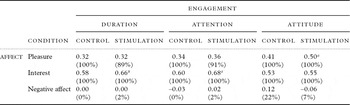
The first hypothesis of a positive correlation between engagement, pleasure, and interest was supported by the data (Table 2). Relationships of all indicators of engagement with interest met the criteria for belonging to the same construct (all correlations were significant with values between 0.53 and 0.68 for sample sizes ranging from 81 to 185). The correlations were somewhat lower for pleasure (ranging from 0.32 to 0.50), and the percent of correlations showed these to be significant in most cases, suggesting a positive correlation between the constructs. As to the relationship between engagement and negative affect, few of the correlations between these variables were significant, and the coefficients were small in magnitude, most likely due to the low levels of observed negative affect.
Correlations between engagement and affect (Spearman correlations and % of trials in which correlation was significant at the 0.05 level

Note: Control scores are averaged from 9 trials with sample sizes of 81–185; when duration was 0 and there was no potential stimulation, attention and attitude were not measured; scores under the stimulation conditions are averaged from 46 trials with sample sizes of 128–185.
a Significant differences between correlations during control and during stimulation conditions.
Duration measured as seconds of engaged behavior; Attention measured on a 4-point scale: not attentive, somewhat attentive, attentive, very attentive; Attitude measured on a 7–point scale ranging from very negative to very positive.
Agitated behavior and engagement
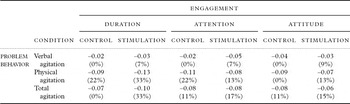
The second hypothesis, which anticipated a negative correlation between agitated behavior and engagement, was not supported. While all correlations between agitated behavior and engagement were negative (Table 3), these were small in magnitude and only a few were significant, which is most likely due to low levels of observed agitation in Sample 1.
Correlations between engagement and problem behavior (Spearman correlations and % of trials in which correlation was significant at the 0.05 level)

Note: Control scores are averaged from nine trials with sample sizes of 81–185; stimulation scores are averaged from 46 trials with sample sizes of 128–185. Differences between correlations during control and during stimulation conditions were not statistically significant.
Agitated behavior and affect
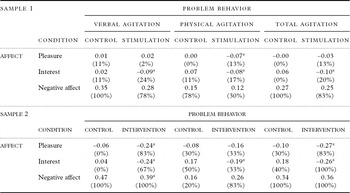
The third hypothesis was supported by the data (Table 4). This hypothesis suggested a positive relationship between agitated behavior (particularly verbal agitation) and negative affect. The magnitude of the correlations was moderate (between 0.12 and 0.47 across both samples, averaging 0.28) with a majority of the correlations being statistically significant (median = 92%).
Correlations between problem behavior and affect (Spearman correlations and % of trials in which correlation was significant at the 0.05 level)

Note: For Sample 1, control z scores were averaged from nine trials with sample sizes of 180–185; stimulation scores were averaged from 46 trials with sample sizes of 129–185. For Sample 2, control z scores were averaged across 10 trials with 117 participants in each; intervention z scores were calculated across six trials with 88–117 participants.
a Significant differences between correlations during control and during stimulation/intervention conditions.
The fourth hypothesis of agitated behavior being negatively correlated with interest and pleasure was also supported by analysis. As can be seen for the correlations pertaining to the non-pharmacological intervention condition (bottom rows, Table 4), there was a negative relationship of agitated behavior with pleasure (correlations between –0.16 for physical agitation and –0.27 for total agitation) and interest (correlations between –0.19 for physical agitation and –0.26 for total agitation). Not surprisingly, correlations were small and few were significant for Sample 1 (since this was not a highly agitated group) and for the control condition of Sample 2 (since no interventions were presented).
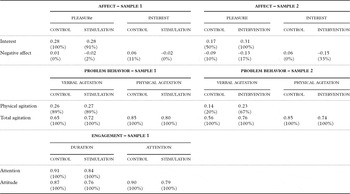
We also examined the inter-correlations among the indicators within each construct, and found the relationships among the three indicators of engagement to be high, with significant correlations ranging around 0.8 and 0.9 (Table 5). For agitated behavior, correlations with total agitation were generally high (around 0.7 or 0.8, with the exception of one case of 0.56); yet, correlations between physical and verbal agitation, while positive, were in the range of 0.1–0.3, indicating that these are different constructs. For affect (particularly negative), the three indicators were also independent. The highest correlations between negative and positive affect were seen for the treatment condition in Sample 2, but these were in the range of 0.1–0.2. Correlations of pleasure with interest were around 0.2–0.3.
Correlations among indicators of each construct (Spearman correlations and % of trials in which correlation was significant at the 0.05 level)

Note: For Sample 1, control z scores were averaged from nine trials with sample sizes of 81–185; stimulation scores were averaged from 46 trials with sample sizes of 129–185. For Sample 2, control z scores were averaged across 10 trials with 117 participants in each; intervention z scores were calculated across six trials with 88–117 participants.
Discussion
The novel contribution of our study is that we have examined the relationship among variables that are frequently examined individually and, by doing so, are able for the first time to clarify the nomenclature used to describe the constructs of affect, engagement, and agitated behaviors. To date, the literature contains many discrepancies with respect to how affect, engagement, and agitation are presented. For instance, the term “negative affect” is often used interchangeably with “agitation”; also, some researchers fail to make a distinction between “interest” and “positive affect”. Our results show that these are separate phenomena.
Specifically, analysis supported the notion that duration, attention, and attitude (with inter-correlations of 0.8–0.9) reflect the construct of engagement. In accordance with previous findings, we saw that verbal and physical agitation tap different types of behavior; similarly, positive and negative affect are relatively independent of one another (Larsen et al., Reference Larsen, McGraw and Cacioppo2001). While interest was originally developed as one of the measurements of affect, it was found to be highly correlated with engagement. This result raises the question as to whether interest belongs to the construct of positive affect or to engagement. Correlations between interest and the three indicators of engagement ranged from 0.5 to 0.7, while correlations between interest and pleasure ranged from 0.2 to 0.3. Interest, defined by Lawton as an indicator of affect, appears closer to engagement than to positive affect in the present study. In addition, engagement was found to be positively related to pleasure, suggesting that engagement may increase pleasure in nursing home residents. This has been posited previously (Cohen-Mansfield et al., Reference Cohen-Mansfield, Marx, Thein and Dakheel-Ali2011).
Engagement was unrelated to negative affect and to agitated behavior, most likely because floor effects were obtained for the latter two measures. We believe that the low observed levels of agitation and negative affect arose from the fact that agitation was not an inclusion criterion for the participants of Sample 1, and that we used an observational measure that tracks problem behaviors within the framework of a 3-minute time sample. Correlations of engagement with agitated behavior, while not statistically significant, were all negative, suggesting that a more robust relationship might be revealed in a more agitated sample. Another indication that engagement may indeed be negatively related to agitated behavior in more agitated samples and more effective stimulation is the significant negative relationship between agitated behavior and interest in the second sample and during individualized interventions (Table 4, second line from bottom).
Relationships between agitated behavior and negative affect appear robust across samples and across conditions. In all cases, agitated behavior is positively related to negative affect, particularly verbal agitation, and the magnitude of the correlation hovers around 0.28. This suggests that (1) agitated behavior and negative affect may be viewed as different constructs, even in this population of cognitively impaired persons, and (2) agitated behavior – verbal agitation in particular – can alert caregivers that a person with dementia may be distressed. This concurs with past research that revealed a relationship between verbal/vocal agitation and depressed affect based on informant ratings rather than direct observation (Dwyer and Byrne, Reference Dwyer and Byrne2000). This relationship between agitated behavior and negative affect is consistent across samples despite the low levels of agitation in the first sample and low levels of negative affect in both samples, but it is higher in magnitude in the more agitated second sample.
The relationship between agitated behaviors and positive affect is complex. In contrast to the relationship with negative affect, no relationship was found in Sample 1 and in the control condition in Sample 2. Only in the treatment condition in Sample 2 was there a modest correlation (median around r = –0.24, with 75% of the correlations reaching statistical significance) between all indicators of agitated behavior and pleasure and interest. This raises several questions: Why was the relationship only evident in this case? Is this a sample effect or a condition effect? The results suggest that both may be involved. First, Sample 2 included only participants who were likely to exhibit agitated behaviors. Second, there was a positive correlation between interest and physical agitation for Sample 2 under the control condition that may simply be related to the tendency of persons with physical agitation to handle objects in their environment – a phenomenon that can be construed as interest. Finally, most of the stimuli presented to those in Sample 1 were uniform (only two were individualized), whereas each intervention provided to those in Sample 2 was tailored to the needs and preferences of each participant, and thus would be expected to elicit more interest and pleasure. Although Sample 2 had significantly higher levels of interest and pleasure even at the control condition, those differences were not clinically meaningful, whereas meaningful differences did emerge during intervention (Table 1).
This is the first paper to examine the structures of affect, engagement, and agitated behavior and their inter-relationships in persons with dementia. The availability of two independent relatively large samples and the inclusion of stimulus and control conditions for each sample allowed us to examine the robustness of the findings. Another strength of the paper is the objective recording of behaviors as these occur in the natural environment, rather than relying on retrospective informant reports. A limitation is that the procedure did not include observing participants who refused stimuli. While we did observe those who did not refuse the stimuli but were nonetheless not engaged with the stimuli, the lack of data on affect and agitation among those refusing stimuli may have reduced the variability observed and thus potentially reduced the magnitude of correlations across variables. Future research can improve upon this.
The lack of a relationship between positive and negative affect suggests that the processes we identified in persons with advanced dementia are similar to those in the cognitively intact (Larsen et al., Reference Larsen, McGraw and Cacioppo2001). Similarly, the relationship between interest and engagement, suggesting that interest may be more closely identified with the construct of engagement rather than affect, may reflect a conceptual classification that is invariant to dementia, i.e. the link between interest and engagement exists not just for those with dementia but is consistent across stages of cognitive function and dysfunction. The prevalence and type of agitated behavior, on the other hand, have been shown to relate to the level of cognitive decline in elderly persons (Cohen-Mansfield et al., Reference Cohen-Mansfield, Culpepper and Werner1995).
The relationship between negative affect and agitated behavior strengthens the finding that agitated behaviors (particularly verbal agitation) are often a manifestation of suffering or discomfort. The lack of relationship between agitated behavior and engagement in Sample 1 could be attributed to low levels of agitation and to less than optimal (i.e. not individualized) stimulation. The finding of a relationship between positive affect and engagement with stimuli is probably dependent on the match between type of stimuli and the population using them, as previous research has shown that nursing home residents with dementia who have current interests in music, art, and pets are more engaged by stimuli that reflect these interests than are residents not sharing these interests (Cohen-Mansfield et al., Reference Cohen-Mansfield, Marx, Regier, Dakheel-Ali, Thein and Freedman2010a). The relationship between positive affect and agitated behavior, on the other hand, appears to depend on the sample and situation. No relationship was found in Sample 1. There was a low negative relationship in the agitated sample (Sample 2), which became stronger in situations of individualized interventions. To better understand the factors impacting the relationship between affect and agitated behavior, researchers should examine conditions in which population, setting, and stimuli vary. Moreover, future research should investigate the relationships with engagement in an agitated sample, and examine relationships among constructs for different levels of cognitive function and for different personal attributes.
Conflict of interest
None.
Description of authors’ roles
Jiska Cohen-Mansfield was involved in all aspects of the research and writing of this paper. Maha Dakheel-Ali collected data and carried out the statistical analyses. Marcia S. Marx was involved in reviewing the literature and writing the paper. Khin Thein coordinated the data collection process and also collected data. All five authors commented critically and contributed to the final draft of the paper.
Acknowledgments
This study was supported by National Institutes of Health grants AG021497 and AG10172. The authors thank the nursing home residents, their relatives, and the staff members and administrators of the nursing homes for all their help, without which this study would not have been possible.