Marginaster capreensis (Gasco, Reference Gasco1876), is a small starfish of the Poraniidae family (order Valvatida), considered rare in the Mediterranean Sea. This species is characterized by a subpentagonal body, with a thin edge carrying a fringe of flattened stings. Other smaller and short stings are on the aboral face: four ambulatory stings, the 2 external of which, are double in size, dental plates with 3 spines almost of the same dimension. The biology of this species is unknown and the information on biogeographical distribution is scarce both in the eastern Atlantic and in the Mediterranean.
This small starfish was recorded for the first time in the Gulf of Naples (Tyrrhenian Sea), between 70 and 84 m (Gasco, Reference Gasco1876); successively it was recorded in the Aegean Sea at 597 m (Marenzeller, Reference Marenzeller1895). In the past century M. capreensis occurred in the Levant Sea at 315 m (Tortonese, Reference Tortonese1965) and in the Gulf of Taranto, Ionian Sea, at 28 m depth (Pastore, Reference Pastore, Candia Carnevali and Bonasoro1998). Recently, one specimen was found on the bathyal bottoms of Corfu Island, 707–742 m depth (D'Onghia et al., Reference D'Onghia, Mastrototaro, Matarrese, Politou and Mytilineou2003) and two specimens in the Strait of Sicily, at 87 m and 136 m depth (Massi et al., Reference Massi, Rinelli and Mastrototaro2007).
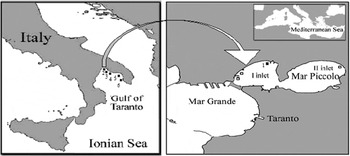
The present paper constitutes a contribution to the knowledge about M. capreensis in the Taranto seas. A total of 9 sampling stations were allocated in the study area (4 stations in the Mar Piccolo Lagoon and 5 in the Gulf of Taranto) as part of a study project financed by the Ministry of University and Scientific Research (Figure 1). Samplings were carried out by SCUBA diving in the Gulf of Taranto, along a depth gradient between 0.5 and 4 m, and using a square metal box (0.5 × 0.5 m) in shallow water of the Mar Piccolo Lagoon at a depth of about 0.5 m.
Map of the sampling stations in the Gulf of Taranto and Mar Piccolo Lagoon: open squares indicate sampling stations and filled squares indicate the presence of Marginaster capreensis.

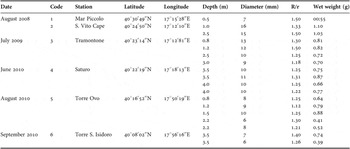
The main information on catch data and biometrics of the individuals found in the Taranto seas is reported in Table 1.
The main information on catch data and biometrics of the Marginaster capreensis specimens collected in the Gulf of Taranto and in the Mar Piccolo stations.

The wet weight of each specimen was determined (±1 g). Prior to weighing, excess water was drained from specimens by placing them on filter paper. Linear measurements of morphological features were made under a stereomicroscope fitted with a micrometer eyepiece.
Starfish measurements include: diameter (distance between two opposite arms); arm length (R, the distance between the centre of the disc and the tip of the arm), and the disc radius (r), representing the distance between the centre of the disc and the edge of the disc in the interradius. The ratio between the two measurements is given as R/r.
A total of 18 specimens was recorded, 17 of which were found in the Gulf of Taranto, on rocky bottoms covered by Laurencia obtusa (Hud.) Lamour and Padina pavonica (L.) Thivy, with a depth range of 2–4 m and one specimen in the first inlet of Mar Piccolo Lagoon, on muddy bottoms covered with dense algal beds mainly composed of Chaetomorpha linum (Müller), Kützing, Gracilaria spp. Greville.
Despite the literature data, M. capreensis from the Taranto seas seems to prefer habitats of shallow water since the individuals were always found in a range between 0.5 and 4 m; the size composition (diameter) of specimens showed smaller individuals (between a range of 6 and 16 mm) than those recorded previously (between a range of 20 and 25 mm) (Tortonese, Reference Tortonese1963; Massi et al., Reference Massi, Rinelli and Mastrototaro2007).
Including the new records from the Taranto seas, only 26 individuals have so far been reported for the Mediterranean.
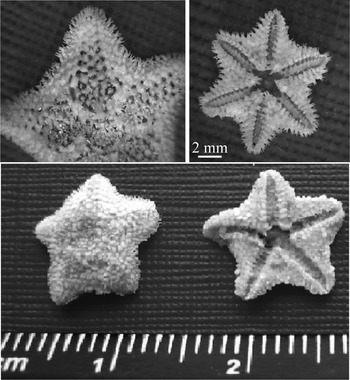
Considering our discovery of 18 specimens of M. capreensis, in the Taranto seas (Fig. 2), a programmed monitoring of the population is required in order to confirm if this species is a resident species of the echinoderm fauna of the Taranto seas.
Specimens of Marginaster capreensis from the Taranto seas.