Introduction
A growing number of publications and conferences on cultural industries have turned their attention to the study of labour.Footnote 1 After years of conspicuous absence in sociology journals, business journals, health, law, education, anthropological and music journals, this new focus on labour may come as a surprise. Yet speaking about the left, the liberals and the conservatives in England, sociologists Mark Banks and David Hesmondhalgh remark,
there has been a validation of creative work as a model for ‘good work’ in general … Indeed, in an era when work is generally presented as a key means to personal freedom (Boltanski and Chiapello Reference Boltanski and Chiapello2006), it may be that creative work has been especially earmarked as the quintessence of a supposed new occupational autonomy in modern societies generally. (Banks and Hesmondhalgh Reference Banks and Hesmondhalgh2009, p. 417)
This utopian representation of creative labour with its exuberant emphasis on creativity as a key means to personal freedom masks at least two things. First, ‘creative labour’ is a very ambiguous expression and is not a homology with cultural industries. Not all workers in these industries – the managers, the staff at the ticket booths, the stagehands, the security personal – are engaged in ‘creative work’. Moreover, in many cases the expression ‘creative work’ does not refer to cultural or artistic work at all. Rather, it pertains to digital computer workers or scientists whose ‘creativity’ (new ideas and patents) is now key to many industries, including the most corporate and the most central to the financial sector.Footnote 2
When creative work is specifically addressed as artistic work, the conflation of creative work with personal freedom is commonly made. Here Banks and Hesmondhalgh's critical remarks about the glorification of creative work are important. As they note, such representation of creative work (artistic work) overlooks how such work is not only about ‘self-actualizing pleasure, [but also] a potentially arduous or problematic obligation undertaken through material necessity’ (Banks and Hesmondhalgh Reference Banks and Hesmondhalgh2009, p. 417).Footnote 3 This representation of labour in cultural industries, however, is not unique to politicians' narratives in England. In Western and non-Western societies, creative work in cultural industries is viewed today, following a neoliberal rationale and its emphasis on entrepreneurship, as ‘the biggest asset for young people who can afford to experiment and take calculated risks in their early stage of life and career when a whole range of possibility exists' (Nurse and Ye Reference Nurse and Ye2012, p. 7). It is now perceived as one of the prime sources of economic contributions and employment.
Paradoxically, what has been missing in most of the publications on creative work and on artistic work and on popular music in particular is a focus on work ethics. In his insightful 2006 article, ‘Moral economy and cultural work’, sociologist Mark Banks, echoing cultural theorist and feminist Angela McRobbie (Reference McRobbie2002), notes,
at the populist end of the literature, questions of ethics and morality are not only deemed ‘uncool’ but regarded as ‘old’ economy hang-ups that serve only to undermine the heroic status of those go-getting entrepreneurs who have (apparently) triumphed simply through their own hard work, individual talent and force of personality (see for example Bentley, Reference Bentley1999; Florida, Reference Florida2002; Leadbeater and Oakley, Reference Leadbeater and Oakley1999). In the social sciences a more critical, but no less morally blind approach has been apparent. This is understandable given that contemporary social and cultural theory is generally antagonistic towards questions of morality and normative value. (Banks Reference Banks2006, p. 457)
According to Banks, ‘the neglect of moral concerns' may also be attributable to a great tendency for sociological accounts to view cultural entrepreneurship strictly in terms of economic determinism. Such a tendency ‘has meant more recent observers have neglected to address non-instrumental aspects of cultural work’ (Banks Reference Banks2006, p. 458).Footnote 4
Not surprisingly, Banks notes, critics of neoliberalism speak of the demoralisation of cultural industries. Referring to McRobbie's (Reference McRobbie2002, p. 523) comment that ‘speed and risk negate ethics, community and politics', Banks concludes that, in this view, ‘the logical outcome of commercialisation of the cultural industries is the destabilistation of moral-political values other than those conducive to neo-liberalism’ (2006, p. 459).
While he understands this critique as a welcome corrective to the celebratory and utopian discourse about creative labour, Banks also points out two of its drawbacks: first, it overlooks the agentive capacity of cultural workers to act in ways not always conforming to market rationality; and secondly, the argument takes a universalist position which must, by definition, ‘decontextualize and desocialize the varied conditions under which cultural industries operate’ (Banks Reference Banks2006, p. 460).
Clearly, more grounded research is needed to revisit the generalised assumptions about work ethics (or lack thereof) in artistic labour today, as Banks remarks, not to diminish the neoliberal critique. Rather, such research is needed to acknowledge the variety of moral values and motivations that inform different kinds of artistic work and actions. It is further needed to reexamine the relation between work ethics and economy and the role that such a relation plays in career success.
In what follows, I first examine how in his 2012 publication in this journal, Banks explores most directly the notion of work ethics in relation to the practice of jazz in England. I then offer additional ways of thinking about the notion of work ethics by turning to the musical biography Roy Cape: A Life on the Calypso and Soca Bandstand (Guilbault and Cape Reference Guilbault and Cape2014) that I wrote with and about Roy Cape, a Trinidadian saxophonist, active performer and bandleader over the past 50-plus years.
The dialogic experiment in storytelling that Roy Cape and I did in this book enabled us to reflect on Roy's musical journey, to recall and reflect on the past socio-economic and musical contexts (in the plural) in which he lived and performed to understand the conditions of possibility of the musical present for him and other musicians in the Caribbean twin islands of Trinidad and Tobago. It enabled us to focus on what it took for someone like Roy, a British colonial and later on a post-colonial subject, to forge his reputation and to circulate widely in and outside the Caribbean. Like any study, biography as a genre presents possibilities and constraints. Similarly, dialogical experiment also makes it possible to address some topics and not others. It was not the place in my conversation with Roy to examine his work ethics in relation to academic work on the subject.
However, in this essay, the goal is to offer new perspectives on musical labour and work ethics based on his experience, articulated and practised from a non-Western, Caribbean islander, raced, lower class, male, Catholic turned Rastafarian, socio-economic conditions, hopes and beliefs.
Theorising work ethics in popular music practice
Many publications document the daily lives of musicians outside the English-speaking islands.Footnote 5 Few, however, address the work ethics of these musicians' practice. One notable exception is Banks's article entitled ‘MacIntyre, Bourdieu and the Practice of Jazz’. As the title suggests, Banks uses his empirical study of jazz to test two diametrically opposed sociological conceptualisations of the labour involved in social practices. He first presents how Alasdair MacIntyre defines his theory of practices as follows: as ‘provid[ing] a context for the exercise of virtue’, meaning here ‘qualities of moral excellence, or capacities that allow for the full flourishing and progressive development of human beings … [that] are seen … as vital to the creation of equal and just societies' (Banks Reference Banks2012, p. 70; emphasis in the original). Banks further distinguishes MacIntyre's understanding of social practices as generating ‘internal and external goods'. In Banks's account, MacIntyre defines ‘internal goods' thus:
[as something that] can only be fully realized through a subordination to, and immersion in, the character of the practice, that is, when practitioners establish a knowledge and appreciation of a given practice's interior qualities, and an intimacy with its specific demands, rhythms and standards. (Banks Reference Banks2012, p. 70)
MacIntyre also speaks of ‘internal goods', Banks adds, to specify how ‘practitioners … become agents of change’ by not only conforming to a practice, but also by constantly bringing ‘constant refinements, challenges and innovations' to that practice (Banks Reference Banks2012, p. 72).
Based on this definition, it could be concluded, the ‘internal goods’ of a practice for MacIntyre, have far more to do with the collective good than an individual pursuit, and far more to do with the ways in which the community of that practice is enriched by the shared common goal of achieving standards of excellence (Banks Reference Banks2012, p. 71).
In contrast, Banks explains, MacIntyre conceptualises ‘external goods’ in reference to things such as ‘money, prestige, esteem, praise and status … [as] exist[ing] in contingent rather than dependent relation to the practice in question, since they can be obtained elsewhere in any kind of practice, or by other means’ (Banks Reference Banks2012, p. 71). Here ‘external goods’ is viewed as profiting individuals rather than collectivity, and as being inextricably linked with competing among one another rather than with sharing contributions and rewards which, Banks reports, MacIntyre views as ‘often detrimental to maintaining the integrity of the practice’ (Banks Reference Banks2012).
Significantly, as Banks points out, MacIntyre views institutions as indispensable for practices to develop and simultaneously as a threat to the practice since institutions cannot survive without cultivating and accumulating ‘external goods’. ‘For MacIntyre, only the virtues can serve to act as a bulwark against the pervasive corruption of the practice’ (Banks Reference Banks2012, p. 73).
Following his analysis of MacIntyre's notion of practices, Banks turns to Bourdieu for an alternative perspective on the subject. Bourdieu, he remarks, does not speak of ‘internal goods’ and ‘external goods’. Instead, Bourdieu views the choices of individuals in the ‘world of cultural practices’ as strongly shaped by the habitus – ‘the system of inherited and embodied dispositions that tend to frame the ways in which people act and react in different social settings’ (Banks Reference Banks2012, p. 79). While it does not determine the individuals' choices, the habitus strongly influences and patterns them. For Bourdieu, Banks further adds, ‘the issue of motivation is strongly linked to the “strategic” pursuit of various kinds of “interest”’ (Banks Reference Banks2012). While the pursuit of these interests could be theoretically in MacIntyre's vocabulary, as much for ‘internal goods’ as ‘external goods’, according to Banks, Bourdieu's notion of interests is situated within what he calls the ‘field of production’ – a field that ‘is predicated on power relationships between agents … [that are] largely determined by their relative possession of, or potential access to, various kinds of “capital” … economic… symbolic… [and] cultural’ (Banks Reference Banks2012, p. 79). Banks thus concludes that,
within Bourdieu's notion of field of production, ‘practitioners [are] involved in continual struggles to establish supremacy and standing through the various power categories. The field (and its constitutive practices) is therefore premised on an antagonistic sociality, whereby actors are concerned primarily with striving for advantage and the enhancement of their own particular interests, linked to acquisition of various capitals’. (Banks Reference Banks2012)
Banks's goal in this article was not only to present MacIntyre's and Bourdieu's theorisation of social practice, but also to test the extent to which they help illuminate the data he gathered in his empirical research on jazz practice in the UK. The results? Banks reports that most musicians he interviewed speak of ‘jazz calling’, ‘the[ir] desire to make or participate in jazz in defiance of rational economic principles’, their ‘self-sacrificial “learning” and acceptance of the necessity of subjecting the self to the technical and stylistic demands and rigours of the practice’, and their efforts to ‘move “beyond” jazz while staying in touch with the canon’ (Banks Reference Banks2012, pp. 74–6) – perspectives that all seem to confirm MacIntyre's insistence on recognising the work done as part of furthering the ‘internal goods’ of a social practice. While he recognises that the musicians’ narratives culled in his research could all be read from a Bourdieusian perspective ‘less as an ethical commitment linked to the intrinsic virtues of the practice, and more as a means of cultivating an “interest in disinterestedness”’ (Banks Reference Banks2012, p. 80), Banks explains why his findings place a much greater emphasis on emulative competition than market competition thus: ‘the jazz economy is sufficiently small, informal and precarious to render significant efforts to establish a market advantage relatively futile’ (Banks Reference Banks2012, p. 77). If this is so, I am wondering, how one would assess the work ethics of British jazz musicians who have achieved commercial success? I am thinking here, for example, about musicians such as Dave Holland, Cleo Laine, George Shearing, John Dankworth, Courtney Pine, Keith Tippet, Evan Parker and Kenny Wheeler.
In all cases, it is interesting that the studies that adopt the Bourdieusian approach referred to by Banks analyse the trajectories of ‘new, up-and-coming, established and consecrated musicians’, solely to demonstrate, in Banks's wording, how ‘[these] musicians have variously sought to develop and protect their status through instrumental forms of alliance, protectionism, exclusion and organization in work’ (Banks Reference Banks2012, p. 80).
In spite of referring to research that emphasises either an exclusive focus on the internal goods of a practice or an exclusive focus on the pursuit of external goods or various kinds of capitals, Banks concludes that both MacIntyre's and Bourdieu's theorisations of social practices and work ethics contribute to a better understanding of artistic labour. While Bourdieu's theory helps ‘dismantle romanticized views of art’ (Banks Reference Banks2012, p. 83), MacIntyre's conceptualisation of social practices helps identify the ‘important persistence of creative, cultural practices … even in the midst of our most avowedly commercial and instrumentally focused of societies’ (Banks Reference Banks2012, p. 84).
Drawing on Banks's conclusion, my goal in the remainder of this article is to show, in contrast to both MacIntyre's and Bourdieu's theories, how instrumentalist and non-instrumentalist moral values are not antithetical to each other in creative labour and pursuits and how these two kinds of values can be not only endorsed, but also practised by the same artist. As I aim to demonstrate through the musical biography of a working musician and bandleader, instrumentalist and non-instrumentalist values are at all times in a delicate balance and are both central to the making of reputation and circulation in musical economy.
Work ethics and musical lives
Let me first briefly introduce the Trinidadian musician with whom I worked. Roy Cape's reputation in terms of both live performances and recordings has long been established in the islands and the Caribbean diasporas – not only in North America but also in Europe. He is highly recognised for having accompanied the most famous calypsonians of the Caribbean in both calypso tents and regional competitions and also for playing with the biggest names in the soca music industry. As a band musician, he is known to have participated in hundreds of recordings. Since 1990, his own band, Roy Cape All Stars, counts eight commercially released CDs, and nearly two-dozen singles in compilations. Roy's recognition in the Caribbean and in the Caribbean diasporas is unique, and all the more extraordinary because, in general, bandsmen's contributions have been devalued locally – not to mention academically – in favour of singers in the pop music industries.
Even though they are the ones who give the pulse and who bring the songs alive, little is known about band musicians in the Caribbean. Roy Cape: A Life on the Calypso and Soca Bandstand is the first book-length study of the journey of an instrumentalist and bandleader in the English-speaking Caribbean. However, as important as it is, my aim was not simply to shift the focus away from Caribbean lead singers to write a different musical biography, another story about the greatness of an individual. In this project, I focused on a bandsman and a bandleader to reveal how the ethics of work come together with work consciousness, work pride and work accomplishment. I ask, how do work ethics, reputation and circulation work symbiotically?
‘Moral values inform economic behaviour’, writes Edward F. Fischer (Reference Fischer and Fischer2014, p. 3). If we take his definition of ‘moral’ to mean ‘what matters most to people, to imply not an absolute or universal morality, but rather contextualised values that orient behaviour’ (Fischer Reference Fischer and Fischer2014, p. 17), Fischer's assertion can well be extended to musical behaviour: moral values inform musical behaviour. Conversely, it could be suggested, musical behaviour informs values. However, as Timothy Taylor insightfully demonstrated in The Sounds of Capitalism (Reference Taylor2012), the moral values informing aesthetic production and industrial production cannot be considered separately: they both simultaneously structure musical behaviour. To use Laikwan Pang's wording, ‘the actual operation of creative labour [read, ‘the moral values that inform musical behaviour’] cannot be differentiated between ‘good’ artistic qualities and ‘bad’ market calculations’ (Reference Pang2009, p. 61). In other words, it would be naïve to think that the artistic values that musicians cultivate are entirely divorced from market considerations.
I agree with Fischer that ‘all economies’, with concern for either artistic qualities or commercial success, ‘are “moral” in the sense that they embody and reproduce values’ (Reference Fischer and Fischer2014, p. 6). So the question is, what does Roy Cape find good musical practice, ‘desirable, worthy, ethical, and just’?Footnote 6 What types of work ethics have enabled him to circulate through so many musical eras, musical styles and musical groups? How has he managed to assemble people from so many different walks of life, with different knowledges and skills, ages, attitudes and political orientations? What relationships on and off the band stand, in and out of the studios, in the Caribbean, the diasporas and beyond, have created the conditions of possibility for him to play and tour?
To assess Roy Cape's work ethics by exploring only these questions in our book, however, would have been problematic, as it would suggest that Roy's agency was deployed exclusively from his own will, as a sovereign subject. In the context of the Caribbean and elsewhere where most music bands do not usually last long together, the 30-plus years since Roy Cape All Stars was formed unquestionably constitute a notable exception. Clearly, as sociologists Howard S. Becker (Reference Becker2008) and Bruno Latour (Reference Latour2005) in their studies of art worlds in particular and the concepts of network and agency in general remark, there cannot be any lasting group – it could be added, nor any musician lasting in the music business – without sustained work. The remark they add to this, however, is significant. In their view, to account for action – such as keeping a band together – one has to trace not only the connections, but also the many things that contribute to making such an action or feat possible. In other words, work ethics are informed not only by a musician's personal dispositions or musical skills. The networks to which humans are connected include not only other humans, but also material things and material cultures of all sorts – geography, history, institutions, laws, industries, media and globalisation. As anthropologist Daniel Miller (Reference Miller2009, p. 4) insightfully remarks, material worlds have power of their own. They establish the frame for proper behaviour and order life (rhythms of seasonal activities, relative access to circulation, appropriate clothing and so on).Footnote 7
So on the one hand, to explore Roy Cape's work ethics, our book had to examine not only his own preferences, that is, what he views as ‘good practice, desirable, worthy, ethical and just’, but also how his work ethics have been and continue to be informed by other people. This is what made it necessary to conceive biography as a history of both social practices and social relations. Doing biography turned into doing inter-biography, that is, biography in its most fully social sense, a story of relationships. To this we joined a practice of experimenting with voice, turning biography into dialography. On the other hand, to explore Roy's work ethics our book had also to address how over the years Roy has dealt with, at times against and still at other times around, materialities – materialities that were not always of his own choosing.Footnote 8
Bearing this in mind, I address here Roy Cape's work ethics in relation to six areas of inquiry: the acquisition of particular values in relation to both his personal history and material working conditions; his pride of craft; his work consciousness; his social pursuits; and his economic focus.
1. Acquisition of values through formative years
A musical journey is never just ‘musical’ but social and economic and is deeply embedded in history. Thus it matters to examine the milieu in which Roy Cape grew up. As Pierre Bourdieu (Reference Bourdieu1977, Reference Bourdieu1984) argues, to acknowledge the interconnections between the field in which individuals live – that is, the set of objective, historical relations that structure certain forms of power and prescribe particular values – and the habitus (as defined earlier) these individuals acquire within this field is crucial to understand the conditions of possibility in which individuals operate.
In his early years, Roy grew up with his single mother amidst a deeply devoted Catholic family who had rescued them from dire poverty. A few years later, Roy was living still in poor conditions with his stepfather and reconstituted family, but he then discovered a new passion in his life: music. Living in a neighbourhood filled with panyards where some musicians were practising at night and others during the day, Roy began missing school to listen to the music. In spite of punishments at home and struggles at school, he became determined to learn music against all odds. Even if the family had trouble making ends meet, Roy enjoyed the relative stability of his home and was able to be around music daily. However, he fell into sheer desperation after his mother fell ill with tuberculosis and was sent to hospital. Separated from her and living in poor conditions, Roy ran away from home with his younger brother to live on the streets. After a month, Roy's stepfather caught them entering a cinema and took them home. They were told that they had to go either to Grenada to live with their grandmother or to the orphanage in Trinidad. Roy already knew some children at the orphanage and chose to go there. Typical to the Caribbean colonial pattern, the orphanage was run by missionaries – in this case, French Catholic missionaries. In addition to living in a Catholic environment where moral values were reinforced daily, Roy continued to develop his burgeoning love of music. He learned to play clarinet as a member of the brass band at the Institution where some members of the police band volunteered to provide musical training for the youth.
Several factors here could be said to have contributed to Roy Cape's sense of work ethics later on in life. These factors must be seen, however, not as determining the ethical values Roy has been known to live by as a professional musician, but as part of the conditions of possibilities from which and in contrast to which (it is all relational) he developed them. Raised as a Catholic by his mother at home and by the missionaries at the orphanage, Roy mentioned to me that he was taught to respect, love and help others. However, in the 1970s, Roy could be said to have changed ‘field’, to use Bourdieu's wording.Footnote 9 Influenced by both the Black power movement in the USA and the roots political and spiritual movement in Jamaica, Roy became Rastafarian, espousing the same kinds of values of love and respect as he had previously acquired, but now from a postcolonial perspective proud of his African ancestry.
As a young aspiring musician but with no access to musical instruments, Roy used intense listening as a mode of learning. Before he was sent to the orphanage, Roy used to go to the panyards and memorised the musical lines the players were learning by rote. The influence of the steelband on Roy's musical life cannot be overestimated. The history and practice of steelband, emblematic of poor Black people at the time, known for emphasising loyalty to the band, caring among the community members, discipline and commitment to rehearsals, as will be shown, undoubtedly influenced the ethical principles Roy has lived by as a musician.
From his teens to this day, he has continued to be an avid listener of not only Trinidadian calypso, but also American jazz, Jamaican music, Latin music and new popular music in general, including American hip hop and Jamaican dancehall. In his view, listening to new music recordings one knows or listening to new music is crucial for musicians. From a work ethics perspective, he views listening not only as a means to learn and constantly update oneself, but also as a way to move with the times, to remain in touch musically with one's public and to cultivate potential wider outreach – that is, as having not only musical but also economic implications.
At the orphanage, his passion for music became channelled through learning to read and to write music and learning about discipline. At 8 a.m. in the morning, together with his band mates, Roy played to accompany the children walking from the dormitories to the school located on the same compound. After school, together with the same young players, he received music lessons from the instructors, who often used harsh words to discipline the children and correct mistakes. Roy explained how the impact of such an experience led him to avoid this approach to discipline as follows: ‘I understand a little bit about psychology now … and if you're teaching a young child and you paranoid him, it freezes up the mental capacity, and you're not going to get nothing out of him’ (Guilbault and Cape Reference Guilbault and Cape2014, p. 37). As a bandleader, Roy translated this sensitive relation between players and teachers to the rehearsal space where in his view players feel equally vulnerable and must thus be treated with sensitivity.
Besides learning about how steelbands help create community, at the orphanage Roy learned about the benefits of working as a team and the major difference it makes to be helped by others. Often in narrating his musical journey to me, he acknowledged how musicians who came also from the orphanage volunteered to help the young players improve their techniques and learn repertoires other than just the military brass band music – how they taught him as much about music as about caring. Roy was given his first professional opportunity to play, thanks to a ‘brother’ from the orphanage with whom he grew up. In conversations with me, he often referred to the musicians who came from the orphanage as forming, in his own words, a kind of ‘lodge’, a tightly knit group of musicians who cared for each other. Inspired by this experience, it could be suggested, Roy has been known to nurture the same kind of tight support system among the band mates he has played with during his long career.
2. Acquisition of work ethics through working material conditions
Most writings relate the development of work ethics to the acquisition of skills in a given practice (in our case, musical practice) or to the pursuit of financial gains within that practice. In this section, I want to show how the material working conditions in which Roy Cape has performed could also be said to have produced tangible effects on the development of his work ethics.
In the early 1960s, Roy worked as a session musician in a recording studio. Having for equipment an Ampex machine with one microphone directed towards the whole band and another one aimed at the singer, everything was recorded all at once, in one take. As Roy explains, ‘The difficulty was, if you're doing a calypso, and you do it fifty times, and on the fifty-first time, on the last band chorus, one of the horns made an error, it was all over again’ (Guilbault and Cape Reference Guilbault and Cape2014, p. 50). The materiality of sound production and circulation then relied interestingly on the same principles associated with capitalism, namely, on discipline, efficiency, productivity and management – in our case, careful coordination of all musicians involved. Musicians had thus to develop these qualities to be able to work as studio musicians.Footnote 10 At that time, Roy had not developed sufficiently his sight-reading skills to withstand the demands and pressure of the recording studios. He was furthermore distracted by the appeal of joining a dance band and of experiencing the live interaction with, and immediate feedback from, a public. Even though his work at the recording studio was short lived, Roy remarked in recounting his musical journey how much this experience taught him about the skills he had to develop to be a better musician.
Whether it was in a dance hall or in the streets during carnival, the poor-to-no amplification of the bands in which he played in the 1960s meant, particularly for wind players such as Roy, that they had to develop stamina and a particular attitude towards the labour of music. To last in this music business, musicians had to be perseverant and accommodating. Roy quickly understood that the work ethics that he deeply admired and recognised among his mentors greatly mattered, however, not only in relation to the limited possibilities of sound technology of the time. As he indicated to me, to adopt such a work ethic was, and continues to be, crucial to deal with the material realities of living on an island. With limited access to financial resources and to musical equipment when one needs it, one has to be able to work with whatever is available and learn to be resourceful. For a bandleader like Roy Cape, this has meant learning to be a manager, a musical director and a bookkeeper all at once. It has also meant recognising one's own limits and knowing when it is necessary to get the help of others to take care of things. It further implies that one has to develop good judgment and accounting skills to assess whether a contract to perform overseas is financially viable and worth accepting.
The physical reality of living on a small island also bears another implication for musicians, that of quick public saturation. The number of performing venues and occasions for bands to perform is limited. To keep performing and earning a living, a bandleader must thus cultivate networks outside of the island. He must maintain regular contact with his likely publics which, in our case, means the Caribbean diasporas in various parts of the world – the USA, Canada, Britain, Scandinavia, and so on. This means, among other things, regularly calling show promoters and friends and making oneself available to welcome them when they visit (or return to) the island. Roy Cape has thus had to manage public relations as part of the work ethics necessary to ensure the survival of his band.
3. Pride of craft
Rehearsal is the key to the success of performance. I think it's one of my strengths. It is about my sincerity to give calypsonians my finished product, as they like to hear it. It is also about a show of tolerance toward them. I am keeping their music so that even if they lost their scores, they can come back to me and get a copy from me. A guy always feels very great about you because he knows then how much you care about the music. (Roy Cape; Guilbault and Cape Reference Guilbault and Cape2014, p. 163)
Roy's habits as a saxophonist and bandleader certainly derive from his passion for music. Here I want to show how his pride of craft cannot, however, be viewed simply as an outcome of passion. It must also be linked to his understanding of the type of work ethic it requires not only to enable him to achieve high musical standards (‘internal goods’), but also to find work and earn an income for himself as a musician and for his band (‘external goods’).
From the outset, Roy's unique sound on saxophone helped him be recruited by the top musicians in Trinidad. In the world of brass musicians, these top musicians were without exception either from the orphanage or from the police band, trained under the rigorous discipline of the Institution or the military. As Roy explained to me, in this context discipline meant showing up on time for rehearsals and also demonstrating that one practised what was taught in previous lessons. In the early part of Roy's professional career, discipline, however, took on additional meanings. As a saxophonist playing in a band, it involved coming to a rehearsal with the right frame of mind, ready to concentrate and play. It meant paying close attention to other players to develop a tight coordination of melodic lines and rhythms. It meant acting as a team player, adjusting the colour of his instrumental sound to that of the other players to produce a blended tone. Later on as a bandleader, showing discipline for Roy has implied not shying away from asking the band to come for additional rehearsals to have a tight sound. Roy's pride of craft is actually not only to sound good, but also to be consistent and thus reliable – and thus to represent a sound investment for anyone hiring the band.
To be able to hear his band perform according to his own musical standards and to become known for his pride of craft, Roy Cape developed distinct work ethics before going on stage. Ahead of time before any show performance in which his band provided the accompaniment for calypsonians or other singers, Roy liked to rehearse the songs in the particular sequence in which they would be performed. The reasons? So that the band got used to the change of tempo from one tune to the next and settled down quickly to accompany each of them.
On the day of the show, Roy used to arrive at the performance site one hour ahead of all his musicians both to make sure that all the equipment was in place and to confirm that the programme had not been changed at the last minute in relation to who was going to perform and the order in which they would do so. Once confirmed, he used to take care himself of placing the scores on the music stand of each player in the order in which they were going to be played to ensure a smooth and efficient transition between songs. He is no longer doing this at 73 years old, but this legacy has been passed on to the musical director he chose for his band.
As a musician who began his career in the 1960s, Roy Cape greatly values having the knowledge of wide repertoire. After Independence in 1962 musicians were committed, as Roy put it, ‘“to be ourselves,” that is, to play calypso’ (Guilbault and Cape Reference Guilbault and Cape2014, p. 63). However, this political commitment could not forego the economic necessities that the musicians faced. As Roy explains, ‘Since we were playing popular music, not playing just for ourselves, but also for the people, we had to play the songs that the people know. We were playing the hits, including foreign hits – for examples, songs by well-known Cuban artists such as Mongo Santamaria or by Pérez Prado’ (Guilbault and Cape Reference Guilbault and Cape2014). In his view, to know a wide repertoire for a musician is not only crucial to learn about new music technologies and to learn about new musical aesthetics. It is also crucial to meet the new ears and musical expectations in the 21st century, and to get contracts.
4. Work consciousness
What we were not seeing [when we were young] is that the leader's responsibility is the survival of the people underneath, and that's why he is named ‘leader’. This is why the guys choose him to be their leader. This is why they come from here to here under his leadership. He has proved to them his caring and his sincerity and his love for them. (Roy Cape; Guilbault and Cape Reference Guilbault and Cape2014, p. 170)
Even if he does not use these words, for Roy Cape pride of craft is intimately linked to work consciousness. Work consciousness here is not referring to class, as is usually the case when addressing work consciousness in relation to economics. Rather, I use the expression ‘work consciousness’ here in the sense of reflexivity and agency. I take it to mean acting through and with circumstances, acting in ways that honour commitments, intentions and decision-making – in other words, as referring to ‘consciousness in action’.
Roy used his position as a bandleader at a calypso tent to make some changes in order to raise the musical standards. To give only two examples: in contrast to the often unpredictable order and time at which calypsonians would come to rehearse, Roy established a schedule and specific time for rehearsal for each calypsonian's song. As calypsonian Chalkdust put it, ‘that became a norm that Roy decided on time’ (Guilbault and Cape Reference Guilbault and Cape2014, p. 195).
As the next story reveals, Roy's high musical standards led him to adopt some rules to protect his band's reputation. Speaking about his experience with Roy, a singer called Brother Resistance mentioned to me that several years ago he had missed a rehearsal for a calypso show. He figured Roy's band must know his tune. When he showed up at the show on Sunday, however, he was told that he could not perform. In his words, ‘Roy say, “we have a policy: if you didn't rehearse, the guys and them won't play for you because they know that it could embarrass the band and everything.” And I had to take that’ (ibid).
In his musical journey, work consciousness for Roy has had much to do with considering carefully how his decision-making may impact the band economically. Even after being offered an attractive contract to perform in Japan, Roy chose to honour his prior commitment to play in Toronto (Canada) for Caribana (the most important Trinidad-inspired festival outside the islands) to protect the band's reputation in terms of reliability and so that this could also hopefully lead to further bookings for this annual event.
Work consciousness for a bandleader like Roy Cape has also involved assessing whether to play for a particular event is worth doing if it risks compromising the wellbeing of his musicians. These are the concerns that led Roy to quit playing on the road for carnival as he realised that his musicians felt too tired and miserable after having to play for up to eight hours on Carnival Tuesday after performing night after night for weeks during the carnival season. Work consciousness has also had to do with recognising one's own limits and the need to delegate. This is how, after years of being all at once the bandleader, the manager, the musical director, the accountant and the instrument repairman, Roy began to pass on many of these tasks to some of his band members, who were highly qualified, and sometimes better qualified than he was, to do them.
Work consciousness for Roy has also meant overseeing that his band ‘moves with the times’ to continue to create popular appeal – which he explains is not only an aesthetic concern, but also a managerial decision to ensure work and thus financial sustainability for the band. This is how, after realising that most soca bands were now including a female singer, in 2000 Roy hired Destra Garcia. A singer who almost overnight became a leading figure in this musical genre, she helped Roy's band earn many touring contracts throughout the Caribbean and North America.
5. Social pursuits
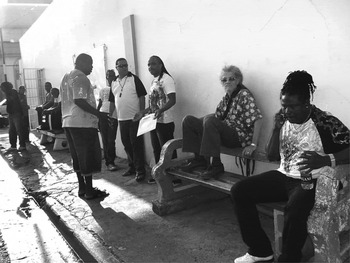
In this photograph, we are outside of our band room … and we were just chilling outside of the band room … As you see, we are a group that hangs together when we are finished rehearsing… For an orchestra to be excellent, the bandleader has to know who to hire that will sound good with the band and how to keep everybody happy. You need to work with everybody to create that total unity. (Roy Cape; Guilbault and Cape Reference Guilbault and Cape2014, pp. 172, 231)
As is the case in most human activities, there are concurrently many ideals and treasured values that lead workers to act in certain ways. For Roy, playing music cannot be divorced from pride of craft. It cannot be divorced from work consciousness. Nor can it be divorced from the sociality that for Roy music is all about. Playing music in a band means playing with people. It also means playing for people. It involves relationships at close, medium and distant range. Roy views affective relationships as central to his life not only as a bandleader, but also as a human being.
Roy and his band members after a rehearsal, 2010. Photograph by Jocelyne Guilbault.

In everyday life, Roy has translated this kind of social pursuit in concrete ways in the band room. I refer to his approach to rehearsals in one section of the book as ‘rehearsing democratically’. Everybody has the chance to participate in the arrangement during the rehearsal of a song. As Roy explains,
when we do soca, there's no written music … So what Juice [Roy's arranger] does is this: he takes the rhythm section [which, in addition to him on keyboard, includes the guitarist, bassist and drummer], tells them the chords and he works them over. And when they [the musicians of the rhythm section] have gotten their parts, we [the horn musicians] come in … He would find the musicians suggesting the licks that they are going to play, and then when we think we have it good, we are now going to write the parts into a score. (Guilbault and Cape Reference Guilbault and Cape2014, pp. 110–11)
So when I remarked, ‘So you go line by line, like that?’ Roy's answer was, ‘Yeah. It's a little time consuming, but what it does is that it gives everybody an opportunity to contribute to the arrangement’ (Guilbault and Cape Reference Guilbault and Cape2014: 111). In other words, it makes everybody feel that their opinion is respected and it creates strong social bonds in the band, and for Roy, these strong social bonds among musicians not only lead to sounding good, but also to feeling good to play together.
It may be because Roy Cape was given a chance to play and earn a living when he needed most that he is particularly sensitive to use his own – by now, very extensive – network to help other musicians in need. To be in need, here, is not measured only financially. So at times, to help means finding a good arranger for a friend who is a steelband leader who is at loss to find one at a difficult moment near the carnival season. At other times, to help means recommending a musician to another bandleader for a gig or a tour. At still other times, to help means buying an airline ticket for a friend in New York who desperately needs money, and inviting him to play in one's band for the carnival season during which the band may be playing for as many as 48 shows in the span of three weeks.
In such a musical practice, work ethic does not just concern the pursuit of one's own fame. It is aligned with a social pursuit and the immaterial labour of managing and nurturing multiple affective relations.
6. Economic focus
Musicians don't like talk and promises. Give them action. If you want to give them something, give them something. But to promise them? We have been promised our whole life, and nothing much has ever materialized. (Roy Cape; Guilbault and Cape Reference Guilbault and Cape2014, p. 170)
For a bandleader who earns his living through music, as has been shown, work ethic is by definition deeply entwined with an economic pursuit. However, in Roy's case, this economic pursuit has always been deeply linked with his interest of raising the bar from what there is to what there ought to be for musicians on the island.
From early on in his career as a bandleader in the early 1980s, Roy Cape used his position to lobby the management of the calypso tent for whom he was working for a salary increase for each musician in his band until they reached a decent income. He also insisted that his band be given a salary over 12 months of the year to ensure that they could live with some financial stability. In the same vein, together with other people Roy tried to create a musicians’ union to protect musicians’ labour, both legally and financially. However, like other musicians who tried to do the same thing before him, his efforts did not materialise.
To ask for testimonies about Roy's band leadership for one of the book chapters was tricky. Musicians are well known everywhere for complaining about the conditions of their employment – including not being paid on time (or not enough or not at all), having erratic schedules, working for bandleaders who are self-centred, uncaring about others or stingy with due credit, or who abandon others to pursue their own careers. In a discourse replete with sniping, mean-spirited comments, ‘bitchiness’ and bitterness about the boss, I wondered, what kind of work ethic in relation to the thorny issue of economics has helped Roy keep his musicians for as long as 15 years on average?
What I learned not too surprisingly was that the key for Roy Cape has been to keep open books, to act with accountability and transparency. In addition, as trombonist Lambert Philips explained, there are several other factors that have helped Roy be able to keep his musicians: all of the band members receive a competitive wage and because of Roy Cape All Stars's reputation in both calypso and soca, they are guaranteed a number of jobs yearly.
The importance of economics in keeping a band together cannot be overestimated. However, what was most striking in the discussion I had with Roy's members was that this question about Roy's work ethics vis-à-vis economics invariably quickly morphed into the ethics of care that Roy has shown to them. In the words of Roy's trombone player, Jakey: ‘Pappy looks out for his men. He makes sure we are comfortable. If Pappy buys champagne for himself, his men have to drink the same thing. … He is not buying that, and the cheaper thing for the guys’ (Guilbault and Cape Reference Guilbault and Cape2014, p. 194).
As this series of explanations about why the musicians have stayed for so long in Roy's band unequivocally suggests, work ethic in relation to economic pursuits can hardly be addressed only in terms of money. It must be addressed together with the social values and sociality that music labour at all times involves.
Concluding remarks
So is Roy totally virtuous and only working for the internal goods of the musical practice, that is, only working to improve the musical standards and the betterment of the conditions of other musicians in that practice? Or as Bourdieu would put it, according to Banks (Reference Banks2012, p. 80), is he focusing on internal goods ‘as a means of obscuring the strategic accumulation of the capitals’, economic, symbolic and cultural, that he is earning?
For most musicians in Trinidad as elsewhere in the Caribbean, playing for pay is the only way to play music full-time – it should be stressed, as is the case for Western orchestra musicians. So for a working musician and bandleader like Roy, to develop a ‘business perspective’, to use Robert R. Faulkner's (Reference Faulkner2013) expression, is not conceived as being devoid of artistic ambitions. The pride of craft and work consciousness understood as helping to develop work opportunities and earn financial incomes are conceived as intimately related.
Philosophically, this view can be linked to what is referred to as ‘pragmatism’. Richard Sennett explains pragmatism as being mainly informed by one concept: experience. He defines experience based on German, which divides the concept of experience into two components, first as referring to ‘an event or relationship that makes an emotional inner impress (“how it feels”)’ and second to ‘an event, action, or relationship that turns one outward and requires skill rather than sensitivity’ (Sennett Reference Sennett2008, p. 288). Here the practical meets the experiential and savoir-faire – a knowledge of context and creative agency of getting things done, making something happen, putting knowledge in action. This idea of pragmatism based on experience depicts well the two main forces that have animated Roy's work: a deep care for what for him ‘feels good’ musically and socially, combined with a serious preoccupation with competing successfully in the calypso and soca musical arenas in terms of number of contracts and economic rewards and thus capacity to work as a musician and to keep the band together.
Roy's work ethics highlight another aspect of the notion of pragmatism as defined by Sennett (Reference Sennett2008, p. 295), by ‘emphas[ing] the value of asking ethical questions during the work process’. He adds, ‘because the person is judging while doing, the result can be more ethically satisfying’. This is what I referred to as ‘work consciousness’ earlier on. As a band musician and bandleader, Roy has learned about and come to place a premium value on cooperative activity as a way of building community among musicians. Over the years, as his musicians indicated, Roy has given the band more space for cooperation and informal socialising, which everyone agrees, has enhanced the quality of the social life as well as the quality of musical cohesion of the band. While ‘work and play appear as opposites’, Sennett (Reference Sennett2008, p. 269) notes, they are in fact producing a healthy dynamic and greater potential for creativity.
As a bandleader, Roy's ethics have clearly aimed to balance the internal goods with the external goods of his musical practice. Yet Roy's efforts to keep this balance have at times been undermined by what could be seen as contradictory impulses and ideas. At times, his focus on his band as community and as embodying sociality, which he so greatly values, has trumped consideration for efficiency and economic concerns by taking far more time for rehearsals and arrangements than is the case in other bands. Recall, for example, the ways musical arrangements are conceived in his band, how they are worked on by everyone in the band, and thus in a sense are far more costly because of taking a substantial amount of time. On other occasions, his own prejudices have led him to take a little longer than other bands to ‘move with the times’, to use his own expression. Roy was indeed initially reluctant to include women in his band for fear that it would bring too many complications on tours, including additional expense for their private rooms and possible distractions in the group.
Roy's work ethics are marked by a pragmatism that is cautious, yet generally open. What this ethnographically grounded study on musical work ethics reveals, then, is the importance of examining how a bandleader reflects on the collective work process, on the quality of experience as well as the material needs of the band.
Acknowledgements
I would like to thank the editor and the two anonymous reviewers for their helpful suggestions. I am also grateful to audiences at the Universidade Nova de Lisboa, Portugal, at University of Hong Kong, and in the USA, at UCLA, Columbia, Harvard, and Stanford universities for their thoughtful comments in response to earlier versions.