1. Introduction
Numerous studies have investigated the relation between gender and child growth indicators as determined by their respective share in households' available resources. However, in addition to adequate nutrition, safe drinking water acts as an indispensable input to child health. More than 2,000 children under the age of five die every day from gastrointestinal diseases, 90 per cent of which is attributed to unsafe water consumption (UNICEF, 2013). All things held constant, the effect of drinking contaminated water on child health outcomes should not differ by gender. However, in the presence of gender bias, girls might be more likely than boys to be adversely affected by environmental pollutants in drinking water. Lack of adequate nutrition and health care during their early childhood can make girls more vulnerable to external environmental hazards due to their lower immunity and underdeveloped bodies. To the best of our knowledge, no study has addressed the role that gender plays in the relation between child stunting and access to safe drinking water.
The first aim of this study is to investigate the impact of exposure to arsenic contaminated groundwater on child growth outcomes in India. Overconsumption of arsenic can lead to fatal health outcomes such as bone diseases, kidney and heart failure, cancer, skin-related diseases, and adverse pregnancy outcomes.Footnote 1 Children are more susceptible to arsenic because of their lower immunity levels and relatively higher proportion of body water compared to adults.Footnote 2 Second, we argue that, in the presence of gender bias, girls born in higher birth orders may be more likely than boys to be adversely impacted by drinking arsenic contaminated water. This is because nutritional deficiencies and shorter duration of breastfeeding might exacerbate the adverse impact of environmental pollutants on health outcomes. While arsenic is known to readily cross the placenta, exclusive breastfeeding protects infants against arsenic (Fängström et al., Reference Fängström, Moore, Nermell, Kuenstl, Goessler, Grandér, Kabir, Palm, Arifeen and Vahter2008; Samiee et al., Reference Samiee, Leili, Faradmal, Torkshavand and Asadi2019).Footnote 3 Thus, if girls, particularly those born in higher birth orders, are less likely to be breastfed or given adequate nutrition in childhood, the adverse health effects of arsenic exposure can be more severe among girls. Consistently, Gardner et al. (Reference Gardner, Kippler, Tofail, Bottai, Hamadani, Grandér, Nermell, Palm, Rasmussen and Vahter2013) find an inverse association between arsenic exposure and growth outcomes of children in Bangladesh with significantly larger effects among girls.Footnote 4 They find that nutritional deficiencies act as a primary factor for adverse effects among girls from low socioeconomic status (SES) households.
Using geographical variation in arsenic concentration in water, we estimate the association between arsenic levels and child health outcomes (height-for-age (HAZ) and weight-for-age (WAZ) z-scores) in India using data from the 2015–16 round of the National Family Health Survey (NFHS-4). But relying on regional variation in groundwater arsenic levels is problematic due to the correlation between concentration levels of arsenic in groundwater and economic activity of a region.Footnote 5 To overcome this identification challenge, we use an instrumental variable (IV) framework. We use the variation in fraction of clayey soil textures across districts to instrument for arsenic levels in groundwater. Finer soils such as clay have relatively higher particle density and are less porous than coarse sandy soil which increases the concentration of contaminated water (Madajewicz et al., Reference Madajewicz, Pfaff, van Geen, Graziano, Hussein, Momotaj, Sylvi and Ahsan2007; Huang et al., Reference Huang, Yuan, Li, Zheng, Nie and Liao2020).
While ordinary least squares (OLS) estimates are imprecise, IV estimates indicate that exposure to arsenic in groundwater has a negative and significant impact on HAZ and WAZ among children less than five years of age, regardless of gender. This is an important finding as child stunting and wasting, which is associated with chronic malnutrition, has long lasting effects on health and overall development of a child. Stunted children fall sick more often, are more likely to have learning difficulties, underperform in school and have reduced future earnings (Glewwe and Miguel, Reference Glewwe and Miguel2007; Case and Paxson, Reference Case and Paxson2008).
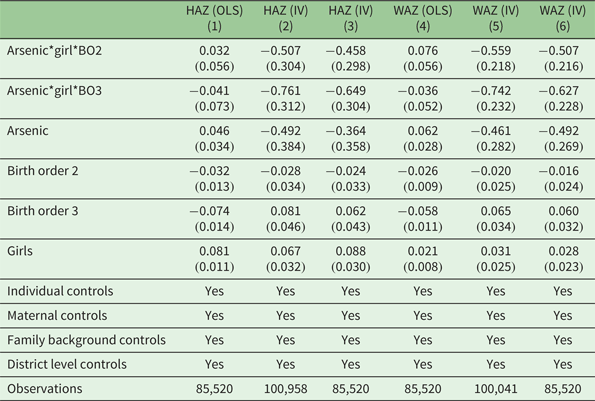
To test if the effects are larger among girls due to a nutritional disadvantage, following Jayachandra and Kuziemko (Reference Jayachandran and Kuziemko2011), we study the effect of birth order on the association between arsenic and health outcomes. We find that a one unit increase in arsenic levels in groundwater leads to a modest reduction in HAZ and WAZ by 0.65 and 0.63 standard deviations for a later born girl child, respectively, relative to a male child born at first birth order.Footnote 6
Existing studies find that children born at higher birth orders have a higher probability of being from a large size family (Behrman and Taubman, Reference Behrman and Taubman1986; Spears et al., Reference Spears, Coffey and Behrman2022). We explore this further by including in a regression both the sibling size effect and birth order effects. The results are robust, even after accounting for the endogeneity of sibling size. While we acknowledge that it is not possible to check the exclusion restriction directly, we conduct several falsification and robustness checks to confirm that we are measuring the causal effect of drinking contaminated water on child health. The findings are also robust to the inclusion of district level controls for health infrastructure, weather, a host of other water contaminants, sex ratio, literacy, and income.
Our study contributes to the under-studied link between gender, environmental pollutants, and child growth measures. To the best of our knowledge, this is the first paper to explore the role of gender in the relation between environmental pollutants and child health outcomes. We also make significant contributions to the literature on social gradients in health and environmental inequality. Our findings are policy relevant as they suggest that economically disadvantaged groups are at greater risk of environmental hazards owing to their weaker immunity, lower nutrition and poor resource access.
The remainder of the paper is structured as follows. Section 2 reviews the existing literature. In section 3 we provide a detailed description of the dataset followed by the empirical framework presented in section 4. In section 5 we report the primary findings of our study, followed by robustness checks and falsification tests in section 6. Lastly, in section 7 we provide concluding remarks and policy implications of our analysis.
2. Relevant literature
Our paper is related to the literature that studies the effect of gender discrimination, measured by unequal parental investment in childhood feeding, health care, and nutrition, on child health by birth order (Lundberg, Reference Lundberg2005; Chung and Das Gupta, Reference Chung and Das Gupta2007; Fledderjohann and Channon, Reference Fledderjohann and Channon2022). Studies find that the height disadvantage among girls increases with steeper birth order gradient, which can be explained by biased preferences of parents towards their eldest sons (Garg and Morduch, Reference Garg and Morduch1998; Jayachandra and Kuziemko, Reference Jayachandran and Kuziemko2011; Jayachandran and Pande, Reference Jayachandran and Pande2017).Footnote 7 Others attribute the differential pattern of investment in child rearing and health inputs due to differences in resources available with parents and their preferences (Becker and Tomes, Reference Becker and Tomes1976; Behrman et al., Reference Behrman, Pollak and Taubman1986; Vogl, Reference Vogl2016). Some studies show that women's nutritional status may be worse off due to lack of access to formal healthcare and differential childcare practices (DeRose et al., Reference DeRose, Das and Millman2000).Footnote 8
We also contribute to the literature on the effect of environmental pollutants on health outcomes of children. Epidemiological studies have established that early-life environmental exposure plays a role in growth outcomes (Gómez-Roig et al., Reference Gómez-Roig, Pascal, Cahuana, García-Algar, Sebastiani, Andreu-Fernández, Martínez, Rodríguez, Iglesia, Ortiz-Arrabal, Mesa, Cabero, Guerra, Llurba, Domínguez, Zanini, Foraster, Larqué, Cabañas, Lopez-Azorín, Pérez, Loureiro, Pallás-Alonso, Escuder-Vieco and Vento2021). In economics, most studies have focused on the negative health outcomes of air pollution (Foster et al., Reference Foster, Gutierrez and Kumar2009; Arceo et al., Reference Arceo, Hanna and Oliva2016; Goyal and Canning, Reference Goyal and Canning2018). Evidence also supports that the effect of air pollution on respiratory health among children differs by gender. However, it is unclear whether the differential effects are due to gender bias in nutritional intakes and health investment, sex specific physiological differences or an interplay of both (Clougherty, Reference Clougherty2010).
A handful of papers have looked at the effect of drinking contaminated water on child health in developing countries. Kile et al. (Reference Kile, Cardenas, Rodrigues, Mazumdar, Dobson, Golam, Quamruzzaman, Rahman and Christiani2016) show that mothers who drank arsenic contaminated water during pregnancy were more likely to give birth to low-weight infants. Brainerd and Menon (Reference Brainerd and Menon2014) find that exposure to fertilizers via contaminated groundwater during pregnancy has a negative impact on child health outcomes.Footnote 9
Finally, our study adds to the well-established literature on social gradients in health. Socially and economically disadvantaged groups may experience increased susceptibility to all forms of environmental hazards owing to weaker immunity, lower nutrition, and poor accessibility of resources (Lynch et al., Reference Lynch, Smith, Harper and Bainbridge2006). More vulnerable communities are disproportionately more likely to suffer from environmental hazards (Fecht et al., Reference Fecht, Fischer, Fortunato, Hoek, De Hoogh, Marra, Kruize, Vienneau, Beelen and Hansell2015; Deguen et al., Reference Deguen, Amuzu, Simoncic and Kihal-Talantikite2022).Footnote 10
3. Data and data source
The data for our analysis comes from the Demographic and Health Survey (National Family Health Survey, NFHS-4, 2015–16), administered by the Ministry of Health and Family Welfare. NFHS is a nationally representative dataset that comprises 111,667 children between the age group of 0 to 5. The survey provides information on key demographics, health, nutrition, and related emerging issues in India. It is the only dataset that provides information on anthropometry measures in the age group of 0–5 years using z-scores calculated in accordance with World Health Organization (WHO) guidelines. To assess the impact of water pollution on child health, we use two measures of child health. First, we study HAZ for children in the age group of 0 to 5 years. HAZ is a commonly used yardstick to measure stunting or nutritional status of children (Deaton and Drèze, Reference Deaton and Drèze2009). It is a cumulative measure of nutritional dearth from birth or conception onwards and is the best aggregate measure of malnutrition among children that is correlated with later life outcomes. Stunting is linked to underdeveloped brains, lower retention and reduced learning ability that adversely affects productivity and earning capacity of an individual.
Apart from stunting, we also study the underweight measured by WAZ z-scores. Underweight is a symptom of acute malnutrition and is a dire consequence of inadequate intake of food or high incidence of infectious diseases. Stunting and underweight are aspects of malnutrition that are closely linked to each other. The presence of both stunting and underweight in a child intensifies the risk of mortality (Thurstans et al., Reference Thurstans, Sessions, Dolan, Sadler, Cichon, Isanaka, Roberfroid, Stobaugh, Webb and Khara2022).
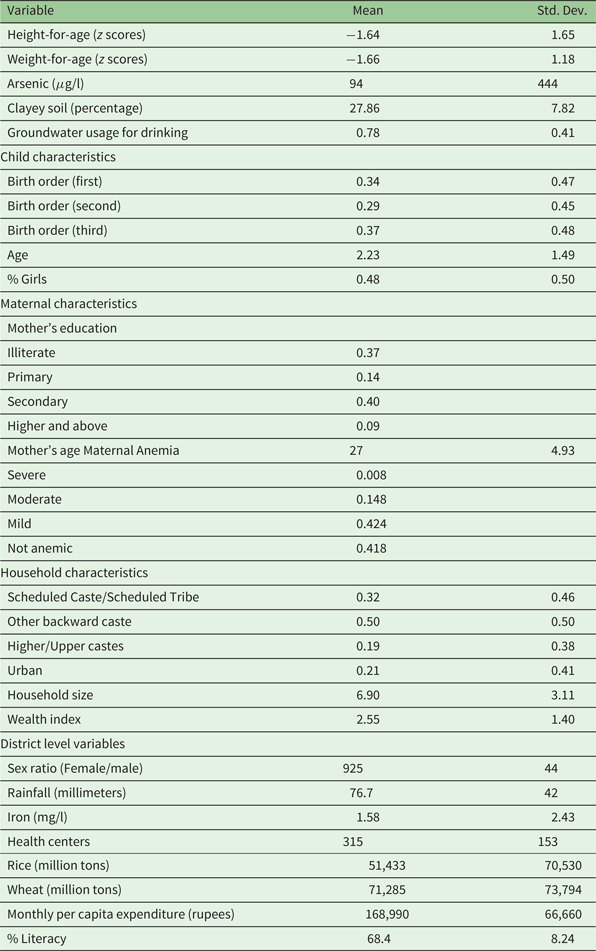
Figures A1 and A2 in the online appendix plot the HAZ and WAZ scores, respectively, by birth order among boys and girls. The percentage of girls who are moderately or severely stunted increases with birth order.Footnote 11 For instance, at first birth order approximately 10 per cent of girls suffer from severe stunting which increases to 12 per cent and 15 per cent for 2nd and 3rd+ birth order, respectively. A similar pattern is visible for boys. The summary statistics of the variables that are included in our analysis are shown in table 1.Footnote 12
Descriptive statistics and district level control variables

Note: Sample size is N = 85,520.
Data for rainfall is provided by the Indian Meteorological Department (IMD) at the district level in India, with a mean value of 76.7 mms. District level sex ratio and literacy data is from the 2011 Census of India. The average sex ratio and literacy rate in our estimation sample is 925 and 68 per cent, respectively. To control for district prosperity, we use data on monthly per capita expenditure (MPCE) from the 68th round of the National Sample Survey Office. Production of rice and wheat (in million tons) for 2011 is obtained from the Ministry of Agriculture and Farmers Welfare. Data for the level of arsenic and iron in groundwater is provided by the Central Ground Water Board. Following the WHO guidelines, the Bureau of Indian Standards has set a standard of 50 μgL−1 (microgram per liter) for arsenic in drinking water. The level of arsenic in groundwater, a continuous variable, is aggregated at the district level from block level data.Footnote 13
We restrict the analysis to only those states where the presence of arsenic is measured beyond the threshold limit in at least one district in that state. The final dataset comprises more than 85,000 children under the age of five, across 261 districts from 9 arsenic affected states, where 105 districts are arsenic affected and 156 are non-arsenic affected districts.Footnote 14 The average level of arsenic is 94 microgram per liter across districts in India, remarkably higher than the threshold limit. The data on soil texture is obtained from Harmonized World Soil Database (HWSD) established in 2008 by the Food and Agricultural Organization and International Institute for Applied System Analysis. HWSD is a global soil database framed within a geographic information system (GIS) and contains updated information on world soil resources. It provides data on various attributes of soil including texture and composition. As reported in table 1, the average clayey soil across arsenic affected states is approximately 28 per cent.
4. Empirical model
We start by investigating whether exposure to arsenic has an impact on growth of children under the age of 5. The following OLS regression is estimated:

We are interested in measuring the effect of arsenic on two outcome variables: HAZ and WAZ of child i in district d of state s as given in equation (1). The main explanatory variable is Arsds which indicates the concentration level of arsenic in groundwater in district d and state s. α 2 captures the interaction effects of arsenic with gender (girl = 1). Xids represents a vector of controls for individual level characteristics (gender, age and age square), mother characteristics (age, education, maternal anemia, standardized height for age and weight for height), family background and socio-economic characteristics (religion, caste, family size, wealth indexFootnote 15 and place of residence). Children born at higher birth orders have a higher probability of being from a large family. Moreover, family size and resources allocated to each child are highly correlated, which might in turn affect the health outcomes of children (Booth and Kee, Reference Booth and Kee2009; Kugler and Kumar, Reference Kugler and Kumar2017). Thus, we control family size in all regressions. We also control for district level controls (Dds) for rainfall, presence of other contaminants (iron), per capita consumption expenditure, sex ratio, number of public health facilities, rice and wheat production and literacy. Finally, we include state fixed effects in our regression analysis. Heteroskedasticity robust standard errors are clustered at the primary sampling unit (PSU) level.Footnote 16
Estimating the effects of arsenic on nutritional outcomes in equation (1), using regional variation in arsenic levels, is problematic since the intensity of economic activities in a region may be correlated with arsenic concentration levels. Hence, to overcome the potential endogeneity of arsenic levels, we use an IV approach.
4.1 Instrumental variable approach
A variety of natural geochemical processes play a vital role in the release, transport, and distribution of arsenic in groundwater. One of the important determinants of arsenic released in groundwater is the age of groundwater, which, in turn, is related to soil permeability. Finer soils have relatively more particle density and lower porosity levels, and, as a result, their permeability level is relatively lower than loamy soil which facilitates arsenic concentration in groundwater (McArthur et al., Reference McArthur, Ravenscroft, Safiulla and Thirlwall2001; Madajewicz et al., Reference Madajewicz, Pfaff, van Geen, Graziano, Hussein, Momotaj, Sylvi and Ahsan2007).Footnote 17 Herath et al. (Reference Herath, Vithanage, Bundschuh, Maity and Bhattacharya2016) find that in the Ganges–Meghna–Brahmaputra basin of India and Bangladesh, aquifers covered by finer sediments (clay) contain greater concentrations of arsenic in groundwater, whereas arsenic concentrations are significantly lower in aquifers with permeable sandy materials at the surface. Since arsenic concentration is higher in clayey relative to coarse soil, we exploit the variation in percentage of clayey soil across districts within a state to instrument for groundwater arsenic contamination. The first stage equation is given by:

In this just-identified specification, the two endogenous variables Arsds and Arsds * Girl are instrumented by Soilds and Soilds * Girl ids, respectively, where Soilds is the percentage of clayey soil in district d and state s. The remaining specification is the same as in equation (1). The main identifying assumption is that soil texture fractions affect health outcomes only through the impact on the level of arsenic in groundwater.Footnote 18 To check if health effects of arsenic exposure vary by gender and birth order, we also estimate the following OLS (equation (3)) and first stage equations (equation (4)):

where 2ndchild is an indicator for a child i whose birth order is 2. Similarly, 3rd +child indicates whether the child born is at 3rd or higher birth order. Children born at the first birth order are taken as the base category in our analysis:

here, the main coefficient of interest to be estimated is a5 and a6 which are associated with the three-way interaction (Arsds * girlids * 2ndchildids) and (Arsds * girlids * 3rd + childids) respectively. Xids account for individual, maternal and family background characteristics as explained earlier. All regressions include district level controls (Dds) as before and state fixed effect (S). Heteroskedasticity robust standard errors are clustered at the PSU level.
4.2 Instrument validity
The validity of the instrument hinges on clayey soil not varying with other weather, geographic or demographic factors which may in turn affect economic outcomes. While there is geographical variation in weather and soil chemical composition, they do not vary by proportion of clayey soil across districts within the same state.
In table A1 in the online appendix, we show the correlation between proportion of clayey soil and several district level indicators of weather (rainfall and temperature), contaminants found in fertilizers and groundwater (arsenic, iron, nitrate, nitrogen, phosphorous, potassium, lead and fluoride), economic and demographic factors (MPCE, rice and wheat production, literacy, sex ratio, male and female employment in agriculture). The table reports the coefficient on clayey soil, from the regression of reported district level variables on the percentage of clayey soils in a district conditional on state fixed effects. Within a state, variation in percentage of clayey soil is uncorrelated with all other contaminants except arsenic and iron. Further, most coefficients have zero magnitude. We also find no evidence that variation in clayey soil across districts within a state is correlated with weather patterns, district income, soil productivity or its suitability for a certain crop.Footnote 19
There is a significant positive correlation between soil permeability and iron levels. However, this would be against finding a negative impact of arsenic on health outcomes and, if anything, underestimating our findings as groundwater with a high iron concentration is associated with a decreased risk of childhood anemia. There is also a positive correlation between rainfall and clayey soil. There is no direct effect of rainfall on soil permeability levels as both are exogenous in nature, but both can combinedly determine the level of groundwater and presence of contaminated metals in groundwater.Footnote 20 Further, we control for iron levels and rainfall in all regressions noting that the results do not change when we exclude these two variables.Footnote 21
5. Results
5.1 Arsenic, child health and gender
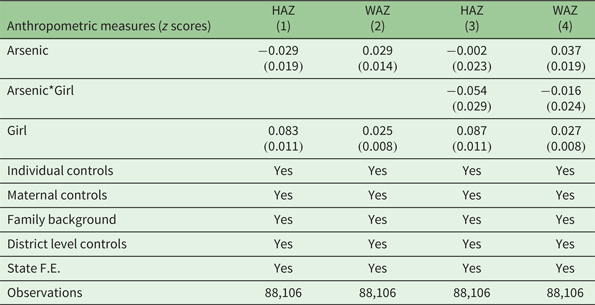
We first show results for OLS estimates using equation (1). Columns 1 and 2 (table 2) show OLS estimates of the effect of arsenic on HAZ and WAZ, respectively. For HAZ scores, OLS estimates are insignificant. OLS estimates for WAZ show that one unit increase in arsenic is associated with a 0.03 standard deviation (SD) increase in WAZ. In the remaining columns we add the interaction effect of gender (girl = 1) and arsenic. Coefficients of the interaction term, though negative, are statistically significant for HAZ scores but not WAZ scores.
Arsenic and child anthropometric measures: by gender (OLS estimates)

Notes: Standard errors clustered at the PSU level in parentheses. Arsenic is measured in milligrams per liter. All regressions include state fixed effects and district level controls for sex ratio, health facilities, rainfall, literacy, iron, rice and wheat production and MPCE, individual level controls (age, age square and gender), maternal controls (mother's age, mother's education, maternal anemia (severe, moderate, mild, non-anemic), mother's standardized height for age (HAZ) and weight for height (WHZ)) and family background controls (religion, caste, family size, wealth index and place of residence).
To overcome the issue of endogeneity, we use an IV approach, where variation in soil texture across districts within a state is used as an instrument for arsenic levels in groundwater. The first stage regression results show a positive and statistically significant relationship between arsenic and soil texture (clayey soil).Footnote 22
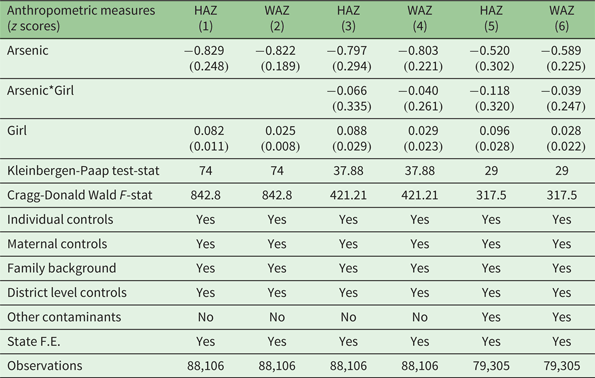
The IV results for HAZ, shown in table 3, indicate that the OLS is severely downward biased. A one unit increase in arsenic leads to a decrease in HAZ and WAZ, both decreasing by 0.83 SD units. We further analyze whether the effect of arsenic on child growth outcomes varies by gender. As is evident from the remaining columns of table 3, there is no difference by gender in the effect of arsenic contamination on HAZ scores though all the interaction terms are negative. While the IV results show that arsenic has an adverse effect on stunting and underweight as measured by lower HAZ and WAZ scores, the interaction effects indicate that girls are not much worse off than boys. All children, regardless of gender, have worse growth outcomes associated with arsenic found in the groundwater. In the last two columns, we show that these estimates are not sensitive to including any other soil and water contaminant. While the magnitude of the effect of arsenic exposure drops marginally, the results stay negative and significant for both health outcomes.
Arsenic and child anthropometric measures (IV estimates)
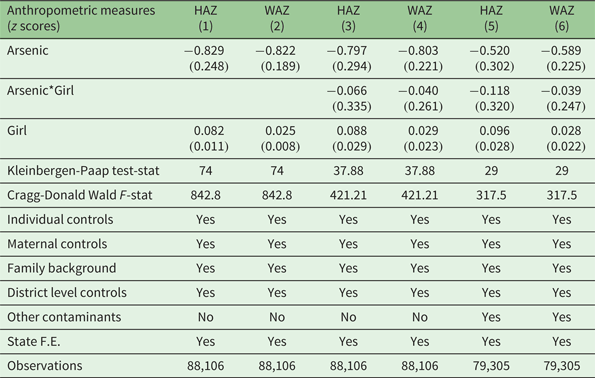
Notes: Standard errors clustered at the PSU level. Arsenic is measured in milligrams per liter. Instrument for arsenic is defined as the percentage of clayey soil present in a district. Regressions include state fixed effects and district level controls for sex ratio, health facilities, rainfall, literacy, iron, rice and wheat production and MPCE. Individual level controls (age, age square and gender), maternal controls (mother's age, mother's education, maternal anemia (severe, moderate, mild, non- anemic), mother's standardized height for age (HAZ) and weight for height (WHZ)) and family background controls (religion, caste, family size, wealth index and place of residence). The last two columns include other soil and water contaminants, namely, nitrate, nitrogen, phosphorous, potassium, lead and fluoride
5.2 Heterogeneous effect of household wealth
As discussed earlier, arsenic may impact child growth via several channels, such as by affecting the distribution and function of micronutrients in the body, via nutritional deficiencies in childhood, duration of breastfeeding and/or in-utero exposure due to arsenic contaminated groundwater consumption during pregnancy. A priori, children belonging to the poorest and low SES households should exhibit larger detrimental effects of arsenic exposure since they are more likely to suffer from nutritional deficiencies.
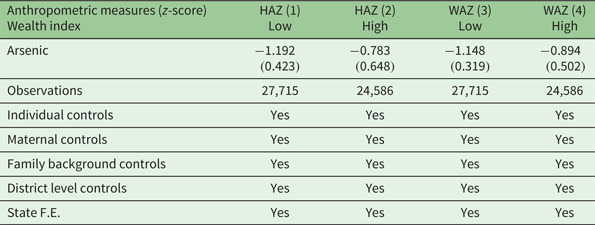
In table 4, we study the relation between arsenic and health outcomes separately for the poorest and relatively richer households.Footnote 23 The results clearly show that among children belonging to lowest income households, a one SD increase in arsenic is associated with a 1.19 SD decrease in HAZ and a 1.15 SD decrease in WAZ scores. The coefficients are lower for the high wealth group and imprecisely estimated (insignificant for HAZ and significant at 10 per cent for WAZ scores). Thus, the negative effect of arsenic exposure on height for age is largest among children from poorest households, consistent with the literature (Lynch et al., Reference Lynch, Smith, Harper and Bainbridge2006).
Heterogeneous effects by household wealth (IV estimates)

Notes: Standard errors clustered at the PSU level. Instrument for arsenic is defined as the percentage of clayey soil present in a district. Regressions include state fixed effects and district level controls for sex ratio, health facilities, rainfall, literacy, iron, rice and wheat production and MPCE. Individual level controls (age, age square), maternal controls (mother's age, mother's education, maternal anemia (severe, moderate, mild, non-anemic), mother's standardized height for age (HAZ) and weight for height (WHZ)) and family background controls (religion, caste, family size and place of residence).
These results capture the effect of arsenic on health among children with poor nutritional intake, however, they do not necessarily imply that the effect is driven by gender specific breastfeeding patterns or nutritional biases. Though we cannot directly test the interlinkages between arsenic exposure and gender bias in nutritional intakes, we can rely on a well-established birth order literature to test this hypothesis.
5.3 Arsenic and child health across gender and birth order
We study the interaction between arsenic exposure, gender, and birth order in table 5. We show OLS results for HAZ and WAZ, respectively, in columns 1 and 4 and the remaining columns show the preferred IV specification using soil quality as an exogenous instrument for arsenic levels. OLS results show no differences in the health effects of arsenic exposure by birth order and gender. On the other hand, IV results in table 5 for the triple interaction terms (arsenic*girl*birth order) suggest that girls in arsenic affected regions have a higher height disadvantage than boys, and the effects are magnified for later born girls relative to the eldest. In column 3 with all control variables included, a one unit change in arsenic leads to a decrease in HAZ (stunting) for third (or later) born girls by 0.65 SDs. The significance of our estimate for third (or later) born girls indicates that arsenic induced stunting in girls increases with steeper birth gradient. We find similar IV results for WAZ as shown in column 6. IV estimates on WAZ indicate that a one unit increase in arsenic leads to a decrease in WAZ (underweight) for second and third (or later) born girls by 0.51 and 0.63 SDs, respectively. When the concentration of arsenic in groundwater increases, later born girls (born at higher birth order) experience more height and weight disadvantage relative to their older sibling (lower birth order), particularly if the elder sibling is male. Some studies attribute the birth order effect to the sibling rivalry effect, i.e., having an older brother limits the availability of essential nutrients along with other health inputs to later born daughters in the family (Fledderjohann et al., Reference Fledderjohann, Agrawal, Vellakkal, Basu, Campbell, Doyle, Ebrahim and Stuckler2014; Chaudhry et al., Reference Chaudhry, Khan and Mir2021).Footnote 24
Arsenic, gender and birth order gradient in height-for-age and weight-for-age (IV estimates)

Notes: Standard errors clustered at the PSU level. Instrument for arsenic is defined as the percentage of clayey soil present in a district. Regressions include state fixed effects and district level controls for sex ratio, health facilities, rainfall, literacy, iron, rice and wheat production and MPCE. Individual level controls (age, age square), maternal controls (mother's age, mother's education, maternal anemia (severe, moderate, mild, non-anemic), mother's standardized height for age (HAZ) and weight for height (WHZ)) and family background controls (religion, caste, family size and place of residence).
6. Robustness and falsification tests
6.1 Arsenic, birth order and sibling size
In a recent paper, Coffey and Spears (Reference Coffey and Spears2021) show that later born children born in India have an advantage in terms of neonatal mortality. They find that a large disadvantage to high sibling size co-exists with a large advantage to later birth order emphasizing the endogeneity of sibling size for estimating birth order effects.
To account for this potential bias in our estimates, we control for the number of siblings under the age of five in the household. Further, to overcome the issue of endogeneity of sibling size, we use the gender of the first child as an instrument for sibling size. Evidence suggests that having a girl as the first child is positively associated with fertility, particularly in the presence of son preference, as parents will continue to have more children until the desired number of boys are born in a family (Aksan, Reference Aksan2021; Pörtner, Reference Pörtner2022). Further, gender of the first child is exogenously determined and should affect child health outcomes only through fertility (Kugler and Kumar, Reference Kugler and Kumar2017).
In this specification, we estimate the regressions separately by gender.Footnote 25 We estimate the following OLS and first stage regressions for boys and girls, separately:


where sib_sizeids is the number of children under the age of five in a household. This variable is instrumented by gender_first, a binary variable for the gender of the first-born child in a household which takes the value of 1 for girls and 0 for boys. All other variables are the same as in the previous regressions.Footnote 26
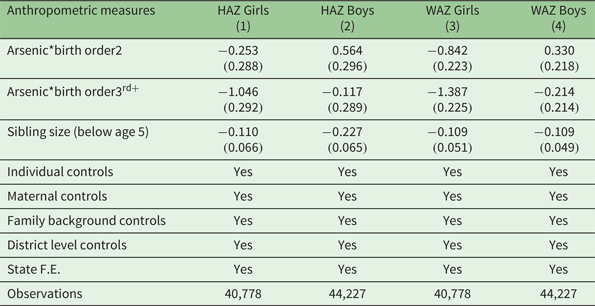
IV results from this specification are shown in table 6. Columns 1 and 3 show IV estimates for health outcomes (HAZ and WAZ, respectively) for girls. HAZ and WAZ for boys are reported in columns 2 and 4, respectively. After controlling for sibling size, a one SD increase in arsenic exposure leads to a significant decrease in HAZ and WAZ for girls born at third (or higher) birth order by 1.05 SD and 1.39 SD, respectively. For boys, we find insignificant effects on HAZ and WAZ for third birth order. Interestingly, column 2 shows a positive effect for HAZ scores among boys born in the second birth order. Looking at the coefficient on sibling size, a greater number of children in the household has a negative and significant effect on growth outcomes after accounting for birth order effects.
Arsenic, sibling size and birth order (IV estimates)

Notes: Standard errors clustered at the PSU level. Instrument for arsenic is defined as the percentage of clayey soil present in a district. Regressions include state fixed effects and district level controls for sex ratio, health facilities, rainfall, literacy, iron, rice and wheat production and MPCE. Individual level controls (age, age square), maternal controls (mother's age, mother's education, maternal anemia (severe, moderate, mild, non-anemic), mother's standardized height for age (HAZ) and weight for height (WHZ)) and family background controls (religion, caste, family size, wealth index and place of residence). Also includes controls for arsenic and birth order.
6.2 Non-arsenic states
We have shown that exposure to arsenic contaminated water impacts child growth and that this process disproportionately affects girls born at a later birth order. Our main regression exploits variation in arsenic levels across Indian states, thus the sample includes the nine states where arsenic is present in groundwater. However, comparing results in arsenic-affected states to those not in arsenic-affected states should also provide a very useful test of our main hypotheses. Since there is no variation in arsenic levels across non-arsenic states, we cannot use the same identification strategy employed above. Instead, we exploit the variation in source of drinking water and gender and compare results by birth order for arsenic and non-arsenic states. Thus, we run the following regression to estimate the impact of consuming groundwater on health outcomes:

where swater is the source of drinking waterFootnote 27 where we categorize it as a binary variable which takes the value of 1 if the primary source of drinking water is unsafe and 0 for safer sources of drinking water.Footnote 28 The main variable of interest is a3 which captures the health effects of drinking groundwater among females. This specification also allows us to control for district fixed effects, so the results are not confounded by geographical variation in agricultural patterns, irrigation, soil type or irrigation. Further, we control a host of household characteristics including income. We estimate the equation separately for each birth order for both categories of states: arsenic contaminated and non-arsenic contaminated states. Note that groundwater contaminants can be via other forms such as agricultural chemicals and septic waste which may also have adverse implications on health outcomes of children. However, this should not lead to adverse birth order effects.
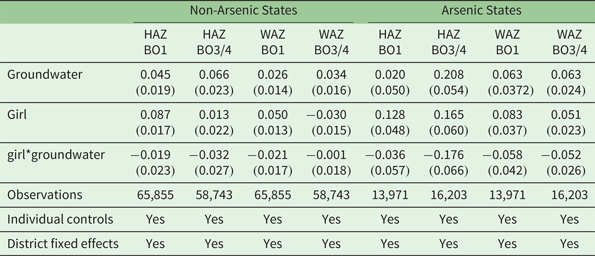
The results in table 7 show that for non-arsenic states there is no effect on health outcomes; all coefficients are statistically insignificant at conventional levels. This is true for both measures of health, HAZ and WAZ, and across birth order 1 and birth order 3 and 4. On the other hand, the right panel shows results for arsenic states. In these states being a later born girl in a household which consumes groundwater is associated with a large negative effect on health outcomes. At the same time, this effect is insignificant for those born in the first birth order. Though the results may not necessarily capture the causal effect of drinking contaminated groundwater (as access to safe water is correlated with household education, income and information), the lack of a significant effect among non-arsenic states gives us further confidence regarding the birth order effects.
Interaction effect of groundwater and gender on health outcomes by birth order (arsenic and non-arsenic states)

Notes: Standard errors clustered at the PSU level in parentheses. All regressions include district fixed effects and individual level controls (age and age square), maternal controls (mother's age, mother's education), maternal anemia (severe, moderate, mild, non-anemic), mother's standardized height for age (HAZ) and weight for height (WHZ) and family background controls (caste, religion, family size, household wealth index and place of residence). Groundwater is a binary variable which takes value 1 if the primary source of drinking water is groundwater (tube-well, well, unprotected springs) and 0 for safer sources of drinking water (piped water, community RO plant, bottled water, rainwater harvesting).
6.3 Soil quality and female labor supply
In a recent study, Carranza (Reference Carranza2014) argues that loamy soils allow for deep tillage and thereby reduce the need for female dominated agricultural tasks. As a result, in areas with a greater fraction of loamy relative to clayey soils, women have a lower economic value. Consistent with this, she finds that the exogenous variation of soil quality (loamy soils) across districts in India can explain variation in the share of female agricultural labor participation and sex ratio.
The falsification check in the previous subsection addresses this concern by showing that clayey soil affects health outcomes only in arsenic prominent districts. Yet, we conduct a further check on the robustness of our results by controlling for male and female labor force participation in agriculture across Indian districts.Footnote 29 Labor force participation in agriculture for female (male) is calculated at the district level and is measured as the total female (male) employment in agriculture divided by the total cultivable land in the district. As shown in table A3 (online appendix), the main results are robust to the inclusion of both the male and female employment in agriculture. Our results are also robust to dropping one state at a time from the analysis, and one region at a time after dividing the nine arsenic states into three regions: North, South and East (there are no western states with arsenic).Footnote 30 Finally, it is worth mentioning that the exogeneity of the instruments is hard to show in practice. At the same time, soil texture is an important determinant of arsenic levels. We also check the robustness of the IV results by estimating the equations simultaneously in an iterated seemingly unrelated regression model. While we do not show the results here, our results are robust to this alternative strategy.
7. Conclusion and policy implications
Gender inequality is a fundamental challenge to sustainable development. While considerable efforts have been made to explore the impacts of gender inequality on women, less is known regarding its impact on child health. India is the only developing country where the under-five child mortality rates are worse among girls than boys (Guilmoto et al., Reference Guilmoto, Saikia, Tamrakar and Bora2018). This might be due to discrimination in resource allocation by parents at early stages of their lives, in the form of shorter duration of breastfeeding, fewer post-natal health inputs such as vaccinations and supplementary food items. This paper adds to the literature on gender discrimination and child health by highlighting the importance of environmental factors in widening the gender gap in health outcomes. Using a large nationally representative sample of children in India (NFHS, 2015–16), we find that exposure to arsenic contaminated water leads to a height and weight disadvantage among girls that increases with birth order. While we acknowledge that finding a good IV is very hard in practice, we address the endogeneity of arsenic levels using an IV strategy which stands robust to several checks for internal validity and to alternate specifications. IV estimates suggest higher valuation of sons' health than daughters' health by their parents, since boys are perceived to yield better economic benefits than girls in later stages of their life. Due to paucity of resources, boys are given preference in terms of better health inputs than girls. We find that the detrimental effects of arsenic on HAZ are largest in poorer households, suggesting that nutritional deficiencies in childhood exacerbate the adverse effects of arsenic exposure.
Our results show heterogeneous effects of arsenic exposure by birth order, highlighting the role played by son biased preferences in magnifying the negative impact of unsafe water on health. Despite safe water being an indispensable input to human health, to the best of our knowledge, there is no existing research that has studied the role of gender in the relation between access to safe water and child health. According to the WHO, lack of accessibility of safe water is the leading cause of morbidity in India.
Consumption of arsenic contaminated water is likely to be a contributor to India's high child mortality rate of 39 deaths per thousand live births (Asadullah and Chaudhury, Reference Asadullah and Chaudhury2011). But any government policy that solely aims to provide safe drinking water will not deliver desired goals unless these policies are accompanied by equitable distribution of food and health care inputs to young children, particularly girls. Water related policies would reduce the burden of diseases to some extent, but lower immunity of girls would remain a challenge.
Supplementary material
The supplementary material for this article can be found at https://doi.org/10.1017/S1355770X24000329.
Acknowledgements
We are grateful to seminar participants at the EFD Annual Meetings, Nairobi, 2024; the NEUDC 2021 and the 3rd annual workshop of women in the economy, ISI Delhi. We thank the editor, coeditor, two anonymous referees and Professor Nidhiya Menon for their feedback and suggestions. All errors are our own.
Statements and declaration
The authors declare that no funds, grants or other support were received for this work and the authors have no financial relationships with any organizations that might have an interest in this work. There are no potential conflicts of interest to declare. This research is original and has not been simultaneously submitted for publication in any other journal. All authors contributed to the study conception and design.
Competing interest
The authors declare none.