Introduction
Over the past two decades, prehospital electrocardiogram teletransmission (E-ECG) has become a cornerstone in early ST-elevation myocardial infarction (STEMI) recognition. Reference Cannon, Gibson and Lambrew1–Reference Kimura, Kimura and Ishihara5 Recent evidence has further reinforced its clinical impact, showing significant reductions in treatment delays and mortality in patients with STEMI. Reference Moxham, d’Entremont, Mir, Schwalm, Natarajan and Jolly6
Most existing systems rely on 12-lead electrocardiogram (ECG) acquisition performed by Emergency Medical Services (EMS) personnel, with teletransmission to hospital-based cardiologists for immediate interpretation and triage decisions. Reference Kohashi, Nakano and Isshiki7–Reference Adams, Campbell and Adams9
However, the majority of published data originate from paramedic-based EMS systems, in which field providers operate with a high-degree of autonomy. In contrast, physician-led EMS systems, such as the Franco-German model implemented in France, rely on a centralized medical dispatch, where emergency physicians are responsible for triage, decision making, and resource allocation.
In this context, early identification of acute coronary syndromes remains challenging, particularly during the initial dispatch phase. Patients may present with atypical or non-specific symptoms—such as malaise, dyspnea, or epigastric pain—which can delay recognition and appropriate mobilization of advanced medical resources. Reference Grosmaitre, Le Vavasseur and Yachouh10–Reference Canto, Rogers and Goldberg12
While E-ECG teletransmission has been shown to improve early cardiology activation, its integration within physician-led dispatch systems—and its impact on real-time medical regulation—remains insufficiently documented.
In the French emergency medical system, firefighter rescuers act as first responders and play a key role in the initial patient assessment. Although they are trained in Basic Life Support and ECG acquisition, they do not independently make medical decisions, which are instead centralized at the dispatch level. The introduction of ECG teletransmission capabilities in this setting represents a potential shift in the diagnostic workflow, allowing dispatch physicians to integrate objective cardiac data earlier in the decision-making process. Reference Alrawashdeh, Ihtoub and Alkhatib13
The Marseille Firefighters Battalion (Bataillon de Marins-Pompiers de Marseille; BMPM; Marseille, France) recently implemented E-ECG teletransmission by rescuers to the medical regulation center. This innovation offers a unique opportunity to evaluate the role of prehospital ECG acquisition in a physician-led EMS system, particularly in terms of its contribution to dispatch-based triage, patient orientation, and resource utilization.
To the authors’ knowledge, no study has specifically evaluated firefighter-performed ECG teletransmission integrated into a physician-led dispatch system.
The objective of this study was therefore to assess the feasibility and clinical utility of ECG teletransmission performed by firefighter rescuers, with a specific focus on its impact on dispatch decision making and prehospital triage in real-world conditions.
Materials and Methods
This retrospective, single-center observational study analyzed all E-ECGs transmitted by firefighter rescuers from the BMPM to the urgent medical regulation center (Service d’Aide Médicale Urgente; SAMU 13) from January 1 through September 15, 2023.
All E-ECGs were performed using Schiller devices (Schiller; Baar, Switzerland) following verbal authorization from a medical dispatcher. At the time of data collection, no standardized protocol defined E-ECG indications, and the decision to perform an E-ECG was left to the discretion of the dispatch physician based on the clinical presentation and operational context.
Cases were identified through a structured, two-phase retrieval process. First, all ECGs recorded and teletransmitted by BMPM rescue vehicles during the study period were extracted from the Schiller telemedicine platform, which automatically archives every transmitted tracing together with its timestamp, device identifier, and vehicle number. Second, each ECG was systematically matched to a corresponding Medical Dispatch Record (Dossier de Régulation Médicale; DRM) within the Centaure 15 (NexPublica; Clichy, France) system using these metadata. Only ECGs linked to an operational DRM from an adult patient were retained. The ECGs recorded during training, cases involving trauma or pregnancy, missing DRMs, and non-interpretable tracings due to artifacts or missing leads were excluded.
For each included patient, all variables were manually collected from the DRM. These variables included the patient’s demographic characteristics (sex, age, name, and date of birth), past medical history, the chief complaint at the time of the emergency call, the type of prehospital resources initially dispatched, and the ECG interpretation documented by the Medical Regulator. Additional operational data were also extracted, including the transport modality (medicalized or non-medicalized) and the final destination. Technical information regarding the ECG itself—such as the presence of artifacts, missing leads, or any transmission problem reported by the Medical Regulator—was also collected.
No additional data sources were used, and only the data explicitly present in the ECG system and the DRM were retained for analysis. Data extraction was performed manually by two trained investigators using a standardized extraction template. Discrepancies were resolved by consensus. No missing values were imputed.
All transmitted ECGs were interpreted in real time by the on-duty Medical Regulator (an emergency physician), whose written interpretation in the DRM served as the final diagnostic reference. This is consistent with recent studies highlighting the importance and limitations of prehospital ECG interpretation for diagnostic accuracy and triage decision making. Reference Alrawashdeh, Ihtoub and Alkhatib13
The E-ECGs were interpreted according to routine clinical practice by emergency physicians acting as Medical Dispatch Regulators; no second adjudication reading was performed. The written documentation in the DRM was considered the reference standard for this retrospective analysis. Cardiologists were not systematically involved in the interpretation process, as the objective of the study was to assess the diagnostic and triage performance of dispatch physicians under real-world operational conditions. The reference standard relied on the interpretation of E-ECGs by a single emergency physician acting as Medical Regulator. No independent adjudication or assessment of inter-observer reliability and diagnostic validity was performed.
Reliability and validity were ensured by applying pre-defined diagnostic categories from the study protocol and by including only ECG abnormalities explicitly documented by the Medical Regulator.
Data were analyzed using p.value-io (Paris, France).
Exclusion criteria were age < 18 years, pregnancy, trauma, automatic intensive-care dispatch, missing DRM linkage, firefighter training ECGs, and non-interpretable tracings (missing leads or excessive artifacts).
The primary outcome was the prevalence of acute ECG abnormalities identified by the dispatcher (signs of ischemia, rhythm, or conduction disorders). An E-ECG was defined as positive (ECG+) if an abnormality was reported in the DRM. Audio recordings of calls were not transcribed and were therefore excluded from the analysis. Secondary outcomes included reasons for E-ECG prescription, medical reinforcement after E-ECG interpretation (SMUR [Structure Mobile d’Urgence et de Réanimation], physician-staffed mobile emergency unit), triage toward cardiology pathways, mode of transport, and technical performance of E-ECG transmission. Management changes were defined as any modification in patient care following E-ECG interpretation, including medical reinforcement and direct triage to cardiology pathways without medical reinforcement.
Ethical Approval
The requirement for informed consent was waived due to the anonymized and retrospective nature of the study. The study has been approved by the ethics committee of the French Society of Anesthesia and Intensive Care (Paris, France) under IRB number 00010254-2026-003. The data have been declared to the CNIL (Commission Nationale de l’Informatique et des Libertés - French Data Protection Authority) under number 2240815.
The manuscript was prepared following the STROBE (Strengthening the Reporting of Observational Studies in Epidemiology) guidelines to ensure transparent and standardized reporting of observational data.
Results
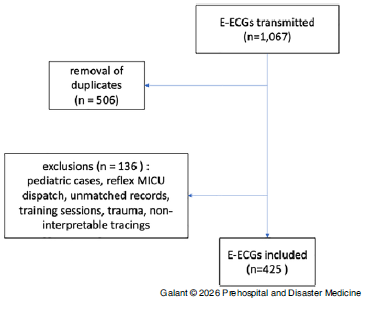
During the study period, 1,067 E-ECGs were transmitted by BMPM rescuers. After removing duplicates and exclusions (pediatric, trauma, training, missing data, and non-interpretable tracings), 425 E-ECGs were analyzed (Figure 1).
Flowchart of Patient Inclusion.
Abbreviation: E-ECG, electronically transmitted prehospital electrocardiogram.

The median age was 56 years (IQR 40–72), and 61% were men. The main cardiovascular risk factors were hypertension (24%), diabetes (17%), and dyslipidemia (11%); 21% had prior cardiac disease, and 16% had a coronary stent.
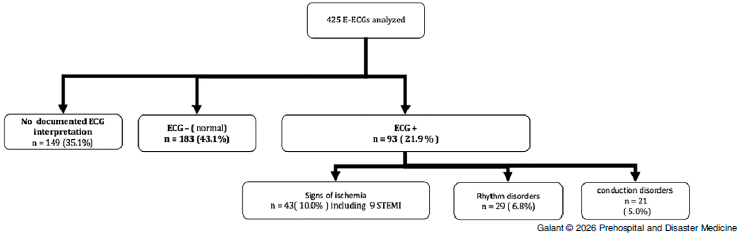
Abnormal E-ECGs represented 21.9% (n = 93) of tracings. Among these, 10.1% (n = 43) presented signs of ischemia, including nine STEMI, 20 non-STEMI, and other ischemic changes (eg, ST depression); 6.8% (n = 29) rhythm disturbances; and 4.9% (n = 21) conduction abnormalities (Figure 2). In nine patients (2.1%), STEMI was diagnosed, eight of whom were men. In five cases, the presentation—malaise or atypical presentation—would not have triggered immediate medical dispatch under national triage guidelines. Eight of the nine were transported under medical supervision to a catheterization laboratory and one without medical escort.
Dispatcher Diagnoses Based on Transmitted E-ECG.
Abbreviations: E-ECG, electronically transmitted prehospital electrocardiogram; STEMI, ST-segment elevation myocardial infarction.

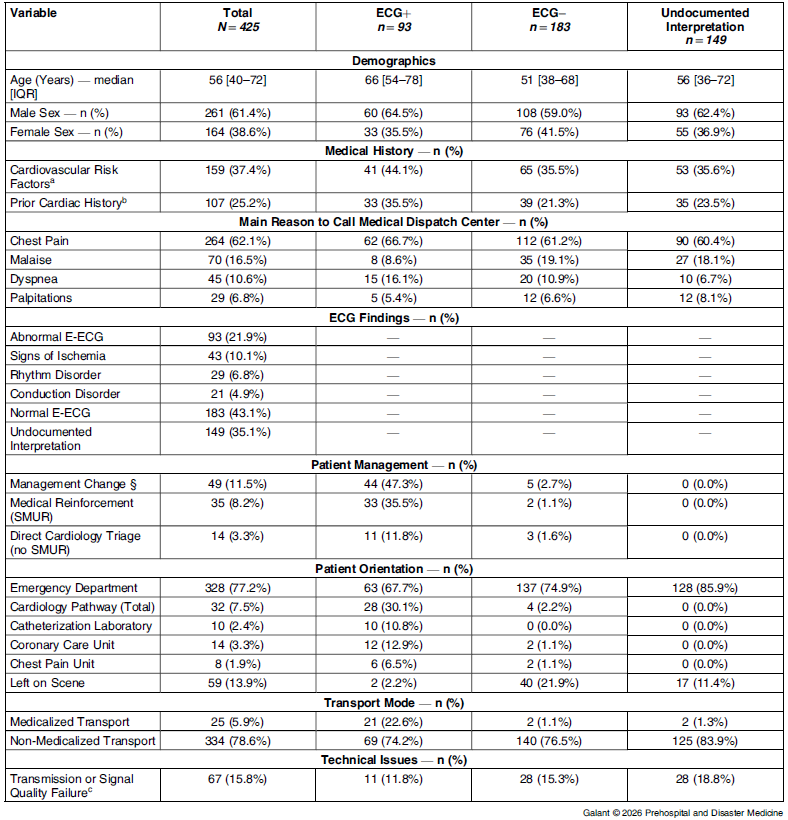
Secondary outcomes are reported in Table 1. The E-ECG indications were primarily chest pain (62.1%), malaise (16.5%), dyspnea (10.6%), and palpitations (6.8%). Transmission results led to management changes in 11.5% of cases (n = 49): 8.2% required additional medical reinforcement, and 3.3% underwent direct cardiology triage without medical reinforcement.
Patient Characteristics and Outcomes — Comparison between ECG-Positive, ECG-Negative, and Undocumented Interpretation Groups

Note: ECG+ = abnormal E-ECG: any rhythm, conduction, or signs of ischemia documented by the on-duty medical regulator (n = 93, 21.9%). ECG− = normal E-ECG (n = 183, 43.1%). Undocumented interpretation = no ECG interpretation documented in the dispatch record (n = 149, 35.1%). The three groups sum to N = 425. Proportions are calculated on their respective subgroup sizes.
Abbreviations: E-ECG, electronically transmitted prehospital electrocardiogram; IQR, interquartile range; SMUR, Mobile Emergency Medical Unit.
a Cardiovascular risk factors: hypertension, diabetes mellitus, or dyslipidemia — at least one present.
b Prior cardiac history: any cardiac disease, ischemic cardiopathy, prior coronary stent, or atrial fibrillation — at least one present.
c Transmission or signal quality failure: Technical issues defined as any ECG tracing with at least one artefact documented in the dispatch record (n = 67, 15.8%). This includes transmission failures and signal quality issues.
Overall, 7.5% of patients (n = 32) were oriented toward cardiology units— ten to the catheterization laboratory, 14 to coronary care units, and eight to chest pain units, while 77.2% were transported to general emergency departments.
Patients with abnormal E-ECGs were more frequently oriented toward cardiology pathways compared with those with normal E-ECGs (30.1% versus 2.2%), whereas patients with normal E-ECGs were more often left at home (21.9% versus 2.2%). No medical reinforcement or cardiology referral was observed in cases without documented ECG interpretation.
Fifty-nine patients (13.9%) were assessed and left at home after remote evaluation. Technical issues occurred in 15.8% (n = 67) of transmissions.
Discussion
From a demographic perspective, the study population was comparable to that described in previous literature. Reference Charpentier, Beaune and Joly14 In this cohort, 21.9% of E-ECGs were abnormal, including 10.1% with signs of ischemia and nine cases of STEMI. In this study, an ECG was considered “positive” when any acute abnormality was identified by the Medical Regulator. However, only a subset of these abnormalities required modification of prehospital management. Certain findings, such as chronic conduction disturbances or previously known arrhythmias, did not necessitate immediate changes in orientation or treatment, whereas others directly triggered medical reinforcement or cardiology referral. In a physician-led EMS system, this heterogeneity of ECG findings implies additional interpretation steps for the Medical Regulator, potentially increasing the workload of an already highly demanding dispatch activity. Reference Leonardsen, Ramsdal and Olasveengen15 These results are consistent with the distinction between diagnostic yield and clinical impact, and they highlight the value of E-ECG as a decision-support tool rather than a standalone therapeutic trigger.
The proportion of abnormal E-ECGs was comparable to previous French studies. A retrospective analysis from the Paris Fire Brigade (Brigade des Sapeurs-Pompiers de Paris; BSPP) reported a 23% rate of positive E-ECGs, while other French prehospital studies have shown management changes in approximately one-quarter of cases, using broader composite endpoints. Reference Thirion16,Reference Perrault17 These findings support the concept that ECG teletransmission primarily functions as a triage-support tool rather than a direct therapeutic trigger in physician-led EMS systems.
These findings show that an abnormal tracing did not consistently translate into a change in clinical management. In 35.1% of dispatch records (n = 149), no ECG diagnosis was documented, a proportion higher than that reported in the BSPP study. Reference Thirion16 Several factors may explain this. During the study period, no standardized protocol governed E-ECG indications. Decisions were left to the discretion of each dispatcher, who was not necessarily the physician responsible for the final diagnosis. In cases of disagreement regarding the indication, the dispatcher might have reviewed but not documented the tracing. Additionally, time pressure and reliance on recorded phone interactions likely contributed to under-documentation. This raises the issue of compliance and adoption of new telemedicine tools by dispatchers.
These findings suggest that E-ECG teletransmission may contribute to prehospital triage by facilitating cardiology referral for abnormal tracings and supporting decision making in patients with normal ECG findings. The absence of medical reinforcement or cardiology referral in cases without documented ECG interpretation suggests that the clinical impact of these tracings may have been under-estimated because of under-documentation.
Among the nine STEMI cases (2.1%), five patients did not initially meet the criteria for immediate intensive care unit (ICU) dispatch based on the national emergency regulation guide published by the French Emergency Medicine Society (SFMU; Société Française de Médecine d’Urgence; Paris, France). 18 Presentations such as isolated malaise, chest pain of intermittent duration, or atypical epigastric pain did not automatically trigger a physician response. These findings are consistent with the results of Brunetti, et al who reported that teletransmitted ECGs corrected approximately two percent of missed STEMI diagnoses. Reference Brunetti, Gennaro and Amodio19 In some circumstances, E-ECG may compensate for the unavailability of a medical response by providing an early diagnostic confirmation. Furthermore, 4.7% of tracings revealed non-STEMI, 11 of which required medical reinforcement, and 3.5% revealed atrial fibrillation, three of which necessitated medical transport. These results are encouraging, as they demonstrate that E-ECG not only helps identify STEMI, but also other high-risk conditions such as non-STEMI or arrhythmia that may require urgent intervention. In the French EMS system, prehospital thrombolysis may be considered in selected situations when timely access to percutaneous coronary intervention (PCI) is not feasible. However, in the urban setting of Marseille, rapid access to catheterization laboratories allows prompt primary PCI in most cases, and prehospital thrombolysis is therefore not routinely used, as no additional clinical benefit is expected. In this cohort, all STEMI patients were referred for primary PCI in accordance with current national recommendations.
Fifty-nine (13.9%) patients were assessed and left at home following E-ECG evaluation. Although this parameter was not the primary focus of this study, it is noteworthy that Haskins, et al reported that telemedicine use in prehospital settings could reduce unnecessary medical deployments by approximately 15%. Reference Haskins, Ellis and Mayrose20 This suggests that E-ECG could contribute to more efficient resource allocation.
A total of 7.5% of patients were referred directly to cardiology units, including catheterization laboratories, chest pain units, or coronary care units. In most cases, STEMI prompted direct referral to the catheterization lab, while non-STEMI and atrial fibrillation were the leading diagnoses for transfers to coronary care or chest pain units.
Only 5.9% of patients required medicalized transport. The low proportion reflects the limited number of severe cases encountered and the primary triage role of dispatchers rather than field providers.
As this study was conducted during the early implementation phase, technical issues and duplicate tracings were frequent, reflecting a learning curve associated with new technology deployment.
Time is a crucial variable in prehospital cardiology, yet it could not be analyzed retrospectively in this study. Recent studies have explored the impact of prehospital ECG transmission on scene time, showing that its use does not significantly prolong prehospital management despite additional diagnostic procedures. Reference Thirion16,Reference Conrad, Müller-Wirtz, Jakob, Armbruster, Thomas and Berwanger21 A study conducted in San Diego (California USA) found that while prehospital ECGs slightly increased on-scene and transport times by approximately ten seconds, they shortened reperfusion delays by approximately three minutes in STEMI patients. Reference Patel, Dunford and Aguilar22
Limitations
This study has several limitations.
First, the high proportion of ECGs without documented interpretation (35.1%) represents a major limitation. This may introduce significant information bias and limits the interpretation of diagnostic performance. During the study period, no standardized protocol governed ECG indications; decisions to perform ECGs were made by dispatch physicians based on clinical presentation and operational context. This lack of formalized criteria likely led to variability in ECG utilization and interpretation across physicians. Several factors may explain this finding, including variability in clinical judgment, differences in experience among dispatch physicians, and operational constraints inherent to real-time medical regulation. However, this limitation also reflects real-world conditions during the early implementation phase of a new telemedicine tool, where heterogeneous adoption and a learning curve are expected, and may have resulted in an under-estimation of its clinical impact.
Second, the reference standard relied on ECG interpretation by a single emergency physician acting as medical dispatcher, without independent adjudication or systematic cardiologist review. This may introduce diagnostic variability and limits the assessment of inter-observer reliability. However, this approach reflects real-world practice in physician-led EMS systems, where ECG interpretation is commonly performed by emergency physicians in the prehospital setting. Current European Society of Cardiology (Brussels, Belgium) guidelines emphasize the importance of early ECG interpretation in acute coronary syndromes and support the use of prehospital ECG analysis to facilitate rapid diagnosis and triage. Reference Byrne, Rossello and Coughlan23
Third, the retrospective design exposes the study to selection and information biases. A proportion of cases could not be matched between data systems, and only information explicitly recorded in the dispatch medical records was analyzed. Audio recordings of calls, which are part of the medical record, were not reviewed and may have contained additional clinically relevant information.
Fourth, this was a single-center study conducted within a specific physician-led EMS system, which may limit the generalizability of the findings to other organizational models, particularly paramedic-based EMS systems.
Fifth, time-related variables—such as time to ECG acquisition, on-scene time, or time to hospital admission—were not available in the dataset and could not be analyzed. These parameters are critical in the evaluation of prehospital cardiac care and represent an important area for future research.
Mortality outcomes were not available in this dataset and could therefore not be analyzed.
Finally, although causality cannot be established in this observational design, the observed association between ECG findings and management decisions supports the role of ECG teletransmission as a clinically relevant triage-support tool. The discrepancy between abnormal ECG rates and management changes reflects the fact that not all detected abnormalities require immediate intervention, but they may still inform and refine dispatch decision making.
Conclusion
In this retrospective real-world analysis, E-ECG teletransmission by firefighter rescuers enabled early identification of significant cardiac abnormalities and supported dispatch decision making in selected patients. Although a positive E-ECG did not consistently lead to changes in management, it contributed to triage optimization and coordination between field teams and medical regulation centers.
Author Contributions
Concept and Study Design: JG, AR, MC
Data Collection: JG, EM, MC
Data Analysis and Interpretation: MC, NC, S-PC
Manuscript Drafting: MC, JG
Supervision: AR
All authors read and approved the final version of the manuscript and agree to be accountable for all aspects of the work.
Disclosure of AI Assistance
ChatGPT (version GPT-5; OpenAI, San Francisco, California USA; 2025) was used to assist in the English translation and linguistic polishing under full human supervision. All intellectual content, data interpretation, and conclusions remain entirely the responsibility of the authors.
Conflicts of interest/funding
Julien Galant: none; Mathilde Corbu: none; Nicolas Cazes: none; Simon-Pierre Corcostegui: none; Emilien Montaigu: none; Aurélien Renard: none.