Introduction
Changes in seed germinability in the incipient phase of seedbank formation have been extensively studied (Baskin and Baskin Reference Baskin and Baskin1998), because they greatly affect the emergence of weed seedlings (Baskin and Baskin Reference Baskin and Baskin2006). The germinability of seeds buried in soil gradually changes. Seeds of some species germinate steadily (Tkachenko Reference Tkachenko2018), while the germinability of seeds of other species decreases over time (Bostock Reference Bostock1978) or fluctuates due to dormancy/nondormancy cycles with annual periodicities (Bouwmeester and Karssen Reference Bouwmeester and Karssen1993; Honěk et al. Reference Honěk, Martinková and Jarošík1999; Van Assche et al. Reference Van Assche, Van Nerum and Darius2002).
Most studies concerning germination behavior in the initial phase after seed burial have investigated single (Bochenek et al. Reference Bochenek, Golaszewski and Gorecki2007; Figueroa et al. Reference Figueroa, Doohan, Cardina and Harrison2007; Honěk et al. Reference Honěk, Martinková and Jarošík1999) or few species (Baskin and Baskin Reference Baskin and Baskin1981; Froud-Williams et al. Reference Froud-Williams, Chancellor and Drennan1984; Milberg and Andersson Reference Milberg and Andersson1997; Pons Reference Pons1991). Comparative studies of many species of local flora (Fenner and Thompson Reference Fenner and Thompson2005; Grime et al. Reference Grime, Hodgson and Hunt2007) are desirable but sporadic. In this work, we studied germinability changes in seeds of dicotyledonous herb species collected on agricultural and nonagricultural land in an intensively farmed area of central Europe. The germinability of seeds buried in soil was monitored for a period of 2-yr after dispersal; this length of time allows trends in germinability changes to occur.
After distinguishing categories for the observed patterns of changes of seed germinability over time, we tested the hypothesis that the frequency of these categories differs between plant species that are typical for “anthropogenic” (ruderal, field) and wild “nonanthropogenic” (grassland, forest) habitats. As there are no previous studies revealing the effects of anthropogenic factors on the frequency of various categories of temporal variation in seed germinability, we can only speculate on what the differences should be. We expect an increased frequency of species with seasonal dormancy/nondormancy changes in seed germinability in anthropogenic habitats. This is because arable lands are exposed to interventions caused by agricultural practices, such as soil cultivation and the sowing and the harvesting of crops. If germination is not limited in time, seedling emergence could occur at an inappropriate period as a result of these interventions. In an unpredictable environment, seasonal cycles in seed germination limit the germination time to a suitable period. Indeed, seasonal cycles of seed germinability have been found in a number of weed and ruderal species, including shepherd’s purse [Capsella bursa-pastoris (L.) Medik.] (Milberg and Andersson Reference Milberg and Andersson1997), corn speedwell (Veronica arvensis L.) (Boutin and Harper Reference Boutin and Harper1991), prostrate knotweed (Polygonum aviculare L.) (Batlla and Benech-Arnold Reference Batlla and Benech-Arnold2006; Courtney Reference Courtney1968), and common mullein (Verbascum thapsus L.) (Baskin and Baskin Reference Baskin and Baskin1981). This intrinsic reduction in germination time is a beneficial adaptation under conditions of intense human activity (Battla et al. 2020).
Material and Methods
Seed Materials
The study included seeds of 116 abundant annual and perennial forb species collected from arable and abandoned fields, ruderal habitats, grasslands, and forests in central Bohemia. The seeds were collected between May 10 and October 7 in 1995 at 24 sites located between 49.13°N and 50.81°N and between 14.28°E and 16.00°E at altitudes from 190 to 660 m above sea level. High-quality seed materials were collected from well-developed stands of mother plants at the time of dispersal. The materials were cleaned of poorly developed or damaged seeds. This procedure guaranteed that the seed materials were viable at the beginning of the experiment. From the time of collection until burial (Table 1), the seeds were dried at 26 ± 2 C and 40% relative humidity.
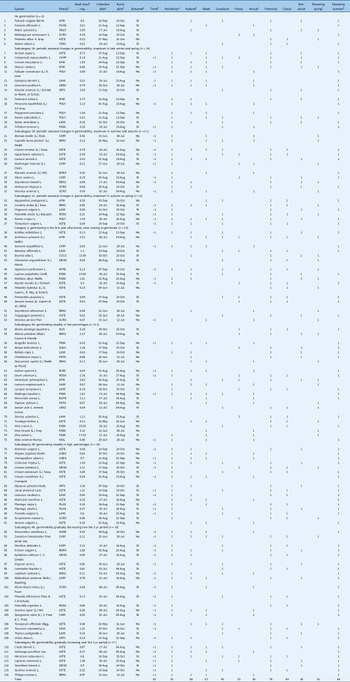
Species included in the study (divided according to categories and subcategories of the pattern of germinability changes) and their characteristics.

a Family: ALIS, Alismataceae; AMAR, Amaranthaceae; APIA, Apiaceae; ASTE, Asteraceae; BORA, Boraginaceae; BRAS, Brassicaceae; CAMP, Campanulaceae; CARY, Caryophyllaceae; CHEN, Chenopodiaceae; CRAS, Crassulaceae; CUCU, Cucurbitaceae; DIPS, Dipsaccaceae; EUPH, Euphorbiaceae; FABA, Fabaceae; FUMA, Fumariaceae; GERA, Geraniaceae; HYPE, Hypericaceae; LAMI, Lamiaceae; MALV, Malvaceae; OENO, Oenotheraceae; PAPA, Papaveraceae; PLAN, Plantaginaceae; POLY, Polygonaceae; PRIM, Primulaceae; ROSA, Rosaceae; RUBI, Rubiaceae; SCRO, Scrophulariaceae; SOLA, Solanaceae; URTI, Urticaceae; VIOL, Violaceae.
b Seed mass: average dry mass of one seed.
c Collection date: day-month (1995).
d Burial date: day-month (1995).
e Exhumed: Mo, monthly; Bi, bimonthly.
f Trend: long-term germinability change trend established using generalized additive modeling; +1, positive; −1, negative characteristic is present in the species.
g Periodicity: periodic seasonal changes in seed germinability established using generalized additive modeling; 1, the characteristic is present in the species.
h Ruderal to forest: habitat; 1, habitat is typical for the species.
i Annual to non-clonal: growth form; 1, growth form is typical for the species.
j Flowering spring, median time of flowering period before June 30; 1, flowering period is typical for the species.
k Flowering summer, median time of flowering period after July 1; 1, flowering period is typical for the species.
Experimental Treatment
The seeds were buried in 1995, for 17 to 58 d (mean 30.9 ± 0.8 d) following collection (Table 1). The seed material of each plant species was divided into 24 or 12 lots (when there was not enough seed to make 24 seed lots) of ca. 1,000 seeds; these lots were wrapped into pieces of nylon fabric with a mesh size of 0.24 mm (56% open area). The seed packets were buried below an unshaded, regularly mown sward at a 20-cm depth. Each packet was connected by a string to a wooden label on the ground to make reclamation easy. Data on soil moisture at 20-cm depth from the meteorology station of the Crop Research Institute (150 m away from the experiment site) are available at https://old.vurv.cz/meteo/.
The first exhumation of seeds of 77 species buried before September was made ˜2.5 mo after burial (i.e., during the later period of the vegetation season in 1995, the year when burial was performed). Exhumation of all 116 species then continued for 2 yr, from January 1996 to October 1997. For plant species for which 24 seed lots were buried, one packet of seeds was exhumed monthly (on day 1 of each month); for species for which 12 seed lots were buried, the packets were exhumed at bimonthly intervals (on day 15 of each even month in 1996 and each odd month in 1997).
The germination experiments started within 24 h after exhumation, during which time the exhumed seeds were stored at 25 C. At each germination date, three samples of 50 seeds each were sampled for germination from each seed species. Each sample was placed into a 10-cm-diameter petri dish on filter paper (Whatman no. 1, Sigma-Aldrich, St. Louis, MO) moistened with 5 ml of tap water. The germination experiments were performed at a constant temperature of 25 C under light conditions. These germination conditions were considered “neutral” and were chosen to allow germination of a maximum number of species. The germinating seeds were counted and removed at 2-d intervals until no germination had occurred within 4 d.
Statistical Modeling
For each plant species, the average germinability percentage of the samples exhumed in successive terms (ordinate) was plotted against the date of exhumation of the samples (abscissa). This ordination of data made for the 2-yr experimental period was called the “pattern of germinability changes.”
The presence of long-term trends and annual cycles of germinability were tested first. The temporal progression of germination was modeled via a binomial generalized additive model (GAM) (Hastie and Tibshirani Reference Hastie and Tibshirani1990; Wood Reference Wood2017) with penalized spline components. For each plant species, the data consisted of the number of germinating and nongerminating seeds at each time point used in the experiment. In particular, the probability of seed germination was modeled as a function of the long-term trend in time from the beginning of the experiment (first germination) until its end (last germination) for a given species, and the seasonality of seed germination was given as a function of the position of each day within a calendar year (1 to 365). The long-term trend was modeled as a linear trend on the logistic scale. For proper seasonality modeling, we have to enforce periodicity (i.e., the beginning and end of the seasonal component curve must meet smoothly). This was done by using the cyclic cubic regression spline (Wood Reference Wood2017). The estimated long-term and seasonal components were tested via penalized likelihood ratio tests and were extracted and displayed for detailed expert inspection.
To differentiate biologically significant trends in the observed patterns of germinability changes, we adopted the ensuing criteria. The long-term trend in germinability was characterized by a decrease/increase in average germinability by ≥15% during the 2-yr experimental period. The value of this difference was calculated from the linear regression interpolated into a given species’ pattern of germinability changes. A criterion for the presence of periodical seasonal changes was a difference in the percentage of germinability between the period of minimum germinability and that of maximum germinability of ≥10%. This value was calculated as the difference between the average of the four maximum germinability values and the average of the four minimum germinability values.
Evaluating Patterns of Germination Changes and Their Frequencies in Groups of Plant Species
We first established categories of seed germinability patterns using three criteria: (1) the presence of seasonal dormancy/nondormancy periodical changes; (2) the presence of a long-term trend in seed germinability; and (3) the survival of seeds after the first year of burial. Second, we determined the frequencies of these categories in groups of plant species that were split according to their preferences to anthropogenic or wild habitats. Data on species habitats, including ruderal, weed, grassland, and forest species (Table 1), were taken from Sádlo et al. (Reference Sádlo, Chytrý and Pyšek2007) and Wild et al. (Reference Wild, Kaplan, Danihelka, Petřík, Chytrý, Novotný, Rohn, Šulc, Brůna, Chobot, Ekrt, Holubová, Knollová, Kocián and Štech2019). Third, we examined the relationships between the frequencies of germinability patterns and taxonomic position (the orders Asterales, Caryophyllales, and Lamiales, which were each represented in this study by more than 15 species), seed mass (a group of species producing light seeds of ≤1 mg in mass and a group of species producing heavy seeds of >1 mg in mass), growth form (annual vs. perennial, clonal vs. non-clonal perennial) and the flowering phenology of species (spring-flowering species, for which the median of the flowering period fell before the end of June, vs. summer-flowering species, for which the median of the flowering period fell after the beginning of July). The data were taken from Dostál (Reference Dostál1989) and the Pladias database (Anonymous 2021).
The differences in the number of species that fall into the particular categories of seed germinability patterns described earlier were tested using contingency tables with groups of plant species as columns and categories of germination patterns as rows. The differences in the number of species in a particular category of seed germinability pattern were tested using a two by two contingency table with groups of plant species as columns and the number of species in a tested category versus the total number of species of all other categories in rows. The statistical significance of the differences in the frequency of species in the contingency tables was tested using the chi-square test.
Results and Discussion
Categories of Long-Term Patterns in Seed Germinability Changes
Of the 116 plant species included in this study, the seeds of six species did not germinate at all. Seeds of these species (Table 1, “No germination”) either decayed (sickleweed [Falcaria vulgaris Bernh.], drug fumitory [Fumaria officinalis L.], high mallow [Malva sylvestris L.], Petasites albus A. Gray, white stonecrop [Sedum album L.]) or did not pass the seed crush test for estimation of the viability of weed seed (Saska et al. Reference Saska, Foffová, Martinková and Honěk2020) after first winter of burial (Melampyrum nemorosum L.). Attempts to germinate residues of decayed seeds continued until the end of the 2-yr experiment. The seeds of these “nonpersistent” species died following burial or persisted in the soil for a very short time (unlike species of category 2, which germinated in the first year).
Of the remaining 110 plant species, 96 species could be tested using the GAM. A long-term germinability change trend was found in 65 species, with negative trends observed in 40 species and positive trends observed in 25 species. Periodic seasonal changes in seed germinability were found in 81 species (Table 1).
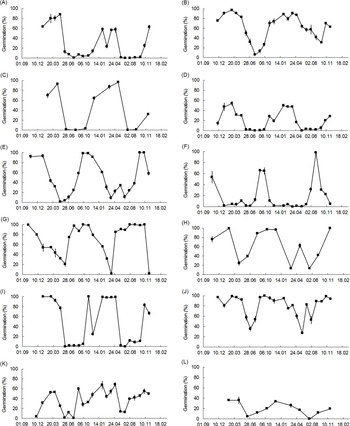
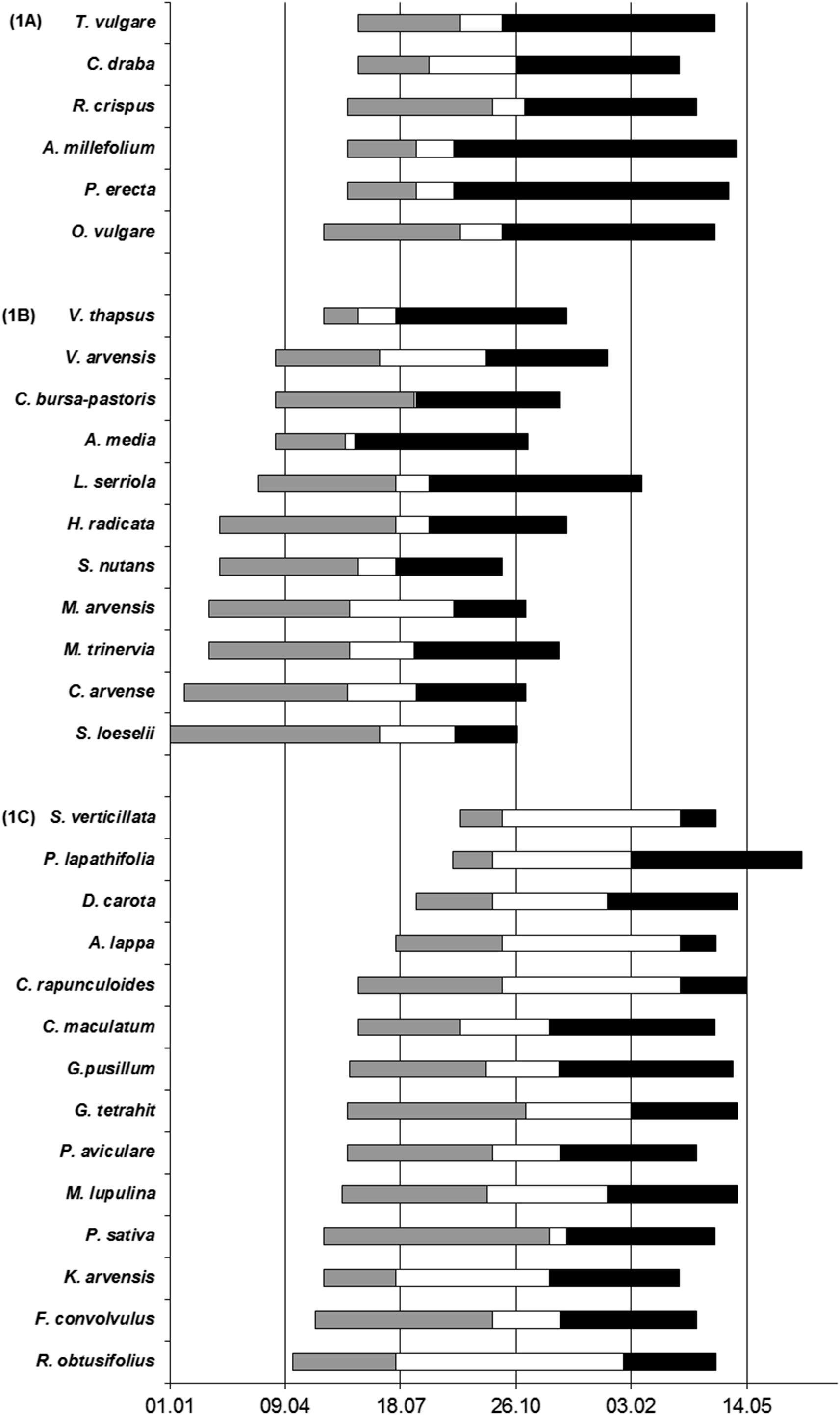
According to their pattern of germinability changes, the species were divided into four categories. Category 1 included 31 species with periodic seasonal changes in seed germinability (Figure 1). Species of this category were divided into subcategories as follows: (1A) species with maximum germinability in late winter and spring (14 “spring” species), (1B) species with maximum germinability in summer and autumn (11 “autumn” species), and (1C) species whose period of maximum germinability extended from autumn of a given year to spring of the following year (6 “winter” species) (Figure 2). The types of seasonal emergence established in this study—spring, autumn, and winter species—are well known in weeds. The periods of maximum and minimum germinability differed among plant species not only in terms of the season in which they occurred but also in terms of their duration (Figure 2).
Changes in seed germinability during the 2-yr period of burial. Examples of plant species of category 1 in which conspicuous seasonal dormancy/nondormancy cycles have been established. Spring species: (A) Galeopsis tetrahit, (B) Daucus carota, (C) Campanula rapunculoides, (D) Polygonum aviculare; autumn species: (E) Veronica arvensis, (F) Sisymbrium loeselii, (G) Alsinula media, (H) Lactuca serriola; winter species: (I) Rumex crispus, (J) Achillea millefolium, (K) Potentilla erecta, (L) Tanacetum vulgare.

Duration of the period of minimum germinability (gray), the transition period from minimum to maximum germinability (hollow), and the period of maximum germinability (black) during the germinability cycle in seeds of plant species demonstrating seasonal dormancy/nondormancy changes. From bottom to top: “spring” species of subcategory 1A, “autumn” species of subcategory 1B, “winter” species of subcategory 1C.

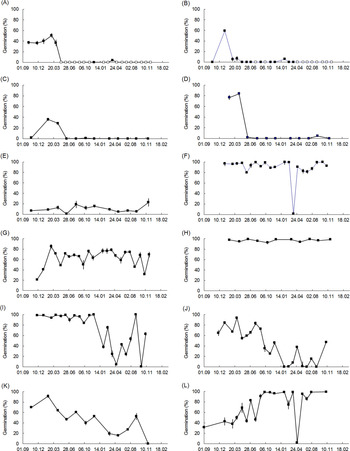
Category 2 included 16 “nonpersistent” species (Figure 3A–D) whose seeds germinated in the first year after burial and later ceased to germinate. This category of germinability likely covers two kinds of seed behavior: first, “true” nonpersistent seed species that germinate in the first year after burial and die later (Grime et al. Reference Grime, Hodgson and Hunt2007), for example, Jack-go-to-bed-at-noon (Tragopogon pratensis L.) (Mahesh et al. Reference Mahesh, Upadhyaya and Turkington1996; Roberts Reference Roberts1986) and bigleaf lupine (Lupinus polyphyllus Lindl.) (Klinger et al. Reference Klinger, Eckstein, Horlemann, Otte and Ludewig2020). True nonpersistent species forming transient seedbanks further include common yarrow (Achillea millefolium L.), white bryony (Bryonia alba L.), fireweed [Chamerion angustifolium (L.) Holub], and wall-lettuce [Mycelis muralis (L.) Dumort.], which germinate in autumn of the year of seed dispersal, and wild chervil [Anthriscus sylvestris (L.) Hoffm.] and Petasites spp. (Grime et al. Reference Grime, Hodgson and Hunt2007; Roberts Reference Roberts1979; Thompson et al. Reference Thompson, Bakker and Bekker1997), which germinate in the spring of the year following seed dispersal. Some species included in category 2 form a class of “false” nonpersistent species. These species, for example, thymeleaf sandwort (Arenaria serpyllifolia L.), common hedgenettle (Betonica officinalis L.), common St. Johnswort (Hypericum perforatum L.), wood ragwort [Senecio ovatus (G. Gaertn et al.) Willd.], hedgemustard [Sisymbrium officinale (L.) Scop.], and birdeye speedwell (Veronica persica Poir.), form persistent seedbanks (Grime et al. Reference Grime, Hodgson and Hunt2007; Thompson et al. Reference Thompson, Bakker and Bekker1997). Seeds of these species germinated in our experiment only in the first year after burial, probably because, during this period, they germinate in a wide range of temperature conditions (including at a constant temperature of 25 C); however, starting with the second year after burial, the seeds require specific germination conditions, likely alternating temperatures.
Changes in seed germinability during the 2-yr period of burial. Examples of plant species of category 2: (A) Tragopogon pratensis, (B) Anthriscus sylvestris, (C) Lupinus polyphyllus, (D) Senecio ovatus; seeds of category 3 with constant germinability: (E) Trifolium arvense, (F) Matricaria maritima, (G) Chenopodium album, (H) Dipsacus sylvestris; seeds of category 4 with long-term trends of changes in germinability: (I) Amaranthus retroflexus, (J) Taraxacum officinale, (K) Microrrhinum minus, (L) Lapsana communis. Open symbols: seeds were rotten.

Category 3 included 38 plant species whose seeds germinated steadily during the 2-yr experimental period, that is, without seasonal changes or long-term decreasing or increasing germinability trends. In 22 species of subcategory 3A, the percentage of germinable seeds was consistently low (<10%) (Figure 3E); in 16 species of subcategory 3B, the percentage of germinable seeds was high (Figure 3F–H). Except for coltsfoot (Tussilago farfara L.) (Namura-Ochalska Reference Namura-Ochalska1987), all species of subcategory 3A form persistent seedbanks in the soil, for example, garlic mustard [Alliaria petiolata (M. Bieb.) Cavara & Grande], catchweed bedstraw (Galium aparine L.), herb bennet (Geum urbanum L.), and eltrot (Heracleum sphondylium L.) (Grime et al. Reference Grime, Hodgson and Hunt2007; Thompson et al. Reference Thompson, Bakker and Bekker1997). For ample germination, the species of subcategory 3A may require conditions other than the constant 25 C used in this study, probably including alternating temperatures. The germinabilities of the seeds of 16 plant species of subcategory 3B were steadily high. These species formed permanent seedbanks in the soil, except chicory (Cichorium intybus L.), broadleaf enchanter’s nightshade (Circaea lutetiana L.), cabbage thistle [Cirsium oleraceum (L.) Scop.], and wild teasel (Dipsacus sylvestris Huds.), which are considered transient (Grime et al. Reference Grime, Hodgson and Hunt2007; Thompson et al. Reference Thompson, Bakker and Bekker1997). However, even these seeds survived in our experiment for 2 yr.
Twenty-five species were included in category 4. For 18 species of subcategory 4A, the percentage of germinable seeds during the 2-yr experimental period decreased (Figure 3I–K), presumably due to deterioration of seeds in the soil. The seedbanks of these species, for example, bitter fleabane (Erigeron acris L.), bristly hawkbit (Leontodon hispidus L.), Melampyrum pratense L., mouse ear hawkweed (Pilosella officinarum Fried & C. H. Schultz), dandelion (Taraxacum officinale Wigg.), and wall germander (Teucrium chamaedrys L.) (Grime et al. Reference Grime, Hodgson and Hunt2007; Thompson et al. Reference Thompson, Bakker and Bekker1997), are termed “transient.” In some species, such as redroot pigweed (Amaranthus retroflexus L.) (Figure 3I), germinability decreases due to changes in the thermal requirements for germination after the first year of burial (Costea et al. Reference Costea, Weaver and Tardif2004). For seven species of subcategory 4B, the percentage of germinable seeds during the 2-yr burial increased (Figure 3L). Except for rough hawksbeard (Crepis biennis L.) and New England hawkweed (Hieracium sabaudum L.), all species of this subcategory form permanent soil seedbanks (Grime et al. Reference Grime, Hodgson and Hunt2007; Thompson et al. Reference Thompson, Bakker and Bekker1997). The causes of the progressive increase in germinability were established for common evening primrose (Oenothera biennis L.), whose seeds require alternating temperatures for germination in the first year after burial and later germinate in a wide range of thermal conditions, including at a constant temperature of 25 C (Baskin and Baskin Reference Baskin and Baskin1994).
The observed patterns of seed germinability point to factors that direct seedling emergence to a period favorable for the survival of seedlings. We succeeded in determining these factors for a large portion of the 110 seed species that germinated in our study. In 31 species of category 1, germination is regulated by seasonal dormancy/nondormancy cycles (Benech-Arnold et al. Reference Benech-Arnold, Sanchez, Forcella, Kruk and Ghersa2000), that is, by intrinsic factors. In 41 species of subcategory 3B and category 4, germinability at 25 C was steady and gradually decreased or increased. Germination and seedling emergence are triggered by environmental factors, such as the onset of suitable temperature and humidity conditions (Boyd and Van Acker Reference Boyd and Van Acker2003; Guillemin et al. Reference Guillemin, Gardarin, Granger, Reibel, Munier-Jolain and Colbach2013; Martinková et al. Reference Martinková, Honěk and Pekár2014; Roberts and Neilson Reference Roberts and Neilson1981) or soil cultivation (Froud-Williams et al. Reference Froud-Williams, Chancellor and Drennan1984; Kahmen and Poschlod Reference Kahmen and Poschlod2008). Eight true nonpersistent species of category 2 germinated within periods convenient for seedling establishment because of transient persistence in their soil seedbanks (Grime et al. Reference Grime, Hodgson and Hunt2007; Thompson et al. Reference Thompson, Bakker and Bekker1997). Thus, in 80 species, it was possible to ascertain mechanisms controlling germination and seedling emergence. For 30 plant species, the mechanisms leading to seed germination have not been fully elucidated. These species included 8 false nonpersistent species of category 2 whose seeds persisted in the soil for more than 1 yr and 22 species of subcategory 3A whose seeds germinated at a low percentage at 25 C. The seeds of the latter species would likely increase in their germinability under alternating temperatures and show one of the above patterns: periodic seasonal changes, steady germinability, or decreasing or increasing germinability.
The positive effect of alternating temperatures on germination has already been demonstrated in several species included in this study, for example, Canada thistle [Cirsium arvense (L.) Scop.] (Bostock Reference Bostock1978), gallant soldier (Galinsoga parviflora Cav.) (De Cauwer et al. Reference De Cauwer, Devos, Claerhout, Bulcke and Reheul2014), G. aparine (Wang et al. Reference Wang, Zhang, Dong and Lou2016), gypsywort (Lycopus europaeus L.) (Thompson Reference Thompson1974), apetalous sandwort [Moehringia trinervia (L.) Clairv.] (Vandelook et al. Reference Vandelook, Van de Moer and Van Assche2008), curlytop knotweed [Persicaria lapathifolia (L.) S.F. Gray] (Araki and Washitani Reference Araki and Washitani2000), silver cinquefoil (Potentilla argentea L.) (Kolodziejek et al. Reference Kolodziejek, Patykowski and Wala2019), woodland figwort (Scrophularia nodosa L.) (Vranckx and Vandelook Reference Vranckx and Vandelook2012), and V. thapsus (Catara et al. Reference Catara, Cristaudo, Gualtieri, Galesi, Impelluso and Onofri2016), and in other weed species not included in our study, for example, Robert geranium (Geranium robertianum L.) (Van Assche and Vandelook Reference Van Assche and Vandelook2006) and addersmeat (Stellaria holostea L.) (Vandelook et al. Reference Vandelook, Van de Moer and Van Assche2008). In fact, the absence of a positive effect of alternating temperature on seed germinability is a rare phenomenon (Ottavini et al. Reference Ottavini, Pannacci, Onofri, Tei and Jensen2019). For the long-term survival of buried seeds, the dependence of germination on oscillating temperature conditions is a useful property. Temperature oscillations provide information on the temporal progression of the season and on the position of the seed in the soil (Saatkamp et al. Reference Saatkamp, Affre, Baumberger, Dumas, Gasmi, Gachet and Arene2011), and this information enables seeds to limit germination to a time and place suitable for seedling emergence. In addition to alternating temperature, germination can also be supported by alternating soil moisture (Batlla and Benech-Arnold Reference Batlla and Benech-Arnold2006; Hu et al. Reference Hu, Ding, Baskin and Wang2018).
Distribution of the Categories of Germinability Patterns in Anthropogenic and Wild Habitats
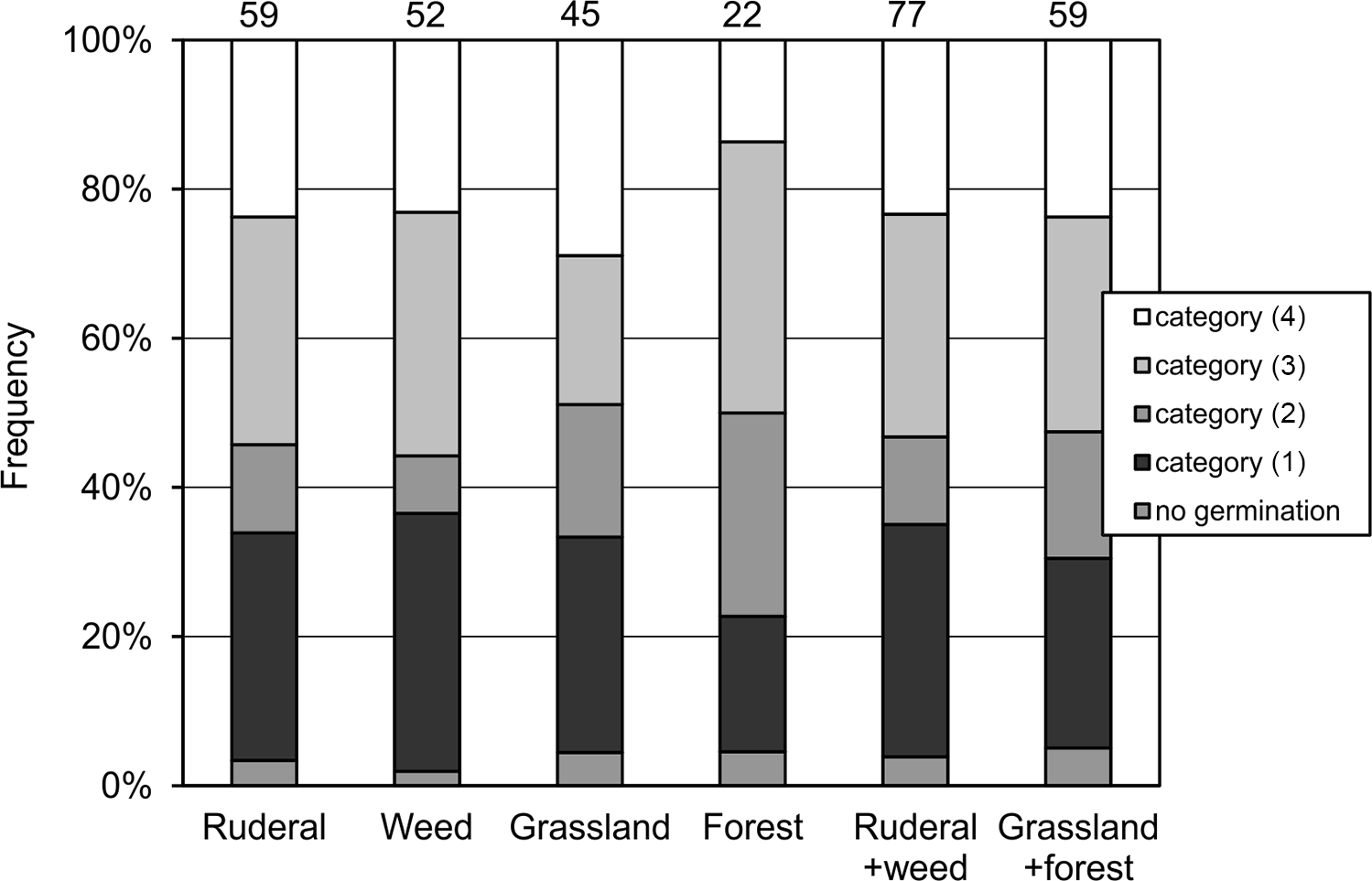
The expected result of our study was the detection of differences in the observed frequency of categories of seed germination patterns in plant species belonging to the flora of anthropogenic habitats that are seriously affected by humans (ruderal and field weed species) and plant species belonging to the flora of wild habitats that are significantly less affected by humans (grassland and forest species). Surprisingly, the differences in the observed frequency of the categories of germinability patterns between the groups of species divided according to this criterion were not statistically significant (Figure 4). The difference between species preferring ruderal habitats and species classified as weeds was not significant (χ2 = 0.9, df = 4, NS), nor were the differences between ruderal and grassland species (χ2 = 2.1, df = 4, NS), ruderal and forest species (χ2 = 4.3, df = 4, NS), weed and grassland species (χ2 = 4.5, df = 4, NS), weed and forest species (χ2 = 6.9, df = 4, NS), or grassland and forest species (χ2 = 4.3, df = 4, NS). No significant difference was found after ruderal and weed species were grouped as species typical of anthropogenic habitats and grassland and forest species were grouped as species typical of wild, nonanthropogenic habitats (χ2 = 1.2, df = 4, NS) (Figure 4). No category of germinability patterns was significantly overrepresented in any of these groups of plant species.
Distribution of the categories of seed germinability patterns in groups of plant species sorted according to their preferred habitat. Ordinate is frequency of plant species with particular patterns of seed germinability changes (the designation of the categories in the legend is the same as in the text): category 1, seasonal changes in seed germinability; category 2, nonpersistent seeds; category 3, seeds with constant germinability; category 4, seeds with long-term trends of changes in germinability. Abscissa is habitats: ruderal, species typical for ruderal habitats; weed, weed species typical for arable lands; grassland, species typical for grasslands; forest, species typical for forest undergrowth; ruderal+weed, species typical for anthropogenic habitats; grassland+forest, species typical for wild habitats. Numbers above the columns: n species. Some plant species are classified as preferring more than one habitat (most frequently, ruderal and weed species).

We sought to answer the question of why there was no difference observed between the floras of these markedly different habitats. The reason for the failure to detect differences in the observed frequencies of categories of seed germinability patterns was not the small number of plant species included in our study. The differences would not be statistically significant even if the number of plant species included in our study were increased 4-fold (assuming that the proportions of the germinability pattern categories were maintained). We assume that this result may be due to rapid changes in the compositions of floras of anthropogenic habitats caused by human activity. The areas and locations of plots of agricultural land and their use as arable land, grassland, plantations of fast-growing trees, and so on are changing. On arable land, the composition of crops and agricultural practices gradually change. This alternation of habitat conditions causes changes in the presence of weed species (Smith and Gross Reference Smith and Gross2006). The composition of weed flora changes spontaneously during long-term farming (Warington Reference Warington1958), mainly due to changes in management practices (McCloskey et al. Reference McCloskey, Firbank, Watkinson and Webb1996), the plowing regime (Chauhan et al. Reference Chauhan, Gill and Preston2006; Mirsky et al. Reference Mirsky, Gallandt, Mortensen, Curran and Shumway2010; Roberts and Feast Reference Roberts and Feast1973), the transition to organic farming (De Cauwer et al. Reference De Cauwer, Biesemans, De Ryck, Delanote, Dewaele, Willekens, Vanden Nest and Reheul2020), the change of arable land to grassland or pasture (Chancellor Reference Chancellor1986; Richner et al. Reference Richner, Walter, Linder and Holderegger2018) and subsequent grazing (Nicol et al. Reference Nicol, Muston, D’Santos, McCarthy and Zukowski2007). Indirect anthropogenic influences, including climate change, also affect the composition of weed flora (George et al. Reference George, Ziska, Bunce, Quebedeaux, Hom, Wolf and Teasdale2009). On the other hand, farming practices can cause changes in weed biology, because agricultural practices exert selective forces on weed populations. As these practices change over time, the adaptive traits of weeds also evolve, allowing weeds to persist in new environments (Batlla et al. Reference Batlla, Ghersa and Benech-Arnold2020). These changes counteract the selection of a flora of species typical for a particular habitat. The formation of floras typical of particular habitats does not keep pace with changes to the landscape.
Other Factors Affecting Seed Germinability
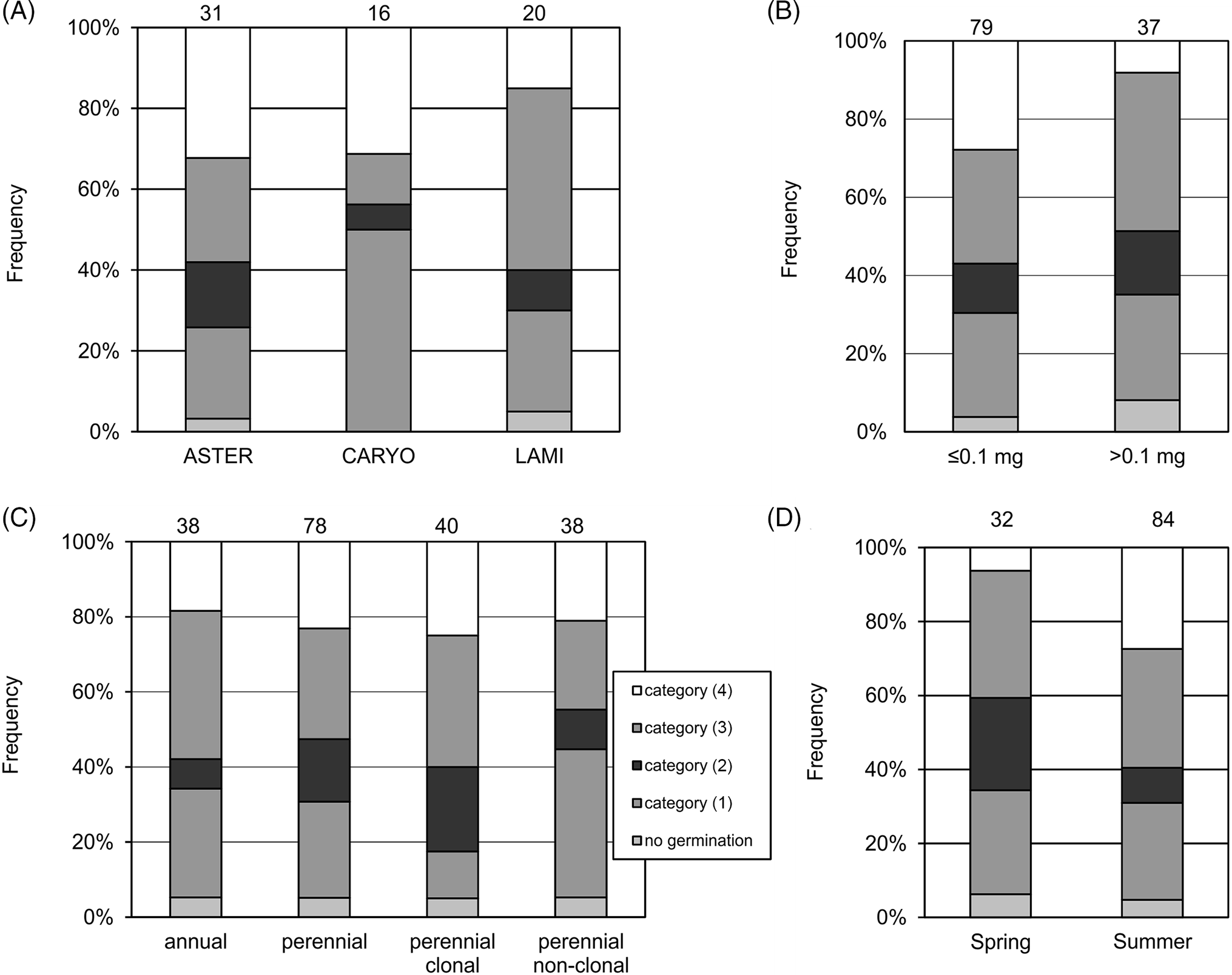
The results indicated that the differences in the frequency of seed germinability categories that occur between groups of plant species are defined by criteria other than habitat preferences. The frequencies of categories were not significantly different among Asterales, Caryophyllales, and Lamiales (χ2 = 9.5, df = 8, NS) (Figure 5A), but the frequency of species of category 2 was significantly higher in Caryophyllales than in other taxa (χ2 = 4.1, df = 1, P < 0.05). In plant species bearing light or heavy seeds, the frequencies of categories of germinability patterns were not significantly different (χ2 = 6.7, df = 4, NS); but species of category 4 were significantly overrepresented (χ2 = 5.8, df = 1, P < 0.025) among the plants bearing light seeds (Figure 5B). The frequencies of germinability patterns were not significantly different between annuals and perennials (χ2 = 2.6, df = 4, NS) or between non-clonal and clonal perennials (n = 38) (χ2 = 8.2, df = 4, NS) (Figure 5C), but the frequency of plant species with seed germinability patterns of category 1 (seasonal dormancy/nondormancy cycles) was significantly higher in non-clonal perennials than in clonal perennials (χ2 = 7.4, df = 1, P < 0.01). The frequencies of categories of germinability patterns were not significantly different between spring- and summer-flowering plant species (χ2 = 9.0, df = 4, NS) (Figure 5D), but the frequency of category 2 plants was significantly higher in spring- than in summer-flowering plants (χ2 = 4.7, df = 1, P < 0.05), while the frequency of plants of category 4 was significantly higher in summer- than in spring-flowering species (χ2 = 6.1, df = 1, P < 0.025). The failure to identify significant differences in the distribution of germinability categories among the above groups of plant species was likely caused by the limited number of species included in this study. The effect of the seed weight, flowering time, and differences between clonal and non-clonal perennial plants would be statistically significant if the number of plant species included in this study were increased 1.5-fold, and the differences among Asterales, Caryophyllales, and Lamiales would be significant if the number of plant species were increased 2-fold (provided the proportional representations of the germinability pattern categories were maintained).
Distribution of the categories of seed germinability patterns in groups of plant species segregated with respect to their taxonomy, growth form, seed mass, and flowering time. (A) Distribution of the categories of seed germinability patterns in plant taxa represented in our study by more than 15 species. Ordinate is frequency of germinability patterns (see explanation in part C). Abscissa is plant classes: ASTER, Asterales; CARYO, Caryophyllales; LAMI, Lamiales. (B) Distribution of the categories of seed germinability patterns in groups of plant species sorted according to their seed mass. Ordinate is frequency of germinability patterns (see explanation in C). Abscissa is seed mass. (C) Distribution of the categories of seed germinability patterns in groups of plant species sorted with respect to the growth form of the plant species. Ordinate is frequency of germinability patterns: category 1, seasonal changes in seed germinability; category 2, nonpersistent seeds; category 3, seeds with constant germinability; category 4, seeds with long-term trends of changes in germinability. Abscissa is species life strategies: annuals, perennials, clonal perennials, non-clonal perennials. (D) Distribution of the categories of seed germinability patterns in groups of species sorted with respect to the timing of their flowering. Ordinate is frequency of germinability patterns (see explanation in C). Abscissa: Spring, species whose median flowering period is in March–June; summer, species whose median flowering period is in July–September. Numbers above the columns: n species.

This study of the seed germinability of 116 plant species enabled the reliable determination of patterns of long-term germinability changes and factors determining seedling emergence in 80 plant species, of which seed germinability steadily or slowly changed in 41 species and oscillated in 31 species due to seasonal dormancy/nondormancy cycles. Eight plant species produced nonpersistent seeds. In 30 species of plants, the pattern of seed germinability remained uncertain, because these species did not readily germinate at a constant temperature of 25 C. To germinate, these species probably require alternating temperatures.
The frequencies of the categories of seed germinability do not differ among groups of plant species that are segregated according to their preference for anthropogenic or wild habitats. We assume that this result may be caused by rapid changes in the composition of the flora of anthropogenic habitats enforced by human activity. The instability of habitat conditions is likely to prevent the selection of floras characteristic for certain habitats and specific in their proportional representations of germination categories.
Acknowledgments
We thank Hana Smutná, Helena Uhlířová, and Jana Kohoutová for excellent technical assistance. This work was supported by institutional support RO0418 of the Ministry of Agriculture of the Czech Republic. The authors also thank American Journal Experts (certificate verification code: 12AE-DB94-7D56-33B1-3333) for their professional English-language editing services. No conflicts of interest have been declared.