INTRODUCTION: GRAIN PESTS IN ROMAN BRITAIN — A CORDON SANITAIRE BROKEN?
In the late 1970s Paul BucklandFootnote 1 made a number of important points concerning the introduction of grain pests to Britain during the Roman period, including their potential importance for the reconstruction of Roman agricultural yields, and any resulting estimations of the population of Roman Britain based on these theoretical yield figures. Buckland noted that granary beetle pests were present, and sometimes abundant, in most of the samples from the Roman deposits which up to that date had been examined for insects. Buckland drew on evidence from the first-century a.d. harbour at Fishbourne, West Sussex;Footnote 2 the fourth-century well at Barnsley Park Villa, Glos.;Footnote 3 third-century charred grain at Droitwich, Worcs.;Footnote 4 the Roman sewer at York (the fills of which are probably of third- or fourth-century date);Footnote 5 the second-/third-century fortress ditch at Malton, North Yorks.;Footnote 6 a fourth-century pit at Alcester, Warwicks.;Footnote 7 and fills of a pond formed in the erosion cone of a pit or well at Dragonby, North Lincs., probably formed in the first century a.d.Footnote 8
Buckland argued that the insect pests of stored grain do not occur in the wild in Britain, are non-native, and must originally have been imported in transported grain. He suggested that their introduction first occurred in the Roman period, since there were no earlier British records. Buckland felt that the absence of grain pests before the arrival of the Romans could be explained by two factors:
(1) Storage pits were commonly used before the Roman invasion, and Buckland proposed that the use of below-ground storage may have prevented insect infestation and inhibited the spread of the pests from Southern Europe. The low temperatures encountered in pits, along with the physical barrier represented by the sealed pit itself, may have curtailed the spread and development of grain pests. In addition, experimental archaeology at Butser Iron Age farm,Footnote 9 ethnographic literature,Footnote 10 and modern storage practiceFootnote 11 all suggested that damp and sprouting grain near the walls of the pit could produce sufficient concentrations of carbon dioxide to inhibit insect development. By contrast, the adoption of large above-ground granaries after the Claudian invasion in a.d. 43 left grain exposed in large warm bulks ideal for insect attack.
(2) Grain production and trade in the Iron Age was on a limited scale, in contrast to the Roman period. In particular, there was limited inward trade, particularly in grain, from continental Europe before the Roman invasion (Buckland in conversation later described these factors as creating a ‘cordon sanitaire’).
Buckland suggested that one major implication of the presence of grain pests at this time was that any simple correlation between Roman grain production and the ‘number of mouths fed’ was flawed.Footnote 12 He demonstrated the potential scale of the problem by citing the United Nations Food and Agriculture Organisation report of 1947 which estimated that at least 10 per cent of the world's cereal production was lost to insect attack.Footnote 13 Modern estimates suggest that losses resulting from insect damage range from 5 per cent in wheat to 40 per cent in some other stored products in areas of the world where insecticides and modern integrated storage controls are not used.Footnote 14 Buckland concluded that: ‘If this hypothesis is correct, the great increase in land under cultivation sometimes claimed for the Roman period … may not be the result of increased population under the Pax Romana or the heavy burden of the annona militaris but the outcome of the increasing attentions of an unwanted guest, Sitophilus granarius, whose activities could have accounted for well in excess of 10% of the cereals produced in the Lowland Zone.’Footnote 15
Whether or not its implications are accepted, Buckland's paper posed important questions which seem to have received little attention among Roman historians, archaeologists and modellers of past economic systems and grain yields.
ARCHAEOLOGICAL RECORDS OF GRAIN PESTS SINCE BUCKLAND: A REVIEW OF 30 YEARS OF ADDITIONAL WORK
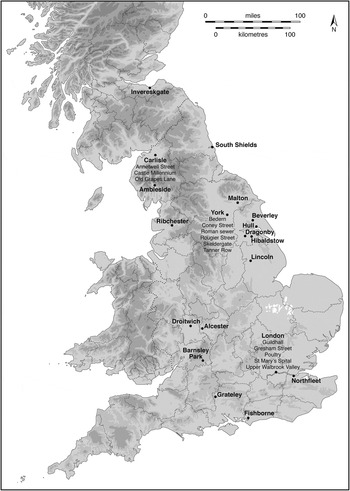
This paper reviews additional archaeological records of Roman insect pests since the publication of Buckland's paper. The present authors have been responsible for much of the insect analysis undertaken on Roman and later archaeological deposits during the past 30 years, either as commercial consultancy or university-based research. The discussion below refers to the majority of the archaeological sites examined where grain faunas were prevalent; for the location of these sites see fig. 1. Many of these excavations are now published and are directly cited in the text below. Where sites have not been published, the insect data are either included in the BUGS CEP programFootnote 16 or are available from the authors.
Location of British sites mentioned in the text.

INSECTS AND GRAIN PESTS IN THE ARCHAEOLOGICAL RECORD
Insect remains are preserved in British archaeological sites in two ways and are encountered in around 10 per cent of archaeological contexts. Most insect remains are preserved by what is commonly referred to as ‘anoxic waterlogging’ (complete saturation and oxygen deficiency, though the preservation mechanism may not be so straightforward).Footnote 17 Waterlogging is fairly common in urban situations, where the water table is high or suspended, in organic-rich ‘sponges’, or where cuts have been dug to considerable depth.Footnote 18 In exceptional circumstances, insect remains can also be preserved by carbonisation (burning). Recent experimental work has suggested that carbonised insects probably only form in a limited range of conditions, and that they may be under-recovered as a result of their fragility.Footnote 19 This raises a number of issues concerning the occurrence of charred insects in the archaeological record.
Extraction and identification of insect remains is relatively straightforward.Footnote 20 Grain pests are routinely recovered from the archaeological record and are easily identified, since they are also amongst the most distinctive of insect fragments seen in environmental samples. Grain pests also seem to have a number of quite specific routes by which they can enter a variety of archaeological deposits, for example by direct deposition in dumped deposits, use in human food and animal fodder, and as components of cess or stable waste having passed through the dietary track of humans and livestock. Understanding these potential routes is clearly important when trying to determine their implications.
THE NATURE OF THE GRAIN PEST FAUNA AND ITS ECOLOGY
Brief summaries of the biology of the full range of storage pest beetles encountered in the British Isles are given by AitkenFootnote 21 and Munro.Footnote 22 However, the fauna encountered in the archaeological record is generally more limited. Insect assemblages from the Roman period in Britain are often dominated by three granary pests. The first species is Sitophilus granarius (L.), the granary weevil, which occurs in most groups of samples and is often the second or third most abundant grain pest encountered in archaeological deposits. It was probably the most destructive beetle pest in granaries, since both the larvae and the adults feed on whole grains and the larvae develop inside them.Footnote 23 The granary weevil is often present in the early stages of spoilage and, depending on grain quality and storage conditions, its direct and indirect effects can cause almost total loss of grain.Footnote 24 S. granarius is described as a primary pest since it often starts the process of damage to grain and develops within the kernel itself. Its metabolism can raise the temperature and humidity in a body of grain, leading to translocation of water into local damp spots, which encourages bacterial and fungal decay of the grain, as well as invasion by other grain pests.
The second major grain pest is Oryzaephilus surinamensis (L.), ‘the saw-toothed granary beetle’, which is often the most abundant species in the grain pest fauna. O. surinamensis is regarded as mainly a secondary pest in grain. It is frequently found on grain that has been attacked and damaged by S. granarius, although the presence of the weevil or other primary pests is not an absolute requirement.Footnote 25 It typically feeds on moulds rather than the grain itself, and is found in a wide range of stored products.Footnote 26 The third important pest in the Roman period is Laemophloeus ferrugineus (Steph.), ‘the rust-red grain beetle’, with an ecology broadly similar to that of O. surinamensis. Footnote 27
Various other insect pests often found in grain stores were present in Roman Britain, though apparently in much smaller numbers. They include Palorus ratzeburgi (Wissm.), ‘the small-eyed flour beetle’, essentially a scavenger in very spoiled grain; Tribolium castaneum (Hbst.), ‘the rust-red flour beetle’; Alphitobius diaperinus (Panz.), the ‘lesser mealworm’; and Tenebrioides mauretanicus (L.), the ‘cadelle’ (often spelled ‘T. mauritanicus’). These insects generally attack damaged and rotten grain (though Tenebrioides can exploit whole grains,Footnote 28 and the damage may only need to be slight for some of the others) and, like O. surinamensis and L. ferrugineus, they can infest a range of other stored products including flour, bran meal, and non-cereals such as dried fruit.Footnote 29 In addition, various moths and mites are important despoilers of grain today, but have yet to be identified from Roman deposits in Britain, though most were probably present. Collectively, and under the right conditions, these storage pests have the potential to devastate bulks of grain on a time scale of months to years.
Today, most of these insects are considered to be part of the established British insect fauna. However, they are not usually encountered in the wild away from human settlement or, indeed, outside of grain or other plant food stores in Britain. This present distribution clearly suggests that they are strongly synanthropic (associated with human activity) and originally were not native to Britain and, therefore, must have been introduced at some point in the past from their original ‘homeland’. Where the original geographical range of these species may have been is not clear, but some of them probably came from the ‘fertile crescent’ of the Near East, from north or east Africa, and from the warmer parts of Asia.
Most of these species are able to overwinter in unheated grain stores in Britain as eggs, pupae or adults in diapause (dormancy).Footnote 30 However, they still benefit from the relatively constant temperatures encountered in larger bulks of grain and human settlement in general. T. castaneum, however, is not believed to overwinter successfully in unheated warehouses and in the twentieth century was often considered to be a pest of imported grain in Britain.Footnote 31 Although this is pure speculation, its occurence in Roman Britain might just possibly suggest the presence of imported as well as home-grown grain throughout the period. These species are also dependent on human activity for dispersal; several are flightless and the others are not often seen to fly in British conditions; it is not known whether any of them can survive in nature here. Today all of these species are considered to be more or less cosmopolitan, having been distributed around the world in transported grain and other plant foods.
THE OCCURRENCE OF GRAIN PESTS THROUGH TIME
The data from the sites examined in our survey clearly suggest that the grain pests have a pronounced pattern of occurrence through time:
Pre-Roman
Despite the passing of three decades since Buckland's review, there are still no records of the beetle grain pests in Britain before the arrival of the Roman army. This is a significant pattern in the data and their absence needs careful consideration and explanation.
Roman
One problem that Buckland faced when he published his 1978 paper was that the sites he examined mostly dated to the third and fourth centuries a.d. It was difficult, therefore, for him to establish whether the introduction of grain pests resulted from a slow and gradual introduction over a long period of time or was the result of early and dramatic importation, most likely with the arrival of the Roman army. It is important to establish this point in order to estimate their potential impact on agriculture and storage throughout the whole Roman period.
The situation has now changed. In the last 30 years grain pests have been recovered from several sets of deposits associated with the very earliest period of the Roman occupation of Britain. Grain pests were clearly an important part of the insect fauna of military posts and the settlements that grew up around them. Certainly, they were present almost immediately after the foundation of the settlement at London. At the Poultry site in Central London, a number of pits, dated from after a.d. 47, the start of the Roman occupation, and sealed by the a.d. 60 ‘fire horizon’ of the Boudiccan revolt,Footnote 32 produced a series of insect faunas in which grain pests accounted for 22–73 per cent of the insect fauna recovered.Footnote 33 A range of similarly dated deposits from the nearby site at Gresham Street also produced insect faunas that contained large numbers of grain pests.Footnote 34 Grain beetle pests were also present in York within 20 years at most of the establishment of the fortress.Footnote 35 Late first- to early second-century field ditches and a timber-lined cistern, thought to be associated with malt production, from the Roman villa at Northfleet, Kent,Footnote 36 have also produced both waterlogged and charred insect faunas that contained small numbers of grain pests (5–15 per cent).
We also now know that the grain pests first arrived with the army in more northerly parts of England in the later part of the first century. They account for 20–58 per cent of the beetles recovered from a number of shallow gullies and timber-lined channels, associated with the possible cavalry barracks, in the Roman fort at the Millennium site at Carlisle Castle, Cumbria. These deposits are dated to just after the establishment of the Roman earth-and-timber fort in a.d. 72/73.Footnote 37 Deposits dated between the early 70s and early 80s a.d. at the Castle Street site, Carlisle also contained numerous grain pests, perhaps from stable manure,Footnote 38 and S. granarius and O. surinamensis were also present in the earliest period at the Old Grapes Lane A site in Carlisle.Footnote 39 Similarly, grain pests were found in the earliest layers, perhaps dating to a.d. 71–74, at the fort at Ribchester, Lancs.Footnote 40 Finally, a late first-century wooden structure at Coney Street, York, interpreted as a warehouse, produced an astonishing fauna from humic silts from in and around beam slots within the foundations of the building.Footnote 41 There were immense numbers of beetles associated with spoiled grain (around 60,000 beetles per kilogramme of sediment for some of the deposits sampled, three orders of magnitude more than typically recovered in ‘beetleiferous’ archaeological deposits), and very few other insects, emphasising the scale of infestation in this building. As an aside, one might speculate as to whether the prevalence of grain pests in very early Roman military supplies was in part the result of infested grain being unscrupulously off-loaded onto the resource-hungry army.
Looking at the numbers of samples that produced grain pests, and their relative dominance in the faunas, it seems that the occurrence of grain pests in the second century a.d. was less significant than it had been in the first century a.d. This is despite the wealth of waterlogged deposits of this age encountered in London, for example at the PoultryFootnote 42 and GuildhallFootnote 43 sites and a number of excavations in the Upper Walbrook Valley.Footnote 44
Insect faunas from a range of sites dating to the late second, third and fourth centuries a.d. contained more substantial numbers of grain pests. Large grain pest insect faunas have been recovered from second-century Invereskgate, West Lothian, and Tanner Row, York.Footnote 45 Grain pests were also abundant in the mid- to late third-century fills of the well at The Bedern in York, and in the material from the Skeldergate well, also in York, which probably substantially pre-dated completion of its back-filling in the fourth century.Footnote 46 The wells at both Skeldergate and Invereskgate appear to have been deliberately backfilled with material that included heavily infested grain.Footnote 47 At Skeldergate, grain pests accounted for 20–50 per cent of the beetles recovered, and at Invereskgate 55–73 per cent. Grain pests were also fairly numerous in deposits dated from the mid- to late third century through to the late fourth century at Lincoln.Footnote 48 Lastly, the abundant grain pests recovered in the fourth-century deposits at Droitwich, Worcs.,Footnote 49 probably came from a dense patch of burnt grain, perhaps specifically destroyed because it was infested rather than being evidence that the general rate of infestation was high at the time.
Early medieval
Insect pests of stored grain seem to disappear from the archaeological record entirely during the early medieval period (fifth to eleventh centuries a.d.). There are no reliable records for much of this time, suggesting that grain pests became extinct, or virtually extinct, in Britain during this period.Footnote 50
Medieval
Though grain pests returned during the Anglo-Norman and later medieval periods in London and York, and are present in other towns, they rarely form as significant a proportion of the insect assemblages as they did in the Roman period. Admittedly, many of the post-Conquest contexts studied have been cess-pits, dominated by other kinds of insects and, therefore, probably not comparable since cess-pits remain a relatively rare feature in the archaeology of Roman Britain. Although grain pests are not dominant in the insect faunas, they tend to be ubiquitous in small numbers in deposits from post-Conquest towns (e.g. London, York, Hull and BeverleyFootnote 51). The same is true of the post-medieval and early modern periods, where most settlement deposits continue to produce grain pest faunas despite indications of a decline in other synanthropic insects which was probably the result of changing building and hygiene practices.Footnote 52 A notable find from this period comes from six contexts in a post-medieval pit located in an open yard at St Mary's Spital, Bishopgate, London, which clearly included dumped spoiled grain since 65–67 per cent of the insects recovered were grain pests.Footnote 53
DISCUSSION: WHY ARE GRAIN INSECTS ABSENT FROM THE ARCHAEOLOGICAL RECORD FOR SOME PERIODS?
ARE INSECT FAUNAS FROM SUITABLE DEPOSITS AVAILABLE FOR STUDY IN THESE PERIODS?
In the 1970s one explanation for the lack of records of grain pests from the Iron Age was that there were not enough insect faunas of this date to allow a true comparison with the Roman period. Since the 1970s, however, a notable expansion in commercial archaeology has resulted in the exploration of a wide range of Iron Age landscapes and features.Footnote 54 Nevertheless, despite the large number of insect faunas examined from a wide range of Iron Age sites in the Thames ValleyFootnote 55 and YorkshireFootnote 56 there are still no records of grain pests.
Similarly, it could also be argued that grain pests are absent from the archaeological record during the fifth to ninth centuries a.d. because of the scarcity of archaeological sites that relate to this period, especially those with good waterlogged preservation. For example, it has recently been suggested that London was essentially abandoned until the seventh century.Footnote 57 The seventh- to early ninth-century trade port of Lundenwic is centred on what is now Covent Garden and the Opera House in London, an area which contains no waterlogged deposits.Footnote 58 It is only in the late ninth century that settlement returns to the area bounded by the Roman walls, where waterlogging is apparently prevalent. As a result Saxon deposits which contain insect remains from London only occur after the late tenth and early eleventh centuries. But even by this relatively late date the contexts examined contained very few grain pests. Despite the numerous floor, pit and dump deposits examined from the Guildhall dating to the Late Saxon period no grain pests were recovered.Footnote 59 The small numbers of granary pests recovered from London in this period actually come from very late eleventh-century deposits at the Poultry site,Footnote 60 which makes them essentially early Norman rather than Saxon. This pattern is also observed at York, where the recovery of grain pests from the Roman period is very much the norm, yet they are almost entirely absent from the many hundreds of insect faunas recovered from the Anglo-Scandinavian deposits at the Coppergate site.Footnote 61 Similarly, in Lincoln grain pests were regularly present in Roman deposits, but absent from (an admittedly smaller) corpus of Saxon samples.Footnote 62 It could be suggested that a lack of insect faunas from suitable deposits — such as pits, floors and dump fills — for these periods could explain this pattern. In essence, we have been looking at the wrong type of archaeological deposit for grain pests. This could also be true for the Iron Age. In contrast to later periods, many of the waterlogged deposits from Iron Age sites have not come from pits or in and around buildings where grain pests might occur. The deposits have generally been derived from ditch fills, waterholes and wells associated with small rural settlements, and such archaeological features tend not to include significant amounts of occupation or crop-processing waste. However, given the large number of Iron Age insect faunas examined over the last 30 years, at least a few ‘stray’ grain pests should have been found if infestation rates were high at this time. Similarly, large amounts of Iron Age charred grain have now been examined,Footnote 63 but no charred insects have been recovered, nor have the characteristic holes or hollows caused by Sitophilus granarius been observed (most archaeobotonists who have worked on this material are at least familiar with insect remains and the damage that these insects can cause).
It is possible, however, that a lack of directly comparable deposits could explain the apparent decline in the numbers of grain pests in the second century a.d. Taken at face value, this decline in numbers might suggest that there had been some success in bringing infestation under control following the ‘explosion’ in grain pest populations after initial importation in the first century and before a resurgence in the third and fourth centuries. However, a far more likely explanation for the drop in numbers of grain pests in the second century is the infrequent opportunity to study primary deposits for this period. For example, the second-century insect faunas from London are all derived from secondary deposits, such as those from a range of mixed dump deposits at Poultry,Footnote 64 Gresham StreetFootnote 65 and the sites in the Upper Walbrook Valley,Footnote 66 or are from water-lain fills from the drains and sumps, as at the Guildhall amphitheatre.Footnote 67 Similarly the fill of a large second-century pit at Alcester, Warwicks., also consists of mixed rubbish.Footnote 68 Grain pests enter such deposits either in mixed rubbish, in surface wash or via the dietary tracts of either humans or stock animals and, therefore, we should only expect a minor presence in what is likely to be a very mixed insect fauna. In view of such records, it seems that generally we cannot explain the absence or decline of grain pests seen in specific archaeological periods solely by the nature of the archaeological record.
LIMITS TO GEOGRAPHIC DISTRIBUTION
Another argument to explain the absence of the insect grain pest fauna from the Iron Age concerns the presence or otherwise of the fauna itself. There is now abundant evidence that grain pests were relatively common in both Pharaonic Egypt and the Mediterranean as early as the second millennium b.c.Footnote 69 Historic records suggest that grain pests were present in Greece during the Classical period and in the Roman Empire south of the Alps.Footnote 70 So if grain pests were absent from the insect fauna north of the Alps during prehistory, then there would simply have been no population pool for any migration to Britain to be drawn from. It could be argued, therefore, that only when the Romans, along with their infested grain, moved north of the Alps could the grain beetles have possibly spread to Britain. However, this is now known not to be the case, for grain pests have been identified at a series of sites dated to the early Neolithic in Germany,Footnote 71 suggesting that they were established very early in Central Europe. Unless these German records represent short-lived populations initiated from infested grain brought from further south (and finding a series of such cases by chance would be most remarkable), they suggest that the pests had colonised Europe north of the Alps and survived, at least locally, for some time.
DIFFERENCES IN STORAGE TECHNOLOGY
There is a clear need to reconsider Buckland's original argument concerning changes in storage technology and its impact on grain pests. Key to his argument was the contrast between grain primarily stored in sealed ‘bell’ pits in the Iron Age, which prevented infestation, and in large open warehouses in the Roman period, that provided ideal conditions for grain pests. However, considerable research into the nature of Iron Age pits over the last 30 years has suggested that grain storage may have been only one of a number of functions that these features served.Footnote 72 Moreover, such ‘bell’ pits are essentially limited to the ‘hillfort belt’ of southern England and the method used to store grain outside of this region is still not clear. Buckland's argument also ignores the ‘four poster granaries’ that are a relatively common feature in the hillforts of southern Britain in the Late Iron Age and also occur further north. Though their function is not completely clear, they are presumed to represent above-ground storage of considerable bulks of grain, even if only seasonally.Footnote 73 Lastly, the efficacy of pit storage as a technique, particularly for the storage of seed corn, has been questioned recently. Twentieth-century evidence suggests that grain may degenerate considerably in anoxic storage, in humid Britain at least.Footnote 74
A more important factor may be the nature of grain storage in the Roman period, rather than that in the Iron Age or between the fifth and ninth centuries a.d. Most grain appears to have been stored in large above-ground warehouses or granaries, particularly in towns and in military establishments. These are notoriously difficult to keep clear of grain pests once a population becomes established.Footnote 75 The problem may have been exacerbated by using an essentially Mediterranean storage technology in a damper climate to which it was not suited. Certainly, the key to modern grain storage is keeping the initial water content of the grain low, then controlling its temperature and humidity; factors that are certainly not helped by the British climate.Footnote 76 This originally raised the possibility that such high levels of infestation might have been a problem peculiar to Britain (and perhaps western France) in the Roman period. This now seems unlikely, since there are growing numbers of records of Roman grain insect from the Continental mainland,Footnote 77 including some from contexts directly associated with storage in the Mediterranean area.Footnote 78
CHANGES IN THE SCALE OF AGRICULTURAL PRODUCTION AND TRADE
BucklandFootnote 79 felt a key factor that explained the absence of grain pests in the British Iron Age, and their arrival with the Romans, was the degree to which grain was traded and moved between the Continent and Britain. He held that grain pests were only able to gain access to Britain when the ‘cordon sanitaire’ was broken by the importation of large bulks of grain from Europe. The records of large numbers of grain pests from first-century London and York clearly suggest that this importation of infested grain occurred directly after the Roman invasion. The recovery of Tribolium castaneum from pre-Boudiccan deposits at the Poultry site, London raises the possibility that some of this grain was imported from somewhere further south in Europe where T. castaneum could over-winter in unheated grain stores.Footnote 80 The presence of grain pests in the Roman and later medieval periods in such large numbers clearly suggests that both trade and movement of grain must have been very large-scale and constant.
However, the contrast between Iron Age and Roman grain production and trade is not quite as clear today as it was when Buckland was writing. Thirty years ago, it was possible to argue that Iron Age grain production was small-scale and local, and that surplus was not widely traded in prehistoric Britain, which would have limited the ability of grain pests to spread between settlements. This low level of production and limited trade in grain, formerly very plausible, is a little less convincing today. Recent studies of charred plant remains recovered from a range of Iron Age sites suggest that there was large-scale grain production, particularly in the hillfort landscapes of southern England.Footnote 81 Though the production of such vast quantities of grain may have been primarily aimed at feasting, it seems reasonable to suggest that the surplus would have been traded or gifted at least at a regional level.Footnote 82 Even so, it seems that it was the continuous movement of extremely large volumes of grain, often transported over considerable distances, in both the Roman and medieval periods that supported a grain pest fauna. This trade in grain, of course, echoes the developments of long-distance trade and exchange and ‘market economies’ generally in both of these periods.
Ecological and biogeographic theories clearly explain why the development of such a level of trade would favour the spread of grain pests in some periods and why these populations would decline in others. Theory suggests that small isolated populations of flightless insects are not viable in the long term. To sustain their presence, there need to be numerous local populations, close enough to allow individuals to migrate into new areas, reinforce existing populations, or replace failed ‘colonies’ should they die out. This allows the wider population, or metapopulation, to survive in the long term, whatever the fate of individual smaller sub-populations. The classic example in the ecological literature is that of the lichen, plant and insect faunas associated with ancient dead trees. Many of these are now endangered since suitable habitats for them have become so widely scattered. Grain pests in small localised grain stores seem to present a similar case; they are unable to survive in the gaps between stores and are likely to be dispersed only by human activity. It seems probable, therefore, that societies with local small-scale storage and a modest degree of regional exchange would not provide the level of movement between sites which would allow a viable metapopulation of grain pests to survive for more than a few years. In the case of the British Isles this is exacerbated by the barrier of the English Channel and the absence of cross-Channel trade in grain in certain periods. This, we can assume, was the situation which existed in Iron Age and early medieval Britain, in clear contrast to the Roman economic and military system where there appears to have been a constant and substantial movement of bulks of grain between very large, long-standing grain stores. This would have enabled large populations of insects to develop and bring about constant re-infestation. Equally, the more contact — in this case through trade — there is between isolated areas, the faster populations of insects will spread and prosper.Footnote 83 Given that several of the insect faunas from pre-Boudiccan London contain large grain pest components, and that they also appeared at the very beginning of the Roman presence in the north of England, it seems certain that large grain stocks were imported with the Roman army from the very start of the occupation.
DOES CHANGING CLIMATE HAVE A ROLE?
Professor Yoshinori Yasuda (pers. comm.) has pointed out that grain pests occur in Britain during the Roman occupation and then again from the beginning of the medieval period — the former probably, and the latter certainly — during episodes of high temperatures, most likely unequalled between the early Holocene maximum and the past two decades.Footnote 84 Though the present authors tend very much towards political, ecological and economic explanations for changing grain pest populations, a climatic influence certainly warrants consideration.
Perhaps the most telling argument against it is the presence of the grain pests, sometimes in great numbers, during the Little Ice Age (after the medieval warm period), a time of notable climatic downturn. In addition, bulk stored grain can provide a very sheltered environment where the metabolism of moulds, bacteria and invertebrates can generate a great deal of heat independent of outside temperatures (quite extreme temperatures can be reached, even leading to spontaneous combustion, a factor perhaps neglected in accounting for fires in stores in the past). As a result, even in high northern latitudes, in Scandinavia for example, grain pests thrive in closed stores. Relatively minor climate changes seem unlikely, therefore, to be a significant factor. Lastly, it is worth pointing out that the palaeoclimatic evidence is itself contradictory: several studies having suggested cooler, wetter weather in the Roman period (at least from the second century a.d.), conditions which would admittedly favour grain pests by bringing about higher moisture content in grain entering granaries.Footnote 85
WHAT IMPLICATIONS DOES THE PRESENCE OF GRAIN PESTS HAVE FOR ROMAN AGRICULTURE, PROVISIONING AND POPULATION?
LEVELS OF INFESTATION AND LOSS OF CROP
In essence Buckland's suggestion that any attempts to reconstruct agricultural yields, the amounts of grain in the food supply and, by extension, population levels must take into account loss of grain in storage, holds true. It is clear from the general occurrence of small numbers of grain pests, whenever preservation is suitable, that grain was often infested to some extent. However, it is difficult to assess the level of infestation generally and thus to judge the extent to which this needs to be taken into account when looking at potential loss of grain. It is once again necessary to return to the question of how typical the deposits that produced such high levels of grain pests are in order to judge how representative they are of stored grain in the Roman period in general. Were Roman warehousemen really as unable to control or prevent infestation as the data appear to suggest? Many of the richest grain pest faunas from the Roman period come from what appear to be intentionally dumped deposits, such as those seen in the wells at Skeldergate in York and Invereskgate. These perhaps represent the worst cases of infestation, requiring a particularly drastic form of disposal to ensure that other grain would not become infested or to ensure that particularly spoilt grain would not enter the food supply, even as animal feed. The need to dispose of this material carefully led to it being burnt or dumped in features, such as wells and deep pits, which favour its preservation in the archaeological record.
It has been assumed that grain stores were used primarily for the storage of provisions for the army and the general human population and that its loss would have an impact on human consumption. There is now growing evidence from the many deposits in Roman York and Carlisle, and in the fort at Ribchester, Lancs., that grain fauna was often present in stable manure, which must have entered these deposits via animal feed or in faecal material after consumption. Indeed, for both the Roman and post-Norman Conquest periods in England, grain pests are a characteristic component of an ‘indicator group’ for stable manure.Footnote 86 This suggests that grain may often have been fed to animals, but it remains unclear if this was a specific use for spoilt and infested grain in particular. However, stable waste itself requires disposal and thus seems to occur particularly often as a component of archaeological fills and dumps.Footnote 87
The examination of bulks of charred grain from the Roman period could perhaps shed more light on the intensity and extent of infestation by grain pests, since the round holes left by the grain weevil should be readily observed. Indeed several large bulks of charred grain from a number of Roman sites have been examined specifically for this damage. Perhaps surprisingly, such evidence appears to be rare despite the presence of associated deposits containing abundant grain pests. This was certainly the case at Coney StreetFootnote 88 and Rougier Street, York,Footnote 89 and at the Roman fort at South Shields, Northumberland.Footnote 90 However, the remains of grain pests, including Sitophilus granarius, were present in the thick and extensive charred grain deposits associated with the Roman fort at Malton, Yorks.,Footnote 91 and in the spread of charred grain at Droitwich, Worcs.Footnote 92 It has been suggested that these deposits resulted from the deliberate destruction of infested grain, but it is notable that the numbers of insects recovered were in fact very small and there seems to have been no holing of the charred grain by weevils. This might indicate that the degree of infestation was relatively small and perhaps not even visible, which may suggest that the burning of this grain may have been accidental rather than deliberate. The large quantity of charred cereals from late fourth-century deposits at the Staniwells Farm site, Hibaldstow, North Lincs., showed no recognisable insect damage.Footnote 93 Other deposits of charred grain from elsewhere do seem to have been destroyed by burning because they were infested. Holes and pits left by granary weevils were seen in the material from the Roman fort at Ambleside, Cumbria,Footnote 94 and larvae were observed in charred grain from a third- or fourth-century corn-drier at Grateley, Hants.Footnote 95 Beyond Britain there are some excellent records of insect-damaged charred grain, for example that from Iron Age Israel reported by Kislev and Melamed,Footnote 96 where charred Sitophilus granarius were abundant. From France, there is a fascinating account of a second-century a.d. deposit of grain at Amiens in the Somme, where preservation of the grain ranged from waterlogged through ‘caramelised’ to charred and which was accompanied by a range of grain pests.Footnote 97
It seems, therefore, that attempting to estimate the exact proportion of grain in store which may have been damaged by insect infestation has to remain somewhat akin to one of Donald Rumsfeld's ‘known unknowns’ (we know it occurred, but not precisely to what extent). This unknown will obviously impact on any attempt to reconstruct Roman agricultural yields and the nature of food supply in the period.
WAS ROMAN GRAIN INFESTATION A MAINLY URBAN PHENOMENON?
The majority of the sites that have yielded abundant grain pests from the Roman period detailed in this survey are urban (e.g. the Poultry and Gresham Street sites in London, the Skeldergate and Tanner Row sites in York, and The Lanes in Carlisle) or directly associated with Roman military activity (e.g. Poultry in London, the Coney Street and Bedern sites at York, the Millennium, Annetwell Street and Castle Street sites in Carlisle, and deposits at Malton and Invereskgate). Few truly rural sites — for example those in the Thames ValleyFootnote 98 — have provided more than a trace of grain pests, though there are exceptions, such as the first- to second-century Roman villa at Northfleet, Kent.Footnote 99
This raises the possibility that severe infestations were a primarily urban problem, or at least limited to the economically linked town and villa system. If this was so, then some of the problems postulated by BucklandFootnote 100 may have been less significant. In particular, the idea that the importation of these species into Britain during the Roman period may have radically affected local grain production and economy is weakened. However, there is a clear need to consider the nature of deposits that are examined. Unlike towns and forts, most Roman rural sites do not produce insect faunas from primary waste pits, middens and warehouse floors, but instead they come from a range of field ditches, wells, and waterholes, features that are effectively secondary deposits and generally unlikely to contain more than randomly deposited grain pests.
CONCLUSIONS
Many of Buckland's conclusions in his 1978 paper still seem valid today despite over 30 years of additional work. There is still no evidence that any of the principal grain pests were present prior to the Roman occupation of Britain when, most likely, the Roman army introduced them in the earliest imported supplies in the mid-first century a.d. Infestation of grain seems to have been common throughout the Roman period, even into the later fourth century. However, whether this was consistently a problem for farmers, the Roman army and civil authorities remains to be established. Certainly the majority of existing data for grain pests are directly linked to towns, military establishements and élite rural settlements (villas). Grain pests also appear to have died out or become very rare and localised during the early medieval period, only reappearing with any certainty after the Norman Conquest.
Two points made by Buckland in 1978 are still particularly pertinent today. Both the archaeological evidence and the ecology of the species of grain pest concerned clearly indicate that the use of large open grain stores containing large bulks of grain is an important factor in grain pest infestation. In addition, large-scale trade and movement in grain — both internal and cross-Channel — from the start of the Roman conquest is crucial.
If it can be established that grain pests did indeed destroy significant amounts of grain in the Roman period, Buckland's argument concerning the implications in terms of attempts to reconstruct nett agricultural yields for the Roman period have to be heeded. Despite Buckland expressing doubts over 30 years ago, a number of historians and landscape archaeologists have tried to reconstruct average agricultural production for the period either at local farm and family level or across wider landscapes.Footnote 101 The scale of crop loss both in the field and later in store to insect, bird and rodent attack, mould damage and simple spillage has still not been fully considered in these models. Furthermore, they have not taken into account that small farms and villas surely produced more than just grain, and that it was not merely produced for subsistence.Footnote 102 The role of ‘bad year economics’ and the need to buffer against bad times are also underplayed in these models.Footnote 103 One must also consider the vagaries of the British climate and the devastating effects of inclement weather at harvest or drought during the early growing stages. It is worth stressing that it is still not known what proportion of crops was lost at various stages, least of all to grain pests. Their presence alone does not automatically equate with economically significant storage losses. Buckland's caveat may hold true, and it certainly should be more widely considered in Roman studies, but — perhaps not surprisingly — three decades of further investigation have merely lead to caveats concerning the caveat!
ACKNOWLEDGEMENTS
We are grateful to Dr Allan Hall, Department of Archaeology, University of York and Dr Wendy Smith, Institute of Archaeology and Antiquity, University of Birmingham for numerous comments on this paper, to Edith Schmidt for the use of unpublished information, to Gary King for discussion, and to Professor Yoshinori Yasuda of the International Research Center for Japanese Studies, Kyoto, for reminding us of the possible role of climate change. We are very grateful to the referees of this paper, who suggested many changes to the sometimes flawed logic and whose comments greatly improved it.