

Distance education programs offer flexibility and accessibility to students who are otherwise unable to undertake traditional on-campus study because of family and work commitments or geographical constraints (Galusha, Reference Galusha1997; McBurnie, Reference McBurnie2000). However, there are indicators that distance education (DE) students experience some degree of disadvantage compared to on-campus students (Khawaja & Stallman, Reference Khawaja and Stallman2011). Not only do on-campus students have more extensive and varied access to library resources and computer laboratories, they also have easier access to student support services and greater opportunities for face-to-face interaction with lecturers and peers (Lebowitz, Reference Lebowitz1997). The culmination of these factors is thought to lead to higher levels of satisfaction (Johnson, Aragon, Shaik, & Palma-Rivas, Reference Johnson, Aragon, Shaik and Palma-Rivas2000) and better learning outcomes (Sher, Reference Sher2009). Although technical difficulties and even confusion over course objectives have been reported as impeding online learning (Song, Singleton, Hill, & Koh, Reference Song, Singleton, Hill and Koh2004), the primary issue with DE courses seems to be reduced contact with an academic community. Indeed, a number of studies have identified student concerns about the lack of participation in class discussions and interaction with lecturers (Chapman & Pyvis, Reference Chapman and Pyvis2005; Johnson et al., Reference Johnson, Aragon, Shaik and Palma-Rivas2000; Salisbury et al., Reference Salisbury, Pearson, Miller and Marrett2002). In line with these findings, Song et al. (Reference Song, Singleton, Hill and Koh2004) found that 71% of DE students cited a lack of connection with classmates as a major source of frustration when studying online. Such findings can be understood within the context of Moore's (Reference Moore and Keegan1993) theory of transactional distance, which specifies how for successful learning, and in turn, satisfaction with the course to occur, differences in ‘perception and understandings’ created by geographical distance need to be overcome. Moore argues that all education involves some transactional distance issues, although the separation in DE can be so significant that key organisational variables (‘dialogue’ and ‘structure’) need to be stressed in order to balance the disadvantages of DE. In addition, ‘autonomy’ needs to be mastered by students for DE programs to be successful (Moore, Reference Moore1991).
Within Moore's (Reference Moore and Keegan1993) theory, dialogue is seen as the crucial two-way interaction between teacher and student. While technology such as email can normalise dialogue, it can also slow down or prevent teacher-student interactions, depending on user skill and commitment, and student access to quality internet services. If dialogue between lecturers and students is diminished, the transactional bridge is incomplete and students become disengaged, resulting in lower levels of satisfaction with the study program. According to transactional distance theory, ‘structure’ refers to how well a course can accommodate individual student needs. Flexible course structure is seen by Moore to compensate in part for reduced levels of dialogue between students and teachers. Finally, ‘autonomy’ can be seen as the extent to which the student is a self-directed learner: their ability to set their own goals and the extent to which they assume responsibility for their own learning experience.
A major concern related to the perceived disadvantages of studying in DE mode are how such disadvantages may intensify inherent levels of stress that come with studying at university (Andrews & Wilding, Reference Andrews and Wilding2004; Furnham, Reference Furnham2004; Robotham, Reference Robotham2008). For example, approximately 75% of all students will experience moderate levels of stress during an academic period, irrespective of where or in what mode they choose to study (Pierceall & Keim, Reference Pierceall and Keim2007). However, there is evidence that stress above expected levels results in severe headaches, insomnia, gastro-intestinal problems (Misra, McKean, West, & Russo, Reference Misra, McKean, West and Russo2000; Winkelman, Reference Winkelman1994), fear, anxiety, depression, anger (Andrews & Wilding, Reference Andrews and Wilding2004; MacGeorge, Samter, & Gillihan, Reference MacGeorge, Samter and Gillihan2005), and the impairment of cognitive processes, such as attention and concentration (Lumley & Provenzano, Reference Lumley and Provenzano2003). In some instances, drinking and drug use have been reported as being used to cope with stress (Stecker, Reference Stecker2004). Consequently, it is of interest how students cope with stress while studying, and how their coping strategies may impact on their academic performance. In particular, and relevant to the present study, it is important to identify whether counselling students studying in DE mode experience more stress and use different coping strategies than do on-campus students. There is certainly some evidence that on-campus students are more likely to use positive coping strategies such as ‘social support’ (Luo & Wang, Reference Luo and Wang2009), but little comparative evidence whether students in different learning modes are in a position to use the same coping strategies.
According to Lazarus and Folkman's (Reference Lazarus and Folkman1984) theory of cognitive appraisal, higher levels of stress would be predicted among those students who experience an imbalance between their resources and the demands of their environment; in this instance, their coping strategies and the course they are studying. In contrast, students who develop a balance between resources and the demands of their environment would be predicted to experience lower levels of stress. Support for this theory has come from Siu and Chang (Reference Siu and Chang2011), who found that students who sought social support in order to manage stress had lower levels of anxiety and depression than those coping privately; and Sasaki and Yamasaki (Reference Sasaki and Yamasaki2007) found that students employing problem-solving strategies, such as planning, strategising, and acquiring resources, typically experienced fewer physiological symptoms of stress than those using avoidance measures. Of significance is the finding that positive coping strategies have been associated with better academic performance (Cohen, Ben-Zur, & Rosenfeld, Reference Cohen, Ben-Zur and Rosenfeld2008), a finding of importance for DE students who have reported a lack of social support as an available coping strategy.
It is clear that some students accept the intellectual challenge involved in academic study more fervently and are therefore less likely to disengage from the process when challenged (Wentzel & Wigfield, Reference Wentzel and Wigfield1998). While a complete review of the many different theories and models that exist to explain academic performance is beyond the scope of this article, both ‘expectancy theory’ (Vroom, Reference Vroom1964; Geiger & Cooper, 1995) and ‘needs theory’ (McClelland, Reference McClelland1961; Steers & Braunstein, Reference Steers and Braunstein1976) are used in this instance to predict academic performance. Expectancy theory identifies student motivation as a combination of the appeal of future outcomes and the likelihood that their actions will lead to desired outcomes, while needs theory posits that motivation to perform academically is mainly driven by intrinsic needs for achievement, affiliation, autonomy, and dominance.
Given that a substantial number of studies have found no significant differences between the academic performances of DE students compared to their on-campus counterparts (Carey, Reference Carey2001; Dell, Low, & Wilker, Reference Dell, Low and Wilker2010; Johnson et al., Reference Johnson, Aragon, Shaik and Palma-Rivas2000; Kekkonen-Moneta & Moneta, Reference Kekkonen-Moneta and Moneta2002; Stizmann, Kraiger, Stewart, & Wisher, Reference Stizmann, Kraiger, Stewart and Wisher2006), and have even reported better academic performance in DE programs (Maki & Maki, Reference Maki and Maki2000; Means, Toyama, Murphy, Bakia, & Jones, Reference Means, Toyama, Murphy, Bakia and Jones2009), it would suggest that DE students are not lacking in motivation to perform well academically. However, a major limitation of these studies is that academic performance has been considered independently of student satisfaction, student stress and use of coping strategies, thus leaving unclear how the factors may be related. Therefore, examining relevant links between student satisfaction, student stress, coping strategies and academic performance may also be particularly relevant for students training to be counsellors in different modes, such as on-campus, off-campus, and offshore. In the present study, on-campus counselling students, depending on whether they were required to complete four or six subjects, received either 144 hours of face-to-face instruction or 216 hours (36 hours per subject), offshore students received either 80 or 120 hours (20 hours per subject), while the off-campus students received 15 hours in total for only one subject, being primarily web-based. The importance of identifying potential differences between the settings and modes of study is to not only to address equity issues, but also to ensure that despite differences in delivery, a high standard of counsellor training is maintained.
While the reviewed studies of DE students were not exclusively conducted with postgraduate students, limiting their relevance to the present study, the reviewed literature has demonstrated that the two problems for many DE students are their lower levels of satisfaction and increased stress levels. Past research examining the same student problems has tended to focus on student stress within an on-campus university setting. There is much less research into student stress and coping strategies of DE students, particularly those offshore.
Accordingly, the present study sought to provide a more comprehensive account of the DE student experience by examining key variables simultaneously. Specifically, DE counselling programs were compared to an on-campus cohort using measures of student satisfaction, student stress, coping strategies, and overall academic performance. For the purposes of this study, DE programs are defined as either off-campus learning (OCL) or offshore. Typically, offshore programs are those in which the learners are located in a country different from the one where the awarding institution is based (McBurnie, Reference McBurnie2000). However, in the present study the offshore mode was also defined by face-to-face instruction in all subjects, unlike the OCL mode in which students only received face-to-face instruction in one subject. Consequently, it was expected that on-campus students would report significantly higher levels of satisfaction than DE students (off-campus and offshore students), and in turn, lower levels of student life-stress. It was also assumed that there would be a significant difference between the coping strategies of on-campus and DE students (off-campus and offshore), and that students utilising positive coping strategies would have lower levels of stress than those employing avoidance strategies. Finally, despite the perceived advantages of on-campus students, it was anticipated, based on previous research, that they would not perform any better academically than the DE cohort.
Method
Participants
Participants were 295 (64 male 231 female) students undertaking a Master in Counselling course. Of the participants, 62 were studying on-campus, 40 off-campus, and 192 offshore (Hong Kong = 80; Singapore = 112. Participants’ ages ranged from 22 to 69 years (M = 36.43 years, SD = 10.29). The majority of the students (84%) were part time, with a much smaller number (16%) categorised as full time. For those participants from remote areas of country Australia, studying in DE mode was often the only option they had to train, for example, as a school counsellor.
Settings
On-campus
Students studying on-campus had weekly lectures and tutorials. This allowed for regular face-to-face interaction between students and lecturers to occur. University support services, library resources and computer labs were all readily accessible and students were also provided with the same online resources as students in the other modes. Additionally, students had the option to meet with lecturers or tutors outside of class time to seek extra support.
Off-campus learning (OCL)
In the present study, all OCL students resided in Australia. Course materials were presented online, with email and online discussion boards forming the basis of lecturer and peer interaction. Students’ face-to-face instruction occurred during an intensive 3-day workshop held at the regular on-campus location. This was the only time during the course that students had face-to-face interaction with lecturers and peers.
Offshore
Offshore study was available in two locations, Hong Kong and Singapore. Similar to off-campus students, the program was also available online. Their primary means of communication between lecturers and students was via email and online discussion groups.
Measures
Demographic questionnaire
Questions were included to establish gender, age, and subject number being studied.
Student Satisfaction Questionnaire (SSQ)
The SSQ was originally developed to assess student satisfaction. The questionnaire contained seven items, including ‘quality of online resources and material’, ‘amount of face-to-face contact with staff’, ‘amount of interaction with fellow students’, and so on. Participants were asked to rate each item on a 6-point Likert scale, according to satisfaction level, with 0 = poor, 1 = sometimes, 2 = satisfactory, 3 = good, 4 = very good, 5 = excellent. Reliability of the questionnaire was tested, showing strong internal reliability with a Cronbach alpha coefficient of .82 for the present study.
Student-Life Stress Inventory (SSI; Gadzella, Reference Gadzella1991)
The SSI was a 51-item self-report inventory measuring sources of student stress as well as reactions to stress. The inventory was comprised of five categories of stressors (frustrations, conflicts, pressures, changes, and self-imposed) and four types of reactions to stressors (physiological, emotional, behavioural, and cognitive appraisal). An example of an item measuring the frustration category of stressors was: ‘As a student I have experienced frustrations due to delays in reaching my goals.’ An example of an item measuring physiological reactions to stressors was: ‘During stressful situations, I have experienced sweating.’ Each of these items was rated on a 5-point Likert scale according to how frequently each item was experienced, with 1 = never, 2 = seldom, 3 = occasionally, 4 = often, 5 = most of the time. The SSI had good internal consistency, with a reported Cronbach's alpha coefficient of .92 (Gadzella, Reference Gadzella and Baloglu2001). In the present study, the Cronbach alpha coefficient was .78
Coping Strategy Indicator (CSI; Amirkhan, Reference Amirkhan1990)
The CSI was a self-report measure, consisting of 33 items that could be categorised into three main coping strategies: problem solving, seeking social support, and avoidance. Participants were initially asked to describe a significant problem they had encountered within the last 6 months. Participants were instructed to keep this problem in mind while indicating the extent to which they employed different coping strategies in order to manage the problem, on a 3-point Likert scale (1 = not at all, 2 = a little, 3 = a lot). The CSI had good internal consistency, with a Cronbach alpha coefficient reported of .89 for problem solving, .93 for seeking social support, and .84 for avoidance (Amirkhan, Reference Amirkhan1990).
Academic performance
The marks and grades from one unit of study were recorded and compared for all groups.
Procedure
Prior to commencing the study, ethical approval was received from the Monash University Human Research Ethics Committee. Students willing to participate and who gave consent completed the questionnaires within a 20- to 25-minute period. In the present study, the academic performance of all students was assessed at the same point as they progressed through the course. This was undertaken in an attempt to avoid potentially high versus low levels of stress if students towards the end of their study had been compared to those beginning their study. Data were collected by way of hard copy questionnaires and were completed in class groups. To account for the difference in course length, students were surveyed at the same point while studying their second subject.
Results
Preliminary Analysis
Prior to the main analysis, data were screened for missing data, outliers and normality. Missing data analysis revealed that less than 5% of data were missing for each scale, and were randomly distributed. Due to these two factors and the large sample size in the present study (N > 200), missing values were excluded pairwise, as suggested by Pallant (Reference Pallant2011). Casewise diagnostics revealed six outliers in the Student-life Stress Scale, and eleven outliers in the Problem Solving scale of the CSI. Comparison of the trimmed mean and the raw mean for these two scales showed no significant differences, therefore the outliers were retained in the data set.
The Kolomgorov-Smirnov test of normality indicated a violation of the assumption of normality for the Student Satisfaction Questionnaire, as well as the Problem Solving, Seeking Social Support and Avoidance scales of the CSI. Inspection of the distributions showed that the Problem Solving and Seeking Social Support scales were negatively skewed, while Student Satisfaction and Avoidance were positively skewed. However, according to Tabachnick and Fidell (Reference Tabachnick and Fidell2007), these violations do not deviate enough from normality to make a substantive difference, given the large sample size (N > 200); therefore, no changes were made.
Data collected on academic performance were also screened for missing values, outliers and normality. No missing data were found. Casewise diagnostics revealed two outliers; however, comparison of the trimmed mean and raw mean showed no significant difference, thus outliers were retained. The Kolomgorov-Smirnov test of normality showed a violation of the assumption of normality. Inspection of the distribution revealed data to be positively skewed; however, this is typical of data on academic performance, thus no transformation of data was performed.
Summary of Research Hypothesis 1
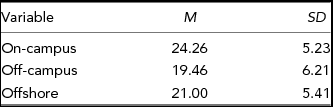
The hypothesis that on-campus students would report significantly higher levels of satisfaction than DE students (off-campus and offshore) was met. Means and standard deviations are displayed in Table 1.
Mean (SD) for Student Satisfaction by Location
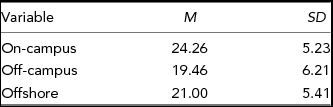
A one-way between-groups ANOVA showed a significant difference between groups on satisfaction levels, F(2, 286) = 11.09, p < .01, with a medium effect size of η2 = .07. Levene's test was not significant, indicating that homogeneity of variance was not violated, F(2, 286) = .56, p <. 05. To reduce the risk of Type I errors, the Scheffe post-hoc comparison test was chosen for its conservative properties (Pallant, Reference Pallant2011). Scheffe post-hoc comparisons revealed that the on-campus students (M = 24.26, SD = 5.23) reported significantly higher course satisfaction than off-campus (M = 19.46, SD = 6.21) and offshore students (M = 21.00, SD = 5.42).
Summary of Research Hypothesis 2
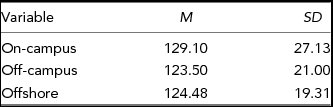
The hypothesis that on-campus students would report significantly lower levels of student-life stress than DE students (off-campus and offshore) was not supported. The mean scores for student-life stress are shown in Table 2.
Mean (SD) for Student-Life Stress by Location
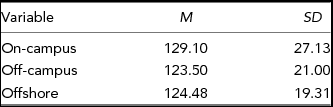
A one-way between-groups ANOVA showed no significant differences between groups on the measure of student-life stress, F(2, 287) = 1.24, p > .05.
Summary of Research Hypothesis 3
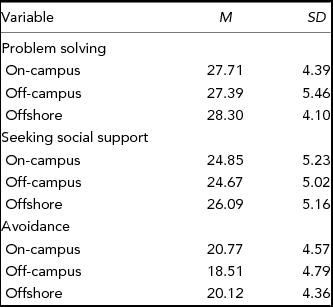
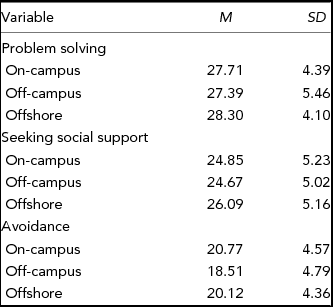
The hypothesis that there would be a significant difference between the coping strategies of on-campus and DE students (off-campus and offshore) was only partially supported. Three separate one-way ANOVAs showed no significant differences between groups on the use of problem solving, F(2, 288) = 0.94, p > .05. Similarly, no significant differences were found for the use of seeking social support, F(2, 289) = 2.14, p > 05. However, a significant difference was found between groups on the use of avoidance as a coping strategy, F(2, 289) = 3.15, p < .05. Unexpectedly, Scheffe post hoc comparisons indicated that on-campus students (M = 20.77, SD = 4.57) used avoidance as a coping strategy significantly more than off-campus students (M = 18.51, SD = 4.79).
Further post hoc tests were undertaken to test for differences in coping strategies that separated offshore students into two groups (i.e., Hong Kong and Singapore). The results of all three ANOVAs indicated no significant differences in the use of coping strategies between Hong Kong and Singapore students; for problem solving, F(3, 287) = 0.63, p > .05; seeking social support, F(3, 288) = 2.5, p > .05); and avoidance, F(3, 288) = 2.09, p > .05. This showed that once offshore was separated into its two locations (Hong Kong and Singapore), the differences between groups on the use of avoidance as a coping strategy failed to reach significance.
Summary of Research Hypothesis 4
The hypothesis that students utilising positive coping strategies would have lower levels of stress than those employing avoidance strategies was only partially supported. The mean scores on coping strategies used across the three locations are shown in Table 3. It can be seen that problem solving and seeking social support were the most commonly utilised coping strategies, across all three locations.
Means and Standard Deviations for Coping Strategies by Location
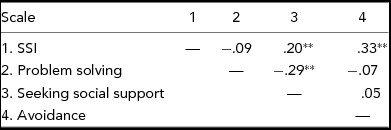
Preliminary analyses were performed to ensure no violation of the assumptions of normality, linearity and homoscedasticity. The results presented in Table 4 show that a significant, moderate, positive relationship between student-life stress and avoidance was found, r = .33, n = 292, p < .01, accounting for 11% of the variance. Unexpectedly, a significant, weak, positive relationship was found between student-life stress and seeking social support, r = .20, n = 292, p < .01, accounting for 4% of the variance. Problem solving was weakly correlated to seeking social support, r = .29, n = 291, p < .01, suggesting that students who used problem solving as a coping strategy were also likely to use social support.
Person Product-Moment Correlations Between Measures of Student-Life Stress and Coping Strategies
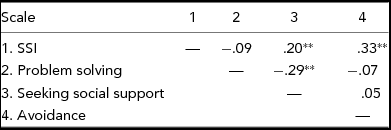
Note: ** p < .01 (2-tailed); SSI = Student-Life Stress.
Summary of Research Hypothesis 5
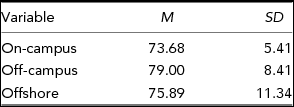
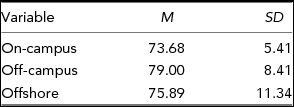
The hypothesis that on-campus students would not perform significantly better academically than DE students (off-campus and offshore) was supported. A one-way between-groups ANOVA showed no significant differences between groups on academic performance, F(2, 142) = 1.51, p > .05. The mean scores for academic performance across locations are shown in Table 5.
Descriptive Statistics for Academic Performance by Location
As the Hong Kong and Singapore offshore programs were combined in the main hypothesis testing, post-hoc analysis was run to investigate possible differences between the two offshore groups on student satisfaction and student-life stress. A finding of significant differences between these groups could have confounded initial analysis where groups were combined.
A one-way between-groups ANOVA was conducted to explore differences in satisfaction across the four locations (on-campus, off-campus, Hong Kong and Singapore). Results revealed a significant difference between groups on satisfaction, F(3, 285) = 9. 94, p < .01. Scheffe post-hoc comparisons revealed that on-campus students (M = 24.26, SD = 5.23) were significantly more satisfied than off-campus students (M = 19.46, SD = 6.21), as was previously found. However, while on-campus students (M = 24.26, SD = 5.23) were significantly more satisfied than offshore students in Hong Kong (M = 19.76, SD = 5.59), they were not significantly more satisfied then those in Singapore (M = 21.89, SD = 5.13).
A one-way between-groups ANOVA was also calculated to test for differences in student-life stress across the four modes of study. Results showed no significant differences between groups in terms of student-life stress, F(3, 286) = .92, p > .05. Finally, a one-way between groups ANOVA also showed no significant differences in academic performance across the four modes of study, F(3, 141) = 1.38, p > .05.
Discussion
The aim of the present study was to investigate differences in satisfaction, stress, coping strategies, and academic performance across on-campus and DE counselling students. Overall, it appeared that student stress, coping, and academic performance was unaffected by location or mode of study, suggesting that for the counselling students surveyed in the present study, a difference in program delivery across modes had not been a major disadvantage. However, while students produced an equivalent standard of academic performance, satisfaction levels were somewhat dissimilar.
The obtained higher levels of satisfaction for on-campus students compared to off-campus and offshore students in the present study was consistent with past research that has shown on-campus students to have higher overall course satisfaction (Johnson et al., 2002; Salisbury et al., Reference Salisbury, Pearson, Miller and Marrett2002; Song et al., Reference Song, Singleton, Hill and Koh2004). Potentially, these findings are the result of regular interactions on-campus students have with lecturers and peers during weekly lectures or tutorials, a finding in line with the theory of transactional distance (Moore, Reference Moore1991). Most importantly, these frequent face-to-face interactions allow for questions and issues to be clarified, as well as the formation of peer support networks, and building rapport with lecturers (Chapman & Pyvis, Reference Chapman and Pyvis2005). In contrast to the previous situation, off-campus and offshore students largely rely on communications media such as email or the use of discussion boards, which according to Chapman and Pyvis (Reference Chapman and Pyvis2005) can diminish communication quality, despite its potential to attenuate transactional distance (Moore, Reference Moore1991).
The absence of a significant difference for stress between the DE and on-campus students suggests that in terms of the theory of cognitive appraisal, the students had sufficient resources (coping strategies) to cope with the stress caused by the consequences of events that occurred during the academic year. Interestingly, the results from the present study were in contrast to that reported by Evans and Tregenza (Reference Evans and Tregenza2002) and Song et al. (Reference Song, Singleton, Hill and Koh2004), who found that the added challenges off-campus and offshore students encountered led to increased levels of stress, and in turn, less use of positive coping strategies. Although the findings of the present study did not support the findings of Evans and Tregenza, further investigation of coping strategy showed that problem solving and seeking social support were the most utilised coping strategies across both modes of study. Thus, stress levels may have been equally buffered in each mode of study. Furthermore, post-hoc analysis revealed that on-campus students utilised avoidance to a significantly greater extent than off-campus students. This could have negated otherwise lower levels of stress experienced by on-campus students, due to the negative affect of avoidance on stress.
The assumption that students utilising positive coping strategies would have lower levels of stress than those employing avoidance strategies was partially supported. The impact of positive coping strategies on attenuating the effects of stress can be explained by Lazarus and Folkman's (Reference Lazarus and Folkman1984) theory of cognitive appraisal, which articulates the importance of the interaction between secondary and primary appraisals of ‘what is at stake’ and how such a decision determines the degree of stress experienced. As expected, a significant positive relationship was found between student-life stress and avoidance. This is in accordance with the findings of Sasaki and Yamasaki (Reference Sasaki and Yamasaki2007), who found students using avoidance coping reported greater physiological symptoms of stress. Surprisingly, the positive relationship found in the present study between student-life stress and seeking social support, suggesting that students who utilised social support as a coping strategy experienced higher levels of stress, is not consistent with previous studies that have found positive coping strategies reduce stress (Sasaki & Yamasaki, Reference Sasaki and Yamasaki2007; Siu & Chang, Reference Siu and Chang2011). One interpretation is that the type of social support they sought was not in fact helpful. The surprising result that on-campus students had significantly higher use of avoidance as a coping strategy than off-campus students is difficult to explain, as they had both ample peer and university support services. Consequently, the assumption that access to increased support factors is inextricably linked to positive coping strategies requires further examination, as once the modes of study were separated into four separate locations (on-campus, off-campus, Hong Kong, and Singapore) differences in use of avoidance across mode of study failed to reach significance. Ultimately, further investigation needs to be conducted into this relationship, as it could simply be an artefact of the large sample size of the current study, rather than a meaningful finding.
The finding that there was no significant difference between the academic performances of the three groups was not unexpected, as recent studies have demonstrated similar findings (Carey, Reference Carey2001; Dell et al., Reference Dell, Low and Wilker2010; Johnson et al., Reference Johnson, Aragon, Shaik and Palma-Rivas2000; Kekkonen-Moneta & Moneta, Reference Kekkonen-Moneta and Moneta2002; Stizmann et al., Reference Stizmann, Kraiger, Stewart and Wisher2006), leading to the conclusion that the motivation to perform academically was not diminished by learning in DE mode. However, it is not possible at this stage to determine which theory (expectancy vs. needs) explains the results more accurately.
In summary, the findings from the present study need to be interpreted in the light of a number of limitations. First, the generalisability of the findings from the academic discipline of ‘counselling’ to other disciplines such as ‘social work’ is not clear. Second, while all students enrolled in the counselling course in the present study had an undergraduate degree, the type of degree, the number of degrees completed, and the time difference between their undergraduate degree and the masters degree was not known. These variables may have impacted on the types of responses to the challenges participants faced while studying. Third, being postgraduate students with an interest in counselling may have created important individual differences to that of undergraduate students, affecting their reactions to stress and coping, and again limiting the generalisability to other student groups.
However, as we progress and publish further studies that account for a wider range of variables, we consider that a more comprehensive understanding of the effects of DE on counselling students will be possible and that these will be of interest and benefit to other groups of counsellor educators. The importance of continuing this line of study is that there are increasing numbers of students enrolling in DE courses and for many, a DE enrolment is the only option if they wish to pursue a career in counselling.