Lactoferrin and lysozyme are two antimicrobial proteins that are found in high quantities in human breast milk, but little is found in the milk of ruminants such as goats and cows (Hettinga et al. Reference Hettinga, van Valenberg, de Vries, Boeren, van Hooijdonk, van Arendonk and Vervoort2011). There are many health benefits that breastfed infants experience as breastfeeding is known to promote the development of the intestinal mucosa and immune system. Evidence shows that lactoferrin and lysozyme in breast milk help to confer these positive effects (Mountzouris et al. Reference Mountzouris, McCartney and Gibson2002; Newburg & Walker, Reference Newburg and Walker2007).
Lysozyme is a N-acetylmuramidase that is able to cleave 1,4-beta-linkages between N-acetylmuramic acid and N-acetyl-d-glucosamine residues found in the peptidoglycan layer of bacterial cells. Lysozyme is also found in other body secretions besides milk, including tears, saliva and intestinal mucus. It possesses the ability to modulate the inflammatory response through several mechanisms (Goldman et al. Reference Goldman, Thorpe, Goldblum and Hanson1986). Along with cleaving peptidoglycan lysozyme binds to lipopolysaccharides (LPS) and lipoteichoic acid (LTA), preventing them from interacting with receptors on intestinal epithelial cells (IECs) and intestinal macrophages (Ohno & Morrison, Reference Ohno and Morrison1989a; Ginsburg, Reference Ginsburg2002). Sequestration of LPS by lysozyme suppresses pro-inflammatory effects, including production of TNF-α (Ohno & Morrison, Reference Ohno and Morrison1989b; Takada et al. Reference Takada, Ohno and Yadomae1994a, Reference Takada, Ohno and Yadomaeb; Kurasawa et al. Reference Kurasawa, Takada, Ohno and Yadomae1996).
Human lactoferrin (hLF) can act as a bactericidal, bacteriostatic and immunomodulatory agent. Lactoferrin is resistant to enzymic proteolysis in the stomach (Liao et al. Reference Liao, Lopez, Shafizadeh, Halsted and Lonnerdal2007), and partial degradation of lactoferrin by stomach pepsin frees the lactoferricin domain, which may be an even more potent antimicrobial (Yen et al. Reference Yen, Lin, Chong, Tsai, Shen, Lin, Su, Chen and Chen2009). Lactoferrin is able to bind and sequester iron, as well as prevent pathogenic bacteria from adhering to intestinal epithelial cells and invading the intestinal tissue (Actor et al. Reference Actor, Hwang and Kruzel2009). There is a 105-kDa lactoferrin receptor (also known as intelectin) that specialises in mediating uptake of lactoferrin into enterocytes and crypt cells, and porcine and human lactoferrin receptors share 82% homology (Liao et al. Reference Liao, Lopez, Shafizadeh, Halsted and Lonnerdal2007, Reference Liao, Jiang and Lonnerdal2012). Once lactoferrin is taken up by enterocytes at the brush border, is internalised into compartments in the apical cytoplasm, where it can have effects on cellular proliferation and directing immune responses including reducing oxidative stress and reducing production of pro-inflammatory cytokines (Kruzel et al. Reference Kruzel, Actor, Boldogh and Zimecki2007; Actor et al. Reference Actor, Hwang and Kruzel2009; Nielsen et al. Reference Nielsen, Hansen and Danielsen2010).
Previous work has yielded a herd of transgenic goats that produce human lysozyme (hLZ) at 270 mg/l which is 68% the concentration that is found in human milk (Maga et al. Reference Maga, Shoemaker, Rowe, Bondurant, Anderson and Murray2006a). Human lysozyme was chosen because it is a more active antimicrobial than other forms of lysozyme such as hen egg white lysozyme (HEWL) (Yang et al. Reference Yang, Wang, Tang, Liu, Guo, Yang, Yu, Li, Zhao, Zhang, Dai and Li2011). Multiple studies have characterised the hLZ in the milk and its effects on bacteria in vitro (Maga et al. Reference Maga, Shoemaker, Rowe, Bondurant, Anderson and Murray2006a, Reference Maga, Cullor, Smith, Anderson and Murrayb; Scharfen et al. Reference Scharfen, Mills and Maga2007). In addition studies in vivo have shown that feeding human lysozyme-containing transgenic goats’ milk at 270 mg/l positively impacts GI morphology, serum metabolites, lymphocyte populations, and increases anti-inflammatory cytokine expression in a porcine model (Brundige et al. Reference Brundige, Maga, Klasing and Murray2008, Reference Brundige, Maga, Klasing and Murray2010; Cooper et al. Reference Cooper, Brundige, Reh, Maga and Murray2011). Consumption of the 270 mg/l hLZ-milk also has the ability to modulate the gut microbiota of healthy pigs, significantly increasing levels of Bifidobacteriaceae and Lactobacillaceae (Maga et al. Reference Maga, Desai, Weimer, Dao, Kültz and Murray2012) and lowering levels of Escherichia coli in studies both in vitro and in vivo (Maga et al. Reference Maga, Cullor, Smith, Anderson and Murray2006b, Reference Maga, Walker, Anderson and Murrayc).
Pharming Group BV, a Dutch-based biotechnology company, has used genetic engineering to produce a herd of transgenic cows that express approximately 1·5–2·0 g/l recombinant human lactoferrin (rhLF) in their milk, a concentration within the range normally secreted in human milk (van Berkel et al. Reference van Berkel, Welling, Geerts, van Veen, Ravensbergen, Salaheddine, Pauwels, Pieper, Nuijens and Nibbering2002). Natural hLF from human milk and rhLF-milk have identical iron-binding and -release properties; however natural hLF and rhLF-milk undergo differential N-linked glycosylation (van Berkel et al. Reference van Berkel, Welling, Geerts, van Veen, Ravensbergen, Salaheddine, Pauwels, Pieper, Nuijens and Nibbering2002). Natural hLF contains complex-type glycans and rhLF-milk contains oligomannose- and hybrid-type N-linked glycans, but the overall structures are identical (Thomassen et al. Reference Thomassen, van Veen, van Berkel, Nuijens and Abrahams2005).
Zhang et al. (Reference Zhang, Sawicki, Lewis, Hanson, Nuijens and Neville2001) showed in an experiment with neonatal mice that feeding rhLF-containing milk from a transgenic mouse strain improved intestinal growth. Studies on feeding the rhLF-milk (1·2 g/l) to young pigs demonstrated beneficial changes in circulating leucocyte populations with a significant decrease in neutrophils and increase in lymphocytes, an indicator of decreased systemic inflammation, as well as changes in intestinal villi architecture including significantly taller villi, deeper crypts and a thinner lamina propria compared with control milk-fed pigs (Cooper et al. Reference Cooper, Nelson, Maga and Murray2013).
When lactoferrin and lysozyme are together they have synergistic antimicrobial properties. Lactoferrin has a cationic domain that allows it to increase lysozyme's ability to kill bacteria. Lactoferrin binds to lipopolysaccharides on the outer membrane which aids in disrupting the membrane and allows lysozyme better access to the peptidoglycan layer underneath in Gram-negative bacteria (Leitch & Wilcox, Reference Leitch and Wilcox1999), and the proteoglycan matrix of Gram-positive bacteria (Ellison & Giehl, Reference Ellison and Giehl1991). In conjunction, lactoferrin and lysozyme demonstrate a synergistic inhibition of growth of both Gram-positive and Gram-negative bacteria (van der Linden et al. Reference van der Linden, Short, Dittmann and Yu2009). Given the synergistic relationship between lactoferrin and lysozyme, milk from transgenic livestock containing both antimicrobials has the potential to have an even more pronounced positive effect on health. In addition, there are studies in vitro with both lactoferrin (Liao et al. Reference Liao, Jiang and Lonnerdal2012) and lysozyme (Maga et al. Reference Maga, Cullor, Smith, Anderson and Murray2006b) that indicated that changing the concentration of these proteins modifies the responses seen; however previous feeding studies in vivo have not investigated the effect of altering the concentrations of rhLF or hLZ in milk. The present feeding study was designed to investigate both the effects of combining rhLF and hLZ-milk and to determine the effects of diluting rhLF-milk and hLZ-milk with non-transgenic control milk, creating milk with half the concentration rhLF and hLZ used in previous feeding studies.
Materials and methods
Milk collection and pasteurisation
Transgenic cow's milk containing rhLF was provided by Pharming Group NV from a second parity Holstein from their herd in Wisconsin. Milk was collected, pooled, frozen and then sent to the University of California, Davis. A non-transgenic Holstein matched for parity and stage of lactation (mid-lactation) from the UC Davis dairy herd was selected and control milk was collected and frozen. Both control and rhLF-containing cows’ milk were pasteurised at 73·8 °C for 10 s and immediately chilled and then stored at 4 °C for no more than a week until consumption by the pigs. Pre and post-pasteurisation samples were collected and tested for lactoferrin activity through a bacterial lysis assay. The rhLF-milk contained 1·2 g/l of rhLF and retained 85% of its activity after pasteurisation.
Transgenic goat milk containing hLZ and control goat milk was acquired from the UC-Davis Goat Facility. The hLZ-milk was collected and pooled from 8 lactating does from the Artemis line of transgenic goats (Toggenburg and Alpine in origin) in their first to sixth parity, inclusive. Control goat milk was collected and pooled from non-transgenic control does of the UC Davis herd, mainly of Toggenburg, Alpine, LaMancha and Saanen in origin in various parities ranging from first to sixth. Milk was pasteurised at 73·8 °C then immediately cooled and stored at 4 °C for no more than a week before being fed to the pigs. Previous studies show that hLZ maintains 50% of its activity and that the concentration remains stable through pasteurisation (Scharfen et al. Reference Scharfen, Mills and Maga2007). Western blots were performed to confirm the presence of the lysozyme in pre and post-pasteurised milk.
Animals, blood sampling, necropsy, and sample collection
Male and female Hampshire-Yorkshire crossbred pigs were obtained from the UC Davis Swine Facility, which is a specific pathogen-free facility. Pigs from 4 litters were weaned at 3 weeks of age and raised in co-housed pens before being moved to a containment facility at 6 weeks of age and housed singly. Pigs were weighed upon arrival and kept in a temperature-controlled room between 25 and 27 °C with ad-libitum access to food (standard grower diet as previously described in Brundige et al. Reference Brundige, Maga, Klasing and Murray2008) and water for the duration of the trial. The pigs were monitored twice daily for physical and general well-being. The pigs were randomly assigned to 1 of 4 milk feeding groups that were balanced for litter and sex. To control for differences in bovine and caprine milk all groups received a 50/50 mixture of cow milk and goat milk. The pigs received either 50% pasteurised rhLF-milk and 50% pasteurised control goat milk with a final concentration of 0·6 g/l of rhLF (rhLF+CG) (n=8), 50% pasteurised hLZ-milk and 50% control cow milk with a final concentration of 135 mg/l hLZ (hLZ+CC) (n=8), 50% pasteurised hLZ-milk and 50% rhLF-milk with a final concentration of 6 g/l of rhLF and 135 mg/l hLZ (rhLF+hLZ) (n=8), or 50% pasteurised control cow milk and 50% control goat milk containing no rhLF or hLZ (CC+CG) (n=8). Each pig was fed 250 ml of milk twice a day for the first week, then the amount of milk was increased to 350 ml twice daily for the second week. Milk was delivered using a feeding pan to ensure that all animals were receiving the same amount of milk. At the end of the second week blood samples were collected via vena cava puncture into tubes containing EDTA for complete blood count (CBC) analysis using an ADVIA 120 Hemaetology System. The pigs were then weighed and euthanised using pentobarbital sodium (Fatal-Plus®, Vortech Pharmaceuticals, Ltd.) and tissue samples were collected. Duodenum samples were taken 20 cm below the pyloric sphincter and ileum samples were taken 20 cm above the ileocaecal junction. Intestinal contents from the duodenum and ileum were collected for enumeration of coliforms and Esch. coli. Tissue samples to be used for qRT-PCR analysis were snap frozen in liquid nitrogen before being stored at −70 °C until RNA extraction, and samples for histology were washed in PBS then placed in formalin. The use and care of all animals in this study was approved by the UC Davis Institutional Animal Care and Use Committee, under Association for Assessment and Accreditation of Laboratory Animal Care International (AAALAC) approved conditions.
Histology
Sections from the duodenum and ileum were placed in formalin for 48 h and then progressively dehydrated in ethanol. Sections were embedded in paraffin and then cut and mounted on slides. Slides from the duodenum and ileum were stained with haematoxylin and eosin and were photographed. Analysis was done by measuring the villi height, width, lamina propria thickness, and crypt depth at 10× magnification, using Spot Advanced Software (v3.4, Diagnostic Instruments, Sterling Heights MI, USA). In addition, the number of intra-epithelial lymphocytes and goblet cells per villus were counted at 40× magnification and analysed as cells per unit villous height. At least five villi were measured per intestinal section for each pig.
RNA preparation, cDNA synthesis, and qPCR
Samples from the duodenum and ileum were used for cytokine expression analysis. The isolation and preparation of total RNA, cDNA synthesis and qPCR conditions have been previously described (Cooper et al. Reference Cooper, Brundige, Reh, Maga and Murray2011). The transcription levels of pro-inflammatory cytokines TNF-α and IL-6, anti-inflammatory cytokine TGF-β1, as well as the intestinal receptor TRL-4, and iron transporter hepcidin were determined using the Pfaffl method with REST-MCS software (Pfaffl et al. Reference Pfaffl, Horgan and Dempfle2002). Briefly, the efficiency of each porcine-specific and validated primer pair was calculated from standard curve data. Each target gene was normalised to the housekeeping gene β-actin to determine pair-wise fold differences in expression.
Coliform and Esch. coli analysis
Intestinal contents from the duodenum and ileum were used for enumeration of colonies of total coliforms and Esch. coli. Samples were serially diluted 1 : 100 three times in Butterfields buffer and then plated on Petrifilm coliform count plates (3M, St. Paul MN, USA) with 2 technical replicates per sample. Petrifilms were incubated at 37 °C for 24 h and the resulting colonies were counted.
Statistical analysis
Statistical analysis of haematological, histological and bacterial data was performed using SAS statistical software (SAS, Cary NC, USA). Tukey's test was used to compare all 4 groups to one another and determine P values and standard errors for these comparisons. Statistical analysis for fold expression differences from the qPCR assay was performed using REST-MCS software. For all analyses a P value of ⩽0·05 was considered statistically significant.
Results
Haematology
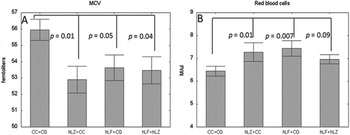
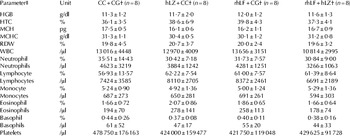
Nineteen haematological parameters were investigated (Table 1). Of these, two were significantly different between feeding groups. Pigs fed hLZ+CC and rhLF+hLZ had significantly lower mean corpuscular volume (MCV) than pigs fed CC+CG (P=0·017 and P=0·0404, respectively) and pigs fed rhLF+CG tended to have a lower MCV compared with CC+CG fed pigs (P=0·051)(Fig. 1a). Both rhLF+CG and hLZ+CC fed pigs had significantly more red blood cells (RBCs) than CC+CG fed pigs (P=0·007 and P=0·011, respectively), and pigs fed rhLF+hLZ tended to have more RBCs than CC+CG fed pigs (P=0·090) (Fig. 1b).
Means for mean corpuscular volume (MCV) (a) and red blood cell (RBC) (b) for the four different groups. P values represent values when comparing the treatment groups (hLZ+CC, rhLF+CG, rhLF+hLZ) against the control group (CC+CG). See text for details of treatments.

Haematological parameters in the pigs fed the various treatments†

† See text for details of treatments
‡ HGB, haemoglobin; HTC, haematocrit; MCHC, mean corpuscular haemoglobin concentration; RDW, erythrocyte distribution width; WBC, white blood cells
Histology
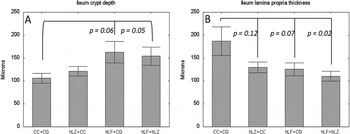
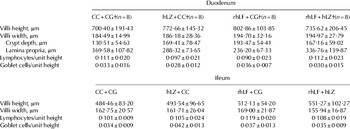
In the duodenum there were no significant differences observed between any of the milk feeding groups (Table 2). In the ileum, pigs fed rhLF+hLZ milk had significantly deeper crypts than CC+CG fed pigs (P=0·05) and pigs fed rhLF+CG tended to have deeper crypts (P=0·065) than CC+CG fed pigs (Fig. 2a). The lamina propria was also significantly thinner in pigs fed rhLF+hLZ (P=0·025) than pigs fed CC+CG, and pigs fed rhLF+CG tended to have a thinner lamina propria than CC+CG fed pigs (P=0·074) (Fig. 2b).
Means for ileum crypt depth (a) and ileum lamina propria thickness (b) for the four different groups. P values represent values when comparing the treatment groups (hLZ+CC, rhLF+CG, rhLF+hLZ) against the control group (CC+CG). See text for details of treatments.

Histological measurements from the ileum and duodenum of pigs fed the various teatments†

† See text for details of treatments
Gene expression
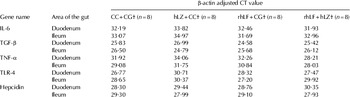
No differences in the expression of TNF-α, IL-6, TGF-β, TLR-4 or hepcidin were seen in the small intestines of pigs fed rhLF+CG, hLZ+CC, or rhLF+hLZ when compared with pigs fed CC+CG milk (Table 3).
Expression levels of cytokines in the duodenum and ileum of pigs fed the various treatments†

† See text for details of treatments
Esch. coli
No significant differences were seen in the number of Esch. coli and coliform in the ileum or colon of pigs fed any of the milk treatments (data not shown).
Discussion
Feeding young, healthy pigs milk containing either rhLF, hLZ, or rhLF+hLZ had local effects within the intestine as well as systemic effects on haematology when compared with pigs fed control milk. Overall, the combination of the two milks was only able to elicit an enhanced response over a single antimicrobial in milk in ileal morphology and none of the other parameters studied. Studies in vitro using mouse cell lines show that lactoferrin can increase proliferation of crypt cells (Liao et al. Reference Liao, Jiang and Lonnerdal2012). In the ileum of the small intestine, feeding rhLF+hLZ milk significantly increased crypt depth, and rhLF+CG milk tended to increase crypt depth compared with control milk-fed animals. Both groups receiving rhLF milk showed this response to a very similar extent, thus we attribute this effect to the rhLF present in the milk. This is consistent with results from previous studies showing that feeding milk with twice the concentration of rhLF to pigs significantly increased crypt depth (Cooper et al. Reference Cooper, Nelson, Maga and Murray2013), as well as studies feeding milk with twice the concentration of hLZ, which do not show this increase in crypt depth (Cooper et al. Reference Cooper, Brundige, Reh, Maga and Murray2011).
The lamina propria was significantly thinner in pigs fed rhLF+hLZ and tended to be thinner in pigs fed rhLF+CG compared with those fed CC+CG. Pigs fed milk with twice the concentration of hLZ (Cooper et al. Reference Cooper, Brundige, Reh, Maga and Murray2011), and rhLF (Cooper et al. Reference Cooper, Nelson, Maga and Murray2013), as well as chickens fed transgenic rice containing a combination of recombinant human lactoferrin and lysozyme (Humphrey et al. Reference Humphrey, Huang and Klasing2002), also had thinner lamina propria than animals on control diets. When fed in combination (rhLF+hLZ) we see this same result, and to a lesser extent in the group fed rhLF+CG. We propose that this is due to the general anti-inflammatory and antibacterial properties of both lactoferrin and lysozyme (Actor et al. Reference Actor, Hwang and Kruzel2009; Lee et al. Reference Lee, Kovacs-Nolan, Yang, Archibold, Fan and Mine2009; van der Linden et al. Reference van der Linden, Short, Dittmann and Yu2009) which is why this effect was seen to be strongest in the combination of rhLF+hLZ. The decreased concentration of hLZ in the hLZ+CC milk was not enough to induce this effect, implying that the thinning of the lamina propria is a dose-dependent effect.
Feeding hLZ+CC milk and rhLF+CG milk significantly increased the number of RBCs, and the combination of rhLF+hLZ milk tended to increase the number of RBCs. The mean corpuscular volume of hLZ+CC and rhLF+hLZ-fed pigs was significantly lower and tended to be lower in pigs fed rhLF+CG compared with pigs fed CC+CG. As RBCs mature they decrease in size (Evans, Reference Evans2009; Moore et al. Reference Moore, Knight and Blann2010) indicating that these pigs with reduced MCV had a more mature population of circulating RBCs along with the overall increase in RBCs. Feeding a variety of antimicrobial and anti-inflammatory supplements such as pomegranate (Harikrishnan et al. Reference Harikrishnan, Kim, Kim, Balasundaram and Heo2012), propolis (Cetin et al. Reference Cetin, Silici, Cetin and Güçlü2010) and probiotics (Harikrishnan et al. Reference Harikrishnan, Balasundaram and Heo2010), have also yielded an increase in RBC counts in multiple species including carp (Kuang et al. Reference Kuang, Xiao, Feng, Liu, Jiang, Jiang, Hu, Li, Tang and Zhou2012), chickens (Cetin et al. Reference Cetin, Silici, Cetin and Güçlü2010) and rats (Ita et al. Reference Ita, Etim, Ben and Ekpo2007). Since this response was seen when feeding lactoferrin and lysozyme, as well as other antimicrobials and anti-inflammatory agents, it is possible that these agents share a common mechanism of action.
One limiting factor in RBC production is iron availability. The bone marrow has a constant need for iron to produce erythrocytes and leucocytes (Jacobs & Summers, Reference Jacobs and Summers1981; Fonseca et al. Reference Fonseca, Pereira, Porto and Arosa2003; Drakesmith & Prentice, Reference Drakesmith and Prentice2012). The main regulator of iron stores throughout the body is hepcidin and hepcidin expression is increased in certain tissues, such as macrophages, during inflammation (Moriguchi et al. Reference Moriguchi, Otaki, Hazeki, Shimada, Matsumoto, Kakita, Kaibe, Kuragano, Nonoguchi, Masayoshi, Hasuike and Nakanishi2012; Wang et al. Reference Wang, Trebicka, Fu, Ellenbogen, Hong, Babitt, Lin and Cherayil2012; Wu et al. Reference Wu, Yung, Cheng, Yu, Babitt, Lin and Xia2012). Lactoferrin, lysozyme, and many other antimicrobials and anti-inflammatory molecules also work by modulating the gut microbiota, promoting growth of beneficial bacteria like Bifidobacterium and Lactobacillus (Hu et al. Reference Hu, Zhao, Wang, Yu, Wang and Li2012; Maga et al. Reference Maga, Desai, Weimer, Dao, Kültz and Murray2012), which in turn lower the pH of the gut and discourage the growth of pathogenic bacteria (Ljungh & Wadström, Reference Ljungh and Wadström2006). While no differences were seen in the number of coliforms and Esch. coli in the intestine, other changes in microbiota could act to decrease inflammatory signals in the gut, thus decreasing hepcidin expression in other tissues such as macrophages and the liver, thus increasing iron absorption and recycling in the body (Drakesmith & Prentice, Reference Drakesmith and Prentice2012; Wu et al. Reference Wu, Yung, Cheng, Yu, Babitt, Lin and Xia2012).
Similar studies feeding healthy young pigs the same volume of either 100% rhLF-milk or 100% hLZ-milk did not change RBC numbers (Brundige et al. Reference Brundige, Maga, Klasing and Murray2008; Cooper et al. Reference Cooper, Nelson, Maga and Murray2013). In the current study increased RBCs were observed when the dose was reduced by half, and other studies have shown a similar dose-dependent response, with lower concentrations eliciting a similar increase in RBCs, which was not observed at higher doses (Cetin et al. Reference Cetin, Silici, Cetin and Güçlü2010). A feeding study by Cerven et al. (Reference Cerven, DeGeorge and Bethell2008) found that rats fed rice containing recombinant human lactoferrin at 100 and 500 mg/kg had increased RBC counts but at 1000 mg/kg there was no effect on RBC count. Why this increase in RBC numbers was only seen in half doses of rhLF and hLZ milk is unknown; however, the 100% doses of both rhLF-milk and hLZ-milk caused proliferation of subsets of leucocytes (Brundige et al. Reference Brundige, Maga, Klasing and Murray2008; Cooper et al. Reference Cooper, Nelson, Maga and Murray2013). Proliferation of leucocytes in the bone marrow is an iron-dependent process (Jacobs & Summers, Reference Jacobs and Summers1981; Fonseca et al. Reference Fonseca, Pereira, Porto and Arosa2003; Drakesmith & Prentice, Reference Drakesmith and Prentice2012) so it is possible that at increased levels rhLF-milk and hLZ-milk still promote increased iron absorption and recycling; however this excess iron is instead funnelled to production of leucocytes as opposed to erythrocytes.
No changes in the expression of cytokines TNF-α, IL-6, or TGF-β, bacterial ligand TRL-4, or intestinal hepcidin, were observed in the small intestines of pigs fed rhLF+CG, hLZ+CC, or rhLF+hLZ when compared with control pigs fed CC+CG. While we observed no changes in expression of intestinal pro-inflammatory cytokines, other parameters including the thinning of the lamina propria indicate that the GI tract of animals fed rhLF+CG and rhLF+hLZ were experiencing a reduction in intestinal inflammation; however these effects may have gradually accumulated over the 2-week feeding period. A study feeding milk containing hLZ at twice the concentration (270 mg/l) fed in the current study found that the hLZ-milk increased production of anti-inflammatory cytokine TGF-β1 (Cooper et al. Reference Cooper, Brundige, Reh, Maga and Murray2011), indicating that when fed at a decreased concentration (135 mg/l) hLZ-milk is no longer able to illicit this change.
Overall the haematological and GI tract changes observed in animals fed rhLF+CG, hLZ+CC, and rhLF+hLZ compared with CC+CG indicate that these substances have anti-inflammatory effects both locally within the GI tract, and systemically. Locally, feeding of both milk treatments containing rhLF caused deepening of the crypts which is consistent with previous work in mouse cell lines and pigs showing that lactoferrin induces crypt cell proliferation and deepens crypts in the small intestine (Liao et al. Reference Liao, Jiang and Lonnerdal2012; Cooper et al. Reference Cooper, Nelson, Maga and Murray2013). Other studies have found that increased proliferation in the crypts leads to increased intestinal absorptive surface area and increased cellular renewal rate (Mahmoud & Edens, Reference Mahmoud and Edens2012). Feeding rhLF+CG and rhLF+hLZ also decreased the thickness of the lamina propria. This same change has been seen in pigs fed milk with twice the concentration of hLZ (Cooper et al. Reference Cooper, Brundige, Reh, Maga and Murray2011) and twice the concentration of rhLF (Cooper et al. Reference Cooper, Nelson, Maga and Murray2013), and is associated with decreased intestinal inflammation (Liu et al. Reference Liu, Guo, Wang and Yuan2010). The haematological results are in agreement with results from multiple other species fed other antimicrobial and anti-inflammatory compounds that show that feeding antimicrobial/anti-inflammatory compounds increases RBC production. We speculate that this is through changes in inflammation which may alter hepcidin regulation, and increase iron availability in the bone marrow for RBC production; however further research is needed to elucidate the actual mechanism. We detected no adverse effects from feeding milk containing hLZ, rhLF, or a combination of the two. Positive effects in both GI tract architecture and haematological parameters were observed, and these changes indicate that milk containing hLZ, rhLF, and a combination of the two decreases intestinal inflammation, and that at decreased concentration rhLF-milk still induces crypt cell proliferation. Given past research, this study also demonstrates that different concentrations of both rhLF-milk and hLZ-milk can induce different physiological changes. Further studies are needed to determine the exact mechanisms that rhLF-milk and hLZ-milk utilise to cause these intestinal and systemic changes, as well as detailed dose response studies to elucidate the threshold concentrations of rhLF-milk and hLZ-milk needed to induce the specific changes that have been observed in this and previous studies.
We would like to thank BV Pharming for providing rhLF milk. We would also like to thank Doug Gisi and the UC-Davis Dairy Barn staff for care and milking of the dairy cows, Jan Carlson and the UC-Davis goat barn staff for care and milking of the goats, and Kent Parker and the UC-Davis Swine facility staff for assistance with pig rearing as well as, Lydia Garas Klobas, Elizabeth McInnis, Erica Scott, and Merritt Clark for help handling the pigs. We thank Katherine Cubbon and Brigette Santamaria, for help examining the histological slides and Samantha Lotti and Justin Nunes for help processing intestinal samples for qRT-PCR. This work was supported by a Jastro-Shields grant from the University of California, Davis.