INTRODUCTION
Termites, through mound construction and soil particle redistribution, act as ecosystem engineers, altering soil physical properties, nutrient availability, hydrology and topography which can ultimately influence local plant richness, plant spatial distribution and vegetation dynamics (Dangerfield et al. Reference DANGERFIELD, MCCARTHY and ELLERY1998, Fleming & Loveridge Reference FLEMING and LOVERIDGE2003, Grant & Scholes Reference GRANT and SCHOLES2006, Holdo & McDowell Reference HOLDO and MCDOWELL2004, Joseph et al. Reference JOSEPH, SEYMOUR, CUMMING, CUMMING and MAHLANGU2012, Reference JOSEPH, SEYMOUR, CUMMING, MAHLANGU and CUMMING2013; Moe et al. Reference MOE, MOBÆK and NARMO2009, Seymour et al. Reference SEYMOUR, MILEWSKI, MILLS, JOSEPH, CUMMING, CUMMING and MAHLANGU2014). These changes have potential to influence browse selection by mammalian herbivores in savanna woodlands where termite mounds are an important feature of the landscape. For example, in the miombo woodlands of central Zimbabwe, Loveridge & Moe (Reference LOVERIDGE and MOE2004) found that the black rhino browsed more on vegetation on termitaria than at distances from termitaria. In this study, however, preference was tested by comparing the cumulative browse scores on different trees with distance from the mound. However, the underlying causes for differences in browse preference were not tested. This limits our understanding of the factors driving the positive selection for vegetation on termitaria by the black rhino in the savanna.
The relatively nutrient-rich soils of termitaria reduce competition for limiting nutrients i.e. nitrogen (N) and phosphorus (P), which alters the competitive dominance of plants and may also enable the coexistence of nutrient-demanding plants. As a result, there is an increase in plant productivity and species richness on termitaria compared with the matrix (Fleming & Loveridge Reference FLEMING and LOVERIDGE2003, Joseph et al. Reference JOSEPH, SEYMOUR, CUMMING, CUMMING and MAHLANGU2012, Moe et al. Reference MOE, MOBÆK and NARMO2009, Seymour et al. Reference SEYMOUR, MILEWSKI, MILLS, JOSEPH, CUMMING, CUMMING and MAHLANGU2014, Sileshi et al. Reference SILESHI, ARSHAD, KONATÉ and NKUNIKA2010). This potentially increases the quantity and variety of browse available for browsers, and at the same time reduces intraspecific competition between the animals. Woody plants on termitaria have also been found to have higher leaf N, P and palatability than those in the matrix (Grant & Scholes Reference GRANT and SCHOLES2006, Holdo & McDowell Reference HOLDO and MCDOWELL2004, Joseph et al. Reference JOSEPH, SEYMOUR, CUMMING, CUMMING and MAHLANGU2014). Additionally, termitaria act as fire refugia for woody plants which allow woody species to persist on mounds post fire (Joseph et al. Reference JOSEPH, SEYMOUR, CUMMING, MAHLANGU and CUMMING2013). Further, the soil moisture content is relatively higher on termitaria than the surrounding matrix (Dangerfield Reference DANGERFIELD1991), which maintains evergreen woody species on mounds. It is, therefore, expected that animals are likely to favour vegetation on termitaria over that in the matrix.
Our study site in south-eastern Zimbabwe, Chipinge Safari Area, is home to a black rhino population translocated in 1990 from the Zambezi Valley secondary to intensive poaching (Rachlow & Berger Reference RACHLOW and BERGER1998). Macrotermes termitaria characterize much of the savanna vegetation on soils relatively poor in nitrogen (N), extractable phosphorus (P) and total exchangeable cations (Bloesch Reference BLOESCH2008, Brossard et al. Reference BROSSARD, LÓPEZ-HERNÁNDEZ, LEPAGE and LEPRUN2007). Thus, if browse from termitaria has greater nutritional value than that found in the matrix, the possible significance of mounds as sources of nutrient-enriched forage for the black rhino is likely to be considerable.
In this study, we tested the hypothesis that the black rhino would browse more on vegetation located on termite mounds than that in the surrounding matrix (hereafter referred to as on termitaria and off termitaria, respectively) in Chipinge Safari Area, south-eastern Zimbabwe. We expected that the preference for vegetation on termitaria would be driven by the foliar nutrient status of the browse since browse preference by animals has been shown to be related to the nutritional quality of the browse (Cooper & Owen-Smith Reference COOPER and OWEN-SMITH1985, Cooper et al. Reference COOPER, OWEN-SMITH and BRYANT1988). Additionally, by determining preference for species occurring both on termitaria and off termitaria, we aimed to identify key browse species favoured by the black rhino in this system.
STUDY SITE
The study was conducted in Chipinge Safari Area (20°21′S, 32°43′E) covering 261 km2 in south-eastern Zimbabwe. The area is relatively dry, and receives an average rainfall of 489 mm y−1 (Department of Meteorological Services unpubl. data). The mean daily temperature recorded over the last 20 y is 23.3 °C, with a minimum and maximum temperature of 9 °C and 41.7 °C, respectively (Department of Meteorological Services unpubl. data). The dominant tree species in the study site include Colophospermum mopane (J. Kirk ex Benth.) J. Léonard, Diospyros quiloensis (Hiern) F. White, Combretum zeyheri Sond., Combretum mossambicense Engl., Combretum apiculatum Sond. and Combretum imberbe Wawra. On rocky areas, Brachystegia spiciformis Benth. and Julbernardia globiflora (Benth.) Troupin are found. The herbaceous layer is dominated by Hyparrhenia filipendula Stapf, Heteropogon contortus (L.) P. Beauv. ex Roem. & Schult., Justicia anselliana T. Anderson, Clutia hirsuta Eckl. & Zeyh. ex Sond., Bromus catharticus Vahl and Hypoestes verticillaris (L.f.) Roem. & Schult.
The mammalian fauna is represented by the black rhinoceros Diceros bicornis (Linnaeus, 1758), kudu Tragelaphus strepsiceros (Pallas, 1766), buffalo Syncerus caffer (Sparrman, 1779), warthog Phacochoerus aethiopicus (Pallas, 1766), bushbuck Tragelaphus scriptus (Pallas, 1766), grysbok Rhacerus melanotis (Thunberg, 1811), impala Aepyceros melampus (Lichtenstein, 1812) and bush pig Potamochoerus larvatus (F. Cuvier, 1822). The carnivores present in the study area include leopard Panthera pardus (Linnaeus 1758), spotted hyena Crocuta crocuta (Erxleben, 1777) and black-backed jackal Canis mesomelas (Schreber, 1775).
METHODS
Plot measurements
We surveyed vegetation on and off termite mounds in December 2013. The study area was divided into 10 blocks of c. 26 km2 in area. Five blocks were randomly chosen for surveying. In each block, a belt transect (30 m wide; 5 km long) was constructed from the southern side running through the centre of the grid in a northerly direction. At each 1 km along each transect, excluding the starting point, a termite mound was selected for survey in the randomly chosen perpendicular to the transect. Five termite mounds were surveyed from each of the five transects for a total of 25 sites. Termitaria with surface area at least 100 m2 and height ≥ 1 m were selected as they contained a variety of plant assemblages (Joseph et al. Reference JOSEPH, SEYMOUR, CUMMING, CUMMING and MAHLANGU2012). The long and short diameter of each termite mound was measured at right angles using a tape measure. The mean (±SE) termite mound height was 2.56 ± 0.5 m and average mound surface area was 334 ± 0.7 m2. For each termite mound, a circular control plot was placed at least 30 m away from the centre of the target termite mound or from the centre of any other nearest mound in the area. The bearing of the control plot from the target mound was taken as the first value between zero and 360 generated from a scientific calculator. A new bearing was generated if the control plot was < 30 m from another termite mound in the vicinity. All mounds were assumed to be purely conical and the area of the control plots were calculated following procedures in Muvengwi et al. (Reference MUVENGWI, MBIBA and NYENDA2013).
Vegetation characteristics measured
Tree canopy cover (C) was calculated using the following equation.
 \begin{equation*}
c = \pi \left(\frac{{d1}}{2}\right)\left(\frac{{d2}}{2}\right)
\end{equation*}
where d1 is the longer diameter of the tree and d2 is the perpendicular short diameter measured using a tape measure. Tree basal diameter was measured using a forest calliper at just above the buttress swelling.
Chemical analysis of soil and foliar samples
Soil and foliar samples were tested for N, P, K, Ca, Mg and Na at the Department of Research and Specialist Services, Chemistry and Soil Research Institute in Harare, Zimbabwe. Soil samples were collected on and off termite mounds at a depth of 20 cm using a soil auger. In the laboratory, the soil samples were then air dried to drive out all the moisture before analysis. Total Ca, Mg, K and Na were extracted using the aqua regia digestion method (Anderson & Ingram Reference ANDERSON and INGRAM1993). Although the black rhino included twigs with diameter 1 cm and less in its diet, leaves were considered for chemical analysis since they were more likely to influence forage selection than other plant parts (Holdo Reference HOLDO2003). General comparison of foliar nutrient concentration between termite mounds and control plots was done by pooling leaves from trees occurring at both sites for analysis. Also, foliar was collected from at least five individuals of the 15 tree species that were found both on and off termitaria. Foliar samples were first ashed, and then dissolved using aqua regia and the mixture dried under ultraviolet light. The resulting compound was then dissolved in concentrated HCl and filtered. The solution was diluted with distilled water. Using a spectrophotometer, total Ca and Mg were determined at 0.460 nm and 0.595 nm, respectively, and flame emission was used for K and Na. For both soil and foliar samples, determination of total N and P was based on a Kjeldahl method (Okalebo et al. Reference OKALEBO, GATHMA and WOOMER2002).
Calculations and statistical analysis
A preference or selection ratio (SR) was calculated for each common species i on and off termite mounds following Crawley (Reference CRAWLEY1983):
 \begin{equation*}
{\textit{SR}} = \frac{{d_i}}{{n_i}}
\end{equation*}
where di is the proportion of damaged plants represented by species i, and ni is the proportion of i in the plot. The overall selection ratio for a species was given by its median selection ratio across all plots in which it occurred. Only species with a minimum of two individuals per plot were included in the analysis because the inclusion of cases in which a single individual occurred could result in damage proportions of 0 or 100% (Holdo Reference HOLDO2003). Black rhino browsing could be easily distinguished from that of any other browsers in the Chipinge Safari Area because of the way they clip shoots and leaves to leave a scissor-like cut stump (Oloo et al. Reference OLOO, BRETT and YOUNG1994, Ritchie Reference RITCHIE1963). In order to minimize errors, only fresh browse of less than 3 mo was considered in this study. Bite intensity was estimated by physical counting of twigs showing fresh signs of browsing by black rhino and was expressed both at tree species level and plot level (the termite mound and its control plot). Species diversity was calculated using the Shannon–Wiener index (Krebs Reference KREBS1999).
All data were tested for normality before analysis. Data on browsing height, basal area, bite intensity and canopy cover deviated from normality and was log10-transformed to meet assumptions of normality and homogeneity of variance. A paired t-test was used to compare vegetation attributes, bite intensity and soil and foliar nutrient concentrations between the two sampling sites (i.e. on and off termitaria). The relationships between vegetation utilization parameters (i.e. selection ratio and bite intensity) and the nutritional concentration of plant species occurring on and off termitaria was analysed using Pearson's correlation analysis. In all our tests α = 0.05. We conducted statistical tests using SPSS 16 for Windows (SPSS Inc., 2007, Chicago, IL, USA).
RESULTS
Vegetation structural variables and diversity indices
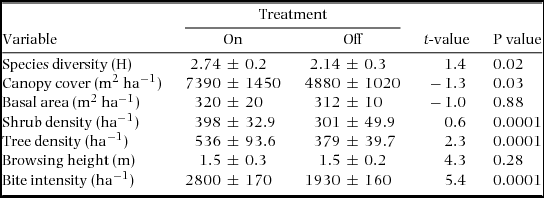
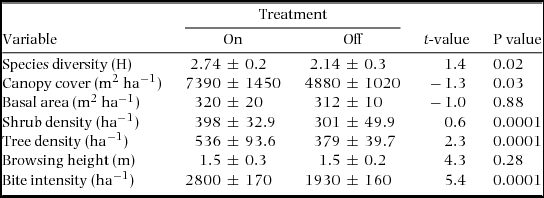
A total of 1051 (on: 563, off: 488) individual woody plants were assessed during the study period. We identified a total of 47 woody species, and of these, 27 species occurred on termite mounds, 20 species occurred off termitaria and 15 species were common on and off termitaria. Vegetation on termitaria was more diverse and dense than that off termitaria (P < 0.05; Table 1). Woody canopy cover was also significantly greater on termitaria than off termitaria (Table 1). However, the basal area of trees and the browsing height of the black rhino did not differ between the sampling sites (P > 0.05).
Mean (±SE) of some measured vegetation variables on and off termitaria in Chipinge Safari Area, Zimbabwe.
Soil and foliar characteristics
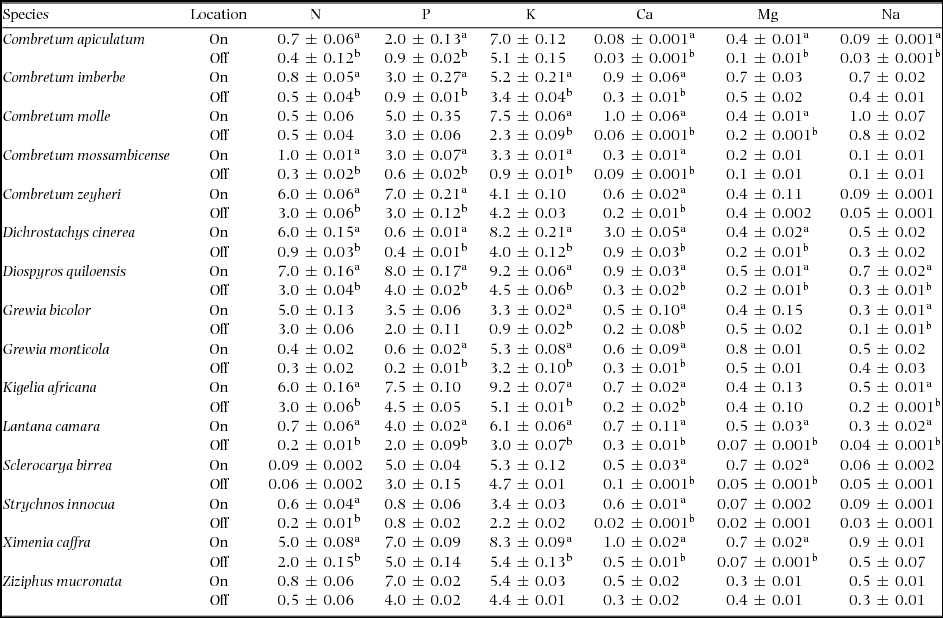
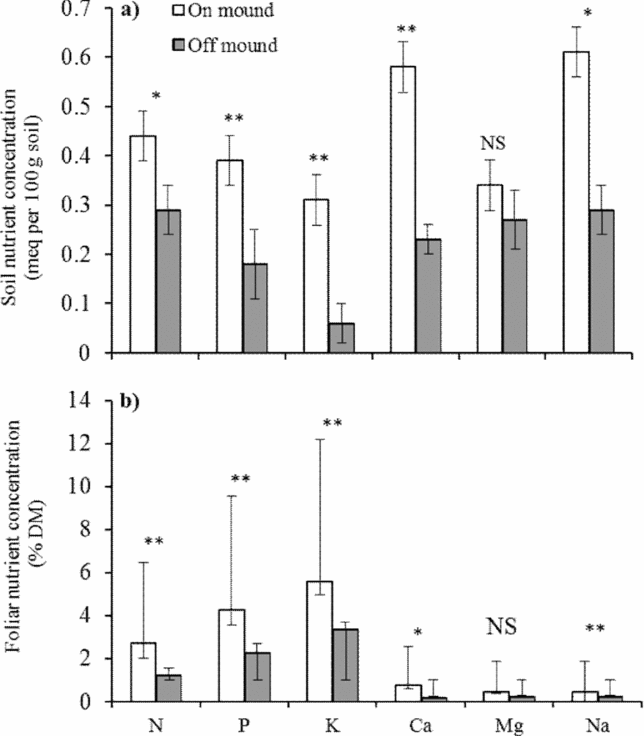
Soils on termitaria had approximately twice the levels of N, P, Ca and Na and much more K than off-termitaria soils (Figure 1a). Foliar nutrient concentrations were generally greater in vegetation on termitaria than off termitaria, also with approximately twice the concentration of tested nutrients (Figure 1b). However, the soil and foliar Mg concentrations did not differ between termitaria and off termitaria (P > 0.05; Figure 1a, b). Most of the tree species followed the between-sampling-site differences in soil nutrient concentrations, with greater foliar nutrient concentrations in trees on termitaria than those off termitaria (P < 0.05; Table 2). However, Combretum molle, Grewia bicolor, Sclerocarya birrea and Ziziphus mucronata seemed not to respond much to soil differences between sampling sites (Table 2).
Mean (± SE) leaf nutrient concentration (%) of trees browsed by the black rhino on and off termitaria in Chipinge Safari Area, Zimbabwe. Nutrient concentration is expressed on a dry matter basis. Different superscript letters (a, b) following means within a mineral element differ significantly (t-test, P < 0.05).

Mean (±SE) soil (a) and foliar (b) nutrient concentration on and off termite mounds in Chipinge Safari Area, Zimbabwe. For each sampling site, n = 25. Tests of significance are based on a paired t-test. *, P < 0.05; **, P < 0.001. NS, not significant.
Selection ratio and bite intensity
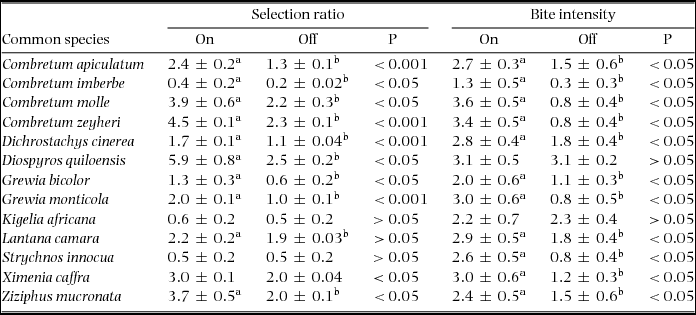
Generally, browse selection ratios were higher on termitaria than off termitaria (P < 0.05; Table 3), indicating positive selection for browse on termitaria by the black rhino. The highest selection ratio was in Diospyros quiloensis whilst Combretum imberbe, Kigelia africana and Strychnos innocua were the least selected (Table 3). Combretum molle, Combretum zeyheri, Grewia monticola, Ximenia caffra, Lantana camara and Ziziphus mucronata also had higher selection ratios than other species (Table 3). Although S. birrea and C. mossambicense occurred on and off termitaria (Table 2), the two species were avoided by the black rhinos at both sites. Bite intensity per plot was significantly higher on termitaria than off termitaria (P < 0.05; Table 1), being greater by a factor ranging from 1.6 for Z. mucronata up to 4.5 for C. molle, and by a factor of 3.3 for S. innocua (Table 3). The most selected species D. quiloensis had similar bite intensity on and off termitaria (P > 0.05).
Mean (±SE) bite intensity and selection ratio of common species browsed by the black rhino (Diceros bicornis) on and off termitaria in Chipinge Safari Area, Zimbabwe. Different superscript letters (a, b) following means within selection ratio and bite intensity differ significantly (t-test, P < 0.05).
Relationships between nutrient concentrations and selectivity parameters
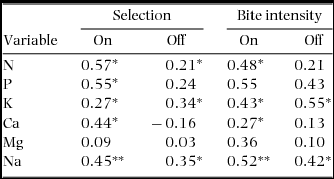
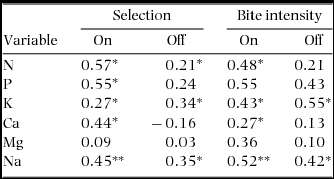
Selection ratio was positively correlated to foliar N, K and Na concentrations on and off termitaria but only correlated to P and Ca on termitaria (Table 4). Bite intensity was related to Na and K concentrations in all sampling sites but N and Ca were only related to bite intensity on termitaria (Table 4). There was no relationship between the selection ratio and bite intensity and foliar Mg on and off termitaria (P > 0.05).
Pearson correlation coefficient (r) matrix of selection ratio, bite intensity, and foliar nutrient concentration of browse species browsed by the black rhino (Diceros bicornis) on and off termitaria in Chipinge Safari Area, Zimbabwe.∗, P < 0.05; ∗∗, P <0.01.
DISCUSSION
Our study confirmed that the black rhino prefers vegetation on termitaria to that off termitaria which is consistent with previous other studies (Holdo & McDowell Reference HOLDO and MCDOWELL2004, Loveridge & Moe Reference LOVERIDGE and MOE2004, Mobæk et al. Reference MOBÆK, NARMO and MOE2005). We recorded higher selection ratios and bite intensities on vegetation on termitaria than that off termitaria, indicating positive selection for vegetation on termitaria. This difference in preference followed the between-site differences in soil and foliar nutrient concentrations, woody species diversity and vegetation density.
Termitaria offer good, almost year-round browsing due to increased soil nutrients (Holdo & McDowell Reference HOLDO and MCDOWELL2004, Seymour et al. Reference SEYMOUR, MILEWSKI, MILLS, JOSEPH, CUMMING, CUMMING and MAHLANGU2014) and increased vegetation nutrient status (e.g. N and P) and leaf palatability (Ruggiero & Fay Reference RUGGIERO and FAY1994, Holdo Reference HOLDO2003, Joseph et al. Reference JOSEPH, SEYMOUR, CUMMING, CUMMING and MAHLANGU2014). Thus, the preference for foliage on termitaria by the black rhino is due to the nutrient-rich soil and vegetation on termitaria relative to that off termitaria. Studies on plant response to resource availability (Bryant et al. Reference BRYANT, KUROPAT, COOPER, FRISBY and OWEN-SMITH1989, Watson Reference WATSON1977) also suggest that plants growing on termitaria may be less defended than plants growing in the nutrient-poor surrounding inter-mound matrices (Loveridge & Moe Reference LOVERIDGE and MOE2004, Van der Plas et al. Reference VAN DER PLAS, HOWISON, REINDERS, FOKKEMA and OLFF2013). Plants growing on nutrient-poor soils often have high concentrations of secondary compounds such as tannins that deter herbivory (Bryant et al. Reference BRYANT, KUROPAT, COOPER, FRISBY and OWEN-SMITH1989, Coley et al. Reference COLEY, BRYANT and CHAPIN1985). Thus, termitaria act as nutrient hotspots that produce nutrient-rich palatable browse which enables the black rhino to maximize dietary nutrient as well as mineral intake (Ruggerio & Fay Reference RUGGIERO and FAY1994). Additionally, due to improved nutrient absorption by plants resulting from the high cation exchange capacity of the clay-rich termitaria soils, plant growth on termitaria is enhanced relative to the surrounding matrix (Arshad Reference ARSHAD1982). The elevated plant productivity, in conjunction with the aforementioned factors likely increases the quantity of browse available for browsers, and at the same time reduces intraspecific competition between the animals.
We found higher woody species diversity on termitaria compared with inter-mound control plots, an observation which is consistent with other studies (Fleming & Loveridge Reference FLEMING and LOVERIDGE2003, Joseph et al. Reference JOSEPH, SEYMOUR, CUMMING, CUMMING and MAHLANGU2012, Reference JOSEPH, SEYMOUR, CUMMING, MAHLANGU and CUMMING2013; Moe et al. Reference MOE, MOBÆK and NARMO2009). In addition, the elevated clay content of termitaria soils increases water retention enabling the establishment and growth of evergreen woody species (Joseph et al. Reference JOSEPH, SEYMOUR, CUMMING, CUMMING and MAHLANGU2012, Van der Plas et al. Reference VAN DER PLAS, HOWISON, REINDERS, FOKKEMA and OLFF2013) and maintenance of green foliage (Jouquet et al. Reference JOUQUET, DAUBER, LAGERLOF, LAVELLE and LEPAGE2006) on mounds. Joseph et al. (Reference JOSEPH, SEYMOUR, CUMMING, MAHLANGU and CUMMING2013) also found that termitaria through mechanisms such as higher soil moisture content, reduced grass cover, and a higher elevation relative to the matrix reduce the effect of fire on mound vegetation which allows the persistence of woody species on termitaria post fire. Therefore, the black rhino prefers vegetation on termitaria than that in the matrix because of the all year-round availability of diverse evergreen woody species and green foliage on termitaria. Another hypothesis, which is supported by our data, is that the black rhino prefers termitaria vegetation because it resembles the dense woodland habitat which it favours (Tatman et al. Reference TATMAN, STEVENS-WOOD and SMITH2000). We found that the tree and shrub density and canopy cover were greater on termitaria than off termitaria. Thus, the densely vegetated mounds provide such habitat where the black rhino may find both shade and cover while feeding (Loveridge & Moe Reference LOVERIDGE and MOE2004, Mobæk et al. Reference MOBÆK, NARMO and MOE2005).
There was a marked difference in selection among the tree species, which supports the suggestion that the black rhino is a selective bulk feeder (Ritchie Reference RITCHIE1963). Diospyros quiloensis was the most-preferred species both on and off termitaria. In a similar study, in the Chewore Safari Area, Zimbabwe, elephants were found to select the same plant species as the black rhino in this study (Muvengwi et al. Reference MUVENGWI, MBIBA and NYENDA2013). We also found higher selection ratios for C. molle, C. zeyheri, G. monticola, X. caffra, L. camara and Z. mucronata than other species. These woody species with high selection ratios should be considered critical browse species requiring close monitoring as they could be a key factor in the successful conservation of the black rhino in its current range or in future re-introductions in its former range. Of all the measured elements, only foliar P and Ca and N and Ca were positively correlated to selection ratio and bite intensity on termitaria, respectively. Termitaria soils and plants are endowed with ample P and Ca providing essential minerals for the black rhino, hence the preference for foliage on termitaria. High levels of N in termitaria foliage imply a high amount of crude protein, which allows greater intake (Cooper et al. Reference COOPER, OWEN-SMITH and BRYANT1988) and may account for the high bite intensity exhibited by the black rhino on termitaria foliage. However, some common species that often occurred on termitaria which were enriched in these elements (C. mossambicense: N, P, Ca; S. birrea: Ca) were not consumed by the black rhino. This suggests that other chemical and physical factors acting alone or in combination may have hindered browsing on these species.
We remain conservative in the interpretation of our data because we did not take into consideration phenological patterns and foliage colour differences between vegetation from termitaria and inter-mound control plots, which have a potential to influence plant species selection ratio (Holdo Reference HOLDO2003, Parrini & Owen-Smith Reference PARRINI and OWEN-SMITH2010). Also, data from this research are short-term, with a high probability of asynchrony in leaf development due to differences in soil nutrients, water availability and effect of fire between termitaria and inter-mound control plots. Additionally, soil cores are point samples that miss nutrient dynamics over time. Thus, we recommend long-term studies which can capture the temporal dynamics of soil and foliar nutrient dynamics on and off termitaria over time.
In closing, the applied value of this study is twofold: given the current plight of black rhino in the miombo system, not only do our findings confirm the importance of termitaria as a source of browse; they also identify key browse species, factors that will prove pertinent to management if future re-introductions are to take place over the former range of the black rhino.
ACKNOWLEDGEMENTS
The authors are indebted to the Director General of the Zimbabwe National Parks and Wildlife Management Authority (ZNPWMA) who granted us permission to carry out this research in Chipinge Safari Area. Special thanks also go to the anonymous reviewers for their time and effort that allowed us to increase the clarity and quality of our work.