Introduction
There is increasing concern about the reduction in availability of pesticides to control pests in horticultural field crops in the UK. As a result, there is considerable interest in the development of alternative control methods, including biological control through natural populations of predators or parasitoids. One method that is of particular interest is the use of habitat manipulation, incorporating within-crop wildflower strips to enhance conservation biological control within horticultural field crops.
Although there is substantial literature (Thomas et al., Reference Thomas, Wratten and Sotherton1991, Reference Thomas, Mitchell and Wratten1992; Zhao et al., Reference Zhao, Ayers, Grafius and Stehr1992; Wäckers et al., Reference Wäckers, Bjornsten and Dorn1996; Frank, Reference Frank1997; Bugg & Pickett, Reference Bugg, Pickett, Pickett and Bugg1998; Chaney, Reference Chaney, Pickett and Bugg1998; Baggen et al., Reference Baggen, Gurr and Meats1999; Landis et al., Reference Landis, Wratten and Gurr2000; Meek et al., Reference Meek, Loxton, Sparks, Pywell, Pickett and Nowakowski2002; Gurr et al., Reference Gurr, Wratten and Luna2003; Frank & Reichhart, Reference Frank and Reichhart2004; Langellotto & Denno, Reference Langellotto and Denno2004; Rebek et al., Reference Rebek, Sadof and Hanks2005; Griffiths et al., Reference Griffiths, Holland, Bailey and Thomas2008; Holland et al., Reference Holland, Oaten, Southway and Moreby2008; Jonsson et al., Reference Jonsson, Wratten, Landis and Gurr2008) showing that habitat manipulations, such as wildflower strips and conservation headlands, lead to an increase in the abundance of a range of natural enemy species, there are few unequivocal demonstrations that these increases lead to an increased control of pests (Griffiths et al., Reference Griffiths, Holland, Bailey and Thomas2008; Jonsson et al., Reference Jonsson, Wratten, Landis and Gurr2008). Habitat manipulations are assumed to increase the abundance and diversity of natural enemies through provision of alternative foods and shelter (Zhao et al., Reference Zhao, Ayers, Grafius and Stehr1992; Wäckers et al., Reference Wäckers, Bjornsten and Dorn1996; Bugg & Pickett, Reference Bugg, Pickett, Pickett and Bugg1998; Baggen et al., Reference Baggen, Gurr and Meats1999; Landis et al., Reference Landis, Wratten and Gurr2000; Meek et al., Reference Meek, Loxton, Sparks, Pywell, Pickett and Nowakowski2002; Gurr et al., Reference Gurr, Wratten and Luna2003). This increased abundance of natural enemies should theoretically lead to a spillover of natural enemies into the crop and provide enhanced natural pest regulation (Tscharntke et al., Reference Tscharntke, Rand and Bianchi2005; Rand et al., Reference Rand, Tylianakis and Scharntke2006). Increased diversity of natural enemies can potentially lead to enhanced biological control through the ‘sampling effect’, where competitively superior enemy species depress pest levels to lower levels than less competitive enemy species, as the chances of the most competitive enemy species occurring is increased (Straub et al., Reference Straub, Finke and Snyder2008).
The majority of habitat manipulation studies, to date, have focussed on perennial manipulations within the field margins, with the aim of developing stable habitats for natural enemies, and few have considered the use of annual habitat manipulations within the crop. Chaney (Reference Chaney, Pickett and Bugg1998) demonstrated that within-field plantings of Sweet Alyssum led to a reduction in the number of Myzus persicae on lettuce, suggesting that within-field habitat manipulations may enhance biological control in annual horticultural field crops. Chaney (Reference Chaney, Pickett and Bugg1998) also demonstrated a distance effect of the wildflower strips, with the efficacy of biological control declining with distance until there was no effect beyond a distance of 11 m. If this effect is common across a range of habitat manipulations, then it would suggest that within-field habitat manipulations are likely to have a greater impact on biological control than perennial manipulations in field margins, as they will increase the amount of crop that receives enhanced biological control, through the mechanisms described above. This is particularly true, if enhanced biological control is achieved through a spillover effect, as this relies on increased edge to area ratios, which will be high for within-crop habitat manipulations, relative to field margin habitat manipulations.
Enhancement of biological control in field horticultural crops relies on the cyclical colonization of the crop (or surrounding habitats) by natural enemies (Wissinger, Reference Wissinger1997), where natural enemies move from overwintering habitats into the crop (or surrounding habitats). Within-crop habitat manipulations may aid this colonisation by providing alternative food and shelter to natural enemies at times when the crop is not suitable for colonization, which then allow spillover effects to provide enhanced natural biological control of pests.
To examine the impacts of within-crop habitat manipulations on the enhancement of natural biological control, we used a model system focussed on lettuce crops and aphids. This system was chosen because of its suitability for field manipulation and because aphids are a major crop pest worldwide, with a large number of natural enemies from a range of different guilds or functional groups, and the system has relevance to UK growers. The experimental system is similar to that used by Chaney (Reference Chaney, Pickett and Bugg1998) and allows comparison with the only published results on the use of within-crop habitat manipulations in horticultural field crops. The experimental work focussed on determining the following:
(i) whether within-crop habitat manipulation could enhance natural biological control of aphids in lettuce crops;
(ii) the importance of floral resources versus shelter on enhancement of natural pest regulation (through removal of floral resources); and
(iii) the effect of distance from the habitat manipulation on enhancement of natural biological control of aphids.
Materials and methods
Experimental design
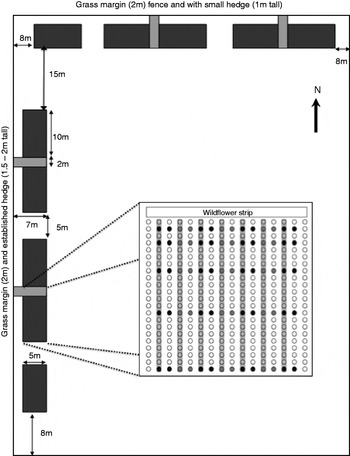
Observations were made in plots of lettuce (cv Enza Cos) grown from early June until the end of September 2006 at Warwick HRI, Wellesbourne, Warwick, UK. The lettuce plants were sown in peat blocks and grown in the glasshouse for four weeks prior to transplanting in the field. Each experiment consisted of two replicates of five plots of lettuce crop (four plots adjacent to wildflower strips and one control) arranged as shown in fig. 1. Each lettuce plot consisted of 22 rows of 16 lettuce plants (spaced at 30 cm within a row and 40 cm between rows). The experiment was repeated twice over time using different crops of lettuce (in June/July and August/September), with each experimental run lasting for seven weeks. The same wildflower strips and treatment randomisations were used for both runs.
Diagrammatic representation of the layout of the field experiment showing the locations and size of the wildflower strips and plots. The insert shows the arrangement of plants in the plots adjacent to wildflower strips. Filled circles are sampled plants, with the black circles representing uninfested plants, and the grey circles represent infested plants. The grey background highlights the plants sampled in weeks 1, 3 and 5, whilst the other plants were sampled in weeks 2, 4 and 7.

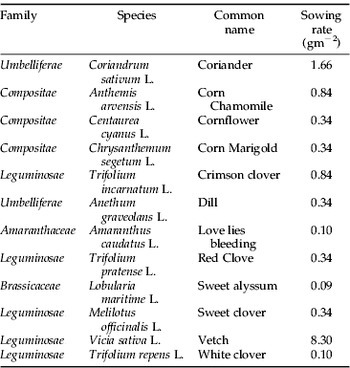
The wildflower strips were hand sown with a mix of 12 plant species (table 1) on 1 March 2006. Each wildflower strip was connected to the headland of the field to maximise natural enemy movement. In each replicate, one wildflower strip was left uncut, whilst the second strip was cut weekly, using shears, to remove buds and flowers. This was done to determine whether there was an impact of the availability of pollen and nectar sources on aphid control.
Wildflower plant species and sowing rates used.

The lettuce transplanting dates, for the two runs of the experiment, were 5 June and 4 August, respectively. The lettuce crop was grown using standard commercial practice, but no pesticides were applied throughout the experiment. All lettuce plots received one herbicide (Glyphosate) and one fungicide (Rovral WP) application at the beginning of the growing season and were hand weeded thereafter. The pesticide treatments and hand weeding included areas immediately adjacent to the lettuce plots.
To ensure that the lettuce plots were infested with aphids, some of the lettuce plants were inoculated with the currant-lettuce aphid Nasonovia ribisnigri (Mosley), using an insecticide susceptible clone (4850A), that was cultured in the laboratory at Warwick HRI. Three pairs of adjacent plants in each of five rows were infested with ten apterous aphids of mixed ages, immediately after planting. The rows selected represented a range of distances from the wildflower strips, so that any effect of distance on the subsequent number of aphids could be determined. The sampling plan, showing the infested and uninfested pairs of plants, and the plants sampled on each occasion, is given in the insert in fig. 1.
Plant sampling
Sampling of the lettuce plants began one week after the artificial infestation of the plants with N. ribisnigri. In the first week, one plant from each of the three pairs of infested plants was sampled from each of the designated rows, together with four additional non-infested plants from each of these rows. The number of aphids (recorded as either N. ribisnigri or not N. ribisnigri) and natural enemies on each plant was recorded. In the following week, the other plant from each of the infested pairs was sampled together with four additional non-infested plants that had not been sampled in the previous week. Again, the numbers of aphids and natural enemies were recorded for each plant. In the third and fifth weeks, the same plants were sampled as in the first week, and in the fourth and seventh weeks, the same plants were sampled as in the second week. Samples were not collected in the sixth week. In the first four weeks of each run, the plants were sampled in situ. All live aphids, mummies (parasitized aphids), fungus-infected aphids, natural enemies and other invertebrates seen on each plant were identified and counted, with the totals per plant recorded. A structured estimation method was used where aphid numbers were considered to exceed 300 aphids per plant. In this situation the aphids on one randomly selected leaf were counted, and this count was used to estimate the numbers of aphids across all leaves, based on the estimated leaf area occupied by the aphids.
At five and seven weeks after inoculation with N. ribisnigri the plots were sampled destructively. The selected plants were harvested, bagged individually, labelled and stored in a cold store (<5°C) prior to the counting the aphids and natural enemies on each plant. As with the in situ sampling, all live aphids, mummies, fungus-infected aphids, natural enemies and other invertebrates found on the plant or in the plastic bag used to store each harvested plant were counted and identified and the totals recorded.
The natural enemies were sorted initially into the following functional groupings:
(i) aerial dispersing natural enemies (Chrysopid adults and larvae, Syrphid larvae, Coccinellid adults and larvae, and Anthocorids, aphid mummies);
(ii) ground dwelling predators (Carabids, Staphylinids, beetle larvae);
(iii) spiders; and
(iv) fungus-infected aphids.
Statistical analysis
The aphid counts were analysed using a generalised linear model (GLM) analysis, using the individual plant data as the variable to be analysed, and assuming a Poisson distribution and a log link function. The assumed treatment structure allowed assessment of differences between the lettuce plots adjacent to the wildflower strips and the untreated control, between the lettuce plots adjacent to cut and uncut wildflower strips, and between lettuce plots running east-west or north-south from the wildflower strips. In addition, the analyses allowed assessment of differences in aphid numbers between artificially infested and non-infested plants (for both the lettuce plots adjacent to wildflower strips and the untreated control), and for plants at different distances from the wildflower strips, and assessment of interactions, as appropriate, amongst all these factors. Separate analyses were done for each individual sampling occasion and combined across all sampling occasions.
Natural enemy counts were analysed using a GLM analysis assuming a Poisson distribution and a log link function. The number of natural enemies from the different functional groups as a proportion of the total number of natural enemies was analysed using a GLM with a binomial distribution and a logit link function. Due to low counts of natural enemies on some of the sampling occasions, the latter GLM was fitted only to data from samples taken in weeks 3 to 7 for the June/July run and weeks 5 and 7 in the August/September run. The same treatment structure was assumed as described above for the aphid counts and was fitted to the following data:
(i) aerial natural enemies – larvae;
(ii) aerial natural enemies – adults;
(iii) total aerial natural enemies;
(iv) total ground natural enemies;
(v) spiders;
(vi) fungus-infected aphids; and
(vii) total natural enemies.
For all analyses, terms were added to the fitted model sequentially, allowing for the appropriate blocking structure. Terms associated with the different wildflower strip treatments were assessed against the between-plot residual mean deviance, whilst those associated with infestation status or distance from the wildflower strips were assessed against the within-plot residual mean deviance. The significance of each term was assessed using an approximate F-test, based on an estimated mean deviance parameter (assuming overdispersed distributions in all cases), comparing the observed term deviance against the appropriate residual mean deviance term.
Results
June/July run of the experiment
Effect of wildflower strips on aphid numbers
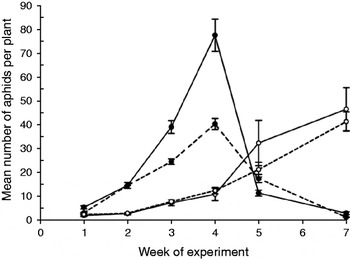
In the June/July run of the experiment, there was a natural infestation of Macrosiphum euphorbiae, and the analyses were done on the total number of aphids of all species recorded on the lettuce plants. Significantly fewer aphids were found on the plots adjacent to wildflower strips than on the control plots (F=5.07, df=1,20, P=0.036), particularly in week 1 (F=15.75, df=1,20, P<0.001), week 3 (F=17.01, df=1,20, P<0.001), week 4 (F=30.48, df=1,20, P<0.001) and week 7 (F=11.45, df=1,20, P=0.003) Overall, across all weeks, there were, on average, 39% fewer aphids per plant in the plots adjacent to wildflower strips compared with the untreated control plots. The mean numbers of aphids per plant in the control plots and the plots adjacent to wildflowers for each week of the experiment is shown in fig. 2. The greatest reductions in aphid numbers occurred in weeks 3 and 4, with the plots adjacent to wildflower strips having 63% and 52%, respectively, of the mean numbers of aphids per plant on the untreated control plots.
The effect of sampling occasion (week) on the mean number of aphids per plant. The solid circles represent the data for run 1 and the open circles run 2, with solid lines for the control plots and dashed lines for the data from the plots adjacent to wildflower strips.

Effect of distance from wildflower strip on aphid numbers
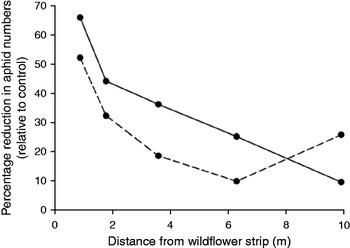
Across all sampling weeks, the number of aphids increased significantly with distance from the wildflower strip (F=11.07, df=4,20, P<0.001), and particularly in week 2 (F=3.40, df=4,20, P=0.028), week 3 (F=4.85, df=4,20, P=0.007), week 4 (F=16.05, df=4,20, P<0.001) and week 5 (F=6.66, df=4,20, P=0.001). Averaging across all weeks, there were approximately 70% fewer aphids on plants within one metre of the wildflower strips relative to the untreated control plots, with this reduction decreasing to only 10% fewer aphids relative to the untreated control plots for plants ten metres from the wildflower strip (fig. 3). No spatial pattern was observed in the number of aphids in the control plots.
The effect of distance from the wildflower strips on the percentage reduction in mean number of aphids per plant compared with control plots without wildflower strips. The solid line shows the data for run 1 and the dashed line show the data for run 2 (data are pooled across all plots adjacent to wildflowers).

There was no consistent effect of orientation of the wildflower strip, but across all weeks, there were significantly more aphids (15% on average) on plants adjacent to wildflower strips with an east-west orientation, compared to plants adjacent to wildflower strips with a north-south orientation (F=7.10, df=2,20, P=0.005).
Effect of removal of flowers and buds from wildflower strips
Cutting the wildflower strip, to remove flowers and buds, had no effect on the number of aphids on plants adjacent to wildflower strips.
Effect of infesting plants
For both plants in control plots and plants in plots adjacent to wildflower strips, significantly more aphids were found on plants that received an initial infestation of N. ribisnigri than on uninfested plants across all weeks, with, on average, 15% more aphids on artificially infested plants than on non-infested plants (F=69.54, df=1,20, P<0.001). There were no consistent significant interactions between artificial infestation and other treatments.
Effect of wildflower strips on natural enemies
There was no effect of the presence of wildflower strips on the total numbers of natural enemies except in week 4, when there were twice as many natural enemies in the control plots, compared to those plots adjacent to wildflower strips (F=11.97, df=1,20, P=0.0025), and week 7, when there were three times as many natural enemies in the plots adjacent to wildflower strips, compared to the control plots (F=16.47, df=1,20, P=0.0006). For the individual functional groups, there were more aerial predators (adults and larvae) in the control plots in weeks 3 (F=5.763, df=1,20, P=0.026), week 4 (F=16.64, df=1,20, P=0.0006) and week 5 (F=4.334, df=1,20, P=0.050), but more aerial predators in the plots adjacent to wildflower strips in week 7 (F=10.62, df=1,20, P=0.004). There were no effects of the presence of wildflower strips on the numbers of other natural enemies, except for spiders, which were over three times more abundant in plots adjacent to wildflower strips, compared to the control plots, in week 7 (F=23.56, df=1,20, P<0.001) and fungi, with twice as many fungus infected aphids in control plots, as compared to plots adjacent to wildflower strips, in week 5 (F=6.20, df=1,20, P=0.022), and nearly twice as many fungus infected aphids in plots adjacent to wildflower strips, compared to control plots, in week 7 (F=4.32, df=1,20, P=0.051).
Distance from the wildflower strip had little effect on total natural enemy numbers, with the exception of weeks 3 (F=6.24, df=4,20, P=0.002) and 5 (F=8.83, df=4,20, P<0.001), where the total number of natural enemies increased with increasing distance from the wildflower strips. For the individual functional groups, the number of aerial predators (adults and larvae) were found on the plants furthest away from the wildflower strips in weeks 3 (F=6.51, df=4,20, P=0.002), 4 (F=3.64, df=4,20, P=0.022) and 5 (F=13.29, df=4,20, P<0.001), but higher numbers of ground predators were found within two metres of the wildflower strips in weeks 4 (F=3.61, df=4,20, P=0.023) and 5 (F=4.18, df=4,20, P=0.013) than at greater distances.
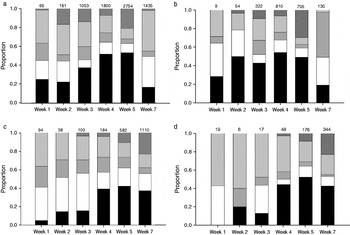
The composition of the natural enemy communities are shown in fig. 4a, b for the plots adjacent to wildflower strips and the untreated control plots, respectively. The larvae of aerially dispersing natural enemies formed a greater proportion of the total numbers of natural enemies in untreated control plots compared to wildflower plots in week 4 (F=11.06, df=1,20, P=0.013) and week 5 (F=9.84, df=1,20, P=0.007), respectively. In week 4, ground predators formed a greater proportion of the total number of natural enemies on plots adjacent to wildflowers compared to the untreated control plots (F=6.82, df=1,20, P=0.017). Similarly, in week 4, spiders formed a greater proportion of the total recorded natural enemies on the plots adjacent to wildflower strips compared to the untreated control plots (F=4.12, df=1,20, P=0.056). In week 3, more fungus-infected aphids were found on plants in plots adjacent to wildflower strips than on those in the untreated control plots (F=6.93, df=1,20, P=0.035), with fungus-infected aphids forming a lower proportion of the numbers of aphid natural enemies in the control plots compared with plots adjacent to wildflower strips. A similar effect was seen for week 5 (F=8.65, df=1,20, P=0.008), with fungus infected aphids forming a lower proportion of the natural enemies in control plots.
The community composition (proportion of total number of the natural enemies recorded) in (a) plots adjacent to wildflower strips and (b) control plots in June/July and August/September (c) and (d), respectively. White bars represent the larvae of aerially dispersing natural enemies, black bars represent the adults of aerially dispersing natural enemies, light grey bars represent spiders, dark grey bars represent ground dwelling predators and the hatched bars represent fungus-infected aphids. The numbers above the bars are the total number of natural enemies recorded in the sample for all plots (eight plots adjacent to wildflower strips and two control plots).

August/September run of the experiment
Effect of presence of wildflower strips on aphid numbers
In the August/September run of the experiment, the numbers of aphids found on plants adjacent to wildflower strips and on plants in control plots were not significantly different (fig. 2) for the individual sampling occasions.
Effect of distance from wildflower strip on aphid numbers
When the aphid counts were averaged across all sampling occasions, significantly more aphids were found on plants further from the wildflower strips compared to plants close to the wildflower strips (F=4.16, df=4,20, P=0.013). Relative to the numbers of aphids on plants in the untreated control plots, there were 52% fewer aphids on plants within one metre of the wildflower strip, this difference declining to 10% fewer aphids at a distance of 6.3 m but then increasing to 26% fewer aphids at a distance of 9.9 m (fig. 3).
Effect of removal of flowers and buds from wildflower strips on aphids
There was no significant effect of removing flowers and buds from the wildflower strips on aphid numbers, except in week 3, where nearly twice as many aphids were found on plants in plots adjacent to cut wildflower strips compared both with the numbers on plants in plots adjacent to uncut wildflowers strips and on plants in the control plots (F=9.93, df=2,20, P=0.005).
Averaged across all weeks, there were 23% and 35% fewer aphids on plants in plots adjacent to uncut wildflower strips, relative to plants in plots adjacent to cut wildflower strips and plants in untreated control plots, respectively (F=8.25, df=1,20, P=0.009).
Effect of infesting plants
As with the previous run of the experiment, when averaged across all sampling occasions, there were 60% more aphids on artificially infested plants compared to non-infested plants (F=76.67, df=1,20, P<0.001), but there were no interactions between artificial infestation and the other treatments.
Effect of wildflower strips on natural enemies
There was no effect of the presence of wildflower strips on the total numbers of natural enemies, except for week 7, when there were 25% more natural enemies in control plots compared to plots adjacent to wildflower strips (F=4.67, df=1,20, P=0.043). There was no effect of presence of wildflower strips on the individual functional groups, except for fungi in week 6 (F=5.00, df=1,20, P=0.037) , where there were nearly twice as many fungus infected aphids in the control plots.
The composition of the natural enemy communities recorded in the plots adjacent to wildflower strips and control plots are shown in fig. 4c, d, respectively. There was no effect of distance from the wildflower strip on the numbers of natural enemies in this run of the experiment.
Discussion
The results from the June/July run of the experiment show that the presence of within-field wildflower strips can influence the numbers of aphids in lettuce crops compared to a control treatment. Our results show that the number of aphids on lettuce plants in plots adjacent to wildflower strips increased with distance from the wildflower strip, rising to similar numbers to those found on control plants at a distance of ten metres. This confirms observations made by Chaney (Reference Chaney, Pickett and Bugg1998) that growing sweet alyssum flowers within a lettuce crop led to a decrease in the number of Myzus persicae on lettuce plants up to a maximum distance of 11 m.
The variable results for the effect of wildflower strips on natural enemies highlights the importance of having counts of both natural enemies and aphids to understand the effect of surrounding vegetation, as an examination of natural enemies alone would suggest that the presence of wildflower strips had little or no effect. Linking information on natural enemies with that of aphid abundance provides a clearer indication that wildflower strips have an impact on aphid abundance, potentially mediated through natural enemies, and that abundance of natural enemies is primarily driven by prey availability. A more detailed analysis of the data is required to fully elucidate the effects of wildflower strips on natural enemy abundance, where the natural enemy abundance is linked to the abundance of aphids, with appropriate delays to account for the time from egg-laying to appearance of larvae.
Conservation biological control theory suggests that manipulated habitats attract natural enemies, which provide a pest control service within adjacent crops (Zhao et al., Reference Zhao, Ayers, Grafius and Stehr1992; Wäckers et al., Reference Wäckers, Bjornsten and Dorn1996; Bugg & Pickett, Reference Bugg, Pickett, Pickett and Bugg1998; Baggen et al., Reference Baggen, Gurr and Meats1999; Landis et al., Reference Landis, Wratten and Gurr2000; Meek et al., Reference Meek, Loxton, Sparks, Pywell, Pickett and Nowakowski2002; Gurr et al., Reference Gurr, Wratten and Luna2003). There was little effect of wildflower strips on the number of natural enemies in lettuce plots, with the plots having the greatest number of natural enemies varying across the weeks. The high abundance of aerial natural enemies in this study (fig. 4) is consistent with the work of Holland et al. (Reference Holland, Oaten, Southway and Moreby2008), who demonstrated that aerial natural enemies were the dominant natural enemies in cereal crops. In June and July, there were more aerial predators in control plots than in lettuce plots adjacent to wildflower strips. This appears contrary to the results showing that plots adjacent to wildflowers had lower aphid numbers. However, natural enemies from wildflower strips may have contributed to a depression in aphid numbers early in the development of the aphid population when analysis of the natural enemy data was not possible due to low abundance of natural enemies. At later sampling occasions, there were more aphids in control plots; and these plots would have attracted greater numbers of natural enemies, as expected from a density dependent response. This is supported by the observation of greater numbers of natural enemies on lettuce plants further away from wildflower strips that have higher numbers of aphids.
In contrast to the observed patterns for aerial predators, abundance of ground predators and spiders was influenced by the presence of wildflower strips, as seen in previous work (Thomas et al., Reference Thomas, Wratten and Sotherton1991, Reference Thomas, Mitchell and Wratten1992; Frank, Reference Frank1997; Frank & Reichhart, Reference Frank and Reichhart2004). In this study, an effect on ground predators was only found within two metres of wildflower strips.
The observed effect of the wildflower strips in increasing fungal infection of aphids, in weeks 5 and 7 of the June/July run and week 6 of the August/September run, is consistent with the work of Ekesi et al. (Reference Ekesi, Shah, Clark and Pell2005) on cereal aphids, which suggested that non-crop habitats could act as reservoirs for infection by airborne spores or through carriage of spores on natural enemies. It is difficult to explain why cutting the wildflowers is associated with an increase in fungal infection of aphids in adjacent lettuce plots, though it could be that the mechanical activity of cutting caused the release of greater numbers of spores into the environment relative to release rates from the uncut strips or encouraged the movement of invertebrates that transmitted the fungal infection into the crop.
The differential effect of the presence of wildflower strips on the different functional groups of natural enemies highlights the importance of considering the community of natural enemies when determining effects on aphid numbers. The high incidence of fungus-infected aphids and spiders in plots adjacent to wildflower strips in week 7 of the June/July run led to significantly greater natural enemy abundance in these plots compared to control plots.
The lack of an effect of the presence of wildflower strips in the August/September run appears contrary to the theory of conservation biological control, but could be a result of low numbers of natural enemies in this part of the season, or of a slow increase in aphid numbers, so that lettuce plants were not attractive to natural enemies until close to the end of the experiment. Fewer natural enemies were observed throughout this later season run; and, in particular, syrphid larvae abundance increased only in weeks 5 and 7, when aphid populations reached high numbers, although this observation may be an artefact of the destructive sampling. The presence of more natural enemies in control plots in week 7 supports this, as there were more aphids in control plots compared to plots adjacent to wildflower strips. In the June/July run, there was a heavy natural infestation of lettuce plants with Macrosiphum euphorbiae, which may have attracted natural enemies to the lettuce plants, leading to the suppression of aphid numbers seen in this run. Macrosiphum euphorbiae prefers to inhabit the outer leaves of lettuce plants, making it more accessible to natural enemies, whilst Nasonovia ribisnigri tends to inhabit the heart of the lettuce and is, therefore, less accessible to natural enemies. This is supported by the results showing that there were 60% more aphids on infested plants in the August/September run, compared with only 15% more aphids on infested plants in the June/July run. In the June/July run, no more than 13% of the aphids on the lettuce plant were N. ribisnigri; whereas, in the August/September run, nearly all aphids were N. ribinsnigri. Further work is required to determine how the location of the aphids within the plant influences the control of aphids by natural enemies.
The presence of floral resources and vegetation structure are believed to influence the attractiveness of manipulated habitats to natural enemies (Zhao et al., Reference Zhao, Ayers, Grafius and Stehr1992; Wäckers et al., Reference Wäckers, Bjornsten and Dorn1996; Bugg & Pickett, Reference Bugg, Pickett, Pickett and Bugg1998; Baggen et al., Reference Baggen, Gurr and Meats1999; Landis et al., Reference Landis, Wratten and Gurr2000; Meeks et al., Reference Meek, Loxton, Sparks, Pywell, Pickett and Nowakowski2002; Gurr et al. Reference Gurr, Wratten and Luna2003). The results of both runs of the experiment appear consistent with this theory, with greater suppression of aphids on plants adjacent to uncut wildflower strips than further from them. Cutting of the wildflower strips, in June/July, had no effect on the suppression of aphids, which appears inconsistent with this theory, although it is consistent with previous work on ornamental crops (Rebek et al., Reference Rebek, Sadof and Hanks2005). If availability of floral resources was crucial, then it would be expected that removal of floral resources would influence aphid suppression. However, cutting of the wildflower strips in the June/July experimental run did not remove all floral resources, and some flowers were available between cuttings. Also, given the abundance of floral resources in surrounding vegetation during June/July, it is possible that floral resources within the wildflower strips were not as important as the availability of shelter sites (Griffiths et al., Reference Griffiths, Holland, Bailey and Thomas2008; Holland et al, Reference Holland, Oaten, Southway and Moreby2008; Langellotto & Denno, Reference Langellotto and Denno2004; Rebek et al., Reference Rebek, Sadof and Hanks2005). This is potentially supported by the observation of fewer aphids on plots adjacent to wildflower strips with a North-South orientation in the June/July run, as these wildflower strips were next to a grass margin with fence and small hedge, which contained a number of alternative floral resources, such as umbellifers. The East-West wildflower strips were adjacent to an established hawthorn hedge with minimal alternative floral resources. The ability to remove inflorescences, without detrimentally impacting on natural biological control, is of practical significance for annual crops, since it minimises the potential for the wildflowers to contribute to the weed seedbank for future crops. More experimental work is required to determine the importance of floral resources, and how landscape provision of floral resources interacts with within-field provision to determine the abundance of natural enemies and subsequent impact on aphid populations.
The experimental work detailed in this paper clearly demonstrates that annual wildflower strips can lead to reduced aphid infestations during June and July plantings of lettuce and, as such, is one of the few experiments to show a direct effect of the presence of wildflower strips on pest numbers in field vegetable crops. The aphids were attacked by a number of different guilds of natural enemy, but, as suggested by Griffiths et al. (Reference Griffiths, Holland, Bailey and Thomas2008), further research is required to determine the precise mechanisms by which the wildflower strips could be facilitating this reduction in aphid numbers. The suppression of aphids achieved in the June/July experiment has potential to be significant in a commercial growing situation, but further work is required to ensure that this effect is achieved consistently.
Acknowledgements
The authors wish to thank Sarah Dyer for her assistance with the fieldwork and Defra for funding the project, and the anonymous referees for their comments on the manuscript.