I.
Oliver Twist, the early novel which a twenty-five-year-old Charles Dickens published serially from 1837 to 1839, revised in the 1840s, and featured in the public readings he offered from 1867 until his death in 1870, might well have inspired the thirty-two-year-old Robert Louis Stevenson before he serialized his own first novel, Treasure Island, in 1882. There are, after all, remarkable similarities between the two texts. For each dramatizes a young boy's immersion in a counter-world headed by villains who defy the norms of a dubious patriarchal order. What is more, the strong spell that thieves like Fagin and Bill Sikes and pirates like Billy Bones and Long John Silver exert over the innocents they mesmerize infects readers of each narrative as well as viewers of their many cinematic adaptations. We thus face a quandary. Despite our empathy with little Oliver and with his adolescent counterpart Jim Hawkins, we may question each boy's reintegration into an order whose fissures have been radically exposed.
As potential parental surrogates, the anarchist subverters of that order act as foils to the “gentlemen” who restore each boy's vulnerable identity. The orphaned Oliver recovers his genteel origins upon his final adoption by a belatedly masculinized Mr. Brownlow, while the fatherless Jim Hawkins assumes the position of a patriarchal scribe when he is instructed by “Squire Trelawney, Dr. Livesey, and the rest of these gentlemen . . . to write down the particulars” of their joint adventures (Stevenson, Treasure Island 1). Initially, however, each boy was drawn to the marginalized outsider who befriended him. Oliver gratefully welcomed the nourishment and shelter proffered by a grinning Fagin who parodies domesticity by first appearing “dressed in a greasy flannel gown” and “dividing his attention” between steaming sausages on a “frying-pan and a clothes-horse” (Dickens, Oliver Twist 64; vol. 1, ch. 8). For his part, young Jim, who had already found the crude virility of “Captain” Billy Bones far more appealing than the subservience of his enfeebled, inn-keeper father, soon finds a more complex parental surrogate in Long John Silver, the smooth, seemingly pliant, one-legged leader who deviously poses as an affable innkeeper and “sea-cook.”
As the master-plotter of Treasure Island, Silver combines Fagin's wiliness with the brutality of Sikes. Whereas Dickens holds both of his villains responsible for the bludgeoning of Nancy, Oliver's protector, Stevenson has Jim admire the mixture of deception and agility that allows Silver, “even without leg or crutch,” to kill a sailor for refusing to join the mutineers (Stevenson, TI 61). Despite witnessing this cold-blooded murder, the awed boy cannot shed his identification with the self-styled “Captain Silver.” He, too, will kill a man after being lulled into complacency by being addressed as “Captain Hawkins.” And he is still tethered to the one-legged pirate before the novel's final twist accidentally restores him to the fellowship of the “gentlemen” who have badly botched the treasure hunt and now fail to deliver this artful dodger to English justice and the gallows.
Whereas Stevenson has Jim Hawkins acknowledge Silver's undiminished power at the end of a narrative that increasingly undercuts traditional standards of virility, Dickens must annihilate his male infractors before an ever-“pure” Oliver, unsoiled by his low-life contacts, can safely reenter the genteel and feminine world from which he was barred. Yet the successive deaths of Bill Sikes as well as of “the Jew” who had cautioned his “bolder” associate to be “crafty, . . . and not too bold” are far more powerfully rendered than Oliver's benign restoration (Dickens, OT 377, vol. 3, ch. 7; 396, vol. 3, ch. 9). Memorably illustrated by George Cruikshank, Sikes's precarious perch on the roof-top from which he and his dog will fall would become an iconic high point – both visual and descriptive – in Oliver Twist and in the book's many dramatic and cinematic adaptations. Dickens himself understood the scene's melodramatic value when he ended his public reading of “Nancy and Sikes” by hoarsely declaiming first, “the crowd's furious cry” on detecting the murderer, and, then, by fully acting out Sikes's final moments of terror and retribution: “At the instant that he brought up the loop over his head before slipping it beneath his arm-pits, looking behind him on the roof he threw up his arms, and yelled, ‘The eyes again!’ Staggering as if struck by lightning, he lost his balance and tumbled over the parapet. The noose was at his neck; it ran up with his weight; tight as a bowstring, and swift as the arrow it speeds. He fell five-and-thirty feet, and hung with his open knife clenched in his stiffening hand!!!” (Dickens, “Sikes and Nancy” 395).Footnote 1
Although equally memorable, Dickens's verbal and Cruikshank's pictorial depiction of the condemned Fagin's last hours proved to be far more problematic for the novel's future adaptations. Dickens has the disheveled Newgate prisoner “remember a few disjointed fragments of what the judge had said” before pausing on the verdict itself: “To be hanged by the neck till he was dead – that was the end” (OT 443, 445; vol. 3, ch. 14). In an unusual departure for a novel that has relied on the externals of dialogue, description, and the narrator's often satirical mediating voice, the ensuing paragraphs render the claustrophobic interiority of Fagin's consciousness. If Sikes's abrupt fall was precipitated by the sudden intrusion of the dead Nancy's eyes, Fagin's recall of all the executions he has seen only confirm the “withering sense” of his present helplessness (446; vol. 3, ch. 14). When, later in the same chapter, Oliver and Mr. Brownlow enter the condemned man's cell, he implores to be taken “Outside, outside” (449; vol. 3, ch. 14). But is not only his prison-cell that Fagin wishes to escape. He also wants to loosen the fetters of his own imprisoning mind, a mind that at this point briefly links this foiled plotter to the over-plotting novelist himself.
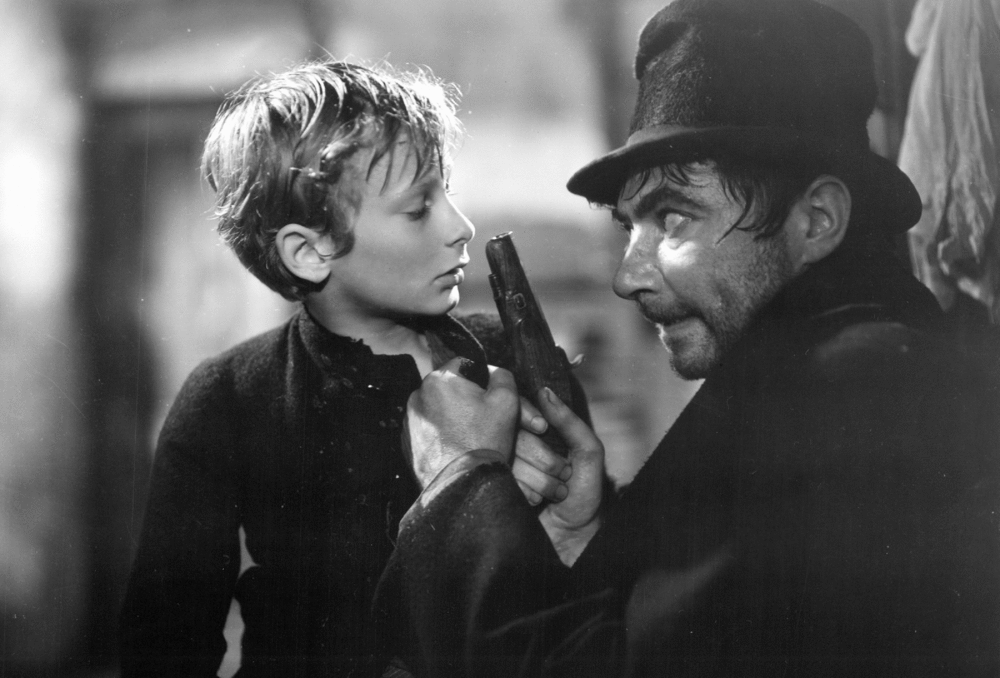
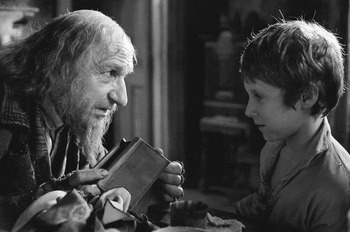
Most film adaptations of Oliver Twist heavily rely on the Dickens/Cruikshank rendition of Sikes's melodramatic death. David Lean's 1948 version even heightens that melodrama: Robert Newton is a terrifying Bill Sikes who threatens John Howard Davis's Oliver (Figure 1) and forces him to join Sikes on the roof from which the “monster” (a Victorian King-Kong) will tumble. Roman Polanski's 2005 adaptation, however, chooses to revisit Fagin in his lonely cell.Footnote 2 Throughout, Ben Kingsley's Fagin mixes menace with kindness in his interactions with Oliver Twist (played by Barney Clark; see Figure 2). In a double self-inscription that carries connotations quite different from Dickens's own quasi-schizophrenic investment in the extremes represented by Oliver and Fagin, Polanski stresses the human bond forged between an outcast boy and the pariah whom Dickens and David Lean prefer to treat as a stereotype.Footnote 3 Although the 2005 film restores the death-sentence that Dickens used to bring his plot to its final (re)solution, it also injects an unexpected note of empathy. Spirited away by a caring Mr. Brownlow, Polanski's Oliver remains visibly troubled by his farewell from the man who had fed him and nourished his imagination. The same Ben Kingsley whom Polanski now casts as Fagin had, after all, not only played a saintly Mahatma Gandhi and a Silas Marner redeemed by his love for the blonde child he adopts and raises, but also, just as memorably, the sad-eyed Jewish survivor of Spielberg's Schindler's List.
Oliver Twist. Dir. David Lean. Perf. Robert Newton and John Howard Davis. Cineguild, 1948. Courtesy of Photofest, Inc.

Oliver Twist. Dir. Roman Polanski. Perf. Ben Kingsley and Barney Clark. Sony Classics, 2005. Courtesy of Photofest, Inc.

The closure of Polanski's 2005 film asks viewers to note that its emphasis on Fagin's death involves a rejection of the antithetical endings of the two major adaptations that preceded Polanski's: David Lean's black-and-white 1948 Oliver Twist and Carol Reed's 1968 technicolor musical, Oliver! The outrage over the sinister Fagin played by Alec Guinness had prompted Lean to cut the cell-scene from the American version of his controversial film and to highlight, instead, the roof-scene that so powerfully dramatized Sikes's death. In his truncated film, that scene is immediately followed by a celebration of the reclaimed Oliver. Freed of the rope that tied him to a master-criminal, a gaily skipping Oliver is reborn into a desexualized universe devoid of fallen women martyred by male aggression. Holding the hands of Mr. Brownlow (whom Lean now casts as the boy's grandfather) and by Mrs. Bedwin, that gentleman's grandmotherly housekeeper, the happy boy can enter the domestic haven that will allow him to forget the seduced mother who died in childbirth as well as the prostitute who was slain by her sadistic lover. Forever sheltered from a brutal and rapacious masculinity, Oliver has become as inviolate as the dome of St. Paul's (used so prominently in this post-war film as an icon of an integrity that withstood an evil enemy's firebombs).
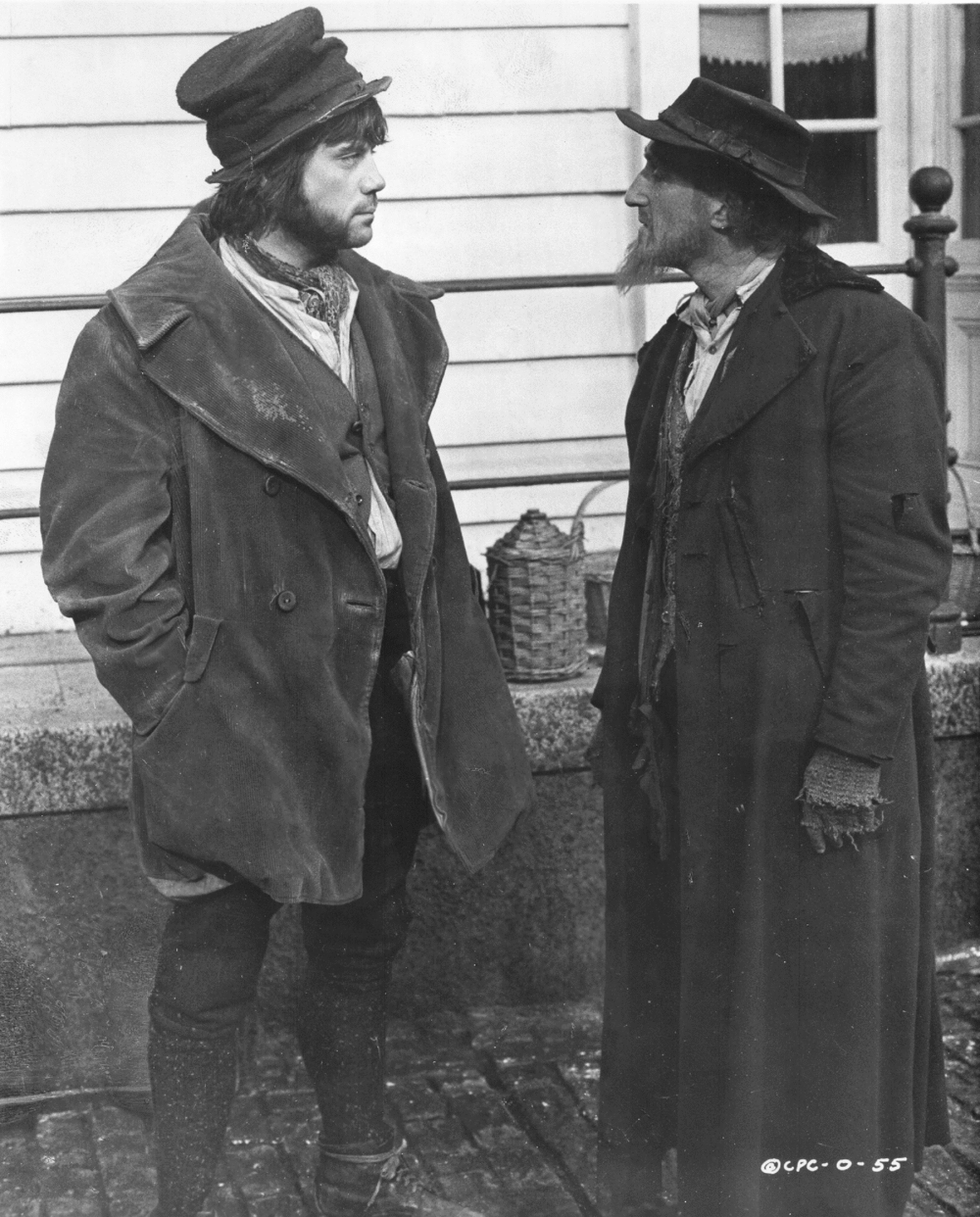
For his part, Carol Reed anticipates the 1971 film version of the Broadway play Fiddler on the Roof by converting Fagin into a Tevye-like survivor in his 1968 Oliver!. Oliver Reed is a Sikes who never sings, while Ron Moody is a more benignantly warbling Fagin in this version (Figure 3). Unlike Lean but also far more than Polanski, he absolves the criminal from any complicity in Nancy's death. It is Sikes alone (an Oliver Reed who proves to be even more terrifying than Robert Newton was in Lean's film) who is solely responsible for a murder he commits only steps away from the fleeing Oliver. As the boy's protector and as Nancy's ally, Carol Reed's genial Fagin (played by Ron Moody) can go free. His escape from justice precedes and even eclipses the obligatory Brownlow/Oliver reunion. Warbling the song that allows him once again “to review the situation,” this bouncy Fagin not only overcomes the loss of his treasure chest but is also joined by an equally resilient fugitive, the Artful Dodger. Mr. Brownlow may once more be allowed to repossess an ever-sweet, easily domesticated child. But turning to pastures new, an outlaw man and an outlaw boy skip off into an ever-refulgent sunset. Like Charlie Chaplin and his boy-companion in The Kid, they are indestructible tramps.
Oliver! Dir. Carol Reed. Perf. Oliver Reed and Ron Moody. Columbia Pictures, 1968. Courtesy of Jerry Ohlinger's Movie Material Store, Inc.

What is notable about both Polanski's and Reed's revisions of Dickens/Lean is that their endings come much closer to that of Stevenson's Treasure Island than to that of Oliver Twist. Dickens needed to purge both Sikes and “the Jew” from his Victorian fairy tale of a “Parish Boy's Progress.” His saintly child may piously ask a Christian God to forgive “this wretched man” and even invite Fagin to kneel and pray with him; but Oliver's charity seems devoid of any emotional ties to the “pleasant old gentleman” who had first made him laugh (OT 449, vol. 3, ch. 14; 66, vol. 1, ch. 9). Polanski's demand that Oliver recollect such bonds and Reed's insistence on Fagin's ability to survive loss may modernize an allegory of redemption that Lean was determined to retain. But their revisions also bring their films closer to Treasure Island, a text in which Stevenson not only extricated Long John Silver from a hostile mob as deadly as that which drives Sikes to his death, but also freed him from the very gallows to which Dickens condemns Fagin. Indeed, like Polanski, Stevenson ended his narrative by stressing the emotional conflict of a boy who cannot exorcise the past that tethered him to a villain he cannot reduce into an emblem of pure evil.Footnote 4
Whereas Dickens re-implanted a prepubescent child into a social order he stripped of male sadism and feminized through Nancy's and Rose Maylie's interventions, Stevenson bars Jim Hawkins from constructing the happy climax demanded by a growing boy's narrative of masculinization. The spirited adolescent who has killed a pirate and recovered a ship regresses as soon as, near the novel's end, he once again becomes Silver's unwilling captive. Tethered by the rope the pirate holds, “now in his free hand, now between his teeth,” Jim feels that he is being “led like a dancing bear” (TI 136). This new twist of the story that Jim is instructed to tell further undercuts his dominance, both over the plot he narrates and as the adult leader he aspired to become. For neither Silver nor his gentlemanly opponents, but rather a crazed child/adult, the fur-clad, ursine Ben Gunn, brings the plot to a close. It is Ben who was in possession of the coveted treasure, Ben who now plays a crucial role in Silver's capture, and Ben, again, who will allow Silver to escape. Once back in England, this child-man promptly loses his share of the hoard and becomes “a great favourite, though something of a butt, with the country boys, and a notable singer in church on Sundays and saints’ days” (151).
Silver's immunity to the retribution that Dickens visits on both Sikes and Fagin certainly allows us to read Treasure Island almost as much of a response to Oliver Twist as Carol Reed's revisionist Oliver! Freed by a crazed Sunday chorister, the buccaneer who had once masked himself as a “clean and pleasant-tempered landlord” (33) can easily slide back into the social order that Dickens and Cruikshank tried to decontaminate when, at the end of the novel, writer and illustrator invited the reader-viewer to look at Oliver and Rose Maylie devoutly staring at the purified interior of an “old village church” (OT 455; vol. 3, ch. 15). The closure of Stevenson's pirate narrative all but mocks the final note of respectability that Dickens provided for his Newgate novel. Absconding with his loot, Silver and his female parrot, “Captain Flint,” are free to rejoin the “old missis” he trusts far more than any male gentleman or fellow-pirate (TI 46). This helpmeet, the loyal “negress” who has thriftily sold their inn, is waiting for him to start life anew (151). Allowed to enjoy a bourgeois afterlife, this transgressive family unit repudiates the conventional Victorian endings that Stevenson had increasingly come to distrust. By 1882, he seemed to have dropped both his early infatuation with droll Pickwickian caricatures and a boyish sentimentality that once made him cry his “eyes out” over The Christmas Books (Letters 2: 55).Footnote 5
As narrator of his own story, Jim Hawkins continues to be haunted by horrors that Oliver (and Dickens) can leave behind. Jim concludes his narrative by decrying the aftermath of adventures he had begun with such alacrity. He vows never to return to the “accursed island” where much of the treasure still lies buried. Unlike the Oliver who stands together with Rose Maylie, in Cruikshank's last drawing for Dickens's text, in thoughtful contemplation of his mother's funeral crypt, Stevenson's Jim Hawkins is plagued by disturbing memories that unsettle him almost as much as those which haunted a condemned Fagin. Jim ends his narrative by acknowledging that he continues to be troubled by nightmares: “the worst dreams I ever have are when I hear the surf booming about [the island's] coast, or start upright in bed, with the sharp voice of Captain Flint still ringing in my ears” (TI 151).
I have so far, in this first section of my essay, marked the affinities that strongly link the original texts of Oliver Twist and Treasure Island, yet have simultaneously stressed some of the major differences that separate Dickens's sprawling novel for adults from Stevenson's much tighter, first-person narrative for juvenile readers. These differences, I have suggested, also separate cinematic versions that retain Dickens's affirmation of a purified, but debilitated bourgeois order, such as Lean's 1948 film, from those later adaptations of Oliver Twist, such as Polanski's and Reed's, that stress the pervasive vitality of Fagin's counter-world. And, lastly, I have coyly hinted that the similarities between Stevenson's late-nineteenth-century text and such late-twentieth-century updatings of Dickens may well allow us to read Treasure Island itself as an adaptation or reconstitution of Oliver Twist.
Still, that hint, however plausible, cannot be verified. Despite Stevenson's abundant allusions to Dickensian texts in his letters, his early fondness for The Pickwick Papers, for example, and his later interest in novels such as Great Expectations and Our Mutual Friend, there is no evidence whatsoever that he ever thought of casting the novel he originally called “The Sea-Cook” as a response to Oliver Twist.Footnote 6 In fact, he never cites, and hence may well never have read, the story of the dispossessed child whose pathos early film-makers found, soon after Stevenson's death, to be as irresistible a commodity for their one-reelers as his own story of a lad's adventures among pirates.
The lovable Oliver's adoption by Mr. Brownlow logically led to his repeated adoption by script-writers of films and radio-programs. Silent films such as the short 1897 Death of Nancy Sykes could focus on Dickens's own chosen set piece whereas longer and more ambitious adaptations such as the 1922 Oliver Twist with Lon Chaney as Fagin and Jackie Coogan as Oliver could draw on Cruikshank's original illustrations for their most memorable tableaux. Even radio broadcasts could fruitfully feed off the ready-made speeches of a novel that had so heavily relied on dialogue. When Orson Welles chose to dramatize Oliver Twist for his 1938 “First Person Singular” series for CBS radio, he reserved for himself the role of Fagin, and, instead of Dickens's garrulous narrator, used the voices of Mr. Brownlow and of an adult Oliver as primary and secondary narrators.Footnote 7
As Welles's own case illustrates, however, popular adaptations of Oliver Twist soon blended with equally popular adaptations of Treasure Island. Indeed, Welles's decision to divide the narration between Brownlow and Oliver may even have been influenced by his earlier dramatization of Treasure Island as the second offering for the same radio series. At a crucial point in Stevenson's original text, Jim's first-person story is turned over to Dr. Livesey who provides us with information unavailable to the boy. Welles's radio script for Treasure Island (in the Lilly collection at Indiana University) also prepared him for his later collaboration (under the droll pseudonym of “O. W. Jeeves”) on the film script of a 1972 adaptation of Treasure Island. In that film, however, the fine actor who had already assumed the voices of Fagin and Silver in his radio broadcasts failed to meet the challenge set by earlier film stars such as Lon Chaney (the 1922 Fagin and 1923 Hunchback of Notre Dame who had played Blind Pew rather than Long John in the 1920 Paramount film), Wallace Beery (the Silver of 1934), and Robert Newton (the Sikes of David Lean's 1948 film and the Silver of 1950 and 1954 versions of Treasure Island). Still, Welles's disappointing performance as the charismatic buccaneer at least cleared the ground for the finest Silver impersonation by an established Hollywood star, Charlton Heston's in Fraser C. Heston's excellent 1990Treasure Island.
It was the medium of film, then, that would confirm and complicate the buried relations between two verbal texts that had appeared forty-five years apart. The recurrent presence of Oliver Twist in cinematic adaptations of Treasure Island from the early 1920 and 1934 versions to more recent hybrids such as the 1996 Muppet Treasure Island and the animated 2003 Treasure Planet validated and refined links that might have gone unnoticed. The adaptations of Stevenson's novel I shall scrutinize in the rest of this essay create transpositions that reflect changing cultural priorities. Why is an older teenager like Jim Hawkins not played as such until Christian Bale's memorable performance in Heston's 1990Treasure Island? Why was Jim, until then, repeatedly cast as the counterpart of a younger and feminized Oliver Twist? Did films that enlarge the small part that Jim's mother played in Stevenson's text want to recuperate the prominence given to femininity in Dickens's text? What are we to make of the “cross-acting” of all those male stars who reappear as Stevenson's Long John or Billy Bones after having performed Dickensian roles? More specifically, how does their earlier appearance as a murderous Sikes affect our responses to the goggle-eyed Robert Newton who plays Silver in the 1950 Treasure Island film and to the grim Oliver Reed who plays Billy Bones in Heston's 1990 version? How does the 1996 Muppet Treasure Island capitalize on the lyric and comic mixtures of Reed's 1968 musical adaptation of Oliver Twist? These are some of the questions I shall now try to address.
II.
“It was to be a story for boys; no need of psychology or fine writing; and I had a boy at hand to be a touchstone. Women were excluded” (“My First Book” 414). Stevenson's frank account of his novel's genesis is illuminating. A “joint volume” projected by his wife and himself is soon displaced by his fortuitous collaboration with a “schoolboy,” her son, the young “artist” whom Stevenson joins. Admiring the boy's host of “water colours,” the frustrated writer supplies a few drawings of his own in what he calls an act of “generous emulation” (413, 414). The partnership between child and adult produces an unexpected dividend. For one of Stevenson's regressive efforts becomes the map that Jim Hawkins will wrest away from a dead Billy Bones. As his narrative begins to take shape, the novelist, energized by adolescent imaginativeness, acquires a second collaborator when he finds himself unexpectedly supported by still another child-like adult:
I had counted on one boy, I found I had two in my audience. My father caught fire at once with all the romance and childishness of his original nature. His own stories that every night of his life he put himself to sleep with, dealt perpetually with ships, roadside inns, robbers, old sailors, and commercial travelers before the era of steam. He never finished one of these romances; the lucky man did not have to! But in Treasure Island he recognised something kindred to his own imagination; it was his kind of picturesque; and he not only heard with delight the daily chapter, but set himself acting to collaborate. When the time came for Billy Bones's chest to be ransacked, he must have passed the better part of a day preparing, on the back of a legal envelope, an inventory of its contents, which I exactly followed. (415–16)
The same boy/man bond that Stevenson credits as the source for its inception soon became the central component of his novel's plot. Yet when film-makers began to adapt Treasure Island, the narrative which had so pointedly “excluded” women from its all-male quest was surprisingly feminized. Indeed, in what Scott Allen Nollen regards as the “first serious feature adaptation of Treasure Island” (93), the 1920 Paramount film directed by Maurice Tourneur, Jim Hawkins's role was given to a girl, Shirley Mason. Nollen speculates that Paramount might have been following an example set by Fox in 1918 with a successful six-reeler in which the boy actor who played Jim had been upstaged by two young actresses, Virginia Lee Corbin, a fellow-adventurer now added to the cast of characters as Squire Trelawney's daughter, and Violet Radcliffe as a Long John Silver whose re-gendering occurs within a dream. The transformation was clearly intended to make this “kiddie” adventure film as palatable to girl viewers as to the boys in the audience.
Unlike this 1918 film, however, Tourneur's 1920 adaptation encouraged its adult viewers to re-encounter a classic they had cherished as young readers; in a production still, the director poses with Lon Chaney (as Blind Pew) and Shirley Mason (as a feminized Jim Hawkins) on the set (Figure 4). The deformation of a text he remembered as ultra-masculine thus greatly offended the film's New York Times reviewer: “The first false note is struck when Miss Shirley Mason appears as Jim Hawkins. She does all a girl can do with the part and in a number of scenes has something of a boyish charm, but at no time is she the sturdy lad depicted by Stevenson” (20 April 1920, qtd in Nollen 93). The reviewer also blamed the screen writer (Jules Fuhrman) for robbing Jim/Shirley of his athletic acts of prowess as well as of his control over the narrative. Even Nollen appears to deplore a reduction of a sturdy boy-hero when he laments hat Jim is “depicted not as a lad who matures in the face of adversity but as a pawn in the schemes of Dr. Livesey and other adults” (93–94).
Director Maurice Tournier poses with Lon Chaney and Shirley Mason on the set of Treasure Island. Paramount Pictures, 1920. Courtesy of Jerry Ohlinger's Movie Material Store, Inc.

Yet the demasculinized Jim of the 1920 film hardly proved to be an isolated or arbitrary phenomenon. From the very outset of their ambitious 1934 adaptation of Treasure Island, director Victor Fleming and screen writer John Lee Mahin have great fun with a simpering mamma's boy. By pairing Wallace Beery (as Long John) and Jackie Cooper (as Jim) for his MGM film, Fleming (celebrated for his dual success with The Wizard of Oz and Gone With the Wind in 1939, yet less lauded for this intelligent film or even for his 1941 adaptation of Stevenson's Dr. Jekyll and Mr. Hyde) deftly capitalized on Beery's and Cooper's previous appearance in a 1931 tear-jerker, The Champ. Retaining that earlier film's central relation, he now altered the object of a boy's hero-worship. Before, a younger Cooper's weepy adoration of the sodden prizefighter-father played by Beery had helped this loser regain his impaired masculinity; now, however, the silly falsifications of the twelve-year-old naif who idolizes a treacherous con-man have become irresistibly funny. Beery's performance as winking ironist leads us to side with him rather than with a boy as easily hoodwinked as an idiotic Trelawney or a crazed Ben Gunn.
As Fleming all too well knew, American movie-goers were fond of films based on Victorian (or pseudo-Victorian) fables that featured an adorable child's redemption of grumpy adults. All adaptations of Oliver Twist consequently retained Mr. Brownlow and his friend Grimwig as bachelors who succumb to the foundling's charm. And the success of Chaplin's 1921 The Tramp (a film Reed still evoked in the ending of his Oliver!), as well as the many adaptations of A Christmas Carol or of Frances Hodgson Burnett's Little Lord Fauntleroy steadily confirmed that there was money to be made in films in which charming waifs wore down the resistance of their crusty elders. By August of 1934, when Fleming came out with his Treasure Island, a six-year-old Shirley Temple had starred in eight films that relied on the selfsame formula of an adult male's redemption by a curly-haired darling.Footnote 8
The opening of Fleming's 1934Treasure Island immediately mocks such sentimental precedents: a rather chubby and pouting Jackie Cooper, who is almost twelve years old, is shadowed by a little girl, at best five or six years old, who has been sent to fetch him by his mother (Dorothy Peterson). Finding the apron-wearing boy in the kitchen, this Shirley Temple look-alike wants to know whether Jim has himself baked a cake he is extracting from an oven. The boy, whose voice has not yet broken and whose bangs accentuate his femininity, whines, visibly upset: “No, I didn't . . . Only girls make cakes.” Unable to shake off the child who sees through his lie, Jim removes his apron, clumsily drops the cake, and awkwardly mends it before confronting the young mother who is celebrating her birthday in the inn's front yard. Pleased and surprised, she is about to repeat the question the little girl has asked: “Why, Jim, you didn't go and bake –,” when, with a worried look, the boy loudly interrupts, “– here's the cake you baked, mother.” His ensuing birthday speech is equally awkward. He insists that, “ever since father died,” he is glad of every day that “she gets old . . ., I mean, I get older, too,” as future man of the house and prospective owner of the Admiral Benbow Inn.
When a storm halts the outdoor merriment, Jim is ordered to close the upstairs windows, once again closely followed by the little girl. When she candidly admits, “I'm scared. Aren't you scared?” he stoutly protests that he is not, but then recoils from the sudden flash of a lightning bolt just outside the window. Through the streaking rain, Jim now glimpses the first of the male figures through whom he will try to define his incomplete manhood, a raucous Billy Bones played by Lionel Barrymore.Footnote 9 The belligerent old sailor soon cows the staid party guests with stories about pirates who open the veins of their female captives and “uses their blood to warm their rum.” But he collapses when his bravado is quickly exposed. His final heart-attack demonstrates that a hoary braggart can be as easily “scared” as any smaller pretender at masculinity.
This opening sequence sets the stage for the appearance of a Long John Silver who reverses the posture adopted by the dying “Captain” Billy Bones by pretending to be a sickly and deferential invalid. In a clever departure from the novel as well as from other adaptations, the script has Jim meet Silver at the docked “Hispaniola” and promptly establishes him as a fellow-reader of Jim's weaknesses. Playing with the ship's huge cannon, Jim becomes aware that he has pointed this phallic piece at a smiling man who promptly calls attention to his presumed castration: “well, sonny, was you aimin’ to blow off the other leg?” Aware of Jim's yearning for manly power, Silver flatters him by asking next: “you be the captain of this ship, be you?” When the boy proudly reports this concealed sarcasm to Trelawney, the Squire's own masculine posturing provides Silver with his next target. Feigning a debility punctuated by coughing attacks and by eye-rolling bouts of nostalgia about a heroic past, Beery's over-acting makes us marvel at the stupidity of his credulous victims.
When Jim recalls Billy Bones's fear of a dangerous one-legged sailor, he asks Silver whether there are “many one-legged sea-faring men” around, unaware that he is feeding his smirking interlocutor the answer he hopes to hear: “Why, the country is full of them, sonny, just like storks on a roof.” When the Squire regrets that he can only “sign on able-bodied men,” Silver nods in sad agreement. Yet he promptly gets himself hired by parading his impressive culinary credentials: “I can make salt pork taste just like roasted pheasant.” Unlike Jim, this male cook has no compunction in acknowledging the kitchen skills Jim preferred to deny.
Fleming's film never allows us to forget the femininity of a boy who would merely have to slim down in order to be credibly cast as a famished Oliver Twist. When an effeminate pirate covetously eyes Jim's “pretty boots,” the boy proudly confides, “yes, my mother gave them to me.” The pirate's drawling reply, “I'm fond of pretty things,” is delivered with an innuendo that an adult audience, though certainly not young “Master Hawkins,” can readily grasp. Fleming also inserts a brief exchange not in Stevenson when he has Jim ask Silver whether the parrot called “Captain Flint” is a “boy or girl parrot.” Silver's coy reply applies to his questioner almost as much as to the bird perched on his shoulder: she is a girl, he explains, but “surely a well-mannered little wench.” In Turner's 1920 film, Shirley Mason's well-mannered Jim was not allowed to recapture the “Hispaniola” or to kill Israel Hands, thus disappointing all those who wanted to see acts of derring-do performed by a “sturdy lad.” Although Fleming's film has Jackie Cooper perform these actions, he amplifies Stevenson's ironic handling of them, much to the chagrin of 1934 reviewers. Even contemporary critics who still denounce the film for its “unambiguous caricatures” seem eager to read the novel as an unambiguous induction into a sturdy manhood (Nodelman 60; Nollen 94–95).
Still, the ending of the 1934 adaptation admittedly overplays its caricatures. As in the novel, Silver escapes by overpowering Ben Gunn, but not until Jim himself has set him free and even provided him with a pistol. Beery shamelessly plays on the boy's sentimentality by magnifying the horrors of the “yard-arm” hanging scheduled to take place next day on board of the docked “Hispaniola.” In Dickens's novel, Fagin had unsuccessfully begged Oliver to release him from his cell, but this crafty prisoner hardly needs Jim's aid to help him escape. Armed with a concealed knife, he has already found a way to slither out of the cubicle into which he has been locked and to crawl back, loaded with money bags taken from the adjoining compartment. Yet Beery's Silver cannot forego one last act of one-upmanship. Solemnly refusing the rum his sad little jailer offers, he rattles Jim with the gory details of an execution the boy will never have to witness.
Silver terrifies Jim with a catalogue of agonies more dire than any of those the quaking Fagin anticipated after Sikes's own death from a slipped noose. Given his body's imbalance, Silver insists, his own noose is bound to slip: “I'd probably swallow my tongue.” Such tongue-in-cheek hyperbole has an immediate effect on a teary Jim, who promptly unlocks the cell. But, weighted down by the heavy bags concealed beneath his shirt, Silver needs the boy's help to rise from the floor. Once on the deck, he swiftly knocks out Ben Gunn, sprinkles rum over the fallen man, and upon Jim's return with a promised pistol, piously deplores the negligence of a watchman asleep in “drunken stupor.” Throughout, Wallace Beery plays Long Silver as a shameless but highly endearing con artist who manipulates a naif Jackie Cooper (as Jim Hawkins; see Figure 5). When a bag of coins drops on the deck just after the over-earnest Cooper has made him vow never to “steal” again, Beery's shameless hamming reaches its high point. Claiming that he was just about to confess having taken that “one” bag, Silver offers it to Jim in mock-contriteness. Touched, the boy sweetly insists, “you may need it,” and is again overcome by tears as soon as Beery lowers himself into the life boat. The grinning man hands him “Captain Flint,” the girl-parrot with the male name from which Stevenson's Silver never parted: “here, feed her good.” To soothe the boy even further, Beery promises that some day a grownup Jim will require his services as a mate to recover the rest of the treasure. But this fantasy is as spurious as the hanging he had previously projected. Unlike the wary narrator who abjures all future voyages at the end of Stevenson's novel, Fleming's Jim will never grow into a sadder and wiser man. Instead, like Oliver Twist, he will remain blissfully (and sentimentally) marooned as a perennial child.
Treasure Island. Dir. Victor Fleming. Perf. Wallace Beery and Jackie Cooper. Metro-Goldwyn-Mayer, 1934. Courtesy of Jerry Ohlinger's Movie Material Store, Inc.

Not surprisingly, Jim Hawkins regained his masculinity shortly after World War II. The 1950 production of Treasure Island (Disney's first venture into a live-action film), not only removed Jim's mother but also replaced Jackie Cooper's apron-wearing baker-boy with a tinier yet wiry twelve-year Billy Driscoll. Driscoll's Jim immediately shows his mettle by trying to thwart a sinister giant from discovering the whereabouts of Billy Bones. Played by Finley Currie, who had been cast as Magwitch in David Lean's 1946 Great Expectations, Bones is a decrepit invalid who expires in the film's first minutes. Although Currie's cameo appearance is briefer than Barrymore's, the new Dickensian cross-over is re-enforced as soon as Robert Newton, the Sikes of Lean's 1948Oliver Twist, appears as Long John Silver to set an opulent meal for Trelawney, Livesey, and Jim in his Bristol tavern (Figure 6). Without resorting to Beery's over-acting, Newton's Silver dominates this trio as much as his Sikes had dominated Fagin and the boys. After persuading Trelawney and Livesey to provide a crew for the “Hispaniola,” Long John sets out to overcome Jim's resistance. He softens the boy by letting him feed the parrot (still a “she”) and then wins him over with the gift of a small pocket-pistol.
Treasure Island. Dir. Byron Haskin. Perf. Robert Newton and Bobby Driscoll. Walt Disney Productions, 1950. Courtesy of Jerry Ohlinger's Movie Material Store, Inc.

Director Byron Haskin and screenwriter Lawrence Edward Watkin replaced the 1934 film's ironic closure by tilting in the exactly opposite direction with a revisionist ending of their own. Jim's final act of self-assertion allows him to match Silver's trickery and to signify his own maturation. The conniving pirate seems to have regained ascendancy when he grabs Jim's little pistol to disarm Trelawney and to force his captors to jump into the water. But when he orders Jim to steer the row-boat into the open sea, the quick-witted boy strands the boat just as he had stranded the “Hispaniola.” After briskly jumping on a sand-bar, he defies the cocked pistol pointed at him. Unwilling to shoot Jim, Long John angrily throws his weapon into the water and vainly tries to extricate the skiff on his own. Yet Silver's sudden helplessness moves Jim to assist him, thus preventing his recapture by the approaching Dr. Livesey. Out on the ocean, the revitalized pirate unfurls a sail and gratefully shouts “good-bye, matie” to the boy who has been joined by Livesey. The salute ratifies Jim's initiation into manhood. Wounded by the knife that had merely grazed Jackie Cooper, this sturdier boy has become the equal of the wiliest of pirates. He has repaid Silver for saving his life, as Livesey grasps when he speaks for both Jim and himself, as well as for Haskin's intended viewers, in the film's last words: “I can almost find it in my heart to hope he makes it.”
Unlike the feminized boys played by Shirley Mason and Jackie Cooper, this post-war incarnation of Jim can now take his place in a company of grownup men. Whereas Newton's pistol-packing Sikes had taken a trembling Oliver to the roof from which he would plunge to death, the same actor's Silver now owes his life to the “sturdy lad” who so calmly stared at the barrel of a pistol. Once again, Oliver Twist has slipped, as an unacknowledged textual foil, into an adaptation of Stevenson's narrative. Further inscriptions would recur in the four later adaptations I shall now more briefly analyze.
III.
Orson Welles was doubly invested in the production of the 1972 adaptation of Treasure Island directed by John Hough. He not only was determined to regain his prominence as a lead actor by playing Long John Silver but also relied on his screenwriting experience by becoming Wolf Mankowitz's co-writer (as the pseudonymous “O. W. Jeeves”). Welles could thus build on the dual role he had already assumed three decades earlier in his 1938 radio productions of Treasure Island and Oliver Twist. As mentioned above, he had not only written the scripts for both radio shows but had also played both Silver and Fagin. Since Welles also relied on the voices of narrators for these two radio scripts, it may hardly be coincidental that the 1972 film should have been the first to rely on voice-overs that adapt Stevenson's own wording at the outset and conclusion of his 1882 novel. The 1972 adaptation also reinstated the mother-figure which the 1950 film had dropped. Indeed, in the first voice-over, an adult speaker, rather than the child-actor Kim Burfield who plays young Jim, asks us to “go back to the time when my mother” [and not ‘my father’] “kept the ‘Admiral Benbow’ inn” (Stevenson, TI 1).
This feminine reintroduction, however, hardly gives “Mrs. Hawkins” the prominence accorded to the women in Oliver Twist and in all its cinematic sequels. At first glance, the attractive Maria Rohm seems to be featured solely to flirt with Dr. Livesey and to look smug when Jim is praised by the gentlemen who greedily pounce on his treasure map. But she soon becomes a foil for Alibe, an equally attractive actress listed as “Mrs. Silver” in the credits. Yet the film's dramatic extension of a figure merely talked about in the novel and its conversion of Stevenson's “old negress” into a young and agile Afro-Caribbean cook only serve to accentuate Welles's domineering masculinity. Although “Mrs. Silver” pinions Jim after he tries to catch the pirate Black Dog, her husband imperiously sends her back to her smoky kitchen. He dismissively tells Jim that, though “smart as paint,” the wild creature he has tamed is unable to speak the King's English. If Alibe's addition was suggested by Welles, he may have wanted to remind viewers of his continuing star-power. Orson Welles is a hefty Long John Silver who asserts his growling and grimacing supremacy over the pirates gathered at his tavern (Figure 7). Though handicapped and aged, this Silver, the film's screen-writer/actor seems to imply, was once an imperious and mesmeric Rochester who, though crippled by the Caribbean madwoman he had caged in his attic, could easily retain his lordly ascendance over Joan Fontaine's unusually submissive Jane Eyre.
Treasure Island. Dir. John Hough. Perf. Orson Welles and Kim Burfield. Walt Disney Productions, 1972. Courtesy of Jerry Ohlinger's Movie Material Store, Inc.

Yet a Dickensian, rather than Brontëan, coordinate is far more overtly introduced when Welles orders his young wife to fetch food from a smoky stove and hand it to Jim, still too young to be given a tanker of rum. Defiant, yet also submissive, “Mrs. Silver” violently spears a sausage-like confection on a long fork and thrusts it towards Jim's face. The scene mimics Fagin's half-threatening and half-nurturing gesture when, wearing a dressing gown as long as this cook's ample skirts, he had also moved away from a smoky stove with the speared sausage he proffers to little Oliver. Reed's 1968Oliver! had perfectly captured that gesture's duality by making Moody's Fagin simultaneously appear demonic as well as nurturing. Whether or not Welles and Mankowitz were reminded of the memorable verbal and pictorial rendering of this scene in the original Dickens/Cruikshank text or recalled its staging by Lean or Reed, their reliance on a “Negress” to replace “the Jew” taps the same uncomfortable mixture of solicitude and aggression that Fagin brings to the text of Oliver Twist. Here, however, Mrs. Silver's ambivalent response is solely introduced to stress the supremacy of her crafty husband and master. Mumbling something incomprehensible about past encounters with cannibals, Welles's Silver rolls his eyes, seemingly troubled by horrifying memories. Welles had also embellished the cell-scene in Oliver Twist for his 1938 radio script by greatly exaggerating Fagin's hallucinations.Footnote 10
As the film's chief star, Welles's Silver seems far more eager to trump adult rivals than to bond with Burchfield's girlish young Jim.Footnote 11 He visibly smarts when Captain Smollett dismisses his assurance that “she” (the “Hispaniola”) will perform according to the same expectations that any man “has a right” to demand from “his very own wife.” Ordered to go below deck and sarcastically told not to “forget your crutch,” Welles's Long John is as deeply offended by the ship's alpha-male as by the pirates who later challenge his own captaincy; he winces when the foppish Squire instructs him, near the film's end, to thank Dr. Livesey for his reprieve. The script's emphasis on male rivalries thus allows Welles to skip the final confrontation between Silver and Jim that is so crucial to all other adaptations of Treasure Island. Deprived of that scene's drama, the viewer must be content with a brief glimpse of a microscopic rowboat sliding away from the anchored “Hispaniola.” Upon Jim's return to the ship, a letter informs him, the “gentlemen,” and us that Silver has absconded with “a sack of gold coins you won't begrudge . . . to an old sailor.” Bereft of Welles's final presence and without the drama of an overpowered Ben Gunn or a resisting Jim, the anticlimactic ending undercuts the pretensions of this expensive, multi-national venture.
Another aging male star, however, may well have profited from the multiple flaws of this muddled adaptation. For when a sixty-six-year-old Charlton Heston appeared as Long John Silver in the elegant and carefully crafted 1990 film directed, produced, and written by his son Fraser C. Heston, he was able to build on his acquired star power far more successfully than the fifty-seven-year-old Welles. Unlike Beery, Newton, or Welles, all of whom overplayed their starring roles in order to stress their superiority over the other male characters, Heston's Silver is matched by the presence of an equally imposing Billy Bones played by Oliver Reed, the Sikes of Carol Reed's Oliver!, and by the visible maturation of a rising teenage star, Christian Bale, as a muscular and increasingly hardened, sixteen-year-old Jim Hawkins.
To accentuate the parallelism between Reed's Billy Bones and Heston's Long John Silver, the film establishes a symmetry between its opening and concluding shots. At the outset, Reed stands against the mast of a small sloop that slowly progresses from a wide expanse of water into a harbor. At the end, Heston, seated in a near-identical vessel and similarly attired, steers back into the open sea away from Jim and the “Hispaniola.” When the film's ending leads us back to its very beginning, we are reminded that antecedents matter and that narratives inevitably involve variations-within-repetition. The continuity created by these two panoramic shots is reinforced by the recurrence of the same haunting musical score.Footnote 12
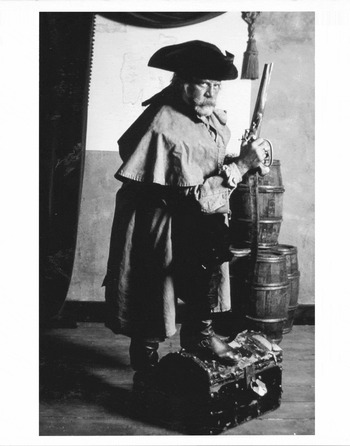
By asking us to regard Charlton Heston as the double of an Oliver Reed who is every bit as intimidating as he had been in Oliver!, the 1990 version of Treasure Island calls attention to an intertextuality towards which earlier adaptations merely gestured. Reed reprises his earlier impersonation of a brutally relentless Bill Sikes in his widely extended role as Billy Bones in the first twenty minutes (Figure 8). To be sure, the 1950 Treasure Island had also borrowed a British Dickensian to play Billy Bones. But the fleeting appearance of Finley Currie, from Lean's 1946 Great Expectations, could at best remind us of a surface similarity between the death-scenes of Pip's benefactor and of the expiring outlaw who makes Jim's fortune. Oliver Reed's Billy Bones, however, totally dominates the first eighteen minutes of the film. We immediately recall his menacing Sikes when Reed confronts the feisty Isa Blair who plays Jim's mother. Since she resembles several of the actresses who had played Nancy by this time, her defiance of Reed also reprises Nancy's defiance of Sikes and protection of Oliver. But the woman who points a gun at the scowling Reed is hardly protecting a quivering waif. The boy who stands by her can fend off male sadists on his own. Using the same gun she had pointed at Billy Bones, the mother kills one pirate-invader before her son extricates her from the clutches of a monstrous Blind Pew (played by Christopher Lee, the veteran of Hammer Studio's horror films).
Oliver Reed as Captain Billy Bones. Treasure Island. Dir. Fraser Heston. Perf. Charlton Heston, Christian Bale, and Oliver Reed. Agamemnon Films, 1990. Courtesy of Jerry Ohlinger's Movie Material Store, Inc.

Even though Reed's Billy Bones backs down when confronted by Mrs. Hawkins's gun (and, later, by Dr. Livesey's challenge), he fully displays his Sikes-like ferocity in a lengthy fight-scene in which he brutally bests a much younger Black Dog. The struggle between an impaired, grizzled, but skilled, veteran who overwhelms a strong opponent further connects Reed to Heston's Silver. Though seemingly at an even greater disadvantage, the one-legged Long John, too, will triumph in fierce hand-to-hand combats witnessed by Jim. Rather than stabbing the “honest” sailor Tom in the back, as Stevenson's Silver or Beery and Newton had ignominiously done, he faces him frontally, and later out-duels his arch-enemy, George Merry. Aided and abetted by his son's script, the ever-grinning Heston, whose mock-obsequiousness to the “gentlemen” is all too apparent, persistently signifies his undiminished vitality. Hardly impaired by the role of an old, hobbling sailor, a Hollywood star in his mid-sixties confidently relies on our recollection of the physical feats he performed as General Andrew Jackson, Judah Ben Hur, El Cid, Major Matt Lewis, Major Dundee, Moses, and Michelangelo. Aware of the resources on which he can draw, this Long John Silver seems unworried about the masculine credentials so nervously introduced by Welles (Heston's former foil in the 1958 Touch of Evil). As Richard Dyer aptly puts it, Heston always “‘means’ Heston regardless of what [any] film is trying to do with him” (148).
But if this film invites us to link Heston to a virile fellow-actor like Reed and asks us to remember his past performances as a muscular hero, it also does away with the last vestiges of the association between Jim Hawkins and Oliver Twist. By casting Christian Bale as Jim, Fraser Heston was replacing the feminized boys of the earlier films with an actor whose painful egress from childhood innocence had been dramatized three years before in Steven Spielberg's Empire of the Sun (1987). “Jamie” Graham, the thirteen-year-old interned in a Japanese concentration camp had, like Jim Hawkins, been steeled by adversity and been subjected to conflicting allegiances. By 1990, however, Christian Bale had grown into an athletic sixteen-year-old on the verge of full manhood, a Charlton Heston in training. He was no longer an Oliver-like naif. The few voice-overs in Welles's 1972 screenplay had been read by a grownup actor rather than spoken by young Kim Burfield.Footnote 13 Now, however, the voice-overs that punctuate the entire 1990 film retain the assured, Welsh-inflected voice of Christian Bale. He is a muscular and determined Jim Hawkins who matches the athleticism and poise of a Long John Silver played by an aging but ever-crafty Heston (Figure 9).
Charlton Heston as Long John Silver and Christian Bale as Jim Hawkins. Treasure Island. Dir. Fraser Heston. Perf. Charlton Heston, Christian Bale, and Oliver Reed. Agamemnon Films, 1990. Courtesy of Jerry Ohlinger's Movie Material Store, Inc.

Scott Allen Nollen may needlessly wonder whether the two Hestons did “correctly” represent the Silver-Hawkins relationship. But he is right in stressing the father/son relation that underlies this fine film when he quotes Fraser on the impact of a book his actor-father had read to him “when I was five years old,” and which, thereafter, became “a dream of mine to make . . . into a film” (113, 111). Like all Treasure Island adaptations, the 1990 film omits the dying father who so briefly appears in Stevenson's text. Welles had made Jim's mother the inn's sole owner; but Fraser Heston goes a step further by having Jim declare that his narrative retreats “to the time when my mother and I kept the ‘Admiral Benbow.’” This Mrs. Hawkins is hardly prone to the fainting spell that cripples her counterpart in the novel. Indeed, Jim's gun-toting mother might well be endorsed by Charlton Heston, the future president of the National Rifle Association of America, for her readiness to shoot any invader of her property. Still, the “Admiral Benbow” is but a breeding ground for the adolescent who soon will learn seamanship from Silver and yet resolutely reject his new mentor.
At the end of his 1990 adaptation, Fraser C. Heston deliberately has his father repeat the words that melted the heart of a weepy Jackie Cooper in the 1934 film. But here the speech that had worked for Beery's wily Silver falls on deaf ears when Bale rejects Long John's account of the protracted agonies that hanged men undergo. When Silver insists that such tortures are “not a pretty sight,” the young man coldly agrees. “I wouldn't think so,” he says, “but maybe you should have thought of that before you turned to piracy. I won't be fooled again, Long John. You saved my life, and I'll try to save yours. Meanwhile, you had better get down below. The captain will want his supper. He'll have your other leg off, if it's not ready.” The tables have turned. There are no residues of Victorian sentimentality.
Silver himself now seems to admire this unsentimental young man: “Oh, bucko, what a pair we two could have made.” Soon, however, as he holds a knife to Ben Gunn's throat, the grinning Heston reminds us that he needs no partner whatsoever. After promising not to sound the alarm, Ben whispers to himself, “And the best of luck to you, Silver.” It is the irate Captain Smollett who informs Trelawney that their prisoner has “taken a sack of doubloons and one of the gold bars.” Paddy Moloney's score returns as Silver waves a mocking salute and Jim soberly scans the horizon. In his last voice-over, this young man vows never to return “to that accursed island.” But we will return, of course, as viewers of future adaptations. For the boat increasingly dwarfed by an ever widening ocean is not only taking us back to the film's beginning but also is licensing future outings of a never-ending journey.
The latest of such journeys is offered by the 2003 animation called Treasure Planet, a film that also converts Jim Hawkins into a fatherless teenager who benefits from the tutorship of Long John Silver (now a cyborg with artificial limbs). But it is the highly-self-conscious, meta-theatrical, 1996 Muppet Treasure Island that I want to examine last, since it cleverly re-inscribes Dickensian elements that the film simultaneously honors and mocks.
The conflict between masculinizing and feminizing texts I have traced acquires a new dimension in a film that playfully toys with its many antecedents. Here too the actor who plays Long John Silver had previously appeared as Sikes, for Tim Curry had starred in a 1982 television production of Oliver Twist and had earlier been paired with Billy Connolly, who now does a comic turn in the role of Billy Bones.Footnote 14 Yet the puppets who mingle with human actors have their own Dickensian past: Kermit the Frog may now be cast as Captain Smollett, Silver's prime foil, but he and his fellow Muppets had already “starred” in the Muppet Christmas Carol (1992), four years before. Moreover, the “Admiral Benbow Inn” has become a work-house for orphaned boys rather than a maternal haven. Considerably younger than Christian Bale yet also more mature than Cooper or Burfield, Kevin Bishop manages to combine Oliver's wistfulness with the adventuresome spirit of Jim Hawkins. Joined by two wise-cracking muppets as his fellow-orphans and fellow-slaves, this fresh British import can rely on the star-power and pluck of his two Americans side-kicks, artful dodgers billed hyperbolically as “The Great Gonzo and Rizzo, as Themselves” in the cast announcements.
Fed – and often denied – scanty table-scraps by the gigantic proprietress of the inn, Mrs. Bluveridge, these three outcasts parody the role of the Dickensian Waif. But the monstrous Mrs. Bluveridge also plays a double role. She can be read as a reincarnation of the stingy matrons of Oliver Twist, a Mrs. Sowerby or the Mrs. Corney who emasculates her mate after becoming Mrs. Bumble. Yet she also shows her Amazonian mettle by tossing pirates to and fro, even after the explosion that totally wrecks her inn. The wreckage itself becomes emblematic of the steady demolition of opposites that Muppet Treasure Island so playfully undertakes.
The film's erosion of binaries leads it to question the alternating gender-ideologies of its precursors. When a French-speaking Blind Pew gropes the face of Jim Hawkins, he calls attention to the boy's Oliverian femininity: “ah, bon, bon, a pretty little girl, izz it? Yezz, my pet – take me to Billy Bonnezze.” The blind pirate dismisses Jim indignant reply (“There's no Billy Bones here, and I am not a girl”) by saying: “I may be visually challenged, but I know you are lying.” Pew is both wrong and right. Jim is not a girl. As his desire to become a sailor has already made apparent, the boy wants to escape his condition as a male Cinderella. But he is also lying, since Billy Bones is “here,” and about to be handed his death-sentence. The duality of Jim's gender-identity is captured by “Something Better,” the lyric he sang to his companions before Pew's appearance. Although Jim wishes to follow the career of the dead sailor-father who has left him a marine compass, his song echoes the plaintive “Where Is She?” voiced by the tiny Mark Lester in Oliver! The soprano voice that yearns for a place he might “explore” forces us to recall Oliver's own yearning for a “sweet” maternal space.
Yet unlike Carol Reed's Oliver!, Brian Henson's comical Muppet Treasure Island mixes music and dialogue to construct a narrative that questions the sentimentality it so deftly taps. Mark Lester's Oliver sang his song tearfully, while thrust into a lonely cellar by Bumble and Mrs. Sowerby; Kevin Bishop's Jim, however, unscathed by his servitude to Mrs. Bluveridge, blithely sings to his wise-cracking companions while brandishing a Cinderella-broom with swash-buckling brio. He is not alone, but an integral part of a new kind of “family.” As Rizzo helpfully points out to him: “I'm a rat, you're a human being, and Gonzo is – ah – whatever – but we're still – yea, we're still a family.” The word “family” will recur, again and again, in this family production marketed by Disney but created by the Henson studio.
Earlier Disney productions of Treasure Island had targeted a child-audience, while the Heston-produced television film clearly tried to appeal to older viewers. But this Henson/Disney collaboration actually recuperates the original trans-generational alliance that Robert Louis Stevenson had described in “My First Book.” Child and adult can now equally cherish a plot that is parodic, yet always respectful, of its multiple literary and cinematic antecedents, an American/British collaboration enacted by humans and muppets who mix song with action, earnestness with irreverence, traditional morality with a delight in anarchy, to form a narrative that also recombines Dickens and Stevenson as components of a new hybrid “family.” Always aware of its many mother-texts, Muppet Treasure Island reshuffles the earlier permutations. Kermit as Captain Smollett is a Romantic wanderer who has failed to form a “family” as much as Oliver's father. For, like Mr. Brownlow's dead friend, he has abandoned the woman he failed to marry. But the seduced woman whose excruciating agonies were so prominently featured at the outset of David Lean's 1948 film has now become a marooned love-goddess, the powerful Benjamina Gunn, deservedly idolized by the hog-natives of the island on which she was stranded by Captain Flint.
The 1996 film's deformations of Stevenson and Dickens are hardly apparent to its younger viewers. Nor would children identify the impish allusions to “adult” classics such as On the Waterfront, North By Northwest, and Evita! or laugh when Jim Hawkins discovers Henry Kissinger's thick tome, Diplomacy, before he comes up with the coveted treasure map. Such inter-textual jokes are reserved for adults to savor. But although both constituencies may laugh when Curry's Sikes-turned-Silver prefaces his Gilbert-and-Sullivan patter about the beauties of piracy by telling us that “this is my only number,” only the most pedantic of cineastes will recall the segregation suffered by another villain when Oliver Reed was denied any lyrics in a film in which Nancy and Fagin, but not he, were allowed to sing and dance.
Muppet Treasure Island gives its own twist to the final confrontation between Silver and Jim. Curry's Silver is no murderer, but the film refuses to exonerate his craven exploitation of Jim's need to find a substitute for his sailor-father. Betrayed by Long John, the boy must learn that he belongs to a more diverse “family.” When Jim catches Silver trying to abscond with the entire treasure, he is no more intimidated by the pistol pointed at him than Bobby Driscoll was in the 1950 Disney film. But when Currie's Silver drops his pistol, as Newton had done, he emotes: “Oh, hell, Jim, I cannot harm you – you are honest and true – you never learned that from me.” The boy's self-righteous reply captures his sense of betrayal: “I learned from my friends. I never want to see you again.” Silver returns the paternal compass to a boy who now knows his bearings. His overloaded boat soon sinks, in a scene that we, but not Jim, will witness. Turning back, a tearful Jim gains Captain Smollett's approval: “Well done, Jim, your father would be proud.” Silver, on the other hand, loses his treasure and becomes the island's latest maroon. Happily reunited with his porcine Benjamina, Captain Smollett abdicates his commmand of the “Hispaniola.” He asks, “Where to, Captain Hawkins?,” to which a carefree Jim replies, “To wherever the wind will take us.”
In the 2003 Treasure Planet, that wind has become inter-galactic and now powers the “solar sails” of a “Hispaniola” that is both a space-ship and an old-fashioned sailing-vessel. Eager to exceed the hybridity of Henson's Muppet Treasure Island, the animation vainly introduces a wide array of grotesque mutants and features still another inter-species romance between a cat-headed Captain Amelia Smollett and a dog-headed Doctor Doffler, Livesey's replacement.Footnote 15 But even though it fails to find a new venue for heterogeneity, this adaptation still returns to its Victorian origins. Adoption and adaptation are inseparable in the recovery of such origins. David Lean's Oliver gained a new family as he joined hands with Mr. Brownlow and Mrs. Bedwin before entering their white-washed house. But the 1948 film's final image also reminds us that cinematic adaptations create new homes and new families for orphaned texts. Lost family relations must be retraced and restored to preserve a threatened identity. By their cross-breeding of two parent texts, the films I have examined can guarantee the joint survival of Oliver Twist and Treasure Island at very different moments of cultural history.