Introduction
Tongue cancer is the most common oral cavity neoplasm, with a remarkable geographic distribution worldwide. The highest tongue cancer rate has been found in India, where the incidence is roughly 9.4/100 000/year.Reference Prince and Bailey1 Tongue cancer is a major health problem in many parts of the world, with poor prognosis despite aggressive combined treatment. This cancer usually affects men more than women, with the highest incidence occurring in the sixth to eighth decades.Reference Lam, Logan, Luke and Rees2
More than 80 per cent of tongue cancers arise from the oral tongue (i.e. the anterior two-thirds of the tongue).Reference Zwetyenga, Majoufre-Lefebvre, Siberchicot, Demeaux and Pinsolle3 Squamous cell carcinoma (SCC) constitutes the vast majority (more than 95 per cent) of oral tongue neoplasms.Reference Stelow and Mills4
Over recent decades, the incidence of tongue cancer has increased in patients younger than 40 years.Reference Prince and Bailey1 There are conflicting reports regarding the prognostic impact of age on the clinical outcome of oral tongue cancer.Reference Lee, Ho, Chen, Hsiao, Hwang and Hung5
This is the first report from Iran which specifically describes the characteristics, prognostic factors and treatment outcome of SCC of the oral tongue. Herein, we investigate the influence on survival of various prognostic factors, in particular age at presentation, in 102 patients with SCC of the oral tongue.
Materials and methods
Patients
This retrospective study was carried out by auditing patients' notes from our departmental computer databases or (for older data) from written patient lists. To overcome possible disease coding errors, over 1500 sets of patient notes with similar diagnoses were reviewed. The study included all patients with a diagnosis of oral tongue SCC treated between 1982 and 2007 at our radiotherapy and oncology department, a total of 102 patients. The patients had been followed up until they chose otherwise or expired. During follow up, any side effects, relapse and patient complaints had been noted.
Chemotherapy
The chemotherapy regimen consisted of cisplatin 80 mg/m2 on day one and 5-fluorouracil 1000 mg/m2 on days one to three. Fifty per cent of the patients received a median two (range one to six) cycles of chemotherapy.
Radiotherapy
All patients received external beam radiotherapy (RT) using cobalt-60 units and/or 9 MV X-ray photons or electrons from a linear accelerator. A mean dose of 55.5 Gy (median 60 Gy) was delivered via a daily fraction of 2 Gy, with five fractions per week. The primary site and upper cervical lymph nodes were treated with two lateral parallel-opposed fields; the lower cervical lymph nodes were treated with a separate en face anterior field. The spinal cord was excluded from the radiation fields after 46 Gy. After 50 Gy, RT was continued to the primary tumour, using reduced size fields, up to 60–70 Gy. Metastatic cervical lymph nodes were boosted through anterior and posterior neck fields with a central block and a dose of 15–20 Gy.
Measures
The following parameters were noted for every patient: age, sex, clinical findings at diagnosis, tumour stage, pathological grade, tumour margin, haemoglobin level, treatment mode, RT dose, operation date, relapse date (if applicable) and date of patient's death (if applicable).
Statistical analysis
Disease-free survival was calculated from the date of registration to the date of disease relapse at any site. Overall survival was calculated from the date of registration to the date of death due to any cause. Univariate analysis for disease-free survival and overall survival rates was performed using the Kaplan–Meier method, and prognostic factors were compared using the log-rank test. Multiple-covariate analysis was performed using the stepwise Cox's proportional hazards regression model. The hazard ratio for death, with the 95 per cent confidence interval (CI), was calculated for the treatment groups. The stratified log-rank test was used to compare treatment results in each disease group. A p value of 0.05 or less was considered to be statistically significant.
Results
Age and sex distribution
The age at presentation was in the range 19–85 years with a median of 57 years. Fifty-eight patients were ≤60 years old at presentation and 44 patients were >60 years old. The peak incidence was observed between the sixth and seventh decades of life. Follow up ranged from nine to 310 months (median 35 months). There were 48 men and 54 women. The distribution of men and women with ages greater or less than 50 years was similar.
Stage distribution
Twelve patients (11.8 per cent) had stage I disease, 35 (34.3 per cent) had stage II disease, 23 (22.5 per cent) had stage III disease and 32 (31.4 per cent) had stage IV disease, as detailed in Tables I and II.
Clinical Staging of 102 Oral Tongue SCC Patients

SCC = squamous cell carcinoma; T = tumour; N = node
Patients' Distribution of Treatment by Disease Stage

RT = radiotherapy; CT = chemotherapy
Treatment distribution
Surgery was undertaken in 81 (79.4 per cent) patients, 50 per cent of whom were treated with a combination of surgery, chemotherapy and RT (seven (6.9 per cent) received surgery followed by sequential chemotherapy and RT, and 44 (43.1 per cent) received surgery followed by concurrent chemo-radiotherapy), whereas 30 (29.4 per cent) received RT alone following surgical resection. The remaining 21 (20.6 per cent) patients did not undergo surgery and were treated with definitive RT with or without chemotherapy. The distribution of treatment choice by disease stage is shown in Table II.
Response and survival rates
A complete response was achieved in 91 patients (89.2 per cent) during or after completion of treatment. All non-responding patients had been treated with definitive RT.
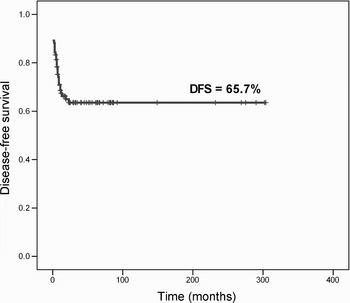
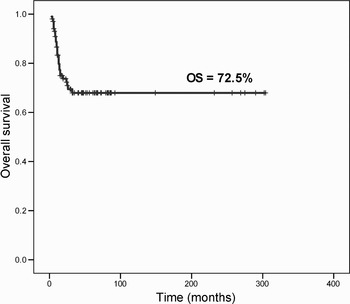
After a median follow up of 35 months for surviving patients, the five-year disease-free survival and overall survival rates were 65.7 and 72.5 per cent, respectively (Figures 1 and 2).
Five-year disease-free survival (DFS) for 102 patients with oral squamous cell carcinoma.

Five-year overall survival (OS) for 102 patients with oral squamous cell carcinoma.

Various prognostic factors were analysed to establish their effect on response rates and patient survival.
Univariate analysis
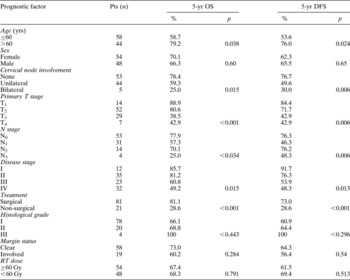
Univariate analysis for overall survival revealed the following as significant prognostic factors: surgical treatment (five-year overall survival was 28.6 per cent for non-surgical patients vs 81.1 per cent in surgical patients; p < 0.001); age (five-year overall survival 58.7 per cent for age <60 years vs 79.2 per cent for age ≥60 years; p = 0.038); extent of cervical lymph node involvement (five-year overall survival rates for uninvolved, unilaterally involved and bilaterally involved nodes were 78.4, 59.3 and 25 per cent, respectively; p = 0.015); tumour (T) stage (five-year overall survival rates for patients with T1, T2, T3 and T4 lesions were 88.9, 80.6, 38.5 and 42.9 per cent, respectively; p < 0.001); node (N) stage (five-year overall survival rates for patients with N0, N1, N2 and N3 involvement were 77.9, 57.3, 70.1 and 25.0 per cent, respectively; p = 0.034); and disease stage (five-year overall survival rates were 85.7 per cent for stage I patients, 81.2 per cent for stage II, 60.8 per cent for stage III and 49.2 per cent for stage IV; p = 0.013).
Sex (p = 0.602), RT dose (p = 0.79), resection margin status (p = 0.28) and tumour grade (p = 0.443) were found not to be prognostic factors for overall survival.
Univariate analysis revealed that age, T stage, extent of cervical lymph node involvement and node stage were independent prognostic factors for overall survival. Patients younger than 60 years of age at the time of diagnosis were found to have a significantly poorer outcome compared with those older than 60 years (p = 0.038). However, this difference was not statistically significant (p = 0.53) when comparing patients younger and older than 40 years. Univariate analysis for disease-free survival showed similar results (Tables I and III).
Univariate Analysis of Prognostic Factors for Clinical Outcome

Pts = patients; yr = year; OS = overall survival; DFS = disease-free survival; T = tumour; N = node; RT = radiotherapy
Multivariate analysis
Multivariate analysis revealed that non-surgical treatment (hazard ratio = 3.816; 95 per cent CI = 1.728–8.430; p = 0.001) and advanced disease stage (hazard ratio for death = 1.521; 95 per cent CI = 0.986–2.346; p = 0.002) had a negative influence on survival.
Recurrence
Thirty-five patients (34.3 per cent) suffered recurrence after treatment. Of these patients, 26 (74.3 per cent) had recurrence at the site of initial cervical node involvement (the most common site of recurrence), five (14.3 per cent) had recurrence at the primary site and the initial cervical node involvement site, two (5.7 per cent) developed distant metastasis, and two (5.7 per cent) developed regional (cervical nodes) and distant failure. Six recurrences occurred in the 14 patients younger than 40 years, 17 in the 40 patients aged between 40 and less than 60 years, and 12 in the 48 patients aged 60 years and older. The mean and median times to recurrence were both five months. All recurrences occurred within 23 months (range zero to 23 months).
Resection margins
Resection margin information was available in 75.5 per cent (77/102) of patients treated with surgery. Resection margins were clear in 75 per cent and involved in 25 per cent of patients.
Treatment complications
Most of the patients developed some degree of treatment-related complications during and/or after RT. Complication rates increased in patients receiving concurrent chemo-radiotherapy. Mucositis was the most frequently observed acute complication, encountered in almost all patients. Xerostomia was the most common and major late sequela, followed by dental caries and neck soft tissue fibrosis each in a remarkable 25–50 per cent of patients.
Discussion
Squamous cell carcinoma of the oral tongue constitutes the majority of tongue cancers. In most reported series, men represent a higher proportion of oral tongue cancer sufferers than women.Reference El-Husseiny, Kandil, Jamshed, Khafaga, Saleem and Allam6–Reference Mäkitie, Koivunen, Keski-Säntti, Törnwall, Pukkila and Laranne12 However, consistent with our series, a few reports have found a preponderance of female compared with male cases.Reference Kuriakose, Sankaraarayanan, Nair, Cherian, Sugar and Scully13–Reference Tan, Adelstein, Droughton, Van Kirk and Lavertu16
Squamous cell carcinoma of the oral tongue occurs commonly in the sixth to eighth decades.Reference Lam, Logan, Luke and Rees2 In the present study, the peak incidence was observed between the sixth and the seventh decades, with a median patient age of 57 years. Fourteen per cent of our patients were younger than 40 years at the time of diagnosis. We found an equal distribution by disease stage, comparing patients younger and older than 40 years of age. In previous studies, the proportion of patients younger than 40 years has been reported as 1–10 per cent.Reference Funk, Karnell, Robinson, Zhen, Trask and Hoffman11, Reference Burzynski, Flynn, Faller and Ragsdale17–Reference Chen, Huang, Lin and Lin19 Sargeran et al. reported a similar age distribution among 470 Iranian patients with cancer of the oral cavity.Reference Sargeran, Murtomaa, Safavi, Vehkalahti and Teronen20
This neoplasm usually presents early, with two-thirds of patients being diagnosed with stage I and II disease.Reference Gorsky, Epstein, Oakley, Le, Hay and Stevenson-Moore8, Reference Funk, Karnell, Robinson, Zhen, Trask and Hoffman11, Reference Mäkitie, Koivunen, Keski-Säntti, Törnwall, Pukkila and Laranne12 In the present study, the majority of patients presented with locally advanced disease, and 55 per cent had stage III or IV disease. The small percentage of patients diagnosed with stage I may be due to the initial lesion being missed or ignored. Sargeran et al. described a similar disease stage distribution among 470 Iranian patients with oral cavity cancer.Reference Sargeran, Murtomaa, Safavi, Vehkalahti and Teronen21
Numerous studies have evaluated various potential prognostic factors for oral tongue SCC, in order to establish their influence on response rates and patient survival.Reference Zwetyenga, Majoufre-Lefebvre, Siberchicot, Demeaux and Pinsolle3, Reference Stelow and Mills4, Reference Davidson, Root and Trock10, Reference Tan, Adelstein, Droughton, Van Kirk and Lavertu16, Reference Chen, Huang, Lin and Lin19, Reference Finlay, Dawson, Robertson and Soutar22–Reference Pernot, Malissard, Hoffstetter, Luporsi, Peiffert and Aletti27 Advanced tumour and nodal stages and the use of radiotherapy as primary treatment modality have been associated with reduced survival rates.Reference El-Husseiny, Kandil, Jamshed, Khafaga, Saleem and Allam6, Reference Funk, Karnell, Robinson, Zhen, Trask and Hoffman11, Reference Mäkitie, Koivunen, Keski-Säntti, Törnwall, Pukkila and Laranne12, Reference Lo, Kao, Chi, Wong and Chang18, Reference Chen, Huang, Lin and Lin19, Reference Sargeran, Murtomaa, Safavi, Vehkalahti and Teronen21 Thus far, nodal status at presentation has been seen as the most important prognostic factor. If the nodes are affected, then the chance of cure reduces by half.Reference Shah and Andersen28 However, the use of surgery for treatment of the primary tumour, including neck dissection, has been found to improve survival.Reference Davidson, Root and Trock7, Reference Gorsky, Epstein, Oakley, Le, Hay and Stevenson-Moore8, Reference Mäkitie, Koivunen, Keski-Säntti, Törnwall, Pukkila and Laranne12
In the current study, the disease stage and the use of non-surgical treatment significantly influenced outcome for patients with SCC of the oral tongue. However, in this and most previous reports, there was a selection bias in the use of RT alone or combined with chemotherapy in oral tongue cancer patients, because in most of these studies non-surgical treatment (RT alone or combined with chemotherapy) was used for advanced, inoperable or unresectable disease.Reference Davidson, Root and Trock7, Reference Chen, Huang, Lin and Lin19, Reference Sargeran, Murtomaa, Safavi, Vehkalahti and Teronen21, Reference Sessions, Spector, Lenox, Haughey, Chao and Marks26 In our study, the treatment received by the majority of patients was surgery and concurrent chemoradiation (43.1 per cent), followed by surgery and RT (29.4 per cent). Treatment was chosen according to the tumour stage and the patient's general condition. Radiotherapy alone or in combination with chemotherapy was given in the case of unresectable or inoperable disease, hence the higher percentage of stage IV tumours being treated with this regime (52 per cent in the non-surgical group vs 26 per cent in the surgical group) (Table II).
There is no consensus regarding the impact of age at presentation on clinical course and outcome in patients with oral tongue cancer. Few reports have found a more aggressive clinical course in younger patients with oral tongue cancer.Reference Friedlander, Schantz, Shaha, Yu and Shah29–Reference Vargas, Pitman, Johnson and Galati31 Other reports have found no difference in the clinical course and prognosis for younger patients with oral tongue cancer, compared with older such patients.Reference Mäkitie, Koivunen, Keski-Säntti, Törnwall, Pukkila and Laranne12, Reference Sargeran, Murtomaa, Safavi, Vehkalahti and Teronen21, Reference Popovtzer, Shpitzer, Bahar, Marshak, Ulanovski and Feinmesser32, Reference Sasaki, Moles, Imai and Speight33 In contrast, some reports have found better survival rates in oral tongue SCC patients younger than 40 years compared with older patients.Reference Lee, Ho, Chen, Hsiao, Hwang and Hung5, Reference Davidson, Root and Trock7, Reference Gorsky, Epstein, Oakley, Le, Hay and Stevenson-Moore8, Reference Funk, Karnell, Robinson, Zhen, Trask and Hoffman11, Reference Mäkitie, Koivunen, Keski-Säntti, Törnwall, Pukkila and Laranne12
In the current study, patients younger than 60 years had poorer survival rates compared with older patients; however, no statistically significant difference was found when patients younger and older than 40 years were compared.
Rates of regional failure are remarkable, even in the early stages of the disease, and in locally advanced disease this is the most frequent type of treatment failure and the leading cause of death.Reference Mäkitie, Koivunen, Keski-Säntti, Törnwall, Pukkila and Laranne12, Reference Lim, Lee, Koo, Kim, Kim and Choi34 Once regional recurrence occurs, prognosis is poor and long-term survival is rare.Reference Lim, Lee, Koo, Kim, Kim and Choi34, Reference Kurita, Koike, Narikawa, Sakai, Nakatsuka and Uehara35 In addition, elective or therapeutic neck management, even in the early stages of the disease, significantly improves regional control and overall survival rate in these patients.Reference Lim, Lee, Koo, Kim, Kim and Choi34, Reference Deng, Chen, Zeng, Wei, Yang and Zhang36–Reference Schiff, Roberts, El-Naggar, Garden and Myers38 In published series, the rate of locoregional recurrent disease has been reported as 28–37 per cent.Reference Mäkitie, Koivunen, Keski-Säntti, Törnwall, Pukkila and Laranne12, Reference Franceschi, Gupta, Spiro and Shah24 In the current study, 34 per cent of patients developed recurrent disease, the vast majority of which comprised locoregional failure (89 per cent); isolated regional failure comprised 74 per cent of all recurrences and was the major cause of death. This finding strongly suggests the need for further improvement in the treatment of cervical nodes, and also highlights the importance of cervical neck dissection. The majority of recurrences occur within the first and second year of treatment.Reference Franceschi, Gupta, Spiro and Shah24, Reference Popovtzer, Shpitzer, Bahar, Marshak, Ulanovski and Feinmesser32 In our series, if the patients had not relapsed by 30 months, then the risk of subsequent relapse was minimal.
• This report suggests that, in Iran, squamous cell carcinoma of the oral tongue tends to present at a locally advanced stage, with a high frequency of locoregional failure and a poor outcome
• Non-surgical treatment and advanced disease stage were the most important prognostic factors, and had a negative influence on survival
• Combined-modality therapy should be considered for the majority of such patients
• Public health strategies should be planned to facilitate continuing education of oral health and general medical practitioners regarding the early detection and diagnosis of this aggressive cancer
Over the past 20 years, better locoregional control of tongue carcinoma has been achieved, together with some improvement in survival.Reference Prince and Bailey1 This improvement may have resulted from a combination of, firstly, elective neck dissection for the N0 neck, and, secondly, the use of adjunctive RT for stage III and IV disease, close or involved margins, multiple nodal metastases, poor differentiation, extracapsular spread, and vascular or perineural involvement.Reference Zelefski, Harrison and Armstrong23, Reference Woolgar, Rogers, West, Errington, Brown and Vaughan39–Reference Fan, Lin, Kang, Huang, Wang and Chen41
Comparison between our results and those of previous studies is difficult, because our patients had more advanced disease and shorter follow-up periods. Nevertheless, our treatment results are comparable with those of previous studies in terms of response and survival rates,Reference Gorsky, Epstein, Oakley, Le, Hay and Stevenson-Moore8, Reference Funk, Karnell, Robinson, Zhen, Trask and Hoffman11, Reference Mäkitie, Koivunen, Keski-Säntti, Törnwall, Pukkila and Laranne12, Reference Zelefski, Harrison and Armstrong23, Reference Sessions, Spector, Lenox, Haughey, Chao and Marks26, Reference Pernot, Malissard, Hoffstetter, Luporsi, Peiffert and Aletti27 and are better than those of some reported series.Reference Chen, Huang, Lin and Lin19, Reference Sargeran, Murtomaa, Safavi, Vehkalahti and Teronen21
However, as the majority of oral tongue cancer cases in our study presented as locally advanced disease, we highly recommend action to enhance public awareness of oral cancer and to continue oral health professionals' education in this field, in order to increase early detection rates and to improve treatment outcome in such patients.
Conclusions
This report suggests that, in Iran, SCC of the oral tongue tends to present at a locally advanced stage, with a high frequency of locoregional failure and a poor outcome. Non-surgical treatment and advanced disease stage are the most important prognostic factors and have a negative influence on survival. Combined-modality therapy should be considered for the majority of these patients. Public health strategies should be planned in order to continue educating oral health and general medical practitioners regarding early detection and diagnosis of this aggressive neoplasm.