1. INTRODUCTION
The interaction of intense radiation and charged particles with solid surfaces has been investigated widely (Pikuz et al., Reference Pikuz, Chefonov, Gasilov, Komarov, Ovchinnikov, Skobelev, Ashitkov, Agranat, Zigler and Faenov2010; Kumar & Verma, Reference Kumar and Verma2011; Zhu et al., Reference Zhu, Zhang, Tang and Lei2011). The underlying physical processes are of major importance not only for basic research, but also for technological applications such as material modifications, X-rays source devices, radiation physics, chemistry, biology, plasma-wall interactions, and surface analysis as well (Lucio et al., Reference Lucio, Gavin and Dubois2006; Bajales et al., Reference Bajales, Cristina, Mendoza, Baragiola, Goldberg and Ferrón2008; Hoffmann et al., Reference Hoffmann, Blazevic, Ni, Rosmej, Roth, Tahir, Tauschwitz, Udrea, Varentsov, Weyrich and Maron2005, Reference Hoffmann, Blazevic, Korostiy, Ni, Pikuz, Rosmej, Roth, Tahir, Udrea, Varentsov, Weyrich, Sharkov and Maron2007; Kudo et al., Reference Kudo, Sakai and Ichinokawa2000). We will here concentrate on the effect of secondary electron (SE) emission from surfaces under ion bombardment. This effect has been extensively studied during several decades because of its fundamental and technological importance. According to Sternglass (Reference Sternglass1957), the electron emission is closely connected to the deposition of electron excitation near the target surface. The Sternglass theory refers to a range of projectile velocities with negligible nuclear stopping power. However, it is necessary to consider the effect of recoil-induced electron emission, whenever bombardment is done under conditions where a substantial fraction of the energy loss of the bombarding particle is due to nuclear stopping (Holmén et al., Reference Holmén, Svensson, Schou and Sigmund1979). Ferron et al. (Reference Ferron, Alonso, Baragiola and Oliva-Florio1981) put forward a basically different excitation model that was more consistent with experimental findings. In his model, he considered collisions between recoiling atoms and target atoms.
In this work, we present experimental results for electron emission yield of Ne2+ and O2+ impacting on clean tungsten surface at normal incidence. The mechanism of electron emission is investigated and we discuss why the effect of recoiling atoms is of crucial importance in our energy range.
2. EXPERIMENTAL SETUP
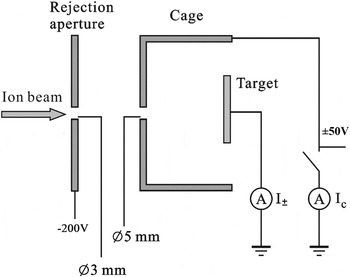
In our experiment, the highly charged ion beam was produced by the 320 kV electron cyclotron resonance ion source platform at the Institute of Modern Physics, Lanzhou (Zhao et al., Reference Zhao, Xiao, Xu, Zhao, Xia, Jin, Ma, Liu, Yang, Zhang, Wang, Li, Zhao, Zhan, Xu, Zhao, Li and Chen2009). A large number of experiments on interaction of highly charged particles with solid surfaces have been performed on this platform (Xu et al., Reference Xu, Zeng, Zhao, Wang, Zhang, Xiao and Li2012; Zhang et al., Reference Zhang, Zhao, Hoffmann, Yang, Chen, Xu, Li and Xiao2011; Wang et al., Reference Wang, Zhao, Qayyum and Xiao2007, Reference Wang, Zhao, Cheng, Zhou, Xu, Sun, Wang, Ren, Yu, Li, Zhang, Li, Liang and Xiao2012). Figure 1 shows the experimental setup for SE yield measurements in our experiment. It consists of three major parts namely, an adjustable beam collimator, a rejection aperture with diameter of 5 mm, and a cage. The beam defining collimator serves to prevent the incoming ions from directly impacting the rejection aperture and has a diameter of 3 mm. The cage is operated at a voltage of ± 50 V and surrounds the target in order to collect or to suppress electrons emitted from the target. The cage has an aperture of Φ5 mm as an ion beam entrance, by which the incident ion beam is collimated before it is able to reach the target surface. A rejection electrode at a potential of −200 V is placed before the cage that prevents electrons from escaping and thus further enhances the electron collection efficiency. The current at the target is measured with a pico-ampere meter.
Schematic diagram of the experimental setup used for measuring the total electron yield.

When applying +50 V to the cage, the total current I + that is measured at the target consists of two components, the current of incoming ions I i and the current of emitted electrons I e,
 $$I_ +=I_i+I_e=I_i+{\rm \gamma} \lpar {{I_i } / q}\rpar .$$
For −50 V applied to the cage, the target current I − is equal to the incoming ion current I i,
 $$I_ -=I_i.$$
Therefore, the total electron yield is given as
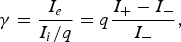 $${\rm \gamma}=\displaystyle{{I_e } \over {{{I_i } / q}}}=q\displaystyle{{I_+- I_ - } \over {I_ - }}\comma \;$$
where q is the charge state of incoming ions. Highly charged ion beams, with ion current in the range of 100–1000 nA, were focused and collimated to a diameter of 3 mm. The target was mechanically polished and placed perpendicular to the ion-beam direction. The pressure in the target chamber was maintained at about 10−8 mbar.
3. RESULTS AND DISCUSSION
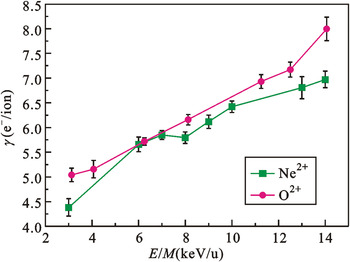
Total electron yield as a function of the projectile energy per mass unit for Ne2+ and O2+ impacting on W surface in the normal incident case is shown in Figure 2. According to Baragiola et al. (Reference Baragiola, Alonso and Oliva-Florio1979) and Michaelson (Reference Michaelson1977), the kinetic emission threshold velocity v th is 2.4 × 10⁵ m/s. For the projectile energy ranging from 3 keV/u to 14 keV/u in our experiment, the projectile velocities v are between 7.60 × 10⁵ m/s and 1.64 × 10⁶ m/s, which are higher than the threshold velocity v th. As it was expected, the total electron yield gradually increases with the projectile velocity. Rothard et al. (Reference Rothard, Kroneberger, Clouvas, Veje and Lorenzen1990) investigated heavy ion induced (15 keV/u ≤ E p/M p ≤ 600 keV/u) SE yield in ultrahigh vacuum. They found that SE yield increased strongly with the projectile nuclear charge Zp. On the contrary, in our results, we find the total electron yield for O2+ impacting on W is larger than the total electron yield for Ne2+ impacting on W. That is to say, the total electron yield increases by going from Ne2+ to O2+ projectiles impacting on W in our energy range. The contribution to the yield from recoiling W atoms may be used to explain the unexpected results.
(Color online) Total electron yield as a function of the projectile energy per mass unit for Ne2+ and O2+ impacting on W surface in the normal incident case.

Schou (Reference Schou1980) found the total electron yield increased with the energy deposition. For projectile velocities with negligible nuclear stopping, the electron yield is connected to the deposition of electron excitation energy near the target surface. This in turn is determined primarily by the electronic stopping power of the projectile (Sternglass, Reference Sternglass1957), which is consistent with the results of Rothard et al. (Reference Rothard, Kroneberger, Clouvas, Veje and Lorenzen1990). However, it is well known that at moderate and low projectile velocities, energy deposition may be distorted drastically by the effect of nuclear scattering (Winterbon et al., Reference Winterbon, Sigmund and Sanders1970). Furthermore, in the region where nuclear stopping dominates, electronic excitation may be substantially due to recoil atoms (Taulbjerg & Sigmund, Reference Taulbjerg and Sigmund1972). Of course, the nuclear stopping power must be so large that an appreciable number of fast recoils are set in motion.
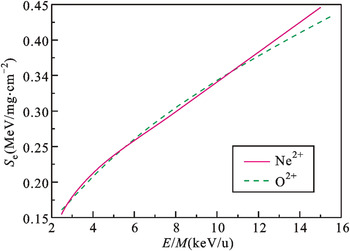
Figure 3 represents the electronic stopping power S e as a function of the projectile energy per mass unit for Ne2+ and O2+ impacting on W surface calculate by SRIM2008 (Ziegler et al., Reference Ziegler, Ziegler and Biersack2008). It shows that considering the electronic stopping power only, our experimental results cannot be explained. The projectile energy in our experiment ranges from 3 keV/u to 14 keV/u, which is lower than the energy mentioned by Rothard et al. (Reference Rothard, Kroneberger, Clouvas, Veje and Lorenzen1990). The recoil atoms may contribute substantially to the SE yield.
(Color online) The electronic stopping power S e as a function of the projectile energy per mass unit for Ne2+ and O2+ impacting on W surface calculated by SRIM2008 (Ziegler et al., Reference Ziegler, Ziegler and Biersack2008).

3.1. Contribution to the Energy Deposition from Recoiling Atoms
Considering the influence of recoiling atoms, the energy deposition D can be expressed as (Schou, Reference Schou1980)
 $$D=D_p+D_r\comma \;$$
where D p represents the energy lost directly to the target electrons by projectiles, D r represents the energy deposited by recoiling target atoms. Here D p is determined by the electronic stopping power of projectiles, while D r depends on the nuclear stopping power of recoiling atoms. According to Schou (Reference Schou1980), D p and D r can be given by
 $$D_p=\displaystyle{{1 - m} \over {1/2+2m}} \cdot \Upsilon ^{m-1} NS_e \lpar E\rpar f_p \Bigg( \displaystyle{{{xNC} \over {E^{2m} }}}\Bigg) \comma \;$$
 $$D_r=\displaystyle{{\lpar 1 - m\rpar ^2 } \over {{\rm \omega} \lpar {\rm \omega} - m\rpar }} \cdot \Upsilon ^{m-1} NS_t \lpar E\rpar \displaystyle{{{\rm \eta} _t \lpar \Upsilon E\rpar } \over {\Upsilon E}}f_r \Bigg( \!\displaystyle{{xNC} \over {E^{2m} }}\Bigg) \comma \;$$
where m is the exponent of the power-law potential (Lindhard, Reference Lindhard, Nielsen and Scharff1968), C is a constant that depends on the charge and mass of the particle as well as the exponent m, ϒ is the efficiency of energy transfer, N is the number of atoms per unit volume, ω is a constant determined by the target and is nearly independent of the projectile energy, S e is the electron stopping power, S t is the nuclear stopping power. Both S e and S t are functions of projectile energy, f p and f r depend only on the mass ratio M 2/M 1 and m, where M 1 is the atomic mass of projectile and M 2 is the atomic mass of target.
Through Eq. (5) and Eq. (6), we obtain that
 $$\displaystyle{{D_r } \over {D_p }}=\displaystyle{{\lpar 1 - m\rpar \lpar {\textstyle{1 \over 2}}+2m\rpar } \over {{\rm \omega} \lpar {\rm \omega} - m\rpar }}\displaystyle{{{\rm \eta} _{\lpar t\rpar } \lpar \Upsilon E\rpar } \over {\Upsilon E}}\displaystyle{{S_t \lpar E\rpar f_r } \over {S_e \lpar E\rpar f_p }}.$$
Considering Eq. (94) in Schou (Reference Schou1980),
 $$\displaystyle{{{\rm \eta} _{\lpar t\rpar } \lpar \Upsilon E\rpar } \over {\Upsilon E}}=\displaystyle{{{\rm \eta} _{\lpar r\rpar } \lpar E\rpar } \over E}\displaystyle{{{\rm \omega} \lpar {\rm \omega} - m\rpar } \over {1 - m}}.$$
Then Eq. (7) can be simplified as
 $$\displaystyle{{D_r } \over {D_p }}=\Bigg( \displaystyle{1 \over 2}+2m\Bigg) \displaystyle{{S_t \lpar E\rpar f_r } \over {S_e \lpar E\rpar f_p }} \times \displaystyle{{{\rm \eta} _{\lpar r\rpar } \lpar E\rpar } \over E}\comma \;$$
where m can be determined through experiment or by Eq. (22) in Schou (Reference Schou1980). Here, m is equal to 1/2, and  $\displaystyle{{{\rm \eta} _{\lpar r\rpar } \lpar E\rpar } \over E}$ is about 0.4. So Eq. (9) can be changed to
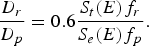 $$\displaystyle{{D_r } \over {D_p }}=0.6\displaystyle{{S_t \lpar E\rpar f_r } \over {S_e \lpar E\rpar f_p }}.$$
Then
 $$\displaystyle{{D_r } \over D} = \displaystyle{{D_r } \over {D_r+D_p }} = \left({\displaystyle{{5S_e \lpar E\rpar f_p } \over {3S_t \lpar E\rpar f_r }}+1} \right)^{- 1}$$
For S e increases with projectile energy, S t decreases with projectile energy in our energy range (Ziegler et al., Reference Ziegler, Ziegler and Biersack2008), it can be easily found that with decreasing projectile energy, the ratio of D r to D increases. In Table 1, D r/D as a function of projectile energy is listed. Edgeworth's expansion can be used to calculate f p and f r, here we use the result of Schou (Reference Schou1980). For Ne2+ impacting on W, f p = 0.167, f r = 0.172. For O2+ impacting on W, f p = 0.137, f r = 0.148. Table 1 show that D r/D decreases quickly when the projectile energy increases. If the projectile energy is high enough, D r can be neglected. This is the reason why many researchers consider S e only in electron emission research under high projectile energy.
The ratio of D r to D as a function of projectile energy

3.2. Contribution to the Electron Yield from Recoiling Atoms
According to Baragiola et al. (Reference Baragiola, Alonso and Oliva-Florio1979), Schou (Reference Schou1980), and Sternglass (Reference Sternglass1957), the electron yield γ can be determined by the relation,
 $${\rm \gamma}={\rm \beta} \Lambda S\comma \;$$
where Λ is a constant depending on the properties of the target material only, S is the stopping power including the electron stopping power S e and the nuclear stopping power S t, β is a constant depending on the mass ratio M 2/M 1 and is rather insensitive to variations of the projectile energy. Considering the effect of recoiling atoms, the electron yield γ can be given by
 $${\rm \gamma}={\rm \beta} _p \Lambda S+{\rm \beta} _r \Lambda S\comma \; $$
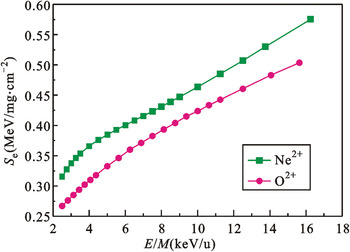
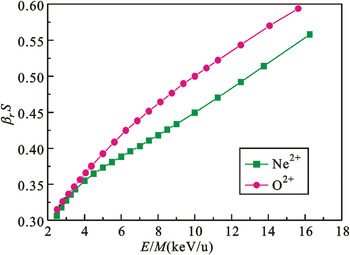
where βpΛS is the electron yield caused by projectiles, βrΛS is the electron yield caused by recoiling atoms. According to Schou (Reference Schou1980), βp increases with the projectile nuclear charge Z p, that is to say, βp(Ne) is larger than βp(O). Figure 4 shows the stopping power S as a function of the projectile energy per mass unit and S(Ne) is larger than S(O)in our energy range (Ziegler et al., Reference Ziegler, Ziegler and Biersack2008). So it can be easily obtained that
 $${\rm \beta} _p \lpar {\rm Ne}\rpar \Lambda S\lpar {\rm Ne}\rpar \gt {\rm \beta} _p \lpar {\rm O}\rpar \Lambda S\lpar {\rm O}\rpar \comma \;$$
which is opposite to the results of our experiment γ(Ne) < γ(O). It can be concluded that the effect of recoiling atoms βr is the reason caused our abnormal results.
(Color online) The stopping power S as a function of the projectile energy per mass unit for Ne2+ and O2+ impacting on W surface calculate by SRIM2008 (Ziegler et al., Reference Ziegler, Ziegler and Biersack2008).

Considering the second term of Eq. (13), βr is a function of mass ratio M 2/M 1, which was calculated by Holmén et al. (Reference Holmén, Svensson, Schou and Sigmund1979). For Ne2+ and O2+ impacting on W, βr(O) = 1.18, βr(Ne) = 0.97. Figure 5 shows βrS as a function of the projectile energy per mass unit and βrS(O) is larger than βrS(Ne) in our energy range, so
 $${\rm \beta} _r \lpar {\rm O}\rpar \Lambda S\lpar {\rm O}\rpar \gt {\rm \beta} _r \lpar {\rm Ne}\rpar \Lambda S\lpar {\rm Ne}\rpar.$$
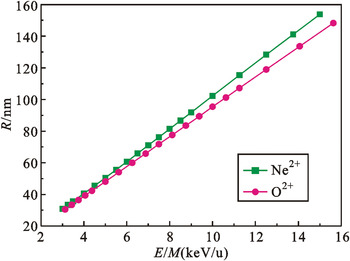
Eq. (15), which is consistent with the results of our experiment, demonstrates that recoiling atoms play a significant role in electron emission in our energy range. We can also find that when the projectile energy is large enough, the lines in Figure 5 will cross, then βr(Ne)S(Ne) will be larger than βr(O)S(O). This is consistent with other researchers' results for higher projectile velocity. Figure 6 shows that the projected range R increases quickly with the projectile energy (Ziegler et al., Reference Ziegler, Ziegler and Biersack2008). The increase of R restricts the chance of electrons excited by recoiling atoms to escape from the target surface. This may be another reason that only D p is considered in researching the electron yield at high projectile velocities.
(Color online) βrS as a function of the projectile energy per mass unit for Ne2+ and O2+ impacting on W surface.

(Color online) The projected range R as a function of the projectile energy per mass unit for Ne2+ and O2+ impacting on W surface calculate by SRIM2008 (Ziegler et al., Reference Ziegler, Ziegler and Biersack2008).

4. CONCLUSION
Experimental results of impacting Ne2+and O2+ on clean tungsten surface at normal incidence are reported and electron emission yield has been discussed systematically. The results show that the total electron yield gradually increases with the projectile velocity. Simultaneously, it is found that the total electron yield for O2+ is larger than the total electron yield for Ne2+, which is opposite to the results at high projectile velocity. After considering the contribution from recoiling atoms to energy deposition and electron yield, we find that recoiling atoms are of crucial importance in electron emission in our energy range. Finally, the abnormal results in our experiment can be explained successfully.
ACKNOWLEDGMENTS
We are in debt to the workers in 320 kV ECR platform. The authors like to acknowledge the support from the Major State Basic Research Development Program of China (‘973’ program, Grant No. 2010CB832902), the National Natural Science Foundation of China (Grant Nos. 11075125, 11075135, 11075192, and 10805063), and the Foundation of Xianyang Normal University (06XSYK253).