Rehabilitation counsellors have a long history of serving people with serious mental illness (SMI; Chan et al., Reference Chan, Leahy, Chan, Lam, Hilburger, Jones and Kamnetz1998; Tansey, Chan, Chou, & Cardoso, Reference Tansey, Chan, Chou and Cardoso2004). Within the context of the Australian federal vocational rehabilitation (VR) system and the American state-federal VR system, there is a significant increase of people with SMI requiring rehabilitation and mental health counselling services (Ingraham, Rahimi, Tsang, Chan, & Oulvey, Reference Ingraham, Rahimi, Tsang, Chan and Oulvey2001; Mental Health Council of Australia (MHCA), 2007; Tansey et al., Reference Tansey, Chan, Chou and Cardoso2004; Waghorn & Lloyd, Reference Waghorn and Lloyd2005). SMI often has a negative impact on social skill development, leading to low levels of engagement in self-care, social and civic activities, and employment (Corrigan et al., Reference Corrigan, Angell, Davidson, Marcus, Salzer, Kottsieper and Stanhope2012; Lemay, Reference Lemay2006; National Alliance on Mental Illness [NAMI], 2015; National Institute of Mental Health (NIMH), 2015; Tschopp & Frain, Reference Tschopp, Frain, Chan, Cardoso and Chronister2009). Poor social functioning has been identified as one of the major impediments to vocational recovery and health-related quality of life of people with SMI (Le Boutillier et al., Reference Le Boutillier, Leamy, Bird, Davidson, Williams and Slade2014; Tschopp & Frain, Reference Tschopp, Frain, Chan, Cardoso and Chronister2009). Conversely, positive interpersonal relationships, which are influenced by empathy, social skills, and insight, are associated with increased functioning, community participation, employment, and life satisfaction (Bandura, Caprara, Barbaranelli, Gerbino, & Pastorelli, Reference Bandura, Caprara, Barbaranelli, Gerbino and Pastorelli2003; Didehbani et al., Reference Didehbani, Shad, Tamminga, Kandalaft, Allen, Chapman and Krawczyk2012; Rössler, Reference Rössler2006).
Individuals with SMI can exhibit poor insight, regarding their mental health status, which is associated with impairment in social functioning, limited social networks, and increased social isolation (Dickerson, Boronow, Ringel, & Parente, Reference Dickerson, Boronow, Ringel and Parente1997; Francis & Penn, Reference Francis and Penn2001; Lysaker, Bell, Bryson, & Kaplan, Reference Lysaker, Bell, Bryson and Kaplan1998; Smith et al., Reference Smith, Hull, Goodman, Hedayat-Harris, Willson, Israel and Munich1999; White, Bebbington, Pearson, Johnson, & Ellis, Reference White, Bebbington, Pearson, Johnson and Ellis2000), as well as diminished basic interpersonal skills, such as empathy (Lysaker et al., Reference Lysaker, Bell, Bryson and Kaplan1998). However, those with SMI who possess greater insight also display better social skills and fewer psychiatric symptoms (Francis & Penn, Reference Francis and Penn2001). Often accompanying a diagnosis of SMI is a decrease in social networks and a shift from non-disabled peers to peers with SMI (Pinfold, Reference Pinfold2000), despite their desire to have rich and robust social networks (Bengtsson-Tops & Hansson, Reference Bengtsson-Tops and Hansson1999). A major impediment in social support for individuals with SMI is a lack of appropriate social skills. Interpersonal competency, or social skills, which include empathy and social functioning, increases an individual's opportunity to expand their social network and support (Dilk & Bond, Reference Dilk and Bond1996; Heinssen, Liberman, & Kopelowicz, Reference Heinssen, Liberman and Kopelowicz2000; Mueser, Reference Mueser, Bellack and Hersen1998; Smith, Bellack, & Liberman, Reference Smith, Bellack and Liberman1996). In turn, social support facilitates recovery (Aldersey & Whitley, Reference Aldersey and Whitley2015), increases social functioning, and improves quality of life for people with SMI (Klein, Cnaan, & Whitecraft, Reference Klein, Cnaan and Whitecraft1998; Pang et al., Reference Pang, Yeung, Cheung, Mui, Chien, Leung and Thompson2015; van Vugt, Kroon, Delespaul, & Mulder, Reference van Vugt, Kroon, Delespaul and Mulder2012). Ultimately, empathy, social functioning, and social support have been positively related to life satisfaction (Sánchez, Rosenthal, Tansey, Frain, & Bezyak, Reference Sánchez, Rosenthal, Tansey, Frain and Bezyak2016b), with social functioning having the greatest impact on quality of life (Pang et al., Reference Pang, Yeung, Cheung, Mui, Chien, Leung and Thompson2015).
The positive psychology movement has promulgated the study of prosocial behaviours. Prosocial behaviours (e.g., comforting, helping, sharing) have been linked with positive life outcomes for the individual and the greater society (Batson, Reference Batson, Gilbert, Fiske and Lindzey1998), and empathic self-efficacy beliefs have been found to predict prosocial behaviour (Alessandri, Caprara, Eisenberg, & Steca, Reference Alessandri, Caprara, Eisenberg and Steca2009; Bandura et al., Reference Bandura, Caprara, Barbaranelli, Gerbino and Pastorelli2003; Caprara, Alessandri, & Eisenberg, Reference Caprara, Alessandri and Eisenberg2012; Eklund, Loeb, Hansen, & Andersson-Wallin, Reference Eklund, Loeb, Hansen and Andersson-Wallin2012). Prosocial behaviours elicit positive responses from others and increase one's social support network (Caprara & Steca, Reference Caprara and Steca2005; Van Willigen, Reference Van Willigen2000), and social self-efficacy and social support buffer the negative effects of depression (McFarlane, Bellissimo, & Norman, Reference McFarlane, Bellissimo and Norman1995). Moreover, social support was found to mediate the relationship between insight and depression in individuals with psychosis (Kaiser, Snyder, Corcoran, & Drake, Reference Kaiser, Snyder, Corcoran and Drake2006). Ultimately, empathic self-efficacy and social self-efficacy are directly related to workplace relationships (Loeb, Stempel, & Isaksson, Reference Loeb, Stempel and Isaksson2016), and workplace relationships have been positively associated with work-life satisfaction in individuals with SMI (Rollins, Reference Rollins2002; Rollins, Bond, Jones, Kukla, & Collins, Reference Rollins, Bond, Jones, Kukla and Collins2011). Social skills training to help people with SMI develop capabilities to understand others’ feelings and effectively engage in social interactions could improve vocational recovery and quality of life. In order to evaluate the effectiveness of social skills training interventions, professionals need to have a psychometrically sound instrument to assess people's perceptions of their ability to experience empathy and competently engage in social interactions (Di Giunta et al., Reference Di Giunta, Eisenberg, Kupfer, Steca, Tramontano and Caprara2010).
Recently, Di Giunta and her colleagues (Reference Di Giunta, Eisenberg, Kupfer, Steca, Tramontano and Caprara2010) developed the Perceived Empathic and Social Self-Efficacy Scale and validated it as an outcome measure for social skills training research. The scale has been validated as both a two-factor multidimensional scale and two separate unidimensional scales amongst Italian, American, Bolivian, and Turkish populations (Akin & Başören, Reference Akin and Başören2015; Di Giunta et al., Reference Di Giunta, Eisenberg, Kupfer, Steca, Tramontano and Caprara2010), deeming it culturally and linguistically sensitive. However, the scale has only been evaluated amongst samples of undergraduate college students; thus, validating the scale with different population samples is warranted. This self-report measure could potentially be used by rehabilitation counsellors to assess self-perceptions of the ability to understand others’ feelings and to engage in social interactions for people with SMI. To determine the scale's construct validity, Di Giunta et al. (Reference Di Giunta, Eisenberg, Kupfer, Steca, Tramontano and Caprara2010) examined its correlations with self-esteem, psychological well-being, and coping strategies (i.e., active coping, positive reframing, emotional support, instrumental support, and behavioural disengagement) constructs. Based on the current literature, empathic, and social self-efficacy were expected to have a small, positive correlation with insight (Kurtz, Olfson, & Rose, Reference Kurtz, Olfson and Rose2013), a small, positive correlation with social support (Resnick, Orwig, Magaziner, & Wynne, Reference Resnick, Orwig, Magaziner and Wynne2002), and a medium to large, positive correlation with life satisfaction (Çakar, Reference Çakar2012).
To date, the scale has primarily been used with participants without disabilities (i.e., adolescents, undergraduate, and graduate students) to measure empathic self-efficacy (Bathini & Vohra, Reference Bathini and Vohra2014; Caprara et al., Reference Caprara, Luengo Kanacri, Gerbino, Zuffiano, Alessandri, Vecchio and Bridglall2014; Caprara, Luengo Kanacri, Zuffiano, Gerbino, & Pastorelli, Reference Caprara, Luengo Kanacri, Zuffiano, Gerbino and Pastorelli2015; Sangiorgi, Reference Sangiorgi2013) and social self-efficacy (Bathini & Vohra, Reference Bathini and Vohra2014; Lorenzo, Reference Lorenzo2014; Sangiorgi, Reference Sangiorgi2013). Most recently, it was used to assess empathic and social self-efficacy in adults with SMI (Sánchez, Rosenthal, Chan, Brooks, & Bezyak, Reference Sánchez, Rosenthal, Chan, Brooks and Bezyak2016a; Sánchez et al., Reference Sánchez, Rosenthal, Tansey, Frain and Bezyak2016b). There are two purposes of the current study: (1) to validate the Perceived Empathic and Social Self-Efficacy Scale for use with individuals with SMI in rehabilitation counselling practice, and (2) to establish construct validity for the Perceived Empathic and Social Self-Efficacy Scale.
Methods
Participants
There are several guidelines for computing sample size for confirmatory factor analysis (CFA), including N ≥ 200, ratio of N to the number of variables in a model (p), N/p ≥ 10; the ratio of N to the number of model parameters (q), N/q ≥ 5; and an inverse relationship between construct reliability and adequate N (Myers, Ahn, & Jin, Reference Myers, Ahn and Jin2011). Based on these guidelines, the current sample size of 194 participants is appropriate for the 11-item Perceived Empathic and Social Self-Efficacy Scale. In order to qualify for inclusion in the study, participants needed to meet the following criteria: (a) be 18 years of age or older; (b) have a primary diagnosis of SMI; and (c) be able to read at a sixth grade level or above. More than half of the participants (53.1%) were female. Approximately 14.9% of participants were between the ages of 18–25 years, 25.8% ages 26–38 years, 24.7% ages 38–49 years, 30.9% ages 50–64 years, and 3.1% were age 65 years or older. The sample was predominately White (60.3%), and less than half were employed (38.2%). Individuals were diagnosed with depression (38.1%), bipolar disorder (35.6%), schizophrenia (21.1%), and schizoaffective disorder (4.6%). Fifty percent of the participants received cash benefits: 23.2% received Social Security Disability Insurance (SSDI), 18.0% received Supplemental Security Income (SSI), and 8.8% received both SSDI and SSI.
Measures
Empathy and social functioning
Empathy and social functioning were assessed using the Perceived Empathic and Social Self-Efficacy Scale (Di Giunta et al., Reference Di Giunta, Eisenberg, Kupfer, Steca, Tramontano and Caprara2010). It is an 11-item measure comprised of two factors: (a) perceived empathic self-efficacy (six-items; e.g., ‘how well can you read your friends’ needs?’), and (b) perceived social self-efficacy (five-items; e.g., ‘how well can you express your opinion to people who are talking about something of interest to you?’). Each item is rated on a five-point Likert-type scale (1 = not well at all to 5 = very well), with higher scores indicating higher levels of empathy and social functioning. Internal consistency reliability estimates (Cronbach's alpha) for the empathy subscale ranged from 0.78 to 0.81 and 0.66 to 0.80 for the social functioning subscale (Akin & Başören, Reference Akin and Başören2015; Di Giunta et al., Reference Di Giunta, Eisenberg, Kupfer, Steca, Tramontano and Caprara2010). The Cronbach's alpha for empathy and social functioning in the current study were computed to be 0.85 and 0.88, respectively.
Insight
Insight was assessed using the eight-item Insight Scale (IS; Birchwood et al., Reference Birchwood, Smith, Drury, Healy, Macmillan and Slade1994). Items are rated on a three-point Likert-type scale (1 = disagree to 3 = agree) with higher scores indicating better insight. The Cronbach's alpha was reported to be 0.75 (Birchwood et al., Reference Birchwood, Smith, Drury, Healy, Macmillan and Slade1994). The Cronbach's alpha of the IS for the current study was estimated at 0.63.
Social support
Social support from family and friends was assessed using the Multidimensional Scale of Perceived Social Support (MSPSS; Zimet, Dahlem, Zimet, & Farley, Reference Zimet, Dahlem, Zimet and Farley1988). The eight items are rated on a seven-point Likert-type scale (1 = very strongly disagree to 7 = very strongly agree), with higher scores indicating higher levels of perceived social support. Cronbach's alpha coefficients for the MSPSS family and friends subscales are 0.87 and 0.85, respectively (Zimet et al., Reference Zimet, Dahlem, Zimet and Farley1988). The Cronbach's alpha of the MSPSS family and friends subscales for the current study was computed to be 0.95 and 0.92, respectively.
Life satisfaction
Life satisfaction was assessed using a 14-item version of Baker and Intagliata's (Reference Baker and Intagliata1982) Satisfaction with Life Domains Scale (SLDS; Calsyn, Morse, Tempelhoff, Smith, & Allen, Reference Calsyn, Morse, Tempelhoff, Smith and Allen1995). Items are rated on a seven-point Likert-type pictorial scale with faces emoting (1 = terrible to 7 = delighted), with higher scores indicating higher levels of life satisfaction. Cronbach's alpha for the SLDS ranged from 0.84 to 0.92 (Calsyn et al., Reference Calsyn, Morse, Tempelhoff, Smith and Allen1995), and the Cronbach's alpha of the SLDS for the current study was estimated at 0.90.
Procedure
After receiving approval from the Institutional Review Board (IRB) at the University of Wisconsin–Madison, study information was disseminated to four community-based mental health agencies in two states in the Southern and Midwestern regions of the United States. The first author administrated paper survey packets along with a numbered envelope to interested participants at each agency in order to maintain confidentiality. Average time to complete surveys was approximately 45 minutes. Upon completing and returning the survey, participants were provided with a $10 gift card as reimbursement for time spent on the study.
Results
Confirmatory Factor Analysis
A CFA was performed to evaluate the factorial validity of the Perceived Empathic and Social Self-Efficacy Scale using the AMOS Graphics statistical programme. The measurement model was examined using the chi-square goodness-of-fit test, the relative chi-square index (χ 2/df), and the comparative fit index (CFI), in accordance with the guidelines recommended by Weston, Gore, Chan, and Catalano (Reference Weston, Gore, Chan and Catalano2008). Models are considered to have a good fit with a non-significant chi-square, a relative chi-square (χ 2/df) ranging from 1 to 3, and CFI values equal to or greater than 0.95 (Byrne, Reference Byrne2001; Hu & Bentler, Reference Hu and Bentler1999; Weston et al., Reference Weston, Gore, Chan and Catalano2008). Furthermore, models with a root mean square error of approximation (RMSEA) value less than 0.05 are considered to have a close fit, and values up to 0.08 are considered to have reasonable errors of approximation (Byrne, Reference Byrne2001).
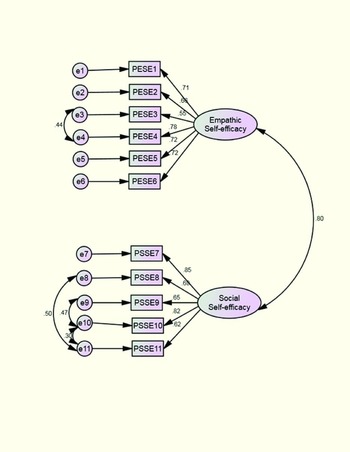
Two CFA models were tested: (a) a one-factor model (to confirm that the Perceived Empathic and Social Self-Efficacy Scale is not unidimensional) and (b) a two-factor correlated model. The one-factor model was not a good fit: χ 2 (43, N = 194) = 216.62, p < 0.001, χ 2/df = 5.04, GFI = 0.83, CFI = 0.85, RMSEA = 0.15, 90% confidence interval (CI: 0.13, 0.16). For the two-factor model, examination of the modification indexes suggests that four pairs of error terms should be correlated: (a) e3 (How well can you recognise whether a person is annoyed with you?) and e4 (How well can you recognise when a person is inhibited by fear?); (b) e8 (How well can you work or study well with others?) and e11 (How well can you actively participate in group activities?); (c) e9 (How well can you help someone new become a part of a group to which you belong?) and e10 (How well can you share an interesting experience you had with other people?); and (d) e10 (How well can you share an interesting experience you had with other people?) and e11 (How well can you actively participate in group activities?). Results of the re-specified two-factor intercorrelated model indicate a good model fit: χ 2 (39, N = 194) = 93.44, p < 0.001, χ 2/df = 2.40, CFI = 0.95, RMSEA = 0.09, 90% (CI: 0.06, 0.11). All items loaded significantly onto their respective factors with factor loadings ranging from 0.55 to 0.79 for the empathy factor and 0.62 to 0.85 for the social functioning factor. Similar to the rule of thumb for exploratory factor analysis, the factor loadings for each item is greater than 0.40, and no item was loaded on more than one factor. The empathy factor was significantly associated with the social functioning factor (r = 0.63, p < 0.001). The two-factor model represents a significantly improved explanation of the data than the one-factor model: χ 2 diff (4, N=194) = 123.18, p < 0.001. Cronbach's alpha coefficients of 0.85 and 0.88 were computed for the empathy and social functioning subscales, respectively, indicating relatively high estimates of internal consistency reliability. A graphical representation of the two-factor measurement model is presented in Figure 1.
Two-factor measurement model of the Perceived Empathic and Social Self-Efficacy Scale.

The empathy and social functioning factors were correlated with insight, social support from family and friends, and life satisfaction. Insight was significantly associated with empathy (r = 0.30, p < 0.001) but not social functioning (r = 0.10, p = 0.17). Social support from family was significantly related to both empathy (r = 0.27, p < 0.001) and social functioning (r = 0.21, p < 0.001). Social support from friends also correlated significantly with empathy (r = 0.38, p < 0.001) and social functioning (r = 0.30, p < 0.001). Finally, life satisfaction was significantly associated with empathy (r = 0.24, p = 0.001) and social functioning (r = 0.40, p < 0.001).
Discussion
Low empathy levels and social functioning pose significant challenges related to social reintegration and employment of people with SMI. Workplace socialisation skill deficits have been found to affect job retention in people with SMI (Becker et al., Reference Becker, Drake, Bond, Xie, Dain and Harrison1998), and as a result helping people with SMI develop empathic and social self-efficacy is vital to the VR counselling process (Gold & Waghorn, Reference Gold and Waghorn2007; Liberman, DeRisi, & Mueser, Reference Liberman, DeRisi and Mueser1989; Meehl, Reference Meehl1962; Suzuki, Amagai, Shibata, & Tsai, Reference Suzuki, Amagai, Shibata and Tsai2011; Tansey et al., Reference Tansey, Chan, Chou and Cardoso2004; Tschopp & Frain, Reference Tschopp, Frain, Chan, Cardoso and Chronister2009). The current study validated the Perceived Empathic and Social Self-Efficacy Scale as a self-report measure of empathy and social functioning for people with SMI. The results of this study confirm the two-factor measurement structure of the Perceived Empathic and Social Self-Efficacy Scale. Furthermore, the findings indicate insight was associated with empathy but not social functioning, and empathy was significantly associated with social functioning. Individuals require insight to develop empathy (Kleinberg, Reference Kleinberg2000), and empathy is the building block for social functioning (Eisenberg et al., Reference Eisenberg, Fabes, Murphy, Karbon, Smith and Maszk1996).
Significant correlations were also found amongst empathy and social functioning, social support from family and friends, and life satisfaction, suggesting that the factors are associated and that enhancement in one aspect of these related constructs could potentially lead to improvement in others. For example, improving the social support network of people with SMI could lead to an improved ability to understand others’ feelings (Lawton, Silverstein, & Bengtson, Reference Lawton, Silverstein and Bengtson1994) and social functioning (Heaney, Price, & Rafferty, Reference Heaney, Price and Rafferty1995) and vice versa (Cohen, Sherrod, & Clark, Reference Cohen, Sherrod and Clark1986; Shumaker & Brownell, Reference Shumaker and Brownell1984). In addition, results showed empathy and social functioning had appreciably higher levels of association with social support from friends than social support from family, suggesting that empathy and social functioning are necessary for developing social skills needed to build friendships. Previous literature in social functioning also suggests that empathy is a requisite skill for developing social functioning, and it plays an important role in the development and maintenance of interpersonal relationships and the formation of social bonds (Di Giunta et al., Reference Di Giunta, Eisenberg, Kupfer, Steca, Tramontano and Caprara2010; Loeb et al., Reference Loeb, Stempel and Isaksson2016).
The concepts of empathy and social functioning have been incorporated in training and education for individuals with SMI (Kopelowicz, Liberman, & Zarate, Reference Kopelowicz, Liberman and Zarate2006). Rehabilitation counsellors can use the Perceived Empathic and Social Self-Efficacy Scale as a baseline measurement in social skills training. It can also be used to gauge the progress made by clients receiving social skills training. With effective social skills interventions that enhance empathic and social self-efficacy, individuals with SMI will interact more effectively in social situations (e.g., work relationships) and thereby increase their levels of social support. People with SMI who develop the requisite skills necessary to sustain interpersonal relationships stand a better chance of obtaining and retaining employment (Becker et al., Reference Becker, Drake, Bond, Xie, Dain and Harrison1998).
Information generated through self-report measures can be of concern, and researchers indicate self-report information from individuals with SMI can be unreliable and vulnerable to ‘affective bias, poor insight, and recent life events’ (Atkinson, Zibin, & Chuang, Reference Atkinson, Zibin and Chuang1997, p. 99). Nevertheless, a recent shift to the recovery philosophy and VR practice emphasises the role of the mental health consumer as a partner in vocational recovery and stresses the value of self-report information. Bandura (Reference Bandura1997) insisted that self-efficacy, a highly subjective construct, could only be reported by the individual. In fact, individuals with SMI's self-report of insight is highly correlated with interview-based measures of insight (Francis & Penn, Reference Francis and Penn2001) and better insight produces self-ratings of empathy more highly correlated with measures of empathy (Lysaker, Hasson-Ohayon, Kravetz, Kent, & Roe, Reference Lysaker, Hasson-Ohayon, Kravetz, Kent and Roe2013). In addition, recent studies have found self-report measures to be useful in predicting functional outcomes of people with SMI (Eisen et al., Reference Eisen, Bottonari, Glickman, Spiro, Schultz, Herz and Rofman2011). Moreover, a self-report measure will be useful for rehabilitation counsellors to determine the degree to which people with SMI hold self-perceptions consistent with their observed ability to experience empathy and to competently engage in social interactions. Discrepancy between perceived and observed social functioning can be emphasised in social skills training for people with SMI in VR.
In summary, empathic and social self-efficacy are required to strengthen interpersonal relationships and social support, which are crucial for community participation, employment, and job retention of people with SMI. The current study validated the Perceived Empathic and Social Self-Efficacy Scale as a measure of empathic and social self-efficacy amongst people with SMI (Di Giunta et al., Reference Di Giunta, Eisenberg, Kupfer, Steca, Tramontano and Caprara2010). This scale can be used by rehabilitation counsellors to determine how accurately people with SMI perceive their empathic and social self-efficacy, along with use as an outcome measure to evaluate the effectiveness of social skills training interventions for people with SMI.