Introduction
Under a Single Non-Transferable Vote (SNTV) electoral system, electoral success does not arise from merely amassing large numbers of votes. Because votes cannot be transferred from one candidate to another, winners are determined solely by how many votes each individual candidate receives, regardless of his or her party affiliation. In addition to winning large numbers of votes, successful parties must also coordinate those votes among their candidates (Taagepera and Shugart, Reference Taagepera and Soberg Shugart1989). On the one hand, parties generally seek to avoid an uneven division of votes among party nominees. A candidate who racks up huge numbers of votes can leave too few for fellow party nominees, thus causing them to lose. On the other hand, if the party wins fewer votes than expected or nominates too many candidates, an even division of votes can leave all party nominees below the threshold for victory. Since the difficulty of successfully navigating these challenges increases as the number of party nominees increases, these coordination problem are most acute for larger parties that need to win multiple seats in each district in order to win a seat share commensurate with their vote share.
Cox argues that a subset of large parties can counter the coordination problems posed by SNTV elections: the parties that manage to successfully capture the control of the government. Through successful control and distribution of the government's multifold resources, the governing party is able to ensure that the votes that accrue to its candidates are more efficiently distributed. In this way, even the most successful candidates do not hog far too many more votes than necessary, while the least successful candidates still garner enough votes to be electorally viable. Opposition parties, without commensurate access to the resources of government, are less likely to achieve the same level of coordination. They do not have as many enticements to persuade candidates to run or to not to run. They also have a much harder time bolstering their weaker candidates or persuading their stronger candidates to ease back their campaign efforts. As a result, the governing party should be able to win more seats, out of the same number of votes, than their counterparts in the opposition, thanks to the coordinative advantage granted by the control of the state (Cox, Reference Cox1996).
For all the advantages that the governing party might enjoy, however, access to the state in a democratic regime is not an exclusive property reserved for it alone. While it may have greater access to government's resources than its competitors, it cannot totally deny the other parties all access. Likewise, the governing party is constrained by norms of democratic politics from going to far in deploying the resources of the state to actively undermine the coordinative efforts of the opposition. It may be that governing parties under SNTV electoral systems always enjoy a greater coordinative advantage, but the magnitude of the advantage depends heavily on the regime type. The ruling party in an authoritarian regime holding SNTV elections has far greater and much more exclusive access to the state resources than its democratic counterpart. It can likewise deploy these same resources against its opponents with far less restraint. The ruling party in an authoritarian regime using SNTV, then, can be much more efficient, relative to the opposition, in coordinating its votes than its democratic counterparts. It follows that, for any given share of votes, governing parties in authoritarian regimes should be able to win more seats than governing parties in democratic regimes.
Free elections, autocratic regimes, and the SNTV solution
In democratic regimes, elections determine which political forces will control the government. In contrast, authoritarian elections are by definition inconsequential in terms of displacing the party in government. Why might the ruling parties in such regimes, then, allow elections to be, in any sense, ‘free’ instead of making up and publicizing nonsensical supposed results that affirm universal support for themselves among their populaces?
There is, in fact, a great deal that even a dictator can gain from permitting free elections among his subjects. First, certifiably free elections confer upon the regime a degree of democratic legitimacy (Bates, Reference Bates2001). The ruling coalition can counter accusations of tyranny by its critics, both domestic and abroad, by showcasing regularly scheduled elections where the citizenry is free to choose among multiple candidates, including those in opposition to the government.
Second, free elections allow the regime to recruit into its cadres those who are most skilled in organizing and mobilizing grassroots support (Magaloni, Reference Magaloni2006). Even the regime's own politicians are often required to win elections in electoral authoritarian states as a precondition for advancement in ranks. Through this process, high positions within the governing hierarchy are filled with successful electoral politicians. While they generate public support for themselves in order to win elections, they do the same for the regime that they are part of.
Finally, free elections permit the regime to address the information problem that chronically affects authoritarian regimes. Wintrobe (Reference Wintrobe1998) has observed that dictators suffer from a dilemma in which they cannot ever know how their subjects regard them. Even authoritarian regimes benefit from having better knowledge on the level of popular support they enjoy. For one, they are more secure in power if they enjoy broad public support. For another, in the absence of a reliable gauge, they face great difficulty choosing appropriate public policies. Elections give the regime hard information about its standing with the population.Footnote 1
Free and fair elections, then, present a paradox to an authoritarian regime. The potential political benefits are enormous, but they come at a huge risk: the regime could lose the election. Should it seek to overtly and blatantly control the electoral outcomes, furthermore, the value of these benefits will wither away. An authoritarian regime may not necessarily quit office and give up power, should it lose the election, but refusing to acknowledge the adverse electoral outcome post facto would reveal the elections to have been a sham after all, and the regime would be forced to give up the benefits of running supposedly ‘free and fair’ elections in the future. Even for authoritarian regimes, heavy handed electoral manipulations avail themselves only as tools of last resort, when all other alternatives are wasted, and actual electoral defeat presents itself as a highly realistic possibility.
An authoritarian regime, however, can avoid the danger of having to roll out the heavy tools of electoral fraud or, at least, put off such a task for a long time by building up an electorally dominant party, one that is unlikely to face the prospect of a heightened chance of electoral defeat except under extraordinary circumstances. A substantial literature has grown up in the recent years focusing on how authoritarian regimes prolong their hold on power by largely democratic means – i.e. by winning elections (Magaloni, Reference Magaloni2006; Greene, Reference Greene2007). Central to these arguments is the judicious deployment of government resources by the governing parties. By deploying the resources, the ruling party's politicians can expand the party's support base – or, perhaps, their own personal votes. By building up a larger support base, they can garner more votes and consistently win elections, certainly in comparison to the resource-starved opposition politicians. The longevity of PRI as the ruling party of Mexico, for example, arose at least in part from the fact that most of its candidates consistently won elections ‘fairly’ throughout twentieth century, without having to resort to overt manipulations that might fatally undermine its credibility.Footnote 2
This is not an entirely novel argument, nor is it a feature limited to unmistakably authoritarian regimes. It is an important feature of such democratic polities as Japan and United States, as observed by McCubbins and Rosenbluth (Reference McCubbins, Rosenbluth, Cowhey and McCubbins1995) and Mayhew (Reference Mayhew1966) among many others.Footnote 3 Control over the government remains an important electoral asset in democratic regimes as well as in authoritarian ones: those who control the machinery of state gain an appreciable electoral edge over its rivals. The extent to which the governing coalition can appropriate the machinery of state for the advancement of its own electoral interests, however, is far more constrained in a democracy than in an authoritarian regime. The governing coalition in an authoritarian regime has far greater ‘ownership’ over the state and its apparatus than its democratic counterpart. The state and the regime are frequently fused into one and the bureaucracy is often directly answerable to the ruling party, whether officially or unofficially. The ruling coalition in an authoritarian regime can, then, call upon the public servants to do far more to service its electoral needs while doing much less for the opposition than its counterpart in a democracy could command. In so doing, the government is less likely to respect the rule of law, and the media and other watchdogs of its unfair conduct may be suppressed or intimidated. All this can be achieved without resorting to obvious electoral fraud. Without engaging in overtly underhanded tactics, the regime enters a gray area between democracy and authoritarianism, able to reap benefits of both while mitigating penalties from either.
There is a significant difference in our argument about the electoral advantages of government control specifically under SNTV and these more general arguments. These latter arguments focus largely on numbers of votes. Our argument concerns the coordination of votes. In other electoral systems, should voters tire of the regime and refuse to vote for the governing party, even with various inducements, the advantage of controlling the state is potentially lost to the electoral authoritarians. SNTV, however, offers an additional layer of electoral advantage beyond mere vote totals. Even if the opposition were able to assemble substantial vote totals, if they fail to efficiently coordinate their votes, electoral success may elude them. Even with comparatively few votes, the governing party, thanks to the greater efficiency in vote distribution afforded them through the control of the state, may be able to hold on to power under this electoral system.
SNTV and efficiency of vote distribution
To repeat, SNTV engenders serious collective action problems, especially for large parties with multiple nominees in each district. Parties that cannot overcome these collective action problems fail to efficiently distribute the votes that they receive among their candidates and wind up underperforming in elections. However, a governing party under the SNTV system can mitigate this problem by using the resources of the government to coordinate vote shares of its candidates more efficiently. Opposition parties, lacking such resources, are much more susceptible to collective action problems where they fail to maximize the seats they can obtain from the votes they receive through inadequate coordination (Cox, Reference Cox1996). In other words, electoral advantages accruing to the coalition in control of the government are an intrinsic part of SNTV itself.
Under the SNTV system, each district has a district magnitude of m, where m ≥1.Footnote 4 Each voter casts exactly one vote for a particular candidate. There is no cumulation or transfer of votes between candidates fielded by each party. The m candidates receiving the most votes are elected.Footnote 5 The challenge for a political party is to estimate how many votes it can win, determine how many seats those votes can elect, nominate that number of candidates, and split the party's votes equally among its nominees. Given a certain number of votes, there are three types of errors a party can make: it can nominate too few candidates, it can nominate too many candidates, or it can fail to equalize the votes among its nominees (Cox and Niou, Reference Cox and Niou1994; Cox and Rosenbluth, Reference Cox and Rosenbluth1994). Any of these three mistakes can cause a party to fail to optimize its seat share.
It becomes more difficult to avoid mistakes as the number of seats a party could potentially win in a district increases. If a party only has enough votes to win one seat, it is usually clear to all that the party should only nominate one candidate.Footnote 6 With only one candidate, equalizing the vote is not a problem. If, by contrast, a party has sufficient votes to potentially elect seven candidates, it is more likely that the party will make one or more of the errors listed above and actually elect fewer than seven candidates. First, splitting the votes equally among seven candidates is more difficult. It takes a lot of organizational capacity, evenly matched candidates, or plain luck for nearly the same number of voters to vote for each nominee. More likely, some candidates will receive far more votes than they need to win, while others will fall short, even if the sum of the party's votes would suffice to elect all of them if distributed appropriately. Second, it is difficult to anticipate in advance the number of successful candidates that the party's eventual vote total can support in a given election. This depends on both the vote totals of all parties in the district and the extent of coordination among their candidates, not only the coordination success within any single party. Perfect equalization of the votes between all candidates from the same party, for example, might ensure that they all lose should there be too many of them and other parties be successful in their coordination efforts with more appropriate numbers of candidates. If the other parties failed to coordinate their candidates’ vote shares efficiently, however, the party with too many candidates might win even more seats than had they nominated an ‘appropriate’ number of candidates for. This problem becomes greater as the number of seats a party can win, given its vote totals in a particular district, increases: it is much harder to turn enough votes for k seats into k actual seats as k becomes larger (Taagepera and Shugart, Reference Taagepera and Soberg Shugart1989: 28–9). As small parties face a smaller coordination problem, they should outperform larger parties under SNTV in turning votes into seats.
Cox argues that this logic of numbers is counterbalanced by the logic of government. The party in the government can use the resources of the state to better overcome the collective action problems engendered by SNTV. It can channel these resources to potential candidates to both affect their decision of whether to run in the first place and also to equalize vote shares of those who do run. The former helps the party control the number of candidates that it fields in a given district. The latter can be achieved by directing additional support to the candidates who need more votes to reach an ‘efficient’ total. The distribution of these resources follows a particularist logic, which Cox argues is superior to a policy or ideological logic in dividing up party support. The voters choose on the basis of the person of the candidate rather than the party. By basing electoral support on individual rather than party votes, each candidate is assured of electoral support from the voters whose support he has cultivated through dispensing favors supplied by his party, through the machinery of the government, whereas he cannot count on votes from those motivated solely by loyalty to his party whose votes might be lost to other candidates from the same party (Cox, Reference Cox1996).
In contrast to the advantages that the governing coalition enjoys, building a successful opposition coalition is particularly difficult under SNTV. To threaten the governing coalition successfully, the opposition needs to join together, form a large party, and win a respectable number of seats. Yet, the electoral logic of SNTV disadvantages a large electoral coalition, for that requires successful coordination among multiple candidates in almost every district. By definition, of course, the opposition coalition is deprived of the coordination advantage that control of government resources provides. In other words, SNTV makes forming a potentially successful opposition coalition particularly difficult.
In authoritarian regimes, the governing party's advantage should be magnified. The ruling party faces fewer constraints in deploying the resources of the states in its electoral campaigns. Unlike ruling parties in democratic regimes, authoritarian ruling parties can depend on judges for favorable rulings, such as in whether a candidacy is invalid, whether vote fraud has occurred, or whether particular business dealings have violated the law. The party can depend on the police, for example, in enforcing or not enforcing particular sections of the criminal or civil code in different cases. Bureaucrats are expected to act according to the party's best interests, and it is not unusual for bureaucrats to openly support ruling party candidates and help coordinate electioneering efforts. The ruling party controls the budget and can strategically funnel assets to candidates who might need more support. In addition, the regime controls a wide variety of patronage positions, and these can be quite useful in persuading superfluous candidates not to run. Friendly media coverage is also easily arranged, and unfriendly coverage can often be squashed. This wide array of tools is available to most authoritarian regimes, and most are not shy to use them to enhance their chances of staying in power (Levitsky and Way, Reference Levitsky and Way2010). However, under SNTV the challenge is somewhat different. The regime not only has to win votes, it also has to ration them among its various candidates. With this large toolbox, the ruling party should find it easier to convince ambitious members in crowded races to withdraw, to bolster the support of weaker candidates, and generally to persuade individual party members to go along with party decisions.
Under an authoritarian regime, of course, coordination for opposition groups is extremely difficult. The government is less constrained and can use harassment, intimidation, surveillance, and other forms of interference – both official and unofficial – to further exacerbate the already difficult coordination problems facing the opposition. Moreover, the regime has many tools available to co-opt potential opposition leaders. The party can offer more venal politicians payoffs or prestigious sinecures, but it can also offer more idealistic politicians a chance to enact favored policies instead of merely talking about them, as long as these remain sufficiently unthreatening. The opposition can unite to pose a meaningful electoral threat only with enormous difficulty. However, we must emphasize that the above merely intensify already existing difficulties: the root of opposition division lies within the incentives created by the electoral system itself. The relative ease with which individual opposition figures can run and win elections under SNTV – allowing them both to define and embody their cause – diminishes the incentive to cooperate with potential allies against the regime in the first place. This, in turn, strengthens the governing party's claims to legitimate rule. On the one hand, it appears that the lack of a credible opposition is due to discord within the opposition rather than any repression from the government. On the other hand, if opposition politicians are always bickering among themselves, it is quite easy for the ruling party to claim that it is the only realistic choice. In effect, the properties inherent in the SNTV system permit the governing coalition to divide the opposition with relative ease and perpetuate itself in power, even as it keeps up the appearance – and perhaps even the reality – of free elections.
To sum up this argument, we define several terms, following Cox asclosely as possible (Cox, Reference Cox1996: 746–8). First, let p be the maximum possible number of seats a party could have won in a particular district if it had nominated and equalized optimally, given its number of votes.Footnote 7 Second, let a be the actual number of seats won. Third, let g be defined as the advantages obtained from governing status. Fourth, let z denote other factors, including a party's inherent organizational capacity.Footnote 8 Cox proposes that a, the number of seats actually won, is a function of p, g, and z. More specifically, Cox hypothesizes that if p is held constant, the value of a for governing parties will be greater than that for opposition parties. Since governing parties have superior access to particularist benefits, unless z is much greater for opposition parties, the higher g values for governing parties will make them better at turning votes into seats. Cox then examines Japanese election data from 1958 to 1990, and finds that, at each level of p, the governing conservative camp does indeed win more seats than the opposition camp. He interprets this finding as evidence that governing parties are advantaged under SNTV.
Cox does not specify exhaustively the potential mechanisms that a set of political actors might have at their disposal to organize and coordinate amongst themselves to address their electoral dilemma under SNTV. Some mechanisms may not involve control of government at all: some parties, by virtue of their history or particulars of their organization, such as the role of organized labor or religious groups therein, might be able to achieve superior internal cohesion or discipline, ceteris paribus (Christensen, Reference Christensen1996; Yu, Reference Yu1999; Pao, Reference Pao1997). In other words, some parties may have higher values of z than others, a problem Cox cannot resolve since only one party, the LDP, holds power throughout his dataset. More pertinent to this paper, the array of options conferred by the control of a government varies depending on the nature of the government itself. Control over an authoritarian regime, where exercise of government authority is subject to less restraint, should yield greater electoral rewards than that over a democratic regime. Again, Cox's data are all from a democratic regime, allowing him to add nothing concerning this variable.
Finally, we reiterate that this argument is different from the standard incumbency advantage argument in that it does not focus on how the incumbent party might win more votes. Rather, we argue that, by controlling for the number of votes a party receives, governing parties are more efficient in translating those votes into seats than opposition parties are. In other words, the unique advantage of SNTV to governing parties is not that it helps them to always amass crushing margins of victory, but that in all elections, whether landslides or razor-thin squeakers, the governing parties’ votes typically produce more seats per vote than opposition parties’ votes do.
Elections under different regime types in Taiwan
Taiwan's electoral history can be roughly divided into three eras. Between 1954 and 1975, elections were held for local offices and for some seats in the national legislature, even as the ruling KMT, led by Chiang Kai-shek, retained an ironclad grip on power, backed by seemingly never-ending martial law. Following the death of Chiang in 1975, KMT started to loosen its control on politics and society and Taiwan began its slow transition to democracy. Even then, however, martial law remained in place and the nascent opposition was not allowed to formally organize into parties. In fact, the opposition prior to the late 1970s was characterized by its lack of cooperation. There were several individuals who were known as opponents of the regime, but they did not put forth a common platform or campaign, and they often wasted votes by winning far more than they needed for election. During the late 1970s and early 1980s, the opposition was loosely, though informally, organized. Politicians within the Tangwai (literally: outside the party) Movement often tried to put forth slates of candidates, and they campaigned across districts. However, with no formal organization, it was not always clear which candidates were really Tangwai and which were merely independents with no real national agenda. The opposition finally formed the Democratic Progressive Party in 1986. However, it was only after the death of Chiang Ching-Kuo in 1988, the son and successor of Chiang Kai-Shek, and the rise of Lee Teng-Hui to the leadership of the KMT that Taiwan could be meaningfully considered to have transitioned into a democratic polity. Specifically, it was not until the 1991 National Assembly and 1992 Legislative Yuan elections that the opposition finally had a real opportunity to capture control of the national government. Thus, we classify the period 1954–75 as the Authoritarian Era, 1977–90 as the Transition Era, and the period starting in 1991 as the Democratic Era.Footnote 9
SNTV has a long history in Taiwan that cuts across all three eras. The system began in Taiwan as a leftover from the Japanese colonial era (Rigger, Reference Rigger1999: 34–9)–the very invention of the SNTV electoral system is attributed to the Meiji oligarchs in early twentieth century Japan who developed the system specifically as the means to undermine electoral cooperation among the opposition (Ramseyer and Rosenbluth, Reference Ramseyer and Rosenbluth1998: 44–6). Since Taiwan reverted to the Republic of China in 1945, most elections for representative bodies have been conducted under SNTV rules. Thus, Taiwan's SNTV experience covers both national and local-level elections in both Authoritarian and Democratic Eras.
For this paper, we employ data for a multitude of offices spanning the period from 1954 through 2005.Footnote 10 For national-level offices, we consider elections to the Legislative Yuan, National Assembly, and Taiwan Provincial Assembly. Elections for the Legislative Yuan and National Assembly were not held in Taiwan until 1969. Due to the triumph of the Communist Party in the Chinese Civil War, it was impossible to hold elections in districts in Mainland China, so the incumbents elected in 1948 simply remained in office. These ‘senior’ legislators and assembly members, overwhelmingly KMT members, effectively held permanent seats. As some of the older legislators and assembly members died, the regime began holding ‘supplemental’ elections, in which a small number of seats were contested in the ‘liberated’ areas of China – in other words, Taiwan.Footnote 11 In 1990, the Council of Grand Justices ruled that the remaining senior legislators and assembly members had to retire, and all the seats of these two bodies were open to election in 1991 (National Assembly) and 1992 (Legislative Yuan). The Legislative Yuan used SNTV for the last time in 2004, and SNTV was replaced by a new mixed-member majoritarian system in 2008. The National Assembly used SNTV for the last time in 1996.Footnote 12 The Taiwan Provincial Assembly used SNTV for elections from its establishment in 1951 to its dissolution after the 1994 elections.Footnote 13 Elections to these three bodies ran according to similar logics. Winning candidates typically needed to garner several tens of thousands of votes and employed similar sets of strategies. Moreover, the partisan patterns of competition were similar among the three bodies. Finally, successful candidates enjoyed similar levels of prestige and power.
We also examine the local-level elections for County and City Assemblies, which have been largely neglected by academics.Footnote 14 The ROC has 23 counties and county-level cities.Footnote 15 The number of votes required to win a seat is very small, ranging from a few hundred in the smallest counties to about ten thousand in the largest counties, making contact with individual voters much more practical than in national-level elections. Successful candidates enjoy far less power and prestige than do winners of national-level elections. More importantly, candidates in these local elections typically employ different strategies than national-level candidates. Local elections seem to run on a non-partisan logic, as winning candidates tend to rely almost entirely on their social networks, locally oriented policy appeals, or vote-buying, rather than on party or national policy appeals. KMT-affiliated candidates typically dominate these elections, and the DPP and various small parties often win only a fraction of the votes they amass in national-level elections. Very few scholars bother to pay attention to local elections, perhaps since they seem so detached from national partisan politics. However, a closer examination of these elections reveals the KMT playing a very active role. For example, Bruce Jacobs, who has done extensive fieldwork in rural Taiwan from the 1970s to the current era, provides a rich account of local politics and recounts numerous examples of precisely the type of party coordination activities behind the scenes that would increase yields. One important element of coordination is nominating the right number of candidates, and Jacobs offers many anecdotes of the KMT's efforts to persuade certain politicians to withdraw from an election so that the KMT would not have too many candidates. For example, in one case, the KMT persuaded a former member of the county assembly not to run to regain his seat by threatening to cancel the LP natural gas license that his business required. When the politician acquiesced, he found that his allotment had been increased, substantially increasing his personal income (Jacobs, Reference Jacobs2008: 233). Another way to maximize yields is to equalize votes among party nominees, and Jacobs details intense election eve lobbying of local party officials to try to persuade them to throw the few hundred votes the party controlled through public officials, employees of state enterprises, and military veterans to one candidate or another (Jacobs, Reference Jacobs2008: 192–208, 233–43). In sum, while campaigns for local office may look very different on the surface from those for national office, we hold that the same mechanisms for governing party advantages still hold.
Government advantage in democratic and authoritarian regimes
Our key dependent variable is a, the actual number of seats won by a party in a given district. The key independent variable that affects a for a given party is its status vis-à-vis government (g). Cox holds that under SNTV, yield is a function of p, g, and z. Holding p and z constant, governing coalitions obtain higher yields than the opposition. Unlike Cox, we do not consider g to be considered a binary variable, simply indicating merely whether a party controls government or not. The extent to which the governing coalition can use the resources of the state to its electoral advantage should depend on the nature of the regime. As per the preceding discussion, the Authoritarian Era offers the most opportunity for the governing regime to increase its yield, the Democratic Era the least, and the Transition Era somewhere in between.
The only party in control of the government during the Authoritarian and Transition Eras was, of course, the KMT. Although both KMT and DPP have had opportunities to control the central government during the Democratic Era, it makes little sense to compare KMT control of an authoritarian government with a DPP control of a democratic government, given the possible differences in their inherent organizational capacity to affect successful electoral coordination. We restrict ourselves in this section to only the periods of KMT control over the national government.
This leads us to the following hypothesis:
H1: Controlling for the number of seats that could be won with the number of votes received (p), the KMT actually (a) win more seats in the Authoritarian Era than in the Transition Era, and it should actually win more seats in the Transition Era than in the Democratic Era.
If there had been an identifiable opposition party throughout this era, we could test a parallel hypothesis suggesting that the opposition should similarly perform better in the Democratic Era than in the Authoritarian Era. However, since there was no organized opposition until fairly late in the Transition Era, we will limit our analysis to the governing party.
We evaluate this hypothesis using a simple OLS regression model. The cases are individual districts in each election. The dependent variable is the number of seats the KMT actually won in a particular district. Since a party always wins zero seats when p = 0, all districts in which the KMT did not have sufficient votes to win at least one seat are excluded. Of course, as p increases, parties will win more seats, so we must control for p in the model.
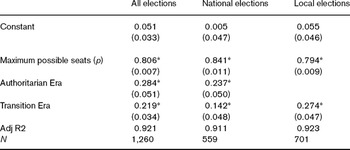
Table 1 shows the results of an OLS regression model of KMT yields across the three eras. In addition to a control variable for the number of seats the KMT could have won (p), we include two dummy variables for the Authoritarian and Transition Eras. As expected from Hypothesis 1, the coefficients on both these variables are both positive and significant. The KMT was markedly better at turning votes into seats in the Authoritarian and Transition Eras than in the Democratic Era. Holding constant the number of seats that the KMT could have won, the KMT actually won about 0.28 more seats in the average district in Authoritarian Era than in the Democratic Era. Likewise, the KMT actually won about 0.22 more seats per district in the Transition Era than in the Democratic Era. Both these differences are significant. Hypothesis 1 suggests that the Transition Era should fall somewhere between the Authoritarian and Democratic Eras. The coefficient is, in fact, between the other two, but the difference between the Authoritarian and Transition Eras is not significant. That exception notwithstanding, these results are consistent with the argument that the transition to democracy saw a decline in the levers of state power that could be harnessed for electoral coordination.
KMT performance across different regimes

Notes: 1. The dependent variable is the number of seats actually won (a). All independent variables other than p are binary. See text for explanation. The model is an OLS regression.
2. National elections include the 1972, 1975, 1980, 1983, 1986, 1989, 1992, 1995, 1998, 2001, and 2004 Legislative Yuan elections; the 1972, 1980, 1986, 1991, and 1996 National Assembly elections; and the 1954, 1957, 1960, 1964, 1968, 1973, 1977, 1981, 1985, 1989, and 1994 Provincial Assembly elections. Aboriginal districts are included, but the functional constituency districts used in Legislative Yuan and National Assembly elections prior to the democratic era are not. Local elections include the 1986, 1990, 1994, 1998, 2002, and 2005 County and City Assembly elections. The data include all the cities and counties in Taiwan Province as well as Jinmen and Lianjiang Counties; they do not include Taipei and Kaohsiung City Council elections.
3. Standard errors are in parentheses. * significant at p < 0.05.
Perhaps the results that we obtain are affected by the particularities of local elections. As noted above, local-level electoral data become available only from 1986. They are appended mostly to the election results from the Democratic Era. Could the results be skewed by the local electoral data systematically diluting the election results from the Democratic and Transition Eras, but not that from the Authoritarian Era? To ensure that these results are not dependent on the mixture of local and national SNTV elections, we rerun the model separately with only national elections and only local elections. In fact, our results are even clearer in these two models. Controlling for the number of seats it could have won, the KMT won significantly more seats in the Authoritarian Era than in the Democratic Era in national elections, and it won significantly more seats in the Transition Era than in the Democratic Era in both national and local elections. Moreover, in national elections, the KMT's won nearly a tenth of a seat more per district in the Authoritarian Era than in the Transition Era, and this difference is significant at the 90% confidence level (p = 0.074, not shown in Table 2). Overall, these two models are also consistent with our hypothesis. Simply put, the government advantage is amplified in an authoritarian regime and muted in a democratic regime.
Governing status and KMT and DPP performance in the democratic era

Notes: 1. The dependent variable is the number of seats actually won (a)0. All independent variables other than p are binary. See text for explanation. The model is an OLS regression.
2. National elections include the 1992, 1995, 1998, 2001, and 2004 Legislative Yuan elections; the 1991 and 1996 National Assembly elections; and the 1994 Provincial Assembly elections. Local elections include the 1994, 1998, 2002, and 2005 City and County Assembly elections, including all the cities and counties in Taiwan Province as well as Jinmen and Lianjiang Counties but not including Taipei and Kaohsiung City Council elections.
3. Standard errors are in parentheses. * indicates significant at p < 0.05.
Alternation of power and government advantage during the Democratic Era
We have argued that the electoral advantage that accrued to the governing regime during the three eras of varying political freedoms in Taiwanese history is attributable to the declining ability of the regime to summon the machinery of the state to serve as an electoral resource in SNTV elections. We have limited ourselves to the case of a single party, the KMT, however it is conceivable that the observed electoral advantages came not from its status vis-à-vis government (g), but the particulars of its internal organizational capacity, independent of its governing status (z). Moreover, the other main piece of evidence consistent with our argument, Cox's analysis of the government advantage in Japanese elections, also suffers from this same problem: only one party, the LDP, held governing power throughout the period studied.
While we cannot categorically reject the possibility that internal party characteristics rather than governing status drove the KMT's electoral bonuses during the Authoritarian and Transition Eras, we can disentangle the effects of these two variables during the Democratic Era, when transitions in control of the central government have taken place. If the KMT was able to retain its electoral advantage even when it was voted out of the central government, it might suggest that the pattern seen in the preceding section was an indication of a decline in organizational capacity particular to the KMT. If the advantage suddenly shifted to the DPP when it took control of the national government by winning the presidency in 2000, it would suggest that the changes observed are indeed associated with the control of government – and the decline in the electoral bonus is indeed attributable the transition to democratic rule.
The transition of power in Taiwan's central government allows us to evaluate the following hypothesis:
H2: Controlling for the number of seats that could be won with the number of votes received, parties should actually win more seats when they control the central government than when they do not control the central government.
The empirical strategy for this hypothesis is slightly different from that for the preceding section. Yields for the party in government and the party out of government can be examined separately, which allows for evaluation of organizational capability for each party. The unit of analysis used for this section, then, is party-district. For each district in each election, there are two cases: one for the KMT and one for the DPP. In other words, there are four types of cases: KMT candidates with a KMT government, KMT candidates without a KMT government, DPP candidates with a DPP government, and DPP candidates without a DPP government. We construct three dummy variables to reflect these four different situations. The omitted category is all KMT candidates. These are contrasted with the KMT candidates when the KMT controls the central government. A second dummy differentiates all DPP candidates from all KMT candidates. The third dummy differentiates DPP candidates, while the DPP controls the central government. If Hypothesis 2 is correct, we should find that the two dummy variables for parties in power are positive.
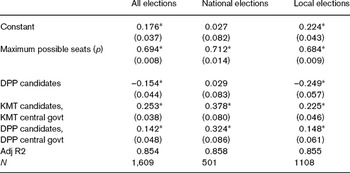
Table 2 shows the results of an OLS regression of how well the KMT and DPP converted votes to seats in elections during the Democratic Era. Looking at all elections, we find that the coefficients for both the KMT in power and the DPP in power are positive (0.253 and 0.142, respectively) and significant. These findings suggest that control of the government results in more efficiency in turning potential seats into actual seats for both KMT and DPP. Moreover, when we disaggregate the data into national and local elections, we find that the trends are even stronger and clearer. In national elections, the KMT wins 0.378 more seats per district when it is in power than when it is out of power, and the DPP wins 0.324 more seats when it is in power than when it is out of power. In local elections, the benefits of governing status are less dramatic, though still clearly positive.
One interesting difference between local and national elections is the widely differing fortunes of the DPP in the two different kinds of elections. While the performances of the KMT and DPP are roughly equivalent in national elections, the DPP is far worse than the KMT, roughly 0.25 seats per district worse, at turning votes into seats in local elections. In other words, in local elections, the KMT always has a much higher z value than the DPP. In fact, this advantage is so large that we expect the KMT to have higher yields than the DPP regardless of who holds power in the central government. This is precisely the problem with Cox's analysis of Japanese elections. Since there was no alternation of power, he could not be sure that the superior performance of the conservative camp was due to governing advantages rather than some inherent internal advantage in organizational capacity. The Taiwanese data allow us to be certain that the government advantage does indeed matter even when all else (z) is not equal. While the KMT always outperforms the DPP in local elections due to its higher z value, the disparity is much smaller when the DPP is in power than when the KMT is in power.
Direct measures of coordination
Christensen challenges the government advantage thesis from another direction, arguing that direct measures of coordination are more appropriate and informative than indirect measures. According to Cox, governing parties are supposed to be better at nominating the appropriate numbers of candidates and dividing their votes among those candidates. Due to these two advantages, governing parties should be better at turning votes into seats. Rather than simply looking at how many seats a party wins, as Cox does, Christensen suggests examining directly whether governing parties nominate and ration votes better. In fact, when Christensen re-examines the Japanese data, he finds that the governing conservative camp was significantly worse than the opposition camp in both these areas. In other words, even though the opposition camp nominated more appropriately and divided its votes more effectively, the governing camp managed to win more seats, holding constant the number of seats winnable. Christensen explains this anomaly by arguing that the difficulty of the task was not actually held constant. At every level of possible seats, the conservatives had a higher vote share. For example, when two seats were possible, the average conservative vote share was 49.1%, while the average opposition vote share was only 37.1%.Footnote 16 As such, the conservatives were more likely to actually win two seats because they had more votes, not because they were better at coordinating (Christensen, Reference Christensen2000: 173–80)
In light of Christensen's argument, it would behoove us to demonstrate that governing parties in Taiwan did, in fact, nominate and split their votes more effectively. Ideally, we would compare the KMT's performance in the Authoritarian and Democratic Eras and show that the government advantage was larger in the Authoritarian Era. However, the data do not permit this test. Prior to 1991, candidates were allowed to determine how the ballot would list their party affiliation. A candidate could simply write in ‘KMT’ as his party affiliation whether or not he had been nominated by the party or was even a party member. Often more than half of the KMT candidates on the ballot were these ‘self-nominated’ candidates. Thus, while the KMT might have been very active in nominating an appropriate number of candidates and dividing the party's support among those nominees, our data are clouded by all the other self-nominated KMT candidates, who generally campaigned without any help and sometimes with active opposition from the party. In any particular election, we suspect that the voting public usually understood which candidates were the ‘real’ KMT candidates and which were the self-starters. However, our data do not allow us to separate these two. As such, any examination of nomination or vote rationing would yield highly misleading results. In the Authoritarian and Transition Eras, the indirect test of coordination is the best we can do.Footnote 17
In 1991, however, the election law was changed so that only candidates with an official letter of nomination from their party were allowed to list their party affiliation on the ballot. Due to this change, we can directly test whether governing parties were more successful at coordination in the Democratic Era.
According to Christensen, a party nominates successfully if the number of nominees is equal to the number of seats that it can possibly win (2000: 174). To this, we add cases in which the party actually wins as many seats as are possible. In these latter cases, the party may have tried to stretch its votes to win another seat, but since this aggressive nomination strategy did not result in losing a winnable seat, it is hard to say that the attempt was harmful. Since the coordination problem becomes more difficult as the number of winnable seats increases, we also control for p. We thus test the following hypothesis:
H3: Controlling for the number of seats that could be won with the number of votes received, parties should nominate appropriately more often when they control the central government than when they do not control the central government.
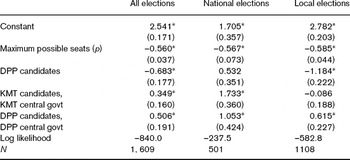
We test this hypothesis with a logistic regression model using the same independent variables as the models in Table 2. The dependent variable is coded one if the party has nominated appropriately, as defined above, and zero otherwise. Thus, we expect the coefficients for parties in government to be positive. The results are shown in Table 3. We find that both the KMT and the DPP are significantly more likely to nominate appropriately when they are in government than when they are not. Once again, there are slight differences between national- and local-level elections. In the former, there are not big differences between the two parties; both do better when in government than when out of government. In the latter, only the DPP does significantly better when in government. Overall, we find that there is solid evidence for the hypothesis that parties in government are better able to nominate an appropriate number of candidates.
Governing status and KMT and DPP nominations in the democratic era

Notes: 1. The dependent variable is a binary variable coded one if the party nominated appropriately. All independent variables other than p are binary. See text for explanation. The model is a logistic regression.
2. National elections include the 1992, 1995, 1998, 2001, and 2004 Legislative Yuan elections; the 1991 and 1996 National Assembly elections; and the 1994 Provincial Assembly elections. Local elections include the 1994, 1998, 2002, and 2005 City and County Assembly elections, including all the cities and counties in Taiwan Province as well as Jinmen and Lianjiang Counties but not including Taipei and Kaohsiung City Council elections.
3. Standard errors are in parentheses. * indicates significant at p < 0.05.
While parties should always want to nominate appropriately, they may not always want to split their votes evenly. If, in the days immediately preceding the election, a party determines that it has too many candidates given the number of votes it expects to win, splitting votes evenly can be a recipe for disaster. We follow Christensen in excluding cases in which splitting votes evenly may not be the optimal strategy. Christensen examines only cases in which the number of party nominees is equal to the number of possible winnable seats (2000: 175–7). To this, we add cases in which the number of party nominees is less than the number of possible winnable seats. In both cases, the party can elect all of its nominees by splitting its votes evenly. This leads to the following hypothesis:
H4: Controlling for the number of nominees, in situations in which it is advantageous to divide votes equally, parties should divide their votes more equally when they control the central government than when they do not control the central government.
We follow Christensen in defining the dependent variable. Christensen looks at the average deviation from the mean, taking the sum of absolute values and dividing by the number of candidates, ∑ |xi − x|/n, where xi is the vote share of the ith party nominee, x is the average vote share for the party nominees, and n is the number of party nominees (2000: 176–8). The independent variables are the same as in the previous two tables, except that we replace the number of winnable seats with the number of nominees to reflect the difficulty of the task at hand. The model is tested with an OLS regression. Since the dependent variable decreases as the vote is divided more evenly, we expect the coefficients for parties in government to be negative.
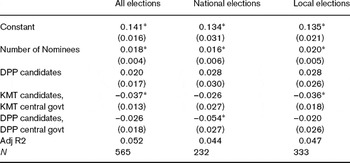
The results, shown in Table 4, are somewhat less clear than in previous models. While all the coefficients are in the expected direction, not all reach conventional levels of significance. Perhaps this is due to the smaller number of cases. On the other hand, all of the significant results are as expected. In the overall model and in local elections, the KMT divides its vote better when it is in government. In national elections, the DPP divides its votes more evenly when it holds power than when it does not.
Governing status and KMT and DPP vote division in the democratic era

Notes: 1. The dependent variable is Christensen's measure of deviation from the mean. All independent variables other than the number of nominees are binary. See text for explanation. The model is an OLS regression.
2. National elections include the 1992, 1995, 1998, 2001, and 2004 Legislative Yuan elections; the 1991 and 1996 National Assembly elections; and the 1994 Provincial Assembly elections. Local elections include the 1994, 1998, 2002, and 2005 City and County Assembly elections, including all the cities and counties in Taiwan Province as well as Jinmen and Lianjiang Counties but not including Taipei and Kaohsiung City Council elections.
3. Standard errors are in parentheses. * indicates significant at p < 0.05.
Looking at Tables 3 and 4 in conjunction, we find that parties always do one of the two coordination tasks better when they are in power. In national elections, the KMT nominates more appropriately, while the DPP both nominates more appropriately and divides its votes more evenly. In local elections, the KMT is better at dividing its vote when in government, while the DPP does better at nominating. Moreover, there is no indication that either of the parties nominate or divide votes better when they are out of power. Overall, the examination of these more direct measures of coordination demonstrate that, at least in the Democratic Era in Taiwan, parties did indeed coordinate more successfully when they were in power than when they were in opposition.
The various finding from the Democratic Era presented in these two sections both reinforce the earlier finding across the Authoritarian, Transition, and Democratic Eras and introduce a potential caveats for future studies. The results strongly indicate that the phenomenon of electoral bonuses to the governing party in SNTV elections is indeed attributable to an increased capacity for coordination stemming from the control over government resources. At the same time, however, they also suggest that a party's organizational capacity may also contribute to the accrual of electoral bonuses that it obtains, independent of its governing status, at least in some electoral contexts. The KMT of 1958 hardly resembled its future counterpart in 1998 in terms of internal organization. This leaves open the possibility that the changes of the past came not only in access to government resources, but also in organizational capacity.Footnote 18 Further studies are needed to further elucidate these linkages.
Discussion
Several recent studies have done much to blur the distinction between electoral authoritarianism and genuine democracy by recognizing that overt electoral fraud is an exception rather than the norm even in the former. The key difference is that, in an authoritarian regime, the electoral advantages arising from the control of the state are much greater than those in a democratic one. To this argument, we have appended an additional layer that calls for a closer examination of the electoral rules and their consequences. While garnering more votes would undoubtedly help a party maintain itself in power regardless of the institutions in use, certain electoral rules confer even greater advantages to the regime, independent of the numbers of votes. Specifically, we have argued that the centrality of successful vote coordination inherent in the SNTV electoral system multiply the electoral advantage of the governing party. The considerable coordinative success enjoyed by the KMT during the authoritarian period of Taiwanese history and the steady diminution of electoral premium from state control that took place as Taiwan democratized lend credence to our argument.
Much additional research is necessary to fully develop this idea. In particular, it would be useful to examine the entire family of electoral systems to determine which systems are more or less advantageous to authoritarian regimes. In this paper, we have pointed to coordination as the crucial factor, and most of the major electoral systems, including single-member, list PR, and mixed-member systems, require far less coordination than SNTV. Instead, the systems that place the highest premiums on coordination tend to be lesser studied electoral systems. In particular, the family of limited vote systems, in which there are multi-member districts and each voter casts one or more votes for individual candidates, tends to demand high levels of coordination. SNTV, in which each voter casts one vote, is a member of this family. The block vote, in which each voter casts as many votes as there are seats, is another member. When there are strong political parties and voters tend to simply vote for an entire slate, such as in the United States Electoral College, the block vote does not demand much coordination. However, when political parties do not have such a strong influence, coordination becomes quite important in the block vote. In this light, we might expect to see significant government advantages in contexts such as the block vote systems in seventeenth-century England, Thailand prior to 1997, and present-day Egypt and Tunisia as well as in the SNTV systems of Japan in the late nineteenth and early twentieth centuries, Korea in the 1970s and 1980s, and in present-day Jordan and Afghanistan, among others.
Our aim here has been more modest. This paper has not sought to offer or develop a more general theory. It has also not claimed that the KMT government on Taiwan actively selected the SNTV system in order to perpetuate its rule. We have sought simply to demonstrate that the logic of SNTV systematically advantages governing parties, and that this advantage is larger in authoritarian regimes than in democratic regimes. SNTV does this by creating coordination problems that the government, with its advantage in resources, can overcome more easily than the opposition, which is usually starved of such assets. Since the opposition politicians have no one but themselves to blame for their failure to cooperate, the government reaps the benefits of holding what look like, and in some sense actually are, free and fair elections. Empirically, the data from the Taiwanese experience are consistent with these theoretical claims. Governing parties are better at turning votes into seats than opposition parties, and this advantage was larger in the Authoritarian Era than in the Democratic Era. Given the empirical record, our theoretical understanding of SNTV, and authoritarian regimes’ desires to both hold elections and maintain power, a strategic dictator would do well to at least consider SNTV.
About the authors
Nathan F. Batto is Assistant Research Fellow at the Institute of Political Science, Academia Sinica, Taipei, Taiwan. He received his Ph.D. from the University of California, San Diego. His research interests include Taiwanese politics, electoral systems, and legislative politics.
Henry A. Kim is Assistant Professor at the University of Arizona. He received his PhD from University of California, San Diego, and his research interests include electoral and legislative politics, campaigns, and political institutions.