Introduction
Aphids (Hemipetra: Aphididae) are one of the most important agricultural pests in various crops worldwide (Blackman & Eastop, Reference Blackman, Eastop, van Emdem and Harrington2007; see also www.aphidsonworldsplants.info, accessed May 2015). They cause severe crop losses due to direct feeding and to transmission of several plant–virus. Carbamates (CARBs) and organophosphates (OPs) are used to control aphids. They express their toxicity by inhibiting acetylcholinesterase (ace), a key enzyme in the nervous system of both vertebrates and invertebrates. Several aphid species have developed resistance towards OPs and CARBs, which has resulted from enhanced sequestration/detoxification, due to elevated carboxyesterases, and/or insensitivity of ace, due to the selection presence of modifications/target site mutations at the active site of the enzyme, which reduce its affinity with the insecticides (for review see Foster et al., Reference Foster, Devine, Devonshire, van Emden and Harrington2007).
Two ace genes, termed ace1 and ace2, encoding for ace1 and ace2, respectively, have been cloned and sequenced in several aphid species, such as the cotton aphid Aphids gossypii Glover (Li & Han, Reference Li and Han2002, Reference Li and Han2004; Andrews et al., Reference Andrews, Callaghan, Field, Williamson and Moores2004), and the peach potato aphid Myzus persicae (Sulzer) (Javed et al., Reference Javed, Viner, Williamson, Field, Devonshire and Moores2003; Nabeshima et al., Reference Nabeshima, Kozaki, Tomita and Kono2003). Among several mutations that have been reported to be associated with insecticide resistance, the mutations S431F and A302S in the ace1 gene has been primarily shown to affect the activity and insecticide sensitivity of the enzyme, conferring resistance to OPs and CARB in aphids, as well as other species (Benting & Nauen, Reference Benting and Nauen2004; Bass et al., Reference Bass, Puinean, Zimmer, Denholm, Field, Foster, Gutbrod, Nauen, Slater and Williamson2014).
The aphid Therioaphis trifolii (Monell) (Hemiptera: Aphididae) is among the most damaging agricultural pests of several crops worldwide, and it shows important invasive abilities and host–plant-related differences. The aphid reproduces sexually (non-host alternating holocyclic) in cold temperate climates of northern and central Europe and more northerly USA. However, it reproduce parthenogenetically through the whole year in warmer regions (Blackman & Eastop, Reference Blackman and Eastop2006; see also www.aphidsonworldsplants.info, accessed May 2015) The subspecies T. trifolii maculata, also known as spotted alfalfa aphid (SAA), can be very injurious to alfalfa, Medicago sativa L. (Fabaceae), crops in many regions, including the Kingdom of Saudi Arabia where it is a major problem (Ajlan et al., Reference Ajlan, Ghanemand and Abdulsalam2007; Abdelkader & Rifaat, Reference Abdelkader and Rifaat2012).
The protection of alfalfa production in Saudi Arabia is achieved by controlling the insect pest populations, such as the primary pest T. trifolii maculata, with insecticides. For effective management of the available insecticides, and thus pest control, it is essential to diagnose and monitor insecticide resistance phenotypes and mechanisms. However, diagnostic tools for that purpose are not available for T. trifolii, where resistance mechanisms have not been studied at the molecular level.
In the present study, a molecular examination was made for the presence of mutations in the ace1 of T. trifolii populations collected from Saudi Arabia. We report the detection of an insecticide-resistant mutation identified for the first time in this species, and the development of a polymerase chain reaction–restriction fragment length polymorphism diagnostic assay (PCR–RFLP) for the early detection of the resistant mutation in individual aphids, and the support of Insecticide Resistance Management (IRM) strategies.
Materials and methods
Aphid samples
Five aphid populations were field-collected from several locations in Al Qassem Area in the Kingdom of Saudi Arabia. All samples were derived from alfalfa fields and the aphids were stored in absolute ethanol until use.
Species identification
Permanent microscope slides of aphids were prepared according to Blackman & Eastop (Reference Blackman and Eastop2000). The identification of the aphid species was based on the keys described by Blackman & Eastop (Reference Blackman and Eastop2000, Reference Blackman and Eastop2006, see also www.aphidsonworldsplants.info, accessed 14 May 2015).
Extraction of DNA cloning and sequencing of ace1 gene
Total DNA was extracted from 65 individual aphids from the five populations as described by Sunnucks et al. (Reference Sunnucks, England, Taylor and Hales1996). Gene-specific primers designed for the ace1 (AJ748115) of A. gossypii were used for the amplification of a homologous region from T. trifolii maculata DNA according to Andrews et al. (Reference Andrews, Callaghan, Field, Williamson and Moores2004). Based on the sequence of the PCR products (sequencing service was provided by CEMIA, Larissa, Greece) a new set of primers were designed (Trif.MaceF: 5′-TGGTTTCCATGCAGTACAG-3΄ and Trif.MaceR: 5 ′-GTTGAGTTGCCCGATAGCTT-3′) that allows the amplification of a 650 bp T. trifolii maculata genomic fragment. The fragment contains both S431F and A302S loci. The PCR reaction (50 µl) contained 2 µl of gDNA (0.3) µM of each primer, 0.8 U OneTaq DNA Polymerase (M0480S, New England Biolabs, Ipswich, MA, USA), 1× reaction buffer (OneTaq Standard Reaction Buffer; providing 1.8 mM MgCl2) and 0.2 mM dNTPs. Amplification started with an initial denaturation step at 94°C for 2 min, followed by 35 cycles of 94°C for 30 s, 53°C for 30 s and 72°C for 45 s and final extension step at 72°C for 10 min.
Sequence analysis of ace1 gene and development of a PCR–RFLP assay to detect resistance mutation
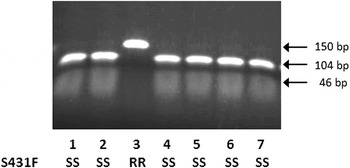
DNA sequences were analysed using DNA STAR software (Lasergene, UK), and compared with other Aphid ace1 sequences. Based on the novel T. trifolii maculata ace1 sequence that was isolated, primers Trif. S431F_F (5′-AAAACCAATATACTCATGGGCAGT-3΄) and Trif. S431F_R (5΄-GTCTGCGTTCGGGTTGAGTT-3΄) were designed to amplify a 150 bp product. The PCR reaction (25 µl) contained 2 µl of gDNA, (0.3) µM of each primer, 0.8 U OneTaq DNA Polymerase (M0480S, New England Biolabs), 1× reaction buffer (OneTaq Standard Reaction Buffer; providing 1.8 mM MgCl2) and 0.2 mM dNTPs. Amplification started with an initial denaturation step at 94°C for 2 min, followed by 35 cycles of 94°C for 30 s, 55°C for 20 s and 72°C for 20 s. Ten μl of the PCR products were digested with TaqαI (New England Biolabs) for 4 h at 65°C. Each reaction (20 µl) contained 4 U of the enzyme and 1× CutSmart Buffer. The digests were analysed by electrophoresis in TAE buffer (40 mM Tris-acetate, 1 mM EDTA, pH 8.3) in a 2% (w/v) agarose gel, stained with 1× GelRed solution (Biotium, Hayward, CA, USA). The PCR product of the wild-type genotypes (SS) is digested into two bands of 46 and 104 bp, whereas the PCR product of the homozygous mutant genotypes (RR) is refractory to digestion by TaqαI and yields one band of 150 bp.
Results and discussion
Identification of Therioaphis trifolii
Using the keys described by Blackman & Eastop (Reference Blackman and Eastop2000, Reference Blackman and Eastop2006, also www.aphidsonworldsplants.info, accessed 6 December 2014), we classified all 65 clones that were collected and used in this study as T. trifolii. That was in line with their geographical origin and host plant (alfalfa).
DNA and deduced amino acid sequence of the Therioaphis trifolii maculata ace1
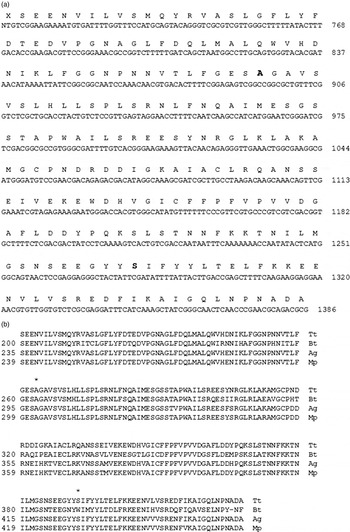
By applying a PCR strategy using initially several primer pairs for insect ace1 from another aphid species, A. gossypi (AJ748115), and then by designing specific primers for T. trifolli maculata we managed to obtain a 650 bp partial sequence of the T. trifolii precursor ace1 mRNA (accession no. AKI18002). This gene fraction contains the sites where the primary resistance mutations S431F and A302S have been reported in aphids. The novel sequence, as well as a comparison of the deduced ace1 mRNA acid sequence with amino acid sequences of the Ttace1 mRNA gene from other aphids is shown in fig. 1. The amino acid alignment indicates a high-sequence identity of the Ttace1 protein with other aphids. The positions of the putative resistance mutations have been also indicated (fig. 1b). At position 302, which characterize the Ace-sensitive aphid genotypes, an Alanine (A) was found in all aphid individuals that were analysed. However, an amino acid substitution occurred at codon 431 in one of the aphids that were analysed by sequencing. The mutation, a Serine (TCG)-to Phenylalanine (TTT) replacement was identified. This insecticide resistance mutation has been functionally characterized and shown to confer both OP and CARB resistance, in other aphid species, such as the A. gossypii (Benting & Nauen, Reference Benting and Nauen2004) and M. persicae (Nabeshima et al., Reference Nabeshima, Kozaki, Tomita and Kono2003). OPs and CARBs, which account for more than 35% of the total global insecticide sales are among the most widely used insecticides to control a broad range of arthropod pests of agricultural importance. Aphids such as T. trifolii have been under OP selection pressure in many crops, and OP-resistant aphid populations can resurge after OP use. This is why OP resistance in alfalfa remains a not to be neglected economic factor. The identification of the S431F mutation also in T. trifolii adds to the large list of conserved target site insecticide resistance-associated mutations, from a wide range of species (french-Constant et al., Reference French-Constant, Pittendrigh, Vaughan and Anthony1998).
Partial sequence of the Therioaphis trifolii ace1 gene. (a) Nucleotide and predicted amino acid sequence of the ace1 region of the Therioaphis trifolii ace1 gene that contains the major OP and CARB resistance. Loci in Aphids (codons 302 and 431) (Gene Bank: AKI18002). The positions of previously reported mutations (A302S and S431F) are shown in bold. (b) Alignment of the deduced amino acid precursor sequence of Ttace1 with ace1 sequences from other hemipteran pests. Stars show the sites for amino acid substitution polymorphisms known to affect insecticide sensitivity. All insect sequences were retrieved from GENBANK (Tt: Therioaphis trifolii ace1 = AKI18002; Ag: Aphid gossypii = AJ748115; Bt: Bemisia tabaci = EF675187; Mp: Myzus persicae = AAN71600).

Diagnostic PCR–RFLP assay for detection of S431F in Therioaphis trifolii
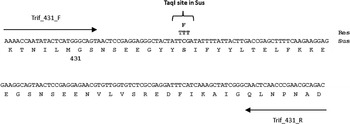
We developed a PCR–RFLP assay that can discriminate the presence of the resistant mutation at codon 331. The alteration (GGG to GGA) at position 431 destroys a site for TaqI (TCGA) (fig. 2) and could therefore be used to differentiate resistant and susceptible alleles. Thus, we were able to determine the presence of 431F putative resistant alleles by restriction digestion of the PCR product (using primers Trif. S431F_F and Trif. S431F_F) with TaqI. The presence of full-length (150 bp) putative resistance-associated alleles (431F) was determined by gel electrophoresis of TaqI-digested amplification products, with susceptible alleles (S431) digesting to give bands of 104 and 46 bp (fig. 3). The diagnostic assay thus allowed for discrimination between the resistance-associated 431F allele. The results were also verified by direct sequencing.
Molecular diagnostic for the detection of the resistance mutation 431F. Diagrammatic representation of the primer locations and mutation-associated restriction site variation in Therioaphis trifolii ace1 amplification products.

PCR–RFLP detection of the S431F ace1 mutation in Therioaphis trifolii. PCR products were obtained using primer set Trif S431F_F and Trif S431F_R, digested with the restriction enzyme TaqI, and separated on a 1.5% agarose gel containing ethidium bromide. Lanes 1, 2, 3, 5, 6 and 7: homozygote susceptible (SS, S431); Lane 4: homozygous resistant (RR, F431).

We have chosen to develop two-step PCR–RFLP procedures for the S431F-resistant mutation in the Ttace1 gene that should be more robust than allele-specific PCR (frequently problematic to establish reliably), and are only slightly more time-consuming. This assay should be simple to use in monitoring the S431F mutation in field-collected T. trifolii material. However, it should be remembered, that although the sequence conservation from our sampling areas was absolute, this should be confirmed by sequencing of more alleles in any future studies of other geographical areas, before this diagnostic test is used, as the (unlikely) possibility of polymorphism cannot be completely discounted.
In conclusion, we cloned a fragment of the ace1 gene of T. trifolii maculata, a major aphid pest of alfalfa in the Kingdom of Saudi Arabia. We identified the substitution S431F in the ace1 in an aphid specimen, one of the highly effective resistance loci for both OPs and CARBs in aphids. We finally developed a robust molecular diagnostic assay for detecting the novel resistance mutation in the target sites of OP and CARBs in T. trifolii. This diagnostic assay can be used for the early identification of the spreading of resistant alleles into field populations, in order to prevent ineffective insecticide applications and facilitate the implementation of IRM strategies.
Acknowledgements
Authors would like to extend their sincere appreciation to their Deanship of Scientific research at King Saud University for its funding this research group No. RG-1435-064. A part of this research has been co-financed by the European Union (European Social Fund e ESF) and Greek national funds through the Operational Program ‘Education and Lifelong Learning’ of the National Strategic Reference Framework (NSRF) e Research Funding Program: THALES (project 377301 and 380264).