Introduction
The majority of cerambycids spend most of their life cycles hidden within the tissues of host plants, and the adults of many species are nocturnal or crepuscular and have dark or cryptic colouration (Linsley Reference Linsley1961). The timing and length of the adult flight period differ among species, generally lasting from a few days to several months for North American species (Linsley Reference Linsley1959, reviewed by Haack et al. Reference Haack, Keena, Eyre and Wang2017). These traits have made trapping and assessment of cerambycid communities difficult (Hanks et al. Reference Hanks, Reagel, Mitchell, Wong, Meier and Silliman2014). To date, attractants, including those identified as pheromones, have been identified for more than 115 cerambycid species (reviewed by Millar and Hanks Reference Millar, Hanks and Wang2017) and have been used to develop synthetic volatile pheromone lures based on the conservation of a number of pheromone structural motifs within and among cerambycid genera, tribes, and subfamilies. This pheromone parsimony has contributed to the effectiveness of these lures and to their value as a tool for testing attraction of cerambycids to pheromone components, community analysis, and monitoring for invasive species and for rare or endangered species (Ray et al. Reference Ray, Arnold, Swift, Schapker, McCann and Marshall2014; Larsson Reference Larsson2016; Millar and Hanks Reference Millar, Hanks and Wang2017; Fan et al. Reference Fan, Denux, Courtin, Bernard, Javal and Millar2019; Molander et al. Reference Molander, Winde, Burman, Nyabuga, Lindblom and Hanks2019; Rassati et al. Reference Rassati, Marchioro, Flaherty, Poloni, Edwards, Faccoli and Sweeney2020). A number of novel pheromone structures within the Cerambycidae have recently been identified for a number of species and genera, increasing the structural diversity known for this family (Ray et al. Reference Ray, Žunič, Alten, McElfresh, Hanks and Millar2011, Reference Ray, Swift, McElfresh, Alten and Millar2012b; Diesel et al. Reference Diesel, Zou, Johnson, Diesel, Millar, Mongold-Diers and Hanks2017; Millar et al. Reference Millar, Mitchell, Meier, Johnson, Mongold-Diers and Hanks2017, Reference Millar, Richards, Halloran, Zou, Boyd, Quigley and Hanks2019; Millar and Hanks Reference Millar, Hanks and Wang2017; Mitchell et al. Reference Mitchell, Ray, Hanks and Millar2018; Meier et al. Reference Meier, Millar, Mongold-Diers and Hanks2019).
Although pheromone production and attraction have been determined for many North American cerambycid species, many species have yet to be evaluated. Little of this type of work has been done in the Pacific Northwest and Intermountain Region of the United States of America relative to other regions within North America (Rodstein et al. Reference Rodstein, McElfresh, Barbour, Ray, Hanks and Millar2009, Reference Rodstein, Millar, Barbour, McElfresh, Wright and Barbour2011; Barbour et al. Reference Barbour, Millar, Rodstein, Ray, Alston and Rejzek2011; Ray et al. Reference Ray, Barbour, McElfresh, Moreira, Swift and Wright2012a). We sought to narrow this regional knowledge gap by conducting field trapping bioassays over three years at sites in western Idaho, United States of America, to test attraction of cerambycids to synthetic volatile pheromone lures containing compounds known to be attractive to specific taxonomic groups within the Cerambycidae (Hanks and Millar Reference Hanks and Millar2013). The regional knowledge gap also extends to the composition and dynamics of the cerambycid community within Idaho (Sandoval et al. Reference Sandoval, Cook, Merickel and Osborne2007; Rice et al. Reference Rice, Merickel and MacRae2017). The use of traps baited with synthetic pheromone lures to target cerambycids is a relatively recent method of capture that has been developed over the last 15 years. This method is more economical, reliable, and efficient than more traditional methods, enabling the capture of many cerambycid species at a particular site (Sweeney et al. Reference Sweeney, Silk and Grebennikov2014; Millar and Hanks Reference Millar, Hanks and Wang2017). The current state of knowledge of cerambycid richness and distribution in Idaho is based largely on older published records and museum specimens that were collected using traditional methods. Rice et al. (Reference Rice, Merickel and MacRae2017) used these specimens and historical records to compile a comprehensive list of cerambycid species previously recorded in Idaho, along with regional locations. Although several studies within Idaho have employed pheromone-baited trapping to capture cerambycids, the studies focused on particular genera and species and were limited to small geographic areas. Barbour et al. (Reference Barbour, Millar, Rodstein, Ray, Alston and Rejzek2011) used pheromone-baited trapping at sites in the United Kingdom and in multiple regions of North America, including sites in southwestern Idaho, to test attraction of Prionus spp. to stereoisomers of 3,5-dimethyldodecanoic acid. The researchers found that synthetic 3,5-dimethyldodecanoic acid can be used to monitor many Prionus spp. and to determine their geographic distribution and abundance. Ray et al. (Reference Ray, Barbour, McElfresh, Moreira, Swift and Wright2012a) conducted bioassays with traps baited with synthetic pheromone lures at sites in California, United States of America, and southwestern Idaho to test attraction of species in the prionine genus Tragosoma to 2,3-hexanediols. The use of pheromone-baited trapping has been increasing as a tool to assess the seasonal phenology of cerambycids (Hanks et al. Reference Hanks, Reagel, Mitchell, Wong, Meier and Silliman2014; Handley et al. Reference Handley, Hough-Goldstein, Hanks, Millar and D’amico2015; Mitchell et al. Reference Mitchell, Reagel, Wong, Meier, Silva and Mongold-Diers2015). Data collected during our multiyear trapping study were also used to examine and compare the seasonal phenology of four Phymatodes species (Lyons-Yerion et al. Reference Lyons-Yerion, Barbour, Mongold-Diers, Williams and Cook2020b). The present study is the first investigation of cerambycid richness, diversity, and evenness in Idaho to examine multiple sites in both northern and southern Idaho in consecutive years. The use of synthetic pheromone-baited traps enabled the capture of a high number of cerambycid genera, species, and individuals.
The next step in the evolution of pheromone lure design has been the development of a single multicomponent lure that can provide a user-friendly, low-cost alternative to the use of a large number of pheromone treatments to monitor for invasive species at ports of entry and other high-risk areas, to survey cerambycid communities, and to monitor for rare and endangered species (Ray et al. Reference Ray, Arnold, Swift, Schapker, McCann and Marshall2014; Larsson Reference Larsson2016; Molander et al. Reference Molander, Winde, Burman, Nyabuga, Lindblom and Hanks2019; Hoch et al. Reference Hoch, Connell and Roques2020). Here, we suggest a method to design a multicomponent lure based on an existing data set from the target region, with the goal of capturing the maximum number of cerambycid species possible.
Our project had four objectives. The first objective was to improve understanding of cerambycid community composition in western Idaho, using traps baited with synthetic volatile pheromone lures to maximise the number of species captured at various sites. The second objective was to perform field bioassays to test attraction of cerambycid species among a set of synthetic volatile pheromone lures to improve our understanding of the pheromone ecology of cerambycids in Idaho. The third objective was to compare the species richness, diversity, and evenness parameters of the captured cerambycid communities among sites and to compare cerambycid species richness, diversity, and evenness of captures among pheromone lure treatments across sites to better understand the dynamics of the Idaho cerambycid community. The fourth objective was to provide a method to develop a region-specific, multicomponent pheromone lure that maximises the capture of total cerambycid species and targets individual species of interest.
Materials and methods
Trapping sites
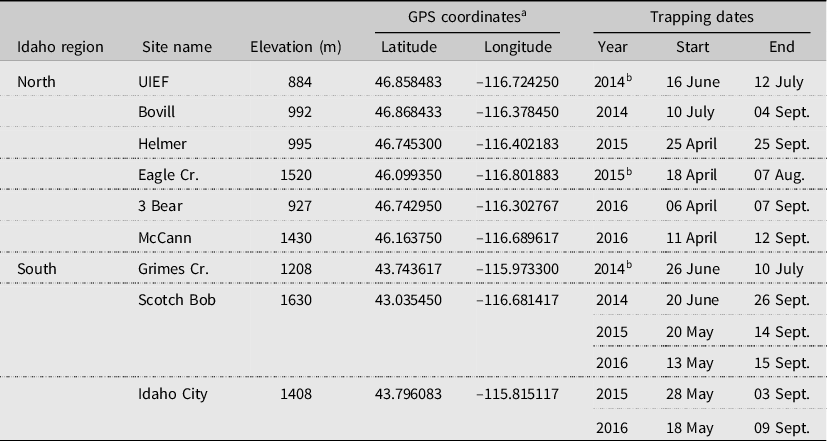
Field bioassays testing attraction to synthetic pheromones were performed in 2014, 2015, and 2016 at two sites in northwestern Idaho and two sites in southwestern Idaho in each of the three years, resulting in a total of 12 site-year replicates (Table 1). Nine different sites were used over the three years of trapping, with the same sites used for multiple years when feasible. However, in some years, different sites in the same geographic area were used because of access limitations or to trap in areas that had been logged recently. Sites were located within areas containing mixed coniferous forest, and where possible, traps were placed within logged patches and in proximity to fresh slash. The Scotch Bob site in southwestern Idaho had not been recently logged but had abundant dead or dying woody debris on the ground or as standing snags.
Idaho sites used during 2014, 2015, and 2016 for field bioassays of pheromone lures for cerambycid species. All sites were within stands of mixed coniferous forest, with trap transects placed in logged areas (except the Scotch Bob site) near slash, woody debris, and snags.

a Datum: WGS84.
b Disturbance of traps by large mammals resulted in an abbreviated trapping season at this site.
Field trapping and bioassays
Field trapping materials and methods were similar to those described in Hanks et al. (Reference Hanks, Reagel, Mitchell, Wong, Meier and Silliman2014). Black corrugated plastic cross-vane flight-intercept panel traps (Alpha Scents, West Linn, Oregon, United States of America) were used for all field bioassays. Trap panels and the interior surfaces of the trap basins were coated with Fluon® fluoropolymer dispersion (10% aqueous dilution; Northern Specialty Chemicals, Woonsocket, Rhode Island, United States of America) to increase capture efficiency (Graham et al. Reference Graham, Mitchell, Reagel, Barbour, Millar and Hanks2010; Graham and Poland Reference Graham and Poland2012). Small holes (1.5 mm diameter) were drilled in the trap basins approximately midway up the plastic trap basin to allow water to drain. Traps were suspended from L-shaped frames constructed from 1.9-cm (inside diameter) schedule 40 polyvinyl chloride irrigation pipe. The L-frame was mounted on a 1.2-m-long, 1.27-cm-diameter steel reinforcing bar post. At the northern sites, a steel hairpin clip (part number: 50840; Double HH Quality Products, Rock Valley, Iowa, United States of America) was inserted into a hole drilled near the end of the horizontal section of the pipe support to secure the trap and prevent detachment of traps during high winds. The base of the trap was tethered to the vertical pipe support with a wire to limit trap movement in the wind. Vegetation beneath the trap was trimmed to allow the trap to rotate freely. Trap basins initially were filled with a saturated sodium chloride solution (150 g rock salt per 3 L tap water) to kill and preserve beetles (Allison and Redak Reference Allison and Redak2017). The sodium chloride solution was replaced during sample collection site visits. In an effort to address trap disturbance by large mammals, the sodium chloride solution in trap basins was changed to propylene glycol diluted onsite with water (approximate dilution ratio: 1:1; Splash RV & Marine antifreeze, Part number: 619526; Splash Products Inc., St. Paul, Minnesota, United States of America) during the 2014 trapping season (Allison and Redak Reference Allison and Redak2017). Continued disturbance of traps ended the trapping season early at several sites (Table 1). To reduce animal disturbance at the northern site, where trapping continued for the remainder of the 2014 season, and for the Helmer site in 2015, the killing agent was changed to Vaportape™ II Insecticidal Strips (Hercon Environmental, Emigsville, Pennsylvania, United States of America). For 2015 and 2016 trapping, use of the insecticidal strips continued at the northern sites and use of diluted propylene glycol continued at the southern sites.
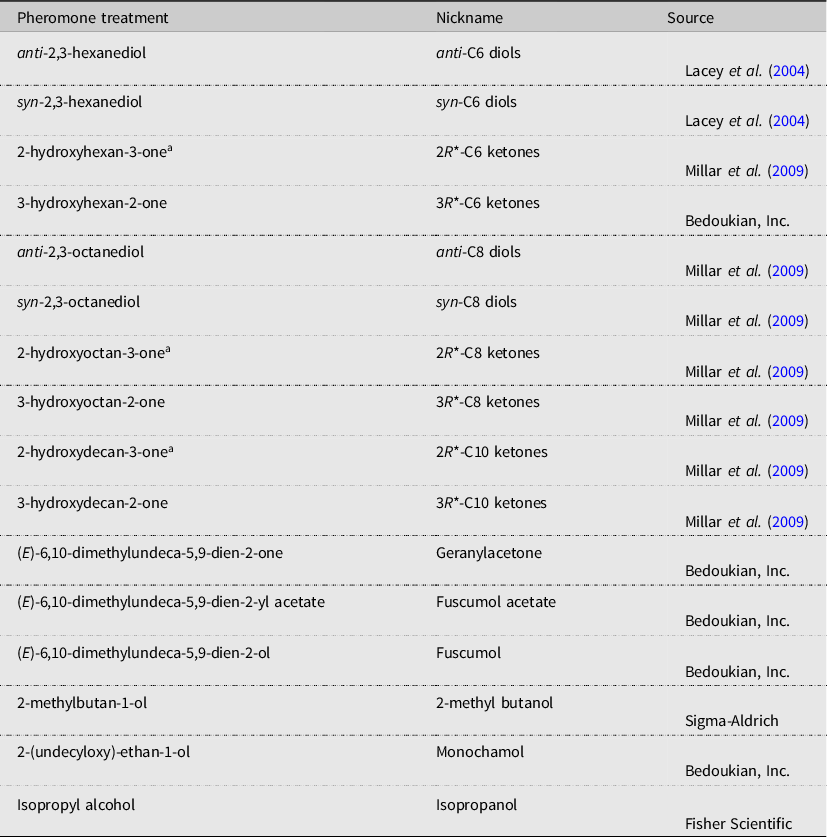
At each site, traps were arranged in a single, approximately linear transect, with each trap baited with one of 16 synthetic pheromone treatments (Table 2). Sixteen treatments, including a solvent-only control, were used in 2014. The number of treatments was reduced to 13 beginning in July 2015 and for all of 2016 by eliminating the six-, eight-, and 10-carbon 2-hydroxy-3-one treatments that do not appear to serve as attractants to North American cerambycids (Table 2; L.M. Hanks, personal communication). The minimum distance between traps was 10 m. Where an obstruction such as a shrub or tree stump prevented positioning at 10 m, the distance was increased to avoid the obstruction. Wong et al.’s (Reference Wong, Meier, Zou, Mongold-Diers and Hanks2017) results suggest that approximately 10-m spacing between traps in a transect provides sufficient separation to avoid interference from adjacent treatments while allowing the testing of relatively weak attractants. Position of lures within the transect was randomly assigned initially and re-randomised when samples were collected at two-week intervals. Due to trap disturbance at some sites, the collection period was changed to a one-week interval at those sites. To avoid contamination, entire traps with their lures attached were moved to the newly randomised positions. Trap lures consisted of polyethylene sachets (press-seal bags, Bagette model 14770, 5.1 × 7.6 cm, 0.05 mm thick; Cousin Corp., Largo, Florida, United States of America) containing a cotton dental wick (#2 medium cotton rolls, 1 × 4 cm; Patterson Dental Supply, St. Paul, Minnesota) loaded with a single synthetic pheromone or enantiomeric blend and secured in the centre of the trap. Lures were kept cool and held individually in glass jars during transport to the field sites. For all but two of the lures, 0.05 mL of the test compound was combined with 0.95 mL of isopropyl alcohol (2-propanol (certified ACS), cat. number A416P-4, Fisher Scientific, Pittsburgh, Pennsylvania) for a total volume of 1.0 mL of solution per lure. The exceptions were 2-(undecyloxy)ethan-1-ol, also known as monochamol (0.025 mL with 0.975 mL of isopropyl alcohol), and anti-2,3-octanediol (a solid at room temperature: 0.05 g in 0.95 mL of isopropyl alcohol). Geographic positioning system coordinates for site locations were recorded using a Magellan® eXplorist 210 GPS receiver (Magellan/MiTac Digital Corp., San Dimas, California) using the WGS84 datum.
Synthetic pheromone lures used in trapping cerambycids during 2014−2016, showing chirality, commercial sources of chemicals, or synthesis citation.

Racemic forms of all compounds were used, with the exception of 2-(undecyloxy)-ethan-1-ol, which is achiral.
a Treatment was discontinued in July 2015 and 2016.
Taxonomy and identification of beetles
Beetles were identified as follows: Centrodera spp. (Lepturinae: Rhagiini) according to Leech (Reference Leech1963), Linsley and Chemsak (Reference Linsley and Chemsak1972), and Valley (Reference Valley2012), images 5477423–5477425 and compared to a paratype of C. autumnata Leech, Reference Leech1963, two paratypes of C. dayi, and specimens of C. spurca (LeConte, 1857) (William F. Barr Entomological Museum, University of Idaho, Moscow, Idaho, United States of America); Phymatodes spp. (Phymatodes) Mulsant, 1839 (Cerambycinae: Callidiini), according to Linsley (Reference Linsley1962b, Reference Linsley1964) and Swift and Ray (Reference Swift and Ray2010) and by comparison to reference specimens, following the taxonomy of Bezark (Reference Bezark2020); Semanotus spp. Mulsant, 1839 (Cerambycinae: Callidiini), according to Hammond and Williams (Reference Hammond and Williams2013) and by comparison to reference specimens; Semanotus basalis (Casey, 1924) according to Bousquet et al. (Reference Bousquet, Laplante, Hammond and Langor2017) and by comparison to reference specimens, following taxonomy of Bousquet et al. (Reference Bousquet, Laplante, Hammond and Langor2017); Tragosoma spp. Audinet-Serville, 1832 (Prioninae: Meroscelisini) according to Laplante (Reference Laplante2017) and by comparison to reference specimens, following the taxonomy of Bousquet et al. (Reference Bousquet, Laplante, Hammond and Langor2017). The remainder of the beetles were identified according to Linsley (Reference Linsley1962a, Reference Linsley1962b, Reference Linsley1963, Reference Linsley1964) and Linsley and Chemsak (Reference Linsley and Chemsak1972, Reference Linsley and Chemsak1976, Reference Linsley and Chemsak1984, Reference Linsley and Chemsak1995) and by comparison to reference specimens, following the taxonomy of Bousquet et al. (Reference Bousquet, Laplante, Hammond and Langor2017) and of Bezark (Reference Bezark2020, for species that do not occur in Canada or Alaska). Voucher specimens have been deposited in the William F. Barr Entomological Museum, University of Idaho.
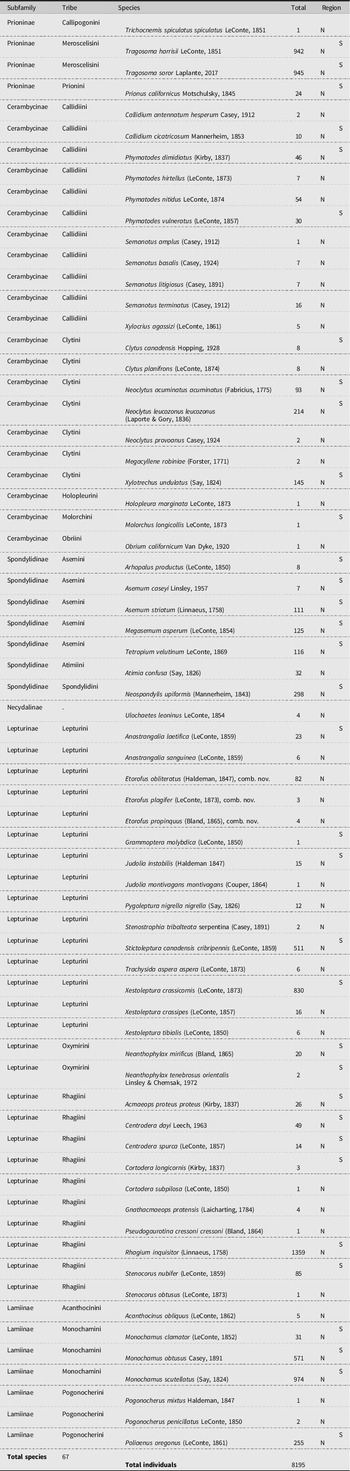
Capture data from the three discontinued pheromone lure treatments (Table 2) were not included in the totals presented in the taxonomy results (Table 3). All species captured at traps baited with the discontinued treatments were also captured among the remaining 13 treatments.
Taxonomy and number of individuals captured for cerambycid species across all site-year replicates (2014−2016) using traps baited with synthetic volatile pheromone lures. Region of Idaho, United States of America, where captured: N = northern Idaho, S = southern Idaho.

Statistical analysis
Field bioassays: response to pheromone treatments
The three discontinued treatments were not included in the analyses (Table 2). Our experiment used a randomised complete block design. Collection site and year (site-year) were used as replicates (n) for analysis. For each cerambycid species captured, trap catch data for all collection periods within a site-year replicate were combined to give the total number of individuals captured of a species for a specific site and year. Site-year replicates with a total of zero (no captures) for a species (summed across all treatments) were not included in the analyses. Due to the high variability in numbers of individuals trapped among sites and years, data were transformed to give the proportion of the number of individuals of that species captured for each pheromone treatment compared to the total number of that species captured for a specific site and year. Because population size can vary from year to year even at a single site, this transformation standardised the data among site-year replicates, allowing direct comparison of capture data among different site-year replicates. Differences among treatments were tested by performing a nonparametric one-way analysis of variance using the Kruskal–Wallis test based on rank sums (PROC NPAR1WAY, Wilcoxon option; SAS Institute 2018), with the Monte Carlo estimate for the exact test to produce a permutation P-value (exact Wilcoxon/n = 10 000; SAS Institute 2018). This analysis was used because the data sets violated the normality assumption of a standard analysis of variance. The significance level for the analysis of variance was set at α = 0.05. Where the variance analysis showed a significant result, the Dwass, Steel, Critchlow-Fligner pairwise multiple comparison test (dscf option; SAS Institute 2018) was performed to determine differences among treatments.
Community parameters: comparisons among sites and lures
Species richness, diversity, and evenness were calculated using the trap catch data from the three years of field trapping and compared among site-years. The Grimes site data were not included because there was only a single, two-week sampling period at this site due to animal disturbance of traps.
Species richness (S), the total number of cerambycid species captured at each site-year replicate, was calculated by summing the number of species trapped at all pheromone lure treatments combined for each site-year. Species diversity (H’) for the cerambycids captured was calculated using the Shannon index for each site-year replicate for all pheromone lures combined, with the equation:
 $$H' = -\Sigma \,{p_i}\,{\rm{ln}}\,{p_i}$$
where p i = n i /N; n i is the abundance of the ith species, and N is the total abundance (Shannon and Weaver Reference Shannon and Weaver1949; Magurran Reference Magurran2004). The Shannon evenness index (J’) was calculated for the assemblage of cerambycids captured during each site-year for all pheromone lures combined using the equation:
 $$J' = H'/{H_{{\rm{max}}}} = H'/{\rm{ln }}S$$
where H’ is the Shannon index of diversity, S is the species richness, H’/H max is the ratio of observed diversity to maximum diversity possible, and H max is the maximum diversity possible (which occurs when all species have equal abundances; Pielou Reference Pielou1969, Reference Pielou1975; Magurran Reference Magurran2004). To facilitate comparisons of cerambycid species diversity, richness, and evenness among site-years, we ranked each measure from highest to lowest and with the total number of individual cerambycid beetles captured for each site-year.
The same parameters – species richness (S), diversity (H’), and evenness (J’) – were compared among the 13 pheromone lure treatments (including the control) for cerambycids captured across all site-years by performing a separate one-way analysis of variance (PROC ANOVA; SAS Institute 2018) for each parameter. For each analysis of variance, site-year served as our replicate (n). The significance level for each analysis of variance was set at α = 0.05. Where the variance analysis produced a significant result, a protected Tukey’s studentised range test (SAS Institute 2018), which controls the Type I experimentwise error rate, was used to compare among pheromone treatments (α = 0.05). Differences in cerambycid species richness (S) among captures at traps baited with one of the 13 treatments were tested to compare the total number of species captured by each pheromone lure across all site-years. Differences among cerambycid species diversity (H’) for captures at traps baited with each pheromone lure across all site-years were determined based on Shannon index values calculated for each lure at each site-year replicate. Differences among cerambycid species evenness (J’) for captures at traps baited with each pheromone lure across all site-years were determined using J’ values calculated for each pheromone lure at each site-year replicate.
Multicomponent pheromone lure design
Data from the field trapping bioassays served as the basis for selection of the four lure components selected for our proposed multicomponent volatile synthetic pheromone lure to target cerambycids in western Idaho. The 13 synthetic pheromone lure compounds (Table 2) served as the candidate pool from which the multiple components were selected because these lures had previously been selected to maximise the richness of cerambycid species captured (Fierke et al. Reference Fierke, Skabeikis, Millar, Teale, McElfresh and Hanks2012; Hanks et al. Reference Hanks, Millar, Mongold-Diers, Wong, Meier, Reagel and Mitchell2012; Ray et al. Reference Ray, Barbour, McElfresh, Moreira, Swift and Wright2012a; Hanks and Millar Reference Hanks and Millar2013). The three 2-hydroxy-3-one lure treatments were not considered as candidates for the multicomponent lure because we discontinued their use in field bioassays in July 2015. Using raw data for all site-year replicates combined, the total number of species captured at each treatment was calculated for each cerambycid species. The lure compound with the highest number of total species captured was selected as the base lure component. The three compounds with the next highest species-richness values, and with the highest number of new species added to previous totals, were selected as additional multicompound lure components. Compound selections were based on the number of species captured without regard for the number of individuals of a particular species captured at that treatment. The number and identity of unique species (species that were captured only at one lure treatment), as well as any specified target species, were considered when making our selections. Potential antagonistic and synergistic effects on attraction among the lure components for a particular species were determined to the extent possible by reviewing the results of previously published studies. Separate lures containing the plant volatiles ethanol or α-pinene may be hung alongside the multicomponent lure in the trap, if desired, to potentially increase the number of individuals and the number of species captured (Collignon et al. Reference Collignon, Swift, Zou, McElfresh, Hanks and Millar2016; Miller et al. Reference Miller, Crowe, Mayo, Reid, Silk and Sweeney2017; Hanks et al. Reference Hanks, Mongold-Diers, Atkinson, Fierke, Ginzel and Graham2018).
Results and discussion
Cerambycid taxonomy
A total of 8195 individual cerambycids, representing 17 tribes, 42 genera, and 67 species, was captured across all site-year replicates in traps baited with synthetic volatile pheromone lures over the three-year study (Table 3). Six of the seven cerambycid subfamilies were represented, with only the Parandrinae absent. Of the 67 total species captured, only single individuals were captured for 11 species, whereas 50 or more individuals were captured for 18 species. Thirty-three species were captured only at northern Idaho sites, nine were captured only at southern Idaho sites, and 25 species were captured at sites in both regions. Our captures included two species not previously recorded in Idaho: Centrodera dayi Leech (Lepturinae: Lepturini) and Phymatodes vulneratus (LeConte) (Cerambycinae: Callidiini) (Lyons-Yerion et al. Reference Lyons-Yerion, Barbour, Merickel and Cook2020a).
Within the subfamily Prioninae, four species representing three tribes and three genera were captured. Within the Cerambycinae, individuals for 18 of the 21 species captured were within eight of 11 genera and were distributed between the tribes Callidiini and Clytini. For the Spondylidinae, we captured seven species within three tribes and six genera, and we also captured one of the two species of Necydalinae previously recorded within Idaho, Ulochaetes leoninus LeConte (Rice et al. Reference Rice, Merickel and MacRae2017). Within the subfamily Lepturinae, 25 of the 27 species captured were distributed between two tribes (Lepturini and Rhagiini) and among 16 of the 17 genera captured, whereas for the Lamiinae, seven species from three tribes and four genera were captured.
Our study resulted in the capture of 65 of the 134 species previously recorded for Idaho (Rice et al. Reference Rice, Merickel and MacRae2017). The capture of nearly half the species known to occur in Idaho and of two species not previously recorded suggests that using synthetic pheromone-baited traps is an effective method to assess regional populations of cerambycids. It should be noted that some cerambycid species may not use volatile pheromones to locate potential mates and may instead employ one or more different mechanisms, such as aggregating on host plants (Hanks et al. Reference Hanks, Millar and Paine1996; Reagel et al. Reference Reagel, Ginzel and Hanks2002; Ray et al. Reference Ray, Lacey and Hanks2006).
Field bioassays: response to pheromone treatments
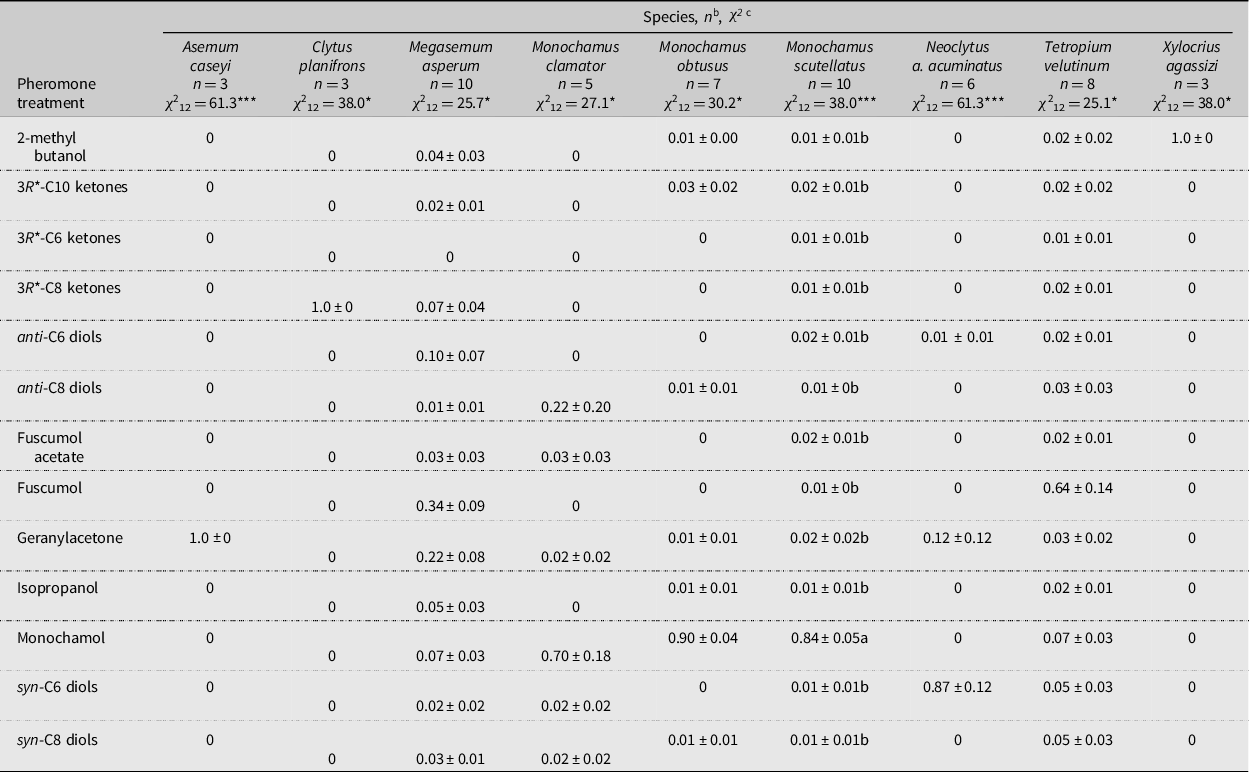
The analyses showed a statistically significant difference in the proportion of individuals of nine species captured among pheromone lure treatments, indicating a treatment effect (Table 4), but the pairwise multiple comparison test produced a statistically significant result among treatments for only one of the nine species. The analysis for Clytus planifrons (LeConte) (Cerambycinae: Clytini) (χ 2 = 38.0; df = 12; P = 0.0011) was based on eight C. planifrons specimens captured at traps baited with 3R*-C8 ketones over three site-year replicates, with no individuals captured at any other treatments. Pheromone production for C. planifrons was previously reported to be 3-hydroxyhexan-2-one (3R-C6 ketone; Hanks and Millar Reference Hanks and Millar2016, supplementary table 1), but it was actually 3R-C8 ketone (Jocelyn G. Millar, personal communication). Our result, when considered in this context, suggests 3R*-C8 ketones are a likely attractant for this species. Two congeners of C. planifrons have been reported to produce or be attracted to eight-carbon hydroxyketones, suggesting this compound might be a potential pheromone component motif for the genus. The European species, C. arietis arietis Linnaeus, produces 3R-hydroxyoctan-2-one, 2S-hydroxyoctan-3-one, and 2,3-octanediols (Schröder Reference Schröder1996) and has shown attraction to racemic 3R*-C8 ketones (Rassati et al. Reference Rassati, Marchioro, Flaherty, Poloni, Edwards, Faccoli and Sweeney2020), whereas the North American species, C. marginicollis Castelnau and Gory, has shown attraction to a combination of racemic 3R*-C8 ketones and ethanol (Miller et al. Reference Miller, Crowe, Mayo, Silk and Sweeney2015), and C. ruricola (Olivier) has shown attraction to plant volatiles (Montgomery and Wargo Reference Montgomery and Wargo1983). Hydroxyketones are a common motif among species in the tribe Clytini for which pheromone production and attraction have been reported, but most of these compounds are six-carbon hydroxyketones rather than the likely eight-carbon hydroxyketones for C. planifrons (reviewed in Hanks and Millar Reference Hanks and Millar2016).
Mean proportion (± standard error mean) a of cerambycid beetles captured at traps per pheromone treatment and site-year replicate during field trapping bioassays in Idaho, United States of America, and results of a nonparametric one-way analysis of variance using the Kruskal–Wallis test based on rank sums.

For species that showed statistically significant overall treatment effects, the Dwass, Steel, Critchlow-Fligner pairwise multiple comparison test was performed to detect differences among treatments. Analyses were performed separately for each species, using site-year replicates (n) where one or more individuals of the species were trapped.
a Means within species with the same letters do not significantly differ (Dwass, Steel, Critchlow-Fligner multiple comparison test, α = 0.05).
n b = number of site-year replicates.
c Asterisks indicate significance level of analysis of variance P-value: *P ≤ 0.01, **P ≤ 0.001, ***P ≤ 0.0001.
Our analyses also revealed a statistically significant difference in the proportion of Xylocrius agassizi (LeConte) (Cerambycinae: Callidiini) captured among the treatments (χ 2 = 38.0; df = 12; P = 0.0022). The analysis was based on a total of five X. agassizi individuals captured at traps baited with 2-methyl butanol over three site-year replicates, with no individuals captured at any other treatments. This suggests that 2-methyl butanol may be a possible pheromone for this species, which would align with 2-methyl butanol as one of several pheromone motifs commonly found among species within the tribe Callidiini and in other tribes and genera within the Cerambycinae (reviewed in Hanks and Millar Reference Hanks and Millar2016). Xylocrius agassizi, also known as the black gooseberry borer and the gooseberry root borer, is considered a pest of gooseberry Ribes Linnaeus spp., including R. hirtellum Michaux and R. grossularia Linnaeus (synonym R. uva-crispa Linnaeus), which is grown commercially in the Pacific Northwest and other regions of the United States of America (Johnson Reference Johnson2010; University of Illinois Extension 2020). A definitive result for attraction would have potential application in the commercial gooseberry industry for developing synthetic pheromone lures for monitoring this insect.
Captures of Monochamus scutellatus (Say) (Lamiinae: Monochamini) in traps baited with monochamol differed significantly among the other treatments (χ 2 = 38.0; df = 12; P = 0.0001), confirming Macias-Samano et al.’s (Reference Macias-Samano, Wakarchuk, Millar and Hanks2012) and Hanks and Millar’s (Reference Hanks and Millar2013) results for attraction, with production of monochamol previously identified by Fierke et al. (Reference Fierke, Skabeikis, Millar, Teale, McElfresh and Hanks2012). Pheromone attraction or production has already been determined for the remaining six species that had significant P-values but for which the pairwise comparison test did not produce significant results. These were Asemum caseyi Linsley (Spondylidinae: Asemini) (χ 2 = 61.3; df = 12; P < 0.0001), Megasemum asperum (LeConte) (Spondylidinae: Asemini) (χ 2 = 25.7; df = 12; P = 0.0098), Monochamus clamator (LeConte) (Lamiinae: Monochamini) (χ 2 = 27.1; df = 12; P = 0.0034), M. obtusus Casey (Lamiinae: Monochamini) (χ 2 = 30.2; df = 12; P = 0.0012), Neoclytus acuminatus acuminatus (Fabricius) (Cerambycinae: Clytini) (χ 2 = 61.3; df = 12; P < 0.0001), and Tetropium velutinum LeConte (Spondylidinae: Asemini) (χ 2 = 25.1; df = 12; P = 0.0084).
The failure of the multiple comparison test to determine significant differences among treatments for species where the omnibus test resulted in significant P-values could be due to one or more possible factors. These include low number of individuals captured, low number of replicates, and a high number of pheromone treatments.
Lyons-Yerion et al. (Reference Lyons-Yerion, Barbour, Mongold-Diers, Williams and Cook2020b) described the present study’s results regarding attraction of Phymatodes spp., and Lyons-Yerion et al. (Reference Lyons-Yerion, Cook, Williams and Barbour2021) described the results regarding attraction of Tragosoma spp.
Community parameters: comparisons among sites and lures
Species diversity is a measure that combines species richness and evenness. Species richness is the number of species measured in the unit being examined, whereas species evenness is a measure of the similarity of abundances among species (McIntosh Reference McIntosh1967; Hubbell Reference Hubbel2001; Magurran Reference Magurran2004).
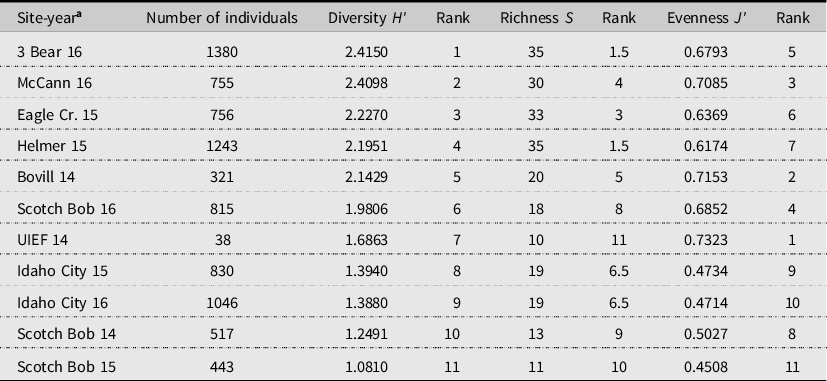
Based on the Shannon diversity index, the lowest measured level of species diversity (H’ = 1.0810) occurred at the Scotch Bob 15 site and the highest measured level of species diversity (H’ = 2.4150) occurred at the 3 Bear 16 site (Table 5). Cerambycid species richness ranged from a low of 10 captured species at the UIEF 14 site to a high of 35 captured species at the 3 Bear 16 and Helmer 15 sites. Species evenness was lowest at the Scotch Bob 15 site (J’ = 0.4508) and highest at the UIEF 14 site (J’ = 0.7323).
Shannon diversity index (H’), species richness (S), and Shannon evenness index (J’) measures for cerambycids captured at each site-year replicate, with the rank for each measure (highest rank = 1) and the total number of individual beetles captured.

a The Grimes site was not included because data were only collected for one sampling period due to animal disturbance of traps.
Because the Shannon diversity statistic is calculated using the measures of species richness and evenness, we evaluated each of these components separately among site-year replicates (Table 5). The 3 Bear 16 site was ranked highest in diversity (H’ = 2.4150) and also had the highest number of individuals captured (n = 1380) among site-years. This site was tied for the highest richness (S = 35), but its evenness (J’ = 0.6793) ranked in the middle among site-years. Because richness at the 3 Bear 16 site was the same as the Helmer 15 site, the lower rank in diversity (H’ = 2.1951) at the Helmer 15 site is probably due to the lower measure of evenness (J’ = 0.6174). Despite having the second-lowest number of individuals captured (n = 321), the Bovill 14 site ranked fifth in diversity among site-years. This might be attributed to a combination of the site’s high evenness (J’ = 0.7153) level and its middle ranking in richness (S = 20). The southern Idaho sites ranked lower in measured diversity than the northern Idaho sites did, with the exception of the UIEF 14 site.
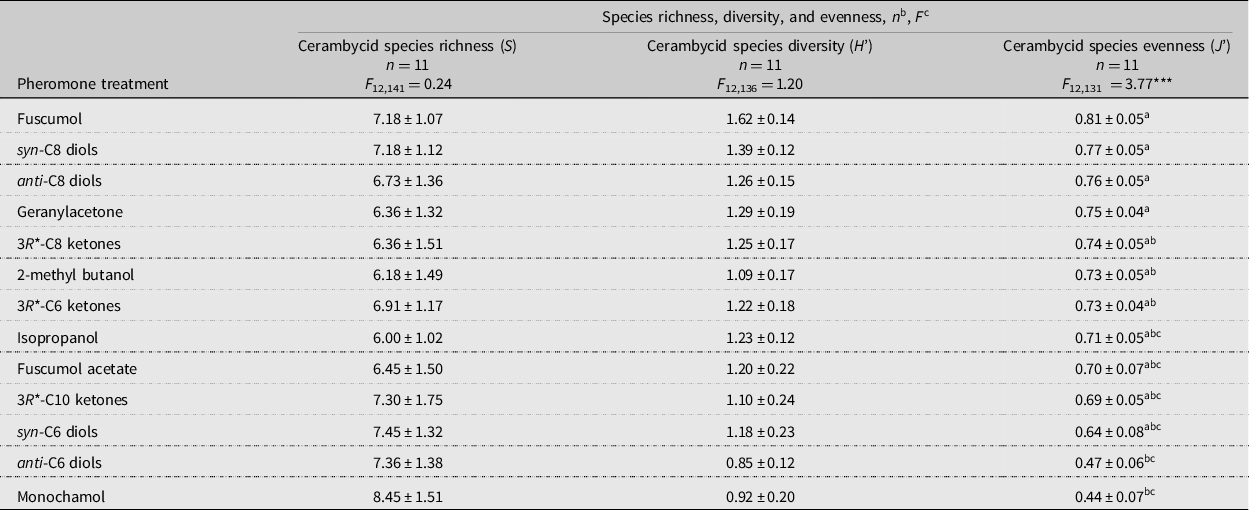
Species diversity among the 13 pheromone lure treatments did not differ significantly across all site-years (F = 1.20; df = 12, 136; P = 0.2913; Table 6). Likewise, species richness among the 13 pheromone lure treatments across all site-years also did not differ significantly (F = 0.24; df = 12, 141; P = 0.9954; Table 6). A significant difference occurred in the evenness of species captured among the 13 pheromone lure treatments across site-years (F = 3.77; df = 12, 131; P < 0.0001; Table 6), with the four compounds having the highest species evenness – fuscumol, syn-C8 diols, anti-C8 diols, and geranylacetone – differing significantly from the two treatments with the lowest means – anti-C6 diols and monochamol. Although differing significantly from only anti-C6 diols and monochamol for species evenness, fuscumol had the highest mean for evenness and for diversity among lure treatments. Monochamol had the lowest mean for evenness but had the highest mean in richness among the other treatments.
Mean number (± standard error mean) of cerambycid species richness (S), species diversity (Shannon diversity index, H’), and species evenness (Shannon evenness index, J’) for captures at traps per pheromone treatment across all site-year replicates a for field trapping bioassays in Idaho, United States of America, and results of analyses of variance performed separately for each measure.

In cases of a statistically significant result, the Tukey’s studentised range test was performed to determine differences among pheromone treatments (α = 0.05). Means with the same letters did not significantly differ.
a The Grimes site was not included in the analyses because data were collected for only one two-week sampling period due to animal disturbance of traps.
n b = number of site-year replicates.
c Asterisks indicates significance level of analysis of variance F-value: F: ***P < 0.0001.
Multicomponent pheromone lure design
A technique to tailor a multicomponent lure to specific geographic areas or needs would be beneficial. The following case study provides a technique to design a multicomponent pheromone lure targeted to the cerambycid community within the Idaho region.
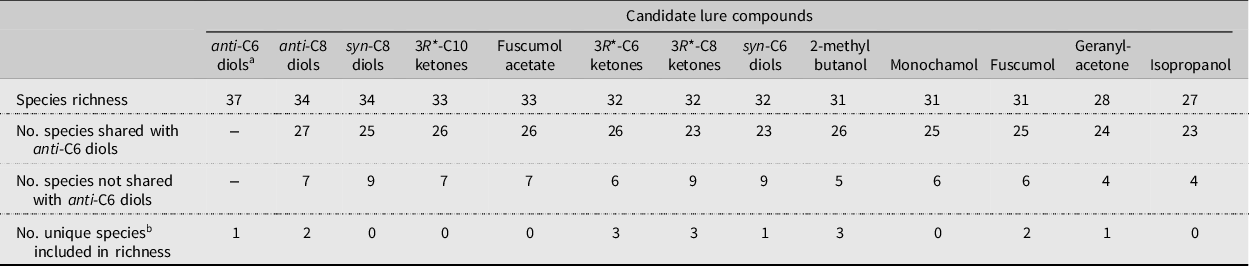
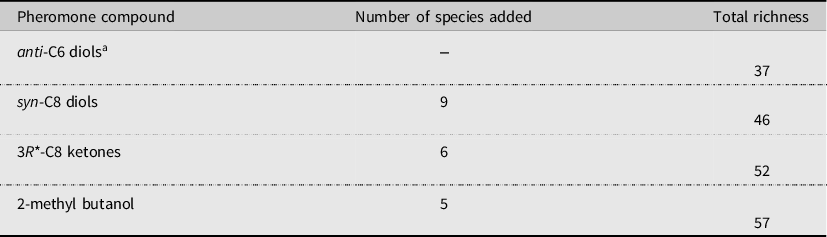
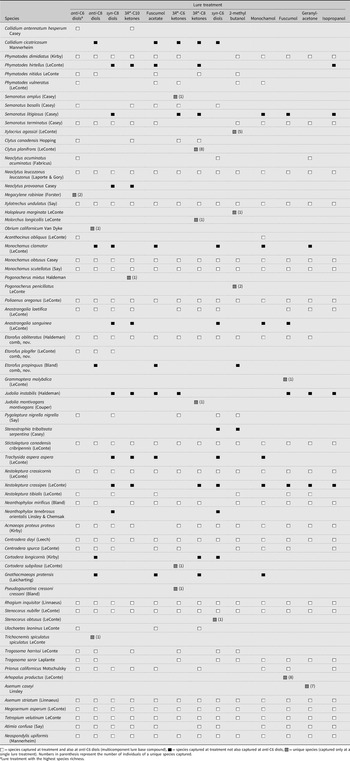
We selected an existing data set from the target region (western Idaho) that used traps baited with synthetic volatile pheromone lures targeting cerambycid communities on several sites (Table 2). Our candidate compounds for our multicomponent lure were selected from this data set. Using raw data from this data set, the total number of species captured at each pheromone lure treatment was calculated for all site-years combined (Table 7). The lure treatment with the highest species richness was selected as the “base compound” for our multicomponent lure. The number of species captured with each of the remaining 12 candidate lure compounds that were also captured with the base compound, the number of species captured that were not shared with the base compound, and the number of unique species (captured only with one compound) were determined. The three candidate lure compounds with the next highest species-richness values after the base compound and that added the most new species to those captured at the base compound were selected as additional components for the multicomponent lure. The number and identity of unique species were also considered when selecting compounds to be included in the lure. The resulting four components were anti-C6 diols (the base compound), syn-C8 diols, 3R*-C8 ketones, and 2-methyl butanol. The three latter lure components combined added 20 new species to the 37 species captured with the base compound, thereby increasing the total potential species richness for the multicomponent lure to 57 species (Table 8). To aid in the selection process, we created a table from the field bioassay data to display the identity of each species captured at each lure, whether these species were captured at the base lure, and unique species (captured at only one lure; Table 9).
Candidate lure compounds for a proposed multicomponent synthetic volatile pheromone lure showing the total number of cerambycid species (richness) captured at each lure in Idaho, United States of America, field bioassays testing attraction of cerambycids to 13 lure treatments (2014−2016).

The lure with the highest richness (anti-C6 diols) was selected as the first component for our lure (the base compound). The number of species captured at each of the remaining 12 candidate lure compounds that were also captured at the base compound (anti-C6 diols) is shown, along with the number of species captured that were not shared with the base compound, and the number of unique species (only captured at one compound).
a Lure compound with the highest species richness.
b Unique species = captured at only one lure compound.
The four compounds selected for the multicomponent pheromone lure, showing the number of cerambycid species added by each compound and the number of species each adds to the total richness (based on data from trapping cerambycids with synthetic pheromone lures in Idaho during 2014–2016; all site-year replicates combined).

a Lure compound with the highest species richness (base compound).
Species captured at 13 pheromone lure treatments (including isopropanol control) over three years of trapping in Idaho, United States of America, for all site-year replicates combined.

Antagonistic effects
When selecting lure components, the potential for antagonistic effects among compounds should be assessed. An antagonistic effect on attraction of a particular species to a synthetic pheromone component is much more likely if the blend also contains a component produced by a closely related species than if the blend contains a component produced by a more distantly related species (Hanks et al. Reference Hanks, Mongold-Diers, Atkinson, Fierke, Ginzel and Graham2018). Testing of multicomponent lures has resulted in the capture of a wide variety of cerambycid species from multiple genera, tribes, and subfamilies, with only a handful of recorded antagonistic effects for specific species (Hanks et al. Reference Hanks, Mongold-Diers, Atkinson, Fierke, Ginzel and Graham2018; Fan et al. Reference Fan, Denux, Courtin, Bernard, Javal and Millar2019; Rice et al. Reference Rice, Zou, Millar and Hanks2020). Few records document antagonistic or synergistic effects of the lure components that we selected for species that occur in Idaho. Anti-C6 diols, syn-C8 diols, and 2-methyl butanol were found to be antagonists that interfered with attraction of Neoclytus a. acuminatus to syn-C6 diols when tested as individual lures in field bioassays (Lacey et al. Reference Lacey, Ginzel, Millar and Hanks2004; Hanks et al. Reference Hanks, Mongold-Diers, Mitchell, Zou, Wong and Meier2019). Although our lure does not contain racemic syn-C6 diols or its SS-enantiomer, we did capture two N. a. acuminatus individuals at traps baited with anti-C6 diols during our field bioassays, so it is possible that the antagonistic compounds in the multicomponent lure may prevent or reduce capture of this species. One possible factor in the paucity of available data for antagonists or synergists for cerambycid species found in Idaho may be that most of the multicomponent lures being developed and tested in North America to date have used 3R*-C6 ketones (Hanks et al. Reference Hanks, Millar, Mongold-Diers, Wong, Meier, Reagel and Mitchell2012, Reference Hanks, Mongold-Diers, Atkinson, Fierke, Ginzel and Graham2018; Hanks and Millar Reference Hanks and Millar2013), whereas we have selected the eight-carbon 3R*-C8 ketones for our lure. A second possible factor is that the majority of the testing of multicomponent lures within North America has been conducted in the eastern and midwestern United States of America, where the majority of species differ from those found in Idaho (Hanks et al. Reference Hanks, Millar, Mongold-Diers, Wong, Meier, Reagel and Mitchell2012, Reference Hanks, Mongold-Diers, Atkinson, Fierke, Ginzel and Graham2018; Hanks and Millar Reference Hanks and Millar2013; Rice et al. Reference Rice, Merickel and MacRae2017, Reference Rice, Zou, Millar and Hanks2020). Field testing our multicomponent lure and each of the individual four lure components might reveal potential antagonistic effects of the lure components. Knowing potential antagonistic effects for certain species would help when determining whether the benefits of using a certain lure component combination outweigh the disadvantages.
Plant volatiles
Placing lures containing the plant volatiles ethanol and α-pinene alongside multicomponent synthetic volatile pheromone lures in traps has been shown to increase the number of individuals and the number of species captured, often with no antagonistic effects (Collignon et al. Reference Collignon, Swift, Zou, McElfresh, Hanks and Millar2016; Miller et al. Reference Miller, Crowe, Mayo, Reid, Silk and Sweeney2017; Hanks et al. Reference Hanks, Mongold-Diers, Atkinson, Fierke, Ginzel and Graham2018; Fan et al. Reference Fan, Denux, Courtin, Bernard, Javal and Millar2019). However, antagonism has been reported for some hardwood-infesting cerambycid species where high release–rate conifer lure volatiles have been employed (Collignon et al. Reference Collignon, Swift, Zou, McElfresh, Hanks and Millar2016). Ethanol has been found to synergise attraction for some cerambycid species associated with hardwood trees, whereas α-pinene synergises attraction for some species associated with conifers. Idaho species for which statistically significant levels of synergism have been documented where plant volatiles were used alongside a multicomponent lure include Monochamus clamator, M. obtusus, M. scutellatus oregonensis LeConte, Asemum striatum (Linnaeus), and Neospondylis sp. (Mannerheim).
Additional components and number of traps
When developing a multicomponent lure, the addition of compounds not suggested by our selection procedure may be necessary to target certain species, genera, or subfamilies. A geographically specific table can be constructed based on a data set for a target region to identify candidate lure components for target species or groups (similar to Table 9). Our tests did not include a comprehensive examination of all potential lure components; therefore, other lures may require compounds not represented in our tests. Among the potential compounds to include (with their potential target organisms noted in parentheses) are prionic acid (Prioninae: Prionini: Prionus spp.), a blend of sulcatol and sulcatone (Lamiinae: Acanthocinini: Leptostylus transversus (Gyllenhal) and Astylopsis macula (Say)), and (R)-desmolactone (Lepturinae: Desmocerini: Desmocerus spp.; Cervantes et al. Reference Cervantes, Hanks, Lacey and Barbour2006; Rodstein et al. Reference Rodstein, McElfresh, Barbour, Ray, Hanks and Millar2009, Reference Rodstein, Millar, Barbour, McElfresh, Wright and Barbour2011; Ray et al. Reference Ray, Swift, McElfresh, Alten and Millar2012b, Reference Ray, Arnold, Swift, Schapker, McCann and Marshall2014; Meier et al. Reference Meier, Millar, Mongold-Diers and Hanks2019).
The number of transects and traps to be used for each lure compound may vary based on the specific requirements of each experiment. Analyses using rarefaction of trap catch data in experiments have suggested that using multiple traps baited with the same lure compound at the same site may increase species detection (Sweeney et al. Reference Sweeney, Silk and Grebennikov2014). When designing their experiment, the user may want to weigh the benefits of using more lures and traps to increase the potential number of species detected against increased costs and effort.
Hanks et al. (Reference Hanks, Millar, Mongold-Diers, Wong, Meier, Reagel and Mitchell2012, Reference Hanks, Mongold-Diers, Atkinson, Fierke, Ginzel and Graham2018) are developing and testing a multicomponent volatile pheromone lure for use in monitoring and detection of domestic and invasive species of cerambycids. The lure components have been selected to target specific taxonomic groups of cerambycids, species of which are known to produce or have shown statistically significant attraction to these compounds, while minimising potential antagonistic effects. Their lure contains the following six components: 3R*-C6 ketones, syn-C6 diols, 2-methyl butanol, fuscumol, fuscumol acetate, and monochamol (all being racemic mixtures except for monochamol). We examined our field bioassay capture data for the lures that were also components of the Hanks et al. (Reference Hanks, Millar, Mongold-Diers, Wong, Meier, Reagel and Mitchell2012, Reference Hanks, Mongold-Diers, Atkinson, Fierke, Ginzel and Graham2018) lure and calculated the number of cerambycid species that would potentially be captured using their six-component lure compared with the number potentially captured with our suggested four-component lure. Using the six-component lure, a total of 55 cerambycid species would potentially have been captured compared with the 57 species captured with the four compounds we selected. It should be noted that our lure has not yet been field-tested and that the Hanks et al. (Reference Hanks, Millar, Mongold-Diers, Wong, Meier, Reagel and Mitchell2012, Reference Hanks, Mongold-Diers, Atkinson, Fierke, Ginzel and Graham2018) lure has not been examined at any of the Idaho sites.
Outcomes and future work
Our first objective was to increase understanding of cerambycid community composition in western Idaho, using traps baited with synthetic volatile pheromone lures to maximise the number of species captured at various sites. We captured 8195 individual cerambycids, representing 17 tribes, 42 genera, and 67 species, over three years of trapping. These data add to our understanding of the community composition within western Idaho. This method of trapping can detect cerambycid species previously unrecorded in a particular region. Our trapping produced two new species records for Idaho (Lyons-Yerion et al. Reference Lyons-Yerion, Barbour, Merickel and Cook2020a), and seven new species were recorded for Delaware in a similar study (Handley et al. Reference Handley, Hough-Goldstein, Hanks, Millar and D’amico2015). Our results provide additional support for using synthetic pheromone-baited trapping to study the cerambycid community, a method that has been used to assess cerambycid communities in several regions in North America and also in the Russian Far East, China, and Australia (Graham et al. Reference Graham, Poland, McCullough and Millar2012; Sweeney et al. Reference Sweeney, Silk and Grebennikov2014; Dodds et al. Reference Dodds, Allison, Miller, Hanavan and Sweeney2015; Handley et al. Reference Handley, Hough-Goldstein, Hanks, Millar and D’amico2015; Hayes et al. Reference Hayes, Griffiths, Nahrung, Arnold, Hanks and Millar2016; Schmeelk et al. Reference Schmeelk, Millar and Hanks2016; Rice et al. Reference Rice, Zou, Millar and Hanks2020; Wickham et al. Reference Wickham, Harrison, Lu, Chen, Hanks and Millar2021), which speaks to the technique’s broad application for use in varying geographic regions.
Our second objective tested attraction of cerambycid species captured among 13 synthetic volatile pheromone lures over three seasons of trapping at sites in western Idaho. Our analysis detected a significant treatment effect for nine cerambycid species, whereas the pairwise multiple comparison test produced a statistically significant result only for Monochamus scutellatus (Say), confirming previous results by others for attraction to monochamol (Macias-Samano et al. Reference Macias-Samano, Wakarchuk, Millar and Hanks2012; Hanks and Millar Reference Hanks and Millar2013). Additional field bioassays targeting Clytus planifrons and Xylocrius agassizi are needed to confirm the pheromone attraction that our results suggest. Testing fewer treatments and increasing the number of replicates should increase the probability of a positive result in a pairwise multiple comparison analysis.
Our third objective was to compare parameters of species richness, diversity, and evenness of the captured cerambycid communities among sites and to compare cerambycid species richness, diversity, and evenness of captures among pheromone lure treatments across sites to better understand the dynamics of the Idaho cerambycid community. We found no significant differences among sites for species richness, diversity, or evenness and no significant differences among lures for species richness or diversity. However, we detected a significant difference among lures for species evenness. This is the first study to examine cerambycid species richness and community composition at multiple locations in both northwestern and southwestern Idaho over consecutive years, and it is the first study in Idaho to quantify the parameters of cerambycid species diversity and evenness using a diversity index.
Our fourth objective was to provide a method to develop a region-specific multicomponent pheromone lure that maximises the capture of total cerambycid species and targets individual species of interest. Our finding of no statistically significant difference in cerambycid species richness or diversity among lure treatments in our trapping bioassays supports the idea that multiple lure compounds could work equally well and could be selected to realise different objectives. This allows considerable flexibility in choosing lure components. Although species richness and diversity did not differ significantly among lure treatments, raw data demonstrated that some species were captured at specific pheromone lures. These data allow for multiple choices of components to target individual species or groups. One potential disadvantage of the method is that an existing data set from the target region using multiple-pheromone lures is required. Potential advantages to the described approach include that it is tailored to the target region, it provides a starting point for examining the region’s cerambycid community, and its built-in flexibility allows both for the addition or substitution of components to target individual species or groups and for the number of lure components to be altered.
Our results add to our understanding of the pheromone ecology and the dynamics of the cerambycid community in western Idaho and provide an important knowledge base for future work by others. The large number of treatments used in our field bioassays allowed us to test the cerambycid response to a substantial variety of pheromone lures but at an increased cost in terms of time and effort. The number of compounds tested limited the number of replicates and influenced our calculations of species composition, richness, and diversity. Future work to assess the cerambycid community across Idaho should perform additional surveys with traps baited with multicomponent lures. Such traps would substantially reduce the number of traps and the time and effort required per site.
Additional site-specific environmental data should be collected in any future work, including parameters such as tree species, stand age, stand composition, volume of dead wood and stumps, and weather parameters. Additional field bioassays should be conducted throughout Idaho to evaluate the suggested multicomponent lure with and without plant volatiles to assess its effectiveness in capturing a high number of cerambycid species.
Acknowledgements
The authors thank Jim Barbour for running trapping bioassays in southern Idaho and for review of this manuscript, Bill McCann, Jr. for allowing us to trap beetles on his property, Noemi Fernandez for preparing and sending lure material, supplies, and beetle specimens, Sanford Eigenbrode for the generous use of his laboratory, Jocelyn Millar for providing lure chemicals, Lawrence Hanks for providing staff and equipment for analysis of headspace volatiles and for providing lure chemicals, Serge Laplante and Frank Merickel for their generous assistance in identifying beetles, Loel Yerion and fellow students Conn Evans, Rodrigues de Andrade Neto (Valmir), Natasha Wingerter, Lucy Cooper, and Laine Smith for their help in the field, and the University of Idaho Experimental Forest, PotlatchDeltic Corp., the Idaho Department of Lands, the United States Department of Agriculture, and the United States Forest Service for assistance locating suitable field sites and for allowing the authors to trap beetles on their land. This research was supported in part by Hatch project 1002810 (to S.P. Cook).
Competing interests
The authors declare no competing interests.