Three very fine papers deal with the Ottoman menace as metaphor in what we now designate as the post-Habsburg period, that discreet time span between the closing decades of the nineteenth century and World War II, with some forays into the contemporary period. In all three papers, the Ottoman (or the Turk, as was the current usage) served as a foil for contemporary grievances. It is not really the “Ottoman menace” they are dealing with, but, accordingly, the communist, socialist, working-class, Jewish, Serbian, or other “menaces” that are additionally demonized by introducing the analogy to a well-known and popular symbol. In the apt observation of the Austrian playwright J. P. Ostland, quoted by Maureen Healy, this was the present packaged as the past. It needs to be stressed that even the phrase “Ottoman menace” is a neologism form the post-World War II period, when scholarly works insisted correctly on a distinction between “Ottoman” as an imperial designator and “Turk” as an ethnic and later a national one. Although this distinction is justified for analytical purposes, it introduces a tinge of anachronism that belies one of the primary goals of history writing.
It is most appropriate, despite the interesting and revealing differences between the separate cases, that the common framework is the Habsburg domain. Further to the southeast, among the historiographies of the nation-states that seceded from the Ottoman Empire in the Balkans, the catchphrase is not the “Turkish menace,” but the “Turkish yoke.”Footnote 1 Further to the west, in France or England, the “Turkish menace” is in use only in its literal sense, but the term does not carry metaphorical authority.Footnote 2 Further to the north and east, in Poland or Russia, despite the greater proximity to the “Ottoman menace,” the term again does not have a similar metaphorical currency, which is played accordingly by the German and Russian thrust or the Tatar yoke. So what makes the “Turkish menace” such a powerful metaphor in Central Europe? I would argue that it is the intimacy with this historical symbol that makes its transposition so effective.
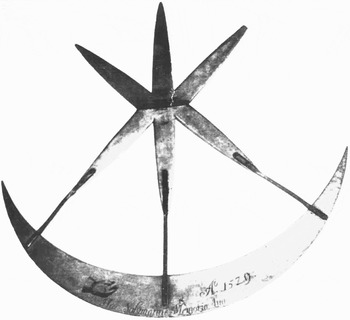
It is worth going back a few centuries to the real Ottoman menace to make a couple of points about this intimacy. The City Museum of Vienna has a huge bronze spire from the steeple of the Stephansdom that adorned Vienna's skyline from 1529 until 1683. This was the period from Suleiman the Magnificent's (Kanuni) first unsuccessful siege of Vienna until the final fiasco of the Ottoman Central European ambitions with the defeat of the Ottoman army led by the grand vizier Kara Mustafa Pasha. This is the time when the citizens of Vienna felt the Ottoman menace immediately and intimately. The spire represents the cross victorious over the crescent. The inscription on the crescent reads: Hac Solimane, memoria sua. On the right is the date: 1529. On the left, there is a human hand. On closer scrutiny, it is clear that the fingers of the hand form the eloquent international sign that is verbally expressed by the phrase “giving someone the finger” (Figure 1). It is, of course, a spiteful sign, but you do not give the finger to a demon; you give it to a rascal you know intimately, someone who will recognize your sign for what it is. It is also directed not at some abstract entity—Islam or the Turk or the Ottoman—but has a concrete and personal addressee, the then-reigning sultan, arguably the most powerful sovereign in Europe at the time. No wonder this bulky artifact is not in the museum's official album, nor are there any photographs on sale. Another object in the museum, but already included in the catalogue, is a late-seventeenth-century Ottoman map of Vienna, which was captured along with other precious items when the disorganized Ottoman army fled to the east. It is a schematic map where one can recognize the main buildings at the time of the second siege. The Stephansdom looks like a mosque, except that there is a cross on top. This is not a wishful map; it simply depicts the religious temple of a well-known adversary through the means of one's own artistic vernacular.
Figure 1:Bronze spire which adorned the steeple of the Stephansdom in Vienna.
Both these examples demonstrate that the real “Turkish menace,” though taken seriously as a threat, was nevertheless domesticated already at the time, whereas its symbolic counterpart continued to live a hyperbolic life and was appropriated in different settings. In addition to the famous Türkenlieder, these examples served multiple functions at the time. They were used as a propaganda tool in the hands of the ecclesiastical and secular rulers; they were an outlet for feelings of humiliation against the victorious Ottoman aggressor; they also served as a news item in current events; finally, they could be utilized even as nursery rhymes, like in the following one: Reit, Ferdl, reit! Tirk is nimma weit. Footnote 3 In the Türkenlieder, the main lament is the disunity of Christendom, a lament that was present in all the popes' missives: from Pope Nicholas V in 1453, Pope Innocent XI in 1683, and Pope Leo XIII in 1683, to Pope John Paul II and Pope Benedict XVI today. But this did not prevent Martin Luther, who believed that God had sent two punishments—the Turk and the plague—to bring back humility to Christianity, from equating the pope with the Turk, hence making use of the metaphoric meaning of the “Turkish menace” at the time of its real presence.
Running through all three papers in the forum about the Ottoman menace is the worldview and role of the Catholic clerical elites in Hungary, Austria, and Croatia. Tellingly, we are dealing with three very Catholic countries, of which Hungary, with its strong Calvinist population, is the least emphatically Catholic. By the end of the nineteenth century, these clerical elites had embraced a universalist narrative when depicting the encounter with the Ottomans. In the words of Healy, the Catholic clergy had managed to “spin a universal siege story” about 1683 that had decided “the destiny of the entire Christian Occident”; Paul Hanebrink shows the appropriation of a universal “clash of civilizations” rhetoric avant la letter by Cardinal Mindszenty, in which Hungary and Western Christendom as a whole have survived Islam and will survive Islam's new hypostasis, communism; and Patrick Patterson documents the special claim that Croat history tellers lay on the role of antemurale christianitatis for Croatia, to the point of spinning a narrative of a triple victimization at the hands of an ungrateful West (both through Austrian and Hungarian domination) as much as by the Turks themselves.
The notion that antemurale christianitatis has been a most powerful mental map is beyond reasonable doubt and has been amply demonstrated in scholarship. Although the United States increasingly played it in the wake of 9/11, antemurale christianitatis was, and continues to be, one of the most important European mental maps. In different periods, it has shifted from one to another European region or nation. Spain, France, Italy, Hungary, Austria, Germany, Poland, Romania, Croatia, Greece, Serbia, Bulgaria, Russia, the Balkans, Slavdom, Central Europe, Orthodoxy, Catholicism, and so on, have all been saving Christianity and Europe. And it is here that it is worth distinguishing between the two claims: defense of Christianity and defense of Europe. Indeed, by 1883, there is a conflation between the two; and Austria, in Healy's account, had carried on a successful mission as carrier of Christian culture that had brought the peoples of Europe to the apex of humanity; and the Vienna commemoration of 1683 celebrated Vienna as the bulwark of Europe, of Christianity, and of the West.
This was not the case at the time. First and foremost, 1683 was not only far from an inevitable result, but it was also far from a foregone event. As late as 1683, the Habsburg Emperor Leopold I wanted to avoid a clash with the Ottoman Empire because of the danger looming from France, and he sent Conte Alberto Caprara as his envoy to Istanbul to negotiate a renewal of the favorable treaty of Vasvár (Eisenburg) that had regulated Habsburg-Ottoman relations since 1664. That the Ottoman side refused to do so and chose to go for war is not necessarily a symptom of a missionary zeal or widely shared expansionist program. The latest research has shown that the sultan himself and a number of his advisers had much more modest war aims. Both the Crimean Khan Mehmet Giray and the Vali of Buda opposed the march against Vienna. To a great extent, the 1683 Vienna siege was the making of a determined man, the grand vizier Kara Mustafa Pasha.Footnote 4 And it is only in the aftermath of the siege that Vienna was transformed from a German border fortress into a Weltstadt of the continent.
The notion of Europe itself underwent a very slow and gradual transformation in the centuries that witnessed the encounter with the Ottomans. It is worthwhile to take an early example from the early fifteenth century, long before the concept of Europe had crystallized into its present shape. Ulrich von Richental, a Constance burgher, lived at the time and place of the great Catholic Church council of 1414–1418, notorious for its burning of Jan Hus. Inspired by the elevated role played by his home city, Ulrich decided to commemorate the event and in the 1430s penned his Chronik des Constanzer Concils.Footnote 5 It is a work that affords an interesting glimpse into the geographical and political ideas of the educated strata of German-speaking society in the fifteenth century.
Ulrich von Richental classified all the peoples attending the council under two rubrics, listing their ecclesiastical and lay rulers. For his ecclesiastical overview, Ulrich started with Asia, the largest part of the world. It was now mostly Muslim and extended from Alexandria in the west to India in the east, hence encompassing all those territories today defined as “embracing the Near to the Far East,” inclusive North Africa. He then moved to the continent of Africa proper. According to Ulrich, “Africa is Greece, and has two empires in it, Constantinople and Athens.” Let us recall that Ulrich wrote at a time when Constantinople was still Byzantine, and he was hence alluding to Eastern/Orthodox/Greek Christianity. To this Africa, Ulrich also added “Wallachia and Turkey, and all the lands that are buttressed by the sea and lie athwart Jerusalem as well as those on the other side of the Danube.” In a word, Ulrich's Africa coincided with the Balkans. Europe was in effect “the land where we live,” and it stretched from the “White Russians and Smolensk right up to Turkey” and included the kings and kingdoms belonging to the Roman crown. It was inhabited by “Romans,” Slavs, Turks, Hungarians, Germans, and others.Footnote 6
Ulrich von Richental was no geographic dolt. His cosmography simply “subordinated topographic information to the religious denominations of its human subject matter.” This is most evident in the case of Bosnia. The subjects of the king of Bosnia came from Europe, whereas those of the duke of Bosnia in Turkey came from Africa. We can see in this echoes of the complex state of contending ecclesiastical hierarchies in Bosnia—the Franciscan order and others loyal to the Vatican, the Orthodox church, and the idiosyncratic Bosnian church—in a period when the mass conversion of Bosnians to Islam was still at least half a century away. Africa signified “infidel,” “pagan,” and “savage.” In learned German treatises of the mid fifteenth century, black Africans were doomed by their nature to the kingdom of Antichrist; it hence followed that the Antichrist ruled in Africa. Ulrich's perceptions of the region were determined by the confusing and fluid situation in the Balkans, populated as it was by heretical Orthodox believers and in the process of being conquered by the Ottomans at precisely this time—in addition to its complicated and changing political and religious allegiances and its double and shifting vassalages.Footnote 7
All in all, German writers from the fifteenth century onward stuck to the geographic criterion of defining Europe. This was a revival of the notions of classical antiquity that had fixed Europe's borders at Constantinople and along the Tanais River (Don).Footnote 8 The person most instrumental in this was Eneas Silvius Piccolomini, a Tuscan, who had studied at the universities of Siena and Florence before becoming Pope Pius II (1405–1464). His cosmographic opinions and authority marked all subsequent scholarship. Piccolomini's work was permeated by the notion of stark cultural differences between Europe and Asia, and he is believed to be “the man who coined the word ‘Europeans’ and bequeathed it to Christendom as a kind of self-identification.”Footnote 9 He was harkening back to the unified state of Christendom; and for Piccolomini the Christians of the Balkans, despite being heretics, were still guardians of Christendom against its foes. We still live today with this legacy, and it is small wonder that the Vatican is one of the main bulwarks against a watered-down and more inclusive conception of European-ness. Let us not forget that the surprisingly successful visit of Pope Benedict XVI to Turkey a couple of years ago had as its primary and central aim not to repair relations with Muslims, but to heal the 1,000-year rift between the once-united Roman Catholic and Orthodox churches. Hence, if from the fifteenth century onward, the notion of Christianity was being increasingly suffused with a European character, today there is strong pressure to suffuse the notion of Europe with a Christian character.
Back to the special rhetorical appeal of the “Turkish menace” in the Habsburg and post-Habsburg period: much of its continuous relevance can be understood with the help of the notion of intimacy, the fact that it continues to be a well-known popular referent even if the menace has disappeared, leaving only the Turk as a close neighbor. This also explains the specific differences between the three cases described in this forum. Some of the elements that Healy emphasized as typifying the Austrian case—especially the fear of the nascent workers' movement, socialism and communism, and the spread of scientific materialism, as well as the traditional opposition to Islam as the archenemy of Christianity—are shared characteristics with the Hungarian and Croatian cases. Others, although seemingly different, display structural similarities. Such, for example, is the nationalists' use of the symbol. For the Austrian nationalists, the pretentions of a Slavic people, the Poles, to the presiding position in the commemoration of the siege was unconscionable. Although they could not exactly deny Jan Sobieski's crucial role, the nationalists tried to downplay it by questioning the sincerity of his motives or distinguishing him from “the treacherous Poles of today.”
It is symptomatic that the Poles at this moment played a strong card by appealing directly to the pope. The Polish artist Jan Matejko produced his masterpiece—The Liberation of Vienna by Jan Sobieski—an enormous canvas, 458 cm by 894 cm, which today occupies the entire north wall of the Sobieski room, preceding the famous Stanze di Raffaello at the Vatican. Matejko waived the payment of 80,000 florins on condition that the painting be presented to Pope Leo XIII on the occasion of the bicentenary of the siege. And, indeed, the scene of the painting's presentation is immortalized in a fresco on the vault of the second bay of the Gallery of the Candelabra at the Vatican.
The other Slavic people with a claim to have actively fought the Ottomans (even if not directly in 1683), the Croats, were totally disregarded in Vienna. This produced the aforementioned identity of triple victimization at the hands of Turks, Germans (Austrians), and Hungarians as part of the grand narrative. Yet, for all practical purposes, as Patterson convincingly shows, the Croat history tellers constructed a “Turkish menace” inhabited by a Christian people, the Serbs, themselves with an identity as direct Turkish victims. What is interesting and unique in the Croatian case is that, with the new geopolitical realities in the twentieth century, this Turkish menace was gradually becoming more stereotypically Turkish and less particularly Muslim. Absent real Turks in their territory but present numerous Muslims (Slavic-speaking converts) in Bosnia-Herzegovina, whom they hoped to convert to a Croat identity, the Croat nationalists blunted the edge of their anti-Muslim rhetoric. The result was Radić's idealization of the Bosnian Muslim as the idiosyncratic amalgam between Croat blood and language and the religion of the “enlightened Arabs, and by no means the barbarian [divljački] Ottoman Turks.” At the same time, these Turks bore no relation to the contemporary Turkish state; in a deeply Orientalizing overall framework, they were simply the rhetorical embodiment and synonym for the corrupt Serbian East, which was allegedly perpetuating the Eastern Asiatic barbarism and despotism of the Ottomans and of Byzantium.
Still, even if only rhetorically, this demonization of the Turk is strikingly different from the Hungarian case. There, we witness quite the opposite process, one insisting on the radical difference between the Turks as a valiant people, indeed ethnic cousins, and their corrupting religion, Islam, for which there was no exemption. Already from the nineteenth century, as Hanebrink aptly demonstrates with the examples of Armin Vámbéry or Ignác Goldziher, there was a growing interest in the common Eastern, Central Asian roots of Hungarians and Turks (as well as Bulgarians), culminating in the establishment of the Turanian Society in 1910. Nor was this a Hungarian fantasy. The French school curriculum introduced the peoples of Eastern Europe under two rubrics: les slaves (Czechs, Poles, Serbs, Croats, etc.) and les peoples jaunes (Bulgarians, Magyars, and Turks).Footnote 10 By the interwar period, radical right-wing nationalism and increasingly Fascism embraced the Turanian idea, which played a formative role in Hungary's foreign policy. The grand narrative predictably stressed the clash between Christianity and Islam and extolled Hungarian resistance as the savior of Europe. On the other hand, the trend emphasizing the Turkish legacy of conquest and state-building, as well as a common ethnogenesis, was used to legitimize domination over the Slavic and Romanian minorities. And this became the ideological garb of the political efforts to forge political cooperation between the revanchist victims of World War I—Hungary, Bulgaria, and Turkey—all the while stressing the common Turkic ethnic component.
What all three papers amply and ably demonstrate is the malleability and multiplicity of the “Turkish menace” trope in the context of the late- and post-Habsburg period. In the present climate of stalled European Union enlargement and efforts to construct a common European identity, in which the question of Turkey's accession looms large and has produced polarized attitudes, it would be fascinating to continue this research to the present. Will the trend that insists on Christianity as the epicenter of Europe take the upper hand? Will the fear of taking on a large entity that would upset the existing power balance prevail? Conversely, can the emphasis on the entangled histories of Europe and the Near East, on the millennial ethnic and religious coexistence of Christians and Muslims, triumph in the end? All of this will require a new forum. In the meantime, we can be sure that while the Ottoman menace may be a page of the past, there still seems to be blood in the “Turkish menace.”





 You have
Access
Three very fine papers deal with the Ottoman menace as metaphor in what we now designate as the post-Habsburg period, that discreet time span between the closing decades of the nineteenth century and World War II, with some forays into the contemporary period. In all three papers, the Ottoman (or the Turk, as was the current usage) served as a foil for contemporary grievances. It is not really the “Ottoman menace” they are dealing with, but, accordingly, the communist, socialist, working-class, Jewish, Serbian, or other “menaces” that are additionally demonized by introducing the analogy to a well-known and popular symbol. In the apt observation of the Austrian playwright J. P. Ostland, quoted by Maureen Healy, this was the present packaged as the past. It needs to be stressed that even the phrase “Ottoman menace” is a neologism form the post-World War II period, when scholarly works insisted correctly on a distinction between “Ottoman” as an imperial designator and “Turk” as an ethnic and later a national one. Although this distinction is justified for analytical purposes, it introduces a tinge of anachronism that belies one of the primary goals of history writing.
It is most appropriate, despite the interesting and revealing differences between the separate cases, that the common framework is the Habsburg domain. Further to the southeast, among the historiographies of the nation-states that seceded from the Ottoman Empire in the Balkans, the catchphrase is not the “Turkish menace,” but the “Turkish yoke.”Footnote 1 Further to the west, in France or England, the “Turkish menace” is in use only in its literal sense, but the term does not carry metaphorical authority.Footnote 2 Further to the north and east, in Poland or Russia, despite the greater proximity to the “Ottoman menace,” the term again does not have a similar metaphorical currency, which is played accordingly by the German and Russian thrust or the Tatar yoke. So what makes the “Turkish menace” such a powerful metaphor in Central Europe? I would argue that it is the intimacy with this historical symbol that makes its transposition so effective.
It is worth going back a few centuries to the real Ottoman menace to make a couple of points about this intimacy. The City Museum of Vienna has a huge bronze spire from the steeple of the Stephansdom that adorned Vienna's skyline from 1529 until 1683. This was the period from Suleiman the Magnificent's (Kanuni) first unsuccessful siege of Vienna until the final fiasco of the Ottoman Central European ambitions with the defeat of the Ottoman army led by the grand vizier Kara Mustafa Pasha. This is the time when the citizens of Vienna felt the Ottoman menace immediately and intimately. The spire represents the cross victorious over the crescent. The inscription on the crescent reads: Hac Solimane, memoria sua. On the right is the date: 1529. On the left, there is a human hand. On closer scrutiny, it is clear that the fingers of the hand form the eloquent international sign that is verbally expressed by the phrase “giving someone the finger” (Figure 1). It is, of course, a spiteful sign, but you do not give the finger to a demon; you give it to a rascal you know intimately, someone who will recognize your sign for what it is. It is also directed not at some abstract entity—Islam or the Turk or the Ottoman—but has a concrete and personal addressee, the then-reigning sultan, arguably the most powerful sovereign in Europe at the time. No wonder this bulky artifact is not in the museum's official album, nor are there any photographs on sale. Another object in the museum, but already included in the catalogue, is a late-seventeenth-century Ottoman map of Vienna, which was captured along with other precious items when the disorganized Ottoman army fled to the east. It is a schematic map where one can recognize the main buildings at the time of the second siege. The Stephansdom looks like a mosque, except that there is a cross on top. This is not a wishful map; it simply depicts the religious temple of a well-known adversary through the means of one's own artistic vernacular.
Bronze spire which adorned the steeple of the Stephansdom in Vienna.
Both these examples demonstrate that the real “Turkish menace,” though taken seriously as a threat, was nevertheless domesticated already at the time, whereas its symbolic counterpart continued to live a hyperbolic life and was appropriated in different settings. In addition to the famous Türkenlieder, these examples served multiple functions at the time. They were used as a propaganda tool in the hands of the ecclesiastical and secular rulers; they were an outlet for feelings of humiliation against the victorious Ottoman aggressor; they also served as a news item in current events; finally, they could be utilized even as nursery rhymes, like in the following one: Reit, Ferdl, reit! Tirk is nimma weit. Footnote 3 In the Türkenlieder, the main lament is the disunity of Christendom, a lament that was present in all the popes' missives: from Pope Nicholas V in 1453, Pope Innocent XI in 1683, and Pope Leo XIII in 1683, to Pope John Paul II and Pope Benedict XVI today. But this did not prevent Martin Luther, who believed that God had sent two punishments—the Turk and the plague—to bring back humility to Christianity, from equating the pope with the Turk, hence making use of the metaphoric meaning of the “Turkish menace” at the time of its real presence.
Running through all three papers in the forum about the Ottoman menace is the worldview and role of the Catholic clerical elites in Hungary, Austria, and Croatia. Tellingly, we are dealing with three very Catholic countries, of which Hungary, with its strong Calvinist population, is the least emphatically Catholic. By the end of the nineteenth century, these clerical elites had embraced a universalist narrative when depicting the encounter with the Ottomans. In the words of Healy, the Catholic clergy had managed to “spin a universal siege story” about 1683 that had decided “the destiny of the entire Christian Occident”; Paul Hanebrink shows the appropriation of a universal “clash of civilizations” rhetoric avant la letter by Cardinal Mindszenty, in which Hungary and Western Christendom as a whole have survived Islam and will survive Islam's new hypostasis, communism; and Patrick Patterson documents the special claim that Croat history tellers lay on the role of antemurale christianitatis for Croatia, to the point of spinning a narrative of a triple victimization at the hands of an ungrateful West (both through Austrian and Hungarian domination) as much as by the Turks themselves.
The notion that antemurale christianitatis has been a most powerful mental map is beyond reasonable doubt and has been amply demonstrated in scholarship. Although the United States increasingly played it in the wake of 9/11, antemurale christianitatis was, and continues to be, one of the most important European mental maps. In different periods, it has shifted from one to another European region or nation. Spain, France, Italy, Hungary, Austria, Germany, Poland, Romania, Croatia, Greece, Serbia, Bulgaria, Russia, the Balkans, Slavdom, Central Europe, Orthodoxy, Catholicism, and so on, have all been saving Christianity and Europe. And it is here that it is worth distinguishing between the two claims: defense of Christianity and defense of Europe. Indeed, by 1883, there is a conflation between the two; and Austria, in Healy's account, had carried on a successful mission as carrier of Christian culture that had brought the peoples of Europe to the apex of humanity; and the Vienna commemoration of 1683 celebrated Vienna as the bulwark of Europe, of Christianity, and of the West.
This was not the case at the time. First and foremost, 1683 was not only far from an inevitable result, but it was also far from a foregone event. As late as 1683, the Habsburg Emperor Leopold I wanted to avoid a clash with the Ottoman Empire because of the danger looming from France, and he sent Conte Alberto Caprara as his envoy to Istanbul to negotiate a renewal of the favorable treaty of Vasvár (Eisenburg) that had regulated Habsburg-Ottoman relations since 1664. That the Ottoman side refused to do so and chose to go for war is not necessarily a symptom of a missionary zeal or widely shared expansionist program. The latest research has shown that the sultan himself and a number of his advisers had much more modest war aims. Both the Crimean Khan Mehmet Giray and the Vali of Buda opposed the march against Vienna. To a great extent, the 1683 Vienna siege was the making of a determined man, the grand vizier Kara Mustafa Pasha.Footnote 4 And it is only in the aftermath of the siege that Vienna was transformed from a German border fortress into a Weltstadt of the continent.
The notion of Europe itself underwent a very slow and gradual transformation in the centuries that witnessed the encounter with the Ottomans. It is worthwhile to take an early example from the early fifteenth century, long before the concept of Europe had crystallized into its present shape. Ulrich von Richental, a Constance burgher, lived at the time and place of the great Catholic Church council of 1414–1418, notorious for its burning of Jan Hus. Inspired by the elevated role played by his home city, Ulrich decided to commemorate the event and in the 1430s penned his Chronik des Constanzer Concils.Footnote 5 It is a work that affords an interesting glimpse into the geographical and political ideas of the educated strata of German-speaking society in the fifteenth century.
Ulrich von Richental classified all the peoples attending the council under two rubrics, listing their ecclesiastical and lay rulers. For his ecclesiastical overview, Ulrich started with Asia, the largest part of the world. It was now mostly Muslim and extended from Alexandria in the west to India in the east, hence encompassing all those territories today defined as “embracing the Near to the Far East,” inclusive North Africa. He then moved to the continent of Africa proper. According to Ulrich, “Africa is Greece, and has two empires in it, Constantinople and Athens.” Let us recall that Ulrich wrote at a time when Constantinople was still Byzantine, and he was hence alluding to Eastern/Orthodox/Greek Christianity. To this Africa, Ulrich also added “Wallachia and Turkey, and all the lands that are buttressed by the sea and lie athwart Jerusalem as well as those on the other side of the Danube.” In a word, Ulrich's Africa coincided with the Balkans. Europe was in effect “the land where we live,” and it stretched from the “White Russians and Smolensk right up to Turkey” and included the kings and kingdoms belonging to the Roman crown. It was inhabited by “Romans,” Slavs, Turks, Hungarians, Germans, and others.Footnote 6
Ulrich von Richental was no geographic dolt. His cosmography simply “subordinated topographic information to the religious denominations of its human subject matter.” This is most evident in the case of Bosnia. The subjects of the king of Bosnia came from Europe, whereas those of the duke of Bosnia in Turkey came from Africa. We can see in this echoes of the complex state of contending ecclesiastical hierarchies in Bosnia—the Franciscan order and others loyal to the Vatican, the Orthodox church, and the idiosyncratic Bosnian church—in a period when the mass conversion of Bosnians to Islam was still at least half a century away. Africa signified “infidel,” “pagan,” and “savage.” In learned German treatises of the mid fifteenth century, black Africans were doomed by their nature to the kingdom of Antichrist; it hence followed that the Antichrist ruled in Africa. Ulrich's perceptions of the region were determined by the confusing and fluid situation in the Balkans, populated as it was by heretical Orthodox believers and in the process of being conquered by the Ottomans at precisely this time—in addition to its complicated and changing political and religious allegiances and its double and shifting vassalages.Footnote 7
All in all, German writers from the fifteenth century onward stuck to the geographic criterion of defining Europe. This was a revival of the notions of classical antiquity that had fixed Europe's borders at Constantinople and along the Tanais River (Don).Footnote 8 The person most instrumental in this was Eneas Silvius Piccolomini, a Tuscan, who had studied at the universities of Siena and Florence before becoming Pope Pius II (1405–1464). His cosmographic opinions and authority marked all subsequent scholarship. Piccolomini's work was permeated by the notion of stark cultural differences between Europe and Asia, and he is believed to be “the man who coined the word ‘Europeans’ and bequeathed it to Christendom as a kind of self-identification.”Footnote 9 He was harkening back to the unified state of Christendom; and for Piccolomini the Christians of the Balkans, despite being heretics, were still guardians of Christendom against its foes. We still live today with this legacy, and it is small wonder that the Vatican is one of the main bulwarks against a watered-down and more inclusive conception of European-ness. Let us not forget that the surprisingly successful visit of Pope Benedict XVI to Turkey a couple of years ago had as its primary and central aim not to repair relations with Muslims, but to heal the 1,000-year rift between the once-united Roman Catholic and Orthodox churches. Hence, if from the fifteenth century onward, the notion of Christianity was being increasingly suffused with a European character, today there is strong pressure to suffuse the notion of Europe with a Christian character.
Back to the special rhetorical appeal of the “Turkish menace” in the Habsburg and post-Habsburg period: much of its continuous relevance can be understood with the help of the notion of intimacy, the fact that it continues to be a well-known popular referent even if the menace has disappeared, leaving only the Turk as a close neighbor. This also explains the specific differences between the three cases described in this forum. Some of the elements that Healy emphasized as typifying the Austrian case—especially the fear of the nascent workers' movement, socialism and communism, and the spread of scientific materialism, as well as the traditional opposition to Islam as the archenemy of Christianity—are shared characteristics with the Hungarian and Croatian cases. Others, although seemingly different, display structural similarities. Such, for example, is the nationalists' use of the symbol. For the Austrian nationalists, the pretentions of a Slavic people, the Poles, to the presiding position in the commemoration of the siege was unconscionable. Although they could not exactly deny Jan Sobieski's crucial role, the nationalists tried to downplay it by questioning the sincerity of his motives or distinguishing him from “the treacherous Poles of today.”
It is symptomatic that the Poles at this moment played a strong card by appealing directly to the pope. The Polish artist Jan Matejko produced his masterpiece—The Liberation of Vienna by Jan Sobieski—an enormous canvas, 458 cm by 894 cm, which today occupies the entire north wall of the Sobieski room, preceding the famous Stanze di Raffaello at the Vatican. Matejko waived the payment of 80,000 florins on condition that the painting be presented to Pope Leo XIII on the occasion of the bicentenary of the siege. And, indeed, the scene of the painting's presentation is immortalized in a fresco on the vault of the second bay of the Gallery of the Candelabra at the Vatican.
The other Slavic people with a claim to have actively fought the Ottomans (even if not directly in 1683), the Croats, were totally disregarded in Vienna. This produced the aforementioned identity of triple victimization at the hands of Turks, Germans (Austrians), and Hungarians as part of the grand narrative. Yet, for all practical purposes, as Patterson convincingly shows, the Croat history tellers constructed a “Turkish menace” inhabited by a Christian people, the Serbs, themselves with an identity as direct Turkish victims. What is interesting and unique in the Croatian case is that, with the new geopolitical realities in the twentieth century, this Turkish menace was gradually becoming more stereotypically Turkish and less particularly Muslim. Absent real Turks in their territory but present numerous Muslims (Slavic-speaking converts) in Bosnia-Herzegovina, whom they hoped to convert to a Croat identity, the Croat nationalists blunted the edge of their anti-Muslim rhetoric. The result was Radić's idealization of the Bosnian Muslim as the idiosyncratic amalgam between Croat blood and language and the religion of the “enlightened Arabs, and by no means the barbarian [divljački] Ottoman Turks.” At the same time, these Turks bore no relation to the contemporary Turkish state; in a deeply Orientalizing overall framework, they were simply the rhetorical embodiment and synonym for the corrupt Serbian East, which was allegedly perpetuating the Eastern Asiatic barbarism and despotism of the Ottomans and of Byzantium.
Still, even if only rhetorically, this demonization of the Turk is strikingly different from the Hungarian case. There, we witness quite the opposite process, one insisting on the radical difference between the Turks as a valiant people, indeed ethnic cousins, and their corrupting religion, Islam, for which there was no exemption. Already from the nineteenth century, as Hanebrink aptly demonstrates with the examples of Armin Vámbéry or Ignác Goldziher, there was a growing interest in the common Eastern, Central Asian roots of Hungarians and Turks (as well as Bulgarians), culminating in the establishment of the Turanian Society in 1910. Nor was this a Hungarian fantasy. The French school curriculum introduced the peoples of Eastern Europe under two rubrics: les slaves (Czechs, Poles, Serbs, Croats, etc.) and les peoples jaunes (Bulgarians, Magyars, and Turks).Footnote 10 By the interwar period, radical right-wing nationalism and increasingly Fascism embraced the Turanian idea, which played a formative role in Hungary's foreign policy. The grand narrative predictably stressed the clash between Christianity and Islam and extolled Hungarian resistance as the savior of Europe. On the other hand, the trend emphasizing the Turkish legacy of conquest and state-building, as well as a common ethnogenesis, was used to legitimize domination over the Slavic and Romanian minorities. And this became the ideological garb of the political efforts to forge political cooperation between the revanchist victims of World War I—Hungary, Bulgaria, and Turkey—all the while stressing the common Turkic ethnic component.
What all three papers amply and ably demonstrate is the malleability and multiplicity of the “Turkish menace” trope in the context of the late- and post-Habsburg period. In the present climate of stalled European Union enlargement and efforts to construct a common European identity, in which the question of Turkey's accession looms large and has produced polarized attitudes, it would be fascinating to continue this research to the present. Will the trend that insists on Christianity as the epicenter of Europe take the upper hand? Will the fear of taking on a large entity that would upset the existing power balance prevail? Conversely, can the emphasis on the entangled histories of Europe and the Near East, on the millennial ethnic and religious coexistence of Christians and Muslims, triumph in the end? All of this will require a new forum. In the meantime, we can be sure that while the Ottoman menace may be a page of the past, there still seems to be blood in the “Turkish menace.”
Maria Todorova is professor of history at the University of Illinois, Urbana–Champaign.