Introduction
The inquiry into which board characteristics render directors best able to contribute to firm advantage has been one of the most extensively explored issues by both researchers and practitioners within the field of corporate governance during the past decades. Earlier governance researchers mostly premise their works on agency theory and explore the effect of board demographics, composition, and structure on firm financial performance (e.g., Huse, Hoskisson, Zattoni, & Viganò, Reference Huse, Hoskisson, Zattoni and Viganò2011; Johnson, Schnatterly, & Hill, Reference Johnson, Schnatterly and Hill2013). However, the research findings in this area are inconclusive (Dalton, Daily, Ellstrand, & Johnson, Reference Dalton, Daily, Ellstrand and Johnson1998; Daily, Dalton, & Cannella, Reference Daily, Dalton and Cannella2003). Alongside investigations that employ easily measured agency-based attributes such as board independence, size, tenure, and age, there is a growing body of research on how directors’ experience, knowledge, and skills help shape firm profitability. Based on resource-dependence theory, this school of thought highlights the value of directors’ resource-dependence role in terms of the various types of board capital they may contribute to firm competiveness and survival (e.g., Pfeffer & Salancik, Reference Pfeffer and Salancik1978; Hillman, Cannella, & Paetzold, Reference Hillman, Cannella and Paetzold2000). Hillman and Dalziel (Reference Hillman and Dalziel2003) integrate the agency and resource-dependence perspectives arguing that directors equipped with experience and expertise, and whose interests are well aligned with those of the shareholders, are best able to make a positive impact on firm performance. They specify that the mere presence of board vigilance and incentive, of which advantages have been highlighted by agency-based studies, may not be enough to enable directors to significantly contribute as they can be inequivalent in their capabilities of providing relevant expertise, owing to their heterogeneous knowledge domains. On the other hand, the possession of expertise and experience is not sufficient for optimal board contribution when directors have a limited ownership stake in the firm and thus lower commitment to creating value for the shareholders. This is particularly true for outside directors, who are part-time overseers of the company and earn only a small percentage of their total income from external board appointments. For such directors, a large ownership stake can increase their propensity to bear the risk of the firm's strategic decisions together with the managing executives that they govern (Tosi, Shen, & Gentry, Reference Tosi, Shen and Gentry2003).
Taking together the importance of both expertise and incentive in achieving board effectiveness, we follow the framework of Hillman and Dalziel (Reference Hillman and Dalziel2003) to investigate the influence outside directors have on the outcome of a firm's joint venture (JV) pursuits. This is an important area to investigate as the value board members bring to this type of strategic move remains under-researched within governance literature, despite the active involvement of directors in the decision-making process (Gulati & Westphal, Reference Gulati and Westphal1999; Pugliese, Bezemer, Zattoni, Huse, Van den Bosch, & Volberda, Reference Pugliese, Bezemer, Zattoni, Huse, Van den Bosch and Volberda2009). We direct our analysis toward outside directors, rather than inside directors, who also serve as firm executives, as outside directors’ part-time positions and limited exposure to the firm's success/failure renders interest alignment critical. More importantly, the external linkages provided by outside directors, along with their experience and expertise, may help mitigate a firm's vulnerability and the information asymmetry it encounters in the JV relationships. As resource-dependence theorists contend, boards act as cooperative mechanisms for firms to form links with the external environment and act as a buffer against adverse environmental changes (Pfeffer & Salancik, Reference Pfeffer and Salancik1978; Hillman, Cannella, & Paetzold, Reference Hillman, Cannella and Paetzold2000). As such, assistance from directors should be particularly valuable in complex/uncertain situations where optimal decisions require considerable deliberation (Haynes & Hillman, Reference Haynes and Hillman2010). The particular quest for board resources under ambiguous conditions leads to the prominence of the board in a firm's JV decision-making process. Researchers note that firms interested in JV engagements are typically subject to severe information asymmetries concerning potential partners’ competencies and opportunistic inclinations (e.g., Reuer & Koza, Reference Reuer and Koza2000; Jiang, Chu, & Pan, Reference Jiang, Chu and Pan2011). While a JV's success requires embedded and tacit knowledge about a potential partner's resource endowments and motives, such information is usually confidential and would not be readily revealed outside an established, close relationship (Gulati & Gargiulo, Reference Gulati and Gargiulo1999). Due to their fiduciary obligations to stockholders and commitment to directing firms’ strategic initiatives, outside directors with relevant experience may be a viable source of expertise that can help alleviate difficulties in searching for reliable partners with pertinent resources. Considering the formidable challenges in JVs and the great potential benefits experienced directors may contribute to mitigate relevant difficulties, JVs provide an appropriate forum for investigating the strategic value of director experience.
Despite the notion within governance research that directors can leverage relevant experience to advance firms’ strategic engagements (e.g., Hillman, Cannella, & Paetzold, Reference Hillman, Cannella and Paetzold2000), extant empirical works include relatively little systematic investigation into the relation between board experience and associated strategic performance. Likely due to laborious and intensive data collection requirements, prior resource-dependence theory studies on the assessment of director experience are based upon indirect indicators, such as board size (Coles, Daniel, & Naveen, Reference Coles, Daniel and Naveen2008), board interlocks (Kor & Sundaramurthy, Reference Kor and Sundaramurthy2009), outside director ratio (Chen, Reference Chen2011; Yoo & Kim, Reference Yoo and Kim2012), and diversity of directors’ functional background (Carpenter & Westphal, Reference Carpenter and Westphal2001). Such indirect assessments, however, cannot adequately assess the value of experiential capital that directors can provide to the strategies contemplated by executives, and thus hinders the testing of the relevant theoretical argument and learning of its practical implications. Arguably, a director's strategy-associated experience should be measured through direct numerical counting of his or her prior involvement related to that strategy. Such a direct assessment of director experience can be essential as directors are increasingly involved in setting firm strategies, which renders how directors contribute their associated experience to advance firm strategies a pressing issue. To address this important topic, we examine the direct linkage between board experience and strategic performance within the context of JVs, and investigate how directors’ knowledgeable assistance can resolve the critical challenges that firms involved in JV partnerships are confronted with.
In order to achieve the aim of our research, we apply the event study approach, following existing studies on JV and other firm strategic investments (e.g., Merchant & Schendel, Reference Merchant and Schendel2000; Reuer & Koza, Reference Reuer and Koza2000; Chang & Chen, Reference Chang and Chen2002; Talay, Dalgic, & Dalgic, Reference Talay, Dalgic and Dalgic2010). This approach is based on the efficient market hypothesis (Fama, Reference Fama1970), which argues that in an informationally efficient market, any new information will be incorporated into security prices when released. Thus, the change in price of a security can reflect the stock market's unbiased estimate of the economic value associated with a particular firm decision or strategy when announced (Brown & Warner, Reference Brown and Warner1985). Finally, a series of robustness tests are performed to lend further validity to the empirical results.
The remainder of this paper is organized as follows. The following section presents the theoretical background as well as the hypotheses that are tested. The third section describes the sample construction and research methodology. The fourth section reports the empirical results. The final section discusses the findings, implications, and concludes.
Theoretical background and hypotheses development
Board capital and value of directors’ strategic experience
According to Hillman and Dalziel (Reference Hillman and Dalziel2003), a key factor that determines board effectiveness is the directors’ expertise, experience, knowledge, and skills applicable to a firm's decision-making process. Based on the view of resource-dependence theory, outside directors may bring experience they have previously accumulated in other companies to bear on current decisions of the firm(s) they oversee, enabling managers to economize their cognitive efforts and time spent on current assignments by providing relevant experience and expertise (Beckman & Haunschild, Reference Beckman and Haunschild2002). Specifically, by participating in the decision-making process in other companies and observing the consequences of those decisions, outside directors acquire experience and a complete knowledge set of a particular strategic engagement (Haunschild, 1993). The human capital generated from these experiences can then be transferred to other firms on whose board they serve, thereby assisting management in addressing the problem of asymmetric information in the decision-making process (Kor & Sundaramurthy, Reference Kor and Sundaramurthy2009). By applying the knowledge obtained through outside directors, managers can further gain an understanding of how other firms construct their strategies, recognize obstacles, determine feasible solutions, and develop adaptive moves in accordance with the evolution of their strategic objectives (Haunschild, 1993). This first-hand knowledge of the actions of other firms provided by outsider directors outperforms indirect knowledge sources such as media reports, business press, and observations of competitors’ behaviors, as expertise obtained from directors sharing their personal experience is more direct, vivid, and profound (Beckman & Haunschild, Reference Beckman and Haunschild2002). Moreover, with the assistance of outside directors’ experiential capital, firms may more effectively and efficiently explore a variety of strategic alternatives beyond their existing knowledge set. Such exploratory benefits can be particularly pronounced in uncertain strategic environments where optimal decisions are difficult to identify and subject to higher levels of information asymmetry (Payne, Benson, & Finegold, Reference Payne, Benson and Finegold2009).
The above discussion suggests the value outside directors’ experience has for associated strategic decisions. In this study, we direct our analysis toward the event of JVs in view of the prevalent role board members have in participating in the JV decision-making process, as evidenced by many anecdotal reports (e.g., Gulati & Westphal, Reference Gulati and Westphal1999; Pugliese et al., Reference Pugliese, Bezemer, Zattoni, Huse, Van den Bosch and Volberda2009). Moreover, by tapping into outside directors’ experience, expertise, and confidential, first-hand knowledge relevant to their JV engagements, executives should be better able to reduce the firm's vulnerability to the information asymmetry inherent in JV partnerships. Despite the strategic value of director experience, there has been little exploration of the magnitude and manner by which it can help alleviate transactional uncertainty within JVs. We therefore focus on this critical firm strategy to address this research gap. In the following section we first discuss the challenges a firm faces in JV partnerships in order to justify the need for executives to have relevant expertise. This is followed by a detailed elaboration of how directors’ prior JV engagements develop their expertise regarding similar strategic engagements. Finally, a series of hypotheses are developed.
Complexities of the JV decision-making process
The management literature views JVs as an appropriate forum for the exchange of firms’ heterogeneous resources that are difficult to obtain through economic exchanges (Das & Teng, Reference Das and Teng2000). Because these resources are either mingled with other firm assets or embedded in organizations, they cannot be easily blueprinted and are not tradable through market transactions (Cui, Calantone, & Griffith, Reference Cui, Calantone and Griffith2011). However, while firms entering partnerships aim to generate cooperative synergies by leveraging those idiosyncratic resources, the innately tacit characteristics of these resources make explicit articulation difficult. Firms interested in JV engagements are therefore at a disadvantage when trying to correctly assess the idiosyncratic resources brought forth by their counterparts to the JV platform (Reuer & Koza, Reference Reuer and Koza2000). The difficulties in assessment may result in miscommunication and a mismatch of resources between partners, impeding the partners’ cooperative effectiveness (Bierly & Gallagher, Reference Bierly and Gallagher2007).
Another critical issue in JV cooperations relates to partner trustworthiness. Because a JV is a voluntary arrangement between two or more autonomous entities rather than an operation under a unified governance system within a firm (Williamson, Reference Williamson1985), its inherent joint management mode leads to the risk that the counterpart will take advantage of a firm's vulnerability in the cooperative relationship to serve its own interests (Johnson, Cullen, Sakano, & Bronson, Reference Johnson, Cullen, Sakano and Bronson2001; Jiang, Chu, & Pan, Reference Jiang, Chu and Pan2011). Furthermore, changes in the surrounding environment may alter the incentives of the contracting parties, moving their orientation away from the ongoing partnership and thereby endangering the continuum of the JV (Hsieh, Rodrigues, & Child, Reference Hsieh, Rodrigues and Child2010). Finally, partnering firms’ disparate organizational designs and operational systems can lead to structural incompatibility, which hampers the integration and effectiveness of their joint activity (Park & Ungson, Reference Park and Ungson2001).
In sum, firms interested in entering into JV relationships require substantial knowledge in order to thoroughly evaluate the resource value and creditability of candidate partners ex ante, as well as institute effective measures to stabilize the joint operation and prevent opportunism during the ex post cooperative process. In the succeeding paragraphs, we elaborate on how a board develops JV-relevant expertise from prior experiential engagements.
Directors’ JV decision experience and expertise
Board members can develop expertise regarding JV management from prior involvement in similar decision-making processes. According to the expertise literature, individuals develop specific expertise in managing a particular type of strategy based on prior use of that strategy (Ericsson & Charness, Reference Ericsson and Charness1994). This is because experiential lessons accumulated from past trials can elicit a more complete understanding of the cause-and-effect relationship of that strategy, and the repeated refining process of experiential engagement further helps individuals enhance their capabilities of distinguishing salient information from unimportant messages when evaluating the whole information set (Ericsson & Lehmann, Reference Ericsson and Lehmann1996). The sophisticated understanding of causal linkages and effective notation of critical information consequently enable individuals to more accurately and efficiently address the difficulties they are confronted with in successive strategic engagements. Furthermore, as individuals accumulate experience, they develop the capability of analogical reasoning, through which they make constructive comparisons between prior experiential examples and the proposed ventures (Sternberg, Reference Sternberg1997). Such capability development helps individuals choose relevant, applicable lessons to resolve the problems at hand in an effective way, thereby saving considerable time and effort in the decision-making process (Sternberg, Reference Sternberg1997). The experiential expertise can be particularly important in complex situations, as both the ability to identify salient information and conduct analogical reasoning can enhance decision speed and accuracy, allowing individuals to reduce the cognitive effort devoted to complex decision making (Ericsson & Lehmann, Reference Ericsson and Lehmann1996).
Applying this expertise argument to assess the value of board experience for firms’ JV engagements, we argue that experience gained from past involvement in JV decisions can enhance a director's capability of intellectually advising a firm's current JV decisions. Specifically, the wisdom derived from prior trials and tribulations helps directors build more accurate mental models of the cause-and-effect relationship of JV undertakings, which enable them to adequately consider the intricacies of JVs and guide the executives in an effective way. Furthermore, directors’ various experiential cases demonstrate a varied set of JV scenarios, which facilitates constructive comparisons between prior situations and the proposed venture. Managers can then draw on appropriate lessons to address the focal challenges, thereby saving time and effort when making decisions (Sternberg, Reference Sternberg1997). To summarize, with the knowledge offered by experienced directors, managers should be able to better handle critical JV issues, including both identifying credible and compatible partners ex ante, as well as determining how to implement operations and resolve conflicts in the ex post integration stage. The expertise offered by experienced directors may be particularly important in JV situations, as they are characterized by great transactional uncertainty, opportunism hazards, and the risk of resources being mismatched (Johnson et al., Reference Johnson, Cullen, Sakano and Bronson2001; Park & Ungson, Reference Park and Ungson2001; Hsieh, Rodrigues, & Child, Reference Hsieh, Rodrigues and Child2010). The great challenges encountered in JVs shed light on the board's resource provision function in the JV decision-making process. Accordingly, we propose the following hypothesis:
Hypothesis 1 : A firm entering a JV with directors having more JV decision-making experience is better able to realize gains from its JV investments than a firm with directors having less JV experience.
If a director's prior involvement in JV decisions does benefit managerial JV undertakings, his/her assistance should be particularly vital when the management team possesses less JV-related experience. Resource-dependence theory contends that a board functions as the boundary spanner of a firm by enlarging its knowledge and information pool and increasing access to critical resources from the environment (Pfeffer & Salancik, Reference Pfeffer and Salancik1978; Hillman, Cannella, & Paetzold, Reference Hillman, Cannella and Paetzold2000). Arguably, resource assistance from experienced directors is especially desirable when managers have little JV experience. This is because insufficient experience prevents managers from foreseeing the achievable synergy of JV projects, as well as visualizing and comprehending the cause-and-effect relationship of JV decisions (Schefczyk & Gerpott, Reference Schefczyk and Gerpott2001). The restricted access to information caused by limited JV engagement experience also magnifies the difficulties of identifying reliable partners with desirable resources. In this situation, decision-making quality could be better ensured when directors with more JV-related experience can provide advice and counsel to managers concerning strategy formulation, partner choices, and procedure implementation. The particular importance of board experience when managers lack JV experience leads to the next hypothesis:
Hypothesis 2 : Director experience with JV decision making is especially valuable when the management team has relatively little JV experience.
Directors’ industry experience and its contribution to JV decisions
In addition to the experience associated with JV decision making, directors’ experience from the industry where a JV is being established may also be vital in mitigating core challenges in firms’ JV undertakings, including both the identification of trustworthy partners and the evaluation of fit between mutual resources. Expertise scholars argue that individuals accumulate knowledge in a particular domain to the extent that they have previously been involved (Ericsson & Charness, Reference Ericsson and Charness1994; Ericsson & Lehmann, Reference Ericsson and Lehmann1996; Sternberg, Reference Sternberg1997). Accordingly, directors with experience associated with a particular industry may accumulate knowledge specific to that industry, including awareness of entry barriers, threat of substitutes, and intensity of rivalry. Awareness of such industry ‘recipes’ can help managers appropriately assess partnership prospects in that industry. Directors previously involved in the JV target-industry can also highlight critical elements of the industry environment and guide executives toward the key considerations in that industry. This allows managers to more efficiently and accurately deliberate on the industry-specific cooperative synergies, foresee critical challenges to operations, and evaluate the fit of the prospective partner's resources with their own. Furthermore, because new development in an industry follows a path-dependent pattern (Arthur, Reference Arthur1994), the directors’ knowledge of prior industry conditions can help managers better understand the industry's current dynamics and technology transitions (Kor, Reference Kor2003). With this assistance, managers can be better prepared to detect emerging opportunities in an industry and capitalize on growth opportunities via efficient JV moves. Finally, directors with industry experience may provide valuable connections to key industry players and access to a variety of critical resources. The foregoing discussion leads to the following hypothesis:
Hypothesis 3 : A firm entering a JV with directors having more experience in the industry where the JV is being established is better able to realize gains from its JV investment than a firm with directors having less such experience.
If director experience relevant to the JV industry does have a positive performance effect, such knowledge assistance should be particularly salient when a firm establishes JVs outside of its own industry. Considering the information asymmetry inherent in JV transactions (Reuer & Koza, Reference Reuer and Koza2000; Hsieh, Rodrigues, & Child, Reference Hsieh, Rodrigues and Child2010; Jiang, Chu, & Pan, Reference Jiang, Chu and Pan2011), executives may be at a serious information disadvantage in the event they do not have industry relevant knowledge that can facilitate the correct evaluation of a JV's value. Lack of industry experience also impedes the development of connections within the JV target-industry, restricting a firm's access to critical resources and strategically related stakeholders (Gulati & Gargiulo, Reference Gulati and Gargiulo1999). To mitigate disadvantages when undertaking JVs in unfamiliar industries, managers may seek directors with target-industry experience in order to gain access to valuable resources and knowledge that they themselves do not possess. The particular advantage derived from directors with industry experience when a JV is established outside of a firm's industry leads to the following hypothesis:
Hypothesis 4 : Director experience within industries where a JV is being established is especially valuable when a firm establishes a JV outside of its own industry.
Moderating effect of director incentives
The above discussion highlights the importance of director experience in contributing to a firm's JV success. However, directors with expertise might offer little help if not properly motivated. Jensen (Reference Jensen1993) argues that directors are agents in their own right, and that shareholders need to motivate them to put forth the agreed-upon governance effort; otherwise, they may shirk their fiduciary responsibilities. The particular importance of providing outside directors with strong incentives in order to ensure their involvement in firm governance is further supported in the following ways. First, unlike inside directors who also serve as top executives of the companies and thus with their careers and personal wealth closely tied to the firm's success/failure, outside directors have no stake in the firm, and thus their personal wealth is little affected by firm performance. Moreover, most enterprises do not conduct performance reviews on individual board members, while top executives’ performance is regularly evaluated by their board (Carter & Lorsch, Reference Carter and Lorsch2004). Finally, researchers find there is a strong social norm for outside directors to not challenge executive decisions, which comes from the conventional expectation that elite corporate leaders’ managerial autonomy and authority should be maintained (e.g., Westphal & Khanna, Reference Westphal and Khanna2003). It is therefore important to provide incentives to outside directors so that they become involved and truly committed to performing their fiduciary duties. This is achievable, according to governance research (e.g., Jensen & Meckling, Reference Jensen and Meckling1976; Eisenhardt, Reference Eisenhardt1989; Jensen, Reference Jensen1993), by increasing directors’ shareholdings in the firms, as this helps align their interests with those of the shareholders. Such an arrangement provides directors with the incentive to commit themselves to firm governance by increasing the relationship between firm prosperity and their personal wealth. Directors with JV decision-making experience and who have accumulated relevant expertise as well as have a large stake in a firm's equity would thus be more actively involved in, and have greater influence over, firms’ JV decisions. In contrast, directors with accumulated JV experience but only a limited financial stake in the outcome of their decisions could be less engaged in JV decisions even though they are knowledgeable in formulating profitable JV projects. The above discussion suggests that the interplay of director experience and incentive predicts JV outcomes better than experience alone. Based on these arguments, the following hypothesis is proposed:
Hypothesis 5 : Director shareholdings positively moderate the relationship between value creation in JVs and director JV experience.
We likewise posit that taking into account the interaction between director industry experience and ownership stake in the firm should better explain JV performance than industry experience alone. As previously mentioned, directors with accumulated experience in the industries where JVs are formed should be in a superior position to help navigate toward a successful JV as they have developed a robust knowledge structure of the industrial environment, and also have built connections with industry players through which firms can increase access to critical resource for their JV projects (Kor, Reference Kor2003). However, as non-executive directors generally have little stock ownership in the appointing firm, they may be passive and inattentive to the firm's strategic moves despite their fiduciary obligations to the shareholders (Shen, Reference Shen2005). By increasing their shareholdings, their personal wealth becomes more closely tied to the profitability of the firm. This should motivate experienced directors to become more involved in a firm's JV decision-making process and to provide management with resources accumulated through prior involvement in the JV target-industry. Taken together, the above discussion suggests the following hypothesis:
Hypothesis 6 : Director shareholdings positively moderate the relationship between value creation in JVs and director industry experience.
Sample and methodology
Sample construction
To conduct the investigation, an initial sample of JVs made by US corporations is taken from the Security Data Corporation's Mergers and Corporate Transactions database. To be selected, a JV must be made by a publicly held firm and be completed. The announcement dates of the JVs are then searched for in both the Lexis/Nexis database (including the Business Wire, PR Newswire, Southwest Newswire, Reuters, and United Press International) and the Dow Jones News Retrieval Service database (including the Dow Jones News Wire and the Wall Street Journal), where JV announcements made during the 2001–2008 period are included. In order to ensure that the JV cases studied represent firms’ major strategic moves, the JV samples selected must have an investment value equal to at least 10% of the firm's market capitalization (Wright, Kroll, & Elenkov, Reference Wright, Kroll and Elenkov2002; Kroll, Walters, & Wright, Reference Kroll, Walters and Wright2008). Board members’ biographical data are obtained from 14As (proxy statements), 10Ks (audited annual reports), and the following databases: Standard & Poor's Register of Corporations, Who's Who in America, and Dun & Bradstreet's Reference Book of Corporate Management.
In order to be included in the final sample, the JV announcements have to meet several additional criteria. First, the common stock returns for each of the sample firms have to be available in the Center for Research on Security Prices (CRSP) daily return files over a period beginning 200 days before the JV announcement and ending 60 days following the announcement. Second, sample firms must not have made other announcements 5 days before or 5 days after the initial announcement date in order to avoid any confounding events that could distort the measurement of the valuation effect. Third, announcing firms without financial and operating data from the Compustat files are deleted. Lastly, announcements made by financial institutions are excluded (SIC codes 60–69) because of unavailability of data. The above search process identifies 415 JV cases made by 293 US firms from 2001 to 2008.
Dependent variables
The standard event-study method is employed to estimate cumulative abnormal returns (CARs), which serve as the dependent variable. While the performance of strategic investments can be alternatively assessed by accounting based measures, such as return on assets, return on sales, return on equity, and profit margin, these measures are subject to several limitsFootnote 1. In order to avoid these limitations, we employ the event study methodology to examine stock price responses to JV announcements, as this measure can reflect the market's unbiased estimate of the economic value created by a particular firm strategy (Brown & Warner, Reference Brown and Warner1985), and has been found to be associated with the strategy's long-term success (Kale, Dyer, & Singh, Reference Kale, Dyer and Singh2002).
To measure the abnormal stock returns of JV announcements, this study follows Brown and Warner (Reference Brown and Warner1985) by applying the market model to obtain estimates of expected returns. The market model depicts the return on a security as varying with the market portfolio return, which is adjusted for the security's risk factor; that is:
 $$E({{R}_{it}}|{}{{I}_{t - {\rm{1}}}},\,\,{{R}_{mt}})\, = \,{{{\rm{\alpha }}}_i}\, + \,{{{\rm{\beta }}}_i}\,\,{{R}_{mt}}$$
where E(Rit| It− 1, Rmt) is the expected return on the i th firm at time t, given the available information (It− 1) and the return on the market portfolio(Rmt), βi measures the risk or sensitivity of the firm's returns relative to the market portfolio, and αi the intercept. The abnormal return is calculated as the residual from the actual return and an expected return generated by the market model with parameters αi and βi, and estimated over a period from 200 to 60 days before the initial announcements. Day 0 in event time is the date of the publication in which the company's initial JV announcement appears. The 2-day period (day −1, day 0) CARs for each security is measured by the deviation of the security's realized return over the 2-day period from an expected return generated by the market model. Daily stock return information is taken from the CRSP return files. The value-weighted NYSE/AMEX/Nasdaq Index is used to measure market returns.
We then investigate the impact of director experience on the market reactions to the JV announcements with the following multiple ordinary least square regression:
 $${\rm{CAR}}({\rm{ - 1}},{\rm{0}})\, = \,f({{x}_{\rm{1}}},{{x}_{\rm{2}}},z)$$
where x 1 is a vector of independent variables measuring board experience including director JV experience and director industry experience, x 2 a vector of moderators–top management team (TMT) JV experience and director ownership, and z a vector of control variables, including firm size, firm profitability, Tobin's Q, board independence, and technical, year, and industry dummies.
Independent variables and moderators
Director JV experience
This study aims to assess the value of director experience beyond what a firm's executives can provide. The paper thus excludes inside directors from the sample as firm executives mostly fill these positions. To calculate the prior involvement of outside directors in JV decisions, the research collects data from 14As (proxy statements) and 10Ks (audited annual reports) based on the outside directors’ recent biographical information (dated back 5 years from the announcement date of the investment) (Kroll, Walters, & Wright, Reference Kroll, Walters and Wright2008). To be acknowledged as a JV-experienced director, he or she must have served as a CEO or TMT member in a firm that has undertaken a JV investment, or have been a member of a board that has presided over JV decisions during the 5 years before the focal JV. The individual director's JV experience is calculated as the sum of the number of JV cases in which he or she has been involved. The JV experience value of a firm is defined as the sum of the individual director's JV experience. The following formula demonstrates the calculation of a JV partnering firm's Director JV experience value:
 $$\mathop{\sum}\limits_{d\, = \,{\rm{1}}}^D {\mathop{\sum}\limits_{Y\, = \,t}^{t{\rm{ - 5}}} {\left( {\mathop{\sum}\limits_{F\, = \,{\rm{1}}}^N {A_{{Y,F}}^{r} } } \right)} } $$
where A is the measure of the JV cases that the outside director has experienced when serving as a board member or manager in F company in year Y, which includes the year t of the JV announcement (determined by announcement date) and is within the 5-year period before the date of the JV announcement. The number of companies where each outside director serves is noted as N and D is the number of outside directors that serve in the focal firm. Managers are defined as those with a TMT position, that is, individuals with the title of senior vice president or above (Carpenter & Fredrickson, Reference Carpenter and Fredrickson2001; Kor, Reference Kor2003).
Director industry experience As with Director JV experience
Director industry experience focuses on the value of outside directors’ industry experience that is not available within the firm itself. This study first limits the experience assessment to the 5-year period before the focal JV announcement, and defines the industry affiliation for a firm and its JV activity by the primary two-digit SIC code. Outside directors are then classified into those with/without industry experience, according to the industry affiliation of firms in which they have held positions of management or been board members. For a director to be considered as having industry experience, he/she must have served as a CEO or held a TMT or board member position in a firm affiliated with the industry of the focal JV. Individual director's industry experience is calculated as the sum of the number of previous managerial or board positions he/she has held in firms within the focal JV industry. The industry experience value of a firm is defined as the sum of the individual director's industry experience.
Moderator variables
The first moderator, TMT JV experience, is similar to that of Director JV experience, in which JV experience of all TMT members are included. To test Hypothesis 2, the whole sample is partitioned into two subsamples based on each JV-announcing firm's TMT JV experience value. The variable, TMT JV experience dummy, is equal to 1 if a firm's TMT members have no JV experience, and 0 otherwise. The second moderating variable, Industry relatedness dummy, tests Hypothesis 5 and equals 1 if a firm and its JV activity have different two-digit SIC codes, and 0 otherwise. The final moderator, Director ownership, tests Hypotheses 5 and 6, and is defined as the average percentage of common equity held by outside directors.
Control variables
To ensure the robustness of the results, a number of control variables considered to influence the market reaction to JV announcements are included. First, since many researchers (e.g., Hertzel & Smith, Reference Hertzel and Smith1993; Kang & Stulz, Reference Kang and Stulz1996) suggest that information asymmetry is likely to be more severe for small firms, we expect the market reaction to be negatively related to Firm Size. Second, since more resources to cooperative relationships are likely to be committed by more profitable firms, they have not much to gain compared with less profitable firms that have better opportunity of resource improvement (Glaister & Buckley, Reference Glaister and Buckley1996). We thus expect a negative relationship between Profitability and value gains in cooperative relationships (Das, Sen, & Sengupta, Reference Das, Sen and Sengupta1998). Third, the importance of growth opportunity in the value creation of corporate investments is well documented (e.g., Chen, Lee, & Yeo, Reference Chen, Lee and Yeo2000; Chan, Kensinger, Keown, & Martin, Reference Chan, Kensinger, Keown and Martin1997). For instance, JVs made by firms with good investment opportunities are generally worthwhile, while those made by firms with poor investment opportunities may be wasteful (Chen, Lee, & Yeo, Reference Chen, Lee and Yeo2000). The studies further show that JV announcements made by firms with better investment opportunities enjoy more positive wealth gains than those with less favorable opportunities. We therefore expect a positive relationship between Growth Opportunity (Tobin's Q) and the market reaction to JV announcements. Fourth, the main functions of outside directors include not only providing the firm with resources necessary for survival and success (Pfeffer & Salancik, Reference Pfeffer and Salancik1978; Hillman, Cannella, & Paetzold, Reference Hillman, Cannella and Paetzold2000; Hillman & Dalziel, Reference Hillman and Dalziel2003), but also monitoring management on behalf of shareholders (Fama, 1970; Eisenhardt, Reference Eisenhardt1989; Dalton et al., Reference Dalton, Daily, Ellstrand and Johnson1998). Several studies show that the presence of independent outside directors leads to improved performance of strategic investments (e.g., Wright, Kroll, & Elenkov, Reference Wright, Kroll and Elenkov2002; Kroll, Walters, & Wright, Reference Kroll, Walters and Wright2008). We control for this by including a variable for the proportion of outside directors on the board, as the level of Board Independence indicates the relative impact of outsiders on board decisions (Fama & Jensen, Reference Fama and Jensen1983). Fifth, we include a dummy variable, Technical Alliances, to control for the effect technical and non-technical cooperative relationships have on market reactions to JV announcements. This is because the differences inherent in such relationships affect the gains the partnering firms can obtain depending on the value of their different resources. Specifically, technical alliances provide a great platform to access the tacit resources of their alliance partners by facilitating direct contact and observation of their behavior. This is relevant as, according to the resource-based view, tacit resources underlie the competitive advantage of a firm because they are non-verbalized, non-codified, non-substitutable, inimitable, and cannot be obtained from arms-length market relations (Barney, Reference Barney1991; Grant, Reference Grant1996). As such, horizontal alliances experience more gains from technical alliances than non-technical ones (Chan et al., Reference Chan, Kensinger, Keown and Martin1997). Finally, since our sample is obtained over a multiple-year period and from different industries, we include Year and Industry dummies to control for their respective effects. The controlling variables are defined as below.

Empirical results
Cross-sectional regression analysis
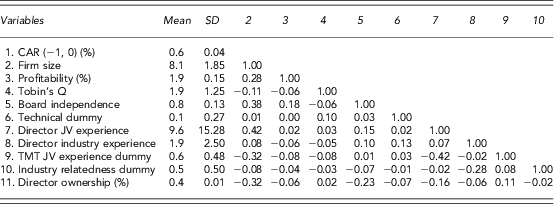
Table 1 depicts the descriptive statistics and bivariate correlation matrix for the variables used in the regression models. Although some of the correlations between the independent and control variables prove significant, variance inflation factor values estimated in conjunction with the regression models do not suggest a serious problem with multicollinearity, as all the independent as well as control variables have variance inflation factor values below the 5.0 criterion advocated by Marquardt and Snee (Reference Marquardt and Snee1975). However, to avoid possible multicollinearity between the interaction terms and their components, this study mean-centers each scale constituting an interaction term and then creates the interaction terms by multiplying the relevant mean-centered scales (Aiken & West, Reference Aiken and West1991).
Descriptive statistics and correlations
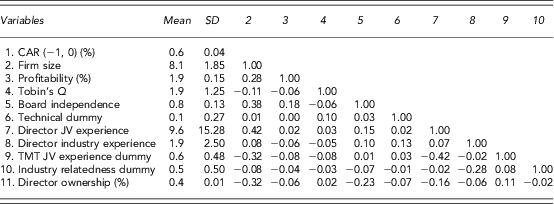
Note. If the absolute value of the correlation is >0.13, the correlation is significant at the .01 level.
CAR = cumulative abnormal return; JV = joint venture; TMT = top management team.
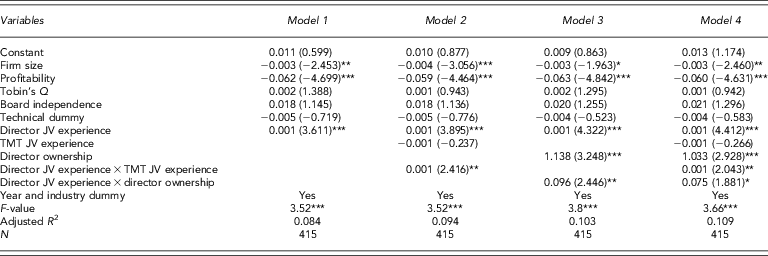
Table 2 presents the cross-sectional regression analyses of abnormal returns of JV announcements after controlling for other possible factors that may influence JV performance. Model 1 regresses abnormal returns against Director JV experience after controlling for the influence from Firm Size, Profitability, Tobin's Q, Board independence, Technical dummy, as well as Year and Industry dummies. In accordance with their anticipated effects as assessed by prior studies, two of the control variables (Firm Size and Profitability) significantly relate to announcement-period abnormal returns. The coefficient of Director JV experience also shows a positively significant association with JV announcement effect (p < .01), consistent with the prediction of Hypothesis 1. This result suggests that a firm interested in JV engagements can benefit from a board structure that includes more JV-experienced directors. Relying on directors’ JV management expertise derived from experience, managers can enhance effectiveness and efficiency of JV decision makings, and obtain access to a wide array of information and resources favorable to JV operations.
OLS regression analysis
Note. T-value is in parentheses.
OLS = ordinary least square; JV = joint venture; TMT = top management team.
***, **, and * represent 1, 5, and 10% significance levels using a two-tailed test, respectively.
Model 2 tests Hypothesis 2 concerning the contingent value of director experience associated with JV decisions and investments. If directors’ JV experience does exert a crucial influence, we may expect that executives’ lack of JV experience would augment the benefits of directors’ experiential capital. To test this possibility, we employ a dummy variable (TMT JV experience) that equals 1 when TMT members have no JV experience and 0 otherwise, and multiply it with value of Director JV experience. As the results show, the interaction term between the TMT JV experience dummy and Director JV experience is significantly positively related to JV performance (p < .05); the coefficient of Director JV experience also remains positively significant (p < .001). This result suggests greater benefits are derived from directors’ JV experience when firm executives do not possess such experience, which is consistent with Hypothesis 2; the findings thus highlight a board's prominent role as a resource provider as related to firms’ JV undertakings.
Model 3 tests the interaction effect between Director JV experience and Director ownership. The results show that the coefficients of the interaction term are significantly positive, suggesting that a JV's value can be enhanced when directors who are compensated by more stockholdings also have a higher level of JV experience. This finding is consistent with Hypothesis 5 and suggests that the value of directors’ JV experience can be contingent upon directors’ willingness to contribute. Finally, in Model 4 all the variables considered in Models 1 through 3 are included in order to isolate the respective impact of the independent variables. Consistent with the findings in the respective models, Director JV experience, its interactive effect with TMT JV experience, and the interaction term between Director JV experience and Director ownership all remain positively significant. It is worth noting that the ‘main effects’ of Director JV experience remain robust in all models with the addition of the interaction terms. Overall, the results of Table 2 confirm directors’ JV experience provides a significant advantage to firms entering into JV engagements.
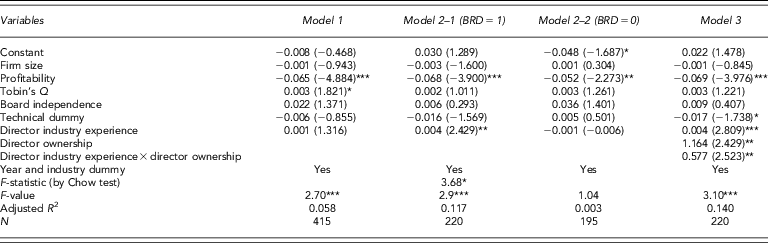
Table 3 examines the value of director experience associated with JV industry. Specifically, we examine whether directors’ prior involvements in industries where JVs are established may significantly increase a firm's gains in its JV investments. The result of Model 1 shows that the coefficient of Director industry experience does not reach the 10% statistical significance level. This finding is inconsistent with Hypothesis 3 for a positive impact of director industry experience on JV performance. The reason why director experience in JV industry fails to confer a universal benefit could be that it matters only when firms establish JVs outside of their own industries. In other words, when the industry of a focal firm entering a JV is different from that of the JV, the benefits received from director experience gained from within the JV industry may be greater. To tackle this issue we first divide the sample firms into two subgroups by the relatedness between a firm's industry and that of its JV activity (judged by their two-digit SIC codes), and then test the performance effect of director industry experience in the separate subgroups. Model 2–1 (Model 2–2) examines the impact of Director industry experience on the abnormal returns of JV announcement when a firm purses a JV outside (inside) its own industry. The results in Model 2–1 show that Director industry experience is significantly and positively associated with the JV announcement effect when a firm and its JV activity are affiliated with different industries. In contrast, when a firm establishes a JV in its own industry, as shown in Model 2–2, the coefficient of Director industry experience is statistically insignificant. The Chow test statistics (F-statistics = 3.68*) further show that the difference in the coefficients of director industry experience between the two subsamples is statistically and significantly different from 0. Overall, the results lend support to Hypothesis 4 that director industry experience is especially valuable when a firm establishes JVs outside of its own industry.
OLS regression analysis
Note. T-value is in parentheses.
OLS = ordinary least square; JV = joint venture; TMT = top management team.
***, **, and * represent 1, 5, and 10% significance levels using a two-tailed test, respectively.
Since the impact of Director industry experience is only significant when firms undertake JVs in different industries, we focus on this subsample to further test Hypothesis 6, which concerns the moderating effect of Director ownership on the relationship between Director industry experience and JV performance. Model 3 shows that the interaction term of Director industry experience and Director ownership is positively associated with abnormal returns of JV announcements. This result suggests that director incentive effectively enhances the contribution of Director industry experience in firms’ JV investments when firms undertake JVs in different industries.
Robustness tests
To further test the robustness of the research findings, this study conducts several supplementary analyses. First, we examine whether the results are consistent across alternative director experience measures. To this end, we perform a separate analysis with Director JV (industry) experience measured alternatively by the mean value of individual outside board member's JV (industry) experience. The results are similar to those of Tables 2 and 3; our findings of a positive director experience impact is thus not sensitive to this alternative experience measure. We further examine the sensitivity of our findings to the specification of the event window. In this study we choose the event window (t −1 to t 0) following JV and strategic literature as it is shown that share prices generally immediately adjust to announcements of significant corporate events (Ryngaert & Netter, Reference Ryngaert and Netter1990). Nevertheless, to catch potential prior leaks and post gradual diffusions of information, we recalculate the CARs with longer event windows, (t −1 to t +1) and (t −2 to t +2). The extended CARs yield essentially similar results to the 2-day window, confirming the robustness of our research results in terms of the selection of event windows.
Third, we examine whether our results are sensitive to the problem of endogeneity. Corporate governance literature has identified the endogeneity problem of reverse causality between a firm's board member recruiting policy and its corporate strategies (Masulis, Wang, & Xie, Reference Masulis, Wang and Xie2007). That is, firms may specify their criteria in director selection based on the anticipation of forthcoming strategic moves. To examine whether this possible endogeneity between director experience and firms’ JV engagements influences the research results, we exclude samples with directors who are recruited within the 2-year window before the focal JV undertakings, and redo the regression analyses. The results are similar to those in Tables 2 and 3. Our findings are therefore not driven by the problem of reverse causalityFootnote 2. Fourth, we examine whether the results are subject to the potential bias of data skewness. We normalize each variable and re-perform the regression analyses. The conclusions remain unchanged.
Finally, because we collect a final sample comprising 415 JV announcements made by 293 firms, our sample includes multiple JV announcements for some of our focal firms. There may thus be autocorrelation, heteroskedasticity, and unobservable firm-specific effects resulting from biased coefficient estimates in the regression models (Greene, Reference Greene2000; Park, Mezias, & Song, Reference Park, Mezias and Song2004). We have therefore addressed the potential problems of autocorrelation, heteroskedasticity, and unobservable firm-specific effectsFootnote 3. We conduct Durbin–Watson (D-W) and Breusch–Pagan (P-B) tests to investigate whether our data suffers from autocorrelation and heteroskedasticity issues, respectively (Kennedy, Reference Kennedy1998). The results of the Durbin–Watson test show that none of our models how an evidence of having significant Durbin–Watson results, implying the regression results are not driven by autocorrelation. As for heteroskedasticity, the P−B test shows that our regression results are subject to heteroskedasticity (p-value<.01). Thus, we re-examine our hypotheses using weighted least squares, with the weights equal to the inverse of the standard deviation of the market-model residual (Chang, Chen, & Lai, Reference Chang, Chen and Lai2008). The results remain unchanged, thereby suggesting the efficiency of our estimates (Lang, Stulz, & Walkling, Reference Lang, Stulz and Walkling1991).
Kennedy (Reference Kennedy1998) indicates that controlling for unobservable firm effects can be achieved through either a fixed or random effects specification. Following Park, Mezias, and Song (Reference Park, Mezias and Song2004), we report random effects models because we do not observe a complete population, and because Hausman tests show that unobservable firm effects are more adequately modeled by such models than by fixed effects models (Greene, Reference Greene2000). Results of the random effects models which are not reported in the tables are consistent with those in the ordinary least square regression analyses. That is to say the results are essentially unchanged, indicating that the previous findings are not driven by unobservable firm-specific effects.
Discussion and conclusion
Discussion
In corporate governance literature, resource-dependence theorists posit there is potential value to be gained from outside directors’ advice and counsel as they can generate strategic insightsFootnote 4. However, directors are heterogeneous in their capability of offering counsel as well as their propensity to do so. In addressing this issue, Hillman and Dalziel (Reference Hillman and Dalziel2003) propose an integrated model arguing that boards with experience/expertise and interests aligned with those of shareholders are best able to contribute to firms’ strategic actions. Our study follows this position and investigates the effectiveness of boards within the context of JVs, a strategy for which the board's resource provision function is critical (Gulati & Westphal, Reference Gulati and Westphal1999) yet its performance effect has yet to be explored.
Overall, our research findings support the framework of Hillman and Dalziel (Reference Hillman and Dalziel2003), suggesting that integrating board capital and incentives leads to the best strategic outcomes. Firms’ JV returns are found to be positively related to the level of director experience with JV decision making, particularly when firm executives do not have previous JV experience. This result supports resource-dependence theory in that directors can leverage their relevant expertise to advance a firm's strategic initiatives (Hillman, Cannella, & Paetzold, Reference Hillman, Cannella and Paetzold2000). It also reveals that boards can capitalize on their members’ accumulated knowledge as they perform related tasks in similar contexts across firm boundaries (Beckman & Haunschild, Reference Beckman and Haunschild2002). Further, we find that director industry experience has a significant performance effect when a JV is executed outside of a firm's industry affiliation. This finding suggests that the advice and counsel from industry-experienced directors is especially prominent when firms are vulnerable to industry unfamiliarity, providing further evidence of the board's resource provision role. Our observation that board members can be diverse in their knowledge endowment suggests that not accounting for the heterogeneity of directors’ competence can lead to an incomplete understanding of the effectiveness of boards. Put differently, only when directors’ associated experience is considered can a more correct assessment of board effectiveness be assured.
Furthermore, our finding of a positive moderating effect of board incentive on directors’ contribution of experiential capital is in line with the arguments posited by agency theory. The results show that the positive impact of director experience is intensified when directors are motivated through the provision of more stockholdings. This finding suggests that providing directors that have relevant experience with adequate incentives renders them best able to contribute to strategic success, which is consistent with the integrated model proposed by Hillman and Dalziel (Reference Hillman and Dalziel2003). Given the incentive value underlying director shareholdings, however, such practices are not always encouraged. For example, this practice is strongly discouraged in the United Kingdom due to the concern that tying outside directors’ compensation to firm performance may undermine their independenceFootnote 5. Shen (Reference Shen2005) states that this is a valid concern, as the decisions made by outside directors can affect the interests of various firm stakeholders (e.g., customers, suppliers, employees, and community members). Therefore, opportunistic behavior may occur where outside directors with large shareholdings take advantage of other stakeholders, making board decisions for their own benefit. To avoid such distortion, Shen (Reference Shen2005) argues that the design of director compensation should be long-term oriented. An example of this would be the requirement that directors hold their shares over their entire board tenure. This can help ensure directors do not just aim for short-term stock price appreciation. Furthermore, it is important that outside directors recognize that only when stakeholder interests are secured will the firm's long-term prosperity, and thus shareholding value, be better assured. This notion has obtained empirical support from several meta-analytic reviews that demonstrate a positive association between corporate social performance and long-term firm profitability in general (e.g., Orlitzky, Schmidt, & Rynes, Reference Orlitzky, Schmidt and Rynes2003; Philip, Pinar, & Jeffrey, Reference Philip, Pinar and Jeffrey2012).
Another concern regarding outside director shareholdings is whether such an arrangement induces outside directors to become too aggressive in challenging management decisions and thus negatively affect board effectiveness. However, Shen (Reference Shen2005) states that this negative outcome is most often effectively controlled because most outside directors are executives in other firms and are aware of firms’ expectations toward ‘non-executives.’ Moreover, knowing that the firm's long-term development is in accordance with their financial interests, directors will focus on helping executives institute promising projects rather than merely challenging executives’ authority. Finally, the board chair or lead director is more likely to discourage directors’ destructive behavior due to his or her obligations to ensure that the board functions in a constructive way. Taken together the above discussion supports a positive moderating effect of director shareholdings on the relationship between director experience and JV performance.
It is further important to address whether directors’ involvement in the formulation of firm strategies in practice is consistent with our findings of a significant impact of director experience. The comparative governance literature suggests that the extent to which boards are involved in strategy formulation can vary across different institutional contexts (e.g., Roberts, McNulty, & Stiles, Reference Roberts, McNulty and Stiles2005; Van Veen & Elbertsen, Reference Van Veen and Elbertsen2008). In countries with two-tier board systems (i.e., those characterized by Rhein capitalism), the board structure is distinguished by a supervisory and an executive board, where the executive board is responsible for managing the firm and the supervisory board supervises and appoints the executive board (Maassen & Van den Bosch, Reference Maassen and Van den Bosch199). Decision management and decision control in this way are formally separated. In contrast, boards in countries with unitary board structures (i.e., those advocating Anglo-Saxon capitalism) are comprised of both executive (or inside) and non-executive (outside) directors. This leads to decision management and control being less clearly separated (Van Veen & Elbertsen, Reference Van Veen and Elbertsen2008), which in turn can increase a board's involvement in the process of strategy formulation and implementation. The active strategic involvement of boards within one-tier institutional environments has been evidenced by several empirical works. For example, Westphal and Fredrickson (Reference Westphal and Fredrickson2001) find that in large- and medium-sized US industrial and service firms, the strategic changes that typically follow the selection of new CEOs reflect the influence of boards rather than top executives. They conclude that ‘prior results that appear to show the influence of managers over strategy could mask the influence of boards’ (Westphal & Fredrickson, Reference Westphal and Fredrickson2001: 1130). Similarly, targeting US firms, Carpenter and Westphal (Reference Carpenter and Westphal2001) and Hillman (Reference Hillman2005) provide empirical support for the influence board members’ expertise and relationship ties have on their contribution to strategy formation. Finally, from 40 in-depth interviews, Roberts, McNulty, & Stiles (Reference Roberts, McNulty and Stiles2005) conclude that the UK unitary board structure facilitates a positive relationship dynamic between executives and non-executives, as it enables ongoing dialogue between the two groups through which firm strategies are refined and incrementally improved. In contrast, the separation of the management and supervisory functions within the German two-tier board structure is seen as a potential obstacle for a strong involvement of non-executives over strategy. As our study employs unitary board data, the above research findings justify our claims regarding the board's influence on JV strategies.
Lastly, in this work we assess the direct linkage between director experience and strategic performance within the scope of JVs. However, director experience is multi-dimensional as it is composed of director international experience, previous board experience, experience with product diversification, etc. To investigate the individual effects of various experience on JV strategic outcomes, we additionally incorporate the above three experience attributes into our regression analysesFootnote 6. The results show that these three variables do not have a significant effect on JV performance, while director JV experience does. This suggests that the former three variables may only indirectly connect a board's professional knowledge with an enterprise's JV performance as they assess board resources from the perspective of overall director experience. In our study we assess the relationship between a firm's JV performance and the types of board experience that are most relevant to a firm's JV engagement, that is, board members’ JV experience and their prior involvement in the JV's target-industry. Thus, our study provides direct evidence concerning whether a board's professional knowledge can improve organizational performance. These results echo several theoretical literatures that state that directors are better advisors to the extent that they have the right kind of knowledge and expertise (e.g., Hillman, Cannella, & Paetzold, Reference Hillman, Cannella and Paetzold2000; Hillman & Dalziel, Reference Hillman and Dalziel2003).
Theoretical and practical implications
The findings of this study can have a number of implications for practice and research. First, our research results can provide valuable contributions to board research as they are derived from a direct quantitative measurement of directors’ strategy-specific experience. This differs from prior studies that investigate the effect of director experience as they exclusively use indirect indicators (e.g., board size, independence, interlock, and tenure), likely due to the difficulty and laborious nature of obtaining direct measures. However, such indirect assessments cannot effectively represent the context of director experience, and thus have been viewed as gross proxies (Daily et al., Reference Daily, Dalton and Cannella2003; Haynes & Hillman, Reference Haynes and Hillman2010). Through extensive data collection, this study addresses this research gap by assessing the direct linkage between director experience and the strategic performance of firms involved in JV engagements. As existing literature on the direct assessment of the linkage between director experience and associated strategic outcomes remains sparse, the present study represents an important step toward better understanding the performance effect of board experience by providing solid evidence from the context of JVs, an event the board's resource-dependence role is prominent in (Gulati & Westphal, Reference Gulati and Westphal1999).
The discovery of a significant performance effect of director experience can also add to JV literature as previous studies on the determinants of JV outcomes exclusively explore transaction-level factors, such as the characteristics of JVs or the motivation of the partners (e.g., Merchant & Schendel, Reference Merchant and Schendel2000; Reuer & Koza, Reference Reuer and Koza2000; Chang & Chen, Reference Chang and Chen2002; Jiang, Chu, & Pan, Reference Jiang, Chu and Pan2011). Thus, how directors’ experience can influence the value of their advice and counsel on JV decisions and contribute to a JV's success has remained an under-researched topic in business research. It is important to note that such an assessment can be informative in view of the increasing practice of board members’ participation in setting JV strategies. Therefore, discovering the type of director experience that helps to deliver the greatest benefits to a firm's JV engagements appears to be a critical issue. Despite the purported bulk of theoretical benefits, empirical evidence on the wealth effect of JVs demonstrates mixed findings (Ren, Gray, & Kim, Reference Ren, Gray and Kim2009, for a review), as there are as many studies that report a positive valuation effect of JVs as those that report otherwise. As extant studies predominantly apply transaction-level considerations, the findings of this study shed new empirical light on the current mixed results of the determinants of JV success by applying an organizational-level construct, board experience, an item that has long been ignored in prior literature.
In addition to the theoretical implications, findings of this study can have implications for the practice of corporate governance. Over the past few decades, corporate governance practices and regulations have gone through important changes as a greater number of boards have acquired structural power in corporate decisions, and increasing legislation has empowered directors’ involvement in firms’ strategies (Pugliese et al., Reference Pugliese, Bezemer, Zattoni, Huse, Van den Bosch and Volberda2009). The significant performance effect of director JV/industry experience found in this study suggests firm leaders to consider requirements for director expertise when they nominate board members and develop new regulations. By ensuring that the experience of their directors fit the firm's strategies and development frameworks, managers can obtain relevant assistance from experienced directors, thus increasing the efficiency of the decision-making process and enhancing strategic effectiveness.
Our study can also have implications for practitioners who undertake JVs. Researchers have noted that enterprises entering JV partnerships seek to efficiently renew competencies by accessing key resources from external parties. However, the high failure rate of JVs (Ren, Gray, & Kim, Reference Ren, Gray and Kim2009) suggests that realization of purported advantages is subject to great transactional uncertainty. Our research findings suggest that managers can mitigate the challenges incurred by referring to directors’ relevant experience. This vicarious learning path can enhance decision-making efficiency and effectiveness because firms do not have to undertake preliminary experiential costs by themselves. Rather, they can reap a second-mover advantage by acquiring fruitful practices from directors’ prior experience (Beckman & Haunschild, Reference Beckman and Haunschild2002). Such efficient obtainment of relevant expertise has important implications for JV practitioners. Since JVs are substantially employed in highly competitive environments as a means of mastering environmental chaos (Hsieh, Rodrigues, & Child, Reference Hsieh, Rodrigues and Child2010; Cui et al., Reference Cui, Calantone and Griffith2011), JV decisions are typically subject to great time constraints in order to ensure timely responses to environmental uncertainty, which makes rational deliberation before making decisions difficult (Bierly & Gallagher, Reference Bierly and Gallagher2007). However, with informed counsel provided by experienced directors, managers are better able to deal with the demand for speedy JV decisions. Managers can therefore maximize the purported JV value by utilizing this readily available board capital.
Research limitations and suggestions for further research
The analysis conducted in this study is prone to some research limitations. First, this study assesses director experience through quantitative measures without considering qualitative aspects such as the success/failure of directors’ prior JV engagements. While our employment of the Security Data Corporation's database methodology does not allow for such a qualitative analysis, it is recommended that future studies take this concern into account. Also, owing to the constraints of database employment, this research could not address the dynamics of the board decision-making process as the collection of these data requires tools such as interviews with directors and observations of the board meeting process. Direct assessment of board dynamics could, however, enrich our understanding of how directors utilize their expertise to advance firm strategies (Machold, Huse, Minichilli, & Nordqvist, Reference Machold, Huse, Minichilli and Nordqvist2011). Future research may revisit this important issue when more data is available. Future studies may also further this research line by applying different quality measures, such as the directors’ work-related and non-work-related experience and various director characteristics (e.g., board diversity, directors’ gender, nationality, education, etc.). Moreover, they may alternatively revisit the issue raised in this study by referring to upper echelons theory, as boards and top teams alike reside at the strategic apexes of firms (Fama & Jensen, Reference Fama and Jensen1983; Finkelstein, Hambrick, & Canella, Reference Finkelstein, Hambrick and Canella200), and are together involved in setting and reviewing strategiesFootnote 7. Finally, this research focuses exclusively on the effects that directors have on the performance of JVs. With the finding of board members’ increasing participation in formulating firm strategies, future research may extend this research into other strategic domains such as alliances, diversification, internationalization, and so forth, in order to explore the extent to which a board's experiential capital can advance corporate strategies.
Acknowledgements
The authors wish to thank the two anonymous referees for helpful comments. Jung-Ho Lai acknowledges funding from the National Science Council in Taiwan (NSC 97-2410-H-141-002).