1 Introduction
Recent work in metrical typology within the framework of Optimality Theory (Prince & Smolensky Reference Prince and Smolensky1993) has emphasised the rhythmic distribution of stress peaks by reference to clashes and lapses (Hyde Reference Hyde2001, Reference Hyde2002, Kager Reference Kager2001, Reference Kager2005, Gordon Reference Gordon2002, Alber Reference Alber2005); in contrast, most previous approaches granted a central role to foot constituency (Halle & Vergnaud Reference Halle and Vergnaud1987, Idsardi Reference Idsardi1992, Hayes Reference Hayes1995). One consequence of this emphasis has been the introduction of constraints that require reference to non-adjacent objects in the representation, in particular sequences of two unstressed syllables (a lapse), together with a position defined by a word edge or a stress peak. I argue here for a constraint-based approach to metrical typology that permits only strictly local constraint formulations. In doing so, I advocate increased reference to foot structure, while maintaining local reference to clashes and lapses.
This change results in different predictions about possible stress systems. An essential requirement for a typology of possible stress systems is, of course, descriptive adequacy (Chomsky Reference Chomsky and Lunt1964); that is, the set of possible languages predicted by the typology must include all attested languages. To some degree, our description of attested metrical systems depends on assumptions made in particular analyses – for example, whether a certain language is treated as having iambic or trochaic feet – but on the whole there is a reasonable sense in the literature of what patterns need to be accounted for. (I discuss in §3.3 a neglected iambic pattern.) A second goal, and one that figures prominently in much recent typological work, is to avoid grammars that are not attested in observed languages – that is, to avoid overgeneration. This issue raises crucial metatheoretical questions. Should the apparent absence of particular sorts of grammars be interpreted to mean that they are impossible for the human language faculty to compute? Or should factors external to the grammar serve as the explanation for at least some of these gaps? How can we know when a gap is accidental? I return to these broad questions in §7, where I favour a greater role for extragrammatical explanations than in most recent metrical typologies. Before then, however, I discuss some formal issues that partly lead to this view of the typology; namely, what are the formally possible metrical constraints, and what typology emerges from a set of properly restricted constraints? I endorse the trend toward categorical rather than gradient constraints, but push further toward strict locality. The consequences of this step are the main focus of the paper.
2 Trends in metrical typology
2.1 Directionality and alignment
In ordered-rule approaches to generative metrical phonology, iterative structure is handled by stepwise creation of metrical feet (Hayes Reference Hayes1980, Reference Hayes1995, Halle & Vergnaud Reference Halle and Vergnaud1987) or some other indication of rhythm or grouping (Prince Reference Prince1983, Idsardi Reference Idsardi1992, Halle & Idsardi Reference Halle and Idsardi1995). A central insight is that when a language avoids non-branching feet, a leftover syllable at the end of the parse will remain unfooted; the direction of parsing therefore determines the location of such unfooted syllables. For example, in Pintupi words with an odd number of syllables, the final syllable is unfooted (Hansen & Hansen Reference Hansen and Hansen1969, Reference Hansen and Hansen1978, Hammond Reference Hammond1986, Hayes Reference Hayes1995), which follows from left-to-right footing (1a); in Warao (Osborn Reference Osborn1966, Hayes Reference Hayes1980), the first syllable is unfooted, indicating a right-to-left parse (1b). Both languages are trochaic, but differ in their directionality.
(1)


Beginning with McCarthy & Prince (Reference McCarthy and Prince1993), standard analyses of metrical systems within Optimality Theory (OT) were designed to model the same generalisations in a non-iterative fashion. The Alignment family of constraints made it possible to evaluate each foot with regard to its distance from a particular edge of the word; the analysis is therefore driven by reference to foot boundaries. In the case of Pintupi, AllFt-L counts a violation for each syllable that intervenes between the left edge of every foot and the left edge of the word. This results in a potentially large number of violation marks (given here as numerals), but higher-ranking Parse-σ forces the effect of iterative footing (see Kager Reference Kager1999).
(2)
This strategy of employing gradient violations is partly a matter of achieving descriptive adequacy: lacking the stepwise construction permitted in a derivational approach, OT requires some other means of capturing the differences among (2b–e), which are equal in their satisfaction of FtBin and Parse-σ. For example, if we had only a categorical alignment constraint Align(Ft)L, requiring that some foot occur at the left edge of the word, we could rule out (2e) but not (2c, d).
Although gradient alignment provides a means of choosing the right output form in languages like Pintupi, the approach presents various formal problems. Conceptually, the class of alignment constraints has not been treated in a consistent manner: some were evaluated gradiently, some categorically (Zoll Reference Zoll1996, McCarthy Reference McCarthy2003). Typologically, certain odd patterns follow from the presence of both AllFt-L and AllFt-R in the grammar: Eisner (Reference Eisner1997a) shows that gradient alignment can be used to force an element such as tone (or stress) to appear as close to the centre of a word as possible. There is dispute about whether the distinction between the rhythmic patterns in (2c, d) is typologically motivated, except as a function of the location of main stress (see Kager Reference Kager1991, Reference Kager2001, Reference Kager2005vs. Hyde Reference Hyde2001, Reference Hyde2002, Reference Hyde2008, Gordon Reference Gordon2002). And computationally, gradient alignment constraints cannot be modelled by a finite state grammar, making them a questionable component of the theory (Eisner Reference Eisner1997b, Reference Eisner2000, Bíró Reference Bíró2003, Riggle Reference Riggle2004, Heinz et al. Reference Heinz, Kobele and Riggle2005, Heinz Reference Heinz2007, Reference Heinz2009).Footnote 1 Nevertheless, much recent work in metrical typology retains at least some use of gradient alignment (Hyde Reference Hyde2001, Reference Hyde2002, Reference Hyde2008, Gordon Reference Gordon2002, Alber Reference Alber2005; see also Beasley & Crosswhite Reference Beasley and Crosswhite2003).
Eisner (Reference Eisner1997a, Reference Eisnerc) develops a theory of Primitive Optimality Theory (OTP) which permits only strictly local constraints, and applies this formalism to the metrical typology of Hayes (Reference Hayes1995), which is couched in a derivational framework. An important aspect of Eisner's approach is the replacement of gradient alignment, which is massively non-local, with other mechanisms that are expressed locally and non-gradiently. For example, the winning Pintupi candidate in (2b), with an unfooted final syllable, is favoured by the equivalent of final extrametricality, i.e. a preference for unfooted final syllables. Since some elements of Eisner's approach do not correlate well with the metrical generalisations more familiar to phonologists, and more detailed typologies have been advanced since that time, I focus here on the typology of Kager (Reference Kager2001, Reference Kager2005), which is similar in using non-gradient constraints to replace AllFt-L/R. McCarthy (Reference McCarthy2003) argues more generally that all OT constraints are categorical, and builds on Kager (Reference Kager2001) in claiming that gradient alignment is not necessary or desirable for metrical typology. I support this rejection of gradient constraint evaluation; one of my goals, however, is to bring Kager and McCarthy's analysis into line with the strict locality advocated by Eisner, and to explore the typological consequences.
2.2 Categorical alignment and rhythmic distribution
Kager (Reference Kager2001) proposes a metrical typology in OT without gradient alignment (some revisions in Kager Reference Kager2005 are addressed below). Categorical alignment of one foot at the left or right edge of the word remains possible, but for most iterative systems the distribution of other feet is handled without alignment. The crucial elements are constraints on the presence and location of lapses (Prince Reference Prince1983, Selkirk Reference Selkirk1984, Nespor & Vogel Reference Nespor and Vogel1989). For example, the Pintupi pattern is favoured by the constraint Lapse-at-End, which states that if any lapse of two unstressed syllables occurs, it must be at the right edge of the word. Align-L(Wd, Ft) requires a single foot at the left edge of the word.
(3)
In this analysis, (3b, c) are rejected not because their feet are collectively further from the left edge than those of (3a), but because their distribution yields lapses in non-final position. Kager's typological survey revealed that this is a preferred location for lapse, and his constraint Lapse-at-End expresses this preference. Because of the categorical alignment required by higher-ranked Align-L, candidate (3d) is rejected despite its perfect satisfaction of the lapse constraints.
Kager (Reference Kager2001) gives the following constraints for lapses, expressed in a notation where 0 is an unstressed syllable and 1 is the main stress (or ‘peak’).
(4)
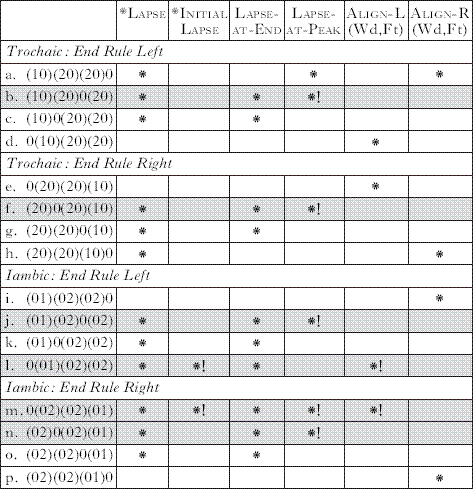
To see how these constraints work, and what typological predictions they make, consider Table I, modelled after Kager (Reference Kager2001) and McCarthy (Reference McCarthy2003). Shaded rows are predicted to be impossible patterns, because they are harmonically bounded: some other candidate has a proper subset of violations and will be preferred under any constraint ranking (Samek-Lodovici & Prince Reference Samek-Lodovici and Prince1999). Syllables are shown schematically with primary, secondary or no stress (1, 2 or 0). The End Rule for the placement of main stress is discussed below.
Harmonic bounding in Kager (2001)'s analysis.

It can be seen that six patterns are harmonically bounded due to at least one fatal constraint violation. Specifically, because of Lapse-at-Peak, (b) is bounded by (c), and (f) by (g), while several violations are responsible for (j, l) both being bounded by (k), and (m, n) by (o). These six patterns are predicted by Kager never to occur, because the universal constraint set will always favour some other parsing of the same string of syllables.Footnote 2 Thus, although the difference between (a) and (c) can be captured by the relative ranking of Lapse-at-Peak and Lapse-at-End, no ranking will prefer (b), no matter how low Lapse-at-Peak is ranked.
It turns out that the iambic predictions in this table are too restrictive, because pattern (l) corresponds minimally to Kashaya (Oswalt Reference Oswalt1961, Reference Oswalt and Shipley1988, Buckley Reference Buckley1992, Reference Buckley1994, Reference Buckley1997). Obviously, any typology that excludes an attested language has not achieved descriptive adequacy. I return to the case of Kashaya in §3.3 after developing a revised typology using local constraints. More generally, I argue that greater reference to constituency is necessary in order to maintain locality without reification of lapses as primitive units of the theory.
3 Local constraints
3.1 Locality in phonology
The issue of locality has played a role in the interpretation of phonological statements for decades; one of the causes of movement away from the variables of Chomsky & Halle (Reference Chomsky and Halle1968) was to provide an explanatory account of precisely when material can intervene between the trigger of a process and the undergoer (early examples are Jensen Reference Jensen1974, Clements Reference Clements1976, Goldsmith Reference Goldsmith1976, Poser Reference Poser, Hulst and Smith1982; see more recent discussion in Nevins & Vaux Reference Nevins, Vaux, Csirmaz, Lee and Walter2003, Mailhot & Reiss Reference Mailhot and Reiss2004, Heinz Reference Heinz2007). Locality in the formulation of metrical rules is discussed, for example, by Hammond (Reference Hammond1984), Halle & Vergnaud (Reference Halle and Vergnaud1987) and Hayes (Reference Hayes1995). Kager (Reference Kager2001: 12) cites Paul Kiparsky on the desirability of expressing metrical generalisations as ‘locally inspectable rhythmic patterns’, although the context is mainly against gradient alignment rather than for strict locality, as I advocate here.
Locality demands that ‘a rule may fix on one specified element and examine the structurally adjacent element and no other’ (McCarthy & Prince Reference McCarthy and Prince1986: 1). More formally, Eisner (Reference Eisner1997a) takes as a central idea of his Primitive Optimality Theory that all proper OT constraints are expressible by reference to temporal overlap. The two basic elements to which constraints can refer are edges and interiors, and their overlap or non-overlap. Thus left-alignment of a foot and a word is a statement about the temporal coincidence of a foot edge and a word edge. The requirement that a syllable be parsed into a foot is stated as the overlap of the interior of a syllable with the interior of some foot.
Although much previous metrical work has tended to obey locality, there are numerous examples of particular rule statements that are not local. In some cases, the problem may be attributed to opacity. For example, two rules of tonic lengthening in Cayuga apply to a penultimate syllable, which implies a right-aligned trochee; but the synchronic footing in the language involves left-to-right iambs. Consequently, the context of a syllable followed by another syllable and also (non-locally) a word boundary has been used to target the penult without reference to a foot (Hayes Reference Hayes1995: 222f). The complexity derives from layers of historical change, including a shift in foot type; the syllabification required for one rule of lengthening differs from what is otherwise required. The best solution might involve some general approach to opacity where at least one representation has an actual stress on the penult.
In other cases, the effect of multiple constraints can eliminate non-local statements by dividing the pattern into smaller pieces. For example, Hayes (Reference Hayes1995: 249) discusses a destressing rule in Central Yupik that makes a CVC syllable light between two stressed syllables; the adjacency on two sides cannot be expressed in terms of a single local constraint. However, Smolensky (Reference Smolensky1995) proposes that a constraint can be self-conjoined; here *Clash&*Clash penalises two clashes at the same location. If the coda consonant in the medial CVC is not assigned the usual mora, this light syllable does not head a foot, and no clash occurs. Since the gridmark over the medial syllable otherwise participates in two clashes (to the left and right), conjunction is a reasonable solution, which maintains a single locus of violation. There are no doubt significant challenges in formulating many complex patterns in a local manner, but in this paper I restrict myself to more basic issues of stress placement.Footnote 3
McCarthy (Reference McCarthy2003: 80), crediting a suggestion by Paul Smolensky, mentions that it may be possible to claim that ‘constraints are inherently local because they can never mention more than two distinct constituents and a relation between them, such as adjacency or shared membership in a superordinate constituent’. This restriction is quite similar to the effect of Eisner's OTP. I do not present the details of Eisner's formal notation here (see especially Eisner Reference Eisner1997a for exposition), but in the discussion that follows, I assume his notion of temporal coincidence in evaluating whether existing metrical constraints satisfy locality. When they do not, I propose replacements (using familiar OT conventions) that obey this restriction. My overarching goal is to develop a new approach to metrical phonology that uses only local constraints but is reasonably close in typological predictions to non-local approaches.Footnote 4
3.2 Local lapse constraints
McCarthy (Reference McCarthy2003) adopts Kager's non-gradient metrical constraints, presenting them in a formalism that is useful in examining whether these constraints are local or not. I provide both formulations here; prose statements were given in (4).
(5)
In Kager's formulations, the constraints might be taken as local if the lapse, symbolised 00, functions as a single unit, or a primitive. I do not believe this to be his intent, however, and certainly the standard view is that lapses are a secondary notion, derivative from the unitary constituent of an unstressed syllable.Footnote 5 McCarthy's approach, by stating each constraint as a restriction on the distribution of a stressless syllable ( ), makes this assumption more explicit. On the other hand, the formulation of *Lapse is clearly local, since it refers to two adjacent syllables; in line with Eisner's theory, the left and right edge of stressless syllables cannot overlap.Footnote 6 As can be seen in (5), however, all the other lapse constraints are non-local.
Consider first *InitialLapse. On an intuitive level, this constraint penalises a lapse at the beginning of a word; but this is a matter of adjacency of two objects only if a ‘lapse’ is reified as a single object. If a lapse is really the derived notion of two unstressed syllables, then the constraint is non-local. In McCarthy's formulation, the syllable in question violates the constraint if two conditions are satisfied: it is adjacent to a word boundary on the left, and adjacent to another unstressed syllable on the right. These three objects do not overlap at a single point in the temporal dimension, and the configuration cannot be described in a local manner without problematic assumptions (such as treating lapse as a unit).Footnote 7
We can propose a new local approach by reconsidering the effect of *InitialLapse. The patterns in Table I that are ruled out by this constraint are iambic only, because even if the first syllable is skipped in a trochaic system, i.e. [0(10), the foot-initial stress prevents a lapse in that position.Footnote 8 Therefore the relevant ill-formed structure is [0(01), where the initial syllable is unfooted in an iambic language. A straightforward means of preventing this result is already part of the constraint set: Align-L(Wd, Ft). The two candidates in Table I (l, m) that violate *InitialLapse also violate Align-L, and are harmonically bounded by the alignment constraint. Thus we can simply eliminate *InitialLapse without adding a new constraint, obviating its non-local nature. Kager (Reference Kager2005) and Houghton (Reference Houghton2006) also eliminate *InitialLapse, although in a different context.
The other two lapse constraints are relevant only when a lapse is present, i.e. when *Lapse is also violated. As a result, they are rather complex, in addition to being non-local. Consider first Lapse-at-End, because it deals with a word edge. Once again, Kager's ‘if 00 then 00]’ is local only if ‘00’ is a single object. As with *InitialLapse, under standard assumptions this constraint requires reference to two unstressed syllables as well as a word boundary, which cannot be done locally. What sort of structure does Lapse-at-End prefer? It is of course satisfied by 0)0], a lapse at the end of a word, but violated by 0)0(1, a lapse in the middle of a word, where it is normally followed by another foot.
A local solution to Lapse-at-End is simply to prefer a structure in which the final syllable is unfooted, regardless of whether the footing is trochaic or iambic. In other words, I propose to use *Align-R(Wd, Ft), which assesses a violation for an overlap between the right edge of the word and the right edge of a foot, and is the equivalent of final-syllable extrametricality (Eisner Reference Eisner1997b, Alber Reference Alber2000).Footnote 9 This constraint favours not only lapsed trochaic (10)0] but also lapse-free iambic (01)0] and unary (1)0]. By forcing a foot away from the right edge, it can have the indirect effect of eliminating lapses elsewhere in the word; for example, by penalising the right-alignment in trochaic (10)0(10)] it will favour (10)(10)0], without making any reference to lapse. The same is true in an iambic language, since *Align-R prefers lapse-free (01)(01)0] over lapsed (01)0(01)] or 0(01)(01)], and yet makes no direct reference to the location of lapses.
The overlap in effect with final extrametricality is not unprecedented: Kager uses rhythmic constraints such as Lapse-at-End to capture the preference for final-syllable extrametricality instead of a Non-finality-type constraint which penalises a foot or a stress on the final syllable (Prince & Smolensky Reference Prince and Smolensky1993; cf. Hyde Reference de Lacy2007a). I take the opposite tack, as does Eisner (Reference Eisner1997b) : a local constraint restricting the location of feet, rather than non-local Lapse-at-End, generates a directionality effect.Footnote 10 By abandoning Lapse-at-End, this approach similarly avoids redundancy in the formalisation of right-edge non-footing effects. *Align-R(Wd, Ft) replaces a common interpretation of Non-finality, although the latter constraint could potentially be interpreted to refer to either a final stress or a final foot (see McCarthy Reference McCarthy2003).
Now consider Lapse-at-Peak, which is quite complex.Footnote 11 Recall McCarthy's formulation * / α__ β in (5), where α does not end and β does not begin with  . Making reference to four different syllable positions in the string, this constraint is certainly not local, although Kager's ‘if 00 then 100 or 001’ gets by with three positions and a disjunction.Footnote 12 As with Lapse-at-End, the local solution I propose is to disfavour certain alignments, so that lapse positions follow secondarily. Specifically, the constraint *Align(HdFt) pushes any foot away from the head foot of the word (representing the main stress), and lapses occur adjacent to that foot rather than elsewhere.Footnote 13 Conceptually, this is a kind of heightened clash avoidance (Prince Reference Prince1983, Kager Reference Kager1994, Alber Reference Alber, Booij and de Weijer1997, Elenbaas Reference Elenbaas1999, Elenbaas & Kager Reference Elenbaas and Kager1999, Gordon Reference Gordon2002), but specific to the most prominent stress (see the *Clash-Head of Plag Reference Plag1999, Pater Reference Pater2000); as with *Align-R, it indirectly prevents the unfooted syllable – and the lapse – from occurring in other positions.
Although symmetry is built into the prose statement of Lapse-at-Peak, i.e. Kager's ‘Lapse must be adjacent to the peak’ in (4d), the formulations in (5) require separate statements of the possible left and right contexts – that is, either *Align(HdFt-L, Ft-R) or *Align(HdFt-R, Ft-L). The relevance of the left or right edge depends on the setting for the End Rule: if the main stress foot is at the left or right edge, only the opposite side of the peak foot can abut another foot and be subject to possible alignment with it.Footnote 14 Thus, the lapse next to the head foot in iambic (02)(02)0(01) is favoured over (02)0(02)(01) by *Align(HdFt-L, Ft-R), while the counterpart *Align(HdFt-R, Ft-L) chooses trochaic (10)0(20)(20) over the otherwise equivalent (10)(20)0(20). In these cases, the disfavoured footings (02)0(02)(01) and (10)(20)0(20) are harmonically bounded, both in Kager's approach (Table I) and in my revised constraint set (Table II below).
The following is a summary of the constraints I have adopted here to do the work of Kager's lapse constraints, formulated in the Alignment family.
(6)
The broader predictions of these constraints compared to those of Kager are discussed in §3.5.
3.3 Initial extrametricality
As noted in the previous section, in recent rhythm-based typologies (Kager Reference Kager2001, Reference Kager2005, Gordon Reference Gordon2002, Alber Reference Alber2005) constraints on the locations of lapses take the place of (final) extrametricality. Thus the trochaic footing (10)(20)(20)0 is caused not by directionality, but by Lapse-at-End or the equivalent. The alternate footing 0(10)(20)(20) avoids lapses entirely, thanks to the left-headed feet. But without some new constraint, there is no way to favour iambic 0(01)(02)(02) over (01)(02)(02)0, because the latter footing avoids lapse entirely, while the former has a lapse in a disfavoured position. Other footings, such as (01)0(02)(02), can be generated by constraints such as Align-R and Lapse-at-Peak. In this kind of typology, initial extrametricality is predicted to be impossible.
For example, Eisner (Reference Eisner1997b) mentions Kashaya as the best example of left-edge syllable extrametricality, but excludes it from his empirical coverage.Footnote 15Kager (Reference Kager2001) excludes initial extrametricality (cf. Table I), claiming that ‘no language is known to require left-edge lapses’; the pattern 0(01)(02)(02) is similarly excluded in Kager (Reference Kager2005). Hyde (Reference Hyde2002: 314) claims that although some trochaic systems (such as Pintupi) have ‘a lapse exactly at the right edge in odd-parity forms. There is apparently no attested language with the mirror-image iambic pattern’; for him, the Non-initial constraint is ‘crucially absent from the theory’ (Hyde Reference Hyde2001: 37). Alber (Reference Alber2005: 496) states: ‘to my knowledge, there are no languages displaying an iambic, right-aligning pattern … with either two initial unstressed syllables, in the case of strictly binary patterns, or two adjacent, final stresses, as in the case of systems allowing for degenerate feet’.
The problem is that initial extrametricality may be rare, but it does occur. The language most famously claimed to require this device is Winnebago (Hale & White Eagle 1980, Hayes Reference Hayes1980, Prince Reference Prince1983, Halle & Vergnaud Reference Halle and Vergnaud1987, Beasley & Crosswhite Reference Beasley and Crosswhite2003), but the interaction of stress with epenthetic vowels has led others to argue for a rule shifting a pitch accent to the right (Miner Reference Miner1979, Hayes Reference Hayes1995; see Hall Reference Hall2003 for an OT account). Nevertheless, a number of authors have proposed a constraint Non-initiality or the equivalent for various languages.Footnote 16 I focus here on Kashaya, which has the pattern equivalent to Alber's (6d), i.e. 0(02)(02), ignoring levels of stress; that pattern is described there as ‘right-aligning’, but I argue below that the pattern in Kashaya is in fact ‘left-non-aligning’.
The full characterisation of Kashaya stress is complex, since a monosyllabic root blocks initial extrametricality, and a long vowel in certain positions can cause foot extrametricality. However, absent these special circumstances the default pattern clearly involves an initial extrametrical syllable, left-to-right iambs and main stress on the first foot (Oswalt Reference Oswalt1961, Reference Oswalt and Shipley1988, Buckley Reference Buckley1992, Reference Buckley1994, Reference Buckley1997).Footnote 17
(7)
From an OT perspective, the subset of forms with default stress must be generated by the same constraints that would model a language in which all words follow the same pattern; typologically, therefore, the prediction based on a default pattern is the same as for a language where that is the only pattern.
To prevent footing of the initial syllable, we require the symmetrical counterpart to the constraint *Align-R(Wd, Ft) in (6), i.e. *Align-L(Wd, Ft). The tableaux in (8) illustrate how high-ranked *Align-L and low-ranked *Align-R combine to produce the effect of initial extrametricality and (apparent) left-to-right directionality.
(8)
Syllable weight and other complications are ignored here; see Buckley (Reference Buckley1997) for an earlier but more thorough OT analysis. Unary feet are required in Kashaya only when forced by syllable weight or word minimality, in which case the location is fixed by other criteria; consideration of heavy syllables is beyond the scope of this paper, especially since weight is a local matter relating syllables and foot structure.Footnote 18 See §5.2 for the implementation of unary feet in a different context.
Although the pattern 0(01)(02)(02) is rejected by various authors cited above as an instantiation of right-to-left iambic footing, the notion of directionality can play no formal role in these OT analyses: the proposed constraints operate without reference to direction per se, and we can only consider what patterns are generated according to the constraints that figure in the theory. In a ‘right-to-left’ system, odd-parity 0(01)(02)(02) would coexist with even-parity (01)(02)(02). In Kashaya, it coexists with 0(01)(02)0, but this does not diminish the fact that the output 0(01)(02)(02) must be generated for a seven-syllable word. This supports my claim that Kashaya is actually ‘left-non-aligning’, i.e. with initial extrametricality, rather than ‘right-aligning’, which is an OT implementation of right-to-left directionality.
3.4 A revised typology
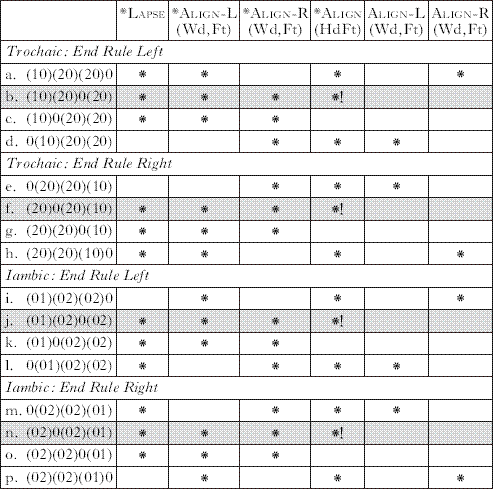
I argued in §3.2 that *Align-R(Wd, Ft) is necessary to prefer right-edge lapses by means of a local constraint, and in §3.3 that the Kashaya facts can be generated in a local fashion by adding the symmetrical constraint *Align-L(Wd, Ft). The resulting typology, including all the new constraints discussed up to this point, is shown in Table II. Violations of *Align(HdFt)-L/R are shown in one column; the L/R relevance depends in each case on the End Rule.
Harmonic bounding in the revised typology.

Compared to the harmonic bounding relationships that exist under Kager's constraint set (Table I), the trochaic systems are unaffected: for example, the new constraints add violations equally to (b) and (c). In the iambic systems, there are two changes: (l) is no longer bounded by (k), although (j) still is, and (m) is no longer bounded by (o), but (n) still is. In other words, four the of six patterns which were originally excluded retain that status. Newly permitted (l) is necessary to account for the existence of Kashaya 0(01)(02)(02).
I do not know of a language with 0(02)(02)(01) that instantiates (m); but every metrical typology that has been proposed predicts languages that have not (yet) been attested, and the descriptive adequacy achieved by permitting (l) must certainly take priority over whether or not (m) corresponds to a known language. It is perhaps notable, however, that (m) is disfavoured by four of the constraints in this set (as is (l)). This pattern corresponds to a simple right-to-left iambic language without unary feet, which has been claimed to be unattested, or at least to be much rarer than one with left-to-right iambs (Hayes Reference Hayes1995, van de Vijver Reference Vijver1998, Alber Reference Alber2005). However, once the constraint set includes *Align-L, which is necessary for Kashaya, right-to-left iambs must be admitted formally as well. See also §7 for typological discussion.
3.5 Factorial predictions
The specific predictions of a factorial typology depend on precisely which constraints are included in the typology. In principle, every constraint in the grammar must be included, but in practice a considerably smaller subset of constraints is considered. Yet a factorial typology that excludes certain constraints because they are not needed to generate a given set of stress patterns may be compromised if the same constraint is motivated by other empirical phenomena and is therefore part of the full constraint set assumed for all languages (such as Parse-σ in the ‘maximally reduced’ typology of Kager Reference Kager2005). In this section I compare some calculations of predicted possible metrical patterns under several different assumptions; my goal is not to provide a definitive number for any theory – which is impossible in the absence of a complete list of constraints – but rather to show the general order of magnitude of difference in the number of grammars encompassed by the local theory, especially in comparison to the categorical, but non-local approach of Kager (Reference Kager2001, Reference Kager2005). The numbers were generated by the program OT Soft (Hayes et al. Reference Hayes, Tesar and Zuraw2004), using words between two and nine syllables in length. Because the issue of descriptive adequacy arises for iambic languages, I focus on this general case.Footnote 19
Every predicted ‘language’ is a distinct set of footings for words of various lengths, and encompasses more possibilities than can be shown in the seven-syllable examples in the tables above. For example, all three languages in (9) include the shape (01)(02)(02)0 – suggesting simple left-to-right footing – but differ in the foot structures of longer or shorter words. To emphasise this point, extra unparsed syllables relative to language A are indicated by underlining.
(9)
The specific constraints and rankings that generate these languages depend on the theory (cf. Tables I and II); the specific constraints assumed in generating the typologies are listed below. As we will see, there are languages generated by one theory that are not generated by another; for example, both Kager's constraints and the present proposal generate language A, which is well attested, but the local approach does not generate language B, and Kager does not generate language C (neither of which is attested).
Consider the six constraints from Kager (Reference Kager2001) shown in Table I. Together with EndRule-L/R, stated in (10), the eight constraints predict 258 different iambic stress patterns. If we add *Align-L to model the effect of left-edge extrametricality, the number jumps to 522. The large numbers are partly due to the fact that the two EndRule constraints create the perverse effect of favouring just one foot in the word, no matter how long: in a five-syllable word, the forms (10)000, 0(10)00, 00(10)0 and 000(10) all satisfy both constraints (see §4 on exhaustiveness of parsing). A gradient constraint such as AllFt-L could assign different degrees of violation depending on the distance of a foot to the edge, but that option is not available in these theories; additional lapse constraints would be needed to distinguish longer words such as 000(10)000 and 0000(10)00.
Since an updated typology is available in Kager (Reference Kager2005), it is more reasonable to make direct comparisons with that approach, which has eleven basic constraints.Footnote 20 Some of these are the same as in Table I, specifically Align(Wd)-L/R, *Lapse and Lapse-at-End; the EndRule constraints are also shared between the approaches. As noted already, *InitialLapse is abandoned and *Lapse-in-Trough replaces Lapse-at-Peak. The wording of constraints is from Kager (Reference Kager2005).
(10)
Align(Ft)-L and Align(Ft)-R, which are interpreted categorically and thus induce at most one violation per foot, are intended to account for unary-clash languages (§5.2); they are included here because Kager lists them among his basic constraints. For discussion of *FinalLongLapse, see §6.
These eleven constraints generate a very restricted set of just 24 iambic languages for words of up to nine syllables. This theory avoids forms such as 000(01)000, thanks to powerful constraints on the locations of lapses. For example, *FinalLongLapse prefers 0000(01)00 to any other candidate with a single foot further to the left. The combined effect of the EndRule constraints can require just one foot, but to avoid a final long lapse that foot can be no further to the left than the antepenultimate stress in 000(01)00; thus, of the seven possible positions for a single binary foot in this eight-syllable word, only three are permitted by *FinalLongLapse, and one of these, 00000(01)0, is ruled out by Lapse-at-End. Note, however, that (01)000000 can be forced by high-ranking Align(Wd)-L.Footnote 21
A crucial problem for Kager's (Reference Kager2005) typology, as for Kager (Reference Kager2001), is that it does not generate the attested language Kashaya, which requires an unfooted initial syllable despite the inevitable lapse induced by 0(01) at the left edge. Given the existence of constraints such as Lapse-at-End, it might seem most consistent with the spirit of that approach to add the symmetrical constraint Lapse-at-Beginning, penalising any lapse located elsewhere than the left edge of the word. This change increases the number of iambic languages modestly, from 24 to 32. However, Lapse-at-Beginning fails to generate Kashaya, for the simple reason that it regulates the location of a lapse when one is present, but does not force the presence of a lapse in every word, as required to model left-edge extrametricality in an iambic language. For instance, one grammar with high-ranked Lapse-at-Beginning (and Align(Wd)-R) predicts 0(01)(02) over (01)0(02), but also (01)(02)(02) over 0(01)(02)0 – an initial unparsed syllable in odd-parity but not even-parity words. No ranking will produce both the needed 0(01)(02) and 0(01)(02)0, because lapse cannot be forced, only positioned. Instead, the addition of a constraint with the effect of *Align-L is necessary. Combined with the constraints in (10), this change increases the number of languages to 42, and successfully generates Kashaya. But this anti-alignment constraint is inconsistent with the rhythmic constraints that are the basis of the typology. That observation ought to bring into question whether the rhythmic constraints (which aim to capture typology) are superior to the anti-alignment constraint (which is empirically necessary). In other words, if anti-alignment is required at all, perhaps it should be the broader basis of a new typology, as I propose here.
My local theory includes the following constraints, which are used for the factorial calculations given below. These are the constraints in Table II, along with EndRule-L/R and Parse-σ, which also occur in Kager's (Reference Kager2005) list. Other overlaps are Align(Wd)-L/R and *Lapse.Footnote 22
(11)
The possible effect of the two EndRule constraints, in preferring a single foot regardless of its location, yields a very high number of distinct outputs, because, without constraints on the location of lapses, there is no way for this theory to distinguish even short forms such as 0(10)00 and 00(10)0. The possibilities become even more diverse as the length of the word increases. Considering forms with between two and nine syllables, there are 2210 distinct stress patterns, obviously a much greater number than for Kager (Reference Kager2005), which has 42 if *Align-L is included.
There are at least two ways of radically reducing this overgeneration. The first is to address the effect at its source by treating EndRule as parameterised. In this view, only one instance of the constraint exists in the grammar, and the learner must not only determine the ranking of the constraint but also the value Left or Right, which can easily be set by observing the location of primary stress (on learning by parameter setting, see Gibson & Wexler Reference Gibson and Wexler1994, Fodor Reference Fodor1998, Yang Reference Yang2002). With this change, there is no longer a pathological effect favouring just a single foot in a long word such as 000(10)000, which then has many gratuitous violations of Parse-σ.Footnote 23 By treating EndRule as a single parameterised constraint, the set of possible iambic patterns drops dramatically from 2210 to 142.
A second way to rule out candidates such as 000(10)000 is to forbid strings of two unparsed syllables, which is heavily violated in such forms. The constraint Parse-2 (Kager Reference Kager1994, Green Reference Green1995, Elenbaas & Kager Reference Elenbaas and Kager1999) has exactly this effect; unlike *Lapse, which penalises adjacent unstressed syllables regardless of footing, Parse-2 penalises two adjacent unfooted syllables.Footnote 24 The constraint is formulated below in the style of McCarthy (Reference McCarthy2003) as well as in alignment terms; the notation σ° refers to an unparsed syllable.
(12)
If candidates that violate Parse-2 are excluded (or equivalently, if in every grammar Parse-2 is undominated), then the prediction of 2210 languages drops to 136. If we further combine both of the proposed solutions – parameterised EndRule and unviolated Parse-2 – then the number of predicted languages is only 66. This number is close to the 42 calculated for Kager (with *Align-L). However, if we apply the same changes to the grammar for Kager – eliminating all candidates with two adjacent unparsed syllables – the number of languages drops from 42 to just ten. This leaves a noticeable difference between the two typologies, but obviously not nearly as great as with the initial figure of 2210. In addition, the comparison is artificial; I have added *Align-L to Kager's rhythmic theory, where anti-alignment is conceptually out of place. Another solution to the left-edge extrametricality problem might yield a different, perhaps larger, typology. At any rate, I consider the larger number of formally possible languages under the local approach to be justified by the coherence and restrictedness of a consistently alignment-oriented and local approach to constraint formulation; see §7 for more discussion.
4 Exhaustiveness of parsing
As noted in the previous section, the elimination of candidates that violate Parse-2 results in a significant reduction in the typological predictions of the local theory. If this is the only step taken, the reduction is enormous (2210 down to 136), but it is also important when added to a parameterised EndRule constraint (142 down to 66). It seems to me quite reasonable to treat EndRule as a single constraint that can take either a L or R value in a particular language. The best evidence for having both EndRule-L and EndRule-R active in the same grammar would be a language in which the main stress is normally at one end of the word, but under certain circumstances the stress shifts to the opposite end. This brings to mind ‘default to opposite’ prominence systems; but in these unbounded systems the apparent shift to the opposite side has, since Prince (Reference Prince1976), generally been attributed to a single foot in the representation, and the headedness of the foot (not the word) causes the stress to occur at the opposite side. For example, in an OT analysis of unbounded stress, Baković (Reference Baković and McCarthy2004: 208) notes that the lower-ranked of the two EndRule constraints is ‘guaranteed never to be able to make a decision between any two competing output candidates’. McCarthy (Reference McCarthy2003) proposes using the presence of both EndRule-L and EndRule-R to generate words containing a single (apparent) foot – an effect noted above – but this goal can be achieved by other means; see §4.2.
The reduction from 2210 stress patterns down to 142 by parameterising EndRule can therefore be accomplished without compromising the analysis of other languages, and I proceed under that assumption. However, this typology still includes grammars with outputs such as (01)000 and (01)00(02). By removing all violations of Parse-2 as well, the number drops to 66, less than half; but this step has greater ramifications. I consider in this section the implications of Parse-2 violations, and in particular the fuller parsing required by a local theory. To anticipate my conclusion: Parse-2 is a violable constraint, but it is likely that learners have a bias toward full parsing and will initially consider only grammars with high-ranked Parse-2.
4.1 (Non-)realisation of feet
The postulation of metrical feet in a phonological representation is motivated not only by the phonetic realisation of a stressed syllable in terms of duration, amplitude, frequency or other properties; some languages require the creation of multiple metrical feet simply to ensure correct placement of a single main stress. Consider the example of Creek and Seminole, two closely related dialects within the Muskogean family, with similar accentual systems. According to Haas (Reference Haas1977), in words without lexically accented morphemes the accent falls on either the final or penultimate syllable, depending on the syllables to the left. In metrical terms, the language has left-to-right iambs and accent is assigned to the head of the rightmost foot (Vergnaud & Halle Reference Vergnaud and Halle1978, Hayes Reference Hayes1980). While iterative footing is therefore necessary to place the accent, in most words only the final foot has any phonetic prominence.
(13)
In ordered-rule approaches, it is possible to create iambs across the word, promote the rightmost foot to main prominence and then use the operation of conflation to remove the superfluous foot structure (Halle & Vergnaud Reference Halle and Vergnaud1987). Even in a derivational approach, however, Hayes (Reference Hayes1995) suggests that it is also possible simply to leave the feet intact and give them no phonetic realisation. Martin (Reference Martin1992) shows that additional tones can sometimes be realised on non-final feet in Creek/Seminole, indicating that ‘full metrical structure is indeed present … although its phonetic manifestation is often incomplete’ (Hayes Reference Hayes1995: 67; see also Jackson Reference Jackson1987). Tyhurst (Reference Tyhurst1987) cites diminutive nouns in which the rightmost iamb (as usual) bears an accent; but if more than one foot is present, the penultimate foot also bears an accent.
(14)
In other words, although traditional conflation seems a reasonable approach in simple Seminole words that accent only the final foot, other contexts show that more than one foot may have an accentual realisation. This implies there may be feet present in a phonological representation that have no phonetic realisation.
Similarly, in Seneca, iterative left-to-right footing is required to identify syllables that are eligible for pitch accent; but whether accent is realised in a particular foot (by raised pitch) depends on the presence of closed syllables, and is blocked on a lengthened penultimate vowel (Chafe Reference Chafe1967, Reference Chafe and Goddard1996, Prince Reference Prince1983, Hayes Reference Hayes1995, Melinger Reference Melinger2002). As a result, many feet may be unrealised phonetically, but required phonologically to ensure correct placement of other feet and to permit diagnosis of accentual realisations. The following footings follow the trochaic analysis of Melinger (Reference Melinger2002), which requires initial extrametricality (as in Kashaya). Accents are realised only in a foot that contains a closed syllable, excluding final syllables; consequently some words bear no pitch accent.
(15)
It is only in recent work that more than one accent per word has been recognised (Melinger Reference Melinger2002: 291). In many other languages for which a single prominence is traditionally described, there may well be evidence for multiple surface feet.
Latvian has been described in the metrical literature as having primary stress on the initial syllable and no secondary stress (Halle Reference Halle, Dressler, Luschützky, Pfeiffer and Rennison1987, Halle & Vergnaud Reference Halle and Vergnaud1987, Goldsmith Reference Goldsmith1990). Traditional descriptions, however, include secondary stress (Endzelīns Reference Endzelīns1923). Phonetic study of segment duration and variable vowel deletion, conditioned by the location of stress, confirms iterative trochaic footing (Kariņš Reference Kariņš1996).
Finally, foot structure is needed in some languages to condition various phonological patterns, such as the location of tone or the domain of feature spreading, without otherwise being realised as rhythmic prominence in the form of pitch or duration (Pearce Reference Pearce2006, de Lacy Reference de Lacy2007a). Such languages also support the presence of foot structure that is not mapped phonetically to what we call ‘stress’.
4.2 Headless feet
Crowhurst (Reference Crowhurst1991, Reference Crowhurst1996) represents feet that are not realised by stress as headless: constituency is present, but at least some feet have no head and so are not detectable by phonetic properties, such as pitch or duration, which are associated with the heads of feet in the language. In an analysis of Cairene Arabic similar to that required for Seminole, Crowhurst (Reference Crowhurst1996) argues that the violable constraint Ft-to-Head requires that every foot dominate the head of a foot, i.e. every foot is headed and (normally) represents a stress. The opposing HeadMax seeks to make every head of a foot also the head of the word, i.e. every stress ought to be the main stress. Eliminating all but the main-stress foot head leads to satisfaction of HeadMax, but does not require elimination of the foot constituency needed to place that main foot correctly in the word.Footnote 25 In Seminole, a possible generalisation is that only syllables bearing an accent also serve as the heads of feet, so that /amapaˈtaka/ has the foot structure (00)(01)0 and/akˈʧohkoˈʧi/ is (0)(2)(01).
At the same time, it is also conceivable that all feet in such words are actually headed, thus (02)(01)0 and (2)(2)(01). Under this view, what makes Seminole and Seneca different from many other languages is that feet receive a realisation as phonetic prominence only in fairly narrowly defined circumstances, but they are uniformly represented with prominence in the phonological footing, where the head is a potential site for accent. This difference in analysis is, by its very nature, based on distinct assumptions about the relation between phonological representations and phonetic realisations, and is not always subject to empirical testing. However, recall that Kashaya requires iterative feet for iambic lengthening; only one foot receives a pitch prominence, but the other feet must be headed – not simply present as constituency – in order for lengthening to apply to the correct syllable. I am therefore inclined to the view that, quite generally, feet not realised as stress still have heads, but lack language-specific implementation as stress; I assume this in the representations below. In either case, there are more feet present in the word than can be identified by inspection of the phonetic prominence on individual syllables.
4.3 Antepenultimate stress
Antepenultimate stress is described as the regular pattern in Macedonian (Lunt Reference Lunt1952, Comrie Reference Comrie1976, Franks Reference Franks1987, Hammond Reference Hammond1989) and a few other languages (Hayes Reference Hayes1995).
(16)
A gradient approach could require that a foot occur as close as possible to the right edge, with a higher-ranked constraint against a final foot (Prince & Smolensky Reference Prince and Smolensky1993), and, similarly, Kager's (Reference Kager2005) Lapse-at-End and *FinalLongLapse prefer the candidate 000(10)0. In a local theory, however, there is no means of choosing exactly the footing 000(10)0. A single foot ‘near’ the right edge is not a viable approach: candidates are indistinguishable because no local constraint can reach into the word to control the foot placement directly. Of course, a single dactylic foot at the right edge, 0000(100), yields a simple solution with local alignment (see also Beasley & Crosswhite Reference Beasley and Crosswhite2003); but I take the position in §6.2 that amphibrachs (010) are the only ternary feet.
Equipped with the formal option of stressless feet, a local binary approach can generate not only Seminole, but also a seemingly non-local pattern such as antepenultimate stress, in which apparent 0000(10)0 is actually (20)(20)(10)0, with non-realisation of secondary stresses.
(17)
Instead of long strings of unparsed syllables that permit the foot to ‘drift’ within the word, a local analysis demands that more foot structure be present phonologically than is at times ‘phonetically detectable’ (Green Reference Green1995). The presence of feet that do not represent stresses, motivated above, transfers to languages like Macedonian that otherwise seem to count three syllables in from an edge.Footnote 26
4.4 The status of Parse-2
Parse-2 must be high-ranked to prevent drifting feet in patterns such as Macedonian. This avoidance of long lapses could be attributed to functional pressure, i.e. a bias on the part of speakers for consistent stress locations, rather than the formal impossibility of a factorial ranking that permits drifting feet. On the other hand, a language with a simple edge-oriented stress, such as always initial or always penultimate, could be analysed in a local framework with a single foot aligned to the edge and no other feet in the word, and therefore low ranking of Parse-2. But given the sometimes elusive nature of secondary stresses, the possible effect of footing on other phonological properties such as tone and feature spreading, and other constraints that prefer the presence of feet (such as *Lapse and Parse-σ), I suspect that even languages that seem on first inspection to contain a single peripheral foot may in fact have fuller metrical structure, which may be only partly or indirectly implemented in the phonetic output (as in Latvian). The tendency for full parsing in languages that count syllables – even if only to locate the penult – suggests a bias on the part of learners to assign full foot structure. In particular, default high ranking of constraints such as Parse-σ and Parse-2 may reflect a general preference on the part of the learner for fully specified structure in phonological representations.
Baković (Reference Baković and McCarthy2004) provides an OT account of unbounded stress systems, which do not show rhythmic alternations. Like Prince (Reference Prince1985), however, he proposes that feet remain maximally binary and that long strings of syllables may be unfooted. For example, a quantity-insensitive system with initial stress might have a word with the footing (10)0000, while a quantity-sensitive system with stress on heavy syllables will contain words such as 00(2)0(1)0, assuming a maximally bimoraic foot. Obviously, these representations necessitate Parse-2 violations, but perhaps one of the characteristics of unbounded stress languages is a low ranking of that constraint. However, the typology that I present in §6 easily accommodates unbounded feet, so that the parsings might be (100000) and 00(20)(10), with only one Parse-2 violation in the second word. At any rate, because the locations of these feet are determined locally – either adjacent to an edge, or over a heavy syllable – no special problems arise for the local theory.Footnote 27
5 Unary feet
Up to this point, the discussion has focused on binary feet; somewhat different predictions are found if unary (non-branching) feet are permitted in a language, which can occur under lower ranking of FootBinarity (Prince & Smolensky Reference Prince and Smolensky1993).Footnote 28 In particular, with unary feet Kager's typology predicts right-to-left iambs: that is, while strictly binary 0(02)(02)(01) is ruled out by Kager, fully footed (2)(02)(02)(01) is permitted for the simple reason that there is no lapse at the left edge when the unary foot is added. That pattern corresponds to the stress of Weri in (18b); see also Alber (Reference Alber2005). Under the revised constraint set that I introduced to keep the formulations local and to account for Kashaya, strictly binary 0(02)(02)(01) or 0(01)(02)(02) is of course not ruled out in the first place, and so inclusion of unary feet does not lead to a dramatic change.Footnote 29
(18)
The issue of lapses becomes considerably less central when unary feet are permitted, since an additional foot often eliminates a lapse; the new issue is the location of clashes, i.e. two adjacent stresses. The common patterns illustrated in (18) avoid both lapses and clashes, yielding just one distribution of stresses for a given foot type: trochees favour a unary foot at the right edge (away from the left-side head), equivalent to left-to-right iterative footing, and iambs favour a unary foot at the left edge, equivalent to right-to-left footing. Thanks to general clash avoidance, and without use of directionality, a trochaic system like Murinbata will prefer (10)(20)(2) to the gratuitous clash in *(1)(20)(20). However, for some languages, other pressures intervene and such clashes do arise – namely, when there is a requirement for stresses on specific syllables in the word.
5.1 Unary-clash systems
Many languages have fixed stress in one position, defined relative to the edge of the word; for example, on the initial or penultimate syllable. A smaller number of languages, however, have fixed stress in two positions; for example, on the initial and the penultimate syllables – one primary, the other secondary, potentially with secondary or tertiary stresses continuing from one of those fixed stresses. When there is no medial stress, only two feet are (audibly) present in the word, such as (20)00(10); this pattern is called a ‘hammock’ by Elenbaas & Kager (Reference Elenbaas and Kager1999) and ‘dual stress’ by Gordon (Reference Gordon2002). A related type is a bidirectional system with fuller parsing, but apparent alignment at both edges, as in (20)(20)0(10); these patterns are a central concern of Kager's lapse typology, and have been addressed above.
My main concern in this section is the typology of languages analysed by Kager (Reference Kager2001) in which there are there is full parsing of syllables, combined with fixed stresses at both edges. Most of these languages require at least one unary foot in every word, often clashing with an adjacent stress, such as (2)(20)(10) with initial and penultimate stress but also second-syllable stress. The challenge is to position the stresses of the medial feet.
Kager (Reference Kager2001) identifies just four attested patterns of the sort I call unary-clash; the languages exhibiting them are Tauya, Biangai, Gosiute Shoshone and Central Alaskan Yupik (where all non-final stresses are described as ‘primary’).
(19)
These systems present additional challenges for an OT account that cannot build feet in two steps. Kager selects the desired outputs in these languages by referring to the positions of clashes; for example, Tauya in (19a) has 220201, where the clash occurs at the beginning of the word, while *202201 is rejected because the clash occurs word-internally.
(20)
Also included here are my McCarthy-style renderings of Kager's statements, where the notation  indicates the main word stress (the peak), while is any stressed syllable.
I illustrate this with Kager's analysis of Tauya (see Gordon Reference Gordon2002 for a very different approach). Foot boundaries play no direct role here; the prominences alone account for the choice of winner.
(21)
The second candidate has a non-crucial violation in parentheses, because Kager leaves open the possibility of a constraint Clash-at-Right, but refers to the left edge in formulating Clash-at-Edge. This constraint is formally parallel to Lapse-at-End, and is similarly non-local. What local substitute might there be?
The answer relies on new foot structure for two of the patterns that Kager gives.Footnote 30 The ill-formed candidates in (19b, d), repeated in (22), have word-internal unary feet, while the winning candidates have unary feet only at the left or right edge. This is not the case for patterns (19a, c), in which two degenerate feet occur together; however, there is no compelling evidence for analysing them with iambic and trochaic feet respectively, as Kager does. I propose to swap these assumptions, so that (a) is now trochaic (a possibility that Kager does mention for Tauya) and (c) is iambic.
(22)
Either set of footing assumptions succeeds in generating the four prominence patterns; but the revised analysis makes it possible to avoid the non-local constraint Clash-at-Edge and refer instead to a local relationship between unary feet and the word edge. Indeed, given the frequent attempts in the literature to restrict the distribution of degenerate or unary feet (see Hayes Reference Hayes1995), it is somewhat surprising to find two adjacent unary feet, as in Kager's (2)(2)(02)(01) and (10)(20)(2)(2); these configurations are eliminated in the new analysis. Under my foot structures (22a, c), the main stress occurs in one of the degenerate feet; but this is actually a context in which degenerate feet are traditionally licensed, e.g. as the only foot in a subminimal word (Hayes Reference Hayes1995).
5.2 Restricting unary feet
The central insight under the revised analysis is that unary feet are restricted to edges in all four patterns. This can be expressed by the constraint Unary-at-Edge, which assesses a violation for any unary foot that is not aligned with an edge of the word.
(23)
An essential aspect of unary-clash systems is categorical alignment constraints requiring stresses on the first or last syllable (similar to the AlignEdges of Gordon Reference Gordon2002), one of which will be required in a particular unary-clash language. (As mentioned in note 22, one of these constraints will always overlap in effect with Align(Ft)-L/R, depending on whether it is a trochaic or iambic system.)
(24)
Tauya (pattern (22a)) is now generated in the following manner, assuming an undominated constraint that feet are trochaic and EndRule-R.
(25)
Under this analysis, there is actually no need for *Clash-at-Peak: it would penalise (c), which is already excluded by *Clash, under trochaic footing. It might be needed in other cases, and the implications for typology still require further exploration that I will not pursue here, because *Clash-at-Peak is local and does not affect the basic claim of this paper. That constraint is also similar to *Align(HdFt, Ft) in (6), and might be entirely eliminated.
Alternatively, to avoid the implicit disjunction in Unary-at-Edge (‘align either the left or right edge’), two distinct alignment constraints will accomplish the necessary task.
(26)
For most patterns, only one of the constraints is needed; but even for Tauya, which requires a unary foot at each edge, the relative ranking of the two is not crucial – any non-peripheral unary foot will violate both constraints, whereas any peripheral unary foot will violate just one and is therefore preferred.
(27)
Although the unary-foot alignment constraints are complex, they are nevertheless local. The unary/binary distinction is crucial in metrical phonology in diagnosing, for example, foot well-formedness (as in Prince & Smolensky Reference Prince and Smolensky1993's FtBin), and the single syllable of a unary foot, along with the foot itself, are both adjacent to the edge of the word when proper alignment obtains.Footnote 31 There is an interesting similarity to work on positional licensing such as Zoll (Reference Zoll1996) and Beckman (Reference Beckman1998), which include categories such as ‘first syllable’ as privileged positions: just as certain featural distinctions might be restricted to a peripheral position, so the marked category of unary feet can be restricted to a left or right edge. For other examples of degenerate or unary feet that occur in restricted positions, quite often on a word-final syllable, see Hayes (Reference Hayes1995), Fitzgerald (Reference Fitzgerald, Antrim, Goodall, Schulte-Nafeh and Samiian1999, Reference Fitzgerald2002) and Shaw et al. (Reference Shaw, Blake, Campbell and Shepherd1999).
More generally, I am primarily concerned in this paper with syntagmatic locality, i.e. whether constraints are predicated of two elements that are temporally contiguous. It must remain possible to refer to multiple elements in the paradigmatic dimension, just as the location of a feature such as [voice] at the end of a syllable is required to capture phenomena such as syllable-final devoicing. In the formalism of Eisner's OTP, the overlapping of all (paradigmatic) tiers can be taken into consideration without restriction, but syntagmatic locality is rigidly enforced.
5.3 Typology of dual stress
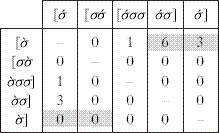
While I have based my analysis so far on Kager's (Reference Kager2001) typology of more fully parsed unary-clash languages, Gordon (Reference Gordon2002) gives a somewhat different classification of dual-stress languages, i.e. those that have exactly two stresses oriented to word edges. Although Kager's analysis deals with iterative footing, there are important points of comparison. Gordon (Reference Gordon2002: 495) lays out 14 non-iterative dual-stress patterns, reproduced in Table III. The shaded cells correspond to the four patterns discussed by Kager (Reference Kager2001), two of which are quantity-sensitive and therefore not part of Gordon's survey: Yupik, here [σ …  ], and Shoshone, [ … ]. While these languages present additional complications when a word contains heavy syllables, individual words with only light syllables function as quantity-insensitive within their derivations – syllable-weight constraints are vacuously satisfied – and must be accounted for by the same constraints used for fully quantity-insensitive languages.
Count of dual stress languages from Gordon (2002).

It can be seen that Gordon includes two languages that involve antepenultimate stress (whether primary or secondary), which Kager does not. He also lists three languages with the initial and penult pattern [ … σ]; this resembles Biangai, except for the End Rule, and could be analysed in the same way modulo the headedness of the word.
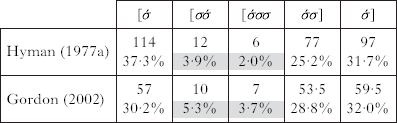
The number of languages described in the literature as dual stress is so small that most cells contain either 0 or 1, a difference that cannot be considered typologically significant. Gordon (Reference Gordon2002: 519) rightly states that the rarity of dual stress systems in general makes it impossible to tell whether a zero represents an impossible stress system or an accidental gap. Indeed, dual stress ought to be uncommon: given the important role of stress in helping the listener to locate word boundaries (Hyman Reference Hyman1977a), a second stress at the opposite edge is potentially in conflict with this function. Gordon also points out that avoidance of stress clash will disfavour such patterns in shorter words, although we have seen from Kager's examples that some languages have a high tolerance for clash. Finally, many conceivable types of dual stress patterns, such as [σ … σσ], are made all the more unlikely by the independent rarity of peninitial and antepenultimate stress. The following figures show how uncommon these two patterns are, relative to the remaining three patterns (initial, penultimate and final).Footnote 32
Frequency of stress systems.

The absence in Table III of any attested languages with peninitial stress cannot be interpreted to mean that a dual-stress system with that component is impossible; rather, it is very likely an accidental gap consistent with the rarity of peninitial stress crossed with the rarity of dual stress systems.
As noted, peninitial and antepenultimate stress systems are uncommon, but are obviously possible because they are attested by a handful of languages. An example of the Kashaya type, which has default stress on the third syllable, thus [σσ, is absent from the lists given by Hyman and Gordon (perhaps, in the case of Kashaya, because the overall system is complex and also for Gordon because it is quantity-sensitive). For the sake of argument, suppose that the ratio of antepenultimate to penultimate stress systems (0·078 for Hyman, 0·131 for Gordon) is reflected in systems oriented to the left edge of the word. That is, if the proportion of [σ: [σσ is similar to σ]: σσ], then we predict essentially one language with third-syllable stress, based on the data of both surveys: for Hyman 12×0·078=0·9, for Gordon 10×0·131=1·3. From this perspective, it is only chance that a language with the default Kashaya pattern, expected to be rare, was not included in either survey. Such typological penumbras cannot be taken as evidence of impossibility: anything that occurs must be formally possible, but something that has not been encountered might still be formally possible (and in existence, if not described in the literature). This topic is pursued further in §7.
As a modest exploration of how the factorial typology is affected by the addition of constraints to deal with unary-clash systems, I examined the results for a grammar that includes the constraints in (28).
(28)
In this comparison, several restrictions were imposed to simplify the task: the initial foot is always the main stress, all feet are iambic and the foot-repulsion constraints *Align(Hd)-L/R are omitted. Only words of from two to five syllables were considered, since the combinatorics of unary feet become quite large with long words.
Looking first at strictly binary parsing, there are twelve possible languages under these restrictions (while still permitting Parse-2 violations, which play a lesser role in words of this length). This set includes certain patterns that are functionally improbable, such as (01)~0(01)~0(01)0~(01)0(02), but serves as a baseline for comparison with the unary typologies. If we permit unary feet, the predicted set of languages is 67 – a definite increase from twelve, but encompassing new types of attested languages not possible under the simple binary typology. If Parse-2 is undominated, the numbers twelve and 67 drop to six and 43. Kager does not provide figures with which this result can be compared; my purpose here is merely to give some indication of how the more directly comparable typology I described in §3.5 is changed by the additional constraints I have proposed. The increase is not trivial, but is also not in the order of 2210 mentioned above.
6 Ternary rhythm
In addition to the constraints discussed up to this point, Kager (Reference Kager2001) gives *LongLapse: ‘no lapse in the context of an unstressed syllable’ (see Selkirk Reference Selkirk1984, Nespor & Vogel Reference Nespor and Vogel1989, Gordon Reference Gordon2002). Houghton (Reference Houghton2006) makes use of an equivalent constraint, *ExtendedLapse, in analysing ternary stress patterns.Footnote 33 This constraint rejects three successive unstressed syllables, but permits a simple lapse of two unstressed syllables, to generate ternary effects with binary footing such as (10)0(20)0. A constraint that refers to three consecutive objects is clearly non-local; in addition, Houghton proposes ExtendedLapse-at-End and ExtendedLapse-at-Peak, which make reference to a fourth object (the right edge or the main stress).
6.1 Binary feet
An important argument for ExtendedLapse-at-End is Houghton's analysis of the stress pattern of Tripura Bangla (Das Reference Das2001). The words in (29), which consist of just light syllables, represent the basic pattern to be captured in any analysis. The salient generalisations are that the main stress falls on the first syllable, with a secondary stress on every third syllable after that, unless it would be final. A consequence is that a word of length 3n+1 ends in three unstressed syllables – a long lapse – whereas elsewhere in the word only simple lapses of two syllables occur.
(29)
Houghton and Das agree on the parsing of these words, which have binary feet separated by unfooted syllables (Hammond Reference Hammond1990, Kager Reference Kager1994, Green & Kenstowicz Reference Green and Kenstowicz1995, Hayes Reference Hayes1995).
Hayes (Reference Hayes1995) calls this pattern of binary feet ‘weak local parsing’, since one syllable is skipped after each foot is constructed. One way to enforce syllable skipping is to propose a direct constraint *FtFt against adjacent feet (Kager Reference Kager1994), but more often the approach in OT has been to minimise the total number of feet – and force unfooted syllables – by foot-alignment constraints that penalise every non-initial foot (Green & Kenstowicz Reference Green and Kenstowicz1995, Ishii Reference Ishii, Agbayani and Harada1996, Elenbaas Reference Elenbaas1999, Elenbaas & Kager Reference Elenbaas and Kager1999). For Das this is gradient AllFt-L, while for Houghton it is categorical Align-by-σ-L(Ft, Wd) modelled after the ‘no intervening’ constraint type of McCarthy (Reference McCarthy2003). Higher-ranked constraints against certain lapses ensure that multiple feet are constructed, while leaving unparsed syllables between the feet to avoid a ‘long lapse’ of three unstressed syllables, except word-finally. As mentioned, for Houghton the location of the two unparsed syllables at the end of the word is ensured by the non-local constraint ExtendedLapse-at-End, similar to non-local Lapse-at-End (5) but requiring reference to an additional syllable.Footnote 34
The use of Align-by-σ to minimise the number of feet is somewhat troubling, since it partly mimics the effect of gradient AllFt-L/R. McCarthy (Reference McCarthy2003) motivates this class of constraints mainly for the alignment of infixed morphological constituents; naturally in this context there will normally just be one morpheme whose alignment is satisfied or not, and the constraint does not have the pseudo-gradient effect. A more restrictive theory will use such constraints only for morphological entities, and not phonological constituents such as feet. I present here a local analysis in terms of ternary feet that does not require a similar mechanism.
6.2 Ternary feet
Rather than weak local parsing, another approach to ternary alternations involves, of course, some version of ternary feet (see Rice Reference Rice, Blaho, Bye and Krämer2007 for recent discussion). An obvious choice for Tripura Bangla is a dactyl (100), given the regularity of initial stress; but another important foot in the ternary literature is the amphibrach (010), also shown here.
(30)
A dactylic footing of Tripura Bangla is advocated by Beasley & Crosswhite (Reference Beasley and Crosswhite2003), although using non-local techniques to generate them within the framework of Idsardi (Reference Idsardi1992); see also Idsardi (Reference Idsardi, Raimy and Cairns2008) for a ternary analysis.
A dactyl (100), or for that matter an anapest (001), if combined with *Align-L/R, predicts either pre-antepenultimate or fourth-syllable stress, patterns that are not reported as the default in any language. (This issue arises with mechanisms of forced extrametricality, but not if one were to combine dactyls with a rhythmic constraint such as Lapse-at-End.) The amphibrach, on the other hand, combines unproblematically with extrametricality to produce the antepenultimate stress attested in ternary systems such as Cayuvava in (32). Further, a theory that permits (100), (001) and perhaps also (010) is considerably looser than one that permits just one type of ternary foot, and therefore if amphibrachs alone can be used, the resulting theory is more restrictive. Note also that with ternary feet, it is essential to exclude the constraint *FtFt from the inventory, since otherwise the theory incorrectly predicts quaternary stress alternations.
The parameters of foot structure proposed by Halle & Vergnaud (Reference Halle and Vergnaud1987) can be construed as violable constraints within OT that fit well with the locality criterion. The Head-Terminal parameter is here collapsed with the distinction between left- and right-headed feet.
(31)
The categories that emerge are unary, binary, ternary and unbounded. More specifically, Bounded is satisfied by the constituents (10), (01) and (010), but not (100) or (001). The dactyl and anapest can arise only incidentally as unbounded feet; from the point of view of foot typology they are of the same type as (10000) or (0001). The amphibrach (010) also satisfies locality within the foot, insofar as every unstressed syllable is adjacent to both the head and a foot edge. Under low ranking of this constraint, the result is an unbounded foot, where the location of the head is determined by weight sensitivity or other factors. To achieve the correct footing of Tripura Bangla with amphibrachs, we must assume high-ranking Stress-L, to force a trochaic realisation (10) at the left edge of the word, yielding stress on the initial syllable; recall this constraint from the discussion of unary-clash systems in §5.2.
A complication arises in words of 3n+1 syllables, with two unfooted syllables at the right edge, as in (10)(020)00. As with dactyls, *Align-R could prevent *(10)00(020) from winning, but the remaining problem is to reject *(10)0(020)0. In this case, a likely solution is a (clearly local) constraint on adjacency of feet, perhaps FootContiguity, requiring that every foot be immediately followed by another foot: Align(Ft-R, Ft-L).Footnote 35 In this formulation, it is necessarily violated by the last foot of any word, but will create the pressure against unparsed syllables between feet. A different formulation may ultimately be preferable – for example, *Align(Ft-L, σ°-R) to penalise an unparsed syllable following a foot – but that is not crucial here.
Another case requiring left-edge binary instantiations of amphibrachs is Cayuvava (Key Reference Key1967: 70f); the same footing is proposed by Halle & Vergnaud (Reference Halle and Vergnaud1987), where right-edge extrametricality and right-to-left rule application together determine the location of the binary foot.
(32)
Antepenultimate stress requires undominated *Align-R. Other components of the analysis are Parse-2, so that 0(010)0 wins over *(010)00, and (relatively low-ranked) Stress-L, so that (10)(010)0 is preferred over (010)(10)0.
Pursuit of a complete ternary typology lies beyond the scope of this paper. This discussion has been intended simply to show that there are local solutions to various footing issues that arise if ternary alternations are analysed with ternary constituents. As emphasised by Rice (Reference Rice, Blaho, Bye and Krämer2007), the prohibition on ternary (and larger) feet – expressed by the listed inventory of feet in a theory like Hayes (Reference Hayes1995) – cannot have the same status under the rich-base assumptions of OT (Prince & Smolensky Reference Prince and Smolensky1993). In particular, since Gen should normally be free to create any structure, this ought to include candidates with ternary feet. A constraint favouring binary feet (i.e. FtBin) will be violable, and so ternary feet are possible with the right constraint ranking. A theory with surface-oriented, violable constraints provides a different perspective on foot typology than a derivational approach that lists the underlying inventory of objects, and simply excludes ternary feet from that inventory. It is sensible within OT to restrict the distribution of ternary feet by surface constraints, in which case we should expect ternary feet to arise in some languages.
7 Conclusions
I have argued for modifications to the set of rhythmic metrical constraints advocated especially by researchers such as Kager (Reference Kager2001, Reference Kager2005), McCarthy (Reference McCarthy2003) and Houghton (Reference Houghton2006). The main goal has been to improve the formal simplicity and tractability of the theory by restricting the tools available for metrical analysis to strictly local constraints as proposed by Eisner (Reference Eisner1997a, Reference Eisnerc). These changes lead to a broader typology of possible languages – for example, four out of 16 conceivable languages are excluded in the revised typology of Table II, as opposed to the six excluded in Table I. To some degree, this broadening is necessary to achieve a descriptive adequacy lacking in many other approaches.
Matching a factorial typology to attested languages is not necessarily straightforward. Some languages may be subject to more than one analysis, depending on assumptions that are not comparable across theories. The essential generalisations of a metrical system may be obscured by additional complexities that lead to omission of the language from standard lists, as seems to be the case with Kashaya. As discussed in §5.3 for dual stress systems, the cells in a predicted matrix of possible stress systems are often sparsely populated, weakening the typological evidence. For example, Kager (Reference Kager2005) predicts twelve iambic languages compared to the 18 predicted under gradient alignment; but only five of these twelve are attested. Further, the larger prediction of 18 includes the Kashaya pattern, which is lost under the reduction to twelve.
More generally, we must recognise that many patterns are formally possible, but unlikely to arise historically. Some previous attempts to model strict typological generalisations in the metrical grammar have required formal mechanisms that are a problem for the theory of possible grammars, e.g. gradient or non-local constraint evaluation. Narrow typologies may also exclude rare but attested patterns, partly because the typological tendencies are actually the result of functional factors that properly lie outside the grammar, and therefore admit of exceptions, however uncommon those may be. If just one exception to a cross-linguistic tendency can be identified and sustained in the face of alternative analyses, that is enough to require a broader set of formally possible languages.
I have argued specifically for locality in the formulation of metrical constraints as an overarching principle that helps delimit the set of possible languages. A related criterion that has emerged in this inquiry is the symmetry of many constraints, such as *Align-L/R alongside the more conventional positive Align-L/R (see also Idsardi Reference Idsardi1992, Halle & Idsardi Reference Halle and Idsardi1995 for an inherently symmetrical approach).Footnote 36 This perspective stands in contrast to much metrical work based on observed asymmetries in stress patterns, and predicts that the asymmetries are not absolute. For example, although right-edge extrametricality is overwhelmingly more common than left-edge, languages such as Kashaya show that this asymmetry is statistical rather than categorical. Similarly, although I have not addressed foot-internal structure in this paper, the same line of reasoning suggests symmetry there as well. Hayes (Reference Hayes1985, Reference Hayes1995) argues that iambs are always quantity-sensitive, but Kager (Reference Kager1993) proposes a symmetrical foot inventory that derives the quantitative effects by other means. Symmetry throughout the system makes sense to the extent that symmetry is so fundamental to central aspects of metrical phonology, such as left/right directionality, left/right headedness of feet and the left/right End Rule.
If locality is accepted as a criterion for valid constraints, there nevertheless remain many possible local formulations from which to choose. I have proposed specific local constraints to analyse basic cross-linguistic patterns of stress placement, but more important than the exact formulations is the principle of locality. Alternative local theories can be compared according to further criteria, such as the formal simplicity of the constraint formulations. Another set of local constraints that generates a smaller number of possible languages, without excluding any attested languages, is to be preferred, all else being equal. But if that set generates a tighter typology only by abandoning formal simplicity, it is less clear whether it represents an improvement. It is also worth considering other sources of information about computational capacity, such as language games (Bagemihl Reference Bagemihl1995) and artificial language-learning experiments (e.g. Creel et al. Reference Creel, Newport and Aslin2004, Newport & Aslin Reference Newport and Aslin2004), which can reveal linguistic abilities with patterns that would not arise by the usual modes of historical change. For example, it may be formally possible to encode a non-directional pattern such as (01)0~0(01)0~(01)(02)~(01)0(02)0, but this distribution of stresses is unlikely to arise even under an unusual sequence of changes if children have difficulty learning distributional generalisations that do not have consistent foot placement at either edge of the stress domain.
Although further research is needed to clarify whether various observed typological patterns qualify as exceptionless formal restrictions or the effect of extragrammatical pressures, there are numerous pressures likely to lie outside the grammar. For example, as Kager (Reference Kager2007: 219) notes, the disfavouring of initial lapses in stress systems ‘is known from other rhythmic domains, in particular musical rhythm, where double upbeats are avoided (Lerdahl & Jackendoff Reference Lerdahl and Jackendoff1983)’. This parallel to a non-linguistic domain suggests an extragrammatical explanation for the asymmetry, which is confirmed by the existence of initial lapses in Kashaya (§3.3). Kager (Reference Kager2001) provides three rhythmic laws (Rarefy near peaks, Rarefy at the right edge and Stress-mark edges), which serve as grounding for the most commonly observed patterns, but the formulation of the constraints is another matter. While there may be functional reasons to prefer left-aligned stress for more efficient word identification and lexical access (Alber Reference Alber2005), this pressure does not amount to a universal requirement, as many languages do indeed have final stresses (see Table IV), which still has a strong demarcative function, and others avoid initial stress. The formal grammar must accept both possibilities, but factors outside the grammar can mean that most languages avoid certain outcomes. Another prominent example is the foot asymmetry encoded in the Iambic/Trochaic Law, i.e. a preference for uneven quantity in iambic feet, but even quantity in trochaic feet. It was proposed in generative phonology by Hayes (Reference Hayes1985, Reference Hayes1987, Reference Hayes1995), with citations of research going back a century; this proposal has led to various later interpretations (Rice Reference Rice1992, Kager Reference Kager1993, Everett Reference Everett2003, Revithiadou Reference Revithiadou, Arsenijevic, Elouazizi, Salzmann and de Vos2004), and is potentially related to a preference for weak positions following stresses (Hung Reference Hung1994, van de Vijver Reference Vijver1998, Hyde Reference de Lacy2007a), itself attributable to the typical need for a peak followed by a trough to realise HL intonation (Bolinger Reference Bolinger1962, Hyman Reference Hyman1977). Numerous other principles may ultimately reflect non-linguistic factors.
The right theory will tell us which gaps in attested language patterns are formally excluded from the set of possible languages, and which must be the result of functional pressures or the nature of historical change and language transmission (Stemberger Reference Stemberger1996, Blevins Reference Blevins2004, Hale & Reiss Reference Hale and Reiss2008). The study of those external pressures must play a significant role in arriving at an accurate understanding of human language. It has been my goal here to advocate locality as one important criterion for the expression of formal generalisations in metrical theory; this approach predicts that typological generalisations that cannot be expressed in a local way must find their explanation in extragrammatical pressures, and are likely to be tendencies with potential exceptions in languages that may yet enter the typological literature.